The World's Biggest Fusion Reactor Just Hit a Milestone
The world's biggest nuclear fusion experiment just got one huge step closer to completion. The International Thermonuclear Experimental Reactor (ITER) in Cadarache, France just received the final shipment of necessary components to assemble the giant magnet at the heart of the reactor. The central solenoid magnet, developed in the United States at the Oak Ridge National Laboratory, is a critical component of the massive experimental site, which is cooperatively funded and operated by a coalition of seven major world economies: China, the European Union (EU), India, Japan, Russia, South Korea and the United States.
The central solenoid is awe-inspiring in its size as well as its capabilities. "The central solenoid is 18 meters (59 feet) tall and 4.25 meters (14 feet) wide, composed of six individual modules," Interesting Engineering reported earlier this week. "Each module weighs more than 122.5 tonnes (135 tons) and is wound from 6 kilometers (3.7 miles) of niobium-tin superconducting cable."
And this is just one component of a jaw-droppingly massive apparatus that represents "the grandest scientific experiment in the world". ITER's tokamak (the donut-shaped device designed to confine plasma with ultra-powerful magnets) measures a kilometer in length. The solenoid magnet as its core is therefore almost inconceivably powerful, and it's just one part of a much bigger and more impressive system. "This component belongs to a magnetic system weighing 3,000 tonnes (3,300 tons) that interacts with nine vacuum vessel sectors," Interesting Engineering goes on to say.
This beating heat of ITER has been 15 years in the making, with each individual module requiring a two-year process for fabrication and testing. ITER will never produce power to supply to the energy grid, but will serve as one of the most important – if not the most important – research projects on Earth to solve the puzzle of creating commercial nuclear fusion, the holy grail of clean energy. Nuclear fusion is the energetic process that powers our own sun. Replicating that process here on Earth could essentially provide limitless clean energy. It's a potentially long-lasting, ultra-efficient energy source that leaves behind zero greenhouse gases and zero hazardous radioactive waste, unlike nuclear fission.
But the scale of ITER, and the unprecedented nature of its goals, has led to increasingly long timelines and a ballooning budget for the slow-moving megaproject. While the delivery of the solenoid marks a major milestone, ITER is still years away from achieving first plasma, around €22 billion and nearly two decades after breaking ground.
ITER is still relevant, and will hopefully bring us invaluable scientific findings that would be impossible without its grand scale and budget. But the megaproject is facing increasing competition from smaller and more dexterous fusion ventures. Various other projects are on track to beat ITER to its mapped goalposts, and much more inexpensively.
The race for nuclear fusion is increasingly going private as investors start to recognize the technology as a matter of when, and not if. Interest from the tech sector is also ramping up as Silicon Valley scrambles to find a panacea to the energy monster that the AI boom has unleashed. As a result, a lot of deep-pocketed entities are now focused on fusion like never before.
"If you know how to build a fusion power plant, you can have unlimited energy anywhere and forever. It's hard to overstate what a big deal that will be," Bill Gates wrote in an October essay. "The availability and affordability of electricity is a huge limiting factor for virtually every sector of the economy today. Removing those limits could be as transformative as the invention of the steam engine before the Industrial Revolution."
A new rush of Wall Street-backed fusion startups is already answering this call to arms, rapidly changing the scientific and economic landscape for nuclear fusion research everywhere. But ITER's backers argue that its looming obsolescence is a sign of the project's success rather than its failure, indicating that its achievements and high profile have inspired the current flood of private investing dollars into fusion research and development. And, if nothing else, ITER now stands as a vanishingly rare symbol of international cooperation for global interests, rather than nationalized and protectionist energy agendas.
By Haley Zaremba for Oilprice.com
British-US consortium aims to build UK fusion plant
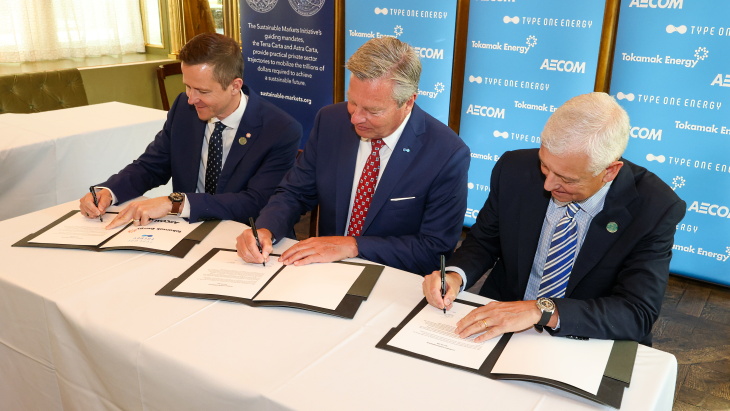
Through the consortium, the three companies intend to develop a fusion project that is commercially credible, deployable using existing enabling technologies, and capable of attracting private capital - consistent with the long-term goals of the government's recently announced UK Fusion Strategy.
The UK Infinity Fusion Consortium combines Type One Energy's 400 MWe Infinity Two stellarator fusion power plant design, AECOM's leading engineering capabilities, and Tokamak Energy's high temperature superconducting (HTS) magnet technology and manufacturing expertise in the UK. The consortium will use these capabilities to develop a UK Infinity Two fusion power plant project that will include participation by the broader UK fusion value chain spanning construction, finance, offtake and other supply chain partners.
The consortium aims to benefit from the UK's significant investment in magnetic confinement fusion technology, supply chain capabilities, regulation, and power plant siting for the government's STEP Fusion programme. It will also capitalise on the synergy and experience gained from the first-of-a-kind Infinity Two fusion power plant project at the Tennessee Valley Authority's (TVA's) Bull Run site in the USA, which is targeted for commercial operation in 2034. The TVA Infinity Two project is being supported by the US government's own fusion programmes and provides a strong technical and programmatic foundation for the UK Infinity Two deployment project.
"The consortium will create a private-sector-led fusion commercialisation pathway complementing the STEP Fusion programme," the partners said. "The UK Infinity Two project further scales growth of the UK fusion supply chain and accelerates time-to-market for this critical new energy source, while strengthening the country's industrial base."
"Fusion needs to be delivered, not just developed," said Type One Energy CEO Chris Mowry. "This consortium brings together the core industrial capabilities in the UK and US required to deploy real-world fusion power plant projects that are commercially viable. By aligning fusion technology, advanced manufacturing, and power plant engineering, we are closing the gap between today's energy innovation and tomorrow's energy infrastructure. Our initiative is fully aligned with UK and US ambitions to be leaders in commercial fusion deployment."
Warrick Matthews, CEO of Tokamak Energy, added: "This consortium puts Tokamak Energy's transformative magnet technology and manufacturing expertise in the centre of another world-class fusion programme. Together, we can accelerate towards commercialising a new form of limitless, clean energy and, in combination with our role as STEP magnet systems partner, strengthen the UK supply chain's leadership in global fusion."
"Fusion represents one of the most important long-term energy solutions, offering a clean, safe and reliable source of power for future generations," said AECOM CEO Troy Rudd. "Delivering on fusion's potential requires disciplined engineering, well-established infrastructure delivery models and collaboration across the entire energy ecosystem. Through this consortium, AECOM is bringing its global experience in complex energy infrastructure to help lay the groundwork for commercial fusion projects that can scale with confidence, supporting the UK's energy system while strengthening its industrial and infrastructure base."
_bd60b19c.jpg)
(Image: Type One Energy)
Type One Energy's Infinity Two is a stellarator fusion reactor - different to a tokamak fusion reactor such as the Joint European Torus in the UK or the ITER device under construction in France. A tokamak is based on a uniform toroid shape, whereas a stellarator twists that shape in a figure-8. This is intended to get round the problems tokamaks can face when magnetic coils confining the plasma are necessarily less dense on the outside of the toroidal ring.
In September last year, TVA issued Type One Energy a Letter of Intent to develop and build Infinity Two - a first-generation 350 MWe baseload power plant using the company's stellarator fusion technology - with construction starting as early as 2028. Type One Energy completed the first formal design review of Infinity Two in May 2025. Final decisions and definitive agreements regarding the funding and construction of Infinity Two, as well as any agreements to purchase the energy output, are subject to TVA Board approval, regulatory review, and alignment with least-cost planning processes, amongst other things, TVA has previously said. In January this year, Type One Energy submitted the initial licensing application in preparation for the construction of Infinity Two at TVA's former Bull Run fossil plant site in Clinton, Tennessee.

No comments:
Post a Comment