It’s possible that I shall make an ass of myself. But in that case one can always get out of it with a little dialectic. I have, of course, so worded my proposition as to be right either way (K.Marx, Letter to F.Engels on the Indian Mutiny)
Wednesday, May 06, 2026
Lufthansa Warns Strait of Hormuz Closure Will Add $2 Billion in Fuel Costs
Lufthansa Group expects the surge in jet fuel prices to cost it an additional $2 billion this year as the closure of the Strait of Hormuz “is leading to a shortage in kerosene supply and thus to a significant increase in kerosene prices,” Europe’s biggest airline said on Wednesday.
Lufthansa expects strong summer travel numbers, but it warned that “At the same time, the current closure of the Strait of Hormuz is leading to a shortage in kerosene supply and thus to a significant increase in kerosene prices.”
The war in Iran and the closure of the Strait of Hormuz have severely constrained Europe’s jet fuel supply, while jet fuel prices have spiked to over $200 per barrel.
The war in Iran has cut most of Europe’s imports of jet fuel, while local output has been falling for nearly two decades due to dozens of refineries closing permanently or being converted to biofuel production.
Despite the fact that the airline group has hedged about 80% of fuel costs for 2026, the spike in jet fuel prices “places a substantial burden on the cost base of Lufthansa Group airlines,” it said.
As of current estimates, the kerosene price surge would lead to additional costs of 1.7 billion euros, or $2 billion, in 2026, Lufthansa said.
“While no restrictions in kerosene supply are currently expected at any of the Lufthansa Group hubs, potentially reduced fuel availability later in the year represents an additional risk factor,” the airline said.
Till Streichert, chief financial officer of Deutsche Lufthansa AG, warned “Our annual profit will likely be lower than originally anticipated.”
Lufthansa last month said it would remove a total of 20,000 short-haul flights from its European summer schedule. A week earlier, Lufthansa had said it was accelerating plans to reduce its flight program and retire some aircraft earlier “In view of significantly increased kerosene prices, which have more than doubled compared to the period before the Iran war, as well as rising additional burdens from labor disputes.”
Cargo vessels and tanker owners, who hoped for a U.S. escort out of the Strait of Hormuz earlier this week, are back scrambling to find feasible solutions to passing the critical trade chokepoint after U.S. President Donald Trump called off the 'Project Freedom' effort to help guide vessels out of the Strait, just three days after announcing it.
Over the weekend, President Trump announced 'Project Freedom' to help guide vessels out of the Strait of Hormuz, and some ships did pass the chokepoint under U.S. protection early this week.
One of two such vessels was a ship operated by a subsidiary of Denmark-based shipping giant AP Moller-Maersk, the company confirmed this week. The ship, Alliance Fairfax, had been stranded west of the Strait of Hormuz since the war began on February 28, Maersk said.
But the short-lived relief that stranded ships could soon find their way out of the Strait was cut short only three days into the project Freedom endeavor. President Trump late on Tuesday called off the effort, saying in a social media post that "while the Blockade will remain in full force and effect, Project Freedom (The Movement of Ships through the Strait of Hormuz) will be paused for a short period of time to see whether or not the Agreement can be finalized and signed."
The Strait of Hormuz was mostly clear of traffic after the pause of the Project Freedom plan, according to vessel-tracking data monitored by Bloomberg.
Since Project Freedom was announced and later abandoned, Iran has signaled it is expanding the area around the Strait of Hormuz it now controls.
Early on Wednesday, reports emerged that the U.S. believed it was nearing a framework agreement to end the war with Iran—a deal that would eventually reopen the Strait of Hormuz. Oil prices plunged by 12% early in the morning EDT before paring their losses.
After Iran announced its plan to charge for safe passage through the Strait of Hormuz in March, a plethora of scam operators popped up to offer fraudulent paperwork in exchange for payment in cryptocurrency. That problem may now have a solution, though not the one that the shipping community would prefer: Iran has launched an official "Persian Gulf Strait Authority" with its own formal email address, providing owners with a verifiable single window for arranging transit with the Islamic Revolutionary Guard Corps, a U.S.-designated foreign terrorist organization.
According to Islamic of Iran Public Broadcasting, vessels wanting to transit the Strait of Hormuz will receive an email from the official address "info@PGSA.ir," which will include information about Iran's transit regulations. Once the shipowner "aligns their procedures with this framework," they can obtain authorization for passage.
The creation of a new government authority to interface with the IRGC does not resolve the questionable legality of Iran's tolls on an internationally-designated strait. But there is a more pressing compliance concern: the U.S. has threatened to sanction any entity that pays Iran for transit. Shipowners may think twice about openly communicating arrangements with the new authority's email account, given the surveillance capabilities of U.S. signals intelligence services.
Meanwhile, on the south side of the strait, the U.S. continues to promote a new safety "umbrella" for ships transiting outbound through Omani waters. The newly-formed "Project Freedom" is a competing vision for marine traffic: guided by the U.S., conducted without charge. Iran opposes the mission and has used force in an attempt to block it, including attacks on merchant ships and on U.S. Navy destroyers.
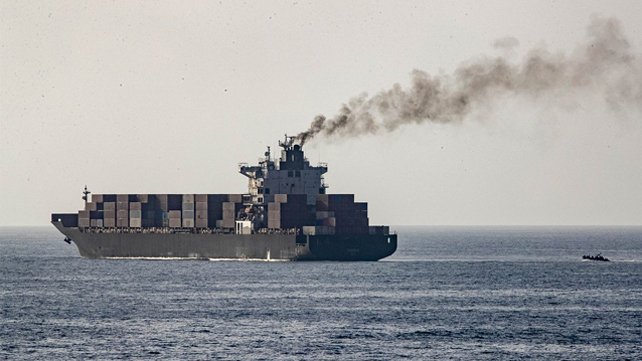
Those actions continued Tuesday: an unspecified cargo vessel was struck by a projectile in the strait, according to UKMTO. Martin Kelly of EOS Risk Group has identified the target as a CMA vessel, and CBS reports that it was the Maltese-flagged boxship CMA CGM San Antonio.
Several of the ship's crewmembers were injured in a cruise missile strike, two officials clarified to CBS.
Like other ships operating in the strait in the last few days, CMA CGM San Antonio has gone dark for security purposes, and her AIS transmission has not been received since Tuesday. Her last known position was off Dubai.
The IRGC's Positions on Larak Overlook the "Tehran Tollbooth" Route
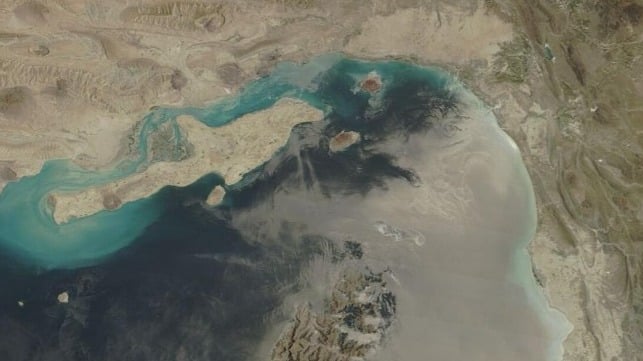
Larak, center, sits just east of Qeshm at the northernmost point of the strait (NASA Worldview)
Larak Island, to the south of and covering the approaches to Iran’s largest port at Bandar Abbas, has achieved some notoriety in recent weeks as the island which Iran’s IRGC says merchant traffic must circumnavigate to transit the Strait of Hormuz on Iranian terms.
Larak is largely barren, a plug of sandstone 134 meters at its highest. The only settlement is the village of Larak on the northern side of the island, which is graced by the remains of a Portuguese castle. Locals get by with subsistence fishing, goat herding and smuggling, and hence the IRGC presence on the island is probably a substantial source of income. A feature of the landscape are recharge dams, designed to trap flood water and replenish local water supply when it rains occasionally.
There is little on the island by way of conventional military footprint, but IRGC facilities will merge with and be largely indistinguishable from the civilian infrastructure. The coast guard maintains a separate establishment to the IRGC Navy, but both communicate with passing sea traffic on the common Channel 16.
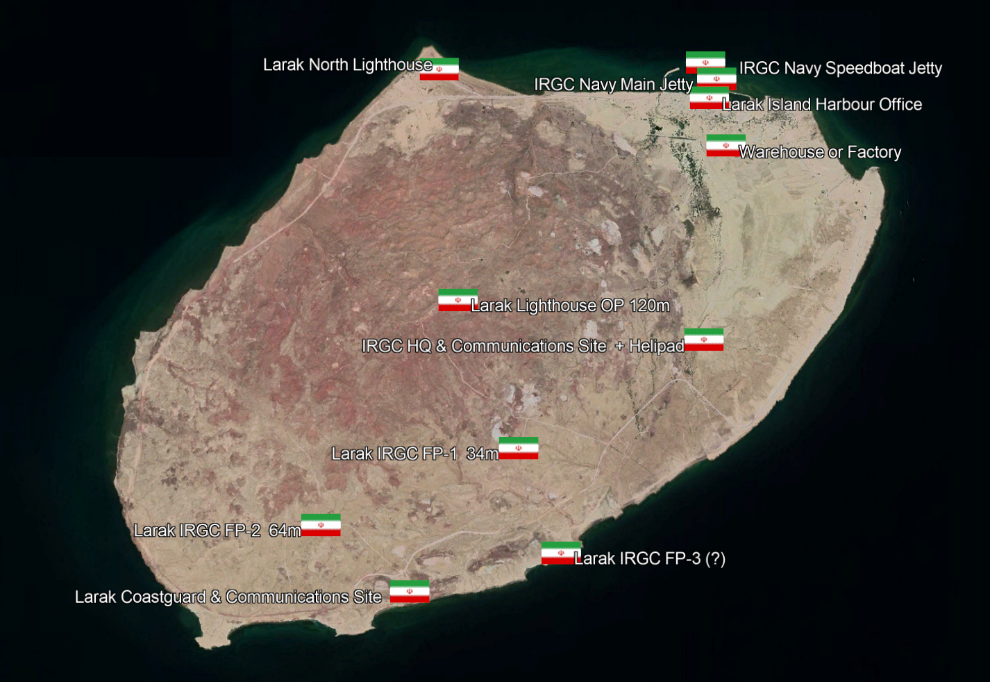
IRGC locations on the island of Larak (Google Earth/Copernicus/CJRC)
Lighthouses: Whether manned by coast guard or IRGC Navy staff, or both, Larak North Lighthouse and Larak Lighthouse on the high point of the island both provide visual observation of sea movements to north and south to fill out the maritime intelligence picture. Larak Lighthouse on the peak appears to have a coastal radar, two communications towers and in normal times flashes a white light every 12 seconds.
IRGC HQ & Communications Site: This is an active site, with until recently two tall communications towers, and a commercial ship’s radar on a 25-meter mast. The site has the only helipad identified on the island, suggestive of the headquarters function. The site also has garaging, which would be suitable for parking up anti-ship missiles and drones on mobile launchers.
Prepared Firing Points (FP1-3): Three prepared locations, each comprising three or more earthwork firing platforms, dominate the strait to the south. All three locations are connected to the island’s road network, so that mobile launchers can quickly reach these positions from hidden or protected storage locations elsewhere on the island. These storage locations cannot easily be identified, and may include caves and underground tunnels, but the IRGC also has protocols for keeping mobile drone and missile launchers in civilian buildings and warehouses. There is a substantial warehouse just south of the village of Larak, for which there is no obvious or declared purpose, which could be such a storage facility.
IRGC Navy Facilities: The IRGC Navy uses the only harbor on the island with a breakwater at Larak village. Before the current war, two 17-meter Peykaap II-class missile boats were frequently seen berthed on the main jetty in the harbor. The Peykaap II are each equipped with a pair of single Kowsar or Nasr anti-ship missile launchers, with the missiles using internal guidance and active terminal homing out to a range of 20 nm. At a second jetty close by, also seen on recent overhead visits, was an average of six fast speed boats, of the Taregh Class or smaller. These two jetties appear, from the low resolution imagery still available since February 28, to be the only two sites which may have been attacked.
Given the covert character of the IRGC presence on Larak Island, some capability is likely to have survived since February 28. Mobile drone and missile launchers can be hidden with relative ease, and replacements may have been brought onto the island during the ceasefire to replace any stock which has been destroyed, such that some offensive drone and missile capability may still be in place. In any case, the most important role for the island in the IRGC scheme of battle is to act as an observation post, from which to maintain surveillance of the Strait and from which to cue strike assets held elsewhere.
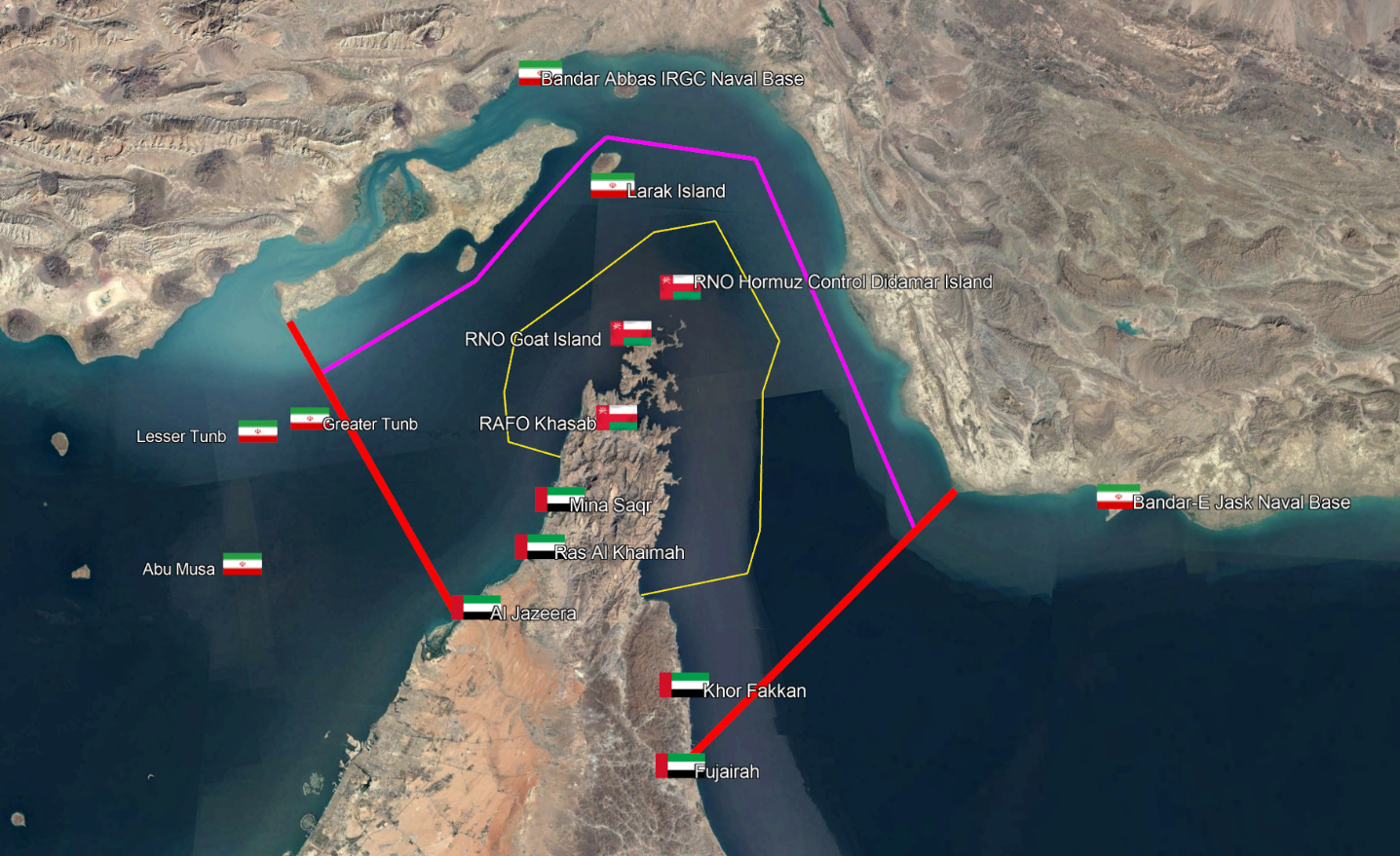
Larak Island sits at the northern tip of the IRGC’s recently-declared prohibition zone. Red boundaries show the approximate border of the prohibition zone, and the Iranian shipping channel is show in purple. The border of Omani territorial waters is marked in yellow. The Disputed Islands in the western approaches to the Strait are occupied by Iran (Google Earth/Copernicus/CJRC)
Fujairah in Focus as Oil Flows Reroute Around Hormuz Crisis
Fujairah has become a critical export and bunkering hub as the Strait of Hormuz remains closed, offering one of the few routes for UAE crude and fuels to reach global markets.
Its importance has surged due to infrastructure like the Abu Dhabi Crude Oil Pipeline, which allows significant volumes to bypass Hormuz—though it cannot fully replace lost regional exports.
Rising strategic value has made Fujairah a target, with recent attacks and escalating tensions highlighting its central role in global oil supply and shipping routes.
As the Strait of Hormuz has now been closed for nearly nine weeks, the oil hub at Fujairah in the United Arab Emirates (UAE) has become an even more prominent oil export and bunkering hub than it has ever been.
Thanks to its strategic position on the east coast of the UAE and outside the Strait of Hormuz, Fujairah is now the key export port for crude and fuels from the UAE and an even more important bunkering port for ship refueling.
The strategic position of Fujairah outside the blocked Strait of Hormuz made it a target of Iranian attacks as early as the second week of the now nine-week-long war. In March, attacks at Fujairah suspended oil loading and bunkering operations several times, before the early-April ceasefire temporarily halted attacks from Iran.
However, the oil port was hit earlier this week after the United States announced Project Freedom to escort ships out of the Strait of Hormuz – currently paused after just three days by President Trump.
The new attack at the Fujairah Petroleum Industries Zone caused a fire and sent oil prices surging on Monday, as the oil hub outside the Strait of Hormuz is strategic to the UAE’s oil exports and to global shipping.
Fujairah is the UAE’s only access to the Indian Ocean and is one of the few key oil export points that do not depend on tankers passing through the Strait of Hormuz
Fujairah is not only a key export route bypassing the critical oil chokepoint, but it is also a major hub for crude and fuels in storage and a key bunkering port for refueling ships. The port is the most important bunkering hub in the Middle East and one of the world’s most critical and largest ship-refueling sites alongside Singapore and Rotterdam, as well as China’s Zhoushan.
The port of Fujairah is the end point of a pipeline carrying crude from the giant oilfields in Abu Dhabi.
The Abu Dhabi Crude Oil Pipeline (ADCOP) runs from onshore oil facilities at Habshan to Fujairah. The original nameplate capacity of the line is 1.5 million barrels per day (bpd) with a reported current capacity close to 1.8 million bpd, according to the International Energy Agency. The UAE has typically exported around 1.1 million bpd of domestic crude via this route, leaving room for up to 700,000 bpd of additional volumes in the case of a Strait closure.
Fujairah is in no way in a position to replace, even partially, the Middle East’s export volumes lost to the closed Strait of Hormuz. But it is critical for supplies to Asia, especially India, in this period of heightened tensions.
Moreover, Fujairah is home to the FRL refinery partly owned by the world’s biggest independent oil trader, Vitol. The refinery offers about 100,000 bpd of refining capacity, adjacent to the storage terminal of VTTI, jointly owned by Vitol, FM Global Infrastructure Fund, and the Abu Dhabi national energy company.
So, Fujairah is one of the few key oil and fuel export routes that bypass the Strait of Hormuz and is a very important bunkering hub in the Middle East for ships traveling to Asia and Africa.
As the Middle East crisis doesn’t appear anywhere close to resolution, the Fujairah hub is taking the spotlight not only because it offers an oil export valve for supply that doesn’t need to pass through the Strait of Hormuz.
As of Monday, according to Iran’s Islamic Revolutionary Guard Corps (IRGC), the new map of expanded Iranian control over the Middle East’s most critical oil shipping lane includes Fujairah.
IRGC unveiled on Monday a new map showing expanded areas around the critical chokepoint that Iran now claims to have under control. The area extends from a line between Kuh-e Mobarak in Iran and south of Fujairah in the UAE, and from another line between the end of Iran’s Qeshm Island and just west of Umm Al Quwain in the UAE, according to the IRGC Navy.
By Tsvetana Paraskova for Oilprice.com
After Attack on CMA CGM Boxship, Trump Suspends Hormuz Transit Corridor
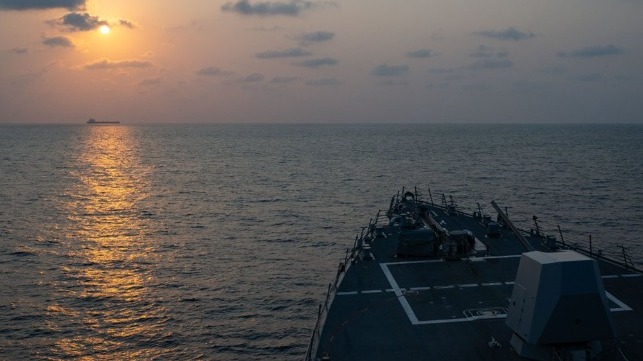
Destroyer USS Pinckney monitors traffic in the Gulf of Oman, May 2026 (USN)
On Tuesday, a cargo vessel was struck by a projectile in the Strait of Hormuz, according to UKMTO - the latest in a series of ship strikes that Iran has launched following the initiation of a U.S.-led maritime security corridor. Shortly after, President Donald Trump announced a temporary "pause" for the corridor program, which was intended to provide a security "umbrella" for merchant ships trapped in the Arabian Gulf to escape via the Omani sector of the strait. The initiative had been in effect for two days, and several participants - and apparent nonparticipants - had come under Iranian attack.
CBS reports that the vessel struck in Tuesday's attack was the Maltese-flagged boxship CMA CGM San Antonio, and officials told the network that the ship may have been hit by a cruise missile. Several crewmembers were injured in the strike, two officials told CBS.
Like other ships operating in the strait in the last few days, CMA CGM San Antonio has gone dark for security purposes, and her AIS transmission has not been received since Tuesday. Her last known position was off Dubai.
Hours after news broke of the strike on the boxship, President Donald Trump declared Project Freedom a "tremendous military success" and announced that it would be paused for diplomatic negotiations.
"Based on the request of Pakistan and other countries . . . we have mutually agreed that, while the blockade [on Iranian traffic] will remain in full force and effect, Project Freedom . . . will be paused for a short period of time to see whether or not the agreement [with Iran] can be finalized," Trump said in a statement.
Just hours earlier, in a Pentagon press briefing, top officials said that the now-suspended Project Freedom corridor was beyond a success - it was a "gift." They gave no predictions that it would be put on hold later in the day.
"As a direct gift from the United States to the world, we have established a powerful red, white and blue dome over the strait. American destroyers are on station, supported by hundreds of fighter jets, helicopters, drones and surveillance aircraft providing 24/7 overwatch for peaceful commercial vessels, except Iran’s of course," Defense Secretary Pete Hegseth told reporters.
"We have a much better defensive arrangement [than traditional escort operations], where we have multiple layers that include ships, helicopters, aircraft, airborne early warning, electronic warfare – we have a much broader defensive package than you would have ever had if you were just escorting. I feel good about that, and it was proven just in the last couple of hours," said Adm. Brad Cooper, commander of Central Command, speaking to TWZ earlier in the morning.
U.S. Releases Additional Iranian Crewmembers to Pakistan for Repatriation
U.S. has released crewmembers from the Iranian containership and will also return the ship after repairs (CENTCOM)
Pakistan’s Foreign Ministry reported that it has organized the repatriation of the Iranian crewmembers from the containership Touska. Pakistani officials called it a “confidence-building measure” by the United States as it continues to seek to mediate the war between the U.S. and Iran.
The statement from the Foreign Ministry said the crewmembers had been flown to Pakistan late on Sunday, May 3, to be handed over to the Iranian authorities. U.S. Central Command (CENTCOM) confirmed in a statement to ABC News that the transfer had taken place, and late on Monday, Iran's Fars News Agency, which is closely aligned with the IRGC, released photos saying the crew was home in Iran.
According to the Iranian report, six of the crewmembers had been released last week, and 15 others had arrived in Iran today. The Pakistanis are saying 22 crewmembers had been handed over. Iran, however, is saying that seven crewmembers remain in Pakistan for a total of 28 from the vessel.
In a bellicose statement last week, Iran said it planned to recapture the containership, which the United States seized on April 19. Donald Trump asserted the ship had ignored warnings in the Arabian Sea after the start of the blockade. USS Spruance fired on the ship, disabling the engine room, and then U.S. forces boarded and searched the ship. Iran said it had deferred military action to rescue the crew and ship to avoid injury to the crew.
Pakistan is reporting that the United States has also agreed to hand the ship back to its owners after repairs. It will be put in Pakistani waters, they report.
“Pakistan welcomes such confidence-building measures,” it said. Pakistan says it will continue to pursue ongoing mediation efforts for regional peace and security.
The move comes as the U.S. continues the blockade and asserts it would be enabling the exit of foreign ships through the Strait of Hormuz. Iran called any actions a violation of the ceasefire, and there were new reports that Iran fired on commercial shipping and claimed an attack on a U.S. destroyer.
CENTCOM on Sunday reported that 49 commercial vessels have now been redirected to comply with the blockade. It said that U.S. forces remain fully committed to total enforcement of the blockade against Iranian shipping and its ports.
Iran Attacked Two US Navy Destroyers During First Day of "Project Freedom"
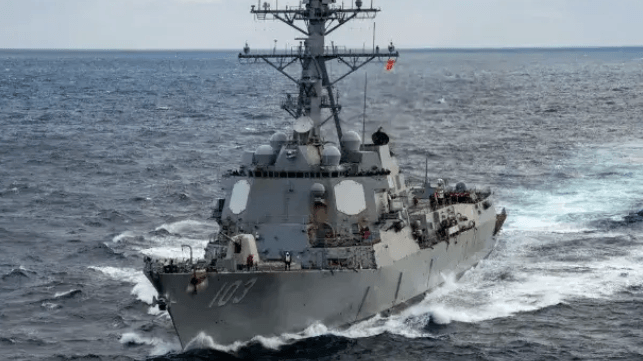
Defense officials have identified the destroyers that transited the Strait of Hormuz Monday as USS Truxtun and USS Mason, according to CBS.
The vessels reached the relative safety of the Arabian Gulf, but only after coming under fire, as previously confirmed by CENTCOM commander Adm. Brad Cooper. CBS obtained additional detail: Iran responded to the transit by launching missiles and drones at the warships, and it dispatched small craft to interfere with the transit.
Other air defense assets were on hand to engage and defeat the inbound threats, and half a dozen small boats were destroyed, according to Adm. Cooper. Neither U.S. warship was struck - but the intensity of the reported barrage is not likely to provide reassurance to shipping, especially as two U.S.-flagged merchant vessels came under fire in the course of the first day of operation.
Foreign-flagged traffic near the waterway also came under fire, even though it is unclear if the foreign vessels selected for attack had any connection to the U.S.-operated "Project Freedom" transit scheme.
The multipurpose cargo ship HMM Namu sustained an explosion and fire in way of the engine room on Monday evening; the fire was out by Tuesday morning, and operator HMM is waiting for safe access to inspect the compartment in order to confirm whether it was an attack or a technical fault. At present, HMM said in a statement, the engine room is still filled with CO2 from the firefighting effort. Once ready, the vessel will be towed into port at Dubai for inspection and investigation.
A second vessel, the ADNOC-operated tanker Barakah, was reportedly hit by two drones off the coast of Oman while conducting a Hormuz transit. The crew are uninjured, ADNOC said in a statement.
Indonesia Says Iranian Tankers Have Legal Right of Passage in Lombok Strait
Two Iranian tankers are reported to have diverted to sail through Indonesia's Lombok Strait in an attempt to avoid the U.S. blockade (file photo from Iranian state media)
Indonesian officials said they are aware of the reports that Iranian crude oil tankers are transiting the Lombok Strait and cited the right of free passage. The statements came after reports by TankerTrackers.com that two Iranian-flagged crude oil tankers have slipped past the U.S. blockade and are routing through the passage east of Bali as an alternative to the more closely tracked Malacca Strait.
“We believe that these vessels are exercising their right of passage in accordance with international law,” Foreign Ministry spokesperson Ynonne Mewengkang is reported to have said, according to the Indonesian news service Bernama. The Foreign Ministry cited the 1982 UNCLOS treaty (United Nations Convention on the Law of the Sea), which has been in force for the past 32 years. It reiterated the right of “Innocent Passage” as well as many of the other basic rules regarding the oceans.
U.S. Central Command (CENTCOM) asserted that as of May 5, U.S. forces had directed 51 vessels to turn around or return to port as part of the blockade on Iranian ships and ports. The number of ships is increased by a few each day according to the CENTCOM statements.
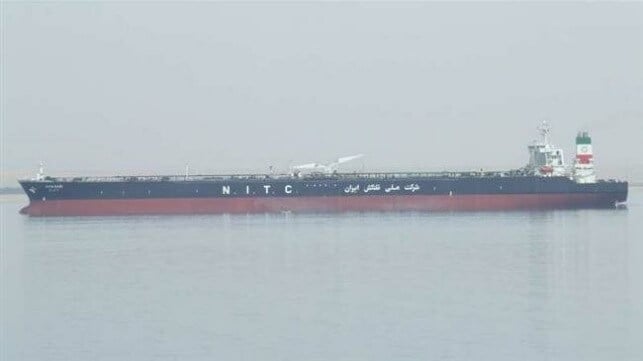
TankerTrackers.com first reported on May 2 that it had confirmed an Iranian-flagged tanker named Huge (IMO 9357183), which it had last seen off Sri Lanka, had in fact transited the Lombok Strait of Indonesia. It said the vessel, which is 317,367 dwt and laden with 1.9 million barrels valued at nearly $220 million, was bound for the Riau Archipelago. It is a notorious area for shadow fleet tankers to make illegal ship-to-ship transfers. TankerTrackers.com noted the vessel had been dark for about six weeks, and they believed it had departed Iran just hours before the U.S. started its blockade.
Huge, built in 2008, has been sailing under the Iranian flag since 2015. It is operated by the National Iranian Tanker Corporation (NITC) and is on the U.S. sanctions list.
While only a handful of vessels appeared to have escaped the U.S. efforts, TankerTrakers.com reported on May 3 that it had spotted a second Iranian-flagged tanker taking the same route. The crude oil tanker Derya (IMO 9569700) appears to have been searching for a destination for its cargo of 1.88 million barrels. TankerTrackers.com reported the tanker missed the window of the U.S. waiver to deliver oil to India and had been at sea since mid-April.
Built in 2013, the vessel is also under U.S. sanctions. It entered the Lombok Strait, also heading to the Riau Archipelago.
TankerTrakers.com calculates that, in total, 25 tankers associated with Iran had departed with crude oil cargoes in April, but 15 of them were before the blockade. Since the start of the blockade, TankerTrackers.com reports seven tankers were redirected, and only one, Huge, had reached the Far East. The U.S. also seized two tankers associated with Iran that were accused of being stateless in April. The U.S. is reportedly seeking forfeiture orders from the U.S. courts for those vessels.
Indonesia said it would continue to monitor the situation and “communicate through appropriate diplomatic channels.” However, at least for now, it is not taking any action against the tankers sailing through its waterway.
We noted in Part 1 that when confronted with the failure of 44 days of bombing Iran “back-to-the-stone-age”and, also, thankfully, being reluctant to send American boots into a Gallipoli-scale slaughter on the ground, the Donald turned to his goofy Secy of Treasury for a 4-D chess move.
To wit, a blockade of the Gulf of Oman, which commenced on April 13th. The latter was supposed to dry-up Iran’s cash flow from global oil sales and to then fill its oil storage tanks full to the rim, thereby causing the pipelines connecting to its 3.5 million b/d oil production apparatus to back up and then explode in a post-constipationary release.
Alas, the Donald’s genius boy band – also including Pete Hegseth and Little Marco Rubio – forget the elephant in the room. To wit, it was always a question of which of the dueling blockades – Iran’s at the Strait of Hormuz or the US Navy’s outside of the SOH on the Gulf of Oman – would run out of time first.
However, you only had to know a little bit about the world’s 103 million barrel per day petroleum supply, demand and storage system, and a tad more about oilfield engineering, production management and storage systems, to realize that there was never a doubt as to the outcome.
Namely, that the true-believers who run Iran, and in the face of an existential threat to their regime, were destined to outlast the world economy’s ability to function without the Persian Gulf’s massive flows of hydrocarbons and its derivatives. These crucial ingredients of global economic life ordinarily transit the Strait of Hormuz (SOH) to the tune of 30 million BOEs (barrels of oil equivalent) each and every day.
Of course, the truth is that the Donald is lazy, impatient and impulsive—and therefore is always ready to run with a factoid or cockamamie notion that suits his purposes at the moment. And regardless of whether it happens to be true, valid, plausible and or even rational.
So when the know-it-all but actually clueless Wall Streeter at the Treasury Department tried to horn-in on the Big Boys action in the White House Situation Room by stumping up his “Operation Economic Fury”, the Donald was all ears. He then assuredly announced that Bessent’s brilliant idea would soon be giving the term “silver bullet” a wholly new definition – even as he patted himself on the back for making it possible:
“The blockade is genius. The blockade has been 100% foolproof. It shows how good our Navy is, I can tell you that. Nobody is going to play games. We have the greatest military in the world, and I built much of it during my first term.”
Except. Except. The prowess of the US Navy wasn’t hardly the half of it. In truth, the blockade was really about oil patch engineering. That and the proven resourcefulness of the Iranian regime when it comes to thwarting attacks on its economy after decades of sanctions, embargoes and malicious economic pressures of every kind.
The Donald was apprised of none of this, of course, so naturally he went ball-to-the-walls, exuberantly promoting the efficacy of the blockade.
“When you have lines of vast amounts of oil pouring through your system, if for any reason that line is closed because you can’t continue to put it into containers or ships… what happens is that line explodes from within, both mechanically and in the earth… They say they only have about three days left before that happens. And when it explodes, you can never rebuild it the way it is.”
Well, three days have passed since the Donald issued the above statement, and nothing has exploded in the Iranian oilfields. And that’s par for the course when it comes to the Donald’s penchant for making up shit and then announcing it to the world.
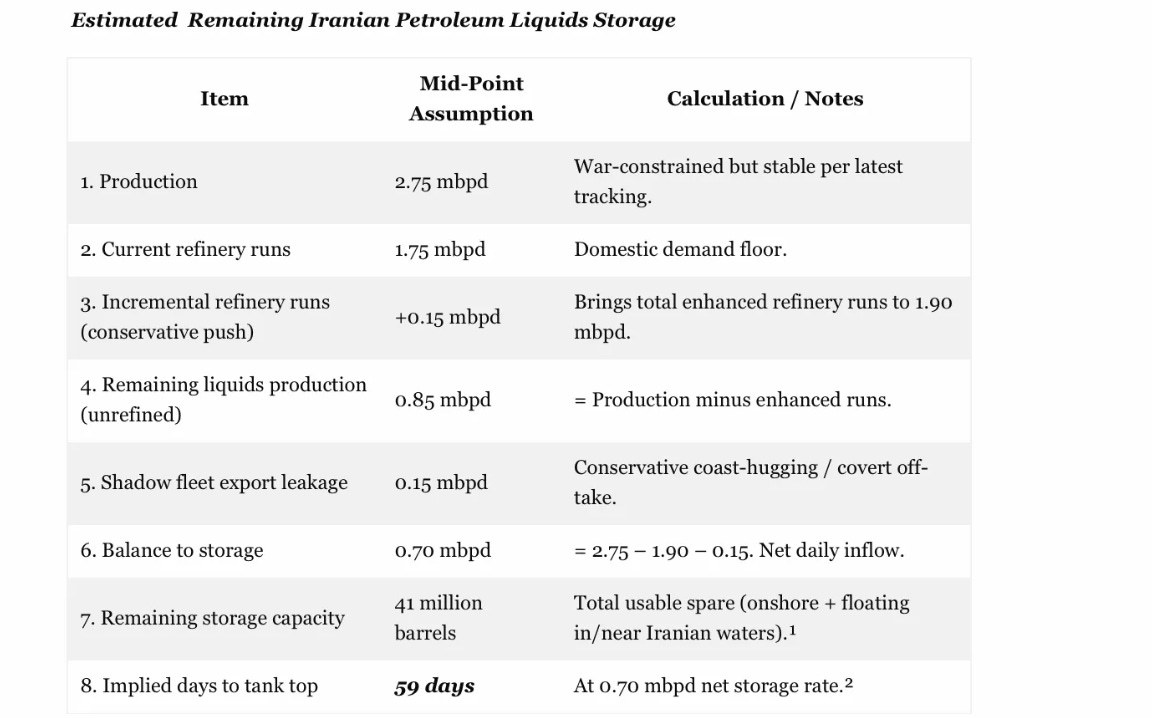
In the first place, there was not a remote chance that Iran’s 41 million barrels of above ground storage tanks would fill to the rim, and then blow up its oil fields in less than three days. As we demonstrated in Part 1, they would have had upwards of 60 days of combined above ground and floating storage – even if production were to remain at the current 2.75 million barrels per day.
But for crying out loud. It doesn’t have to remain there. Iran’s extensive oilfields do not function as some inflexible deus ex machina. Over any reasonable period of time, production levels can be managed significantly higher or lower.
As it happens, however, people who know how to produce 3-5 million barrels per day, as they have over the last decade from Iran’s aging oilfields, would sure as hell know how to carefully reduce production to the level of domestic use (1.75 million barrels/day) plus available storage.
To be sure, throttling back the daily oil lifting rates might well hurt economically via short-run revenue losses and potential future output declines requiring costly restarts. But modulating production levels is a manageable engineering task – not the Donald’s doomsday “lines exploding from within” scenario.
Indeed, oil companies the world over do this during periodic field maintenance, price crashes, or force majeure all the time. The current US blockade, therefore, might create some pain through sustained pressure on exports and storage but not an unmanageable, instantaneous blow-up.
So the blockade was never destined to generate a sudden catastrophic “gotcha” event, as portrayed by Bessent, who knows little about the oil fields and the Donald, who comprehends even less.
Oil production (especially in Iran’s mature fields) can and routinely is managed with gradual rate reductions, flow choking, and planned shut-ins to minimize reservoir and infrastructure damage. The “explosion in three days” scenario is therefore not merely hyperbolic; it’s just plain barking nonsense.
In fact, gradual cutbacks to close the gap between daily output and daily off-take – even with no exports and extremely limited storage – would be readily feasible and well within the range of standard oilfield practice.
So start with the current gap between production at 2.75 mb/d and domestic refinery runs and internal use at about 1.75 mb/d. Even if the enhanced refinery runs and small leakage shown in the table below did not happen, the maximum required cutback from current production levels would be about 35% or 1.0 mb/d. Tops.
Needless to say, Iran’s petroleum engineers and oilfield managers – especially given several weeks to implement adjustments – have designed their wells, pipelines, and reservoirs with controls for this exact situation. Thus, its wells have adjustable chokes (valves) at the wellhead. Operators can slowly reduce flow rates over hours or days instead of slamming everything shut. This prevents sudden pressure spikes while allowing the reservoir to equilibrate.
Iran could also prioritize this production curtailment process on a field-by-field basis, starting with less critical wells. So if exports stop completely, upstream production doesn’t have to keep pumping at full volume into full tanks/pipelines.
They can throttle back lifting rates to match available storage or domestic use. Many Iranian fields already use gas lift or water/gas injection for pressure support; these systems can be scaled down gradually to avoid disrupting reservoir dynamics.
In fact, they’ve handled temporary large shut-ins before without “explosions.” Standard protocols involve monitoring bottom-hole pressure, injecting inhibitors (to prevent corrosion/scaling), and avoiding abrupt stops that could cause paraffin/wax buildup or sand settling.
Long-term issues (e.g., clay swelling in carbonates, water intrusion, or minor mechanical deformation) are real in mature fields like Iran’s. But they’re mitigable with planning – not irreversible “explosions.”
Similarly, high water-cut wells might need nitrogen lifts or pumps to restart, but that’s routine work-over work, not evidence of a field-destroying crisis. So what the “explosion” claim actually refers to is the risk of pressure buildup in pipelines and reservoirs when off-take flow is blocked downstream while upstream production continues unchecked. In theory, this could lead to over-pressure, clogs, or leaks—but real world systems have safety relief valves, pressure sensors, and automatic shutdowns.
Indeed, oilfield experts note that literal pipeline/well explosions from this kind of hypothetical situation are “nearly impossible”. The real risk is longer-term in the form of forced shut-ins in mature carbonate reservoirs (common in Iran). This could disrupt pressure support from gas re-injection, leading to some permanent productivity loss (e.g., 100k-500k bpd in worst-case selective fields).
But even this kind of potential impairment builds over weeks and months with poor – not standard – management. Moreover, Iran’s fields are not uniquely fragile like ultra-heavy oil (Venezuela) or shale. They’ve restarted after past shut-ins with limited lasting damage.
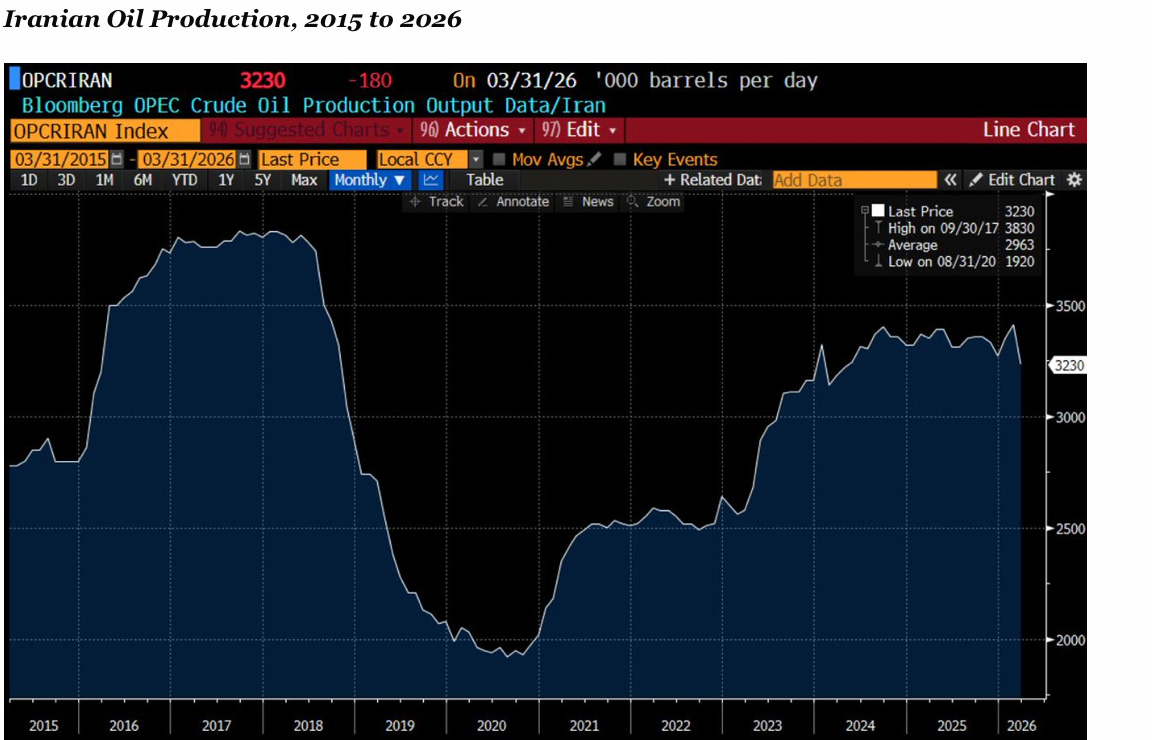
For example, after the global collapse of oil demand in the spring of 2020 owning to worldwide pandemic lockdowns, Iranian production was reduced by nearly 50% in a matter of months, from 3.75 mb/d to 1.9 mb/d.
Yet after the global economy re-opened and returned to normal petroleum demand levels, production was subsequently restored to pre-war levels at just under 3.5 mb/d during 2024 and 2025.
In short, there is going to be no explosion in the Iranian oil fields. The Donald is chasing yet another delusion ponied up by his utterly incompetent staff.
Between creative expansion of its storage including floating vessels and salt caverns, enhanced refinery runs to bolster the domestic economy, even minor export leakages via its coast-hugging dark fleet and standard oilfield production management, the Iranians are likely to keep their petroleum economy stable and functioning.
So the blockade won’t be a SILVER BULLET to rescue the Donald from his Iranian War folly, either.
Meanwhile, the Donald is yet again waiting for Godot. But he doesn’t have much time left because the other side of the dueling blockade equation is deteriorating fast. That is, not only is oil heading once again to $125 per barrel and $5 per gallon for gas, but the rest of the vast array of industrial commodities which normally flow through the SOH are beginning to take a larger and larger bite out of global economic stability with each passing week.
So the Donald, as usual, is utterly delusional when he plays school yard negotiator, barking at the swing-sets and slides with the refrain “I’ve got all the time in the world.”
He doesn’t. Not even remotely.
In fact, the near-total closure of the Strait of Hormuz since early March 2026 has also created one of the most acute non-oil supply shocks in modern agricultural history, to take the most obvious example.
Roughly one-third of global seaborne fertilizer trade – about 16 million tonnes in 2024 and 2025 – normally transits the SOH from Persian Gulf producers. Accordingly, the Gulf states plus Iran account for 34-49% of globally traded urea, 23-30% of ammonia, 41-50% of sulfur, and 20-26% of phosphate fertilizers (DAP/MAP).
These volumes cannot be easily rerouted: pipelines serve only crude oil, not bulk fertilizers or sulfur, and alternative ports lack capacity or infrastructure. Production has also been directly curtailed by attacks on gas processing infrastructure and feed-stock shortages.
On the nitrogen fertilizer side (urea and ammonium nitrate chains), Qatar’s QAFCO is the world’s largest single-site urea exporter with capacity of 5.4 million tonnes/year or about 10-14% of global exports. But it halted output almost entirely after the LNG/gas plant strikes. Saudi Arabia’s SABIC and other Gulf producers have also seen exports drop sharply.
On a pre-crisis basis the region shipped about 10.5 million tonnes of urea annually (21% of global trade) and supplied India 40% of its urea imports – along with major quantities to Brazil, the USA, Australia, and West Africa. Monthly Arab Gulf urea loadings exceeded 1.5 million tonnes; Iran added another 350,000-400,000 tonnes.
With shipments stalled, urea prices jumped 50%+ within weeks after February 28th (e.g., from $480/tonne to $720/tonne), and ammonia followed. Ammonium nitrate, derived from the same ammonia stream, faces parallel tightness. These nitrogen fertilizers are critical for cereal, oil-seed, and rice crops. The shortages now swelling by the day will force farmers to cut application rates or switch crops, directly lowering yields.
The negative impacts of the SOH closure on the sulfur-phosphate chain is further compounding the ag crisis. Gulf producers (Saudi Aramco, ADNOC, Qatar) supply 41-50% of globally traded sulfur, a byproduct of oil/gas desulfurization and essential feedstock for sulfuric acid.
Sulfuric acid, in turn, converts phosphate rock into water-soluble DAP and MA – which are the world’s go-to yield enhancing fertilizers. In this context, Saudi’s Ma’aden complex is the region’s largest phosphate exporter, accounting for 26% of global DAP trade. Disruptions here ripple far beyond the Gulf to China, Morocco and Indonesia (the major phosphate producers), which rely on Gulf sulfur. So their output is now constrained, as well.
Phosphate prices and NPK blends have surged, hitting West Africa and Latin America especially hard. Overall, analysts estimate 25-38% of global nitrogen/phosphate trade and 45% of sulfur trade are at risk.
The timing is truly catastrophic for “next fall.” Northern Hemisphere spring/summer 2026 planting (already underway in parts of the US, Europe, and Asia) faces immediate shortages, but the bigger shock will likely hit the 2026-2027 crop year fall planting in the Southern Hemisphere (Brazil, Australia, Argentina) and winter wheat cycles in the Northern Hemisphere.
IFPRI and other forecasters warn of 5-15% potential declines in global grain/oilseed yields if fertilizer use drops 10-20% in import-dependent regions.
India (heavily reliant on Gulf urea) and Brazil (key soy/corn exporter) are most exposed. Reduced applications in these two giant ag producers could shrink global harvests by millions of tonnes, tightening global food supplies into late 2026 and 2027.
Food-price inflation is already materializing: urea-driven cost increases are already feeding into higher bread, rice, meat, and vegetable prices. Developing nations therefore face acute food-security risks, including higher import bills, subsidy strains, and possible rationing or unrest.
Even the US and EU, though less dependent, are faced with elevated farm-input costs and secondary effects via global commodity markets. No quick fixes exist. Alternative suppliers (Russia, Egypt, China) cannot scale fast enough, and many face their own export curbs or logistics issues.
In addition, strategic fertilizer reserves are minimal compared to oil stocks. The result is a classic “food security time bomb”. Higher fertilizer prices squeeze margins, reduce planted acres or yields, and cascade into grocery bills and political instability – all likely hitting by fall 2026.
In the case of helium and semiconductors, Qatar supplies 30-36% of global helium as a byproduct of its massive North Field LNG/gas processing. Production at Ras Laffan – the world’s largest helium hub – halted in early March after infrastructure missile strikes and LNG curtailments, removing roughly one-third of world supply overnight.
Helium ships in specialized cryogenic containers that last only 35-48 days before boil-off. Consequently, thousands of containers are now stranded or evaporating. South Korea and Taiwan (largest importers) will face acute shortages first.
Helium is irreplaceable in semiconductor fabrication for wafer etching, plasma processes, and ultra-low-temperature cooling. Chipmakers already report 14-20% export cuts translating into fab-line risks; prices have soared 50%+.
Needless to say, the Chip Shock threatens AI hardware, memory, and advanced logic production at a time of surging demand.
Healthcare (MRI magnets) and aerospace are also being hit. But semiconductors feel the earliest pinch – with potential major output losses in Asia within weeks if stocks run dry.
The Persian Gulf is also a 35-40% player in global petrochemical exports ($20–25 billion annually through SOH). Saudi, UAE, and Qatar export massive volumes of methanol (14 million tonnes/year regionally), monoethylene glycol (MEG, 6.5 million tonnes), polyethylene (PE, 12.5+ million tonnes), polypropylene (PP), and other olefins derived from ethane, propane, and naphtha.
Iran’s 80-90 million tonne petrochemical capacity has also curtailed exports to prioritize domestic needs. Naphtha and LPG feedstock flows to Asia (Japan imports 70%, South Korea 50%) are already being throttled, forcing steam cracker shutdowns in Northeast Asia.
Downstream impacts, of course, cascade into plastics, textiles (MEG for polyester), packaging, automotive parts, and construction resins. Prices for PE, PP, and MEG have jumped by upwards of 10% to 15% in days. Consequently, Asian buyers are scrambling to access US or European alternatives, tightening global polymer markets.
The shocks, in turn, are already reshaping supply chains and inflating costs for everyday goods from bottles to fibers. And given the complexity and length of global supply chains, these effects are expected to persist for months even if shipping partially resumes.
Aluminum and broader industrial sectors are also being impacted heavily. The Gulf smelters (UAE’s EGA at about 2.7 million tonnes, Saudi Ma’aden at about 0.8 million tonnes, Bahrain’s Alba) produce about 9-10% of global primary aluminum, almost all exported via the SOH.
Strikes damaged EGA’s Al Taweelah complex and Alba facilities. So exports have largely halted, with limited truck rerouting to Oman ports proving costly and slow. Raw-material imports (alumina/bauxite) are also being blocked, risking further Gulf smelter production curtailments.
The region supplies about 20% of non-China aluminum to the US, EU, and Asia. Accordingly, LME inventories have already plummeted, while aluminum prices have hit 4-year highs. Overall, the global industry has seen premiums surge and the market flip from pre-war surplus to a growing supply deficit.
Downstream effects from the growing shortage of primary aluminum are rippling into autos, construction, packaging, renewables (solar frames, wind components), and aerospace. Other industrials (e.g., sulfur for metals processing) face collateral pressure.
Combined, these shocks are materially raising manufacturing costs globally, delaying projects, and feeding inflation in finished goods – compounding the fertilizer and petrochemical hits.
Needless to say, recovery in all of these Persian Gulf-fed sectors hinges on Hormuz reopening. In turn, that means the Donald does not have all the time in the world – if any time at all – before widespread “stagflation” spreads globally and laps up on the economic shores of the USA, as well.
The U.S. military is matching Iran's new kinetic methods of blockade enforcement, switching to more forceful means to prevent an inbound tanker from running the naval cordon in the Gulf of Oman.
According to the U.S. Central Command, the sanctioned, Iranian-flagged tanker Hasna (IMO 9212917) was under way and attempting to reach a port on Oman's Gulf of Oman coastline. U.S. forces issued several warnings to the Hasna's crew to cease movement or turn around, but the Hasna did not comply.
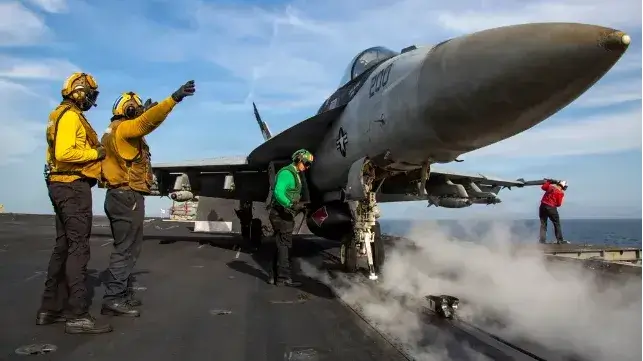
To enforce the blockade, CENTCOM dispatched an F/A-18 Super Hornet from USS Abraham Lincoln to take kinetic measures. At about 0900 Eastern Time on Wednesday, the fighter used its 20mm cannon to target the vessel's rudder, disabling Hasna and compelling her crew to stop transiting to Iran. (On a large tanker in ballast, the upper half of the rudder is out of the water and vulnerable to targeting.)
"The U.S. blockade against ships attempting to enter or depart Iranian ports remains in full effect," the command said in a statement. "CENTCOM forces continue to act deliberately and professionally to ensure compliance."
The fighter-strike method of blockade enforcement could improve CENTCOM's ability to tighten the interdiction campaign against Iranian shipping, without requiring scarce surface combatants or manpower-intensive boardings. Tanker-tracking experts have observed leakage through the American blockade, particularly westbound tonnage transiting in ballast. These empty tankers are critical to to Iran's ongoing effort to keep oil production high, as the vessels provide extra floating storage - extending the time horizon before Iranian producers have to begin shutting in wells for lack of a place to put more oil. Shut-ins risk damage at wellheads and long-term lost production; the administration has attempted to turn that risk into a ticking countdown clock in a calculated effort to pressure Iran into political concessions. Tanker storage has given Iran the ability to keep pumping for weeks after many analysts' early expectations, thereby lessening long-term economic harm from the blockade and making it easier to resist U.S. demands.

No comments:
Post a Comment