Saturday, October 18, 2025

From Food Aid To Free Trade: Europe Courts India — With Caveats – Analysis
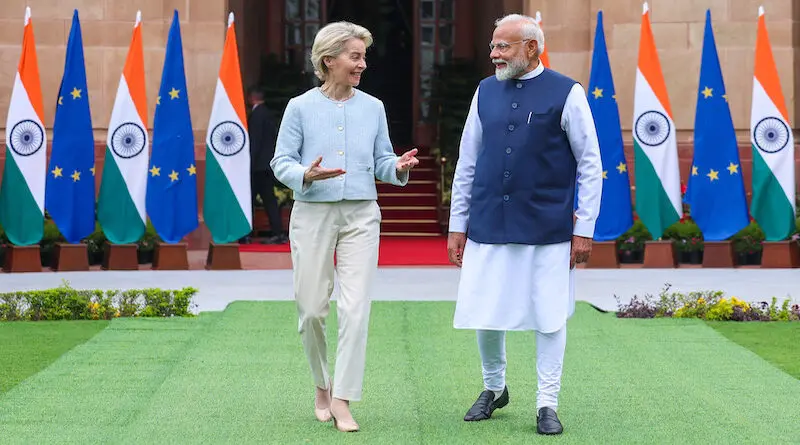


India's PM Narendra Modi meets the President of the European Commission,

 Ms. Ursula Von Der Leyen. Photo Credit: India Prime Minister Office


October 17, 2025

By Ramesh Jaura


Since the 1960s, India has prioritised strategic autonomy in its foreign policy, consistently avoiding alliances that could compromise its sovereignty. Western partners often overestimate their influence, overlooking India’s strong commitment to independence. For India, autonomy is not a tactic but a core principle.

In September 2025, European Commission President Ursula von der Leyen unveiled an ambitious India Strategic Roadmap, which includes the world’s largest free trade agreement, a startup corridor, deeper ties to Horizon Europe, and broad security and defence cooperation.

However, the agreement included caveats. The EU warned that India’s continued purchases of discounted Russian oil and joint military exercises with Moscow would impede closer ties.

Indian leaders anticipated this response and maintained their position. The legacy of the 1960s remains relevant, when the United States used the PL-480 “Food for Peace” program to influence India during the Cold War.

The core challenge remains: India consistently defends its autonomy, while Western partners often seek alignment as a condition for partnership.
PL-480: Food as Foreign Policy

The 1954 Agricultural Trade Development and Assistance Act, commonly referred to as PL-480, was designed to dispose of surplus U.S. grain and foster goodwill. For India, this aid was essential.

By the late 1950s, India faced recurring droughts, rapid population growth, and stagnant farm output. U.S. wheat imports through PL-480 soared, reaching nearly 10 million tonnes annually by 1965.

Though touted as humanitarian, PL-480 quickly became a foreign policy tool
Under President Lyndon Johnson, the U.S. enforced a “short-tether” policy, authorising aid in small, conditional tranches.

Continued aid depended on India’s support for U.S.-Vietnam actions and alignment with Washington.

When Prime Minister Lal Bahadur Shastri condemned the bombing of Hanoi in 1965, U.S. shipments slowed mid-drought.

The message was clear: food aid was contingent on political alignment.

India’s Response: Tightening Belts, Guarding Sovereignty

The PL-480 experience exposed the risks of dependence and reinforced India’s commitment to the non-aligned path envisioned by Nehru.

Non-alignment was an active assertion of independence. India engaged with major powers but consistently set its own terms.

Prime Minister Shastri made it plain: “We have to tighten our belts, but we will never sacrifice our freedom.”

This stance had significant consequences:

1. The Green Revolution

The crisis led to a domestic agricultural revolution. By the 1970s, India no longer relied on foreign grain.

2. Strategic Skepticism of Conditional Aid


PL-480 demonstrated that Western aid often includes conditions. This caution continues to influence India’s foreign policy today.
Brussels in 2025: A Familiar Tune, New Instruments

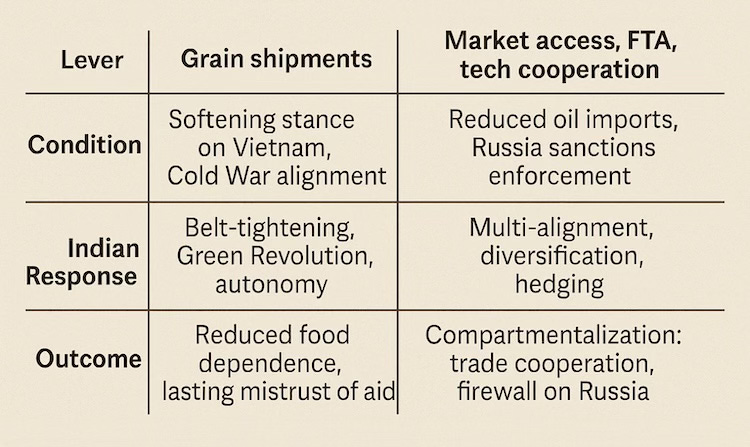
The EU’s 2025 Strategic Roadmap echoes the PL-480 era. While the focus is now on market access, technology, and supply chains rather than wheat, conditionality remains central.

Economic Leverage

The EU promises the “largest FTA in the world,” but links it to compliance with Russia sanctions, oil import curbs, and a crackdown on “shadow fleets.”

Security Incentives with Strings

Offers of defense cooperation and intelligence sharing depend on India aligning with Europe’s Russia policy and reducing its ties to Moscow.

Regulatory Conditionality

EU norms on data privacy, green standards, and due diligence act as informal pressure tools that shape India’s policies.

India no longer relies on foreign aid, yet the EU continues to use economic leverage to influence political decisions.
India’s Modern Doctrine: Multi-Alignment, Not Non-Alignment

India’s strategy still channels the instincts forged in the 1960s, now reinvented for a world of shifting power centres.

This approach represents multi-alignment rather than neutrality:
Oil from Russia
Weapons from France
Chips from Taiwan
Markets in the EU
Capital from the U.S.
Connectivity via the Gulf
India partners modularly:QUAD for Indo-Pacific security
BRICS for financial coordination
SCO for regional dialogue

This is a deliberate risk-management strategy. As the Green Revolution ended food dependency, multi-alignment now protects India from geopolitical challenges.

The EU’s Blind Spot


The EU’s sanctions-first approach defines post-Ukraine cohesion. Urging partners to follow supports a rules-based order.

However, this approach overlooks India’s realities:Energy Needs
Discounted Russian oil is vital for India’s energy security and inflation control.
Defense Interoperability
Over 60% of India’s military hardware comes from Russia. Transitioning will take time.
Global South Optics
India’s approach resonates in the Global South, where many see sanctions as unilateral rather than universal.

The EU’s use of conditional tactics risks repeating the mistakes of the PL-480 era by overestimating its leverage and underestimating India’s commitment to autonomy.

PL-480 vs. EU Roadmap: A Comparative Lens
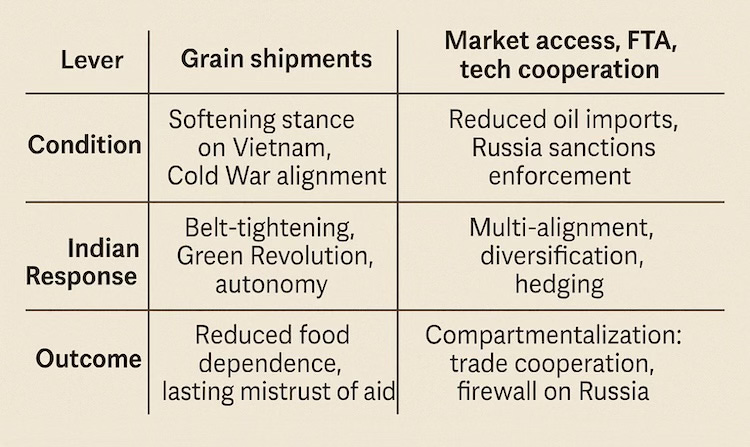

Three Lessons Europe Hasn’t Learned

1. Autonomy Is Existential

India is willing to weather any storm to safeguard its independence.

2. Compartmentalisation Works

When interests converge—in mobility, technology, climate, or maritime security—progress follows. But when partners try to force connections where they do not fit, the effort backfires.

3. Respect Builds Trust

India seeks partnerships built on mutual respect, not on condescension or demands for subordination. France’s defence engagement has been successful without requiring India’s ideological alignment.

Toward a Smarter EU Strategy


If Brussels seeks a meaningful strategic partnership, it should:De-link trade from sanctions politics
Negotiate the FTA on economic merit.
Pursue modular wins
Talent mobility, green tech, maritime awareness, and startups offer quick progress.
Embrace India’s multi-alignment
Multi-alignment strengthens Europe’s China de-risking strategy.
Engage in quiet diplomacy.
Sensitive issues such as shadow fleets should be addressed discreetly, not through public pressure.

The Continuity of Autonomy

From the grain crises of the 1960s to today’s energy crunch, India has weathered wave after wave of Western economic pressure, emerging each time more resilient than before.

This pattern continues: India resists external pressure, adapts, and becomes increasingly self-reliant.

PL-480 unintentionally birthed the Green Revolution.

Today, EU conditionality could spark fresh breakthroughs in homegrown defence, clean energy, and financial innovation in India.

Europe must recognise that a genuine partnership can succeed only when India’s autonomy is respected and protected, without exception. Any attempt to pressure India will only strengthen its independence, the very quality others seek to influence.


Ramesh Jaura is a journalist with 60 years of experience as a freelancer, head of Inter Press Service, and founder-editor of IDN-InDepthNews. His work draws on field reporting and coverage of international conferences and events.


India’s retail payment revolution

India’s retail payment revolution
/ Nathana Rebouças - Unsplash
By bno - Mumbai bureau October 17, 2025

India’s payments landscape has reached a pivotal stage, with digital transactions now accounting for 99.8% of all retail payments, according to a new report by CareEdge Advisory. Despite this near-total digitisation, cash continues to hold a 50% share in private consumption expenditure (PFCE) as of the first quarter of FY26, reflecting the coexistence of traditional and digital modes in the economy.

The study traces how the country’s payment ecosystem has been reshaped by policy reforms, technology adoption, and the rapid expansion of internet and smartphone use. It concludes that India has built a “hybrid payments economy” - digital for convenience, but cash for certainty.

UPI remains the growth engine

The Unified Payments Interface (UPI) continues to drive the country’s digital transformation. UPI transactions rose to 54.9bn in Q1FY26 and 185.9bn in FY25, growing at a compound annual rate of 49% between FY23 and FY25. Digital payments accounted for 92.6% of total retail payment value in Q1FY26, up from 89.1% in FY23, with UPI alone contributing over 90% of total transaction volume.

The average UPI transaction value declined from INR1,662 ($18.72) in FY23 to INR1,330 in Q1FY26, showing that consumers increasingly use the platform for small-value, everyday purchases such as groceries, transit fares, and utilities. CareEdge said this trend indicates growing trust and adoption in smaller towns and semi-urban areas, where digital payment usage has accelerated significantly.

The RBI’s Digital Payments Index (DPI) rose from 445.5 in March 2024 to 493.2 in March 2025, reinforcing the rapid pace of digitisation across all demographic segments.

Financial inclusion and infrastructure expansion

The growth of digital payments is closely tied to rising internet access and financial inclusion. Internet penetration in India increased from 60.7% in March 2021 to 70.9% in June 2025, while the Financial Inclusion Index improved from 53.9 to 67 during the same period. Wider smartphone ownership and affordable data have brought millions of users into the formal digital economy.

Government programmes such as the Payments Infrastructure Development Fund (PIDF) have supported the rollout of acceptance infrastructure in smaller towns and rural areas. New tools like UPI Lite for offline payments and UPI123Pay for feature phones have made digital transactions more inclusive by enabling users without smartphones or stable internet connections to participate in the system.

According to CareEdge, UPI now serves 491mn users and 65mn merchants, and powers nearly half of all global real-time digital payments. The system’s recent expansion into France signals India’s growing influence in the international fintech ecosystem.

Cards and NEFT retain relevance as PPIs decline

While UPI dominates in both volume and value, traditional systems such as NEFT and IMPS remain critical for higher-value transfers. NEFT, with an average transaction size of about INR48,000 in Q1FY26, continues to handle large business and interbank payments. IMPS remains significant for instant transfers, though some activity has shifted to UPI.

Credit card usage continues to expand, driven by e-commerce growth and flexible EMI options, but debit card transactions have declined sharply as users migrate to UPI for smaller purchases. Prepaid payment instruments (PPIs), once popular for mobile recharges and transit payments, have fallen out of favour due to tighter regulations and wallet integration with UPI.

Systems such as NACH and AePS remain relevant for recurring payments, government transfers, and financial inclusion. NETC continues to drive contactless toll and transit transactions. CareEdge’s analysis indicates that India’s payment architecture is now a multi-layered ecosystem — with each instrument serving a specific need, while UPI anchors overall growth.

Digital expansion, cash resilience

Despite the dominance of digital payments, cash remains a vital component of India’s payment ecosystem. Its share in private consumption has fallen from 70% in FY23 to 50% in Q1FY26, but it continues to play a stabilising role, particularly in rural and informal sectors.

The report attributes cash’s continued importance to its reliability, ease of use, and universal acceptance. It remains a preferred mode for small merchants and unbanked populations, and acts as a dependable fallback during network outages or system failures. The current 50:50 split between cash and digital payments marks what CareEdge calls a “tipping point”, suggesting that while digital modes will continue to expand, cash will remain entrenched in cultural and economic practices.

India’s payment evolution, the report observes, is no longer about replacing cash but integrating it into a hybrid, resilient model where both channels complement each other.

Challenges and sustainability of growth

CareEdge notes that UPI’s zero-merchant discount rate (MDR) framework has accelerated adoption but poses questions about the long-term sustainability of payment systems. The next phase of growth is expected to come from value-added services such as micro-credit, merchant analytics, insurance integration, and fintech collaborations that can ensure financial viability for service providers.

The surge in digital transactions has also heightened the importance of security, fraud prevention, and consumer protection. With billions of payments occurring in real time, regulators and payment companies face growing challenges in maintaining robust safeguards against cyber threats and misuse.

The next few years are expected to consolidate India’s position as one of the world’s leading digital payment markets. Internet penetration is projected to reach 85% by 2028, which will further widen the user base. Meanwhile, ongoing financial literacy initiatives and government-led digital inclusion schemes are likely to accelerate adoption across smaller cities and rural regions.

The report adds that affordable smartphones, low-cost data plans, and interoperable payment systems will remain the strongest growth enablers. As connectivity deepens, the diversity and frequency of digital payments are expected to rise, extending beyond peer-to-peer transfers to encompass retail, services, and investments.

To this end, CareEdge expects UPI transaction volumes to exceed 250bn by FY27, maintaining double-digit growth over the next three years. Digital payments are projected to expand further as regulatory innovations enhance accessibility and interoperability.

However, the report argues that cash will remain part of India’s consumption pattern, particularly in regions where digital penetration remains low. This coexistence of cash and digital modes provides flexibility and resilience, making the system less vulnerable to shocks.

India Rejects U.S. Claims of Halving Russian Oil Imports

India hasn’t requested refiners to cut imports of Russian crude oil and no cuts have been seen for the already placed nominations for loadings in November, Indian industry sources told Reuters on Friday, after the U.S. claimed refiners had stared to reduce Russian supply. 

U.S.-Indian talks in Washington this week were productive and Indian refiners are already halving crude oil imports from Russia, a White House official told Reuters on Thursday.

U.S. President Donald Trump said on Wednesday that India had agreed to cut imports of Russian crude oil. 

According to the U.S. President, India’s Prime Minister Narendra Modi had assured him that Indian refiners would stop buying Russian crude "within a short period of time". 

Despite the U.S. claim that Indian refiners are already cutting imports from Russia by 50%, unspecified Indian industry sources told Reuters that any potential cuts could be shown in volumes for December and January crude imports as the refiners have already booked the cargo loadings for November and part of the loadings for December.   

Russian oil imports account for about a third of all crude arrivals in India, which has significantly boosted Russian crude buying in the past three years.  

Some refiners in India have started to prepare to reduce their purchases of Russian crude, Reuters reported on Thursday, citing unnamed sources in the know. The sources said the reduction would be gradual. 

Officially, India on Thursday neither confirmed nor denied that it would indeed cut or halt imports of Russian crude.  

In response to comments on India's energy sourcing, Randhir Jaiswal, an official spokesperson for the Foreign Ministry, said “India is a significant importer of oil and gas. It has been our consistent priority to safeguard the interests of the Indian consumer in a volatile energy scenario. Our import policies are guided entirely by this objective.” 

By Charles Kennedy for Oilprice.com 

First Post-Tariff Brazil–US Talks Deemed ‘Very Positive’


Brazil's Foreign Minister Mauro Vieira, with US Secretary of State Marco Rubio. Photo Credit: ABr

October 18, 2025
By ABr


In a joint statement, Brazilian Foreign Minister Mauro Vieira, US Secretary of State Marco Rubio, and US Trade Representative Jamieson Greer noted that they had “very positive discussions on trade and ongoing bilateral issues.”

Mauro Vieira and US officials met this Thursday (Oct. 16) at the White House in Washington, with talks focusing primarily on the tariffs imposed by the United States on Brazilian products.

The statement further points out that the officials are committed to setting up an encounter between Presidents Luiz Inácio Lula da Silva and Donald Trump.

“Secretary Rubio, Ambassador Greer, and Foreign Minister Mauro Vieira agreed to collaborate and hold discussions on several fronts in the near future, while also establishing a path for joint work. Both parties agreed to work together to arrange a meeting between Presidents Trump and Lula at the earliest possible opportunity,” the statement released by the ministry said.

No date or location has been announced. Initially, the expectation was that it would take place during the Association of Southeast Asian Nations (ASEAN) Summit in Malaysia at the end of October.

However, as the Brazilian foreign minister told reporters, the presidents’ schedules will determine the most appropriate time.


The consultation between Vieira and Rubio marks the resumption of dialogue between the two countries after several months of diplomatic tension.

Relations between Brazil and the United States have been unstable since the Trump administration imposed 50 percent tariffs on Brazilian products. The White House justified the measure as a response to an alleged “politicization” of the Brazilian judiciary, which, at the time, was trying former President Jair Bolsonaro for an attempted coup d’état. Bolsonaro was later sentenced to 27 years and three months in prison.

In addition to the tariff hike, Washington also imposed financial and consular sanctions on Brazilian officials, including Supreme Court Justice Alexandre de Moraes. These actions were perceived in Brasília as political retaliation.

The talks between Vieira and Rubio are the first high-level interaction since Trump resumed the US presidency in January. They signal an effort to restore relations between the two countries, following a brief conversation between Lula and Biden during the United Nations General Assembly in September in New York.Wellton Máximo contributed to this report.


ABr

Agência Brasil (ABr) is the national public news agency, run by the Brazilian government. It is a part of the public media corporation Empresa Brasil de Comunicação (EBC), created in 2007 to unite two government media enterprises Radiobrás and TVE (Televisão Educativa).
US set for anti-Trump ‘No Kings’ protests, Republicans slam ‘Hate America rallies’

More than 2,700 "No Kings" protests against President Donald Trump's policies are planned in several US cities on Saturday in the biggest day of demonstrations since the Republican billionaire returned to the White House. Top Republicans have slammed the protests as "Hate America rallies".


Issued on: 18/10/2025 
By: FRANCE 24

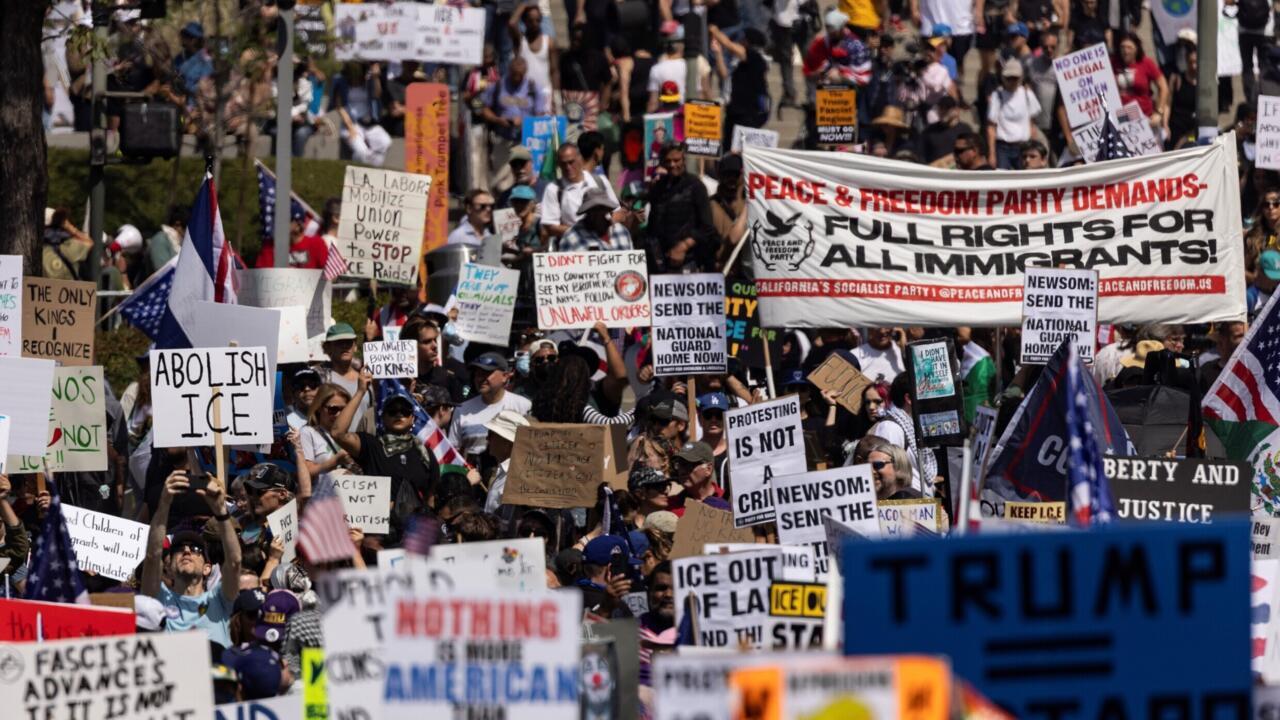
Demonstrators are seen rallying in Los Angeles at a 'No Kings' protest in June 2025 -- and they will hit the streets again on October 18, 2025. © Etienne Laurent, AFP file photo

Rallies from New York to San Francisco under the "No Kings" banner on Saturday will gauge popular anger at President Donald Trump's barnstorming second term, months after a previous day of action brought millions to the streets.

"The president thinks his rule is absolute. But in America, we don't have kings and we won't back down against chaos, corruption, and cruelty," the "No Kings" movement – which unites some 300 organisations – says on its website.

More than 2,700 demonstrations are planned coast to coast, from big cities to small towns, and even near Trump's Mar-a-Lago residence in Florida, where he will spend the weekend. Organisers say they are expecting millions to attend.

Millions attended rallies on June 14 after Trump ordered the deployment of troops to Los Angeles, a move that led critics to accuse him of acting like a dictator.


It was the biggest day of demonstrations since the Republican billionaire returned to the White House in January.

Trump in June had promised to use "very big force" if protesters attempted to disrupt the army parade in the US capital.

In the months since, he has expanded the deployments of troops to US cities, outraging critics.
A protester holds a 'No Kings' sign as police monitor a rally in Houston, Texas, on September 1, 2025. © Ronaldo Schemidt, AFP file photo


An ongoing government shutdown is in its third week, with the Trump administration firing thousands of federal workers and lawmakers showing little sign they are ready to break the impasse.

Trump's response to the latest big rally day has been more muted.

"They're saying they're referring to me as a king. I'm not a king," he told Fox News show "Sunday Morning Futures".

But his top surrogates in the Republican Party were in more fighting form, with House Speaker Mike Johnson calling the day of protest the "Hate America rally".

"You're going to bring together the Marxists, the Socialists, the Antifa advocates, the anarchists and the pro-Hamas wing of the far-left Democrat Party," he told reporters.

Republican lawmaker Tom Emmer also used the "Hate America" phrase and referred to participants as the "terrorist wing" of the Democratic Party.

Democratic congressman Glenn Ivey rejected the term "hate", telling AFP on Friday: "I understand why they're nervous about it and trying to paint it in a bad light."

"It's really the strong counter-push to what they've been doing – that's undermining the country, destroying the rule of law and undermining our democracy," said Ivey, adding that he would attend protests in his Maryland congressional district.
'Country of equals'

Beyond New York and San Francisco, protests are scheduled in major cities such as Washington, Boston, Chicago, Atlanta and New Orleans, but also in small towns across all 50 states.

The "No Kings" movement is even organising events in Canada.

On Thursday, Deirdre Schifeling, chief political and advocacy officer for the American Civil Liberties Union, said protesters wanted to convey that "we are a country of equals".

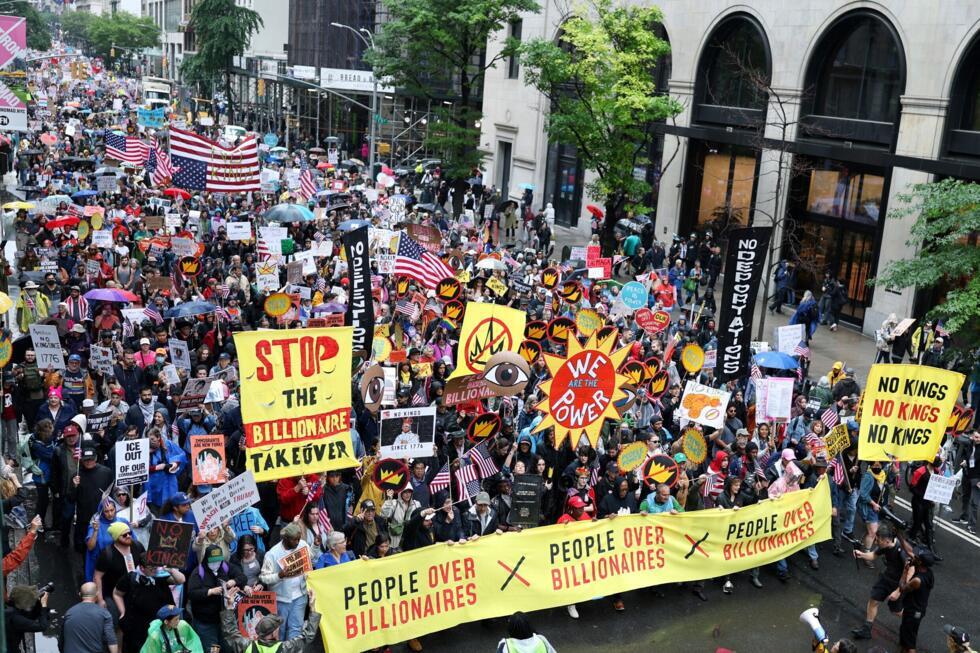
Millions attended 'No Kings' protests in June, like this New York one, and organizers hope October 18, 2025 will be a similarly huge day of action against President Donald Trump. © Charly Triballeau, AFP file photo


"We are a country of laws that apply to everyone, of due process and of democracy. We will not be silenced," she told reporters.

Leah Greenberg, co-founder of the Indivisible Project, slammed the Trump administration's efforts to send the National Guard into US cities, crack down on undocumented migrants and prosecute political opponents.

"It is the classic authoritarian playbook: threaten, smear and lie, scare people into submission," Greenberg said. "But we will not be intimidated. We will not be cowed."

Oscar-winning actor Robert De Niro, a known Trump critic, called on Americans to rally.

"We've had two and a half centuries of democracy... often challenging, sometimes messy, always essential," De Niro said in a short video.

"Now we have a would-be king who wants to take it away: King Donald the First," he said.

"We're rising up again this time, nonviolently raising our voices to declare: No kings."

(FRANCE 24 with AFP)


No Kings Day Expected To Draw Millions For Anti-Trump Mass Protests


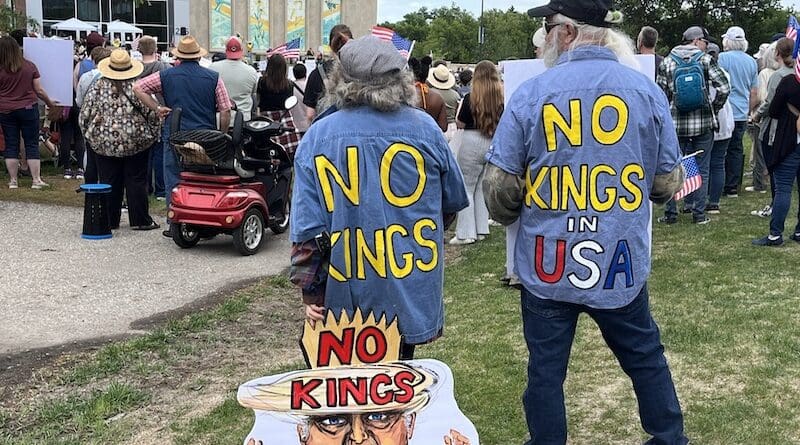
Participants in the No Kings rally in Fargo, North Dakota, on June 14, 2025. (Photo by Erin Hemme Froslie/North Dakota Monitor)

October 18, 2025 
Oregon Capital Chronicle
By Shauneen Miranda

(Oregon Capital Chronicle) — More than 2,600 nonviolent demonstrations against President Donald Trump’s administration are slated Saturday as part of No Kings day.

The second No Kings day, following another in June, is in response to what a broad coalition of liberal advocacy and labor organizations say is “the increasing authoritarian excesses and corruption of the Trump administration, which they have doubled down on since June.”

Organizers expect millions of Americans to join in peaceful events in Washington, D.C., across the country and internationally. Locations are pinpointed on a map on the organization’s website.

“No Kings is back,” said Eunic Epstein-Ortiz, a national spokesperson, at a press conference Thursday. “And over the past few months, thousands of people have organized once again in their communities, on the ground locally, volunteering to bring their neighbors, families and friends together to say, unequivocally, we have no kings. Together, they’re the ones making this Saturday’s mobilization the largest single-day protest in modern history.”
Among the states:In Utah, Salt Lake City’s No Kings protest organizers canceled the march portion of the event and are instead holding a longer demonstration at the state Capitol, according tothe Utah News Dispatch.
In Maine, at least 30 No Kings events are set to be held, per the Maine Morning Star.
In Nevada, demonstrators in downtown Las Vegas will again be confined to sidewalks, the Nevada Current reports, citing high permit costs.
In Kentucky, nearly 30 No Kings protests are popping up in the Bluegrass State, according to the Kentucky Lantern.
Ten No Kings protests are planned in North Dakota, according to the North Dakota Monitor.
In Arkansas, the Arkansas Advocate reports that the protests in more than a dozen cities come as the potential for severe weather ratchets up at the same time the events are scheduled.
Shutdown, Trump crackdown since June protests

The demonstrations build off the No Kings protests in June, which coincided with Trump’s massive military parade on his 79th birthday.


Four months later, the federal government is mired in an ongoing shutdown that began Oct. 1 with no clear end in sight. The administration has also cracked down on U.S. cities, deploying National Guard troops and partaking in sweeping immigration raids.

Leading voices from labor and advocacy groups that are part of the broad No Kings coalition amplified their message ahead of the planned protests during the Thursday press conference, underscoring a peaceful day of action on Saturday.

“We’re going to vigorously exercise our democratic rights peacefully and nonviolently, and against this tyrannical threat of Donald Trump and his administration, we are going to protect American democracy,” said Robert Weissman, co-president of Public Citizen.
House speaker criticizes No Kings day

National leaders from the coalition also pushed back against U.S. House Speaker Mike Johnson’s depiction of the demonstrations as the “hate America rally.”

The Louisiana Republican claimed on Fox News Oct. 10 that “it’s all the pro-Hamas wing and the antifa people — they’re all coming out,” adding: “Some of the House Democrats are selling T-shirts for the event, and it’s being told to us that they won’t be able to reopen the government until after that rally because they can’t face their rabid base.”

Leah Greenberg, co-founder of Indivisible, said “there is nothing more American than saying that we don’t have kings and exercising our right to peaceful protest,” adding: “America doesn’t have kings. That’s our entire point.”

Greenberg said: “I also want to be clear: it is ridiculous, it’s also sinister, because it is part of a broader effort to create a permission structure to crack down on organized opposition and peaceful dissent in this country.

“They are sending the National Guard into American cities, they are terrorizing our immigrant friends and neighbors with their secret police, they are prosecuting political opponents, and now they are trying to smear millions of Americans who are coming out to protest so that they can justify a crackdown on peaceful dissent.”

Katie Bethell, executive director of MoveOn, said “let’s be crystal clear about who is peacefully taking the streets on Saturday — it’s teachers, federal workers, nurses, families, our neighbors and our friends.

“All of our leaders, Republicans and Democrats alike, should listen to what these patriotic Americans have to say,” Bethell said.

“The millions of people protesting are centered around a fierce love of our country, a country that we believe is worth fighting for,” she said. “This is the reality across cities and towns, large and small, rural and suburban, in red areas, blue areas — millions of us are peacefully coming together on Saturday to send a clear and unmistakable message: The power belongs to the people.”
In other states: The Ohio Capital Journal noted dozens of No Kings protests set to take place in the Buckeye State.
About 40 No Kings protests are planned in Indiana, according to the Indiana Capital Chronicle.
Rhode Island is expected to see at least 10 No Kings protests, according to the Rhode Island Current.
More than 100 communities across Michigan plan to hold No Kings rallies, the Michigan Advance reports.
In Arizona — where more than 60 No Kings protests are anticipated — high turnout is expected even in the state’s rural Republican strongholds, according to the Arizona Mirror.


Oregon Capital Chronicle

The Oregon Capital Chronicle, founded in 2021, is a professional, nonprofit news organization. We focus on deep and useful reporting on Oregon state government, politics and policy. Staffed by experienced journalists, the Capital Chronicle helps readers understand how those in government are using — or abusing — their power, what’s happening to taxpayer dollars, and how citizens can stake a bigger role in big decisions.


Taming the (Crooked) Leviathan: The Politics Of Corruption And Economics Of Power Symmetry In An Illiberal Society – Analysis


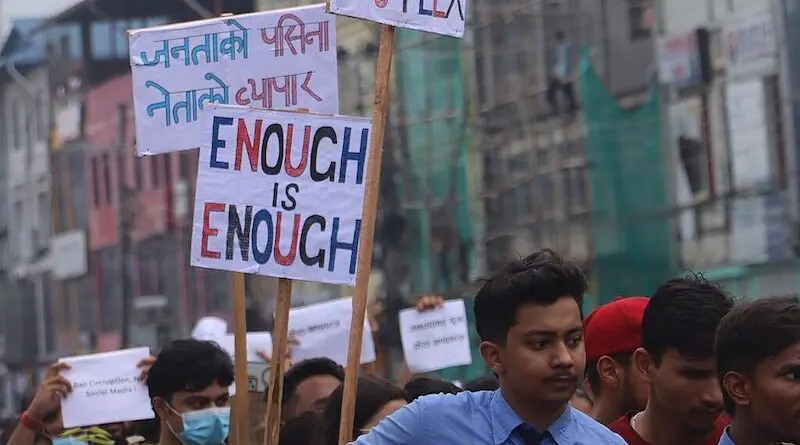
Protest in Nepal. Photo Credit: हिमाल सुवेदी, Wikipedia Commons

October 17, 2025

By Jumel Gabilan Estrañero, Chinalexi Khyle M. Tejada, Ritchel G. Pasadas, Stephanie Louise M. Acedera, Meryxine Kyle P. Zabala and Lian Alistair A. Cordova


For several decades, corruption has existed as a force undermining the economy, depleting the legitimacy of trust and governance, and thus, fueling public resistance movements. This is depicted in the recent protests in Nepal, Indonesia, Bangladesh, and the Philippines, where government failures and economic grievances induce social upheaval to urge for reform and accountability. The commonality across these nations lies in their deep history of corruption within structural, institutional, and cultural frameworks.

Despite several reforms such as decentralization and anti-corruption establishments, corruption remains a tremendous issue, making it far more than an issue of “a few bad apples.” In Nepal, protests initiated by Generation Z[1] activists erupted in mid-July 2025, who are deeply frustrated over the long-standing corruption, inflation, and, particularly, the government-imposed ban on social media. The non-stop rallies and confrontations compelled the resignation of Prime Minister Pushpa Kamal Dahal weeks later in August.

The corruption in Nepal‘s Political Economy is ignited by the instability and fragile governance. They have weak institutional frameworks, political instability, and entrenched patronages when it comes to networks—which causes misuse of resources. The CPI (Corruption Perceptions Index)[2] has consistently ranked Nepal as one of the corrupt countries in South Asia. Nepal’s common forms of corruption include bribery, misuse of development funds, and collisions between the politicians and businessmen. On the other hand, in India, they met with a widespread systemic corruption at multiple levels of government even though they have vigorous democratic institutions and a strong framework[3]. High-profile scams are common in India, and this is where the scale of political corruption has been exposed. In the Philippines, the root cause of corruption in political economy is rooted to political dynasties[4]. It also remained a common practice for vote-buying, nepotism, and misuse of public funds remain common. It hinders the growth of the economy and but harnesses further the weaknesses of the government and economy. All these countries lack transparency, consistency, patronage, and transparency.

Meanwhile, mass gatherings and rallies broke out in Indonesia throughout the beginning of August due to the exposed corruption scandals, including the 2025 Pertamina corruption case, also referred to as “Pertamina Gate,” wherein an oil import embezzlement scheme caused a massive loss of over twelve billion dollars. The Parliamentary Allowances also triggered Indonesian citizens because it was revealed that the House of Representatives (DPR) members were set to receive monthly housing with a stipend of Rp 50 million (around $3,000 USD), which was extremely higher than the average minimum wage in Jakarta. The candidacy of the son of former President Joko Widodo (Jokowi) also sparked controversy because his son was allowed to run for regional office despite not meeting the age requirements for candidates. The public viewed this as nepotism in an attempt at democratic backsliding, where political elites abuse their power for dynastic and personal gain. The Philippines also attains its fair share of ongoing political controversies over the misallocation of funds.

The current notable issue revolving around this is the Flood Control Projects Corruption Scandal, also known as “ghost projects,” wherein hundreds and billions of pesos were washed down the drain by contractors, public officials, including legislators, for personal consumption. Similarly, in the Philippines large-scale protests over anti-corruption and flood control projects with billions allegedly stolen from the Filipino people’s taxes, have majorly led and organized by Filipino youth groups. The public outrage was further enraged due to “nepo-babies” and political elites flaunting their ill-gotten wealth.

These protests have common themes, such as it being majorly youth-led protests and fighting the systemic issue of corruption in their respective governments. It not only echoes the cry for a better system but also exposes the deep-rooted failures of political institutions that have long prioritized elite interests over public welfare. The convergence of youth activism, digital mobilization, and economic frustration marks a pivotal moment in the political economy of South and Southeast Asia—one that demands urgent attention and transformative reform.

Although contexts differ, these protests share a common denominator: systemic corruption[5] and this protest is being led by Gen Z.[6] Their politics does not primarily take place in parliaments or traditional party structures, but in hashtags, memes, livestreams, and decentralized networks that can mobilize thousands within hours.[7] Additionally, according to Hilotin (2025), the further grievance uniting these movements is the glaring persistence of “nepo politics” — the rise of second- and third-generation heirs of corrupt families who continue to dominate public office despite decades of promises of reform, Khan (2025)[8]. Yet while corruption is entrenched, Gen Z movements are reshaping how resistance is organized. In Nepal, 2025 saw a wave of Gen Z-led protests coordinated through Discord and Instagram after revelations of elite enrichment amid economic downturns, Subedi (2025). In Indonesia, students and Gen Z mobilized against attempts to weaken the Corruption Eradication Commission (KPK) and the rollback of democratic safeguards, Harvey (2025). In the Philippines, as revealed by Ratcliffe (2025), on September 21, around tens of thousands of Gen Z Filipinos took to the streets on Sunday to protest versus government corruption after it was alleged that taxpayers have lost billions of dollars to bogus flood control projects.[9]

These protests have common themes, such as it being majorly youth-led protests and fighting the systemic issue of corruption in their respective governments. It not only echoes the cry for a better system but also exposes the deep-rooted failures of political institutions that have long prioritized elite interests over public welfare. The convergence of youth activism, digital mobilization, and economic frustration marks a pivotal moment in the political economy of South and Southeast Asia—one that demands urgent attention and transformative reform.
Analysis, Implications and Some Recommendations

1. Power: Structural Legacies and Weak Institutional.

The structural causes of corruption are rooted in the failure of governments to disseminate reform institutions and allocate funds effectively. There is an apparent parallelism with corruption in Nepal, Indonesia, and the Philippines, wherein it is centralized around the occurrence on the powerful elite controlling the entirety of their government. One should not question “who is in charge,” but “how the system is built to let them keep getting away with it.” The wealthiest and most influential families have historically controlled key positions in the government, and it has been a destructive tool to create laws and policies that only benefit them and unfairly profit from national resources or public money. For instance, in the Philippines, the elite historically used political power, exemplified by the late Ferdinand Marcos, through the plunder of crony capitalism (“cryonism”), granting “behest loans” using public funds to establish numerous empires. While in Indonesia, powerful networks under the Suharto regime persist in controlling access to the natural resources of the country, wherein they also manipulate the government subsidies and agreements for private profit. Besides the power elite playing games, the problem also lies in the weak structure of many local district-level government institutions.

Moreover, the persistence of corruption in countries of Nepal, Indonesia, and the Philippines cannot be separated from the entrenched political dynasties and oligarchic structures that dominate state institutions. From a political economy lens, these elites treat governance as a marketplace of rents, where political power is used to extract resources, distribute patronage, and preserve family wealth. For Generation Z[10], the visible rise of “nepo babies” or the heirs of established political clans, has become a symbol of systemic injustice. The anger is fueled by the contrast between inherited privilege and the lived reality of precarity among the citizens where access to decent jobs, affordable education, and housing remains limited. This structural imbalance explains why protests are not just reactive to scandals but are expressions of generational disillusionment against a state captured by dynastic and oligarchic interests.

From here, we can learn that the corrupt environment is fostered by highly regulated economies that create monopolies, weak legal institutions, and easily manipulated laws, where the benefits of corruption outweigh the risks. Politics is often treated as a business, leading to the normalization of corrupt practices. Specific examples include collusion in the Philippines to secure funds for overpriced or non-existent “ghost” projects, and the appointment of individuals to government posts in which the perceived closeness to power becomes an “invaluable asset” for securing business contracts and preferential treatment.

At this juncture, anti-corruption reform must move beyond slogans and ad hoc investigations. In Nepal, Indonesia, and the Philippines, this means enforcing genuine checks on dynastic succession (through enforceable anti-dynasty provisions, campaign finance transparency, and stricter wealth disclosure laws), while simultaneously professionalizing bureaucracies through merit-based recruitment and career protections. These reforms ensure that state institutions are not permanently captured by family networks and partisan loyalties. Long-term sustainability depends on embedding accountability mechanisms in everyday governance rather than episodic “clean-up” drives.

2. Profits: Rent-Seeking and Natural Resources. 

The operation for illegal profits, transforming state power into private gain, is often through “rent-seeking” in sectors that are rich in resources, an ongoing circumstance that is manifested in Nepal, Indonesia, and the Philippines. One case perfectly exemplifies this, which is Nepal’s “AAR Corporation Bribery Case”. Between 2015 and 2020, AAR Corp., an American aviation firm, paid bribes to high-ranking Nepali officials via intermediaries in order to secure a fraudulent commercial deal for the sale of two Airbus A330-200 aircraft to the state-owned Nepal Airlines firm. Furthermore, in Indonesia, politically inclined networks also extract wealth from public funds generated by natural resources like gas, mining, timber, and oil. In the Philippines, illicit profit is also measured by a major economic cost, with the country losing at least twenty (20) percent of its national budget every year through graft and corruption, including disposition of public assets, bribery, and extortion.

3. Protests: Dialectic of Anti-Corruption Mobilization. 

Mass rallies or protests are not merely reactions to corruption but are substantial to the political pavement to a promising and effective change. In retrospect on the political history of the Philippines, it is heavily characterized by a constant dialectic, where most corruption scandals are encountered by powerful anti-corruption movements that strive for political change, making citizens less and less tolerant of corruption over time.

However, this moral progress carries a hidden risk: the rise to popularity of anti-corruption “fundamentalism,” a reform agenda often led by the elite that perceives corruption in legalistic terms, where it is disconnected from the day-to-day economic struggles and structural realities of the Filipino society. When this idealistic “politics-as-it-should-be” fails to deliver tangible improvements to ordinary individuals, it induces deep cynicism about the entire democratic process. This mistrust creates an abyss that is swiftly filled by populist strong leaders (a trend seen with figures like Duterte and Marcos Jr.) who promise “strong governance”, rapid, effective results, over the slow, transparent process of “clean and genuine good governance,” ultimately leading to the rejection of democratic norms, hence risking the very democratic foundations the anti-corruption fight was meant to protect in the first place.

Recognize Gen Z as long-term partners in governance by granting them formal roles in oversight councils, participatory budgeting, and youth commissions with decision-making powers. At the same time, governments must address youth precarity through job creation, education reforms, and support for youth-driven industries. This dual approach transforms protest energy into constructive engagement while tackling the structural inequalities that fuel disillusionment.

4. Digital Transparency and Civic Accountability Ecosystems.

 Given Gen Z’s digital activism, governments should harness technology to institutionalize transparency, for instance, even though existing but REQUIRED AND UPDATED e-governance platforms that make public budgets, procurement, and contracts fully accessible. At the same time, states must protect online freedoms and resist the temptation to weaponize disinformation against young activists. On a broader scale, regional bodies like ASEAN and SAARC should promote harmonized anti-corruption frameworks, share best practices, and include youth voices in regional policymaking. By embedding reforms in both domestic and regional political economies, governments can demonstrate genuine commitment to accountability and inclusivity, addressing not only the anger of the present but also the sustainability of democratic legitimacy in the future.

5. Credentials and Furtherance of Fangs of Law and Order. 

The requirements in joining the government or obtaining a political position should be changed. Strict implementation of specific requirements should be done to avoid leaders who are incapable of running the country. This is also to avoid corruptions and political dynasties—which is already in the constitution but failed to establish.

Also, the Philippine government can create citizen-led oversight councils, including youth representatives, to monitor public spending and corruption investigations. These councils should review audit findings and procurement data, recommend policy changes and flag irregularities, and serve as liaisons between civil society and anti-corruption bodies.

On one hand, we can push for the implementation of a Robust (Influence Peddling) Law. This policy is to specifically target and dismantle the informal yet powerful system where being influential or close to the powerful is an “invaluable asset” that facilitates corruption. Introduce a new law that criminalizes influence peddling. This legislation would make it illegal for any individual to leverage their perceived closeness to power to secure “contracts, licenses, tax cuts and other forms of preferential treatment”. This policy directly targets the normalized behavior where “politics is treated as business,” making it riskier for politicians and their ‘nepo babies’ to shamelessly use their positions for personal enrichment.

Conclusion and Way Ahead

In a nutshell, if corruption committed by the politicians that the public trusts to serve them is equated to business and protests their action is considered as violence, is it still a society that the people should dream of living in? And when the same is happening to neighboring countries but they manage to overturn it step-by-step, yet ours remain in the same position we were years ago– what does that say about the people? Justice that caters to one group of people alone is not justice; it is a self-serving policy that protects those who commit injustice.

The political economy nexus of corruption in Nepal, Indonesia, and the Philippines exemplified cycle where weak institutional Power facilitates massive Profits through illicit rent-seeking, fueling mass Protests. While these protests demonstrate a catalyst for change, accountability in office and effective reforms shall be implemented. The ultimate challenge is to bridge the border between the moral demands of clean government and the practical, daily needs of the people.

Indeed, these substantive protests reflect a broader crisis in the political economy, where the youth are excluded from decision-making, economic opportunities are monopolized by elites, and institutions lack accountability. At larger end, the convergence of economic despair and digital mobilization has transformed youth from passive observers to active agents of change.

*Ideas and/or views expressed here are entirely independent and not in any form represent author’s organization and affiliation.

About the author:

Jumel G. Estrañerois a defense, security, & political analyst and a university lecturer in the Philippines. He worked in the Armed Forces of the Philippines, Office of Civil Defense, National Security Council-Office of the President, and currently in the Department of the National Defense. He is currently teaching in De La Salle University Philippines while in the government and formerly taught at Lyceum of the Philippines as part-time lecturer.
Chinalexi Khyle M. Tejada is a Political Science major in De La Salle University, and Senior Officer of Pre-Law Debate Society. She is specializing in international relations, Cross Strait relations, and regionalism.

Ritchel G. Pasadas is a Political Science major in De La Salle University, and President of the Political Science Program Council. She is specializing in Southeast and MENA Region area studies as well as human rights.

Stephanie Louise M. Acedera is an International Development Studies major in De La Salle University, Senior Diplomat in Lasallian Student Ambassadors and specializing in post-structural feminism and power politics, gender and development, pop culture, and diplomacy.

Meryxine Kyle P. Zabala is a International Development Studies major in De La Salle University, Senior Committee Officer in Lasallian Student Ambassadors and specializing in international law, migration studies, and diplomacy.

Lian Alistair A. Cordova is Political Science major in in De La Salle University, Deputy Executive Secretary in University Student Government (8th Congress), international law debater while being the OIC-Executive Director of Pre-Law Debate Society. She is specializing in American and European politics and gender issues. She also represented the university in Xi Global Leadership Program with other international student leaders across the region.


Endnotes:

[1] Generation Z (born between 1996 to 2012) has often been described as the “digital native” generation. Unlike earlier cohorts, they came of age in an era dominated by smartphones, social media, and online platforms. This technologically adept generation has emerged as a formidable force, challenging authoritarianism, corruption, and economic inequality.

And recently, across Asia, Gen Z has been taken to the streets and digital platforms to demand political accountability, economic opportunities, and an end to entrenched corruption. From stormed palaces in anti-corruption marches in Jakarta and Kathmandu, a growing wave of youth activism, and now in Philippines, is reshaping the political landscape. In Nepal and Indonesia, Gen Z has mobilized against weakening democratic safeguards and elite enrichment, while in the Philippines they have spearheaded online activism against dynastic rule, disinformation, and human rights abuses specially with the funds from the taxes of the Filipinos being use for personal gained.

Due to the influence of Generation Z, a big consumer generation born between the mid-1990s and the early 2010s, marketing techniques have gotten more complex in the current digital landscape. Because of their proficiency with technology and distinctive purchasing habits, this generation, known as “digital natives,” offers marketers both special chances and challenges.

[2] Corruption Perceptions Index is an index that keeps track of the scores and ranks of each country by their perceived levels of public sector corruption. It defines corruption as and “abuse of entrusted power for private gain.”. It is annually published by the Transparency International ever since 1995.

[3] Central Vigilance Commission is and Indian governmental body which was created in 1964 to address corruption, and Lokpal Act is an anti-corruption in India to provide for greater transparency and accountability when it comes to governance.

[4] Political Dynasty is when multiple members of a family is involved in politics—particularly electoral politics. Despite having the Article II Section 26 of the 1987 Constitution, also known as the anti-political dynasty law, it is still a common practice and the bill itself is ignored by politicians.

[5] These countries are facing similar crises, rooted in the same issues: growing economic hardship, the decline of democratic and civic rights, and the failure of governments to hold themselves accountable to their people. Farmers are denied decent living, young people are denied a voice, and everyday communities are left to bear the weight of corruption, increasing costs, and oppressive measures.

[6] Aggrawal, Bhojwani and Ganglani (2025) states that the driving force of young people who are furious over a lack of jobs, rampant corruption and rising economic inequality as they are being forced into precarious types of employment, including young people with education, and they are now angry and feel unprotected or feel that their futures are not secure.

[7] In September 2025, Nepal was rocked by its most intense political unrest in decades. What began as a government-imposed ban on 26 social media platforms quickly ignited a nationwide movement, with thousands of young Nepalis – proudly calling themselves Gen Z – pouring into the streets of Kathmandu, Pokhara, and other major cities.1 Their anger was not just about the ban; it reflected years of frustration over corruption, nepotism, shrinking opportunities, and an unresponsive political class.

[8] As stated by Ahmer Khan (2025), “everybody wanted a change. We knew the country was ruined by corruption and governance.

[9] “I feel bad that we wallow in poverty and we lose our homes, our lives and our future while they rake in a big fortune from our taxes that pay for their luxury cars, foreign trips and bigger corporate transactions,” student activist Althea Trinidad told The Associated Press news agency.

[10] Gen Z’s mobilization reflects a deeper critique of how the political economy systematically excludes them from decision-making while expecting them to bear the economic burdens of misgovernance. High youth unemployment in Nepal, the rollback of anti-corruption institutions in Indonesia, and the consolidation of dynasties in the Philippines all feed into a shared narrative of betrayal by leaders who inherited power rather than earned it. Yet, unlike past generations, Gen Z leverages digital platforms to create decentralized networks of resistance, circumventing traditional gatekeepers like political parties and mainstream media. Their protests highlight how corruption is not only an economic drain but also a generational theft of opportunities, intensifying the sense of political alienation. Thus, Gen Z experiences the political economy of corruption both materially, through shrinking opportunities, and symbolically, through the domination of elites who pass power within their families.


Jumel Gabilan Estrañero

Jumel Gabilan Estrañero is a defense, security, & political analyst and a university lecturer in the Philippines. He has completed the Executive Course in National Security at the National Defense College of the Philippines and has participated in NADI Track II discussions in Singapore (an ASEAN-led security forum on terrorism). His articles have appeared in Global Security Review, Geopolitical Monitor, Global Village Space, Philippine Daily Inquirer, Philippine Star, Manila Times, Malaya Business Insights, Asia Maritime Review, The Nation (Thailand), Southeast Asian Times, and Global Politics and Social Science Research Network. He worked in the Armed Forces of the Philippines, Office of Civil Defense, National Security Council-Office of the President, and currently in the Department of the National Defense. He is currently teaching lectures in De La Salle University Philippines while in the government and formerly taught at Lyceum of the Philippines as part-time lecturer. He is the co-author of the books titled: Disruptive Innovations, Transnational Organized Crime and Terrorism: A Philippine Terrorism Handbook, and Global Security Studies Journal (Springer Link, United States). He is an alumnus of ASEAN Law Academy Advanced Program in Center for International Law, National University Singapore and Geneva Centre for Security Policy, Switzerland. He is also a Juris Doctor student.


Iran's capital Tehran showcases new "Virgin Mary" Metro station

Iran's capital Tehran showcases new
Artwork of the Virgin Mary in the first Christian-themed Metro station in the country. / CC: Alik newspaper
By bnm Tehran bureau October 15, 2025

Tehran's contentious mayor Alireza Zakani has said the construction of the "Maryam Moghaddas" (Saint Mary) Line 6 metro station "demonstrates the coexistence of divine religions" in the Iranian capital, Shahr reported on October 15.

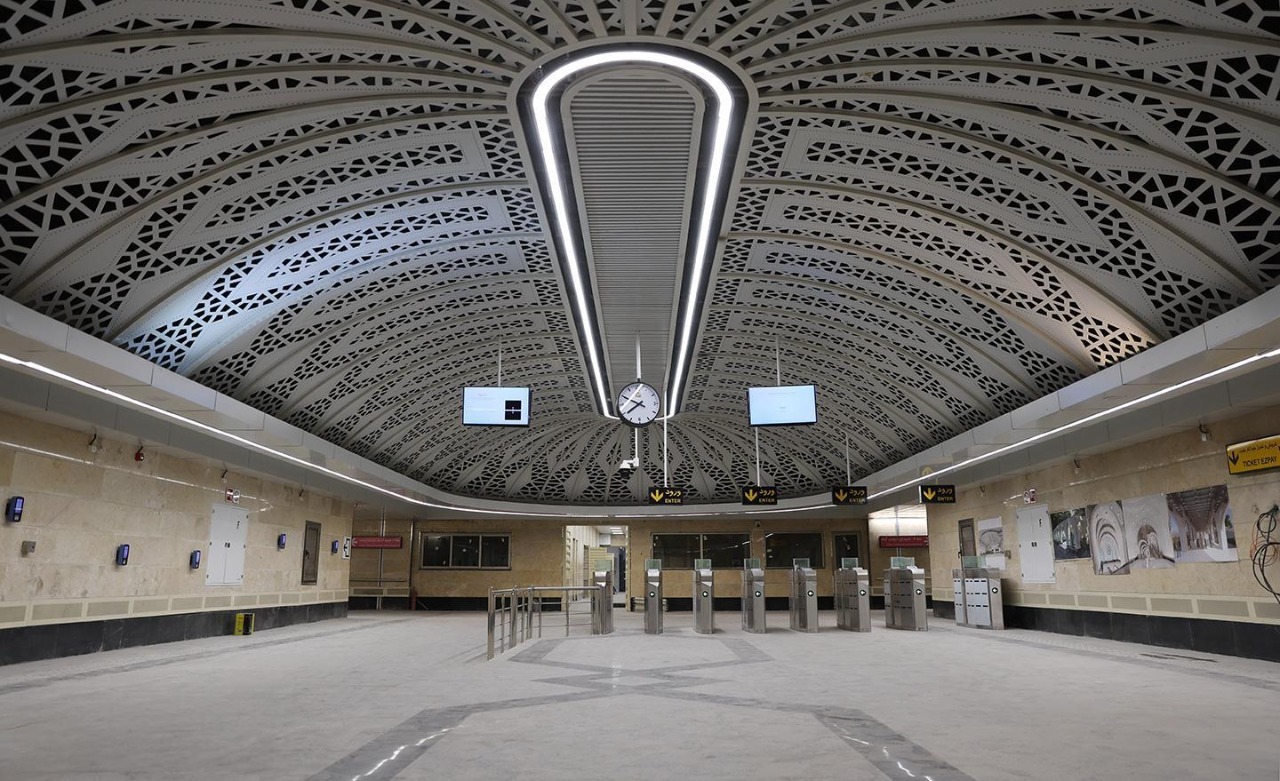
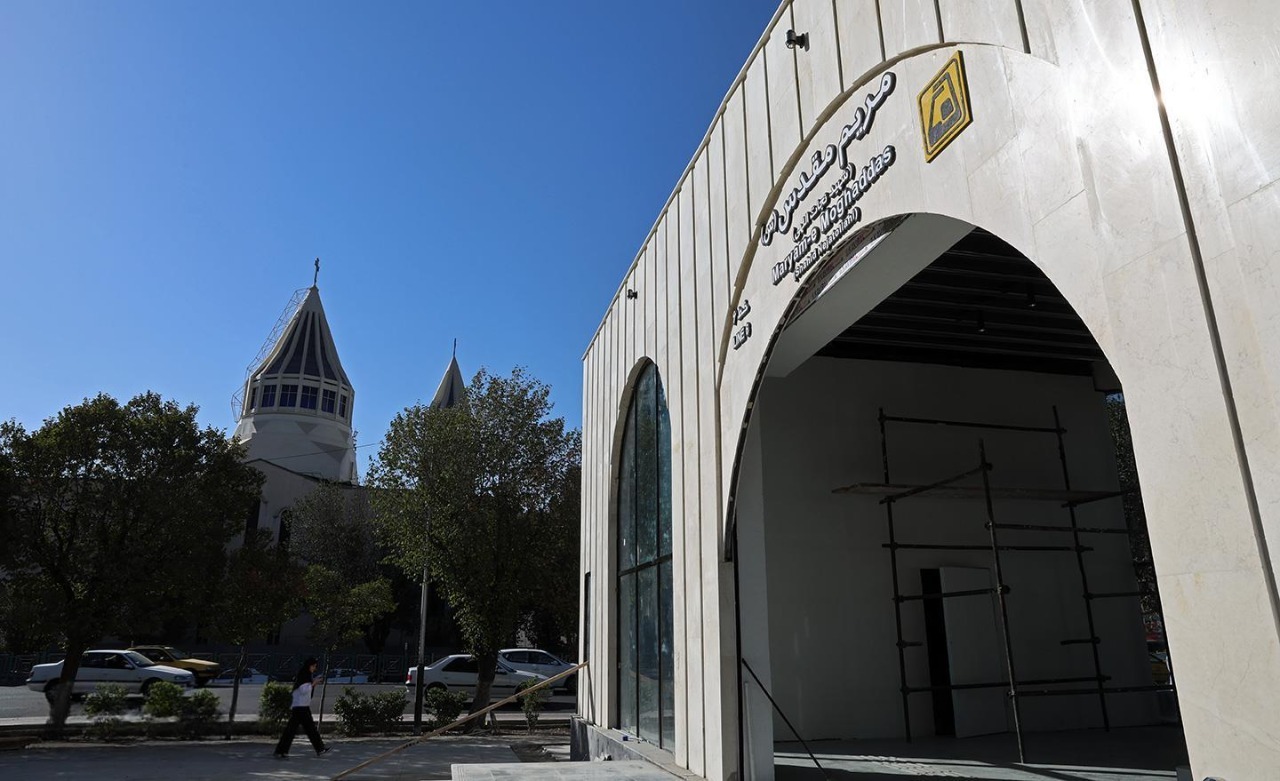
The station, located in the western section of appropriately-named Maryam Park opposite the Holy Virgin Church, features a design that combines the features of the church's architecture with Persian geometric elements. The ceiling design replicates the dome of the Holy Virgin Church, with stainless steel structures and oval recesses fitted with lighting.

The entrance features inscriptions in Armenian and Persian reading "In the name of God". The station is situated at a depth of 25 metres with three escalators to transport passengers, Armenian language newspaper Alik wrote on October 13.

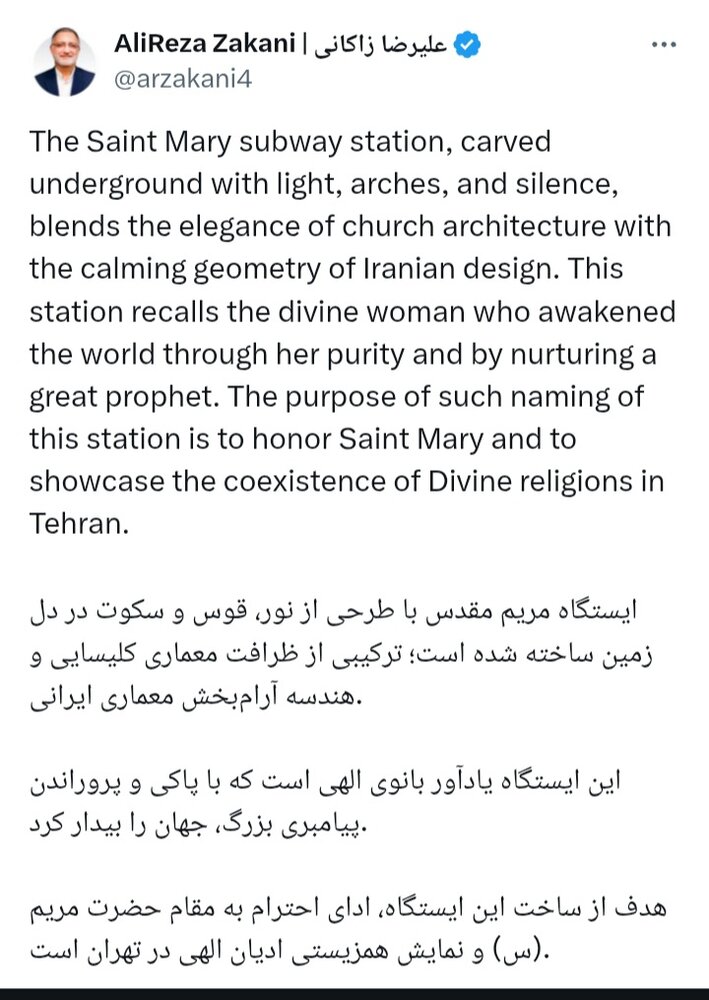
Zakani wrote on his social media page on X, alongside images of the station which will soon be inaugurated, that the station has been built with a design incorporating light, arches and silence underground, combining the delicacy of church architecture with the calming geometry of Iranian architecture.

"This station is a reminder of the divine lady who, with purity and raising a great prophet, awakened the world," Zakani wrote, according to the municipality’s Shahr news agency.

The mayor stated that the purpose of constructing this station is to pay respect to the status of the Holy Mary and demonstrate the coexistence of divine religions in Tehran.

Social media users were quick the admonish the hardline mayor after years of animosity from his grouping for his comments of peace and co-existence. Anti-Islamic Republican groups online stated that the Iranian government has persecuted

The station is part of Tehran's expanding metro network, which serves millions of passengers across the city.

The naming of the station after the Virgin Mary, a revered figure in both Islamic and Christian traditions, reflects Iran's recognition of shared religious heritage.

The station has been compared to Shiraz's Vakil-ol-Roaya metro station, one of Iran's most beautiful stations that attracts many travellers and tourists. However, like other stations, adequate space for bicycle parking or convenient bicycle transport remains limited.

The Armenian Christian community in Iran, numbering between 150,000 and 355,000, is the country's largest Christian minority and one of its oldest ethnic communities, with roots dating back over 400 years.

Abdolmotahar Mohammadkhani, spokesman for Tehran Municipality, said the station is located at the intersection of Ostad Nejatollahi and Karimkhan Zand streets. Implementation operations began in 2015 and the station is now ready to be made available to the public.

Mohammadkhani said the station was built at a depth of 34 metres with a floor area of approximately 11,000 square metres. More than 102,000 cubic metres of excavation, 3,600 tonnes of reinforcement and 27,000 cubic metres of concrete pouring were carried out. Six thousand square metres of stonework was completed in various sections of the station to maintain safety and aesthetics at the desired level.

Mohammadkhani said the opening of Virgin Mary station is part of a package of inaugurations in the second half of October that includes other projects on Lines 3 and 7.

Currently, there is an estimated range of 75,000 Christian Armenians in Tehran, despite the large emigration of the minority in recent years due to the poor economic conditions of Iran. 


Iranian startup targets computer science skills gap with project-based learning model

Iranian startup targets computer science skills gap with project-based learning model
Iranian startup targets computer science skills gap with project-based learning model. / CC: IRNA
By bnm Tehran bureau October 17, 2025

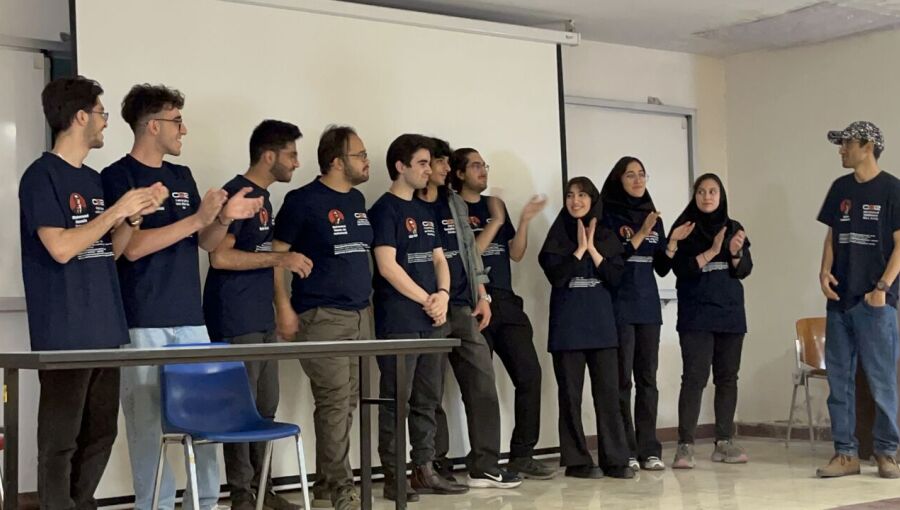
An Iranian startup has designed a new model for computer science education aimed at bridging the gap between university teaching and real job market needs, targeting students as young as 13 to stem the brain drain in the technology sector, IRNA reported on October 17.

CS12 has introduced a model for learning computer science that focuses on teamwork, practical projects and direct connection with the real job market environment, contrasting with traditional models based on theoretical teaching and memorisation.

Farhan Ebrahimzadeh, one of the startup's founders, said on the sidelines of the Computer Science 12 community's zero event at Tehran's Shahid Beheshti University that computer science education in Iran typically proceeds with emphasis on theoretical topics without engaging students with real projects.

In Iran, computer science education usually emphasises theoretical topics without engaging students with real projects. As a result, many graduates face serious problems when confronting the job market," Ebrahimzadeh said. "CS12 seeks to change this path so that learning begins from a young age."

The educational model is designed so teenagers and young people aged 13 to 15 become familiar with basic computer science concepts and gradually enter more specialised levels through real projects, group work and participation in building software products rather than through memorisation and repetition of course materials.

The model's main pillar is an active and dynamic community where learners have continuous interaction with mentors and teammates, learn from each other and play roles in real projects. A team of specialists act as validators who simultaneously monitor content and the educational process and upgrade it when necessary to ensure educational quality.

Classes are held as practical workshops and weekly sessions rather than being limited to teacher-centred education, with participants learning technical and soft skills simultaneously and gaining work experience in a real environment from the beginning.

"Instead of focusing on high-level education and complex theories, we start from infrastructure, exactly where the shortage of specialist personnel in the country is most felt - areas such as network design, distributed systems, security and technical infrastructure," Ebrahimzadeh said. "If we can fill this gap, we can build strong and local teams and no longer be dependent on outside the country for infrastructure development."

CS12 currently operates with a 20-person team in Tehran and is gradually expanding to other provinces, with units launched in cities including Arak, Sari and Sistan and Baluchestan, whilst a Shiraz branch will be added soon.

"One of our big problems in Iran is that social networks in the technology field have mostly become places for conversation and information transfer and do not produce real technical output," Ebrahimzadeh said. "We have come to change this situation - to turn mere networking into effective team building and real projects."

The startup aims to train a new generation of specialists and committed personnel for the country's future who can remain in the country, grow, and pave the way for technology development in Iran rather than emigrate.

"This startup, relying on project-based learning, gradual education, purposeful team building and geographical expansion, is trying to play a real role in upgrading Iran's technology ecosystem and train a new generation of specialist and committed forces for the country's future - forces that instead of emigrating, can stay in the country, grow and pave the way for technology development in Iran," Ebrahimzadeh said