Tuesday, November 25, 2025


Toxic mines put Southeast Asia’s rivers, people at risk, study says
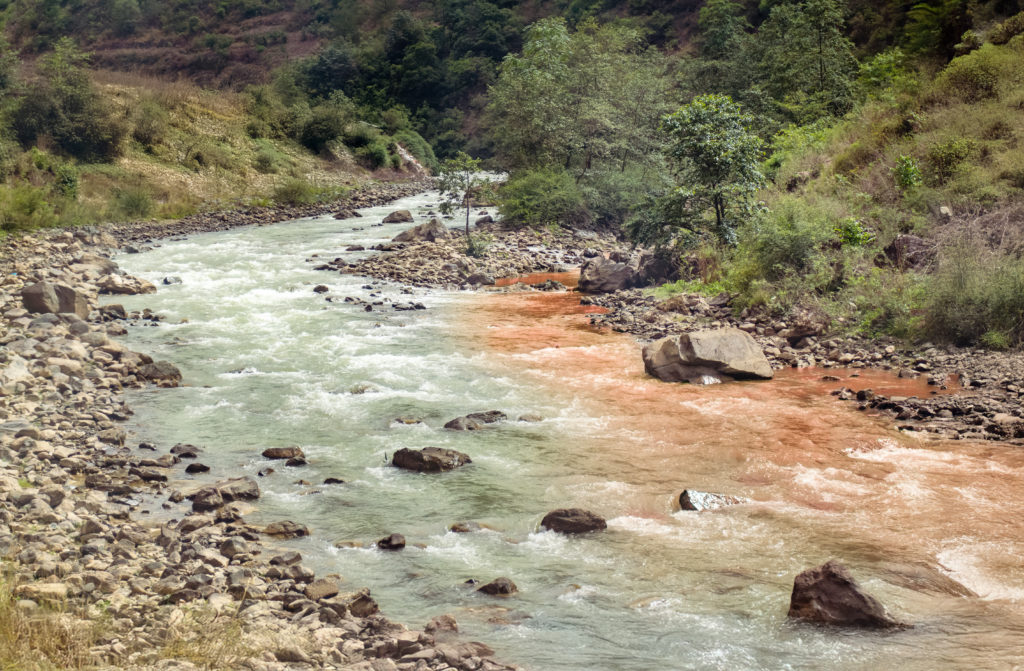

Rare earth mining processing cause pollution in river on Southeast Asia. Stock image.

For most of her life, 59-year-old farmer Tip Kamlue has irrigated her fields in northern Thailand with the waters of the Kok River, which flows down from neighbouring Myanmar before joining with the Mekong River that cuts through Southeast Asia.

But since April, after authorities warned residents to stop using the Kok’s water because of concerns over contamination, Tip has been using groundwater to grow pumpkins, garlic, sweet corn and okra.

“It’s like half of me has died,” Tip said, standing by her fields in Tha Ton sub-district, and looking out at the river that she is now forced to shun.

Across mainland Southeast Asia, more than 2,400 mines – many of them illegal and unregulated – could be releasing deadly chemicals such as cyanide and mercury into river water, according to research from the US-based Stimson Center think tank released on Monday.
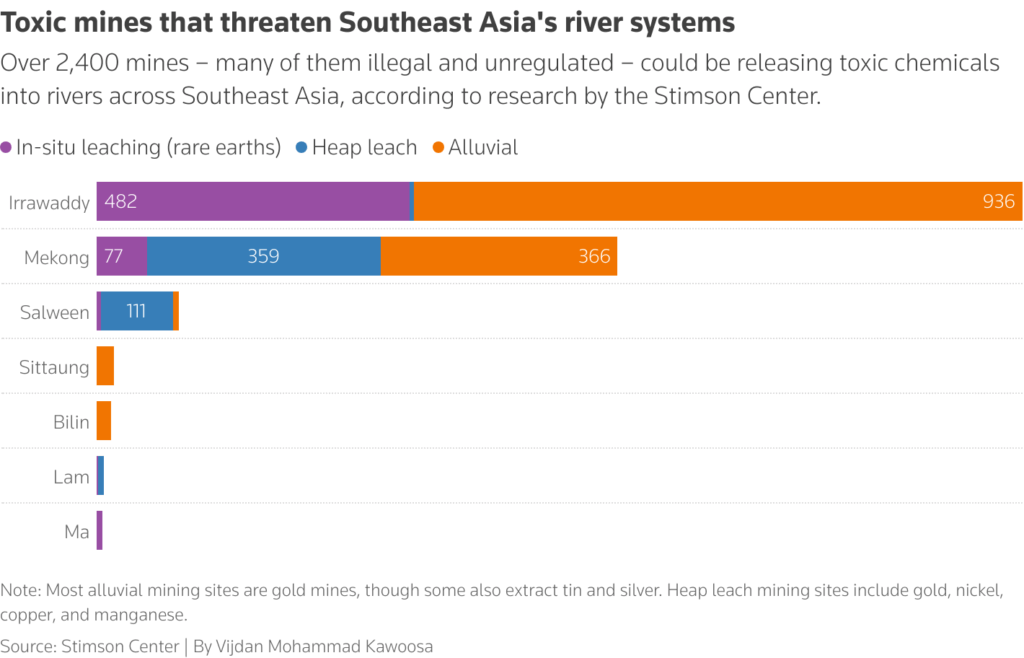
“The scale is something that’s striking to me,” said Brian Eyler, senior fellow at Stimson, pointing to scores of tributaries of major rivers, like the Mekong, the Salween and the Irrawaddy that are probably highly contaminated.

The Stimson report marks the first comprehensive study of potentially polluting mines in mainland Southeast Asia. Researchers analyzed satellite imagery to identify mining activity including366 alluvial mining sites, 359 heap leach sites and 77 rare earth mines draining into the Mekong basin.

Most alluvial mining sites are gold mines, though some also extract tin and silver. Heap leach mining sites include those for gold, nickel, copper, and manganese extraction.

The Mekong is Asia’s third-largest river and supports the livelihood of more than 70 million people as well as the global export of farm and fisheries products. It was previously perceived to be a clean river system, said Eyler.
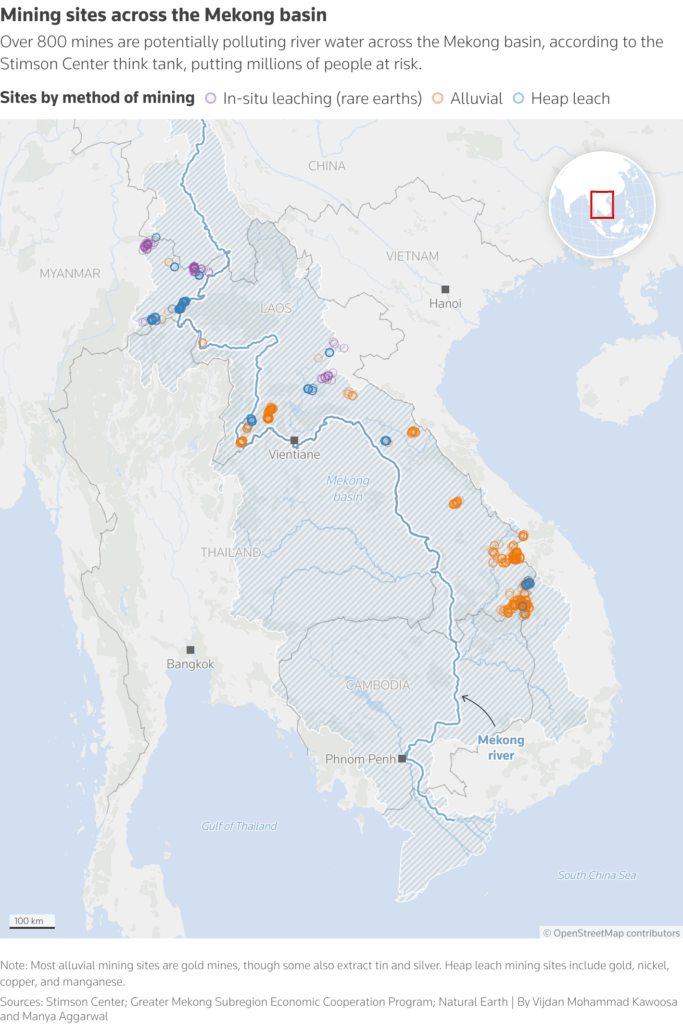
“Because so much of the Mekong Basin is essentially ungoverned by national laws and sensible regulations, the basin is unfortunately ripe for this kind of unregulated activity to occur at a high level of intensity and the huge scale that our data reveals,” he said.

The toxic chemicals released through unregulated rare earths mining include ammonium sulphate, and sodium cyanide and mercury that are used for two different types of gold mining, according to Stimson researchers.

That exposes not only the millions of people who live along the Mekong in Southeast Asia to health risks, but also consumers elsewhere.

“There is not a major supermarket in the US that doesn’t have products from the Mekong Basin, including shrimp, rice and fish,” said Eyler.

China-backed mining

The emergence of new China-backed rare earth mines in eastern Myanmar, not far from the mountainous border with Thailand, initially set off concerns among researchers of the danger of downstream pollution along the Kok River, including areas like Tha Ton.

The contamination pattern on samples from the Kok River shows the presence of arsenic – linked to rare earth and gold mining – alongside heavy rare earths like dysprosium and terbium, said Tanapon Phenrat of Thailand Science Research and Innovation, a Thai government research agency.

“It has only been two years since the rise of rare earth and gold mining in Myanmar at the Kok River’s source,” said Tanapon, who conducted testing of the waters this year and warns of a sharp rise in contamination levels unless mining is stopped. Tanapon was not involved in the Stimson study.
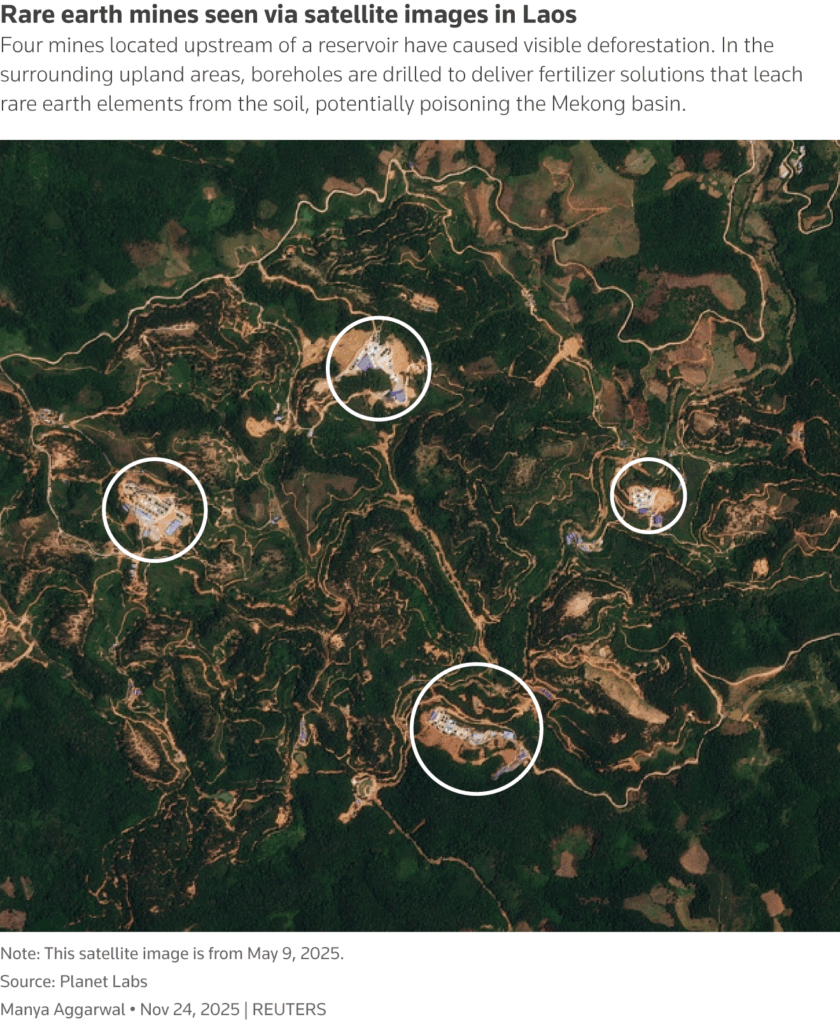
Myanmar, which erupted in conflict after the military seized power in 2021, is one of the world’s largest producers of heavy rare earths, critical minerals infused into magnets that power the likes of wind turbines, electric vehicles and defence systems.

From mining sites in Myanmar, the raw material is transported for processing to China, which has a near-monopoly over production of these vital magnets, with Beijing deploying rare earths as leverage in its tariff war with the US.

Mines across Myanmar and Laos use in-situ leaching for rare earth elements that was initially developed within China, according to Stimson’s Eyler.

“In general, Chinese nationals work on these mines as managers and technical experts,” he said.

In response to questions from Reuters, China’s foreign ministry said it was not aware of the situation.

“The Chinese side has consistently required overseas Chinese enterprises to conduct their production and business operations in accordance with local laws and regulations, and to adopt stringent measures to protect the environment,” it said.

The Thai government has established three new task forces to coordinate international cooperation, monitor the mines’ health impact and secure alternative supplies for communities along the Kok, Sai, Mekong and Salween rivers, said Deputy Prime Minister Suchart Chomklin.

In northern Tha Ton, signs still hang on a bridge over the Kok River, calling for authorities to shut down the rare earths mines upriver, and farmers like Tip are desperate for an intervention.

“I just want the Kok River to be the way it used to be – where we could eat from it, bathe in it, play in it, and use it for farming,” she said.

“I hope someone will help make that happen.”

(By Napat Wesshasartar, Devjyot Ghoshal, Vijdan Mohammad Kawoosa, Julio-Cesar Chavez and Gershon Peaks; Editing by Kate Mayberry)


UK unveils critical minerals strategy, industry welcomes push for domestic supply

UK Prime Minister Keir Starmer says boosting domestic production and recycling will help shield the economy.

UK Prime Minister Keir Starmer says boosting domestic production and recycling will help shield the economy.

24th November 2025

By: Mariaan Webb

Creamer Media Senior Deputy Editor Online

The UK government on Sunday launched a new critical minerals strategy, setting out ambitions to reduce the nation’s reliance on imported minerals by scaling up domestic miningrefining and recycling capacity.

Backed by up to £50-million in new funding, the strategy aims to secure key inputs for technologies ranging from smartphones and fridges to fighter jets, electric vehicles and renewable-energy systems.

Announced by Prime Minister Keir Starmer, the plan outlines targets to meet 10% of mineral demand through domestic production and 20% through recycling by 2035, while also capping import exposure so that no more than 60% of any one critical mineral comes from a single country.

Lithium features prominently, with the government setting an ambition to produce at least 50 000 t/y of lithium by 2035. Demand for lithium in the UK is forecast to grow by 1 100% by 2035, while demand for copper is expected to almost double.


Starmer said the strategy responds to an era of rising geopolitical risk in mineral supply chains. “Critical minerals are the backbone of modern life and our national security. For too long, Britain has been dependent on a handful of overseas suppliers . . . That is why we are taking decisive action to change that, boosting domestic production, ramping up recycling, and backing British businesses with the investment they need.”

Business and Trade Minister Chris McDonald added that the strategy formed part of the government’s national security agenda. “We have been dependent on a select few sources for our supplies, putting our national security at risk. Now, we’re taking the bold action needed to shore up our supply chains.”

INDUSTRY WELCOMES STRATEGIC CLARITY
Mining and processing companies across the UK have broadly welcomed the plan, saying it provides the long-awaited framework needed to unlock investment and accelerate domestic projects.

Cornish Lithium CEO Jamie Airnes said the strategy gave industry the certainty it had been seeking. “It provides a clear strategic framework within which industrial-scale UK critical minerals production can become a reality. Securing a domestic supply of critical minerals, including lithium, will create high-quality jobs, deliver supply-chain resilience and support key manufacturing sectors across the UK.”

Critical Minerals Association founder Jeff Townsend described the strategy as a “timely step forward”. “Modern industries, from advanced manufacturing to defence, clean energy and high-tech innovation, are only as strong as the minerals on which they depend. If fully supported and delivered with intent, this strategy can secure the UK’s position as a trusted global partner.”

Anglo American Crop Nutrients CEO Tom McCulley said the policy recognised the importance of mining to the country’s future. “With London at the centre of global mining finance, the UK has an opportunity to drive investment and growth through partnerships along the value chain and through the emergence of a modern mining industry in the UK itself.”

In Devon, Tungsten West CEO Jeffery Court stressed the importance of swift implementation. "Devon is home to one of the world’s largest tungsten deposits, primed to meet national and international demand. Our aim is to bring the project into production in late 2026, and we look to the government to rapidly apply the strategy to deliver real and tangible support.”

Cornwall-focused tin developer Cornish Metals said the strategy reinforced tin’s importance to the electronics and renewable-energy sectors. CEO Don Turvey noted the company had already received £28.6-million from the National Wealth Fund to advance its South Crofty mine. “Reviving domestic production will create over 300 direct jobs and many more across local supply chains.”

Rare earths recycling company Ionic Technologies also welcomed the government’s recognition of Belfast as a strategic hub for advanced materials. “Our patented magnet-recycling and REE separation technology is increasingly important in protecting UK rare earths supply chain security. There has never been a more important time for the government to back businesses that will have an impact on critical minerals supply chains," said Ionic Rare Earths MD Tim Harrison.

Alongside domestic production, the UK will explore stockpiling options, including through defence procurement, and will continue participating in NATO’s Critical Mineral Stockpiling project. The government will also expand partnerships with resource-rich countries to diversify supply chains using the UK’s strengths in finance, technology and trade.

Critical minerals currently contribute £1.79-billion to the UK economy and support more than 50 000 jobs, with more than 50 extraction and refining projects active across the country.

Regions identified as key contributors include Cornwall and Devon, with significant lithium, tin and tungsten resources; Swansea, home to one of Europe’s largest nickel refineries; and Northern Ireland, where companies are advancing rare earths recycling technologies. 

Ni


Major Indonesia nickel plant cuts output as waste piles up


Credit: GEM Co.

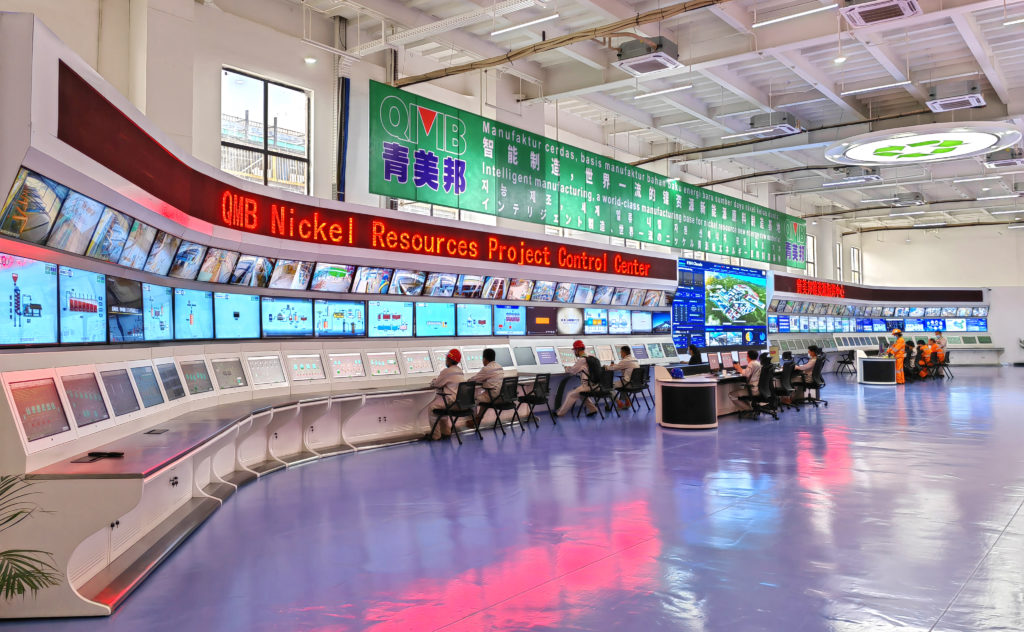
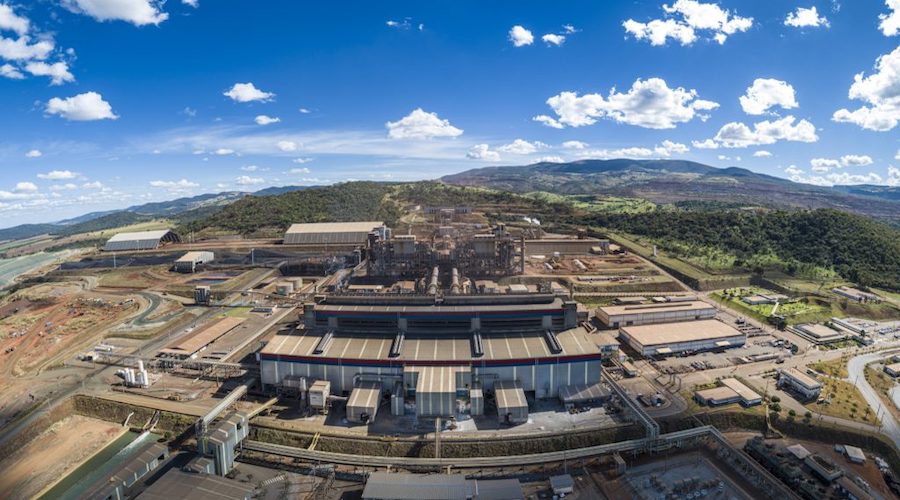
A majority Chinese-owned plant at Indonesia’s most important nickel site is cutting back production as its tailings site is nearly full, according to people familiar with the matter, highlighting the industry’s growing waste management challenge.

Output at PT QMB New Energy Materials Co. Ltd. will be lower for at least two weeks, according to the people, who asked not to be named as they’re not authorized to speak publicly. QMB counts China’s GEM Co. and Tsingshan Holding Group Co. among its shareholders.

A representative of Indonesia Morawali Industrial Park on Sulawesi island, the country’s largest such facility and home to QMB, confirmed the reduction in run rates. The plant’s tailings storage inside the park is almost full, and paperwork for another location is still being processed, the representative added.

GEM, QMB’s biggest investor, did not immediately respond to requests for comment.

Indonesia accounts for more than half of the world’s output of nickel, a metal used in electric-vehicle batteries and stainless steel, thanks to a surge in production that’s been driven by investment from China. The high-pressure acid leaching method used by the plants allows the use of lower-grade ore and is relatively cheap, but it results in high volumes of waste, which is typically dried and compacted before being stored.

The rapid expansion of the nickel industry is facing greater local scrutiny in Indonesia, partly due to waste-related concerns. Experts have questioned whether the HPAL method can ever be used safely and sustainably in the tropical archipelago, where torrential rain and earthquakes are frequent. A deadly landslide at QMB’s tailings site at the Morawali park resulted in disruptions to output earlier this year.

HPAL producers have also been contending with the higher cost of sulfur, a chemical used to produce acid.

Still, demand for mixed hydroxide precipitate – a form of nickel produced at the HPAL plants that also contains cobalt – has benefited from a tailwind this year following the imposition of cobalt export controls by the Democratic Republic of Congo.

(By Annie Lee)

MMG’s deal to buy Anglo’s Brazil nickel assets faces EU regulatory delay


Barro Alto nickel mine in Brazil. (Image courtesy of Anglo American | X Feed.)

Hong Kong-listed mining and metals company MMG said on Monday that the European Commission had extended the review of its deal to purchase Anglo-American’s nickel business in Brazil.

The Commission, which acts as the EU competition enforcer, had initiated the phase II merger investigation in early November.

However, it is unclear how long the European Commission may require to complete its review, MMG said on Monday.

The extension underscores regulatory caution and heightened scrutiny of resource deals with China.

Anglo American announced the sale in February, which includes two ferronickel and two greenfield projects in Brazil.

The Commission had warned earlier this month that the deal could enable MMG to divert ferronickel from Europe and hurt European stainless steel production.

While awaiting the Commission’s review, the parties have agreed to extend the deadline for meeting all deal obligations to June 30, 2026, from the previously planned November 18, 2025, MMG said.

MMG will continue to work with Anglo-American and the European Commission to assist the Commission in its review, it added.

(By Sherin Sunny; Editing by Rashmi Aich)


Column: Limp COP30 deal matters little in renewables vs fossil battle


Credit: UNclimatechange | Flickr, under Creative Commons licence CC BY-NC-SA 4.0.

The weak statement that omitted any mention of fossil fuels was probably the best outcome that could have been realistically expected of the COP30 climate summit.

It was always going to be a tall order to put nearly 200 countries with massively different perspectives together and deliver a strong statement that commits to combating climate change.

The question to ask after the summit in the Brazilian city of Belem is: Does what the concluding statement says, and doesn’t say, actually matter?

Assume that the environmentalists had got their way with a strong communique that made firm commitments to phase out fossil fuels in a timeline that would meet ambitious climate targets.

Would this alter the views of major crude oil producers and exporters such as Saudi Arabia, Russia and the United States?

Would these countries decide to scale back their investment in fossil fuels and switch their efforts to building renewable energies such as wind, solar and battery storage?

It would be highly unlikely that even a bold statement on meeting climate targets would alter the behaviour and plans of the major fossil fuel producers.

Countries with vast reserves of fossil fuels are still likely to develop them for domestic use and exports as it makes sense for them to do so.

What the COP30 summit did confirm is that the energy transition is increasingly divided into those countries that rely on fossil fuels for domestic energy and export revenue, and those that are trying to end reliance on fossil fuels by electrifying their systems and using renewables.

The part of the COP30 statement that is more important than the lack of any mention of fossil fuels is the deal to triple climate finance for developing nations by 2035.

While details of how this money will be sourced and what projects it will be used for are still to be clarified, what it does mean is that more investment will be placed into energy transition, and largely in countries that the fossil fuel lobby is trying to win over to their cause.

China’s soaring clean energy technology exports

It’s likely that in the coming years there will be a battle for the energy future of much of the developing world.

On the one side will be fossil fuel promoters such as the United States using tactics such as trade tariffs or access as leverage to encourage countries to buy liquefied natural gas (LNG).

On the other will be countries like China, using its massive cost advantage in renewable technologies to sell cheaper electricity solutions that don’t lock in a reliance on imports of price-volatile fossil fuels.

China’s exports of clean energy technologies are surging and hit a record high of $20 billion in August, according to data compiled by research consultancy Ember.

The value of China’s exports of electric vehicles has surged 26% in the first eight months of 2025 from the same period a year earlier, Ember said in a report last month.

Battery shipments are up 23% in the January-August period, while the value of grid components rose 22% and wind by 16%, although exports of solar panels dropped 19% in value.

The drop in the value of solar exports is more a factor of falling prices for panels rather than any drop in volume, with Ember saying exports totalled 46 gigawatts in capacity in August, a new record high and more than the entire installed solar capacity of Australia.

If China can maintain, or even lower prices for its clean energy products it will be hard for the fossil fuel exporters to compete.

It may be a cliché, but the phrase “money talks, everything else walks” does bear relevance to the energy transition.

Ultimately the winner will be the system that provides the most affordable and secure source of energy.

This means that fossil fuels will stick around for as long as they can compete with the renewable alternatives, and how long this is the case will vary from country to country.

Coal will remain competitive in countries like India and China for decades given they can mine and transport it cheaply.

But coal is likely to start losing ground in importing countries such as Japan and South Korea, which are unlikely to build new coal plants to replace ageing fleets as renewable alternatives are not only lower in emissions but also in price.

(The views expressed here are those of the author, Clyde Russell, a columnist for Reuters.)

(Editing by Muralikumar Anantharaman)

AU/CU

Freeport Indonesia cuts 2026 output plan; in talks with Amman for concentrate supply

Grasberg is responsible for more than a quarter of Freeport’s total output. 

Freeport Indonesia on Monday said it cut its 2026 production plans for its Grasberg mine following a fatal accident in September that killed seven people.

A mud flow at Freeport’s Grasberg Block Cave (GBC) operation triggered a suspension of the mine, which accounts for a majority of the complex’s output. Grasberg is the world’s second-largest copper mine and largest gold mine.

In late October, Freeport resumed operations at the Big Gossan and Deep Mill Level Zone operations, the two other components of the Grasberg complex, as they were unaffected by the mud flow.

Freeport now expects to produce 478,000 metric tons of copper cathode and 26 tons of gold in 2026, chief executive Tony Wenas told members of Parliament, down from an earlier expectation for around 700,000 tons of copper cathode and 45 tons of gold.

“We continue to conduct the recovery at Grasberg Block Cave with a target to begin operating this mine in the first quarter of 2026,” Wenas said.

GBC’s full recovery is expected in 2027, he said.

The company expects $8.3 billion in sales next year, down slightly from an earlier expectation of $8.5 billion, as it forecast higher copper and gold prices.

Freeport’s copper sales volume is expected to be 30% lower than initially planned in 2025, with gold sales 50% lower, though revenues are likely to decline by just 18% due to higher copper prices.

For 2025, the company estimates it will report 537,000 tons of copper metal sales and 33 tons of gold sales.

Wenas also said the company has held talks with miner Amman Mineral Internasional over a possible copper concentrate supply deal for Freeport’s smelter, but no deal has been reached.

Amman did not immediately respond to a request for comment.

With the current limited production capacity at its mines, Freeport could only supply concentrate to a refinery operated by PT Smelting, while its Manyar smelter sits idle, Wenas said.

The Manyar smelter is expected to remain out of commission until the second quarter of next year.

(By Fransiska Nangoy and Dewi Kurniawati; Editing by David Stanway and Thomas Derpinghaus)


CU

ANGLO TECK MERGER

The three days when BHP tried to crash a copper mining mega deal


BHP’s Escondida copper mine in Chile. (Image: Wikimedia Commons)

Last Thursday night, the world’s biggest miner made a brazen attempt to gatecrash one of the industry’s biggest-ever deals. Yet just three days later, the bid was already dead.

BHP Group’s last-minute proposal to buy Anglo American Plc and prevent the smaller company from completing its $60 billion combination with Canada’s Teck Resources Ltd. has left investors, bankers and rival executives reeling — especially because the commodities giant spent the past 18 months insisting it had “moved on” from its last failed attempt to acquire London-based Anglo.

The surprise move and near-instant capitulation have raised questions about BHP’s strategy and its confidence in its standalone growth plans in copper, the metal viewed as increasingly critical by governments across the globe and in tight supply over the coming years. But the company has also drawn praise from some investors for its willingness to once again walk away rather than risk overpaying for a deal.

This account of BHP’s latest bid for Anglo American and its rapid reversal is based on conversations with a dozen people familiar with the situation, who asked not to be identified because the information is private. Representatives for both companies declined to comment.

For BHP and chief executive officer Mike Henry, the attempt simply represented a last-chance attempt to negotiate a friendly deal to acquire a group of copper mines that it has long coveted, according to some of the people. Anglo’s South American operations are some of the best in the business, and were the key driver for BHP’s failed attempt last year.

“There’s a general sense of ‘now-or-never’,” said Tiago Rodrigues Lourenco, a fund manager at Aberdeen Group Plc, whose funds hold shares in both Anglo and BHP. “After the business combination, the complexity of acquiring Anglo–Teck will be much greater, and it would be a much bigger asset for any new bidder to try to acquire in its entirety.”

Anglo has also spent the past year and a half improving and simplifying its business — including by exiting the South African platinum business that BHP didn’t want to own.

When Anglo announced this September it had agreed to a combination with Teck, the industry’s biggest players saw the prospect of two prized copper targets slipping out of reach. Anglo and Teck’s shareholders are due to vote on the combination on Dec. 9 — just two weeks away.

Premium offer

And so BHP made its move. A small team led by CEO Henry and chief development officer Catherine Raw put together a bid which was comprised mostly of shares, but also included a cash component, according to people familiar with the matter.

The offer was for all of Anglo, and at a premium to the current share price — which BHP’s team believed should be more attractive than the zero-premium deal announced by Anglo and Teck. The companies haven’t disclosed a valuation, but two people familiar with the matter said it valued Anglo’s shares at comfortably above £30, versus a closing price on Thursday of £27.36.

It was also significantly more straightforward than BHP’s proposal last year, which had required Anglo to first partly break itself up before being acquired, and which the company rejected at the time as overly complex.

Coincidentally, executives from both companies attended events around the G-20 over the past week in South Africa — whose government was viewed as one of the key stumbling blocks for BHP’s previous bid for Anglo.

BHP contacted Anglo over the course of last week, before sending the formal and detailed proposal to the Anglo board late Thursday, or early Friday morning in Australia, where the bigger company is based.

The bold move set off a rapid chain reaction.

Anglo alerted Teck to the development on Friday, leaving its new partner and its advisers waiting anxiously to see how the situation would play out.

The Anglo board gathered online to discuss the proposal, comparing it to the benefits offered by the Teck deal which would allow the two firms to generate savings and efficiencies by combining their giant and neighboring copper mines in Chile. Chief executive officer Duncan Wanblad dialed in from South Africa, where his own calendar included a dinner attended by President Cyril Ramaphosa.

BHP was hoping its overtures would remain behind the scenes to give it time to win over Anglo and avoid a repeat of last year’s public rejection. But on Sunday morning, Bloomberg reported BHP’s approach, citing people familiar with the matter.

Shortly after that, Anglo informed the larger company that it wasn’t interested. The board had decided that the Teck deal remained its best option.

For BHP, there was only one response, according to people familiar: the company would walk away immediately. The world’s biggest miner still feels the scars from its prolonged and public attempt to win Anglo over last year — this time, the proposal would only work if Anglo was interested from the outset in discussing a friendly deal.

BHP’s board and management were also acutely aware of how a protracted process, with little chance of success, would undermine its own growth story.

BHP has huge copper growth options, including new mines in Australia and Argentina as well as growing output at its Escondida mine, the world’s biggest. Still these projects are costly, even for a company of BHP’s size, and do little to offset declines in its production in the short term.

No deal

By late Sunday night in London, and before Australian markets opened, BHP issued a terse statement saying it had decided against a deal with Anglo after preliminary discussions. Under UK takeover rules, that means it’s restricted from making an offer for the company for the next six months, except in specific circumstances.

The terms BHP offered have not been made public by either side, leaving Anglo investors wondering what might have been offered for their company.

“It would need to be quite a reasonable premium because the Anglo-Teck combination does offer upside in our view,” said George Cheveley, a portfolio manager at asset manager Ninety One, who owns Teck and Anglo shares.

People close to BHP say the offer was serious and compelling and marked a superior bid to the one Anglo rejected 18 months ago.

But from Anglo’s perspective, there were also significant risks tied to discussing a largely stock deal, given BHP’s high dependence on iron ore and its ongoing conflict with China over its sales of the steelmaking ingredient.

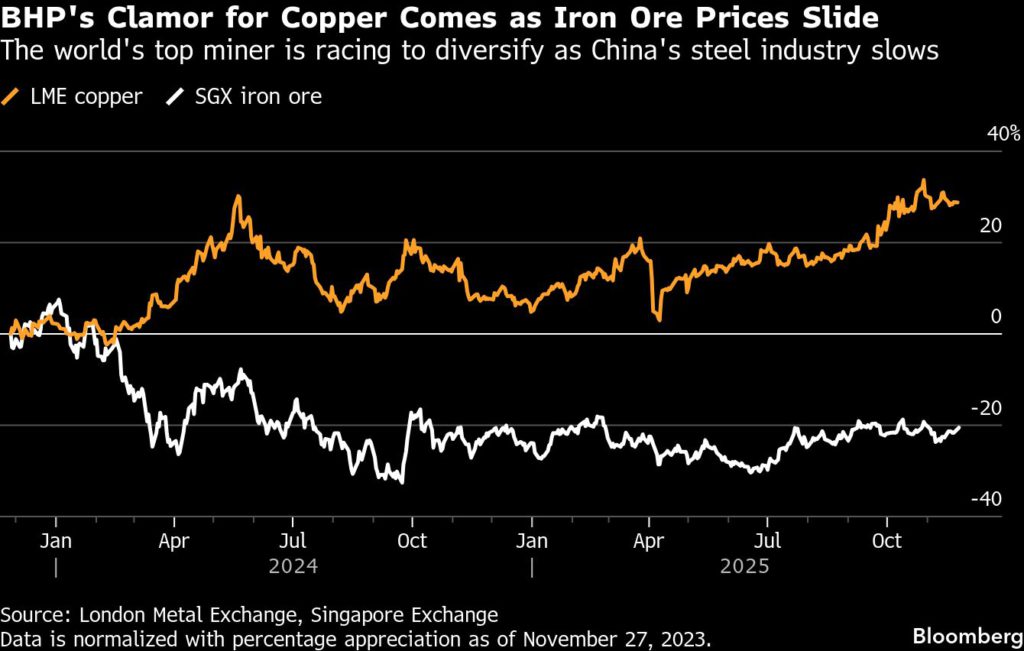
Copper prices have risen 24% this year after a series of setbacks at key mines around the world, helping to boost Anglo’s stock relative to BHP because of its greater exposure to the wiring metal. Iron ore by contrast has gained less than 5%.

While investors were still digesting the fast-moving turn of events on Monday and seeking more information from the companies, some BHP shareholders said they would have been concerned about valuation and the risk that BHP might overpay.

“This underscores just how hard it is to do M&A for copper in the current environment,” said Jamie Hannah, the Sydney-based deputy head of investments and capital markets at Van Eck Associates Corp., which holds shares in BHP. “It was always going to be hard.”

(By Thomas Biesheuvel, Aaron Kirchfeld, Dinesh Nair and Paul-Alain Hunt)


Glass Lewis recommends Teck to vote in favor of Anglo merger

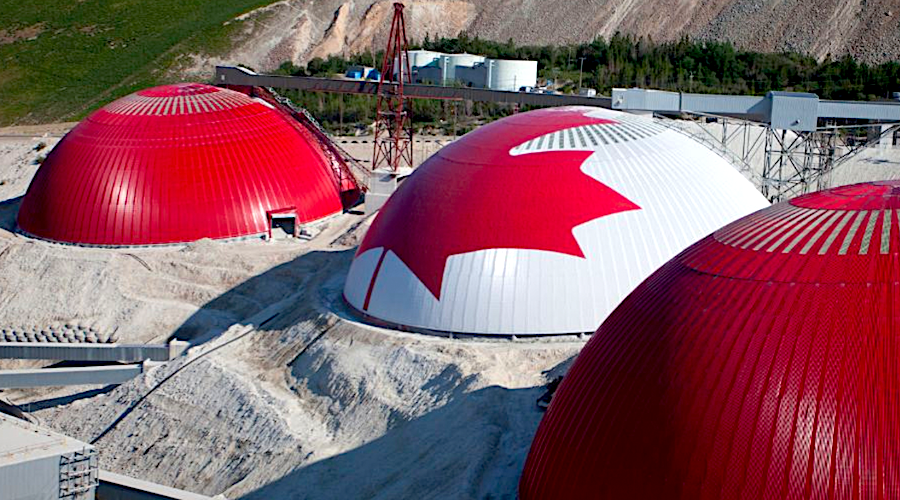
Highland Valley Copper Operations in British Columbia sports the flag. (Image courtesy of Teck Resources.)

Independent proxy advisory firm Glass Lewis on Friday recommended Teck Resources shareholders to vote in favor of a deal to combine with Anglo American.

The planned merger, which was first announced in September, marks the copper mining sector’s second-biggest M&A deal ever, with the combined market capitalization exceeding $53 billion.

Glass Lewis said in a report that the terms of the merger appear reasonable for Teck shareholders.

Adding further that the deal offers Teck shareholders the chance to join a larger, more diversified critical-minerals group with increased copper exposure, significant synergy potential, and stronger long-term growth prospects than it could achieve alone.


The shareholder vote is expected to take place on December 9.

(By Pranav Mathur; Editing by Alan Barona)

CU

Barrick committed to Reko Diq copper project, says interim CEO

Barrick’s Reko Diq copper-gold project in Pakistan. (Image courtesy of Barrick Mining.)

Barrick Mining Corp remains committed to its Reko Diq copper mine in Pakistan, one of the world’s largest undeveloped deposits of the metal, its interim CEO said on Tuesday after reports of a possible withdrawal.

The $7 billion project in the remote, insurgency-hit western province of Balochistan is held in an equal partnership between the company and the Pakistani authorities and is expected to start production by the end of 2028.

Barrick’s board had raised the possibility of splitting the company’s assets, which could include an outright sale of the Reko Diq mine and the company’s African assets, Reuters reported this month, citing sources familiar with the company’s thinking.

“Barrick remains committed to the Reko Diq project and to Pakistan,” Mark Hill told Reuters.

Security, scale, stake

Balochistan suffers frequent attacks by separatists and jihadists, making security a major concern for the mine. The project also requires a railway line upgrade to transport copper concentrate to Karachi for processing abroad.

Lenders including the International Finance Corporation and the Asian Development Bank among others are assembling a financing package exceeding $2.6 billion.

The Reko Diq project added 13 million ounces to Barrick’s gold reserves in 2024 and is expected to produce 200,000 metric tons of copper a year in its first phase, doubling after expansion, with projected free cash flow of more than $70 billion over 37 years.

Pakistan’s mineral play

The remarks from Barrick underscore Reko Diq’s importance to both Pakistan and the company, with Islamabad counting on the mine to anchor its minerals strategy while the Canadian miner advances one of its largest long-term projects.

Sources familiar with the company’s thinking told Reuters this month that board members and some shareholders worry that exposure to riskier assets in Pakistan and Africa may be weighing on Barrick’s valuation compared with its safer North American operations, particularly in the context of any potential takeover interest.

Barrick returned to Pakistan in 2022 after a years-long legal dispute was settled, and the mine has since become a flagship investment for the country as it seeks to draw more capital into its minerals sector.

(By Ariba Shahid and Sakshi Dayal; Editing by Kirsten Donovan and David Goodman)

US EXIM to invest $100B in critical minerals and energy, says chair


The Reko Diq deposit is located in the Balochistan province. (Image courtesy of Barrick Gold.)

The US Export-Import Bank (EXIM) will invest $100 billion in support of the Trump administration’s strategy of achieving global energy dominance, the export credit agency said.

In an interview with the Financial Times, newly appointed chair John Jovanovic said the move aims to address the West’s over-reliance on supplies from China and Russia.

“We can’t do anything else that we’re trying to do without these underlying critical raw material supply chains being secure, stable and functioning,” he said.

The first tranche of investments, according to Jovanovic, will be in Egypt, Pakistan and Europe. These include $4 billion worth of natural gas being delivered to Egypt by New York-based commodities group Hartree Partners, and a $1.25 billion loan for the giant Reko Diq copper mine being developed by Barrick Mining (TSX: ABX, NYSE: B) in Pakistan’s Baluchistan province.

However, the EXIM chair told FT that the bank is finalizing several other critical minerals deals that are  “orders of magnitude larger” than the Reko Diq loan. While he did not provide further details, Jovanovic said EXIM is “ready” to be part of various critical minerals pacts that the US has with its allies such as Australia.

To date, it has deployed $35 billion of the $135 billion authorized by the US Congress, he noted.

On top of critical minerals, the bank is also placing a heavier investment emphasis on energy security. Jovanovic told FT that it was “actively in discussions” about several nuclear projects in southeast Europe, where US companies such as Westinghouse were looking to invest. Last year it supported $1.6 billion in green energy projects, an increase of 74% compared with 2023, he noted.

Also of significance is LNG, for which EXIM has received requests for US support from Europe, Africa and Asia, and “a series of multibillion-dollar LNG supply deals” could be announced soon, according to Jovanovic.

(With files from Reuters)