It’s possible that I shall make an ass of myself. But in that case one can always get out of it with a little dialectic. I have, of course, so worded my proposition as to be right either way (K.Marx, Letter to F.Engels on the Indian Mutiny)
Friday, December 05, 2025
U
Shares in China’s only uranium miner triple on Shenzhen debut
View of Rössing uranium open pit mine. (Image courtesy of Rio Tinto.)
China’s only uranium miner raised around 4 billion yuan ($570 million) as it debuted on the Shenzhen exchange on Wednesday, with its shares more than tripling in value.
The initial public offering comes as China aggressively expands its fleet of nuclear power plants. It has the highest number of reactors in operation and under construction in the world, and may surpass the US and France as the biggest atomic power operator by 2030.
China National Uranium Co., the only firm granted rights to mine the element that’s used as fuel in nuclear reactors, offered 248 million shares at 17.89 yuan each, according to an exchange filing. The stock closed at 67.99 yuan. The company plans to allocate the proceeds to four uranium mines and a handful of other associated minerals, according to another statement.
Uranium prices have rallied over the past four years in anticipation of a surge in demand for the nuclear fuel. The US, Japan and France are among several nations that have pledged to triple nuclear energy capacity by 2050.
Meanwhile, China’s domestic fuel supply has fallen short and the country has relied on imports to meet more than 70% of its demand.
“We will push for global deployment and enhancing supply capacity and competitiveness,” China National Uranium chairman Yuan Xu said, according to Xinhua.
The firm, with a market value of 141 billion yuan, is owned by the state-run China National Nuclear Corp. It mines natural uranium and some other chip-making materials like molybdenum and rare earth chlorides. Its net income rose about 16% to 1.5 billion yuan in 2024 from a year earlier, according to the filing. It acquired a 69% stake in Namibia’s Rossing uranium mine, the world’s sixth-largest, from Rio Tino in 2019.
AU
Zimbabwe gold miners warn higher royalty will boost smuggling
A Zimbabwe one hundred trillion dollar note and small gold bars. (Image by Paul, Flickr.)
Zimbabwe’s small-scale gold producers said government plans to double a mining royalty will deter investment and spur an increase in smuggling of the precious metal.
“New investment in exploration and mine development will stall,” the Zimbabwe Miners Federation said in a letter to Finance Minister Mthuli Ncube. “We project a dramatic increase in smuggling as miners seek better returns in neighboring countries with lower fiscal impositions.”
The federation — representing more than 450,000 small-scale miners who produce about 65% of the country’s gold — confirmed the letter dated Dec. 2. Ncube couldn’t immediately be reached for comment.
The government of the southern African nation announced plans last month to introduce a new royalty structure for gold miners on Jan. 1, as it seeks to cash in on bullion’s record-breaking rally this year. The federation says that raising the royalty to 10% for gold above $2,501 an ounce will remove an incentive for miners to sell the metal through formal channels, curbing fiscal revenues.
“As production shifts to illicit channels, official gold exports — a critical source of foreign currency — will decline, harming the country’s balance of payments and exchange rate stability,” the federation said in the letter.
Zimbabwe’s gold export revenues jumped 88% to $3.76 billion during the first 10 months of this year, driven by record production and with bullion prices near an all-time high above $4,200 an ounce.
(By Godfrey Marawanyika)
Italy urged by ECB to reconsider gold reserves proposal
Italy was urged by the European Central Bank to rethink a push to declare its gold reserves the property of its people, a move critics say could open the door to the government selling off bullion.
In a legal opinion dated Tuesday, the Governing Council asked Premier Giorgia Meloni’s government to review the proposal following a request from Rome for officials in Frankfurt to study the matter.
“The Italian authorities are invited to reconsider the draft provision, also with a view to preserving the independent performance of the basic ESCB-related tasks of the Banca d’Italia under the Treaty,” the ECB’s policymakers said.
The Bank of Italy holds about 2,452 tonnes of gold, the third-largest stash after the US and Germany. Following recent price gains for bullion, some lawmakers in Meloni’s center-right party proposed an amendment to the country’s upcoming budget which confirms that the reserves are managed and held by the central bank but “belong to the Italian people.”
“It is not clear to the ECB what the concrete purpose of the draft provision is,” the Governing Council said.
The amended proposal has left both economists and central bankers perplexed as the gold is already the property of the Italian state, and therefore of Italians. At current market prices, it’s worth over €280 billion ($327 billion).
The issue seems to be that the bullion is held by the central bank, which is a public institution independent of the government as required by Italy’s membership of the euro. Ministers therefore can’t freely dispose of some reserves in the way that the UK sold off about half of its own stash under Tony Blair’s government, starting in 1999.
“The problem with this amendment is that it violates European treaties,” former Bank of Italy Director General Salvatore Rossi said in an interview. “Approving it as Italian law means opening up a huge battle with European institutions, and I wonder politically whether this is a good idea.”
Meloni’s Brothers of Italy party has periodically raised the issue of political control over the country’s reserves, and the far-right League party had proposed giving the state control over its gold back in 2019. At the time, the ECB responded that it was against European Union treaties.
“We go full circle since 2019, it hasn’t changed at all,” ECB President Christine Lagarde said Wednesday. “From a bookkeeping point of view, from a management point of view, from a distribution-of-results point of view, it is Banca d’Italia which has full authority.”
Speaking to European lawmakers in Brussels, she stressed that “Banca D’Italia has the duty to hold and manage those reserves.”
Growth struggles
The conversation over gold is one linked to deeper questions about Italy’s growth trajectory and future fiscal plans. The economy is forecast to expand only 0.5% this year, by the government’s own reckoning, and its debt remains well above 130% of economic output, making it difficult to spend either to help its citizens or boost growth.
Meloni has managed to put tax cuts for the middle classes in the latest budget which is scheduled to be approved by year-end. She and Finance Minister Giancarlo Giorgetti have been praised for their fiscal efforts, which have brought the deficit down to the EU’s 3% ceiling.
Just this year, Italy has earned four upgrades from ratings assessors used by the ECB to gauge collateral. Investors have rewarded the country by narrowing the yield spread between Italian 10-year bonds and equivalent German bonds to well below 80 basis points.
But the road ahead seems more complex. The EU’s recovery fund program, which has helped keep the economy up through investment in infrastructure and other projects, is winding down. Meanwhile global trade tensions are persisting.
That has pushed politicians to look for other options to help buoy its fiscal position, from common EU debt to tapping the country’s gold reserves.
About half of Italy’s bullion is to be found under a palm-lined street in central Rome in the Bank of Italy’s vaults. Most of the rest is located in the US, while further small portions are in the UK and Switzerland.
“Gold remains a guarantee, a form of security which boosts stability, and any country thinks 30 times before selling a piece of gold because it would send a bad signal — as if saying to the world that I am selling my last resource, that I’m at the end of the rope,” said Rossi. “That’s not a signal you want to send to markets.”
(By Alessandra Migliaccio)
CU
Glencore cuts 2026 copper target but sets up for long-term surge
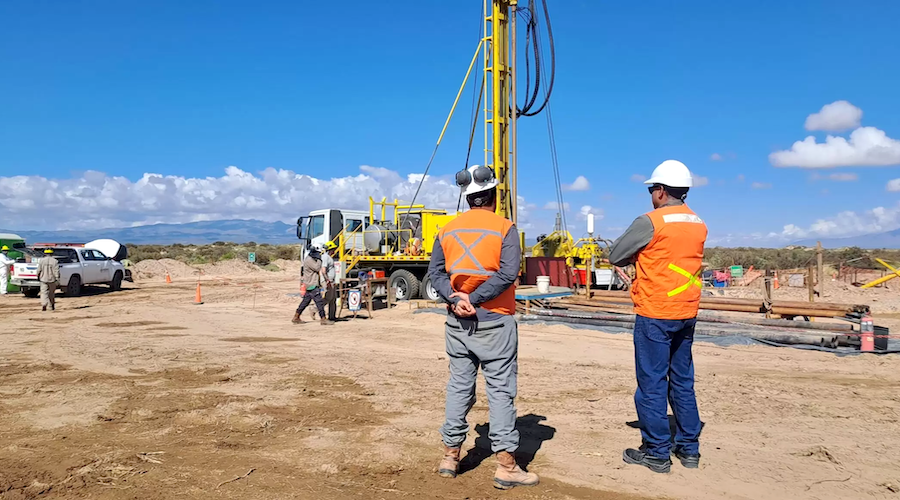
MARA links the Agua Rica deposit with Alumbrera’s idle infrastructure in an integrated copper project. (Image courtesy of Minera Agua Rica–Alumbrera | MARA.)
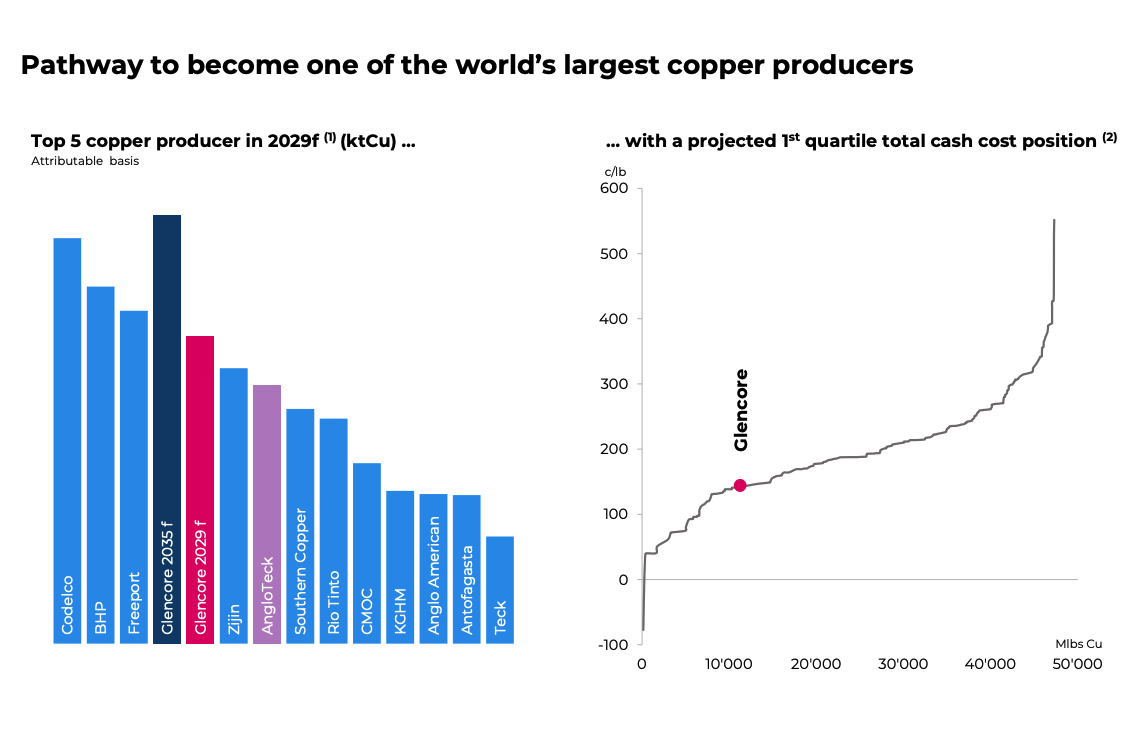
Mining and commodities giant Glencore (LON: GLEN) plans to expand annual copper production to about 1.6 million tonnes by 2035 as it seeks to reverse a multi-year slump in output.
Chief executive Gary Nagle told investors in London that the company expects its base copper business to exceed 1 million tonnes a year by the end of 2028, positioning Glencore among the world’s five largest producers.
The push comes as global miners race to increase supply, even as Glencore’s own copper output is set to fall for a fourth straight year and sit about 40% below 2018 levels.
The Swiss miner has faced pressure after its shares hit their lowest since 2020 and investors complained about repeated production cuts and operational underperformance. In response, Glencore has launched a sweeping operational review, which will see it cut about 1,000 jobs. It targets roughly $1 billion in recurring cost savings by the end of 2025, the miner announced at its first investor day in London in three years.
Copper prices hit a fresh record above $11,400 a tonne on Wednesday, extending a 30% gain this year on the back of supply disruptions and strong investor demand tied to electrification and the energy transition.
Eyes in South America
Despite outlining long-term growth plans, Glencore cut its 2026 copper guidance to 810,000–870,000 tonnes from a previous 930,000-tonne target after setbacks at Chile’s Collahuasi mine, which it jointly owns with Anglo American (LON: AAL). The company also lowered its zinc and cobalt forecasts for next year.
The Swiss firm reiterated that copper output should reach 1 million tonnes by 2028 and said the restart of its Alumbrera mine, in the Catamarca Province of Argentina, will support that ramp-up.
The operation is expected to restart in Q4 2026, with first production in the first half of 2028. Once fully operational, it is expected to produce about 75,000 tonnes of copper, 317,000 ounces of gold and 1,000 tonnes of molybdenum over four years.
“These projects are mostly brownfield and expected to be highly capital efficient,” Nagle said. He added that Glencore would be looking for partnerships to “reduce financial and operations risks” in certain projects.
Glencore noted the restart offers strong stand-alone economics and serves as a natural enabler for the Minera Agua Rica–Alumbrera (MARA) project by reducing ramp-up risk for the concentrator and downstream logistics, maintaining and retraining the workforce ahead of first ore, and keeping critical infrastructure active for shared use, generating operational synergies.
Keeping Chile footprint
In neighbouring Chile, Glencore plans to keep an equal share in its copper joint venture with Anglo American should the partners eventually merge the Collahuasi operation with Teck Resources’ (TSX: TECK.A TECK.B, NYSE: TECK) nearby Quebrada Blanca mine once Anglo acquires Teck. “We won’t be a junior partner,” Nagle said, adding Glencore could inject cash to keep its stake level in any future combination.
Teck and Anglo shareholders will vote next week on the deal to create a copper-rich mining giant, with the two Chilean assets seen as a central motivation. The expectation that Collahuasi and Quebrada Blanca could be integrated to unlock major cost savings has circulated for years.
Nagle said any combination must reflect Collahuasi’s improved relative value after recent setbacks at Quebrada Blanca. “We’re not ignorant to some adjacent potential synergies,” he said. “At a minimum, the value attributed to the two properties, the value has materially moved towards Collahuasi.”
Rio Tinto’s Nuton tech makes first-ever copper cathode at Gunnison mine
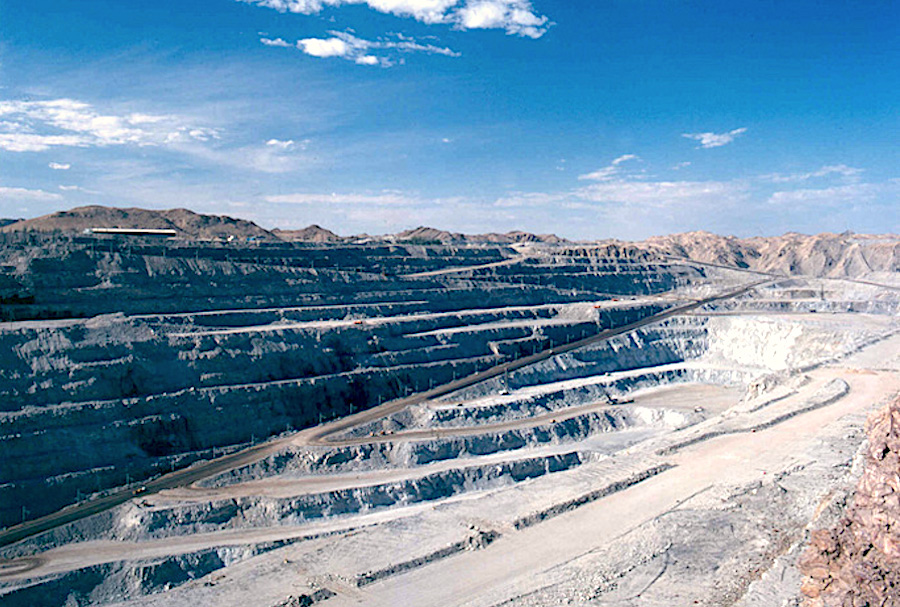
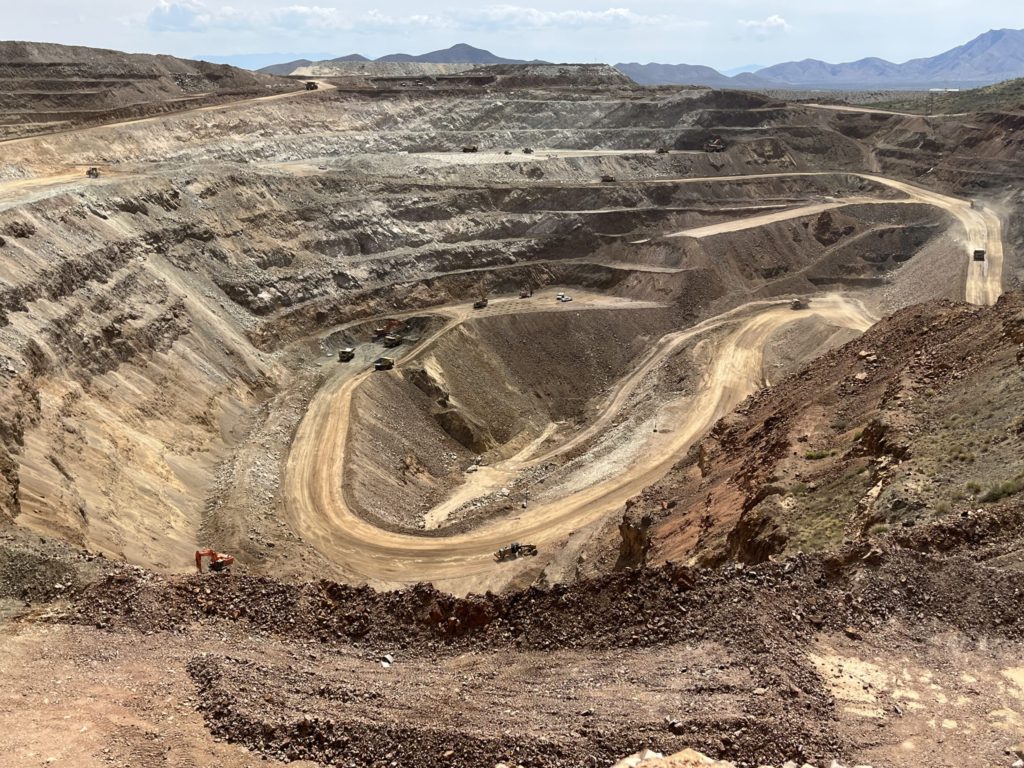
The open pit at Gunnison Copper’s Johnson Camp Mine in Arizona. Credit: Blair McBride
Rio Tinto (NYSE, LSE, ASX: RIO) venture partner Nuton has produced the first copper using new technology at Gunnison Copper’s (TSX: GCU) Johnson Camp Mine (JCM) in Arizona.
The Nuton-made copper cathode, produced last month with a unique sulphide bioleaching technology, is part of a four-year demonstration period at JCM using its heap leach pad for the production of about 30,000 tonnes of refined copper, Gunnison said Thursday. JCM is about 105 km east of Tucson.
“This is a breakthrough achievement for our Nuton technology, which is proving that cleaner, faster, and more efficient copper production is possible at an industrial scale,” Rio Tinto Copper CEO Katie Jackson said in a release. “In an industry where projects typically take about 18 years to move from concept to production, Nuton has now proven its ability to do this in just 18 months.”
Trio of milestones
The milestone comes three months after Gunnison produced its first copper cathode at JCM, making the mine the United States’ newest red metal producer. The first Nuton-produced cathode is the result of more than 30 years of research and development, Gunnison said. Nuton began its collaboration with Gunnison’s predecessor Excelsior Mining at the site in 2023.
Gunnison shares gained 2.7% to C$0.38 apiece on Thursday morning in Toronto for a market capitalization of C$146.4 million ($105 million).
Microbes aid processing
The technology uses natural microorganisms grown in Nuton’s proprietary bioreactors to extract copper from sulphide ores, which tend to be difficult to process. The microbes speed up the oxidation of minerals in the heap leach pad, generating heat and allowing the red metal to dissolve into a leach solution. It’s then processed into 99.99% pure cathode.
Nuton achieves recovery rates of up to 85% and cuts out milling, tailings, smelting and refining, thus shortening supply chains and delivering copper cathode right at the mine, Gunnison said. The technology could reduce water usage by up to 80% and carbon emissions by as much as 60% compared to traditional copper concentration. It can also extend mine life by extracting metals from waste material.
‘Low-carbon copper’
The achievement at JCM in such a short time frame shows the possibilities of innovation, strong operational performance and a shared vision coming together, Gunnison CEO Stephen Twyerould said.
“With Nuton copper now entering the US supply chain, this milestone underscores the critical role we can play in strengthening domestic access to cleaner, low-carbon copper,” he said.
The next stage at JCM is to focus on validating Nuton’s long-term technical performance, Gunnison said. That would comprise multi-year testing, independent third-party verification and an internal review by Rio Tinto to ensure recovery consistency and environmental performance.
Nuton has invested $100 million in technology deployment and construction at JCM, while Gunnison holds ownership and operational control. The two-stage partnership is to last for four or five years during which copper output would pay down Nuton’s investment.
In the second stage, and after full-scale commercial production using Nuton technology is underway, the companies would form a joint venture, with Gunnison holding 51% and Nuton 49%.
15-to-20-year life
The JCM open pit and heap leach mine has an annual capacity of 25 million lb. of copper over a 15 to 20-year life, according to a 2023 preliminary economic assessment prepared for Excelsior.
It hosts about 108 million measured and indicated tons grading 0.31% copper and 51 million inferred tons at 0.32% copper.
In a base case, JCM has a post-tax internal rate of return of 30% with a payback period of about four years, and a net present value of $180 million, at a 7.5% discount rate. Initial capital costs are pegged at $58.9 million.
Anglo Asian completes first copper concentrate sale to Trafigura
Demirli mine, Anglo Asian’s newest producing asset. Image supplied by Anglo Asian Mining.
Anglo Asian Mining (LON: AAZ) has begun copper concentrate sales from its new Demirli mine as part of a recently signed agreement with commodities trading group Trafigura.
On Nov. 3, the London-listed miner, which operates mines in Azerbaijan, contracted to sell copper concentrates produced at Demirli in Karabakh to Trafigura, with the latter agreeing to a $25 million prepayment.
In the second half of November, Anglo Asian made its first sale to Trafigura — totalling 2,055 wet tonnes of copper concentrate containing 351 tonnes of metal. This is expected to generate a revenue (before the government of Azerbaijan’s share) of $3.6 million, it said.
To facilitate the shipment, the company said it established a dedicated logistics centre for storage and delivery near Ganja, close to the main highway between Azerbaijan and Georgia. The location would allow Trafigura trucks to receive concentrates without obtaining permission to enter Karabakh, which has restricted access.
“We are continuing to make great progress at the Demirli mine, which was brought into production on time and on budget, and we have now completed our first copper concentrate sales to Trafigura,” Reza Vaziri, CEO of Anglo Asian, stated in a press release.
“We continue to invest in this relationship, which is strategically important for Anglo Asian, by establishing our new logistics centre which will drive significant efficiencies.”
In July, the company announced the successful commissioning of the Demirli mine. According to its forecasts, the operation is expected to deliver 4,000 tonnes of copper concentrates this year, then rising to 15,000 tonnes from 2026 onwards.
A new kind of copper from the research reactor
Cu-64 is a copper isotope needed for medical applications — but it is very difficult to produce. At TU Wien, researchers have now developed an alternative production method.
The copper isotope Cu-64 plays an important role in medicine: it is used in imaging processes and also shows potential for cancer therapy. However, it does not occur naturally and must be produced artificially — a complex and costly process. Until now, Cu-64 has been generated by bombarding nickel atoms with protons. When a nickel nucleus absorbs a proton, it is transformed into copper. At TU Wien, however, a different pathway has now been demonstrated: Cu-63 can be converted into Cu-64 by neutron irradiation in a research reactor. This works thanks to a special trick — so-called “recoil chemistry.”
From Nickel to Copper
Copper atoms contain 29 protons, while the number of neutrons can vary. The most common naturally occurring variant is Cu-63, which has 34 neutrons and is stable. Cu-64, by contrast, contains one additional neutron and is radioactive, decaying with a half-life of about 13 hours. This makes Cu-64 attractive for medical use: it remains stable long enough to be transported to its target location inside the body, but decays quickly enough to keep the patient’s radiation exposure low.
“Today, Cu-64 is typically produced in a cyclotron,” explains Veronika Rosecker of TU Wien. “You can produce Cu-64 by taking Ni-64 and bombarding it with protons. The nickel nucleus absorbs the proton, ejects a neutron, and is thereby transformed into copper-64.” This method works very well, but it is expensive — and it requires access to both a cyclotron and enriched Ni-64, itself a rare isotope.
Copper with One Extra Neutron
It is therefore natural to consider a simpler alternative: producing Cu-64 from Cu-63 directly. All that is needed is to add a single neutron — something a research reactor can provide. But this approach comes with a challenge: “When Cu-63 is irradiated with neutrons, Cu-64 nuclei are indeed produced, but it is almost impossible to separate them chemically from the ordinary copper atoms,” says Martin Pressler. “You end up with a mixture that consists mostly of ordinary copper, with only tiny traces of the desired Cu-64.”
Now, however, this problem has been solved using recoil chemistry. This effect has been known for nearly a century, but has not previously been used for the production of medically relevant radioisotopes. Before irradiation, the copper atoms are built into specially designed molecules. “When a Cu-63 atom within such a molecule absorbs a neutron and becomes Cu-64, it briefly holds a large amount of excess energy, which it releases as gamma radiation,” says Veronika Rosecker. The emission of this high-energy photon gives the atom a recoil — much like a rocket recoils when expelling exhaust. This recoil is strong enough to eject the copper atom from the molecule.
“This means that Cu-63 and Cu-64 can now be cleanly separated,” says Veronika Rosecker. “The Cu-63 atoms remain bound within the molecules, while the newly formed Cu-64 atoms are released. This makes it easy to separate the two isotopes chemically.”
Finding the Right Molecule
A key challenge was identifying a suitable molecule. It needed to be stable enough to withstand conditions inside a nuclear reactor, yet soluble enough to allow efficient chemical processing afterward.
“We achieved this using a metal–organic complex that resembles heme — the molecule found in human blood,” explains Martin Pressler. Similar substances had been studied before, but were not soluble. The new complex was chemically modified to make it soluble, enabling straightforward recovery of the Cu-64 after neutron irradiation.
The method can be automated, the molecules can be reused without loss, and — instead of requiring a cyclotron — it only needs a research reactor such as the one at TU Wien.
Rio Tinto (ASX, LON: RIO) chief executive Simon Trott has outlined a plan to generate $5 billion to $10 billion through divestments and productivity growth, as he moves to simplify the structure of the world’s second largest miner.
Trott, speaking in his first major strategy briefing almost five months into the job, said he wants Rio to become the world’s “most valued” miner and that after executing his plan the company will be “stronger, sharper and simpler”.
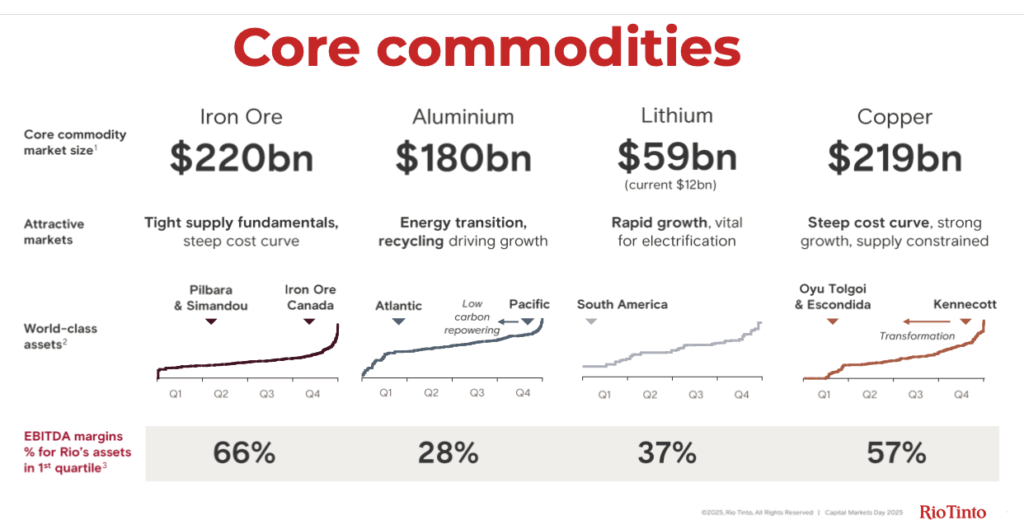
The strategy centres on narrowing Rio’s portfolio to iron ore, copper, aluminum and lithium while applying tighter capital discipline across the business. Rio shares jumped almost 4% on Thursday to a record $140.58, extending a 17% gain over the past year, although the stock still lags BHP on a price-to-earnings basis.
Trott aims to close that gap by selling non-core units, including titanium dioxide and borates, and by exploring commercial, partnership or ownership changes across land, infrastructure, mining and processing assets.
Investors have been waiting for specifics since August, when Rio announced it would streamline its structure to three core units and pursue only the most profitable operations. The company now joins global rivals in offloading non-core assets, cutting jobs and tightening capital amid shifting commodity cycles and pressure for stronger returns.
Rio will look to release cash from projects where third-party funding falls below its cost of capital and will review sales of smaller product lines.
Capital expenditure is projected to drop below $10 billion a year from 2028 as spending on large projects winds down and as the company scales back decarbonisation investments.
Decarbonization spending has been cut to $1 billion to $2 billion through 2030, down from an earlier target of $5 billion to $6 billion. Investment in new lithium projects will proceed only “when supported by markets and returns”, Trott told investors.
On the chopping block
In outlining the overhaul, Trott said assets the company “does not need to own” include titanium, borates, land, infrastructure and processing facilities. Rio is also reviewing partnership options and plans to cut unit costs by 4% from 2024 to 2030.
Rio’s top boss added the company is working with top shareholder Chinalco to resolve governance constraints that have limited share buybacks.
Trott has already trimmed leadership ranks and paused spending on projects such as BioIron and the Jadar lithium project in Serbia. Those moves are expected to deliver about $650 million in annualised productivity gains.
The world’s biggest miners have been cutting costs as volatile prices and uncertainty over long-term demand for key commodities press on valuations. Glencore (LON: GLEN) said this week it would cut 1,000 jobs to improve performance, and Vale (NYSE: VALE) downgraded its iron ore output guidance as new supply enters the market.
Many of Rio’s peers have been in consolidation mode, with Anglo American (LON: AAL) and Teck Resources (TSX: TECK.A TECK.B, NYSE: TECK) advancing a proposed $53 billion merger. Rio itself held preliminary talks with Glencore about a possible combination earlier this year, though Trott dismissed further large-scale consolidation unless it delivered clear “synergies” and “value to the table”.
BMO Capital Markets analysts offered a slightly positive first take on Rio’s update. “On the whole, guidance updates are in line with estimates, although higher copper in 2025 is offset by lower 2026 output,” analyst Alexander Pearce wrote.
Pearce added that a first look at 2026 plans for the giant Simandou iron ore project in Guinea points to a slower than expected ramp-up, though the return to less than $10 billion in annual group capex in the mid-term and the target of $5 billion to $10 billion in divestment proceeds are positives.
BMO noted Simandou’s flagged sales of 5 to 10 million tonnes of iron ore in 2026, on a 100% basis, fall short of its 19 million tonne estimate, suggesting a slower initial ramp-up.
Copper front and centre
Rio raised its 2025 copper production forecast on the back of stronger activity at Mongolia’s Oyu Tolgoi mine. It now expects 2025 copper output to be up to 3% higher than earlier estimates.
Copper production this year is projected at 860,000 to 875,000 tonnes, up from a prior range of 780,000 to 850,000 tonnes, followed by 800,000 to 870,000 tonnes in 2026.
Bauxite output is also set to beat expectations, while Canadian iron ore volume will fall short. Although Rio still earns most of its profits from iron ore, it is shifting toward copper with a target of producing 1 million tonnes annually by 2030.
Copper prices sit at record levels as global energy systems move toward greener technologies. Rio said copper output from Oyu Tolgoi should rise more than 50% this year and about 15% in 2026.
Homeland digging
Rio’s key division, Australian iron ore, is expected to deliver steady volume, with 2026 Pilbara production forecast between 323 million and 338 million tonnes.
The new Simandou mine in Guinea shipped its first ore this week and is expected to produce 5 million to 10 million tonnes in 2026.
Rio shares have climbed 36% since June 20, lifted by rising copper prices, resilient iron ore markets and expectations that Trott will boost cash flow through asset sales and cost cuts. Benchmark 62% iron ore was trading at $108 a tonne on December 3, up from less than $93 in mid-June.
Oil Tanker Rates Skyrocket by 467% Amid Shipping Chaos
The daily rates for chartering a vessel to transport commodities have surged this year, with oil tanker rates skyrocketing by 467%, as shippers of a growing commodity supply are grappling with a series of route disruptions and sanctions.
Despite the typically weaker commodity demand period toward the end of each year, the last weeks of 2025 don’t show any weakness in the vessel rates for transporting crude oil, LNG, iron ore, or wheat.
The unusual strength at the end of the year has seen oil tanker rates on the key shipping routes surge by 467% year to date, according to Bloomberg’s estimates based on data from the Baltic Exchange and commodity markets data provider Spark Commodities.
LNG tanker rates have soared fourfold, while the daily rates for vessels shipping iron ore have more than doubled year to date, the data showed on Thursday.
At the end of November, supertanker rates on the route between the Middle East and China hit their highest in five years as traders sought alternatives to Russian crude after the U.S. sanctioned Russia’s biggest oil producers and exporters, Rosneft and Lukoil. Rates for smaller tankers have also shot up as traders turn to all available vessels to transport crude.
Tanker rates have been climbing for over a month amid sanction-related disruptions that led to a surge in oil in transit.
In the LNG freight market, spot charter rates to hire an LNG tanker on the U.S. to Europe route have jumped to their highest level in two years as soaring American exports tighten the Atlantic LNG vessels market.
In addition, shippers continue to be careful and many still avoid the Red Sea route due to Houthi activity, which adds weeks to voyages for the vessels.
While the tanker owners and operators reap handsome profits, they know the market is inefficient right now.
Asked to forecast the freight market in the first quarter of 2026, Lars Barstad, CEO of supertanker fleet operator Frontline Management, said on the company’s earnings call two weeks ago, “you're asking me to give my view on one of the world's most volatile markets. Actually, the fact that it is this volatility tells you that this is not an efficient market.”
“We're not seeing any kind of weakness in this market. We're seeing an old-school, extremely tight physical shipping market,” Barstad said.
“But of course, who knows what can happen next week?”
Wärtsilä Identifies Four Key Trends to Shape the Future of Shipping in 2026
Roger Holm, President, Wärtsilä Marine emphasises that collaboration will play a vital part in driving the sustainable transformation of shipping and shaping a cleaner and smarter future for the maritime industry (credit: Wärtsilä Corporation)
As the maritime industry prepares to enter 2026, technology group Wärtsilä has identified four important trends that will affect global shipping in 2026. From the rise of digitalisation and big data to the growing importance of flexible decarbonisation strategies, these trends are set to redefine competitiveness, efficiency, and sustainability for vessel owners and operators worldwide:
Lifecycle optimisation: With rapid technological advances and evolving regulations, vessel owners are shifting from short-term fixes to holistic, long-term strategies. Lifecycle optimisation considers environmental impact, operational efficiency, and economic viability from vessel design through to end-of-life, supporting smarter investment decisions and asset value preservation. Collaboration and transparency between owners, operators, and OEMs are key to maximising benefits and navigating future uncertainties.
Flexible decarbonisation strategies: Decarbonisation approaches must be tailored to each vessel’s operational profile, available fuels, and business priorities. A flexible strategy - encompassing planning, integration, and continuous monitoring - ensures vessels remain competitive and compliant as technology and regulations evolve. Investments in fuel-flexible engines, hybrid propulsion, and methane slip mitigation are among the solutions enabling owners to future-proof their fleets.
Digitalisation, big data, and analytics: The increasing complexity of vessels - featuring hybrid setups, advanced power management, and alternative fuel systems - demands robust digital integration. Harnessing onboard data through advanced analytics enables real-time operational recommendations, driving significant reductions in fuel consumption, emissions, and operational costs. While some industry leaders are already leveraging these capabilities, widespread adoption is still hindered by challenges such as data governance and integration, but the path forward is clear.
Less predictable regulations: Despite the recent delay in the IMO’s Net-Zero Framework, the regulatory landscape continues to evolve, with regional initiatives like the EU Emission Trading System and FuelEU Maritime impacting a significant portion of global shipping. As businesses prepare for stricter emissions requirements, robust compliance and reporting protocols are becoming essential.
Looking ahead
“As we look ahead to 2026, collaboration will play a vital part in driving the sustainable transformation of shipping and shaping a cleaner and smarter future for the maritime industry. Wärtsilä’s leadership in fuel flexibility, integration and cross-industry partnerships reflects the growing need for OEMs, operators, ports, fuel providers and regulators to work together. We stand shoulder-to-shoulder with our customers, bringing innovative solutions, expert guidance and a clear focus on enhancing efficiency and creating long-term value,” comments Roger Holm, President, Wärtsilä Marine.
Holm continues: “Legislation is critical to accelerating investment in alternative fuels, but it is no silver bullet. Decarbonisation is a team effort. The maritime ecosystem is full of remarkable ingenuity and world-class technical excellence that we can use to drive decarbonisation and digitalisation hand in hand. We already have the tools in the toolbox to build a cleaner, smarter future for global shipping.”
The products and services herein described in this press release are not endorsed by The Maritime Executive.