Sunday, February 15, 2026


Syria: Can the Rojava Revolution survive?
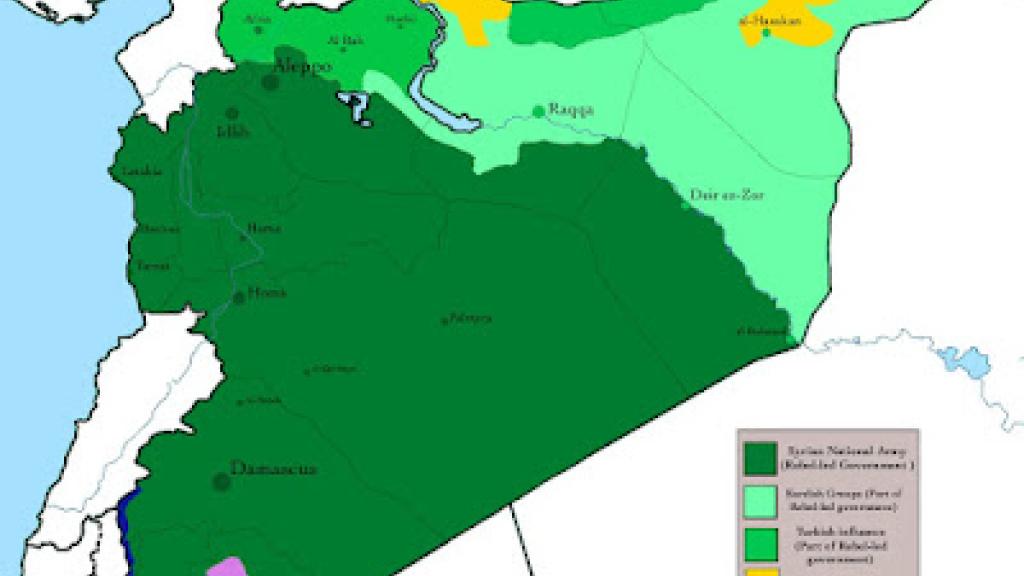

New map of Syria

First published at Arguing for Socialism.

This January saw dramatic changes in Syria. From controlling one-third of the country, the Democratic Autonomous Administration of North East Syria (DAANES) and its military forces, the Syrian Democratic Forces (SDF), have been pushed back to the Kurdish heartland in north-east Syria and forced to agree to a very harsh “integration” with the Islamist regime in Damascus.

On January 6 a meeting took place in Paris: Israel, Syria, the United States and Turkey were all involved. It set the seal on what later took place.

That same day the assault began against Kurdish districts in Aleppo. The SDF was soon pushed out of all positions west of the Euphrates. Next it was forced to withdraw from Arab-majority towns east of the river, in the south: Deir Ezzor, Taqba and Raqqa.

Raqqa had been the Islamic State (IS) capital in Syria. It was liberated at tremendous human cost in a gruelling four-month battle in 2017. The Women’s Protection Units (YPJ) played a central role in the victory.

Rojava Revolution

French Marxist Michel Löwy recently gave an interview to ANF News.

Löwy said the Rojava experience must be protected, adding that the coming weeks and months will show whether the Rojava model can survive. He said: 

If this experience comes to an end, it would be tragic. Despite all its problems, limitations, and contradictions, Rojava has been one of the most advanced experiences in the world in terms of real democracy and women’s liberation.

For everyone fighting for socialism, women’s rights, and ecology, it has been an inspiring experience. That is why its complete destruction would be a great loss.

Western governments profess a commitment to women’s rights, democracy, multiculturalism and ecology, but in reality they saw Rojava as a threat — they do not want anything like it in the Middle East or at home. So, beyond some empty words they have no intention of doing anything meaningful to support Rojava in its hour of need.

Alliance with the US

Washington has openly thrown the Kurds under the proverbial bus. What was involved? As US envoy Tom Barrack brutally explained, previously the US needed them, now it does not. Washington has instead plunged on Turkey and the Damascus regime.

I think it is incorrect to describe this as a “betrayal”. Washington was never on board politically and never pretended otherwise. The collaboration was never more than a tactical alliance between the US military and the Kurdish/SDF forces.

So, when Turkey seized Afrin in 2018 and two years later seized another chunk of Rojava, the US did nothing. In the light of what has happened, the idea — popular in some quarters — that the Kurds were a “proxy” of the US is simply ridiculous.

Arab involvement

The SDF was a majority Arab formation. Several hundred Arab fighters were martyred in various struggles. A significant number of Arab women joined the YPJ, attracted by the idea of a life free of patriarchal restrictions and commitment to the struggle.

Since the fall of Bashar al-Assad, the new Damascus regime and its Turkish backers have made an enormous and sustained effort to peel the Arab tribes away from their alliance with the Kurds. Arab chauvinism has always been a key weapon of successive regimes in Syria and it was obvious it would feature heavily this time around too. Because the revolution has had a differential impact on Kurdish and Arab society, this tack had a considerable effect.

Any Arab personalities or forces that continue to collaborate with the Kurds will be under mortal threat from Turkey and the Damascus gang.

Turkey’s role

From the foundation of the Turkish republic in 1923, the various regimes there have always been extremely anti-Kurd. There have been massacres, language bans, repression and marginalisation of the 25% of the population that is Kurdish. The regime aims to crush any manifestation of Kurdishness, wherever and whenever it appears.

Of course, Turkey is perfectly happy with the kleptocratic Barzani gang, which dominates the Kurdistan Regional Government (KRG) in Iraq. The KRG is a typical Third World setup, with extreme inequalities of wealth and income. It is completely subservient to Turkey and the US.

Turkey constantly presents Rojava as a security threat. The idea that a few million people who simply want a peaceful life seriously threaten Turkey’s security is completely ludicrous. But what does threaten the Turkish regime is the power of a positive example (feminism, self-government, democracy, inter-ethnic harmony and so on).

In his interview, Lowy also addressed the ongoing process in Turkey aimed at a democratic solution to the Kurdish question, saying that the government of Recep Tayyip Erdoğan has never approached this process sincerely. Löwy said: 

The attacks on Rojava are proof of this. The Kurdistan Workers’ Party (PKK) accepted disarmament, yet Erdoğan did not show even the smallest sign of goodwill. Kurdish prisoners remain in jail. The leaders of the legal Kurdish party are imprisoned. Kurdish mayors have been removed from the office. While steps have been taken on the side of the Kurdish movement, there has been no corresponding step whatsoever from the Turkish government.

We might add that Turkey continues building its bases in northern Iraq. Furthermore, Shengal (Sinjar), the autonomous area that is home to the Kurdish Yezidi people, is under constant threat from Turkey or the Iraqi government under Turkish pressure.

It seems that Erdoğan simply wants an electoral boost for his party from the dissolution of the PKK and that is it.

Details of deal

Let us look at what the deal between the Kurds and Damascus involves. All this is taken from the January 30 article on X by MaximeAzadi (machine translation; I’ve numbered the points for convenience):

The main points of the agreement

  1. Ceasefire between Damascus and the SDF.
  2. Withdrawal of military forces from the lines of contact.
  3. Deployment of Syrian Ministry of the Interior security forces in the urban centres of Hasakah and Qamishli.
  4. Gradual integration of local security forces into the structures of the Syrian state.
  5. Creation of a military division integrated into the Syrian army, composed of three SDF brigades and one brigade from Kobani, under the authority of the Aleppo Governorate.
  6. Integration of the institutions of the Autonomous Administration into the Syrian state.
  7. Permanent positions for current civil servants.
  8. Guarantee of the civil, cultural, and educational rights of the Kurdish people.
  9. Safe and dignified return of displaced persons to their areas of origin.

So far, Kobani remains under total siege (by Turkey and the Damascus regime); no refugees have been allowed to return to Afrin and the other Turkish-occupied regions; and Damascus is demanding that the SDF hand over its heavy weapons (i.e., effectively disarm).

Maxime Azadi continues:

What is not stated

  1. Kurdish rights: To what extent will the civil, cultural and educational rights of Kurds be guaranteed? Will there be a dedicated education system in the Kurdish regions or will Kurdish language instruction be limited to a single optional subject, as Damascus desires? Will these rights be individual, collective or national in nature? No details have been provided at this stage.
  2. Afrin and Serekaniyê: What guarantees exist for the return of residents to Kurdish cities under Turkish occupation? What will the form of administration, security, and governance be in these regions? Here again, no clear mechanism has been announced.
  3. Women’s Defence Forces: Will the Women’s Defence Forces be part of the integrated brigades? Will their presence be maintained in the Kurdish regions as it is today? Will they be integrated into the local security forces in the Kurdish regions, or will they be completely dissolved? No specific details have been provided.
  4. Preservation of identities and ways of life: Will the Kurds be able to preserve the democratic and secular character of their regions, or will it be dominated by Damascus’s vision? This question also applies to all other ethnic and religious communities. Will they be able to preserve their distinctiveness and way of life?
  5. Applicability of the agreement: The implementation of the agreement remains uncertain in a context where the Syrian regime relies on a mosaic of armed groups, including several jihadist groups and pro-Turkish paramilitary militias, accused of war crimes and crimes against humanity. Some of these factions are still on Western terrorist lists.
  6. Guarantees and oversight: Who will be responsible for overseeing the implementation of the agreement? What mechanisms are in place to address violations or failures to uphold commitments?
  7. Justice and accountability: Will perpetrators of serious crimes be prosecuted and held accountable, or will they enjoy de facto impunity?
  8. Security of the Kurdish population: How can the Kurdish civilian population trust the Damascus forces deployed in Kurdish cities? Who will concretely guarantee the protection of Kurdish civilians on the ground?

Crucial role of solidarity

How bad will it get? As Azadi’s post indicates, things are already bad and could get much worse very quickly.

The Kurdish people and their allies will resist. They still have their armed forces. But they do not want Rojava to be given the Gaza treatment (that is, mass destruction and a general massacre).

International solidarity is of vital importance. Already, the large and repeated actions in Western Europe have put the spotlight on Rojava and forced the Western governments to sound some warnings to Damascus. The large protests in Iraqi Kurdistan have also been notable.

Was Rojava doomed from the start? That is not a revolutionary attitude. Was the Russian Revolution doomed? Is the human race doomed by climate change? In a particular situation people seize their chance and risk everything to push the struggle forward to a new level. The future is not given; the struggle decides.

Sheikh Akram Mashoush: ‘After all the martyrs, how could we suddenly ally with parties whose mentality we do not believe in?’
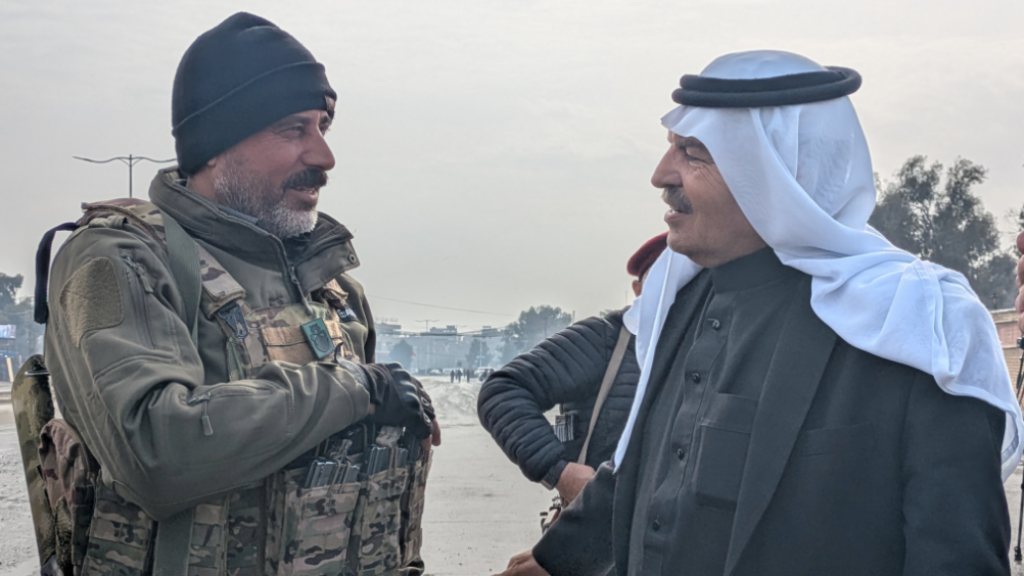

Sheikh Akram Mashoush talks to an SDF soldier in Heseke.

First published at Rojava Information Center.

What is the history of your tribe in this region? How was it during the Assad government?

The tribal connections between different tribes and communities go back decades, not only to the Assad era, but even to the Ottoman Empire. In particular, the links between Arab and Kurdish communities date back to Ottoman times, continued through the French mandate, and survived throughout the Assad regime. These connections endured all those eras and were never broken. After the establishment of the Autonomous Administration (AANES), these links did not disappear. For those of us who have a conscience, they cannot be ignored. We have family ties, neighborly ties, and shared village life. In our villages, Kurds and Yazidis live together with Arabs. These connections cannot be forgotten or denied. They were not created by us, but by our grandfathers. They made our communities connected and cohesive, and with time, they have only grown stronger. Today, when we see our Kurdish brothers suffering and under attack, can we abandon them? We see our Kurdish brothers being attacked by ISIS and by different forces that have taken control of parts of Syria. No, we cannot abandon these humanitarian, social, and ethical bonds. These ties force us to remain together — not only within AANES, but in all aspects of life. Even if AANES were to end, we would not separate or cut these ties. They are social bonds based on coexistence. These connections go so deep that they even exist at the level of milk kinship, a Middle Eastern tradition in which a child breastfed by a woman who is not his mother becomes her milk-son or milk-brother to her children. Such ties are never forgotten, regardless of what happens. We will continue on this path no matter what we go through.

In Hasakah, there are around one million people from the Jabour tribe. This tribe has a different and special relationship with the Kurds compared to other tribes. The Jabour tribe has a long history of ties with the communities of the region, and because we lived side by side with Kurds in mixed areas, these ties became even stronger. My own name, Akram Hajo Mashoush, comes from a Kurdish person from Tirbespiye. These ties are not new. We learned the Kurdish language through living together. It is impossible for us to abandon all of this simply because of military circumstances.

At the military level, the situation of Jabour was different. Even during the Assad era, we were marginalized. Unlike the Shammar tribe, which comes from broader regions and formed the Sanadid Forces to protect borders, we did not form a separate military entity. We preserved our tribal structure and focused on social cohesion and family ties through marriage with different communities. With full respect to other tribes, these factors gave Jabour a unique relationship with the Kurds. There are members of Jabour from Sheddadi married to Kurdish women in Darbasiye, and the same exists between Tel Brak, Qamishlo, and Derik. These ties were not invented or recently created; circumstances simply made the Jabour tribe more closely connected to the Kurds than any other tribe. What is the SDF? It is a force formed from tribes. There is a clan called Mahasin with more than 5,000 fighters within the SDF. There are more than 800 martyrs from the Jabour tribe within the SDF. We did not seek an autonomous entity or structure; we only wanted to protect ourselves. We joined the fight against ISIS because of its brutality – killings, slaughter, oppression, and harsh treatment of women. These conditions only strengthened our cohesion and unity.

What is your opinion about the most recent agreement between the SDF/DAANES and the Syrian Transitional Government (STG)?

The fundamental principle of the current agreement is the ceasefire. As people everywhere welcome such understandings, we, as people living in the area, strongly support and bless it. Government forces are only a few kilometers away, and we are surrounded. Deadlines were given for evacuating areas. Therefore, any ceasefire or agreement is something we genuinely support. All notable figures of the Jabour tribe welcome it. We have always sought a ceasefire between the Damascus government and the SDF. This agreement must lead to positive outcomes that serve the Syrian people. Fighting only brings bloodshed, displacement, and deeper divisions among communities. We want guarantors to take responsibility and ensure the agreement is implemented and not violated. We support the SDF and AANES delegations in their agreements related to security arrangements, integration, and the formation of brigades within the Syrian Army. In the end, we are Syrians. We do not want Syrian blood to be shed. All those killed are Syrians. None of the foreign states have lost their citizens; only Syrians pay the price. This agreement aims to preserve Syrian blood, and its most important pillar is the ceasefire, which can revive coexistence.

Can you explain about the recent tribal defections from the DAANES to the STG?

Turkey has worked to divide the tribes in order to destroy the social fabric. They do not see the SDF as representing Syrians, but only as representing Kurds, and they consider it an enemy, despite the SDF having over 15,000 martyrs and more than 50,000 wounded. Some tribes were influenced by this mentality, including ISIS-like thinking. Turkish intelligence (MIT) also played a role, convincing some tribes — not all — that their situation would improve if the SDF were gone. Even some figures within AANES, such as Muhbash, the head of the negotiation committee, acknowledged this. Tribes are not political organizations and lack deep political experience. They were subjected to pressure, threats, and promises of financial support. This explains why some switched sides. When cities like Tabqa, Raqqa, and parts of Deir ez-Zor fell, uprisings happened even before the Syrian army arrived, proving that there were prior plans. Weaknesses in the security experience of AANES prevented early detection of these breaches. At the same time, the SDF and AANES did not want to be dragged into cycles of violence. They did not want destruction or to kill their own brothers and sisters who rose against them. That is why these areas fell quickly. Many of my relatives and cousins are in Damascus. They offered me defection, positions, and benefits. I completely refused. This goes against my principles and conscience. After all the martyrs, sacrifices, and coexistence, how could we suddenly switch sides and ally with parties whose mentality we do not believe in? This is for those in Damascus. But unfortunately, some members of our tribe, here in the area, used extremely bad language toward me. They threatened me, sent insulting messages and videos, and attempted to intimidate me.

After the agreement is implemented, we hope bloodshed will stop and the situation will be organized. We are all Syrians, and no one should be denied their rights. The Kurdish people have a special situation and legitimate rights that must be recognized. They were among the first to fight and offer martyrs in the revolution, before the formation of the SDF, through the YPG and YPJ. They protected everyone, including Arab communities, even before the creation of the SDF and AANES.

Do you have any critiques for the DAANES?

We do acknowledge shortcomings in services and administration. These were not military or political failures, but administrative ones. Despite having agricultural land, oil, and resources, we failed to meet people’s needs. There was no water, electricity solutions were lacking, bread shortages existed despite wheat abundance, and fuel crises persisted despite oil resources.

These failures are real. However, they do not justify switching sides simply because AANES is weakening. Administrative and service failures exist, but abandoning everything because of them is not justified.


 

Theses for an Ecosocialist critique of artificial intelligence


AI graphic

First published in French at Alencontre. Translated by Adam Novak for Europe Solidaire Sans Frontières.

This text deals essentially with generative AI. The formulation in theses (of unequal length) is not intended to establish certainties, but to facilitate debate through the conciseness of the exposition.

Intelligences and human intelligences

1. What we call intelligence is what enables us to grasp difference, to apprehend the new, to anticipate the possible in the course of events that punctuate time.

2. Intelligence is an emergent product of the non-linear evolution of living things.

Nature makes leaps. Inert things are not intelligent. Symbiotic organisations of plants and fungi communicate and adapt to events without anticipation or consciousness. Intelligence as defined here appears in the animal kingdom, where it takes diverse forms and degrees. In unicellular organisms and organisms without a brain, it merges with the “survival instinct” (survival mechanisms).

3. Human intelligence combines a great capacity for abstraction from a small number of data, sophisticated communication, thought, and a developed spiritual life expressed in complex symbolic achievements, both individual and collective.

4. Homo sapiens identifies regularities and symmetries in its surroundings from earliest infancy, and therefore also what is rare or unusual. Absent in other primates, this aptitude underpins our species’ capacity to classify objects through reason and to penetrate their mechanisms through science.

5. Without human society, without bodies communicating and collaborating, there is neither reflexive intelligence, nor spiritual life, nor consciousness.

The characteristics of our intelligence result both from physical traits (the volume and structure of the brain, bipedalism, the specialisation of the hand, the vocal apparatus) and from the fact that Homo sapiens is a social mammal. The young of our species can survive only thanks to prolonged parental care; we exchange through a complex syntactic language; and our social relationship with the rest of nature is mediated by labour, carried out with the aid of tools. These traits confer upon Homo sapiens multiple intelligences and a great adaptability, decisive for understanding the ontogenetic development of humanity.

6. Mind, thought and consciousness depend on the development and functioning of the brain but also of the body in general.

Mind, thought and consciousness are not localisable in a precise zone of the brain. These properties are, so to speak, secreted in the process of individuation by which human beings develop physically, psychically and collectively.

7. Human intelligence is not only social but also ecosystemic.

The capacity of young humans to identify and classify forms, regularities and exceptions is shaped by climate, seasons and biotopes. Our intelligence is enriched by the exceptional diversity of terrestrial fauna and flora, as well as by the complexity of their relationships with the physical world.

8. Intelligence necessarily combines reason and emotion, knowledge of what is, memory of what is no more, and desire for what could be.

Emotion — etymologically “that which sets in motion”, “that which makes one go beyond oneself” — is what arises from the tension between self and otherness; the wished-for world and the world as it is; the project and its realisation; the existing and the absent. It founds ethics and is therefore much more than an added extra to reason: an essential part of our intelligence. Without emotion, without empathy, without ethics, reason would be dangerously pathological.

9. The forms of human intelligence unfold historically and ecologically.

In the social production of their existence, human beings develop knowledge, techniques and modes of production. They transform society, nature and their metabolism with it, and consequently also the conditions in which they communicate and collaborate — and therefore their intelligence. Homo sapiens probably did not think in the same way before and after the invention of writing; its artistic creations were not identical before and after the steam engine; its symbolic universes differ in the Arctic tundra, the tropical forest, and the megacities of iron and concrete.

AI, intelligence, machinism and capitalism

10. The breakthrough of AI accelerates the destructiveness of capitalist progress.1

The rise of capitalism is punctuated by advances in science. Leaps forward in knowledge have developed the means of production, extended trade, broadened horizons. But this progress is contradictory. By reducing intelligence to reason, and reason to the calculation of profits, Capital mutilates both. The law of value renders reason absurd and plunges emotion into “the icy water of egotistical calculation”. The deployment of AI accelerates these tendencies: it intensifies the destruction of community bonds and of biodiversity, thus impoverishing the social and ecosystemic sources of intelligence. Whilst testifying to more extensive knowledge than ever, it narrows the fields of scientific investigation and encourages feedback loops in research.

11. Despite its feats, AI is not intelligent and cannot be.

Research on AI advances our understanding of how the brain functions. The mastery of language by artificial neural networks, in particular, constitutes a major scientific breakthrough. But AI does not think, does not dream, does not imagine. It “speaks” without knowing (or seeing) what it is speaking about, for it has no world. The future it projects is induced from what has dominated the past in statistics. Its inventory capacities are at once dizzying and partial, for its data (our data, which it appropriates!) are limited to the portion of collective human knowledge circulating on the internet.

12. AI is human, not “artificial”. It exacerbates capitalist extractivism, its instrumental reason, and the subsumption of labour.2

Algorithms are in the hands of capitalist-engineers who seek to maximise profit. Thanks to their monopoly position and global reach, the digital giants evade the equalisation of the rate of profit.3 It is this mechanism of capturing value created by labour that enables them to accumulate gigantic rents. These are rooted in the mechanisms characteristic of the system: the (over)exploitation of the labour force (notably in the extraction and refining of rare earths4 made available by nature), and the gratuitous appropriation of accumulated human knowledge. The masters of Big Tech aspire to an absolute power that bears similarities to that of the ruling class under the ancien régime, but digital capitalism is not a feudalism.

13. Marx’s critique of the machine is decisive for apprehending AI.5

For Marx, the machine reduces the proletarian to a series of gestures useful for capitalist valorisation.6 The worker’s know-how is reduced to crumbs, alienated labour “extinguishes” creativity; the worker becomes an accessory to the machine; it has taken the worker’s place, and the worker loses dignity. When the machine is automatic, the appropriation of living labour by dead labour becomes a fact of the productive process itself; machinery thus gives Capital its most adequate form. Thenceforth, the collective intelligence appropriated by the capitalist — objectified labour — completely dominates living labour; the machine appears at once as a “hostile force” and as the precondition of production. Subsumption of labour under capital shifts from formal to real.7 This Marxian critique of the machine system applies perfectly to AI.

14. The danger does not lie in the possibility that the machine might become “more intelligent” than us — “superintelligent”. It lies in the fact that AI is the “hostile force” par excellence, instrumental reason in its pure state, capitalist inhumanity objectified. To increase its power is to increase the power of that which dominates us and drags us towards the abyss.

AI, long waves and the exploitation of labour

15. Confronted with labour, AI “embodies” the logic of capital better than the capitalist.

In a non-capitalist world, other AIs could relieve humanity of tedious and repetitive tasks. In education, in health, in the care of ecosystems, for example, specific AIs would allow living labour to concentrate on social and ecological interactions, enriching these within a human logic of “caring”. In the actual capitalist world, however, “caring” — cancer detection, weather forecasting and so on — is subordinated to profit. AI is calibrated for the extraction of surplus value down to the last drop, automatically, without respite or rest. It substitutes yet more dead labour for living labour, extends real subsumption to administrative and service tasks, drains creative professions. Algorithms perfect the Taylorist logic of labour control8: the worker’s activity, gestures, location, the sequence of operations, working times and travel times can be commanded, evaluated and rewarded (and above all sanctioned) remotely and directly. Far from lightening work, AI makes it more intense and dense.

16. The promises of a new golden age through AI are without serious foundation. No technology can rescue capitalism from the contradictions of value production.

Current projections of productivity gains from the deployment of AI vary between 0.07 and 0.7 per cent per year over ten years. This is insufficient to fuel a long wave of growth.9 AI does not relaunch accumulation; it sharpens systemic contradictions. We find Marx again: the machine system entails an enormous fixed capital that “no longer orients itself towards immediate value” but towards “production for production’s sake”; the amortisation of machines consequently requires that the circulating fraction orient itself towards “consumption for consumption’s sake”. But surplus value must still be realised regularly, over a sufficient period. After forty years of wage austerity and in a world of powers competing for hegemony, this is where the problem lies: who can guarantee the durable sale of the commodities promoted by billions of smartphones? In keeping with the insights of Ernest Mandel, the gravity of the ecosocial systemic crisis and the classical contradictions of value production probably exclude any new long wave of capitalist expansion.

17. It is not the revival of employment that AI will deliver, but the deepening of social and environmental plunder.

Unlike previous technological revolutions, the job losses caused by AI have little chance of being compensated by the development of equivalent new functions. As the enormous development of the fixed portion of capital tends to push down the rate of profit, capital resorts to well-known counter-tendencies: intensified plunder of free natural resources and of underpaid labour power. The dematerialisation of the economy is a myth. In reality, the breakthrough of AI is accompanied by growing material brutality in the imperialist appropriation of ecosystems and in the cruellest overexploitation of proletarians (platform capitalism, child labour, zero-hours contracts and so on). All these mechanisms simultaneously accentuate colonial inequalities and ableist, racist and gender-based discrimination.

18. AI inflates a new bubble of fictitious capital and reinforces the tendency towards militarisation.

The astronomical sums that a handful of oligopolies invest in the development of AI reflect the unprecedented glut of money-capital, the weight of finance in contemporary Capital, and its very high degree of concentration and centralisation. But the fetishism of technology combined with specific intra-oligopolistic competition blinds investors. In themselves, their investments bring no solution to the problem of valorisation. AI does not achieve the expected results, costs too much; clients prefer human contact, and so on. AI thus inflates a new bubble of fictitious capital.10 Sooner or later, to cushion the blow, technology capital will impose the use and payment of what today presents itself as a marvellous free service. But that will not suffice. The rush towards AI has everything needed to trigger a new major financial crisis and to accelerate the tendency of crisis-ridden capital to invest in arms production as a lifeline.

Global inequalities, civilisation and “technofascism”

19. AI deepens the gulf between imperialist metropoles and peripheral countries.

Only the powerful monopolies of the most developed capitalist countries can mobilise the enormous masses of capital necessary for AI infrastructure. Its frenzied development is already an additional factor in the deepening of inequalities between the most developed capitalist countries (in particular the United States and China) and low- and middle-income countries (LMICs). This division stimulates the mechanisms of the crudest imperialist-colonial domination and encourages imperialist powers to harden still further their barbaric management of migratory flows.

20. From a general social standpoint, generalist AI degrades intelligence, creativity, empathy, ethics and public health (mental health in particular) — especially that of children.

Communication and collaboration are inseparable. Today, algorithms are seizing upon the former just as steam engines, yesterday, seized upon the latter. The toxic tendencies that result overflow the sphere of labour. In society in general, contact with the other, always different, human and non-human, is competed against by the frequentation of the same within a narcissistic bubble; the machine replaces the confidant; informational hypersolicitation clips the wings of wandering thought; the joyful quest for truth is replaced by the sad addiction to virtual realities and their lies; the hope for a different future is lost in the statistical compilation of an objectified past.

21. By helping Capital to subsume labour as never before, AI helps it to subsume as never before the whole of society.11

In the sphere of reproduction, through the medium of “social” networks, AI multiplies the possibilities for realising the surplus value produced by the exploitation of labour. It accelerates the circulation of commodities and intensifies the consumerist subjugation of minds. The machinery of the industrial revolution deskilled the producer’s know-how by dispossessing workers of mastery over the labour process. AI deskills, so to speak, the “art of living” — the formation of desires and of consciousness. Free access to a machine that seems to speak, understand, even sympathise, creates affective dependencies that will subsequently be monetised. The subsumption of labour grows into the subsumption of life.

22. Through its inability to distinguish truth from falsehood, AI favours supremacism, the law of the strongest, the elimination of the weak, and the end justifying the means in a war of all against all.

Children acquire the notion of truth through socialisation and the learning of language. AI being neither alive nor social, the notion of morality is foreign to it — alien. The machine is called “self-learning” but it cannot by itself exclude the gigantic masses of data corrupted by lies, hatred and perversion. Thousands of underpaid “click workers” are tasked with instilling “values” in it. These values derive from the worldview of their employers. It is hardly surprising that AI helps the suicidal to commit suicide, swindlers to swindle, rapists to rape. It “lies”, “cheats”, “schemes”, and “prevents itself from being switched off” — in the image of its creators.

23. AI is the perfect instrument in the service of a rogue capitalism that finds its unabashed political expression in a “technofascism” that is bigoted, racist, sexist, LGBT-phobic, colonial, anti-ecological and neo-Malthusian.

Generalist AI favours the rise of the far right, fed by more than forty years of neoliberalism. Fascists use it to manipulate the masses via social networks and to rig elections. Authoritarian powers use it to control populations to a degree never before seen in history. Governments (less and less) democratic use it to track migrants and to file opponents. AI has an unparalleled capacity to bring individuals to change their opinions. The generation of images and texts constitutes a formidable means of indoctrination that solicits the cerebral mechanisms of “rigid thinking”. Some neuroscience researchers believe that these mechanisms lead to epigenetic changes,12 transmissible over several generations (a possibility glimpsed by Darwin). If this is correct, AI would have the potential to durably return humanity to the yoke of irrational beliefs.

AI, ecology and cataclysm

24. AI accelerates the social-ecological catastrophe, the climate catastrophe in particular. Its development precipitates the crossing of “tipping points”.13

US data centres consumed 17 billion litres of water in 2023, a figure expected to more than double by 2028. Globally, the 8,000 data centres consumed 460 TWh of electricity per year in 2024, to which should be added in 2026 between 160 and 590 TWh (compared to 2022) — respectively the annual consumption of Sweden and Germany. CO2 emissions from these infrastructures will triple between 2020 and 2035, according to the IEA (International Energy Agency). The extraction of rare earths necessary for AI generates globally 13 billion tonnes of waste per year, and some studies project more than a hundred times that figure by 2050. The poor of poor countries are hardest hit by these effects, whether directly through mining and the depletion of water resources pumped by relocated data centres, or indirectly through biodiversity loss and extreme climate events.

25. AI increases the risks — inherent in capitalist competition — of major technological catastrophes.

AI has become the primary stake in competition between Tech monopolies tightly interlocked with states in struggle, principally China and the United States. The race for AI is therefore immediately a race for military applications. Research is opaque and departs from the scientific practice of “organised scepticism”. This configuration favours secrecy, which increases dangers. The self-insertion into numerous systems of an even more powerful AI could interrupt basic services, produce dangerous viruses, trigger a nuclear attack, without anyone knowing exactly how. The inability of the capitalist system to halt the climate shift (perfectly documented by science) shows that these scenarios do not belong to science fiction.

Paths for a necessary elaboration

26. A public initiative is indispensable to identify risks and take immediate measures to protect society against the effects of AI.

A broad democratic debate, duly informed by scientific expertise independent of capitalist interests, should pronounce on the social utility of AI and place the following problems and measures on the agenda:

  • AI research and development must be removed from the hands of capitalist groups and subjected to the procedures of the scientific community;
  • total transparency on the design of models, the training of algorithms and the technical methodologies used by companies;
  • prohibition of AI in the field of artistic and literary creation; repression of data piracy;
  • protection of cooperative initiatives using digital technologies (Wikipedia and others) against competition from AI and piracy by AI;
  • in the face of the risk of the dehumanisation of social relations through the use of AI, the maintenance and expansion of employment in the “care” sectors (education, health, early childhood support and support for the elderly, prevention of violence against women, and so on); 
  • guarantee that public-facing counters in government services are maintained;
  • prohibition of AI applications in military and police domains;
  • prohibition of racist, sexist and LGBT-phobic content;
  • suppression of access to social networks for children under sixteen years of age; education about technologies and their risks;
  • reform of school curricula with the aim of developing cooperation, the sense of belonging to nature, and respect for living things.

27. AI confronts the world of labour with the necessity of a combative international trade unionism, radically anticolonial, which articulates struggles at all levels of the value chain and puts workers’ control back on the agenda.14

The power of Big Tech’s rentier capitalism rests upon the overexploitation of millions of workers and children in the mining sector, in the refining of rare earths and in the electronics industry. The consequent struggle against these rapacious monopolies and against their technofascist project requires the unification of workers at all levels of the value chain. Recognition of trade unions and trade union freedom everywhere. Compulsory consultation of workers on the introduction of AI in the workplace. Trade union veto power. Workers’ control over the evolution of workload, in quantity and quality. Against redundancies caused by the introduction of AI in enterprises, reduction of working time without loss of pay.

28. A moratorium on the construction of data centres and other heavy AI infrastructure is indispensable. Any further advance must be subordinated to the adoption of a global ecological and social strategy, including notably: a strategy aimed at reducing social inequalities, the sustainable management of resources (water, minerals), the restoration of devastated ecosystems, as well as a precise plan for binding reductions of greenhouse gas emissions, in conformity with the objectives of the Paris Agreement on climate.15

29. Develop a counter-culture in the face of AI. In social movements, implement collective practices to resist the degradation of social relations and of the debate of ideas by AI.

The formation of a collective intelligence cannot do without collective action decided upon and evaluated democratically in the course of face-to-face exchanges, allowing for verbal and non-verbal expression. Social networks are not a place for debate. The left must combat the fascination with “machines that speak”, work consciously to banish the use of smartphones from its meetings, and rehabilitate printed publications aimed at the exchange of viewpoints and in-depth analyses.

30. Another digital realm, public and democratic, is possible.

Within the framework of an indispensable redistribution of wealth, local, regional and national authorities must have the means to ensure free public infrastructure for messaging, data storage and social networks under democratic control, with protection of users’ data and the development of domain-specific AIs.

31. Struggling against capitalism in the age of AI reinforces the necessity of a radical refoundation of the left.16

The breakthrough of AI casts a harsh light on the disarray of the left. It reinforces the necessity of purging Marxism, and the left in general, of productivism, instrumentalist ideologies (“the end justifies the means”), the cult of progress and the idea of “technological neutrality”. The global grip of Big Tech from Silicon Valley, Shenzhen and other imperialist centres underlines the absurdity of campism17: the break with capital can only be conceived within the internationalist perspective of a permanent revolution until the worldwide abolition of capitalism. Beyond Marxism, the left must also break with postmodern conceptions such as “actor-network theory”18: fully taking account of the dangerous consequences of AI’s alien nature presupposes abandoning the idea that technical devices functioning as prostheses of human activity should, because they have a social effect, be considered as social actors. It is humans who forge their history, not machines.

32. The threats of AI underline the urgency of a revolutionary, ecosocialist break with the civilisation of capitalist growth.

The threats of AI do not derive solely from capitalism. Whatever the relations of production, neural networks will remain structurally incapable of distinguishing truth from falsehood and of projecting a different future. The replacement of capitalist property by collective property, in itself, would not suffice to bring the ecological footprint of AI within the limits of terrestrial sustainability. The idea that AI would act as a miracle cure allowing the market to solve the terrible problems created by the market belongs to magic, not to reason. The only perspective compatible with human dignity and with the survival of the species is the ecosocialist degrowth of global material production, planned in social justice, aiming at a world economy of satisfaction of real needs democratically determined in respect for ecosystems, their limits and their fragile, irreplaceable beauty.

Note by Daniel Tanuro: At various stages of their drafting, these theses benefited from the remarks of Marius Gilbert, Cédric Leterme, Léonard Brice, Michaël Löwy, Christine Poupin, Julia Steinberger and Mélodie Vandelook, whom I thank for their attention.

Daniel Tanuro is a Belgian agricultural engineer, ecosocialist activist and author. His works include L’impossible capitalisme vert [The Impossible Green Capitalism] (La Découverte, 2010), Trop tard pour être pessimistes! (Textuel, 2020) and Écologie, luttes sociales et révolution [Ecology, Social Struggles and Revolution] (La Dispute, 2024).

  • 1

    On the ecosocialist analysis of capitalism’s structural incompatibility with ecological limits, see Daniel Tanuro, “Foundations of an ecosocialist strategy”, Europe Solidaire Sans Frontières. Available at: http://www.europe-solidaire.org/spip.php?article22770

  • 2

    On the dynamics of rentier capitalism and technological monopolies in the current crisis, see Romaric Godin, Antoine Larrache and Jan Malewski, “A capitalism in crisis, predatory and authoritarian”, Europe Solidaire Sans Frontières, April 2025. Available at: https://europe-solidaire.org/spip.php?article74329

  • 3

    In Marxist economic theory, the equalisation (or peréquation) of the rate of profit is the tendency for competition to produce an average rate of profit across different sectors of the economy. Marx argued that capital flows between sectors until rates of return converge.

  • 4

    Rare earth elements are a group of 17 metallic elements essential for manufacturing electronic components, batteries and other high-technology products. Their extraction involves severe environmental damage and is concentrated in a small number of countries, principally China.

  • 5

    On Marx’s ecological thought and its relevance to contemporary ecosocialism, see Daniel Tanuro, “From Metabolic Rift to Rational Management: Daniel Tanuro on Marx’s Unfinished Ecology”, Europe Solidaire Sans Frontières, July 2025. Available at: http://www.europe-solidaire.org/spip.php?article75630

  • 6

    In Marxist theory, valorisation (Verwertung) refers to the process through which capital increases its value by extracting surplus value from labour in the production process.

  • 7

    Marx distinguished between formal subsumption, where capital takes over existing labour processes without fundamentally altering them, and real subsumption, where capital reshapes the labour process itself to serve the logic of accumulation.

  • 8

    Taylorism, named after Frederick Winslow Taylor (1856—1915), is a system of scientific management that analyses and optimises workflows to maximise labour productivity, typically through the minute subdivision and surveillance of tasks.

  • 9

    The concept of long waves (or Kondratieff waves) in capitalist development refers to cyclical patterns of roughly 40-60 years of economic expansion and contraction. The Belgian Marxist economist Ernest Mandel (1923-1995) developed a theory linking these waves to technological revolutions and the dynamics of the rate of profit.

  • 10

    In Marxist economics, fictitious capital refers to financial assets (shares, bonds, derivatives) whose value is not directly tied to real production but to expectations of future profits. It can grow independently of the real economy, creating speculative bubbles.

  • 11

    On the far right’s use of digital platforms and the need for democratic alternatives, see Paulo Antunes Ferreira, “Beyond the Echo Chamber: Reclaiming Digital Space from Fascist Infiltration”, Europe Solidaire Sans Frontières, July 2025. Available at: https://europe-solidaire.org/spip.php?article75561

  • 12

    Epigenetic changes are heritable modifications to gene expression that do not involve alterations to the underlying DNA sequence. They can be triggered by environmental factors and, according to some research, may be transmitted across several generations.

  • 13

    On the broader relationship between capitalist destruction of the environment and the ecosocialist alternative, see Fourth International, “Resolution on The capitalist destruction of the environment and the ecosocialist alternative”, Europe Solidaire Sans Frontières. Available at: https://europe-solidaire.org/spip.php?article44086

  • 14

    On the relationship between trade unionism and ecosocialism, see the exchange between Sophie Binet and Daniel Tanuro, “Syndicalisme et écologie”, Europe Solidaire Sans Frontières. Available at: http://www.europe-solidaire.org/spip.php?article73088

  • 15

    The Paris Agreement, adopted at the 21st Conference of the Parties (COP 21) in December 2015, commits signatory states to limiting global warming to well below 2°C above pre-industrial levels, with efforts to limit the increase to 1.5°C.

  • 16

    On the ecosocialist perspective and the need for a revolutionary break with capitalist growth, see Fourth International, “Manifesto for an ecosocialist revolution – Break with capitalist growth”, Europe Solidaire Sans Frontières, February 2025. Available at: http://www.europe-solidaire.org/spip.php?article74933

  • 17

    Campism is a political tendency on the left that identifies any state or bloc opposed to Western imperialism as progressive or deserving of support, regardless of its own oppressive character. Ecosocialists reject this binary framework in favour of internationalist solidarity with popular movements everywhere.

  • 18

    Actor-network theory (ANT), associated with Bruno Latour, Michel Callon and others, is a theoretical framework that treats human and non-human entities (including technologies) symmetrically as “actants” within networks. Ecosocialists critique this approach for obscuring the social relations of power and class that shape technological development.