Interview
The Black Anti-Fascist Tradition Recognized Fascism Didn’t Begin in Europe
Black anti-fascists have long warned about creeping fascism, from slavery to mass incarceration to ICE terror.
By George Yancy ,
February 21, 2026

Prisoners at the Attica Correctional Facility give the Black Power salute on September 10, 1971. “I believe the connection between abolition and Black anti-fascism is crystallized in the writings and activism of political prisoners and prison abolitionists,” says scholar Jeanelle K. Hope. “The Attica prison uprising of 1971 stands as a major inflection point in this history.”
Bettmann / Contributor / Getty Images
Back in 2016, I was asked what I thought about Donald Trump. Even back then, I saw him as an aspiring fascist, and I responded:
Simply put. He is a conduit through which white America expresses its most vile desire for white purity. An apocalyptically dangerous white man who sees himself as the center of the world. That kind of hubris bespeaks realities of genocide.
Trump 2.0 has only confirmed my fears, my dread, and my anger. Make no mistake about it: This administration is unapologetically and shamelessly hellbent on establishing a violent white fascistic state. I know that some are surprised, but the truth of the matter is that the horrible reality of anti-Black fascism is not a new formation. The soul of this country was founded upon white power, white greed, and white violence. So, I am not surprised by the likes of Trump; he is a product of a vicious poison, a historical legacy, that predates his abominable presidency. But this isn’t mere speculation or exaggeration. Our bodies and psyches are a record of this history: chains, enslavement, dehumanization, scarred backs, raped bodies, castrated bodies, broken necks, broken family ties, denied rights, denied citizenship, mass incarceration, and slow death. Indeed, there are those Black voices who not only recorded this history, but who understood its fascistic logics. For example, Black poet and activist Langston Hughes wrote:
Yes, we Negroes in America do not have to be told what Fascism is in action. We know. Its theories of Nordic supremacy and economic suppression have long been realities to us.
And it was Black sociologist and philosopher W. E. B. Du Bois who wrote, “We have conquered Germany … but not their ideas. We still believe in white supremacy, keeping Negroes in their place.”
Back in 2016, I was asked what I thought about Donald Trump. Even back then, I saw him as an aspiring fascist, and I responded:
Simply put. He is a conduit through which white America expresses its most vile desire for white purity. An apocalyptically dangerous white man who sees himself as the center of the world. That kind of hubris bespeaks realities of genocide.
Trump 2.0 has only confirmed my fears, my dread, and my anger. Make no mistake about it: This administration is unapologetically and shamelessly hellbent on establishing a violent white fascistic state. I know that some are surprised, but the truth of the matter is that the horrible reality of anti-Black fascism is not a new formation. The soul of this country was founded upon white power, white greed, and white violence. So, I am not surprised by the likes of Trump; he is a product of a vicious poison, a historical legacy, that predates his abominable presidency. But this isn’t mere speculation or exaggeration. Our bodies and psyches are a record of this history: chains, enslavement, dehumanization, scarred backs, raped bodies, castrated bodies, broken necks, broken family ties, denied rights, denied citizenship, mass incarceration, and slow death. Indeed, there are those Black voices who not only recorded this history, but who understood its fascistic logics. For example, Black poet and activist Langston Hughes wrote:
Yes, we Negroes in America do not have to be told what Fascism is in action. We know. Its theories of Nordic supremacy and economic suppression have long been realities to us.
And it was Black sociologist and philosopher W. E. B. Du Bois who wrote, “We have conquered Germany … but not their ideas. We still believe in white supremacy, keeping Negroes in their place.”

Amid Trump’s War on Antifa, Activists Face Arrest for Zines and Group Chats
The Trump administration now has zine distributors and jail support efforts in its sights.
By Brit “Red” Schulte , Truthout January 10, 2026
Thinking about the reality of anti-Black fascism led me to the indispensable work of Jeanelle K. Hope and Bill V. Mullen. When it comes to documenting anti-Black fascism, they trace a longer arc with respect to the rise of fascism; they show just how European fascists drew from early U.S. laws for their own specific fascist formations, and how the U.S. functioned as the very hub of fascist discourse and practice. Given this rich history and its importance for how to strategize moving forward, I conducted this exclusive interview with Jeanelle K. Hope, who is an independent scholar and a lecturer at the University of California-Washington Center.
George Yancy: It is important to historically situate the phenomenon of fascism, especially within our contemporary context where the Constitution is being trampled upon, and what one might call the paramilitary deployment of Immigration and Customs Enforcement (ICE). Your book, The Black Antifascist Tradition: Fighting Back from Anti-Lynching to Abolition, which you co-authored with Bill V. Mullen, powerfully challenges the narrative that fascism is a phenomenon that is exclusive to 20th-century Europe. In this regard, your book constitutes a necessary counter-narrative that highlights the gratuitous violent history that Black people in the U.S. have faced since their enslavement. This counter-narrative is what you term the Black anti-fascist tradition. In brief, what are some of the features that define the Black anti-fascist tradition?
Jeanelle K. Hope: The Black anti-fascist tradition recognizes that there has been a long arc of fascism throughout history, and that anti-Blackness has long undergirded fascist policies and formations, thus, disrupting prevailing historical narratives and theorizing on fascism. We argue that the earliest roots (or pillars) of fascism — authoritarian rule, genocide and ethnic cleansing, militarism, racial capitalism, dual application of the law — can be traced to the colonization of Africa and chattel slavery across the Americas. One of the most salient and defining features of anti-Black fascism is genocide. We chart out the systematic genocide of Black people from the brutality of enslavement, post-emancipation lynchings, to state-sanctioned violence and police brutality. Ida B. Wells’s Southern Horrors and Red Record, W.E.B. Du Bois’s lynching reports in The Crisis, William Patterson’s petition to the United Nations entitled, “We Charge Genocide,” and Arlene Eisen’s 2012 report “Operation Ghetto Storm” all meticulously document the impact of lynchings and the immiseration of Black life. And with such damming evidence in hand, they argued that such acts constitute genocide. Indeed, “We Charge Genocide” emerges as a cross-generation rallying cry among Black anti-fascists like Patterson, Stokely Carmichael, and the Chicago-based youth group aptly named “We Charge Genocide.”
Beyond presenting this counter-narrative, so much of our book also names how Black people have been on the front lines of anti-fascist struggles in Europe (the Spanish Civil War), Ethiopia (the Italian invasion of Ethiopia), and across the United States. Moreover, the Black anti-fascist tradition underscores that fascism attacks on multiple fronts (i.e., art and cultural production, education, immigration, law and policy, health care, housing, etc.) and subsequently, requires a multifaceted resistance. Black anti-fascists have incorporated various organizing strategies, tactics, and actions including legal challenges, mutual aid, anarchy, autonomy, self-defense, boycotts, solidarity, and abolition.
What I think is an important takeaway from the Black anti-fascist tradition is knowing that Black people have long warned about what I describe as fascism’s incessant creep. Fascism is not born overnight. It is relentless and creeps through society, systems, laws, and more over time. Black anti-fascists have played the long game, trying to check the creep of fascism at every turn, knowing that if left unchecked, humanity will enter some truly dark days.
In your book, you write, “By the time the regimes of Hitler and Mussolini began to theorize racial purity and Aryan identity politics, discussing race in this quasi-biological sense in the U.S. was old news.” This is such an important observation as it places anti-Black racism at the very core of the foundation of this nation. Talk about the centrality of “racial purity” and how that myth shaped the U.S., and how it continues to do so. And here I’m thinking about Trump’s disgusting use of the expression “shithole countries” and his encouragement of immigrants from Norway.
Recognizing that race/racism/racial hierarchy are at the very foundation of colonial rule, it is of no surprise that race is also at the crux of fascism. From the onset, the history of the United States is marked by colonialism, and race almost immediately emerges as a system of domination to subordinate Indigenous peoples and enslaved Africans brought to the country. This racial hierarchy had/has significant economic and social implications. With Black, Brown, and Indigenous people viewed as subordinate, the belief of white supremacy and white domination in the western hemisphere was fomented. Up until the early 20th century (and some would even argue still today), great lengths (i.e. anti-miscegenation laws, racial integrity laws, racial purity tests, etc.) were undertaken to ensure a rigid racial hierarchy. The mere existence of interracial relationships and mixed-race people has long served as a threat to this system, blurring the racial binary, and forcing society and governments to have deeper questions about “who is white,” and thus, gets to benefit from this system of domination.
Moreover, throughout U.S. history, this “gatekeeping” or protectionism of the white race shows up countless times from anti-immigration laws (i.e., the Chinese Exclusion Act), Jim Crow laws, the eugenics movement, and recent discourse around the “Great Replacement” theory. These efforts have largely (and unsuccessfully) sought to stymie influxes of non-white immigration, non-white births, and interracial relationships. It is also important to name that the constant pursuit of white racial purity is fundamentally tied to patriarchy, natalism and the regulation of women’s bodies, hence the recent rollbacks on abortion access and reproductive health care.
I was aware of Adolf Hitler’s admiration for the U.S.’s racial segregationist practices and its eugenics movement, but your argument delineates in detail that European fascism “had its roots in American Anti-Black Fascism.” This is a significant charge against the U.S.’s view of itself as “innocent,” and as a “shining city on a hill.” Indeed, it is this understanding of the U.S. that is necessary as we currently confront fascism in this country. You write, “Seldom have historians drawn connections between the Nuremberg Laws, Italian Racial Laws, and Jim Crow Laws of the US.” What is it about certain historians that they have failed or refused to make such a significant connection? I would even say such a significant indictment.
Naming that U.S. racial policies effectively served a blueprint for the various legal systems of European fascism would disrupt a decades-long historical narrative surrounding WWI and WWII. The story of the “Axis vs. the Allies,” and the United States’ role in defeating fascism has long been the prevailing historical narrative taken up by historians. I think there is at times a failure among historians to step back, read across archives, and to stitch multiple historical events together. We also must be honest that there has been a concerted effort among both politicians and historians to preserve a liberal or redeeming narrative surrounding the United States’ role in WWII. For example, it took decades for mainstream American history to finally recognize that the incarceration of Japanese Americans during the war was heinous. Yet some would still draw the line at comparing those “internment camps” to Nazi concentration camps. But it is that type of comparison that is direly needed to be able to understand the impact and evolution of fascism across time and space. We must also connect the current ICE detention centers to this broader history as well.
Finally, I think one of the biggest issues among historians, and even many leftist activists, is the aversion to name any formation of fascism outside of interwar Europe as fascism. For far too long, many have believed that Hitler and Mussolini’s fascist rise was like capturing lightning in a bottle, when fascism has long existed beyond the confines of early 20th-century European history. From a deeply human standpoint I understand why one would want to believe that the atrocities of the Holocaust and Nazism could not be replicated. Yet, Black anti-fascists have long rang the proverbial alarm about the incessant creeping nature of fascism and its onslaught on Black life. Furthermore, to ignore or discount the claims of Black people like Robert F. Williams, Harry Haywood, George Jackson — among a host of others that have named fascism as the greatest threat to Black people (and all people) just because they don’t neatly fit within longstanding scholarly traditions on historical fascism — to me, is ahistorical.
I agree! Talk about how contemporary forms of abolitionist discourse and activism are linked to the Black anti-fascist tradition. I think that such a link is so important as it communicates the historical arc of Black people who continue to refuse fascism.
I believe the connection between abolition and Black anti-fascism is crystallized in the writings and activism of political prisoners and prison abolitionists starting with George Jackson, Angela Davis, Ericka Huggins, and Kathleen Cleaver, and later in the work of Ruth Wilson Gilmore and Dylan Rodriguez, among others. Many of the Black political prisoners of the late 1960s and early 1970s were among the most vocal in naming that America was engaging in fascism, arguing that prisons and the rise of mass incarceration amounted to the latest evolution of fascism’s incessant creep on society. They recognized that prisons helped facilitate systematic genocide and was buttressed by a criminal justice and legal system that openly practiced a dual application of the law, whereby Black people were subjected to different interpretations of the law and harsher sentences, among other injustices. I think about Ericka Huggins’s letters from Niantic prison where she describes their poor conditions, the inhumane nature of solitary confinement, and the unjust way many Black Panther Party members, and other radicals of the era, were largely swept into prisons on trumped-up charges. I even think of those early pages of Assata Shakur’s autobiography (Assata: An Autobiography) where she describes the guards of the prison in which she was incarcerated giving Nazi salutes to each other. The Attica prison uprising of 1971 stands as a major inflection point in this history.
Prison abolitionists have long connected American prisons to the long arc of fascism, arguing that they are so deeply entrenched in fascism that they are beyond reform, concluding that abolition is the only solution. These arguments, of course, are most fervently explored in Angela Davis’s Are Prisons Obsolete? and the work of Critical Resistance. It is from Davis and Critical Resistance’s work that more contemporary abolitionists descend. Thus, it is of no surprise that during the height of the Black Lives Matter movement, calls to abolish the police emerged, and with the current wave of mass deportations and practice of “crimmigration,” there are calls to abolish ICE. The Black anti-fascist tradition recognizes that the incarceration of Black people has long been tied to the fascist pillar of genocide, thus, any reproduction of incarceration — be it ICE detention centers or Japanese internment camps — will always be part of a broader fascist project. The harrowing reports of ICE detention center conditions and deaths is the latest harbinger of fascism’s incessant creep.
Given the specificity of how Black people in the U.S. have been brutalized and dehumanized in terms of anti-Black fascist logics, talk about what strategies have emerged out of Black struggles for countering and resisting (I want to say overthrowing) U.S. fascism. On this topic, I often feel a great deal of pessimism. Yet I agree with Robin D. G. Kelly where he said to me, “There is no guarantee that we will win — whatever that means — but I guarantee that if we don’t fight, we lose.”
To feel pessimistic under the boot of fascism is only natural, and a feeling that is important to sit with. To draw upon the words of Kelly Hayes and Mariame Kaba, I think we also must work through that pessimism and “let this [moment] radicalize you.” Earlier in the interview, I highlighted some of the major organizing tactics, strategies, and actions that animate the Black anti-fascist tradition, so I’ll use this space to stress some more practical forms of resistance for this moment. First and foremost, we all must begin the resistance to fascism through organizing and studying.
Remember, fascism attacks on all fronts, so we must develop a strategy that recognizes this and can be adapted in various spaces. Fascist policies are dismantling public education before our eyes. Parents and teachers must organize at the school district level to resist book bans and anti-ethnic studies bills. And even more so, parents must see “school choice” and “school vouchers” for what they are — the privatization of public schools. This is anti-democratic.
Fascism will quite literally starve its constituents. I cannot over-emphasize the importance of mutual aid in a moment where unemployment is increasing, particularly amongst Black women, and the federal government has slashed the budgets of many social safety-net programs, like SNAP. As fascism seeks to further divide society, we must remember to take care of those in our communities.
While there have been several boycotts and protests over the last 13 months, I do think there is much we can learn from European citizens that have mounted national strikes in response to government austerity. Overall, there is much that can be done to organize workers, as fascism’s grip on capitalism will have disproportionate impacts on the worker — as we are currently witnessing.
And most importantly, one of the most significant efforts we can do to resist fascism is to build solidarity. Solidarity is crucial to resisting fascism as it spurs organizations and mass movements. Solidarity is built through relationships, shared struggle, and deep communication with one another. While this work may seem ancillary, it will prove to be our most challenging, as fascism (and predatory social media algorithms) has fractured so many communities. Fascism thrives on division (racial, economic, national, political, gender, age, etc.), so one of the most important ways to resist it is to close those divides through respect and mutual cooperation.
A New Era of Scholarship Is Shining a Light on the Black Philosophical Tradition
Without this history, students may see Black thinkers as footnotes rather than world-historical contributors.
By George Yancy ,
February 18, 2026
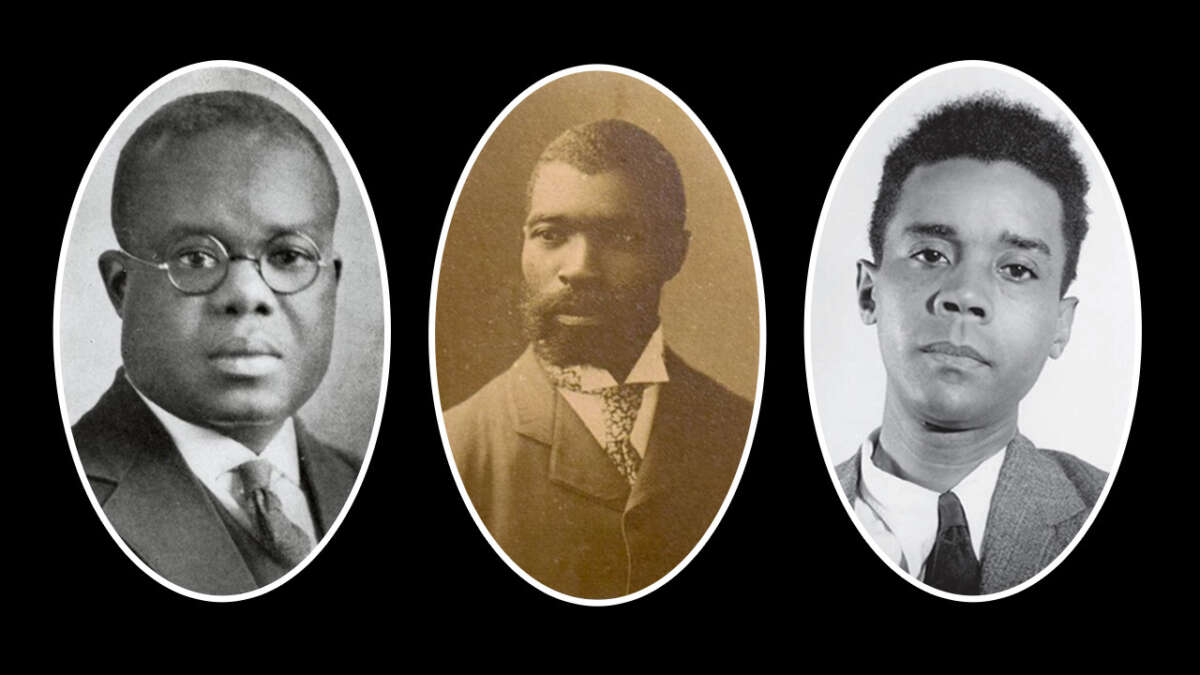
From left to right: Philosophers Hubert Harrison, Thomas N. Baker,
and C. L. R. James.
Given the field of philosophy’s paucity of Black or African American philosophers, it is still something of an oxymoron to be a Black or African American philosopher. It is still possible to get second looks when saying, “Oh, I’m a philosopher.” Being a Black or African American philosopher doesn’t compute within a culture, and within academic settings, where images and discussions of Socrates and Plato or René Descartes and Jean-Paul Sartre dominate what philosophy looks and sounds like. In short, white folk continue to comprise the majority in the field: 81 percent. While most of my philosophical work has focused on the meaning of racial embodiment, especially anti-Blackness, and the structure of whiteness, I had the fortune to write and publish the first (or certainly one of the first) essays on African American philosophers Thomas N. Baker and Joyce M. Cook.
Baker was the first Black man to receive his Ph.D. in philosophy, awarded from Yale in 1903. And it was Cook, a dear friend of mine, who was the first Black woman to receive her Ph.D. in philosophy, also from Yale, in 1965. There is serious work that still needs to be done toward the construction of African American philosophy and primary research within the field. The work is out there — but it requires far more, as it were, archeological study. Many celebrate the history of Black Studies and the canonical figures within it, but have little sense of the existence and powerful work of African American philosophers — which is not to say that these areas are mutually exclusive.
It is for this reason that I decided to conduct this exclusive interview with philosopher Stephen C. Ferguson, a professor in the Department of Philosophy and Religious Studies at North Carolina State University and author of the recent book, The Paralysis of Analysis in African American Studies: Corporate Capitalism and Black Popular Culture. Ferguson is one of the leading philosophers (along with John H. McClendon) whose scholarship has been invaluable in researching, locating, and critically interpreting the history and contemporary relevance of African American philosophy.
George Yancy: When I was an undergraduate studying philosophy in the early 1980s at the University of Pittsburgh, I thought that I was the only Black philosopher in the world. This was partly a function of the fact that I was typically the only Black student sitting in my philosophy classes. I had no idea that there was something called “African American philosophy.” Let’s begin there. What is African American philosophy?
Stephen C. Ferguson: A useful place to begin is with a minimal but clarifying definition. African American philosophy refers, first, to a body of texts written by African American thinkers who themselves understood their work as philosophical. This challenges a long-standing presumption within professional philosophy — that philosophy is defined exclusively by disciplinary recognition rather than by intellectual practice.
Related Story
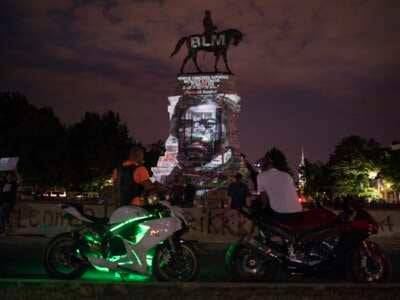
Frederick Douglass’s Words Ring True: “Power Concedes Nothing Without a Demand”
Let’s draw on the defiant wisdom of Frederick Douglass as Trump carries out a blitzkrieg against democracy in the US. By George Yancy , Truthout February 15, 2025
Here the work of Black philosopher and theologian William R. Jones is indispensable. In his seminal essay, “The Legitimacy and Necessity of Black Philosophy: Some Preliminary Considerations,” Jones argued that skepticism toward African American philosophy often rests on a mistaken assumption: that race must function as its essential organizing principle. Subsequently, Jones insisted that African American philosophy is not grounded in biology or some sort of “racial essence.” As he put it, “Black experience, history, and culture are the controlling categories of a Black philosophy — not chromosomes.” In this formulation, “Black” denotes an ethno-cultural formation shaped by shared historical conditions.
This does not mean that questions of race are irrelevant. The philosophy of race is an important subfield within African American philosophy. The mistake lies in assuming that it exhausts the field.
Jones therefore urged that philosophy itself be understood more broadly than narrow professional definitions allow. He proposed attending to factors such as author, audience, historical location, and antagonist. From this standpoint, African American philosophy recognizes the philosopher as situated within a specific ethno-cultural community, often addressing that community as a primary audience. Their philosophical point of departure is a historically specific experience requiring conceptual articulation, frequently from an antagonistic position that challenges academic racism in terms of concepts, curricula, and institutions.
Underlying this account is a distinction between race and ethnicity — or more precisely, between race as a classificatory system imposed through domination and ethnicity or nationality as a historically formed collective shaped by shared institutions and struggle. In the U.S. context, African Americans constitute such a distinctive ethno-national formation — forged through slavery, segregation, labor exploitation, and political resistance within a multinational state.
Following Jones, I also draw an analytic distinction between the history of African American philosophers and the philosophy of the Black experience. The former includes all African American philosophers regardless of topic or method. The latter refers to philosophical projects explicitly devoted to analyzing the meaning and consequences of Black life under determinate social conditions. As the number of African American philosophers grows, so too does the range of philosophical problems addressed — many extending well beyond race as a topic.
As an undergraduate, I knew that Martin Luther King Jr., Frederick Douglass, Angela Davis, and others were activists, but no one told me that they were philosophers or that what they had to say was of philosophical significance. The only person who shared this with me was my mentor James G. Spady. Speak to how important it is that this history be told.
I had a similar experience as an undergraduate at the University of Missouri–Columbia. Philosophy appeared almost entirely detached from Black intellectual life. That changed when I met John H. McClendon III. From that point forward, McClendon and I — very much in the spirit of Marx and Engels — worked collectively to recover and reconstruct the African American philosophical tradition.
One of the most important outcomes of our collaboration is African American Philosophers and Philosophy: An Introduction to the History, Concepts, and Contemporary Issues. The work was the result of years of philosophical reading and archival research. What distinguished that book was not simply that it introduced African American philosophers, but that it introduced philosophy itself through the African American philosophical tradition. Before this, African American thinkers were often treated as supplementary figures or “special” topics. Or we might find, in the case of African American philosopher Charles Leander Hill, someone who writes a history of modern Western philosophy. With A Short History of Modern Philosophy from the Renaissance to Hegel, published in 1951, Hill became the first African American philosopher to publish a book on the history of modern philosophy. No one had seriously asked how to introduce philosophy — its core problems and methods — through African American thought. That intervention remains foundational.
This matters because it challenges the assumption that figures such as Frederick Douglass, Malcolm X, or Angela Davis were merely activists. What our work demonstrates is that Black thinkers have produced sustained philosophical reflection on what are often called the “big questions”: metaphilosophy, ontology, epistemology, philosophy of science, philosophy of religion, philosophy of history, and social philosophy. Even when these questions were not framed explicitly in racial terms, the Black experience formed the historical context of their inquiry.
“Examining Ethics” podcaster Christiane Wisehart once described John and me as “philosophical archaeologists,” and that description is apt. Our work represents a first step in the discovery, recovery, and reconstruction of an African American philosophical canon. We do not claim to have completed that task. The hope is that future generations will build upon this foundation, extending the canon we helped recover.
“Historically, Black philosophical traditions emerged less from philosophy departments than from Black intellectual culture — churches, newspapers, political movements, labor struggles, and independent study.”
African American philosophy is best understood as a species of Black intellectual thought. Historically, Black philosophical traditions emerged less from philosophy departments than from Black intellectual culture — churches, newspapers, political movements, labor struggles, and independent study. This does not sever African American philosophy from European or Anglo-American traditions; it gives it a determinate identity shaped by distinct historical conditions. Without this history, students are left believing Black thinkers are philosophical footnotes rather than world-historical contributors.
In your article, “Marxism, Philosophy, and the Africana World,” you argue that the professionalization of philosophy is rooted in institutional racism. Even as a graduate student in philosophy, at Yale and Duquesne University, I was confronted by a sea of white faces. This continues to be true now that I’m a professional philosopher. Say more about how the professionalization of philosophy is rooted in institutional racism. This issue is especially important as we now face executive and legislative policies designed to erase Black knowledge production. Think here of the March 27, 2025, executive order “Restoring Truth and Sanity to American History,” which is aimed at censoring the full truth about the struggle of Black people in the U.S. This executive order, it seems to me, is another manifestation of racism.
To address this adequately, we must begin from a dialectical materialist standpoint and situate professional philosophy within the historical development of the modern university. Specialization and professionalization were not neutral intellectual advances; they were foundational to the university’s role within capitalist society. The specialization of knowledge led to the emergence of academic disciplines; authority shifted from broad intellectual engagement to credentialed expertise. This process established boundaries between legitimate and illegitimate inquiry.
Certain ideas and figures become hegemonic — what Marx famously described as the ruling ideas of the ruling class — while others are disqualified as philosophy and displaced from the academic marketplace. Marxism, for example, is routinely declared a historic failure or an intellectual dinosaur, even as every waking hour of social life under capitalism is organized around the urgent task of making capitalism function.
The exclusion of African American thinkers from academic institutions must be understood through class location and the organization of labor in the United States. From capitalist slavery to sharecropping, and later industrial wage labor and mass unemployment, African Americans were denied the material conditions — time, security, and institutional continuity — necessary for a stable philosophical intelligentsia. Religious institutions therefore functioned as alternative sites of education and abstraction, much as they did for other oppressed groups within the U.S. multinational state.
“The exclusion of African American thinkers from academic institutions must be understood through class location and the organization of labor in the United States.”
The autodidact materialist philosopher Hubert Harrison, known as the “Black Socrates,” exemplifies this contradiction. He produced systematic philosophical lectures such as “World Problems of Race” and works such as When Africa Awakes, yet was denied recognition precisely because his philosophy was embedded in Black working-class political culture rather than professional philosophy.
Dialectical analysis requires us to go further. Even when partial inclusion occurred, new constraints emerged. There remain “ruling ideas” that restrict what African American philosophy is permitted to be — shaping not only who is recognized as a philosopher, but which questions can be asked without professional penalty.
If we examine African American political philosophy across the long Cold War — from the 1950s to the present — a striking pattern emerges. Many African American philosophers aligned themselves with variants of social contract theory — a framework historically used to legitimate bourgeois democracy. From William Fontaine to Bernard Boxill to Charles Mills, one finds a persistent commitment to anti-communist liberalism — often “radicalized,” but liberalism nonetheless. Structural critiques of capitalism, imperialism, and class power are often displaced in favor of moral critique or legal reform. This has been very evident during the Reign of Emperor Trump.
The irony is profound. African American philosophers are often presented as ruthless critics of racism and white supremacy, yet the dominant theoretical orientation has largely avoided questions about the compatibility of capitalism with Black liberation, or the material limits of liberal (bourgeois) democracy.
August Nimtz and Kyle A. Edwards’s work The Communist and the Revolutionary Liberal in the Second American Revolution is instructive. It offers a real-time comparison of Karl Marx and Frederick Douglass during the struggle to abolish slavery. Marx’s and Engels’s writings on the U.S. Civil War reveal abolition not simply as a moral triumph, but as a world-historical rupture between competing social systems: capitalist slavery and industrial capitalism.
By placing Douglass’s liberalism alongside Marx’s scientific socialism, Nimtz and Edwards show that while liberalism was powerful in mobilizing moral outrage, Marxism offered a deeper structural explanation of why capitalist slavery had to be abolished. It was not the fulfillment of liberal democracy, but a contradictory breakthrough that generated new forms of labor exploitation.
The point is not to denigrate Douglass, but to clarify (via philosophical interpretation) the theoretical stakes. Liberalism and Marxism offer fundamentally different diagnoses of power and social change. To remain within liberalism is to risk mistaking reform for revolution.
You’re a Marxist-Leninist philosopher and an African American philosopher. Talk about the complexity of your identity. What does Marxist-Leninist philosophy have to teach African American philosophy and vice versa?
As a good dialectician, I have to point out that the question presumes a distinction that I do not accept. It assumes that Marxist-Leninist philosophy and African American philosophy are identities to be reconciled. My own formation suggests a different starting point.
I grew up in a Black working-class community in the Midwest, raised by parents whose political sensibilities were shaped by the Black Power movement. That environment formed my social consciousness long before I had a philosophical vocabulary. As a young ravenous reader, I consumed whatever was available — Dumas’s The Count of Monte Cristo, Dickens’s Hard Times and Great Expectations, Langston Hughes, Luke Cage comics, popular history, and political biography — until encountering The Autobiography of Malcolm X, which became a moment of nationalist awakening. That awakening unfolded against the backdrop of deindustrialization, urban decay, and the hollowing out of working-class life in the 1980s and 1990s. The racial character of that devastation was obvious, but so too was its class content. So, my philosophical journey became understanding the class character of racism and national oppression, its roots in world capitalism. This required me to read Marx’s politico-economic works, particularly Das Kapital; Vladimir Lenin’s text, Imperialism, The Highest Stage of Capitalism; and Kwame Nkrumah’s Neo-Colonialism, the Last Stage of Imperialism. I should add I read C. L. R. James’s masterpiece Black Jacobins in high school.
There is no neat progression “from race to class,” no linear movement from identity to politics. My racial and class consciousness emerged together, forged by the same historical conditions. I became who I was because I am a product of my time. This is precisely the point Marx makes when he reminds us that philosophers do not emerge fully formed from abstract reflection, but from material life itself:
Philosophers do not spring up like mushrooms out of the ground; they are products of their time, of their nation, whose most subtle, valuable and invisible juices flow in the ideas of philosophy. The same spirit that constructs railways with the hands of workers, constructs philosophical systems in the brains of philosophers. Philosophy does not exist outside the world, any more than the brain exists outside man…
My Marxist-Leninist orientation, then, was not an identity choice layered onto an already-formed Blackness. Blackness shaped my motivation; dialectical and historical materialism shaped my method of investigation. That distinction has guided my work ever since.
As I was coming of age philosophically, I intensively read Black philosophers debating whether philosophy could be meaningfully adjoined to Blackness. Against William Banner’s insistence that philosophy must transcend Blackness, Roy D. Morrison (among others) posed a deeper challenge: whether Enlightenment reason itself could be reconstituted from the standpoint of Black historical experience — a project that reads as a prolegomenon to any future Black Enlightenment. Those debates raised a fundamental question: Is Blackness a philosophical perspective, or is it an object of philosophical investigation?
Here Black Studies becomes decisive. Its relationship to the philosophy of the Black experience is analogous to that between physics and the philosophy of physics. Black Studies created the intellectual space in which Blackness could be studied systematically as a material and historical phenomenon rather than treated as a deviation from an assumed universal norm. Philosophy is a critical tool among others for conceptual clarification, critique, and synthesis. It is therefore no accident that early work in the philosophy of the Black experience appeared first in Black Studies venues rather than in philosophy journals, which were far slower to recognize Black life as a legitimate object of philosophical inquiry.
It was through my engagement with Black Studies that I came to understand the limits of bourgeois democracy. And yet, professional philosophy treats bourgeois democracy as the natural — and often the only — horizon of political legitimacy. Among many African American philosophers, this assumption largely goes unchallenged. Questions about justice, rights, and citizenship are routinely framed within liberal constitutionalism, while alternative democratic traditions and historical experiences are left unexplored. Where, for example, are the sustained philosophical engagements with democracy in Cuba, Venezuela under Hugo Chávez, or the Soviet Union? What might these experiences teach us about popular sovereignty, collective decision-making, and mass participation beyond the limits of bourgeois democracy?
This silence reflects the long Cold War repression of socialist political thought. It is therefore telling that figures such as Marxist philosopher C. L. R. James remain marginal within contemporary philosophy curricula. James’s Every Cook Can Govern, a profound meditation on democracy from ancient Greece to modern socialism, should be central to any serious discussion of democratic theory.
As McClendon put it succinctly, Blackness provides the motivation for doing philosophy, not the philosophical orientation. I take that formulation seriously. Marxism-Leninism offers African American philosophy the analytic tools to examine capitalism, imperialism, and the state as material systems shaping Black life. The relationship, then, is not one of identity complexity or reconciliation, but of theoretical necessity.
As African American philosophers, we must do more to get African American students to pursue the field professionally. What strategy do you suggest?
Any serious strategy must begin with an honest reckoning with the history of the American Philosophical Association (APA) and its attendant academic racism.
This was already clear in 1974, when Jones issued concrete recommendations to the APA: placement services, rosters of Black philosophers, surveys of philosophy at Black institutions, graduate fellowships, colloquia on Black philosophy, curriculum development, and the upgrading of philosophy at Black colleges. Since that time, the philosophical landscape has not moved beyond the horizon Jones set. Incremental progress has occurred, yet the overall number of African American philosophers has remained low.
We can no longer wait for professional philosophy to magically deliver Black students into the discipline. We must build our own institutional infrastructure — connected to the academy but not dependent on its permission, promises, or resources.
“Our struggle is an intergenerational relay race: We inherit unfinished questions and are accountable for carrying them forward. No one is coming to do this work for us. The future belongs to those who build.”
Changes in professional philosophy will come through institution-building and long-term strategy, not spontaneity. We must create layered spaces of intellectual formation — archival recovery, collective study, political education, and intergenerational mentorship — inside and outside the academy. Only through institution-building will we sustain a Black philosophical community that revisits core problems at increasing levels of rigor over time.
Forward ever, backward never!
In a moment when Black Studies and ethnic studies face sustained political attack, building independent yet affiliated philosophical infrastructure is not separatism; it is institutional realism.
Our strategy cannot rest on persuasion alone; persuasion presumes institutions are willing to act. History suggests otherwise. What is required is construction. Our struggle is an intergenerational relay race: We inherit unfinished questions and are accountable for carrying them forward. No one is coming to do this work for us. The future belongs to those who build.
This article is licensed under Creative Commons (CC BY-NC-ND 4.0), and you are free to share and republish under the terms of the license.
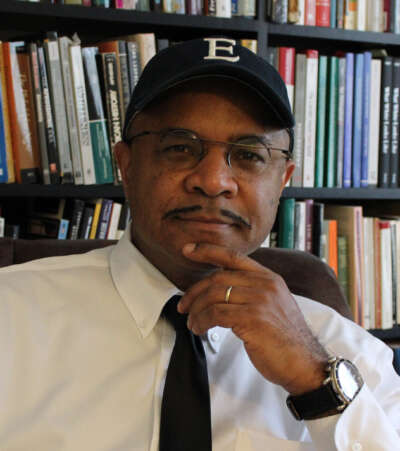
George Yancy
George Yancy is the Samuel Candler Dobbs professor of philosophy at Emory University and a Montgomery fellow at Dartmouth College. He is also the University of Pennsylvania’s inaugural fellow in the Provost’s Distinguished Faculty Fellowship Program (2019-2020 academic year). He is the author, editor and co-editor of over 25 books, including Black Bodies, White Gazes; Look, A White; Backlash: What Happens When We Talk Honestly about Racism in America; and Across Black Spaces: Essays and Interviews from an American Philosopher published by Rowman & Littlefield in 2020. His most recent books include a collection of critical interviews entitled, Until Our Lungs Give Out: Conversations on Race, Justice, and the Future (Rowman & Littlefield, 2023), and a coedited book (with philosopher Bill Bywater) entitled, In Sheep’s Clothing: The Idolatry of White Christian Nationalism (Roman & Littlefield, 2024).
Clementine Barnabet: The Black woman blamed for serial murders in the Jim Crow South
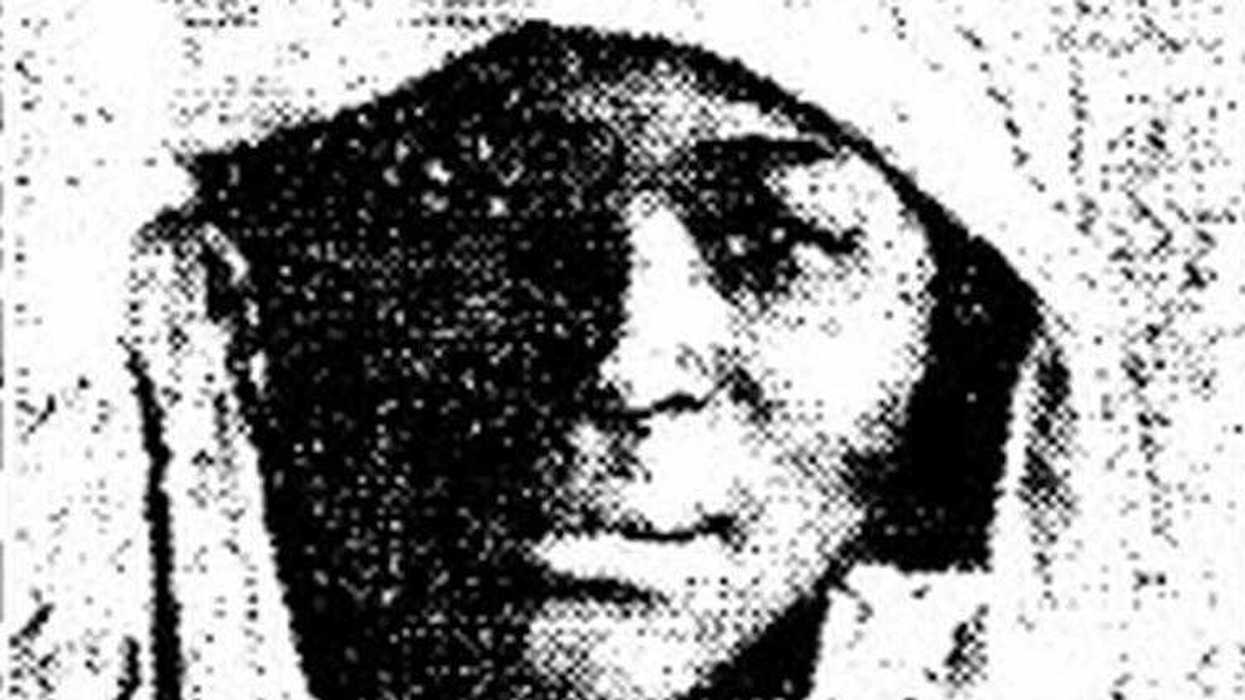
A grainy photograph of Clementine Barnabet.
A grainy photograph of Clementine Barnabet.
A 1912 edition of The Atlanta Constitution newspaper via Wikimedia Commons Lauren Nicole Henley, University of Richmond
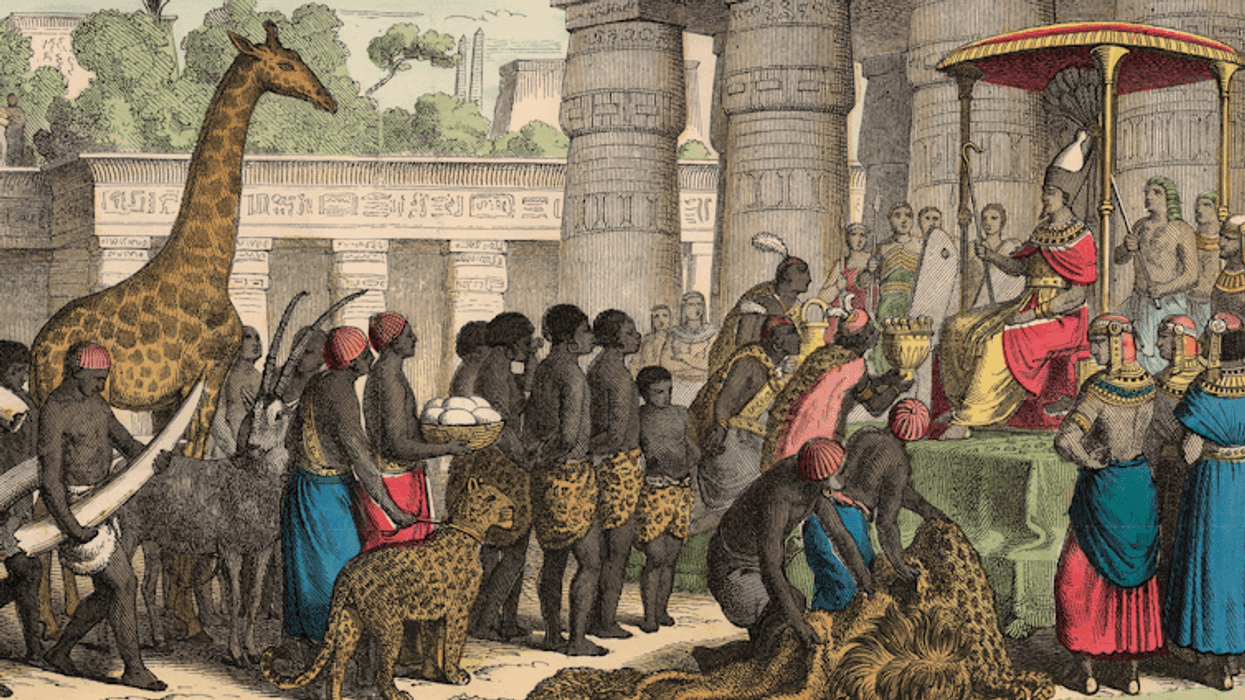
When Napoleon embarked upon a military expedition into Egypt in 1798, he brought with him a team of scholars, scientists and artists. Together, they produced the monumental “Description de l’Égypte,” a massive, multivolume work about Egyptian geography, history and culture.
At the time, the United States was a young nation with big aspirations, and Americans often viewed their country as an heir to the great civilizations of the past. The tales of ancient Egypt that emerged from Napoleon’s travels became a source of fascination to Americans, though in different ways.
In the slaveholding South, ancient Egypt and its pharaohs became a way to justify slavery. For abolitionists and African Americans, biblical Egypt served as a symbol of bondage and liberation.
As a historian, I study how 19th-century Americans – from Southern intellectuals to Black abolitionists – used ancient Egypt to debate questions of race, civilization and national identity. My research traces how a distorted image of ancient Egypt shaped competing visions of freedom and hierarchy in a deeply divided nation.
Egypt inspires the pro-slavery South
In 1819, when lawyer John Overton, military officer James Winchester and future president Andrew Jackson founded a city in Tennessee along the Mississippi River, they christened it Memphis, after the ancient Egyptian capital.
While promoting the new city, Overton declared of the Mississippi River that ran alongside it: “This noble river may, with propriety, be denominated the American Nile.”
“Who can tell that she may not, in time, rival … her ancient namesake, of Egypt in classic elegance and art?” The Arkansas Banner excitedly reported.
In the region’s fertile soil, Chancellor William Harper, a jurist and pro-slavery theorist from South Carolina, saw the promise of an agricultural empire built on slavery, one “capable of being made a far greater Egypt.”
There was a reason pro-slavery businessmen and thinkers were energized by the prospect of an American Egypt: Many Southern planters imagined themselves as guardians of a hierarchical and aristocratic system, one grounded in landownership, tradition and honor. As Alabama newspaper editor William Falconer put it, he and his fellow white Southerners belonged to a race that “had established law, order and government over the earth.”
To them, Egypt represented the archetype of a great hierarchical civilization. Older than Athens or Rome, Egypt conferred a special legitimacy. And just like the pharaohs, the white elites of the South saw themselves as the stewards of a prosperous society sustained by enslaved labor.
Leading pro-slavery thinkers like Virginia social theorist George Fitzhugh, South Carolina lawyer and U.S. Senator Robert Barnwell Rhett and Georgia lawyer and politician Thomas R.R. Cobb all invoked Egypt as an example to follow.
“These [Egyptian] monuments show negro slaves in Egypt at least 1,600 years before Christ,” Cobb wrote in 1858. “That they were the same happy negroes of this day is proven by their being represented in a dance 1,300 years before Christ.”
A distorted view of history
But their view of history didn’t exactly square with reality. Slavery did exist in ancient Egypt, but most slaves had been originally captured as prisoners of war.
The country never developed a system of slavery comparable to that of Greece or Rome, and servitude was neither race-based nor tied to a plantation economy. The mistaken notion that Egypt’s great monuments were built by slaves largely stems from ancient authors and the biblical account of the Hebrews. Later, popular culture – especially Hollywood epics – would continue to advance this misconception.
Nonetheless, 19th-century Southern intellectuals drew on this imagined Egypt to legitimize slavery as an ancient and divinely sanctioned institution.
Even after the Civil War, which ended in 1865, nostalgia for these myths of ancient Egypt endured. In the 1870s, former Confederate officer Edward Fontaine noted how “Veritable specimens of black, woolyheaded negroes are represented by the old Egyptian artists in chains, as slaves, and even singing and dancing, as we have seen them on Southern plantations in the present century.”
Turning Egypt white
But to claim their place among the world’s great civilizations, Southerners had to reconcile a troubling fact: Egypt was located in Africa, the ancestral land of those enslaved in the U.S.
In response, an intellectual movement called the American School of Ethnology – which promoted the idea that races had separate, unequal origins to justify Black inferiority and slavery – set out to “whiten” Egypt.
In a series of texts and lectures, they portrayed Egypt as a slaveholding civilization dominated by whites. They pointed to Egyptian monuments as proof of the greatness that a slave society could achieve. And they also promoted a scientifically discredited theory called “polygenesis,” which argued that Black people did not descend from the Bible’s Adam, but from some other source.
Richard Colfax, the author of the 1833 pamphlet “Evidence Against the Views of the Abolitionists,” insisted that “the Egyptians were decidedly of the Caucasian variety of men.” Most mummies, he added, “bear not the most distant resemblance to the negro race.”
Physician Samuel George Morton cited “Crania Aegyptiaca,” an 1822 German study of Egyptian skulls, to reinforce this view. Writing in the Charleston Medical Journal in 1851, he explained how the German study had concluded that the skulls mirrored those of Europeans in size and shape. In doing so, it established “the negro his true position as an inferior race.”
Physician Samuel George Morton’s “Crania Aegyptiaca,” an 1844 study of Egyptian skulls, reinforced this view. He argued that the skulls mirrored those of Europeans in size and shape. In doing so, noted the Charleston Medical Journal in 1851, Morton established “the Negro his true position as an inferior race.”
Physician Josiah C. Nott, Egyptologist George Gliddon and physician and propagandist John H. Van Evrie formed an effective triumvirate: Through press releases and public lectures featuring the skulls of mummies, they turned Egyptology into a tool of pro-slavery propaganda.
“The Negro question was the one I wished to bring out,” Nott wrote, adding that he “embalmed it in Egyptian ethnography.”
Nott and Gliddon’s 1854 bestseller “Types of Mankind” fused pseudoscience with Egyptology to both “prove” Black inferiority and advance the idea that their beloved African civilization was populated by a white Egyptian elite.
“Negroes were numerous in Egypt,” they write, “but their social position in ancient times was the same that it now is, that of servants and slaves.”
Denouncing America’s pharaohs
This distorted vision of Egypt, however, wasn’t the only one to take hold in the U.S., and abolitionists saw this history through a decidedly different lens.
In the Bible, Egypt occupies a central place, mentioned repeatedly as a land of refuge – notably for Joseph – but also as a nation of idolatry and as the cradle of slavery.
The episode of the Exodus is perhaps the most famous reference. The Hebrews, enslaved under an oppressive pharaoh, are freed by Moses, who leads them to the Promised Land, Canaan. This biblical image of Egypt as a land of bondage deeply shaped 19th-century moral and political debates: For many abolitionists, it represented the ultimate symbol of tyranny and human oppression.
When the Emancipation Proclamation went into effect on Jan. 1, 1863, Black people could be heard singing in front of the White House, “Go down Moses, way down in Egypt Land … Tell Jeff Davis to let my people go.”
Black Americans seized upon this biblical parallel. Confederate President Jefferson Davis was a contemporary pharaoh, with Moses still the prophet of liberation.
African American writers and activists like Phillis Wheatley and Sojourner Truth also invoked Egypt as a tool of emancipation.
“In every human breast, God has implanted a principle, which we call love of freedom,” Wheatley wrote in a 1774 letter. “It is impatient of oppression and pants for deliverance; and by the leave of our modern Egyptians, I will assert that the same principle lives in us.”
Yet the South’s infatuation with Egypt shows how antiquity can always be recast to serve the powerful. And it’s a reminder that the past is far from neutral terrain – that there is rarely, if ever, a ceasefire in wars over history and memory.
This article has been updated to correctly attribute Samuel George Morton as the author of “Crania Aegyptiaca,” not as the author of the Charleston Medical Journal article. Quoted texts from Phillis Wheatley and William Falconer have also been slightly amended for accuracy.
Charles Vanthournout, Ph.D. Student in Ancient History, Université de Lorraine
This article is republished from The Conversation under a Creative Commons license. Read the original article.
February 19, 2026
In April 1912, a young Black woman named Clementine Barnabet confessed to murdering four families in and around Lafayette, Louisiana. The widespread news coverage at the time effectively branded her a serial killer.
Her confession, however, did not align with the timeline of crimes that had gripped America’s rice belt region with fear. Even today, her guilt is debated.
From November 1909 until August 1912, an unknown assailant – or assailants – zigzagged across southwestern Louisiana and southeastern Texas. Many Black families were slaughtered in their homes under the cover of darkness. An ax – the telltale weapon – was almost always found in the bloody aftermath.
All but one of the scenes were located within a mile of the Southern Pacific Railroad’s Sunset Route. In each case, a mother and child were always among the victims. Evidence of additional weapons was often found nearby, suggesting a deliberate cruelty to the carnage.
Dubbed the “axman”, the unknown assailant eluded the authorities and terrified local Black communities.
Today, when scholars and laypeople alike discuss Clementine Barnabet, they oscillate between two extremes: portraying her as a fear-inducing, cult-leading Black female serial killer, or as an innocent young Black woman caught in circumstances beyond her control.
In more than a decade of researching Clementine Barnabet, I’ve been struck by how print media created overtly sensationalized accounts of the mythology of the axman and, by extension, the axwoman. Whether Barnabet committed the crimes she said she did – or any of the axman murders, for that matter – is irrelevant to the primary motive the media constructed for her fatal violence: religion.
Diverse faith traditions
In Jim Crow Louisiana, various expressions of faith were possible. The state’s history as a French colony – one that also practiced slavery – meant it was home to the largest percentage of Black Catholics in the United States.
At the same time, religions like Voodoo, that originated in West Africa, reached the region on slave ships. Voodoo was not necessarily at odds with Catholicism; enslaved practitioners creatively adapted their ancestral faith to that of their enslavers.
Some displays of faith were not organized religions at all, but folkways. Hoodoo, for example, has West African origins, though it also draws upon European and Native American elements. Hoodoo practitioners – sometimes called doctors – and their clients often practice a religion, yet they also seek comfort in the supernatural possibilities of their craft.
This craft involves the physical manipulation of earthly elements such as graveyard dirt or plants like John the Conqueror root to achieve magical ends, often resulting in conjures – or ritual objects – needed to bring about desired goals. Conjures are believed to help people protect themselves, harm one’s adversaries, alter one’s circumstances, intervene in one’s relationships and more.
In their most powerful form, believers contend that conjures can bring about a person’s death.
For some believers, elements of Catholicism, Voodoo, Protestantism and hoodoo combine into syncretic faith practices. Incorporating multiple systems of beliefs has been an aspect of many Louisianans’ identities for generations. Most of the time, this blending of practices, ideologies and communities is depicted as a quirky – even “backward” – way to make sense of the world.
Yet during the axman’s reign in the early 1900s, a Black woman’s confession to murder was interpreted through the lens of religious deviance rather than diversity.
A timeline of events
When Barnabet confessed in April 1912, it was technically the second time she had done so. The first time was in November 1911 in the aftermath of the Randall family murder. Five members of the Randall family and their overnight guest had been brutally slaughtered in Lafayette, Louisiana at the end of the month.
According to regional newspapers, Barnabet was in the crowd that had gathered near the Randall family’s home after the murders were discovered. Reportedly, she caught the attention of the local sheriff. Not only did she live near the slain, but, according to a New Orleans daily, the authorities found “her room saturated with blood and covered with human brains.”
Barnabet was given a “third degree” examination – meaning she was tortured – by the New Orleans Police Department, and then supposedly confessed that she had killed the Randalls because, according to a Midwestern newspaper, they “disobeyed the orders of the church.” That church would become a topic of scrutiny and sensationalism by regional lawmen and news outlets alike throughout much of 1912.
At that time, Barnabet is also said to have confessed to killing another family in Lafayette.
Thus, Barnabet had already been in jail for over four months before her springtime confession. Between January and March 1912, four more families had been axed to death between Crowley, Louisiana and Glidden, Texas. In April, when Barnabet re-confessed, she added two more families to her victim roster.
In aggregate, the four families Barnabet confessed to killing had been slain between November 1909 and November 1911. Four more families had been murdered between her arrest and second confession, meaning she was in jail when they occurred. After her second confession and while she was still in custody, another three families were attacked with an ax, though for the first time, people survived the axman.
This convoluted timeline, in which more than half of the axman murders occurred after Barnabet had been apprehended, presented a challenge for investigators. They generally believed the crimes were related. Yet Barnabet could not have physically carried out the attacks in 1912.
To explain the continuation of the killings despite Barnabet’s incarceration, local lawmen leveraged the young woman’s own statements that had landed her in jail in the first place: that religion compelled her to murder.
It was this November 1911 confession that gave investigators the motive of religious fanaticism to attach to the axman crimes. Then, in January 1912, when the Broussards – another Black family – were murdered with an ax in Lake Charles, Louisiana, the local police found a Bible verse scrawled on their front door. This overtly religious symbol appeared roughly two months after Barnabet’s first confession and seemed to confirm her claims.
By April 1912, the idea of religiously motivated serial murder had been circulating in the rice belt region for months.
Hoodoo, conjures, and sensationalism
Barnabet’s confession was transcribed by R. H. Broussard (no relation to the victims), a newspaper reporter for the “New Orleans Item,” in April 1912.
According to the report, Barnabet claimed that she and four friends purchased conjures from a local hoodoo doctor one evening while socializing. They paid the practitioner for his services. Supposedly, the group then used the charms to move about undetected while committing murder.
In both her November 1911 and April 1912 confessions, Barnabet offered faith-based motives, albeit different ones. In the first case, it was the victims who reportedly erred in their religious duties. In the second, it was Barnabet’s own belief in hoodoo that facilitated such carnage. White media outlets did not interpret either of these statements as evidence of the region’s deep history of diverse faith expressions.
Instead, they labeled Barnabet “a black borgia,” “the directing head of a fanatical cult,” and the “Priestess of [a] Colored Human Sacrifice Cult.”
Moreover, sensationalized news coverage labeled the church Barnabet mentioned as the “Sacrifice Church.” Not surprisingly, the press depicted it as a cult-like organization, portraying Barnabet as either a low-level member or the “high priestess.” Sometimes, news reports also conflated the Sacrifice Church with Voodoo, thereby criminalizing a legitimate West African-derived religion as a cult.
According to unsubstantiated media accounts, the so-called Sacrifice Church promoted human sacrifice to gain immortality. Simultaneously, newspapers treated the conjure Barnabet possessed as proof of her fanaticism, reporting her claim that the only reason she confessed was because she had lost her charm.
Combined these selective – and sensational – interpretations of Barnabet’s supposed religious beliefs ignored the possibility of diverse spiritual practices that enriched life in the rice belt region.
Jim Crow and Black faith
I have yet to find evidence the Sacrifice Church existed. My research suggests the white press conflated the word “sacrifice” with the word “sanctified.” This might have been due, in part, to both sensationalism and ignorance.
Pentecostalism, a branch of evangelical Christianity that emphasizes baptism by the Holy Spirit and direct communication from God, started growing in popularity in the U.S. in the early 1900s. Many Pentecostal denominations call their adherents saints and their churches sanctified. Since sanctified churches were relatively new to Louisiana and some Pentecostal teachings – like speaking in tongues – challenged more mainstream Protestant doctrine, Pentecostalism might have contributed to the media’s reporting.
Although the Sacrifice Church may have simply been a linguistic error in reference to any number of sanctified churches in the rice belt, it is possible that Barnabet did indeed possess a conjure. The hoodoo doctor she accused of selling her and her comrades their charms was arrested and questioned by the Lafayette authorities. The statements he gave to the police aligned with hoodoo practices even as he denied knowing Barnabet or being involved in such folkways.
Given the variety of faith practices in Jim Crow Louisiana, it is possible both that Barnabet believed in her conjure and that sanctified churches were growing in popularity in the region. Whether she ever attended one is hard to know, just as the legitimacy of either confession is difficult to determine.
What is clear is that faith anchored the statements Barnabet made to the authorities. The other anchor, however, was murder. The consequences of how these events aligned reverberate in how Barnabet has been depicted.
Barnbet was front-page news in 1912. People knew her name, even as they debated her guilt. When she was convicted of murder, she was sentenced to life at the Louisiana State Penitentiary. A little over a decade later, she was released and disappeared from public view.
Today, however, no Black female serial killer occupies a similar place in America’s collective memory.
In recent years, there have been calls for a more serious acceptance of Black women’s experiences, knowledge and beliefs within the dominant culture. This shift also invites, I believe, a fresh look at Barnabet’s confessions and the crimes that were attributed to her.
Lauren Nicole Henley, Assistant Professor of Leadership Studies, University of Richmond
This article is republished from The Conversation under a Creative Commons license. Read the original article.
Her confession, however, did not align with the timeline of crimes that had gripped America’s rice belt region with fear. Even today, her guilt is debated.
From November 1909 until August 1912, an unknown assailant – or assailants – zigzagged across southwestern Louisiana and southeastern Texas. Many Black families were slaughtered in their homes under the cover of darkness. An ax – the telltale weapon – was almost always found in the bloody aftermath.
All but one of the scenes were located within a mile of the Southern Pacific Railroad’s Sunset Route. In each case, a mother and child were always among the victims. Evidence of additional weapons was often found nearby, suggesting a deliberate cruelty to the carnage.
Dubbed the “axman”, the unknown assailant eluded the authorities and terrified local Black communities.
Today, when scholars and laypeople alike discuss Clementine Barnabet, they oscillate between two extremes: portraying her as a fear-inducing, cult-leading Black female serial killer, or as an innocent young Black woman caught in circumstances beyond her control.
In more than a decade of researching Clementine Barnabet, I’ve been struck by how print media created overtly sensationalized accounts of the mythology of the axman and, by extension, the axwoman. Whether Barnabet committed the crimes she said she did – or any of the axman murders, for that matter – is irrelevant to the primary motive the media constructed for her fatal violence: religion.
Diverse faith traditions
In Jim Crow Louisiana, various expressions of faith were possible. The state’s history as a French colony – one that also practiced slavery – meant it was home to the largest percentage of Black Catholics in the United States.
At the same time, religions like Voodoo, that originated in West Africa, reached the region on slave ships. Voodoo was not necessarily at odds with Catholicism; enslaved practitioners creatively adapted their ancestral faith to that of their enslavers.
Some displays of faith were not organized religions at all, but folkways. Hoodoo, for example, has West African origins, though it also draws upon European and Native American elements. Hoodoo practitioners – sometimes called doctors – and their clients often practice a religion, yet they also seek comfort in the supernatural possibilities of their craft.
This craft involves the physical manipulation of earthly elements such as graveyard dirt or plants like John the Conqueror root to achieve magical ends, often resulting in conjures – or ritual objects – needed to bring about desired goals. Conjures are believed to help people protect themselves, harm one’s adversaries, alter one’s circumstances, intervene in one’s relationships and more.
In their most powerful form, believers contend that conjures can bring about a person’s death.
For some believers, elements of Catholicism, Voodoo, Protestantism and hoodoo combine into syncretic faith practices. Incorporating multiple systems of beliefs has been an aspect of many Louisianans’ identities for generations. Most of the time, this blending of practices, ideologies and communities is depicted as a quirky – even “backward” – way to make sense of the world.
Yet during the axman’s reign in the early 1900s, a Black woman’s confession to murder was interpreted through the lens of religious deviance rather than diversity.
A timeline of events
When Barnabet confessed in April 1912, it was technically the second time she had done so. The first time was in November 1911 in the aftermath of the Randall family murder. Five members of the Randall family and their overnight guest had been brutally slaughtered in Lafayette, Louisiana at the end of the month.
According to regional newspapers, Barnabet was in the crowd that had gathered near the Randall family’s home after the murders were discovered. Reportedly, she caught the attention of the local sheriff. Not only did she live near the slain, but, according to a New Orleans daily, the authorities found “her room saturated with blood and covered with human brains.”
Barnabet was given a “third degree” examination – meaning she was tortured – by the New Orleans Police Department, and then supposedly confessed that she had killed the Randalls because, according to a Midwestern newspaper, they “disobeyed the orders of the church.” That church would become a topic of scrutiny and sensationalism by regional lawmen and news outlets alike throughout much of 1912.
At that time, Barnabet is also said to have confessed to killing another family in Lafayette.
Thus, Barnabet had already been in jail for over four months before her springtime confession. Between January and March 1912, four more families had been axed to death between Crowley, Louisiana and Glidden, Texas. In April, when Barnabet re-confessed, she added two more families to her victim roster.
In aggregate, the four families Barnabet confessed to killing had been slain between November 1909 and November 1911. Four more families had been murdered between her arrest and second confession, meaning she was in jail when they occurred. After her second confession and while she was still in custody, another three families were attacked with an ax, though for the first time, people survived the axman.
This convoluted timeline, in which more than half of the axman murders occurred after Barnabet had been apprehended, presented a challenge for investigators. They generally believed the crimes were related. Yet Barnabet could not have physically carried out the attacks in 1912.
To explain the continuation of the killings despite Barnabet’s incarceration, local lawmen leveraged the young woman’s own statements that had landed her in jail in the first place: that religion compelled her to murder.
It was this November 1911 confession that gave investigators the motive of religious fanaticism to attach to the axman crimes. Then, in January 1912, when the Broussards – another Black family – were murdered with an ax in Lake Charles, Louisiana, the local police found a Bible verse scrawled on their front door. This overtly religious symbol appeared roughly two months after Barnabet’s first confession and seemed to confirm her claims.
By April 1912, the idea of religiously motivated serial murder had been circulating in the rice belt region for months.
Hoodoo, conjures, and sensationalism
Barnabet’s confession was transcribed by R. H. Broussard (no relation to the victims), a newspaper reporter for the “New Orleans Item,” in April 1912.
According to the report, Barnabet claimed that she and four friends purchased conjures from a local hoodoo doctor one evening while socializing. They paid the practitioner for his services. Supposedly, the group then used the charms to move about undetected while committing murder.
In both her November 1911 and April 1912 confessions, Barnabet offered faith-based motives, albeit different ones. In the first case, it was the victims who reportedly erred in their religious duties. In the second, it was Barnabet’s own belief in hoodoo that facilitated such carnage. White media outlets did not interpret either of these statements as evidence of the region’s deep history of diverse faith expressions.
Instead, they labeled Barnabet “a black borgia,” “the directing head of a fanatical cult,” and the “Priestess of [a] Colored Human Sacrifice Cult.”
Moreover, sensationalized news coverage labeled the church Barnabet mentioned as the “Sacrifice Church.” Not surprisingly, the press depicted it as a cult-like organization, portraying Barnabet as either a low-level member or the “high priestess.” Sometimes, news reports also conflated the Sacrifice Church with Voodoo, thereby criminalizing a legitimate West African-derived religion as a cult.
According to unsubstantiated media accounts, the so-called Sacrifice Church promoted human sacrifice to gain immortality. Simultaneously, newspapers treated the conjure Barnabet possessed as proof of her fanaticism, reporting her claim that the only reason she confessed was because she had lost her charm.
Combined these selective – and sensational – interpretations of Barnabet’s supposed religious beliefs ignored the possibility of diverse spiritual practices that enriched life in the rice belt region.
Jim Crow and Black faith
I have yet to find evidence the Sacrifice Church existed. My research suggests the white press conflated the word “sacrifice” with the word “sanctified.” This might have been due, in part, to both sensationalism and ignorance.
Pentecostalism, a branch of evangelical Christianity that emphasizes baptism by the Holy Spirit and direct communication from God, started growing in popularity in the U.S. in the early 1900s. Many Pentecostal denominations call their adherents saints and their churches sanctified. Since sanctified churches were relatively new to Louisiana and some Pentecostal teachings – like speaking in tongues – challenged more mainstream Protestant doctrine, Pentecostalism might have contributed to the media’s reporting.
Although the Sacrifice Church may have simply been a linguistic error in reference to any number of sanctified churches in the rice belt, it is possible that Barnabet did indeed possess a conjure. The hoodoo doctor she accused of selling her and her comrades their charms was arrested and questioned by the Lafayette authorities. The statements he gave to the police aligned with hoodoo practices even as he denied knowing Barnabet or being involved in such folkways.
Given the variety of faith practices in Jim Crow Louisiana, it is possible both that Barnabet believed in her conjure and that sanctified churches were growing in popularity in the region. Whether she ever attended one is hard to know, just as the legitimacy of either confession is difficult to determine.
What is clear is that faith anchored the statements Barnabet made to the authorities. The other anchor, however, was murder. The consequences of how these events aligned reverberate in how Barnabet has been depicted.
Barnbet was front-page news in 1912. People knew her name, even as they debated her guilt. When she was convicted of murder, she was sentenced to life at the Louisiana State Penitentiary. A little over a decade later, she was released and disappeared from public view.
Today, however, no Black female serial killer occupies a similar place in America’s collective memory.
In recent years, there have been calls for a more serious acceptance of Black women’s experiences, knowledge and beliefs within the dominant culture. This shift also invites, I believe, a fresh look at Barnabet’s confessions and the crimes that were attributed to her.
Lauren Nicole Henley, Assistant Professor of Leadership Studies, University of Richmond
This article is republished from The Conversation under a Creative Commons license. Read the original article.
Pharaohs in Dixieland: How 19th-century America reimagined Egypt to justify slavery
February 19, 2026
When Napoleon embarked upon a military expedition into Egypt in 1798, he brought with him a team of scholars, scientists and artists. Together, they produced the monumental “Description de l’Égypte,” a massive, multivolume work about Egyptian geography, history and culture.
At the time, the United States was a young nation with big aspirations, and Americans often viewed their country as an heir to the great civilizations of the past. The tales of ancient Egypt that emerged from Napoleon’s travels became a source of fascination to Americans, though in different ways.
In the slaveholding South, ancient Egypt and its pharaohs became a way to justify slavery. For abolitionists and African Americans, biblical Egypt served as a symbol of bondage and liberation.
As a historian, I study how 19th-century Americans – from Southern intellectuals to Black abolitionists – used ancient Egypt to debate questions of race, civilization and national identity. My research traces how a distorted image of ancient Egypt shaped competing visions of freedom and hierarchy in a deeply divided nation.
Egypt inspires the pro-slavery South
In 1819, when lawyer John Overton, military officer James Winchester and future president Andrew Jackson founded a city in Tennessee along the Mississippi River, they christened it Memphis, after the ancient Egyptian capital.
While promoting the new city, Overton declared of the Mississippi River that ran alongside it: “This noble river may, with propriety, be denominated the American Nile.”
“Who can tell that she may not, in time, rival … her ancient namesake, of Egypt in classic elegance and art?” The Arkansas Banner excitedly reported.
In the region’s fertile soil, Chancellor William Harper, a jurist and pro-slavery theorist from South Carolina, saw the promise of an agricultural empire built on slavery, one “capable of being made a far greater Egypt.”
There was a reason pro-slavery businessmen and thinkers were energized by the prospect of an American Egypt: Many Southern planters imagined themselves as guardians of a hierarchical and aristocratic system, one grounded in landownership, tradition and honor. As Alabama newspaper editor William Falconer put it, he and his fellow white Southerners belonged to a race that “had established law, order and government over the earth.”
To them, Egypt represented the archetype of a great hierarchical civilization. Older than Athens or Rome, Egypt conferred a special legitimacy. And just like the pharaohs, the white elites of the South saw themselves as the stewards of a prosperous society sustained by enslaved labor.
Leading pro-slavery thinkers like Virginia social theorist George Fitzhugh, South Carolina lawyer and U.S. Senator Robert Barnwell Rhett and Georgia lawyer and politician Thomas R.R. Cobb all invoked Egypt as an example to follow.
“These [Egyptian] monuments show negro slaves in Egypt at least 1,600 years before Christ,” Cobb wrote in 1858. “That they were the same happy negroes of this day is proven by their being represented in a dance 1,300 years before Christ.”
A distorted view of history
But their view of history didn’t exactly square with reality. Slavery did exist in ancient Egypt, but most slaves had been originally captured as prisoners of war.
The country never developed a system of slavery comparable to that of Greece or Rome, and servitude was neither race-based nor tied to a plantation economy. The mistaken notion that Egypt’s great monuments were built by slaves largely stems from ancient authors and the biblical account of the Hebrews. Later, popular culture – especially Hollywood epics – would continue to advance this misconception.
Nonetheless, 19th-century Southern intellectuals drew on this imagined Egypt to legitimize slavery as an ancient and divinely sanctioned institution.
Even after the Civil War, which ended in 1865, nostalgia for these myths of ancient Egypt endured. In the 1870s, former Confederate officer Edward Fontaine noted how “Veritable specimens of black, woolyheaded negroes are represented by the old Egyptian artists in chains, as slaves, and even singing and dancing, as we have seen them on Southern plantations in the present century.”
Turning Egypt white
But to claim their place among the world’s great civilizations, Southerners had to reconcile a troubling fact: Egypt was located in Africa, the ancestral land of those enslaved in the U.S.
In response, an intellectual movement called the American School of Ethnology – which promoted the idea that races had separate, unequal origins to justify Black inferiority and slavery – set out to “whiten” Egypt.
In a series of texts and lectures, they portrayed Egypt as a slaveholding civilization dominated by whites. They pointed to Egyptian monuments as proof of the greatness that a slave society could achieve. And they also promoted a scientifically discredited theory called “polygenesis,” which argued that Black people did not descend from the Bible’s Adam, but from some other source.
Richard Colfax, the author of the 1833 pamphlet “Evidence Against the Views of the Abolitionists,” insisted that “the Egyptians were decidedly of the Caucasian variety of men.” Most mummies, he added, “bear not the most distant resemblance to the negro race.”
Physician Samuel George Morton cited “Crania Aegyptiaca,” an 1822 German study of Egyptian skulls, to reinforce this view. Writing in the Charleston Medical Journal in 1851, he explained how the German study had concluded that the skulls mirrored those of Europeans in size and shape. In doing so, it established “the negro his true position as an inferior race.”
Physician Samuel George Morton’s “Crania Aegyptiaca,” an 1844 study of Egyptian skulls, reinforced this view. He argued that the skulls mirrored those of Europeans in size and shape. In doing so, noted the Charleston Medical Journal in 1851, Morton established “the Negro his true position as an inferior race.”
Physician Josiah C. Nott, Egyptologist George Gliddon and physician and propagandist John H. Van Evrie formed an effective triumvirate: Through press releases and public lectures featuring the skulls of mummies, they turned Egyptology into a tool of pro-slavery propaganda.
“The Negro question was the one I wished to bring out,” Nott wrote, adding that he “embalmed it in Egyptian ethnography.”
Nott and Gliddon’s 1854 bestseller “Types of Mankind” fused pseudoscience with Egyptology to both “prove” Black inferiority and advance the idea that their beloved African civilization was populated by a white Egyptian elite.
“Negroes were numerous in Egypt,” they write, “but their social position in ancient times was the same that it now is, that of servants and slaves.”
Denouncing America’s pharaohs
This distorted vision of Egypt, however, wasn’t the only one to take hold in the U.S., and abolitionists saw this history through a decidedly different lens.
In the Bible, Egypt occupies a central place, mentioned repeatedly as a land of refuge – notably for Joseph – but also as a nation of idolatry and as the cradle of slavery.
The episode of the Exodus is perhaps the most famous reference. The Hebrews, enslaved under an oppressive pharaoh, are freed by Moses, who leads them to the Promised Land, Canaan. This biblical image of Egypt as a land of bondage deeply shaped 19th-century moral and political debates: For many abolitionists, it represented the ultimate symbol of tyranny and human oppression.
When the Emancipation Proclamation went into effect on Jan. 1, 1863, Black people could be heard singing in front of the White House, “Go down Moses, way down in Egypt Land … Tell Jeff Davis to let my people go.”
Black Americans seized upon this biblical parallel. Confederate President Jefferson Davis was a contemporary pharaoh, with Moses still the prophet of liberation.
African American writers and activists like Phillis Wheatley and Sojourner Truth also invoked Egypt as a tool of emancipation.
“In every human breast, God has implanted a principle, which we call love of freedom,” Wheatley wrote in a 1774 letter. “It is impatient of oppression and pants for deliverance; and by the leave of our modern Egyptians, I will assert that the same principle lives in us.”
Yet the South’s infatuation with Egypt shows how antiquity can always be recast to serve the powerful. And it’s a reminder that the past is far from neutral terrain – that there is rarely, if ever, a ceasefire in wars over history and memory.
This article has been updated to correctly attribute Samuel George Morton as the author of “Crania Aegyptiaca,” not as the author of the Charleston Medical Journal article. Quoted texts from Phillis Wheatley and William Falconer have also been slightly amended for accuracy.
Charles Vanthournout, Ph.D. Student in Ancient History, Université de Lorraine
This article is republished from The Conversation under a Creative Commons license. Read the original article.