Sunday, April 26, 2026

Reparations for Slavery: a Legitimate Struggle

 April 24, 2026

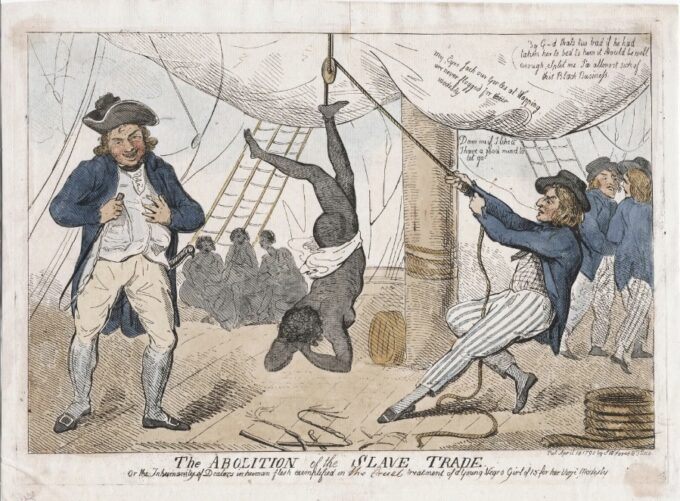
The abolition of the slave trade, or, The inhumanity of dealers in human flesh exemplified in the cruel treatment of a young negro girl of 15 for her virjen [sic] modesty. Illustration by Isaac Cruikshank, 1792. British Museum catalogue.

When one person hurts another, common sense dictates that the person should apologize and, preferably, make amends for the harm they may have caused. Apologize, make amends, and ensure it won’t happen again. These seem like basic rules of coexistence. Coexistence among people, but also among sectors of a society and among entire nations. History shows us that coexistence is not the norm. Colonialism and exploitation have been present, but the perpetrators of these crimes rarely acknowledge them.

The colonization of what is now called the Americas (beginning in 1492) is an example. Europeans invaded, appropriated lands that did not belong to them, murdered millions of its inhabitants, and subjected the rest to servitude. Almost immediately, the kidnapping of Africans began; they were forced into slave labor, which generated immense profits that produced the ‘primitive accumulation’ discussed by Karl Marx in Capital and paved the way for the development of capitalism.

Europe became the dominant power, and the standard of living it enjoys today is the product of wealth violently extracted from our lands, from Africa, and later from the rest of the world. A veritable plunder to which the U.S. later joined. They have, as the revolutionary Thomas Sankara said, a blood debt to the peoples of the world.

Recently, the United Nations General Assembly adopted Resolution A/80/L48, dated 25 March 2026, which ‘declares the trafficking of enslaved Africans and racialized chattel enslavement of Africans as the gravest crime against humanity.’ The resolution goes beyond the symbolic and highlights the nature of the crime in terms of the rupture it caused in world history, the magnitude and duration of the crime, its systemic character (institutional, normative, logistical), its brutality, and its lasting consequences expressed in ‘racialized regimes of labour, property, and capital.’

This resolution brings to the table a crucial issue such as reparative justice, by urging states that benefited from slavery to take concrete measures that include not only formal apologies but also financial compensation and the immediate return of cultural property, works of art, manuscripts, documents, artifacts, etc., without hindrance and at no cost to their countries of origin. The Resolution reaffirms that, due to its gravity, this crime is not subject to a statute of limitations.

The Resolution was approved by 123 votes in favor—primarily from Africa, Latin America, and the Caribbean—3 votes against from the U.S., Israel, plus the shameful vote of Argentina, and 52 abstentions, including the entire European Union, Canada, Australia, and Japan. As might be expected, the colonizers placed themselves on the dark side of history. Europe, in particular, argued that reparations could not be demanded for something that was not illegal at the time.

There can be no greater cynicism that of do not understand the concept and that, throughout history, have taken actions in favor of the perpetrator—what we might call ‘reverse justice.’ During the 19th century, for example, England provoked two wars in China known as the Opium Wars. Essentially, England sought to flood China with drugs to weaken its people and reap economic benefits. Even so, after the wars, England, the aggressor country, forced China to pay ‘reparations’ equivalent to $736 million today to cover the costs of the war. Part of the reparations was also intended to compensate for the opium destroyed by Chinese authorities and to indemnify the merchants—that is, the drug traffickers—for the losses they suffered.

Another case, equally outrageous, is the payment France forced Haiti to make to compensate for the damages caused to France by the loss of its colony. Haiti was paying a debt—clearly illegal—from 1825 to 1947. In 2003, then-President Jean Bertrand Aristide demanded that France return $21.7 billion to Haiti. The following year, he was deposed by a military coup supported by France and the U.S.

Resolution A/80/L48 acknowledges the crime, the victims, and the perpetrators, and urges the perpetrators to make reparations for the crime committed. It calls for achieving true restorative justice. This is not a new development, as the struggle for such recognition has been brewing for decades in various forums, including multilateral ones. Thus, in 1973, the United Nations (UN) proclaimed the Decade for the Elimination of Racial Discrimination, which was extended in 1983 and 1993. Little concrete progress was made during those decades, so in 2001, the UN organized the World Conference against Racism, Racial Discrimination, Xenophobia, and Related Intolerance in the city of Durban, South Africa. The Conference produced a Final Declaration and a Plan of Action that serve as a comprehensive framework for addressing racism and discrimination and include measures to combat them, ranging from calls to reform legislation, concrete actions to protect victims of racism and discrimination, education and health plans, measures to combat poverty, resources for victims, and more.

In 2013, given that the objectives set forth in the Plan of Action had not been achieved, the UN proclaimed, in its Resolution 68/237 of 23 December, the International Decade for People of African Descent, effective from 1 January 2015, to 31 December 2024, extended for an additional 10 years until 2034 (Resolution A/79/193).

Specifically regarding reparations, a notable development in 2013 was the creation of the CARICOM Reparations Commission, which produced a 10-Point Plan outlining concrete actions to demand reparations from European governments for the genocide perpetrated against the 15 million indigenous people of the Caribbean and for the multitude of ‘crimes against humanity,’ slavery and its legacies, which were committed against enslaved Black or African people.

In this same context, on 24 March 2018, the International Meeting on the Decade of Afro-Descendants was held in Caracas, during which the Venezuelan government signed the decree for the National Decade for Afro-Descendant Peoples, in order to implement actions in this regard. In May 2018, the First International Meeting on Reparations was organized, where Venezuela committed to promoting lines of research on the legal, multilateral, political, historical, and philosophical aspects of the issue. Following this, Venezuela has organized three International Seminars on Reparations, and the Ministry of People’s Power for Science and Technology has funded research projects addressing this issue.

The struggle for reparative justice is a legitimate struggle that unites the peoples of the Global South with a shared history of colonization and that unites the racialized and discriminated peoples of the world. Ghana promoted the adoption of the resolution declaring the transatlantic slave trade the most serious crime against humanity. CARICOM proposed a 10-point plan to implement reparations; Venezuela has made progress in creating institutions that fight for this right and has promoted research to inform public policies on the issue. Sharing these experiences is of vital importance. Demanding reparations—that is, recognition of the crime, compensation in whatever form, and guarantees of non-repetition—is a cause of the Global South and a cause worth fighting for.

This article was produced by Globetrotter.

Guillermo R Barreto is Venezuelan and holds a PhD in Science (Oxford University). He is a retired professor at Simón Bolívar University (Venezuela). He was Deputy Minister of Science and Technology, President of the National Fund for Science and Technology, and Minister of Ecosocialism and Water (Bolivarian Republic of Venezuela). He is currently a researcher at the Tricontinental Institute for Social Research and a visiting fellow at the Center for the Study of Social Transformations-IVIC.

LA REVUE GAUCHE - Left Comment: Search results for SLAVERY


LA Teachers Strike: Education Workers Defend Their Livelihoods in Face of Inflation


 April 24, 2026

In the 12 months following the surrender of Japan, over five million American workers were involved in labor strikes, including 750,000 steel workers, coal (340,000 workers), auto (320,000), railroad (250,000), electrical 174,000, oil, meatpacking, and many other industries. There were strict wage controls during the war, and the Office of Price Administration, created in January 1942 by the Emergency Price Control Act, kept inflation relatively low. It was terminated in 1946. Inflation rose to 8% in 1945, 14% in 1946, and 8% in 1947.

The wide gap between what companies were able to pay and what they were willing to pay was part of what set off the strikes. For example, General Electric and Westinghouse had reported record profits but offered workers a raise of only four cents a day. The United Electrical, Radio and Machine Workers union struck, winning a raise 37 times that.

The big business backlash against strike victories led to the 1947 Taft–Hartley Act, which attempted to handcuff labor by limiting solidarity or political strikes, secondary boycotts, and mass picketing, and allowing states to enact right-to-work laws banning closed shops. Correctly understanding that communists and socialists were behind the giant American labor victories of the 1930s, Taft-Hartley required union officers to sign non-communist affidavits.

Parallels between post-war strike wave & the 2023 & 2026 LA educator labor battles

There are many parallels between the Los Angeles education worker strikes/battles of 2023 and 2026 and the post-war strike wave:

+ Inflation ate away at wage gains made by United Teachers Los Angeles and Service Employees International Union Local 99, prompting labor action

+ The employers were seen as having the ability to afford the raises

+ UTLA and SEIU gained significant wage increases both in 2023 and 2026

+ There has been a backlash against the two unions’ demands, particularly over salary.

Fortunately, conservatives have figured out how to make inflation disappear

Nobody could claim that the Editorial Board and columnists of the Wall Street Journal–the conservative mouthpiece of American capital–are dismissive of the problems inflation causes. From January 1, 2022 until Trump’s inauguration, the following inflation-related commentary and many more appeared in their opinion pages:

The Inflation Thief Rises Again (WSJ Editorial Board)

How Inflation Ended Neoliberalism—and Re-Elected Trump (commentary)

Inflation Demands Bold Fed Action (commentary)

It’s Joe Biden’s Inflation (WSJ Editorial Board)

They Wouldn’t Know Inflation if It Bit Them in the Ballot (commentary)

Inflation Isn’t Conquered Yet (WSJ Editorial Board)

A Home Is Your Castle Against Rising Inflation (commentary)

Inflation Drives Wages Down, Not Up (commentary)

Government Policies, Not Low Rates, Are Driving Inflation (commentary)

Jerome Powell Is Wrong. Printing Money Causes Inflation. (commentary)

How Inflation Raises Your Taxes (commentary)

What Carter and Biden Have in Common (Inflation) (WSJ Editorial Board)

Yet the WSJ did figure out how to make inflation disappear–whenever a union asks for a raise, inflation no longer exists.

In July 2024, 1,000 Philadelphia sanitation workers represented by the American Federation of State, County and Municipal Employees District Council 33 went on strike for the first time in almost 40 years.

In A Trashy Fourth of July in Philadelphia in July of 2024, the WSJ Editorial Board wrote:

“Public unions are often at odds with the public interest, and Exhibit A is Philadelphia this week. Over the Fourth of July weekend, the home of Independence Hall is greeting holiday guests with garbage piles on streets and limited city services. That’s thanks to one of the city’s biggest worker strikes in decades.”

The WSJ Editorial Board–after years of decrying inflation, which had averaged almost 6% a year for the three previous years and almost 5% a year from 2019 to 2024–never references it. Instead, they actually write that, somehow, “(Philadelphia) Mayor Cherelle Parker’s offer of a 2.75% raise, followed by two years of 3% hikes…wasn’t enough for the union.”

When the sanitation workers “won” a 14% raise over 4 years–a princely 3.5% a year–the WSJ bitterly noted that “taxpayers will be paying for this city disservice, a reminder of how public unions can hold a city hostage.”

Conservatives make inflation disappear in Chicago Teachers Union contract battle

In the 2019-2025 Chicago Teachers Union-Chicago Public Schools contract, the average Chicago teachers’ salary rose 16%–well below the rate of inflation. Normally conservatives would agree with CTU President Stacy Davis Gates’ statement “We are experiencing an extraordinary amount of inflation…pay has not kept up with the prices…”

Yet while Chicago teachers are exactly the type of workers that Michigan Senate candidate Mike Rogers, speaking at the 2024 Republican National Convention, told us were getting “crushed by inflation”, the sympathy conservatives profess for American workers’ struggles with inflation was nowhere to be found in their treatment of the CTU.

For National Review, Chicago teachers are a “select and privileged group of public-sector union members” who through “corrupt self-dealing” are “increasingly captur[ing]” the beleaguered city’s “tax dollars.”

For the Wall Street Journal, the CTU’s attempt to gain back for its members some of what they lost in the inflation of the Biden-Harris era represents “huge raises.”

Chicago teachers ended up getting a 4% cost-of-living increase in Year 1 of the contract, and 4-5% in each of the remaining three years, depending on inflation–a far cry from “huge”.

The cost of living in Los Angeles: home prices

The high school where I teach is not an elite one–in fact, with our heavily-immigrant population, we have one of the lowest student socioeconomic levels in the state. Yet it’s not hard to see why so many of my colleagues–even those who are well into their 30s–are still living with their parents and often face long commutes. A Zillow search of three bedroom homes for sale in our zip code reveals that of the 32 houses currently available, 18 are over $1 million, and only one is below $800K. An $800K mortgage, with $160,000 down, is $4,204 a month, including property taxes and insurance. The median three-bedroom home prices in five mid-level LA regions that are part of LAUSD are:

+ East Los Angeles, Boyle Heights 90063: $670K

+ South Los Angeles, Carson 90745: $770K

+ Mid City Los Angeles, Baldwin Hills 90016: $909K

+ Northeast San Fernando Valley, Sun Valley: 91352: $867K

+ South East Los Angeles, South Gate 90280: $657K

+ The average median price among the five is $774,600.

The cost of living in Los Angeles: condo prices

Zillow search of two bedroom condominiums in my school’s zip code reveals nine of 11 cost over $400K and all cost over $300K. The median two bedroom condominium prices in the five regions:

+ East Los Angeles, Boyle Heights 90063: $500K

+ South Los Angeles, Carson 90745: $465K

+ Mid City Los Angeles, Baldwin Hills 90016: $577K

+ Northeast San Fernando Valley, Sun Valley: 91352: $395K

+ South East Los Angeles, South Gate 90280: $550K

+ The average median price among the five is just under half a million dollars, $497,400.

The cost of living in Los Angeles: rent

The median rents for two bedroom apartments in the five regions:

+ East Los Angeles, Boyle Heights 90063: $2,700

+ South Los Angeles, Carson 90745: $3,100

+ Mid City Los Angeles, Baldwin Hills 90016: $3,000

+ Northeast San Fernando Valley, Sun Valley: 91352: $2,900

+ South East Los Angeles, South Gate 90280: $2,400

+ The average median rent for a two-bedroom apartment among the five is $2,820.

2023: LA education workers criticized for defending their livelihoods in the face of inflation

Despite Los Angeles’ high cost of living, Inflation was strangely absent from the discussion regarding SEIU’s and UTLA’s contract demands leading to the March 2023 strike. Witness these comments on SEIU’s demand for a 30% salary increase:

+ SEIU “walked off the job this week because they want a massive 30% pay hike.” (Southern California News Group Editorial Board)

+ [SEIU wants] “a whopping 30% across-the-board pay raise” (Aaron Withe, CEO of the Freedom Foundation)

+ “SEIU Local 99 is demanding a whopping 30% increase in wages for school employees (Lance Christensen, California Policy Center)

However, the 30% raise the SEIU sought covered four years–7.5% a year. This is hardly unreasonable: according to the US Social Security Administration, prices rose 5.9% in 2021 and 8.7% in 2022. In January and February 2023, inflation ran at 6.2%.

Moreover, inflation impacts lower wage workers like those in SEIU more heavily than people with higher wage jobs. It’s difficult for such workers to handle inflation by cutting back their spending when they’re already spending the overwhelming majority of their take-home pay on basic necessities.

For example, before the strike, one of our paraprofessionals had been a special education assistant for 23 years and at the top of her pay scale for 17 years. She made $25.76 an hour for a six hour workday. She tried to work during the summers, but positions are limited. She earned under $30,000 a year.

Many SEIU education workers earned even less. For example, cafeteria workers made $16.91 an hour, as did 21 other categories of LAUSD employees.

UTLA’s demand for a 10% a year raise was also panned.

On the John and Ken Show, one of the hosts explained, “UTLA wants 20% over two years–10% more a year? They’ve got to be kidding–they’re just greedbags…they don’t care.”

2026: LA education workers criticized for defending their livelihoods in the face of inflation

Because the inflation rate has since declined, the WSJ, the Washington Post, and other critics are now willing to mention it, but only as a club against UTLA and SEIU. What they sidestep, however, is how much of our previous raises have been eaten up by inflation.

The Wall Street Journal is unhappy that new teachers will earn $77,000 a year and makes time to complain about our health care and our pensions, though neither was directly involved in this contract battle and near-strike.

The Washington Post, the WSJ’s new ideological twin, is unhappy over UTLA’s raise but is particularly galled over SEIU’s 8% a year raise and other gains. Sounding like a feudal lord annoyed that the serfs seem to be living a little too well, the Post’s editorial board complains that education worker unions “shake down taxpayers” and “menace the public.”

Perhaps on some level these purported defenders of the taxpayer are unhappy that, with union actions, LAUSD is increasingly unable to do what so many enterprises in the US do–benefit from the cheap labor of immigrant families.

A sad reminder of how comfortable American bosses have become…

Re: the Philadelphia strike, in a sad reminder of how much American labor unions have declined and how comfortable American bosses have become, the WSJ was surprised and unhappy that the “union chose to strike as soon as its previous contract expired”.

”No Contract, No Work” used to be a key maxim for the labor movement…

Glenn Sacks teaches social studies at James Monroe High School in the Los Angeles Unified School District.