Friday, May 08, 2026


Potato futures soar 700% in less than a month on Iran war speculation

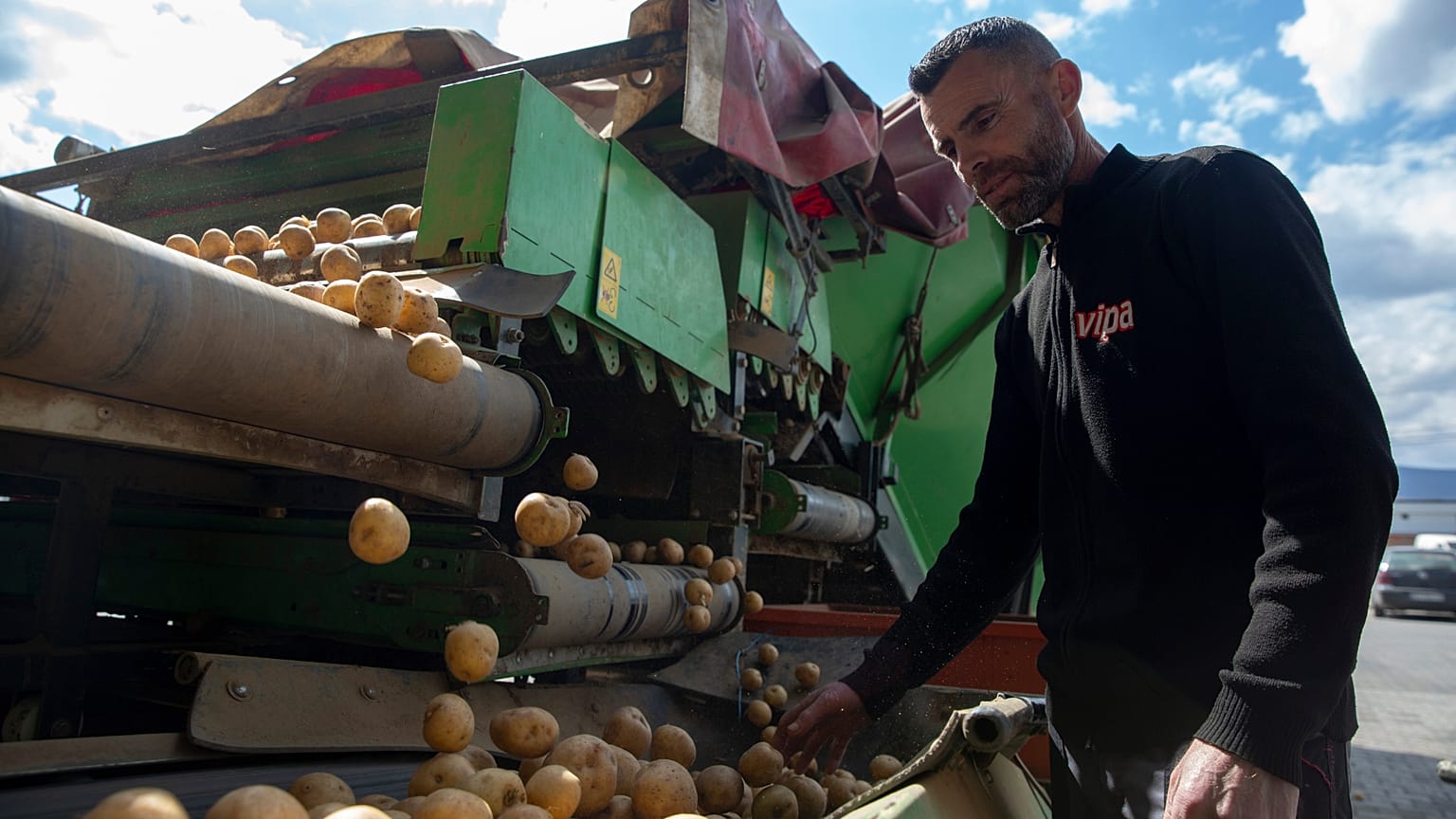
A worker inspects the potatoes in the village of Pestove, Kosovo, 26 March 2026
Copyright AP Photo/Visar Kryeziu


By Quirino Mealha
Published on 

Potato-linked financial contracts have risen over 700% in a few weeks, despite a current oversupply in Europe, due to speculative trading surrounding the volatile environment caused by the Iran war.

Potato contracts for difference (CFDs), which track the benchmark market for the commodity, have seen prices soar roughly 705% in less than a month.

Since 21 April, the cost per hundred kilograms has risen from approximately €2.11 to a staggering €18.50.

However, this price is in fact still very low compared to where the potato market was in the last two years. This is due to the underlying physical market in Europe currently suffering from a major oversupply.

After shortages and strong prices in previous seasons, farmers in countries including Belgium, Netherlands, France and Germany expanded planting areas significantly.

Favorable weather conditions then produced exceptionally large harvests, creating a substantial surplus across the European market. As a result, processors and exporters have struggled to absorb the supply, pushing farmgate prices sharply downward.

Reportedly some lower-quality potatoes intended for animal feed or industrial use have traded at extremely low or even negative prices. In those cases, growers may effectively pay transport or disposal costs to move excess stock off their farms.

The cited €18.50 benchmark generally refers to “free-buy” potatoes sold on the open market rather than potatoes already covered by fixed-price contracts between growers and processors.

Although this price is above the negative values seen in secondary markets, many producers still consider it financially unsustainable because production costs, including fuel, fertiliser, storage and electricity, have risen substantially.

The contrast between weak physical prices and sharp movements in financial benchmarks reflects the difference between commodity trading markets and the real agricultural supply chain.

Financial markets can react strongly to volatility, expectations about future harvests, weather risks, export demand or potential supply corrections, even while current physical inventories remain excessive.

In other words, the large percentage increase seen in potato-linked financial instruments does not mean potatoes have suddenly become expensive in Europe, instead, it reflects volatility in a market attempting to price future conditions linked to the current instability.

Negative effects of the Iran war

The conflict in the Middle East has severely hindered the export of essential chemicals and minerals required for industrial farming, leading to widespread fears regarding global food security.

As potatoes are a nutrient-intensive crop, the sudden lack of affordable fertiliser has direct implications for future yields and current market valuations.

To make matters worse, the regional instability has made primary shipping lanes increasingly hazardous, complicating the logistics of agricultural trade.

According to the UN, roughly a third of the world's fertilisers such as urea, potash, ammonia and phosphates normally pass through the currently blocked Strait of Hormuz.

In response to these rising costs and uncertainty, traders are seemingly repricing futures contracts and no longer prioritising the current reality of oversupply.

While for European consumers, this does not presently translate to a massive increase in the cost of a basic dietary staple, the move in potato CFDs highlights an anxious market attempting to price the several and encompassing economic effects of the Iran war.


‘EU legislation cannot be dictated by social media threats,’ says MEP trade chief

The EU and the US concluded a trade deal in July 2025 which still needs to be enforced.
Copyright AP Photo

By Peggy Corlin
Published on 

Bernd Lange, the MEP lead on the EU-US trade deal, has rejected pressure from Washington to fast-track implementation, insisting the bloc’s democratic procedures cannot be dictated by tariff threats from President Donald Trump.

German MEP Bernd Lange (S&D), the European Parliament’s lead negotiator on the EU-US trade deal, defended on Friday the EU legislative process aimed at implementing the agreement, pushing back against US criticism that Europe is moving too slowly.

The comments came after US President Donald Trump gave the EU until 4 July to cut tariffs on US goods to zero, as agreed under the deal signed last year in Turnberry with European Commission President Ursula von der Leyen, warning otherwise of new tariffs on European products.

Washington has stepped up pressure on Brussels to fast-track the legislation needed to enforce the agreement. But negotiations between the EU’s co-legislators failed Wednesday night to produce a deal.

“European legislation cannot be dictated by threatening social media posts from Washington,” Lange said in a statement, adding: “Our democratic procedures are not negotiable. Even in stormy weather, we stay firmly on course.”

Last week, Trump had already threatened to impose 25% tariffs on EU cars if the bloc failed to implement its side of the agreement — far above the 15% cap agreed in Turnberry.

The latest threats did not alter negotiations between MEPs and member states, which stalled over the safeguards Parliament wants attached to the agreement.

US courts' rulings

Since the deal was struck, MEPs have been among its fiercest critics, denouncing what lawmakers see as a lopsided arrangement under which the EU faces 15% tariffs and commits to major investments in the US while reducing its own duties to zero.

MEPs suspended the deal earlier this year after Trump threatened tariffs against Europe in his push to acquire Greenland. Parliament later added conditions to the agreement, including a “sunset clause” ending the deal in March 2028 and a suspension mechanism in case of new threats from Washington, market distortions linked to US imports or economic coercion.

Lange said the safeguards must also shield the agreement from growing legal uncertainty in the US, coming from recent court rulings including a decision Thursday by the US Court of International Trade blocking tariffs affecting two plaintiff companies, as well as a February Supreme Court ruling declaring the 2025 tariffs illegal.

“All of this underlines how important a stable European safety net is,” the MEP said.

“Europe must remain capable of acting. We need to uphold the agreement while also being able to react quickly if the US position shifts again. Anything else would be reckless and short-sighted.”

Lange confirmed a new round of negotiations between EU lawmakers and member states would take place on 19 May, both sides hoping to secure a deal that could be rubber-stamped by Parliament in June, ahead of Trump’s latest deadline.


This historic Oxford cinema could be lost to film lovers soon if its lease is not renewed

The facade of the Ultimate Picture Palace cinema in east Oxford.
Copyright Ultimate Picture Palace

By Indrabati Lahiri
Published on 

The Ultimate Picture Palace in Oxford, UK, requires a lease extension past 2037 to be able to carry out key renovations and make the most of grants for energy efficiency and accessibility.

Film lovers could be at risk of losing one of the UK’s oldest independent cinemas, due to lease renewable issues.

East Oxford’s Ultimate Picture Palace first opened in 1911 and has since been a beloved cultural hub for generations of residents and students alike.

With a capacity of 106, it boasts a charming and nostalgic vibe with a manually opened curtain and an old-timey box office. The UPP has also hosted the likes of Oscar-winning director Sam Mendes.

However, the cinema is now facing an uncertain future, as its landlord, the University of Oxford’s Oriel College, is unwilling to extend the Grade II-listed building’s lease to undergo much-needed renovations.

Although the UPP is now a community-owned business, its long-term future depends on the Oriel College extending the lease past 2037.

This would allow the UPP to make critical renovations and take advantage of grants that would enhance accessibility and energy efficiency. The cinema has seen a surge of 25% in its operating costs in the last four years and continues to deal with financial concerns.

“This lease was agreed recently in 2022 with a new registered society. We have no plans to amend the lease at this early stage in the tenancy… We continue to be in dialogue with the new managers about how to ensure the cinema remains open to the wider public,” a spokesperson for Oriel College said, as reported by The Guardian.

Oriel College also owns several other east Oxford properties and has plans to expand.

This highlights the worsening “studentification” trend, which shrinks independent third spaces for locals and puts a number of popular and historic spots at risk.

Back in March, a petition and campaign to save the UPP was launched, which amassed 22,000 signatures.

Why a weakened Starmer will worry the EU

Britain's Prime Minister Sir Keir Starmer meets Labour Party members at Kingsdown Methodist Church Hall, in Ealing, west London, Friday May 8, 2026, a day after the local elec
Copyright AP Photo

By Leo CENDROWICZ
Published on 

After bruising local election losses, Sir Keir Starmer is preparing a renewed push for closer ties with the European Union — but Brussels worries that his political weakness could stall or derail any meaningful post-Brexit reset.

"I'm not going to walk away and plunge the country into chaos," British Prime Minister Sir Keir Starmer said on Friday after local election results showed millions of voters had abandoned his Labour Party.

It is a far cry from the general election less than two years ago that saw Labour win one of the largest majorities in British parliamentary history.

Starmer admitted that the elections — which saw hundreds of Labour councillors lose seats amid massive gains for Nigel Farage’s Reform UK party — were painful. “The results are tough, they are very tough, and there's no sugarcoating it,” he said.

He is already planning a reboot of his premiership, starting on Monday, with a major speech that is expected to promise closer ties with the European Union.

That ties in with the political mood. Almost ten years on from the Brexit referendum, voters see the decision to leave the EU as a mistake by a two-to-one margin.

Brussels sees opportunity — and danger

In Brussels, officials will welcome improved relations, after a decade defined by Britain’s rancorous divorce from the EU. Global events, from the war in Ukraine to the re-election of Donald Trump, have already brought the UK and EU closer, particularly on defence issues.

Starmer has played a vital role in rallying the so-called coalition of the willing behind Ukraine, which last year pledged strengthened support as the US pulled back its aid for Kyiv. He has also aligned with the EU’s cautionary tone on the war in Iran, calling for restraint despite fierce criticism from US President Donald Trump for not joining the conflict.

However, the EU will be wary too.

Starmer is historically weak. National polls show Labour support hovering under 20%, sometimes behind both the Conservatives and the Green party. They are well behind Reform, at around 25%.

Starmer’s personal ratings are catastrophic: polls show just 19% of voters approve of his leadership, and his net approval is minus 45%. Betting markets now have his exit as an effective coin-toss before the end of June.

Rivals within the Labour are circling. Rumours abound in Westminster about potential challenges from the likes of former Deputy Prime Minister Angela Rayner, Health Secretary Wes Streeting and Mayor of Manchester Andy Burnham.

That matters in Brussels, where there is little appetite for reopening difficult negotiations only to see a weakened UK government retreat under domestic pressure or be overtaken by events. “Anything that comes up would still need to be negotiated — and we’ll be careful about going all in with Starmer if he’s out in a few months,” said one EU diplomat.

And what about the longer term? Reform UK has been leading the polls since early 2025, and bookmakers have them odds-on to win the next general election, which must take place by 2029.

Even if voters have warmed to the EU, the likeliest next prime minister is Nigel Farage, who also led Reform’s previous incarnation, the Brexit Party. He has pledged a harder approach to the EU, including a renegotiation of the post-Brexit trade deal to strip EU citizens of benefit rights.

“Ever since Brexit, there has been a concern in Brussels about Britain making commitments that it cannot fulfil, especially if they could be reversed by a Farage government,” says Fabian Zuleeg, chief executive of the European Policy Centre.

Slow reset, lingering suspicion

But even beyond political questions about the fate of Starmer and Labour, the EU has found it hard to measure the UK’s engagement. Despite Starmer’s much-vaunted “reset” after entering Downing Street, progress has been slow and heavily constrained by Labour’s own red lines: no return to the Single Market, customs union or freedom of movement.

Negotiations have advanced in some areas, notably on defence cooperation, energy links and a veterinary agreement aimed at reducing post-Brexit trade friction. Yet many of the headline ambitions remain bogged down in technical disputes over funding, regulatory alignment and youth mobility schemes.

Talks on UK participation in the EU’s €150 billion SAFE defence fund have already run into arguments over financial contributions, while negotiations on student fees and mobility caps have become politically toxic in London.

In Brussels, there is also frustration that Britain still appears uncertain about what kind of long-term relationship it actually wants.

EU officials increasingly argue that London cannot simultaneously demand deeper access to parts of the Single Market while rejecting many of the obligations that come with it. The old Brexit-era suspicion of British “cherry-picking” has never fully disappeared.

For now, European leaders still see Starmer as serious, pragmatic and infinitely preferable to the chaos of Boris Johnson, one of his predecessors.

But privately, officials worry that his weakening political position could make even modest agreements harder to deliver.

Few in Brussels want to spend political capital negotiating sensitive deals with a British prime minister who may not survive long enough to implement them — or whose successor could unravel them all over again.


English elections see Labour Party punished and gains for populist Reform

Partial results from local elections held yesterday in England show big losses for the governing Labour Party and gains for the anti-immigration Reform UK, fuelling doubts over Prime Minister Keir Starmer's future just two years after he was elected in a landslide victory.


Issued on: 08/05/2026 - RFI

Reform UK leader Nigel Farage celebrates "historic" change in British politics after his party won more than 300 seats in England. AP - Yui Mo


Thursday's elections for 136 local councils in England, alongside those to elect devolved parliaments in Scotland and Wales, are the most significant ‌test of public opinion in the United Kingdom before the next general election due in 2029.

Most of the results from England – as well as all the seats in the Scottish and Welsh elections – are due to be ​declared later on Friday.

Partial results from England show Labour lost 247 seats, including in some traditional strongholds in former industrial regions in central and northern parts of the country, along with some parts of London.

The main beneficiary was the right-wing, anti-immigration Reform party of Brexit campaigner Nigel ‌Farage, which gained 335 council seats in early results in England.

It could also form the main opposition in Scotland and Wales to the respective pro-independence parties, the Scottish ⁠National Party and Plaid Cymru.

Starmer said he took "responsibility" for his party's poor results. "They are very tough, and there's no sugarcoating it," he told reporters on Friday.


'Historic change'

The Conservative Party has lost 127 seats, while Labour has been wiped out in some of the most closely watched early results.

The party lost control of the council of Tameside ​in Greater Manchester for the first time in almost 50 years, after Reform picked up all 14 seats it was defending.

In nearby Wigan, a former mining community Labour has also controlled for more than 50 years, it lost every one of the 20 seats it was defending to Reform. In Salford, the party held just three of the 16 ​seats it was defending.

The results were "soul-destroying", said Rebecca Long-Bailey, a Labour member of parliament for Salford.

Reform won hundreds of local council seats in working-class areas in England’s north that were once solid Labour turf, and also made gains from the Conservatives in areas such as Havering in east London.

Farage said the results marked “a historic change in British politics".


Starmer's future in balance

The elections are widely viewed as an unofficial referendum on Starmer, whose popularity has plummeted since he was elected less than two years ago, with voters growing impatient for the economic growth and dramatic change promised following 14 years of Conservative rule.

Some Labour MPs have said that if the party performs poorly in Scotland, loses power ⁠in Wales and fails to hold many of the roughly 2,500 council seats it is defending in England, Starmer will face renewed pressure to quit – or at least set out a timetable for his departure.

However, Starmer's allies have said it's not the time to move against ​him.

Defence Minister John Healey said the last thing voters wanted was "the potential chaos of a leadership election".

(with newswires)

Criminalizing Childhood: When The Justice System Fails America’s Youth – Analysis


May 9, 2026
By Colin Greer and Reynard Loki


From child labor to incarceration, U.S. laws often treat youth as disposable rather than nurturing their potential.

Does your community care about children? This deceptively simple question carries profound moral, social, and civic weight. Across the United States, children are too often treated not as developing citizens deserving care and opportunity, but as problems to be managed. Systems meant to safeguard youth—juvenile justice, labor laws, immigration enforcement, and foster care—can instead respond with punishment, neglect, or harm. Children bear the consequences of policies and practices they did not create, producing predictable cycles of disadvantage.

Poverty is the underlying condition shaping these outcomes. It is more than a statistic or isolated hardship—it is the framework under which children experience multiple forms of structural deprivation. Children growing up in economically marginalized neighborhoods face limited access to healthcare, gaps in educational opportunities, hazardous work conditions, and heightened interaction with punitive systems. Extreme poverty, in particular, dictates the parameters of possibility from the earliest years. While Black, Brown, and Indigenous children are disproportionately affected, poverty touches children of all races, showing that structural inequity—not race alone—drives risk.

Communities frequently fail children across five sectors of their lived experience: ages of criminal responsibility, juvenile detention, child labor, immigration enforcement, and foster care. Policies in each area combine with economic and social conditions to limit opportunity and perpetuate harm. Examining these systems side by side reveals a pattern: children most at risk are those whose families, schools, and communities cannot buffer against structural deprivation. International comparisons demonstrate that the U.S. approach is a policy choice, not an inevitability. Countries like Norway and Sweden prioritize education, family, and social services rather than criminalization, showing that alternative paths are possible, practical, and effective.

Caring for children requires coordinated action. Families, institutions, and communities must recognize that attention, guidance, and structured opportunity are among the most effective forms of protection. Adults—whether educators, mentors, neighbors, or civic leaders—can prevent childhood from being criminalized, exploited, or neglected.

Criminalization and Detention of Youth

Across much of the U.S., children are criminalized at shockingly young ages. In North Carolina, children as young as sixcan technically be held responsible for criminal behavior. In Rutherford County, Tennessee, elementary‑aged children—some as young as seven—were taken into custody after watching or being near a minor scuffle, with authorities charging them under a ‘criminal responsibility’ theory that did not reflect an actual crime, underscoring how early criminalization can reach children based on proximity rather than conduct. Arrests of young children signal a community that views youth not as developing citizens but as problems to control.

Racial and disability disparities exacerbate these effects. In 2017–18, Native Hawaiian/Pacific Islander, Black, and American Indian/Alaska Native students were arrested at rates two to three times higher than white students. In 2020, law enforcement agencies made an estimated 424,300 arrests of persons under 18. Children from impoverished neighborhoods are disproportionately caught in these systems, where families and schools often lack resources to intervene effectively.


By contrast, Finland sets the minimum age of criminal responsibility at 15, with younger children handled through social welfare. These international comparisons make clear that early criminalization is a policy choice rather than an inevitability. Communities that respond with punitive measures risk creating cycles of trauma and neglect.

When children make mistakes, communities can choose to provide guidance or impose confinement. U.S. juvenile detention leans toward punishment: children may be placed in secure facilities for minor offenses such as truancy, shoplifting, or skipping school. Solitary confinement, still legal in some states, inflicts lasting psychological harm. About 70 percent of youth in detention have mental health diagnoses, including trauma, anxiety, and depression.

The school-to-prison pipeline illustrates how disciplinary actions often funnel children into the criminal justice system. Once in the juvenile system, they may face detention and adult incarceration, compounding disadvantage—especially for youth from impoverished communities. Children with disabilitiesand Black, Indigenous, and Latinx youth are disproportionately represented.

Many youths arrested for minor offenses like truancy experience long hours of isolation, minimal educational programming, and insufficient counseling, which research links to anxiety, trauma responses, and reluctance to return to school. Research shows that extended juvenile detention disrupts education, limits access to meaningful schooling, and is associated with higher rates of anxiety, depression, and other mental health challenges. After release, many youths are more likely to disengage from school and struggle with psychological harms that can make returning feel daunting and traumatic.

Evidence-based interventions can improve outcomes dramatically. Programs such as Multisystemic Therapy and Functional Family Therapy provide family-centered approaches to reduce recidivism. Youth Advocate Programs and credible messenger mentoring pair at-risk youth with adult mentors, fostering guidance, trust, and accountability. Restorative justice interventions focus on repairing harm rather than imposing punishment and have been shown to reduce repeat offenses. Wraparound services provide individualized plans for education, mental health, and employment.


International examples show alternatives. Norway, the Netherlands, and Finland prioritize rehabilitation: secure facilities are rare, stays are short, and youth have access to robust social, educational, and psychological services. Children are treated as developing individuals, not criminals. Communities also intervene informally. Adults who mentor or provide structured work opportunities—restoring the legendary neighborhood “stoop”—offer protective oversight, preventing trajectories toward confinement. Early engagement, attention, and investment reduce reliance on punitive systems.
Exploitation and Neglect Across Work, Migration, and Foster Care

Despite federal laws, child labor persists in the U.S. In fiscal year 2024, the U.S. Department of Labor documented 736 cases of child labor violations, involving thousands of minors in hazardous work ranging from agriculture and meatpacking to domestic labor and industrial settings. In 2024, for example, the Department of Labor reported on federal investigations that found minors—including teens as young as 13—working overnight shifts cleaning meatpacking machinery, such as brisket saws and head splitters, exposing them to hazardous conditions and chemicals while compromising schooling and safety. These situations illustrate the tangible risks behind child labor violations uncovered by the Department of Labor.

Migrant children, often from economically marginalized households, are especially vulnerable. Families facing extreme poverty may rely on child earnings, perpetuating cycles where labor substitutes for education. Unsafe conditions, intimidation, and limited legal protections exacerbate risk.

International comparisons show alternatives. Germany and the Netherlands strictly regulate youth work: setting minimum ages, limiting tasks, establishing hours, and requiring supervision. These frameworks protect health, education, and development, demonstrating labor exploitation is a policy choice rather than an inevitability.

Communities can intervene through structured, education-compatible work programs offering safe employment, mentorship, and skill-building. These programs provide income, purpose, and guidance without exposure to hazards, thus fostering civic engagement and resilience.

Federal immigration enforcement often treats youth as security risks rather than children in need of protection. Border Patrol detention, harsh asylum procedures, and family separations expose minors to trauma.

In 2018, a joint ACLU–University of Chicago report found approximately 25 percent of unaccompanied children in Customs and Border Protection custody experienced physical abuse, including sexual assault, stress positions, and beatings. Thousands more were separated from parents, with minimal oversight or access to legal and emotional support.

Many migrant children come from economically marginalized communities, where families lack resources to buffer migration stress. Poverty, legal precarity, and institutional neglect increase exposure to exploitation, including trafficking.

Internationally, New Zealand and Canada prioritize family reunification and community-based support, providing supervised housing, education, and social integration. Local communities can provide legal aid, mentorship, and trauma-informed education, offering stability and opportunity even when federal systems fail.

Foster care often fails to provide stability. Youth average three to four placements, undermining attachment and emotional development. Trafficking within foster care illustrates systemic failure: about 40 percent of youth with trafficking experiences reported incidents before the age of 18, and nearly 80 percent occurred while in foster care.

Vulnerable children—including Black, Native American, and Latinx youth, children with disabilities, and low-income youth—are disproportionately affected. Many who age out at 18 or 21 face homelessness, unemployment, and limited resources.

Internationally, Sweden and Denmark maintain robust foster care systems with stable placements, trained caregivers, and wraparound services, reducing risk and promoting stability. Communities can supplement formal systems through mentorship, nonprofits, and structured guidance, reinforcing protections and improving youth outcomes.
From Punishment to Justice: Patterns and Solutions

Across juvenile justice, child labor, immigration enforcement, and foster care, children’s vulnerabilities are too often met with punishment rather than support. Austerity, underfunded schools, racial disparities, privatization, and political neglect converge to normalize punitive approaches. International models show that early intervention, family support, and rehabilitation prevent harm, underscoring that criminalization is a choice.

Community attention—the “stoop”—is critical. Volunteer programs, mentorship, civic engagement, and safe work opportunities provide oversight, guidance, and resilience where formal systems fail. For example, credible messenger and mentoring programs connect justice‑involved youth with adult mentors and career pathways—including structured employment, apprenticeships, and reentry support. These programs have been shown to improve engagement, reduce recidivism, and help young people build skills and confidence as they reintegrate into their communities.

State-supported youth employment programs, like New York’s Summer Youth Employment Program, place thousands of teens from low‑income families in paid, supervised jobs. Participants gain workplace skills and income without exposure to hazardous conditions, helping build confidence, job readiness, and connections to future opportunities.

Justice for children should mean support, opportunity, and rehabilitation. Evidence-based interventions—including restorative conferencing, family therapy, and mentorship programs—reduce recidivism and improve outcomes. In Alameda County, California, youth in restorative conferencing programs were 19.6 percent less likely to be adjudicated delinquent within 18 months—a 47 percent relative reduction. Oakland, California, schools using restorative practices saw African American suspensions drop approximately 40 percent, while New York City schools reported a 43 percent decline in suspensions alongside stronger student-staff relationships.

Community-based foster care programs, mentorship, and structured work opportunities provide continuity, guidance, and stability. Civic structures like local commissions can monitor policies, advocate, and provide systemic oversight, reinforcing protections and reducing systemic neglect. International lessons show that early, coordinated intervention, paired with social support, nurtures children rather than punishing them.
A Moral Test for Every Community

The question “Does your community care about children?” is neither rhetorical nor abstract. Across the United States, children face overlapping crises: they are criminalized at alarmingly young ages, exploited through labor, left vulnerable in foster care, and exposed to trauma in immigration enforcement. Poverty, systemic neglect, and under-resourced institutions create these outcomes, but communities are not powerless.

Active engagement—through mentorship, safe employment, trauma-informed services, and civic oversight—signals that children are valued, protected, and supported. Programs that pair youth with mentors, offer structured work, and implement restorative practices in schools show that guidance and support can replace punishment and neglect. Communities that invest in these strategies help prevent cycles of trauma and build pathways to education, employment, and civic participation.

Caring communities take responsibility not only for immediate safety but also for the long-term well-being of children. By acting collectively through volunteer initiatives, policy advocacy, and inclusive oversight, communities can ensure that every child has a chance to thrive. The question of whether children matter is a moral test for every neighborhood, city, and state; the answer lies in whether communities are willing to act, to protect, and to nurture their young and to protect them.


About the authors:
Dr. Colin Greer has served as president of the New World Foundation since 1985. A former Brooklyn College professor, he directed studies on U.S. immigration and urban schooling at Columbia University and CUNY. He has advised national leaders, including First Lady Hillary Clinton and Senator Paul Wellstone. His books include A Call to Character and Choosing Equality, winner of the ALA’s Eli M. Oboler Award. A poet and playwright, his work has appeared in Transfer, Hanging Loose, Tikkun, and Kosmos. His plays, including Imagining Heschel and Spinoza’s Solitude, are collected in Religious Differences Between Artichokes, with a preface by Cornel West. His long poem, “Treaty Between Self and Earth,” was performed at Rattlestick Theatre in 2022.

Reynard Loki is a co-founder of the Observatory. He is a writing fellow and the editor and chief correspondent for Earth | Food | Life at the Independent Media Institute. His work has appeared in Salon, Truthout, EcoWatch, BillMoyers.com, and Yes! Magazine. A former environmental editor at AlterNet, he writes on the intersections of justice, ecology, and human rights. He serves on the board of the Stuyvesant Park Neighborhood Association, where he supports education programming for local children and families. He regularly speaks with high school students about environmental awareness and community advocacy.


Credit Line: This is the second article in the four-part series “Does Your Community Care About Children?” It was produced by the Independent Media Institute for the Observatory. It is licensed under the Creative Commons Attribution-NonCommercial-ShareAlike 4.0 International License (CC BY-NC-SA 4.0)