It’s possible that I shall make an ass of myself. But in that case one can always get out of it with a little dialectic. I have, of course, so worded my proposition as to be right either way (K.Marx, Letter to F.Engels on the Indian Mutiny)
Friday, May 22, 2026
‘Ready for violence’: Serbian STATE hooligans target protesters
Supporters of the ruling Serbian Progressive party (SNS) stand in front of their party headquarters - Copyright AFP Jung Yeon-je Ognjen ZORIC, Andrew LEESON
When Voja was beaten and dragged from a Belgrade street into a waiting car, the young activist thought he would die.
After an hours-long ordeal, his assailants freed him, bruised and bloodied.
“I feared for my life. I had no idea what they were planning to do with me,” Voja, who asked to be identified only by his first name, told AFP.
Weeks later, he is still visibly shaken when recounting the April 29 incident, just one report in a mounting pattern of violence against people connected to Serbia’s long-running protest movement.
But unlike many other attacks, Voja said his captors made no attempt to hide their faces — and had allegedly emerged from a van emblazoned with the campaign slogan of the ruling party of President Aleksandar Vucic.
– ‘Ready for violence’ –
For more than a year, student-led protests have swept across Serbia, with some rallies drawing crowds unseen since demonstrations toppled strongman Slobodan Milosevic in 2000.
Demands for a transparent investigation into a railway station canopy collapse in November 2024, which killed 16 people, have snowballed into a push for early elections, in a direct challenge to Vucic.
As the largely peaceful demonstrations grew, groups of young men — largely dressed in black and wearing masks — increasingly targeted anti-government gatherings.
During a series of demonstrations last year, protesters claimed the police shielded groups of masked men, some armed with batons and fireworks, and violently suppressed the anti-government side.
Council of Europe observers also witnessed the “threatening” presence of large groups of men, several masked, outside polling stations during local elections that were marred by violence earlier this year.
The ties between these groups, locally referred to as hooligans, and Vucic’s Serbian Progressive Party (SNS) run deep, according to Predrag Petrovic, research director at the Belgrade Centre for Security Policy.
“The essence of it is that you have an organised group of people ready for violence, for street violence, and you want them on your side,” he said.
– ‘A blind eye’ –
According to Petrovic, the existence of a pro-government camp — reportedly containing known criminals — near the country’s parliament shows a clear connection to the government.
“Hooligan leaders wanted to be seen there in order to send a message to others about which side was the right one,” the expert said, referring to the camp, which has remained ringed by fences and guarded by police for months.
There have been several reports of assaults on protesters and journalists near the camp, while Serbian media have identified known criminals staying inside.
“But the police turned a blind eye,” Petrovic said.
Last summer, the president pardoned four men, linked to the SNS, accused of beating students and breaking a woman’s jaw in Novi Sad.
Vucic has also visited what he dubbed the “defenders of Serbia” in the pro-government camp several times and bragged about being “partly a football hooligan” in a recent podcast — claiming he was arrested “many times”.
“Those remarks should be taken very seriously, and they are certainly utterly inappropriate,” Petrovic said.
– ‘Nightmares’ –
With Vucic flagging potential early election dates, political outreach has ramped up on both sides, and it was during campaigning that Voja and his two friends were attacked.
After handing out stickers on the street in the Belgrade suburb of Resnik, a van painted with the campaign slogan of Vucic’s party blocked their path, he said. A group of about five or six people jumped out to confront them.
As the men began threatening and grabbing the trio, one of Voja’s friends used pepper spray.
According to Voja, the men chased him into a supermarket before dragging him out, beating him and forcing him into the car — while repeatedly claiming to be police officers.
He said they drove him to an empty field and interrogated him before his friends published the alleged attackers’ names on social media, at which point the men dropped him on a nearby street.
Neither the Interior Ministry nor the SNS responded to AFP’s request for comment.
The incident has been reported to police and prosecutors, but Voja said he doubted there would be any real action.
With a badly bruised and swollen face, he remains fearful every time he goes outside.
“I have sleeping problems, mostly nightmares.”
‘French Banksy’ and Daft Punk star turn Paris bridge into Alpine cave
'Incredible': the work transforms the Pont Neuf in Paris into a wild cave mountain - Copyright AFP SIMON WOHLFAHRT
Tourists and Parisians goggled at the sight of the French capital’s oldest bridge transformed into a giant “cave” on Thursday, a spectacular new public work by the street artist JR.
JR, dubbed the “French Banksy” after the British street artist, has wrapped the Pont Neuf in fabric painted white, grey and black to create the impression of a rocky grotto.
The creation, 120 metres (390 feet) long, 20 metres wide and varying in height from 12 to 18 metres, drew curious onlookers to the banks of the Seine on a sunny spring morning.
“You imagine mountains, the Alps or something like that, and contrasts so strongly with the architecture of Paris, that it’s just very surprising.”
JR, who began his career as a street Paris graffiti tagger and has become one of the best known figures on the French art scene, created the work as a tribute to the duo Christo and Jeanne-Claude.
They wrapped the Pont Neuf in fabric in 1985, drawing millions of visitors, as well as the Arc de Triomphe in 2021.
“People used to tell me about Christo’s project on Pont Neuf, so I never imagined I’d see as an adult the wrapping of the Pont Neuf by JR… it’s spectacular!”
– Mixing the wild and the elegant –
From June 6 to 28, visitors will be able to explore inside the new work, with electro artist Thomas Bangalter — one half of legendary French dance act Daft Punk — providing the soundtrack.
JR said he wanted to “juxtapose the rough and the wild with the refined elegance of Paris, creating a dialogue between the past and the present.
“There is also a kind of unknown, of fear, of entering into a cave — and at the same time, a fascination,” he told AFP.
Organisers are expecting to draw big crowds, particularly foreign tourists, with some of the city’s major attractions including Notre Dame cathedral just a stone’s throw away.
“It’s wonderful, isn’t it? The way Paris plays with the city is extraordinary, in my opinion,” Canadian tourist Peter Stuart said.
The work, titled “La Caverne” (The Cave) in French, is the latest in a series of large-scale public art pieces to grace Paris, and even appeared to be winning round the sceptics.
“I’m not a fan of contemporary art. I love Paris as it is, beautiful,” tourist Vince, 75, from New York, told AFP.
“But I must admit it’s fascinating. When I see it like that, I like it… it’s like a little bit of the Alps in Paris.”
Air France, Airbus guilty of manslaughter in 2009 Paris-Rio crash: French court
The loss of Air France Flight AF447 was the worst disaster in the company's history - Copyright AFP Ilia YEFIMOVICH
Alexandre Marchand
Paris’ appeals court Thursday found Air France and Airbus guilty of involuntary manslaughter over the 2009 crash of a Rio-Paris flight that killed 228 people, the worst disaster in France’s aviation history.
The Paris Court of Appeal ruled that the French flag carrier and Europe’s leading aerospace manufacturer were “solely and entirely responsible for the crash of flight AF447,” ordering each to pay 225,000 euros ($261,000) — the maximum fine for corporate manslaughter.
While the penalties are symbolic, the ruling will be seen as significant reputational damage for both companies.
On June 1, 2009, Air France Flight AF447, travelling from Rio de Janeiro to Paris, was cruising over the Atlantic when the pilots lost control of the aircraft, causing it to plunge into the ocean.
There were no survivors among the 216 passengers and 12 crew on board the Airbus-built A330 aircraft, the dead including 72 French nationals and 58 Brazilians.
The companies, who have denied any criminal liability, blaming pilot error, had been acquitted by a lower court in 2023.
That verdict was a blow to the victims’ families, who said they were outraged by the court’s decision to clear the companies of the charges.
Although prosecutors at the time had asked for the charges to be dropped, they had subsequently lodged the appeal to allow “the full potential of the legal appeals procedure” to play out.
The eight-week appeal trial ran between September and December last year.
– ‘Indecency’ –
In November, prosecutor Rodolphe Juy-Birmann lambasted the behaviour of Air France and Airbus over the years.
“Nothing has come of it — not a single word of sincere comfort,” he said.
“It’s a rock-solid defence. One word sums up this whole circus: indecency.”
Lawyers for the families have argued that both companies were aware of the problem with pitot tubes, which are used to measure flight speed, and that the pilots were not trained to deal with such a high-altitude emergency.
The court heard how a malfunction with the tubes, which became blocked with ice crystals during a mid-Atlantic storm, caused alarms to sound in the plane’s cockpit and the autopilot system to switch off.
Experts highlighted how, after the instrument failed, the pilots put the plane into a climb that caused the aircraft to stall and then crash into the ocean.
The companies were found guilty on all counts.
The court criticised Airbus for underestimating the seriousness of problems with sensors and failing to properly inform the crews of operating airlines.
Air France was found guilty of failing to provide pilot training tailored to situations involving icing of pitot tubes and to adequately inform flight crews.
In October, Christophe Cail, who represented Airbus, said in court the company’s goal was “zero accidents”.
“Even the smallest accident is a failure for our entire community,” he said.
Pascal Weil, who represented Air France, said at the time that the company “had the means to conduct high-altitude training, but we did not do so because we sincerely believed it was unnecessary”.
‘Go Home’: Greenlanders Protest New US Consulate as Trump Envoy Makes Clear Takeover Threat Remains
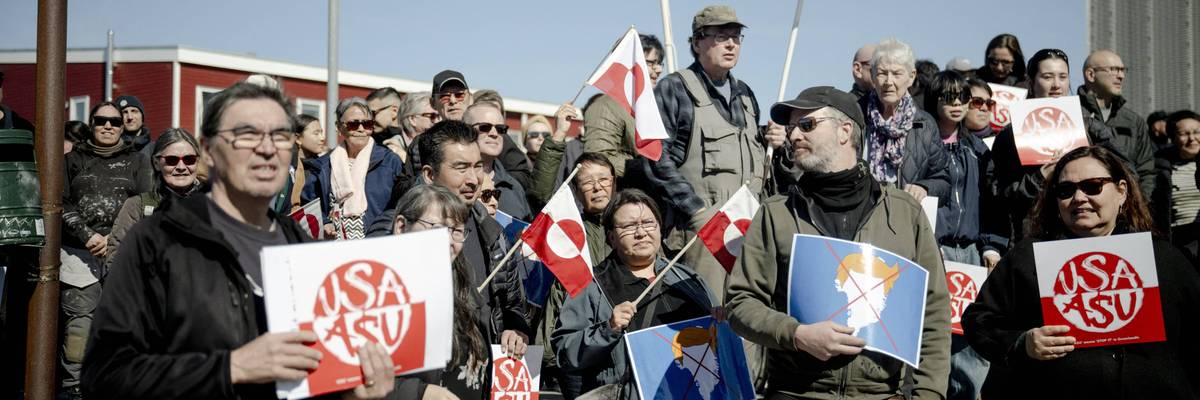
“I think it’s time for the US to put its footprint back on Greenland,” said the president’s envoy, Jeff Landry. Protestors with placards that read USA, ASU (Stop USA in Greenlandic) demonstrate against the new US Consulate in Nuuk, Greenland, on May 21, 2026. (Photo by Oscar Scott Carl/Ritzau Scanpix/AFP via Getty Images)
Hundreds of Greenlanders demonstrated outside the new US Consulate in Nuuk on Thursday as President Donald Trump’s envoy signaled that he’s still seeking to control the self-governing Danish territory that straddles the Arctic and Atlantic oceans.
Various Greenlandic politicians also declined invitations to attend the opening of the consulate, with Prime Minister Jens-Frederik Nielsen telling the local outlet Sermitsiaq that “we haven’t made a decision in principle, but I won’t participate.”
Protesters were armed with Greenland’s red and white flag and signs that read “USA ASU,” which translates to “Stop USA,” as well as messages in English, including “Make America go away!” and “We are not for sale!” Their chants included “Greenland belongs to Greenlanders,” “Go home,” and “No means no.”
“It’s very important, now more than ever, to show the American people what we already said, that no means no, and that the future and self-determination of Greenland belongs to the Greenlandic people,” said Aqqalukkuluk Fontain, a 37-year-old IT account manager and protest organizer, according to The Guardian.
“The protest itself is not to provoke Donald Trump or Jeff Landry but to show the world that Greenland has its own democracy,” Fontain added. Landry, the Republican governor of Louisiana and the president’s envoy to the island, arrived in Nuuk on Sunday.
The newspaper noted Trump’s envoy traveled there “uninvited with a delegation including a doctor, who caused fury by saying he was there to ‘assess the medical needs of Greenland.’ Landry briefly attended a business conference with the US ambassador to Denmark, Kenneth Lowery, and left Nuuk on Wednesday night.”
During Landry’s “ham-handed trip,” The New York Timesreported, “he offered chocolate chip cookies and red MAGA hats to people he met on the street. He didn’t get many takers, and Greenlandic officials criticized the visit.”
It was Landry’s first visit to the island of 57,000 since Trump appointed him as envoy in December. On Monday, he met with Greenlandic Foreign Minister Múte Egede and Nielsen, who called the talks “constructive,” even though there was “no sign... that anything has changed” regarding Trump’s position.
While polling has shown Americans and Greenlanders alike oppose Trump’s takeover threats, Landry told Agence France-Presse near the end of his trip that “I think it’s time for the US to put its footprint back on Greenland.”
“I think that you’re seeing the president talk about increasing national security operations and repopulating certain bases in Greenland,” he continued. “Greenland needs the US.”
The envoy made similar remarks on Friday during a Fox News appearance, highlighting Greenland’s oil resources amid soaring global prices—which stem from Trump’s illegal war on Iran that led the Iranian government to restrict ship traffic through the Strait of Hormuz, a key trade route for fertilizer and fossil fuels.
In addition to waging war on Iran and continuing to threaten both Greenland and Cuba, Trump invaded Venezuela early this year, abducting President Nicolás Maduro and seizing control of the South American country’s nationalized oil industry.
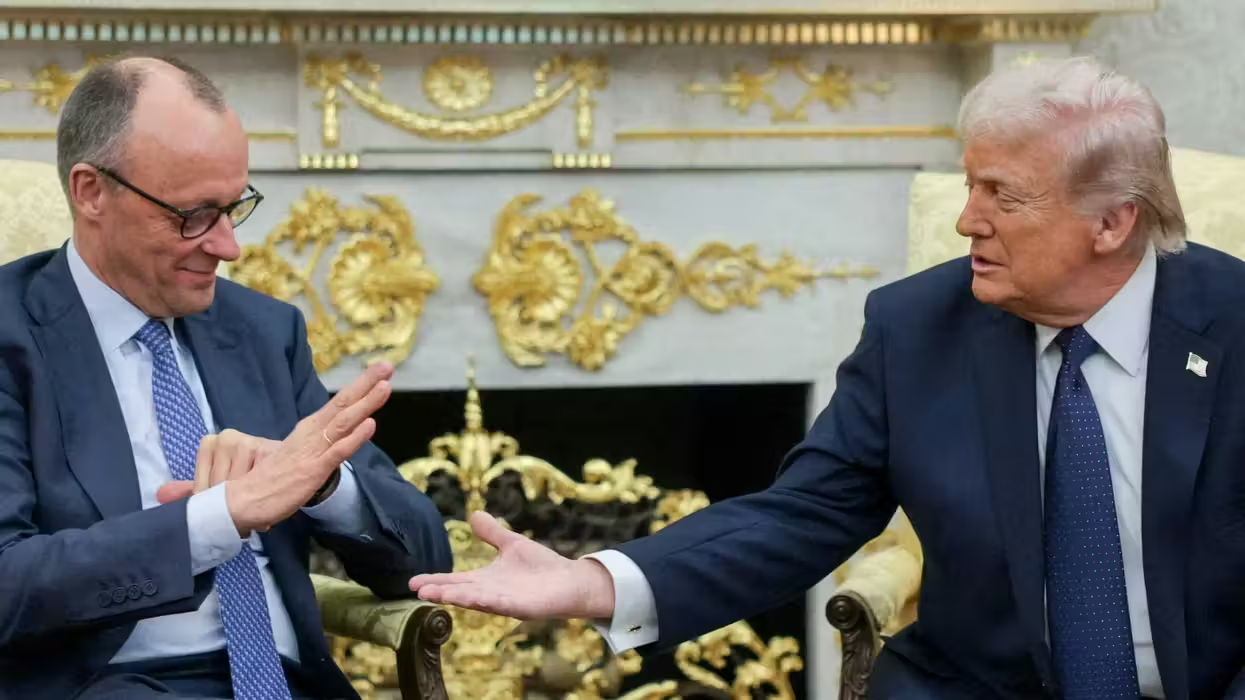
America’s closest allies see 'no point' in negotiating with Trump U.S. President Donald Trump and German Chancellor Friedrich Merz in the White House in Washington, D.C., U.S., March 3, 2026. REUTERS/Jonathan Ernst
During his second presidency, Donald Trump's foreign and economic policies have been a frequent source of frustration not only for Democrats and Never Trump conservatives, but also, for leaders of democratic countries that have long enjoyed a close relationship with the United States — from Canada to the European Union (EU). And according to journalist Matt Gurney in the conservative website The Bulwark, many democratic leaders see no "real value" in negotiating with Trump.
"As Donald Trump lurches from one erratic foreign policy decision to another," Gurney explains in his Bulwark article, "America's traditional allies and partners wonder if the United States possesses anything resembling a coherent strategy for its dealings with other countries. While Americans wrestle with Trump's impulsive decision-making at home, democratic leaders around the world are attempting to guess what Trump and Trumpism mean for the U.S.-led international order. And they are starting to plan for a world without it. From here out, any U.S. ally or partner has a strong interest in trying to get as little done with the United States as possible until Trump is gone — or, at the very least, constrained by a Democratic Congress."
Gurney adds, "That might take a while. America First risks becoming America Alone."
The journalist laments that for Canadian and European leaders, "faith in American motives and consistency is impossible" during Trump's second presidency.
Gurney warns, "We're way beyond the art of the deal here…. Trump is incentivizing his would-be partners to avoid making deals with him at all, and, to the greatest extent possible, reduce their reliance on the United States and, with it, American influence…. European leaders are increasingly blunt in their own public comments to and about Trump, whose wrath is so hard to avoid it can no longer really be feared. Canada, Europe, and allies across Asia may be tiptoeing around Trump at the moment, but they are also rapidly seeking out new trading partnerships."
Trump, according to Gurney, "has turned the act of bargaining with the United States itself into something no western leader can casually risk."
"Give Trump a cheap win he can tweet about, one that doesn't cost you and your country too much — but don’t actually invest any effort in trying to accomplish something real or substantive," Gurney writes in his Bulwark article. "There's no point. The midterms are only six months away, and it's possible that a Democratic Congress will impose some sanity on this cracked administration. But even that is an awfully big assumption."
Gurney continues, "No U.S. partner or ally can take for granted that big Democratic gains in November will be of much help…. Until and unless Trump is no longer president, few democratic leaders will see any real value in negotiating with him."
Mexico, EU to lower tariffs in bid to grow non-US trade
EU chief Ursula von der Leyen will sign an expanded trade deal with Mexico aimed at reducing both countries'dependence on trade with the United States - Copyright AFP RONALDO SCHEMIDT
Arturo ILIZALITURRI
The European Union and Mexico will on Friday sign a deal reducing tariffs on each other’s goods as both seek to lessen their dependence on trade with the United States.
The expansion of an accord dating to 2000 comes as Mexico fights hard to preserve a three-way free trade agreement with the United States and Canada, which is crucial to all three economies.
The EU is Mexico’s third-largest trading partner, lagging far behind the United States and China.
Mexican President Claudia Sheinbaum has stressed the importance of “opening other horizons” at a time when both Mexico and the European Union are grappling with US President Donald Trump’s tariff offensive.
The updated agreement to be signed by Sheinbaum and European Commission President Ursula von der Leyen during the eighth EU-Mexico Summit removes most remaining barriers to trade and investment.
It facilitates trade in auto parts, a sector particularly affected by Trump’s tariffs.
“Mexico wants to reduce its dependence on its northern neighbor, but also on Asian, or rather, Chinese, supply chains, and in Europe we are pursuing the same objectives,” an EU official told AFP on condition of anonymity.
On a visit Thursday to Mexico City, the EU’s foreign policy chief Kaja Kallas, said the deal would create new opportunities for “both economies to compete globally” and build on the momentum of the past decade, which has seen a 75-percent leap in EU-Mexican trade.
Earlier this week, the European Union moved to end a trade standoff with Trump by agreeing to implement a deal signed last year with the United States, which sets tariffs on most European goods at 15 percent.
Average US tariffs on Mexican goods are a quarter of that — with many avoiding levies altogether under the USMCA (United States, Mexico, Canada) agreement.
The lower tariffs enjoyed by Mexico will benefit the European Union, according to Sergio Contreras, president of the Mexican Business Council for Foreign Trade.
Mexico will be “the point of convergence, the platform for the European Union and North America to come together,” he said.
From agave syrup to raw materials: EU, Mexico agree trade expansion
Mexico and the European Union have both been hit by US President Donald Trump's steep tariffs - Copyright AFP/File Guillermo Arias
The EU and Mexico agreed to expand their trade ties Friday against the backdrop of a more protectionist United States under President Donald Trump.
Trade between Mexico and the EU is worth some 100 billion euros ($116 billion), but Brussels says the updated trade agreement will boost this further.
The EU is Mexico’s third largest trading partner, while Mexico is the bloc’s second biggest trading partner in Latin America after Brazil.
Brussels said the update to the pact would make it easier for the “likeminded partners” to export and invest in each other’s markets.
– Food and drink –
The EU said European farmers would benefit since Mexico is a net food importer, and there are limits on how much Mexico can export sensitive goods.
For example, the EU will limit imports of Mexican beef, with a quota of 5,000 tonnes of the meat allowed in with a preferential tariff rate of 7.5 percent.
Brussels wants to avoid upsetting farmers after a fierce fight over the trade agreement between the EU and the South American Mercosur bloc.
Mexico also agreed to recognise hundreds of food and drink products from specific regions of the EU, such as Parma ham and Roquefort cheese.
And it will lower tariffs on more products, and give duty-free access to pasta, chocolate, potatoes, canned peaches, eggs and certain poultry products.
In exchange, the EU will give access to Mexico to the bloc’s market for products like coffee, fruits, chocolates and agave syrup.
– Critical raw materials –
For Brussels, the update means European companies will have greater access to the Mexican market and can bid for more public contracts.
The agreement also means EU firms will find it easier to export machinery, pharmaceuticals and transport equipment, Brussels said.
The EU hopes the deal will mean better supply of critical raw materials from Mexico, already a top supplier to the bloc. The deal bans EU importers from paying a different price to Mexican buyers for critical raw materials.
The EU has been scrambling to diversify its supply of critical raw materials, as it seeks to cut its dependence on the elements from China.
And the agreement will facilitate European firms to ship auto parts to Mexico through the recognition of European certifications and international standards.
But Brussels insisted it would not allow Chinese manufacturers to use Mexico to export vehicles produced in China to Europe.
EU seeks to rebalance trade relationship with China
Sejourne is leading EU efforts to rebalance trade with China
- Copyright GETTY IMAGES NORTH AMERICA/AFP ALEX WONG
The EU must rebalance its trade relationship with China, the bloc’s industry chief said Friday, as Brussels renews its focus on commerce ties with Beijing.
The European Union’s goods trade deficit with China hit some 360 billion euros ($418 billion) last year, and calls are growing to address the imbalance.
“Openness to trade, which is in Europe’s DNA, remains a priority for us,” vice president Stephane Sejourne said, but there needs to be “a rebalancing of trade, given that we currently have a deficit of over 360 billion euros with China”.
The EU executive team including Sejourne will hold a special debate next Friday on how the 27-nation bloc should approach China to level the playing field.
A visit by Chinese Commerce Minister Wang Wentao to Brussels late next month is also under discussion, an EU official said.
Following the debate by the European Commission, European leaders will discuss the EU’s trade ties with China during a summit in Brussels on June 18 and 19.
EU trade ministers meeting in Brussels Friday trod a fine line, stressing that the EU-China relationship was important, but more balance was needed.
China is “an important trading partner. But what I think we need to ensure is that there is a greater balance when it comes to that overall relationship”, Irish trade minister Helen McEntee told reporters.
She said the EU needed to address “some of the risks, not least when we talk about rare earth minerals and the recent challenges that we’ve seen in the implications for our overall economy”.
“It’s a bit of a race, because our dependencies are there and our ability, our tools to build our sovereignty, independence in this area are increasing as well,” Poland’s Michal Baranowski said.
There have been trade frictions between China and the EU for months.
Tensions heightened especially after Beijing imposed export curbs on rare earths last year. The restrictions highlighted Europe’s heavy dependence on rare earths from China, which is the world’s top producer of the elements.
Brussels has also taken several steps to protect its market from what it describes as unfair Chinese competition, including slapping extra levies on small parcels from China.
Italian divers in Maldives may have got lost in cave: recovery firm
The alarm was sounded last Thursday after the divers failed to return - Copyright AFP Mohamed Afrah
Ella IDE
Italian divers who died in the Maldives may have taken the wrong tunnel in a cave and died in a dead-end corridor, the head of the company that recovered their bodies told AFP Thursday.
Finnish divers working for Dan Europe found their bodies in a corridor with a dead end inside the cave complex, some 50 metres (165 feet) down in the Indian Ocean archipelago.
“The bodies were found together in an area of the cave. Based on the cave’s layout, they may have got lost,” the company’s CEO Laura Marroni told AFP.
The Italian divers included a marine biology professor with many years of experience, her daughter, two young researchers, and their Maldives-based guide.
The alarm was sounded last Thursday after they failed to return from a dive.
The cave, an underwater system which extends for hundreds of meters through multiple chambers and internal passages, begins with a first large, bright cavern with a sandy bottom.
That is where the guide’s body was found, in an earlier recovery operation by Maldivian authorities.
At the end of this cavern is a corridor, which is almost 30 metres long and three metres across, and which leads to a second chamber of the cave.
The corridor ends in a sandbank, which is easy to get over into a second chamber, but “which could limit visibility” when attempting to leave again, Marroni said.
“The divers, unable to find the exit corridor, found themselves in a corridor to the left of what would have been the exit, which, however, was a dead end,” she said.
The dead-end corridor is where the four other bodies were found.
– ‘Limited air supply’ –
“Considering that they had a very limited air supply and therefore only a few minutes at the bottom, there probably wasn’t even time for them to make numerous attempts to find the correct exit,” said Marroni.
An attempt by the Maldivian National Defence Force (MNDF) to recover them was called off after one of its rescuers died Saturday from decompression complications, and the Finnish team was called in.
It was made up of three divers: one tasked with recovering the bodies, the second with operational safety support, and the third documenting the recovery and dive site.
The divers “are highly trained” and “conducted an extensive reconnaissance with us, and developed a conservative dive plan, considering that no one knew the cave well”, Marroni said.
“This type of operation always involves a great deal of responsibility, emotional toll, and a strong desire to return bodies to their families,” she said.
The team recovered the bodies on Tuesday and Wednesday.
The divers were returning to the cave Thursday to remove guide lines and operational equipment used inside the cave system during the recovery efforts.
“Much like at a crime scene, everything is documented, archived, and then cleaned up,” Marroni said.
The photos and videos taken by the Finnish team during the recovery operation will be shared with the Maldivian authorities, who are investigating how the Italians were allowed to descend to a depth of 60 metres.
The Indian Ocean country permits a maximum depth of 30 metres for tourists.
Taiwan to manufacture 100,000 drones monthly by 2030
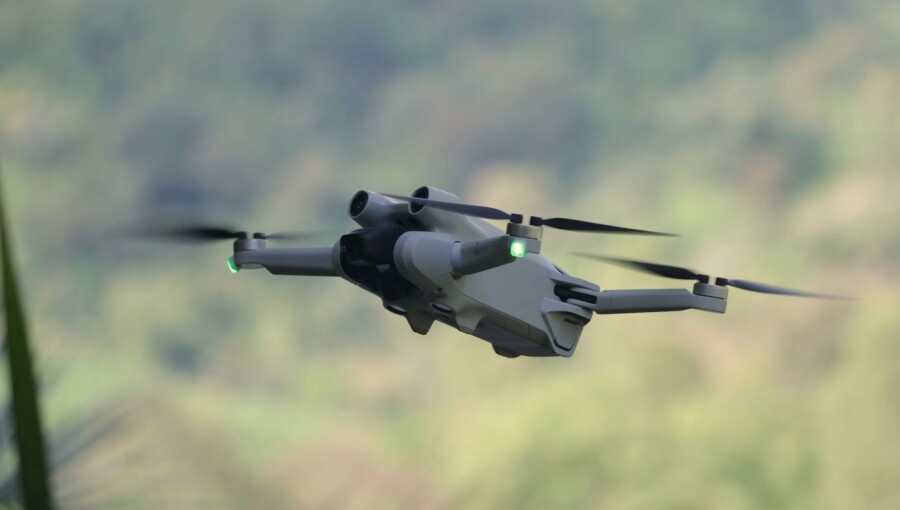
Taiwan projects its drone industry will expand massively to manufacture 100,000 units per month by 2030 and export half of them, the Ministry of Economic Affairs announced on May 21, Taipei Times reports.
The move highlights Taiwan's push to build a reliable, democratic hardware supply chain in Asia. This rapid capacity scaling aims to offer global buyers a secure alternative to Chinese tech amidst rising regional tensions.
Current assembly capabilities stand at 15,000 units monthly, but local factories can scale up quickly as market demand rises, Industrial Development Administration Director-General Chiou Chyou-huey told a press conference in Taipei on May 21.
Taiwanese drone output surged 2.5-fold last year to TWD12.9bn ($408.3mn) under a government investment programme for uncrewed vehicles, Chiou said.
The Executive Yuan approved a TWD44.2bn ($1.40bn) funding blueprint over six years to develop domestic uncrewed aerial hardware, targeting an output value above TWD40bn ($1.27bn) by 2030. If production value doubles to TWD26bn ($822.8mn) this year, the 2030 target could be revised upward, Chiou noted.
The domestic drone ecosystem currently relies on local purchase orders, with commercial-grade military hardware driving the bulk of manufacturing.
Outbound shipments account for just over 20% of total sales, led by the US, Poland and the Czech Republic.
International sales reached $147mn in the first four months of this year. Outbound shipments totalled $93mn last year, Chiou told a Cabinet press briefing on April 30.
Chinese consumer quadcopters hold a dominant price advantage due to massive manufacturing scale. However, the price gap narrows significantly for military-grade commercial systems where reliability, autonomous flight and anti-jamming features matter most, making Taiwan highly competitive, Chiou added.
According to Taipei Times, the XPONENTIAL 2026 uncrewed systems expo in Detroit drew significant interest from firms in the US, Japan, South Korea and Turkey for potential joint ventures, Chiou said.
The convention generated initial business prospects estimated at TWD1.3bn ($41.1mn) across optical modules, thermal imaging systems and flight software architectures.
Taiwan formalised memorandums of understanding with the Michigan Drone Association and the North Dakota Trade Office during the exhibition. These agreements focus on autonomous piloting, urban air mobility and shared testing facilities to help local enterprises access international validation and certification resources, Chiou concluded.
From conflict to cleaning, expo showcases China’s drone dominance
Drone World Congress opened in the southern Chinese tech hub of Shenzhen - Copyright AFP HECTOR RETAMAL
Peter CATTERALL
Russians looking for drone interceptors brushed shoulders with entrepreneurs keen to see the latest industrial cleaning technology at a massive industry expo showcasing China’s dominance of the drone industry on Thursday.
Unmanned aerial vehicles of all sizes, antennaed detection devices and anti-jamming gadgets straight out of a science fiction movie were on display at the Drone World Congress as it opened in the southern Chinese tech hub of Shenzhen.
Chinese firms’ supremacy spans sleek new roles from agriculture and infrastructure to military applications.
The high-flying machines rely on small, powerful magnets and other key components that are widely available in China’s manufacturing ecosystem and unparalleled elsewhere in terms of efficiency and variety.
“When you need to get any component, you have hundreds of different options (in China),” said exhibitor Javier Balaguer from Spain-based business consulting and services firm Applus+ Laboratories.
“If you… have direct access to them, it will be much easier,” the 30-year-old drone specialist told AFP.
Over 1,200 companies were taking part in the expo, according to organisers, plying their wares to the tens of thousands of attendees there for a startling variety of motives.
One of the most high-profile uses of drones recently has been in warfare, with the machines featuring heavily in the Ukraine conflict.
Beijing says it supports legitimate civilian use of drone technology, and has implemented “dual-use” export controls to prevent weapons proliferation.
But the often-overlapping technologies for commercial and military purposes create a grey zone that is difficult to enforce — especially across borders.
One participant from Russia, who declined to provide his name or affiliation, told AFP he was at the Shenzhen expo to look for drone “interceptors”, without giving more details.
Several booths away, AFP spoke to three Ukrainians, including one who said drone technology has become an “everyday necessity” since the war began.
“China dominates the whole supply chain”, especially in certain magnetic parts that are difficult to source from within Ukraine, one of the men said, also declining to provide his name.
– Counter-drone tech trending –
AFP spoke to foreign attendees from the European Union, the Middle East and Southeast Asia on Thursday, drawn to Shenzhen’s prowess for everything from infrastructure maintenance and aerial monitoring to racing events.
Organisers said they expected this year’s attendance to be 150,000.
Applus+ Laboratories’ Balaguer told AFP that the scale of the event has multiplied each of the last three years he has attended.
This year, the new trend is counter-drone technology, he said.
The general manager of Chinese firm Yinyan General Aviation, Wu Yingjie, told AFP that her work involves the deployment of “drone countermeasures” along China’s international border.
Wu’s firm is based in the southwestern city of Nanning, less than 150 kilometres from Vietnam.
Drone countermeasure technologies have been used for detection, reconnaissance and combating unauthorised flights, she said.
“It was because of the Russia-Ukraine war that the world saw the drone countermeasures industry,” she added.
“Drones play a very important role in low-altitude security.”
– Seeking inspiration –
Among the busiest booths at the expo Thursday were those of China’s — and the world’s — industry champions.
DJI was one clear star of the show, its centrally positioned displays thronged with crowds of participants.
The Shenzhen-based firm, established in 2006, has held more than two thirds of the global commercial drone market in recent years, studies with varying estimates show.
Booths of less well-known companies showcased the diverse range of drone technologies available, including “anti-jamming” devices, “sound recognition”, “infrared thermal imaging” and “laser countermeasures”.
Others offered industrial applications like lifting heavy payloads, which could be used, for example, to string power lines on tall towers.
Luca Musiolik, CEO of Germany-based industrial drone firm DroneShine, told AFP that he was there to learn about the latest drone-powered industrial cleaning technologies.
“You don’t really have any competitors in Europe or any innovation coming out of Europe,” said Musiolik, 21.
“So we’re just really trying to get inspired by the technology, a bit like China did with the German car industry.”
Russian Patrol Ship Improvises Using Fencing to Protect Against Drones
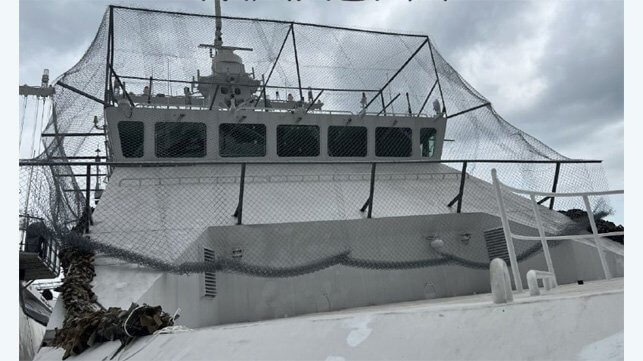
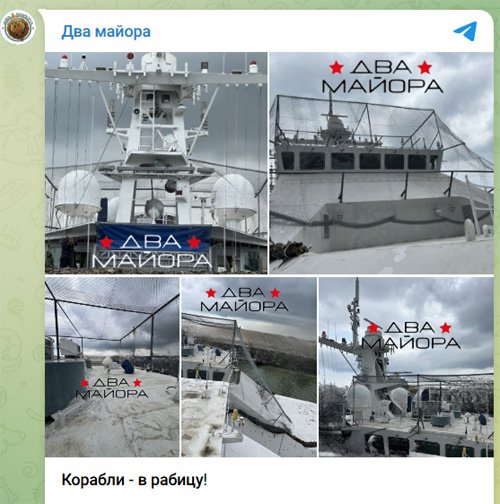
Fencing struck around the bridge and superstructure as makeshift protection against drones (DVA Major on Telegram)
In the more than four years since Russia invaded Ukraine in an all-out war, Ukraine has become proficient in drone technology and has frequently reported its use of its systems to attack Russian warships and other critical infrastructure. Ukrainian media this week spotted photos posted on Russian social media showing an improvised solution to add protection to Russian patrol boats.
The pro-Russian site DVA Major posted pictures showing Russian patrol boats “covered in chain-link fencing!” It says that public funding was used to buy the material and that it has been applied to more than one patrol ship.
The area around the bridge was seen draped with the fencing. It has also been applied to the top of the superstructure.
“This solution isn't a panacea. It won't protect against all types of enemy ammunition. But if nothing is done, nothing will happen,” writes DVA Major.
The Ukrainian site Militarnyi studied the pictures, and although the vessel was not named, it believes it has identified the class of ship. It says the structure around the bridge is unique to the Project 22460 patrol ship.
Russia commissioned the first of the vessels in 2009 and uses them for various coastal patrols. The media reports are that four of the vessels are currently based in Crimea, and two more are at Krasnodar Krai.
In February 2026, Ukraine's general staff said it had used drones to hit two border guard ships moored near the town of Inkerman in Crimea, at the easternmost end of Sevastopol Bay. The vessels damaged were Project 22460 Rubin-class fast patrol boats. Further, it was reported that Ukraine had targeted vessels of the same class in December 2025 in the Caspian Sea. Last weekend, Ukraine also reported hitting a different class of patrol ship in Crimea with drones.
The 22460 patrol boats are fast, with a speed of 25 knots and 650 tons displacement. They are 62.5 meters (205 feet) in length, with reports that they have a crew of 20 and space for 14 additional people.
Other pictures were recently online of the Russian Project 21980 class, which is used for anti-sabotage operations. One of those vessels also appeared to have been fitted with a similar netting made of fencing to block drones.
It remains to be seen if it is judged an effective protection and if it will appear on other Russian ships.
VICTORY!
Samsung chip employees to get average $338,000 bonus under strike deal
Samsung Electronics chip employees are expected to receive average bonuses worth 509 million won ($338,000) under a tentative deal to avert a strike - Copyright AFP Jung Yeon-je
Samsung Electronics chip employees are expected to receive average bonuses worth 509 million won ($338,000) this year, a company official said Thursday, under a tentative deal between management and labour unions to avert a strike.
The tech giant and its union reached the provisional agreement late Wednesday following last-minute government-mediated talks, avoiding a planned 18-day strike that was set to begin Thursday.
The dispute unfolded against the backdrop of a global artificial intelligence boom that has turbocharged Samsung’s chip business while lifting South Korea’s economic growth and stock market.
The tentative deal introduces a new bonus pool for employees in the semiconductor division, equivalent to 10.5 percent of the division’s operating profit, to be paid in stock.
Combined with an additional 1.5 percent in cash, the deal would allow workers to share up to 12 percent of operating profit as bonuses.
Samsung semiconductor employees are expected to receive around 509 million won under the new deal, a company official confirmed to AFP on Thursday.
The figure is a rough calculation based on the estimated 331 trillion won in operating profit –- in line with market consensus reported by Yonhap News Agency — as well as a 12 percent bonus pool and roughly 78,000 chip employees.
The bonus scheme would last 10 years and is conditional on the chip division posting annual operating profit of more than 200 trillion won between 2026 and 2028, and more than 100 trillion won annually through 2035.
While workers are expected to benefit from the deal, some shareholders voiced opposition.
A group of Samsung Electronics shareholders vowed Thursday to pursue legal action against the tentative agreement.
The Korea Shareholder Action Headquarters staged a rally near the residence of Samsung Electronics Chairman Lee Jae-yong, arguing that operating profit-linked bonuses had not been approved through a shareholder resolution and therefore lacked legal validity under the current commercial law.
The group said it would “use all legal means available” to block any disbursement of company funds based on the agreement if it is finalised without following the required procedures.
Samsung memory chips are used in products ranging from consumer electronics to computer processors, while its next-generation high-bandwidth memory chips are key components for scaling up AI data centres.
Samsung said in April that its first-quarter operating profit jumped roughly 750 percent from a year earlier, while its market capitalisation topped $1 trillion for the first time this month.
The prospect of a strike had raised concerns over the potential impact on South Korea’s economy, with semiconductors accounting for around 35 percent of the country’s exports.





.jpg)
