Showing posts sorted by relevance for query ALBERTA BOOK BAN. Sort by date Show all posts

Wednesday, September 03, 2025

CANADIAN PROVINCE BANS FAMOUS CANADIAN AUTHOR

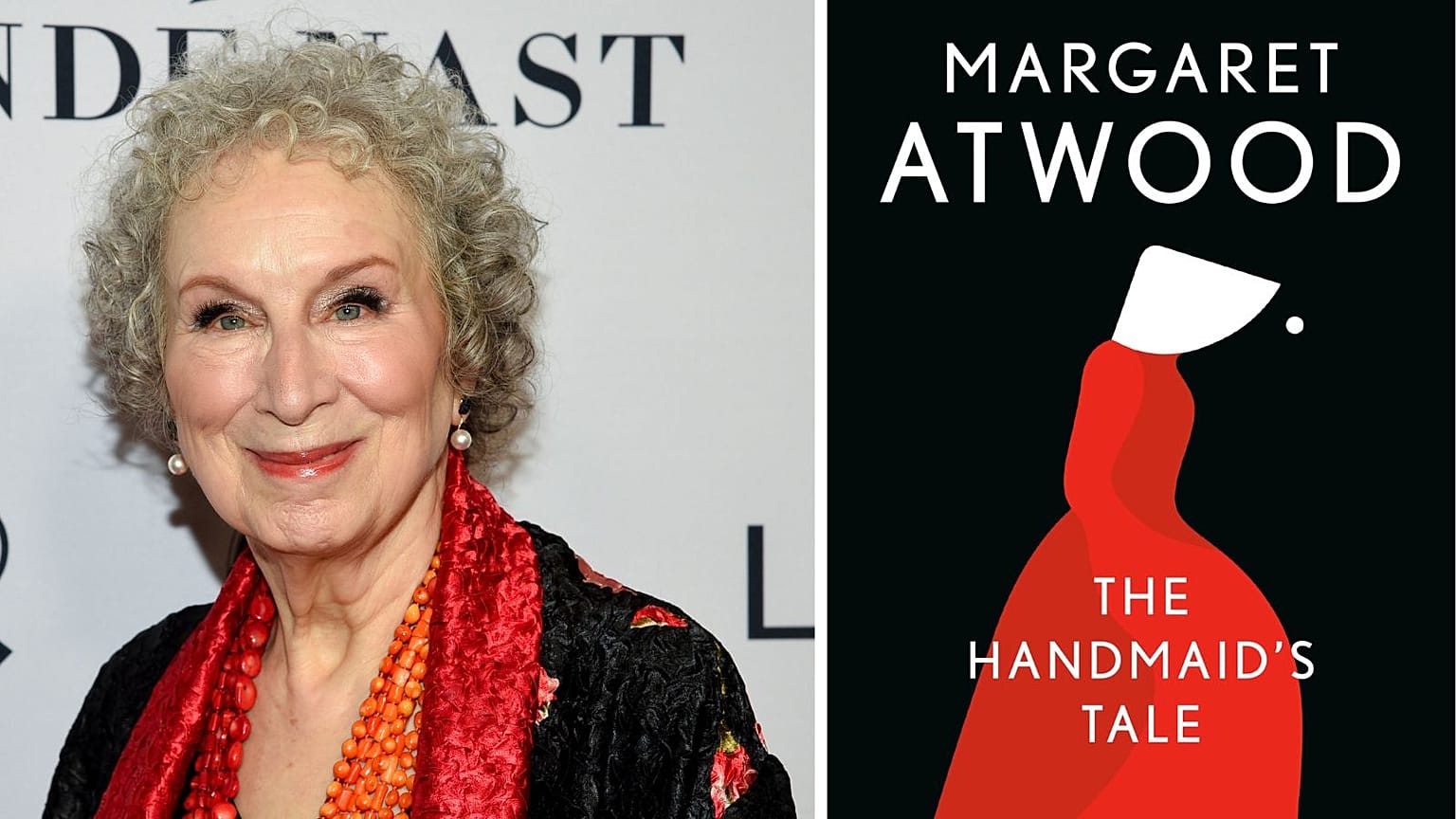
'Public book burnings': Margaret Atwood comments on 'The Handmaid's Tale' Alberta book ban
OOPS
Margaret Atwood on Alberta schools banning ‘The Handmaid’s Tale’
Copyright AP Photo - Vintage UK


By David Mouriquand
Published on 

Margaret Atwood is taking aim at Alberta’s new rules on school libraries and has even posted a new short story which satirizes the censorship at play.

Celebrated Canadian author Margaret Atwood is speaking out after her award-winning dystopian novel “The Handmaid’s Tale” was included on a list of more than 200 books removed from public school libraries under the Canadian province of Alberta’s new school restrictions. 

In July, Alberta's education ministry ordered school libraries to remove "materials containing explicit sexual content" by 1 October. 

In response to this equally dystopian ruling, Atwood wrote on X, “Get one now before they have public book burnings,” and released a new short story online that satirizes the book ban.  


The story focuses on two "very, very good children" named John and Mary, who “never picked their noses or had bowel movements or zits” and who “married each other, and produced five perfect children without ever having sex.” 

John and Mary ignored "forgiving your enemies and such; instead, they practised selfish rapacious capitalism". Atwood added: "The Handmaid's Tale came true and Danielle Smith found herself with a nice new blue dress but no job." 

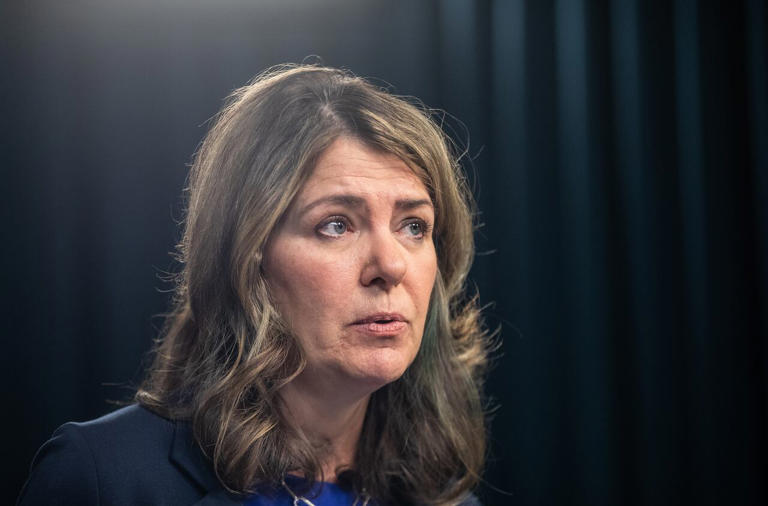
This is a reference to both the blue garb worn by the wives of the high-ranking commanders in “The Handmaid's Tale” and Alberta Premier Danielle Smith, who has backed the new directive to keep out sexually explicit content.

However, Smith has recently stated that Edmonton's public school board was practising a form of "vicious compliance" and had gone over the top in following the directive. She told reporters late last week that the province was happy to reissue its directive to the school boards which misunderstood it. 

Other classics that the Edmonton Public School Board announced were being removed from school libraries include Maya Angelou's "I Know Why the Caged Bird Sings", George Orwell's "1984", Alice Walker's "The Colour Purple", and Aldous Huxley's "Brave New World".


JUST SAY NO, BOOK BANS!


Alberta rewriting order banning school library books to protect classics: Smith

Story by Jack Farrell and Lisa Johnson
SEPTEMBER 2, 2025
The Canadian Press

Alberta Premier Danielle Smith, right, stands with new Minister of Education and Childcare, Demetrios Nicolaides, following a swearing in ceremony in Calgary, Friday, May 16, 2025.THE CANADIAN PRESS/Jeff McIntosh© The Canadian Press

EDMONTON — Alberta Premier Danielle Smith says her government is rewriting an order directing school divisions to ban books with sexually explicit content to ensure classic books stay on library shelves.

The order is being changed, Smith says, to only target books containing sexual images.

The government's initial order, issued in July, covered books with images, illustrations, audio and written passages with sexually explicit content.

"It's images that we're concerned about, graphic images," Smith said Tuesday at an unrelated news conference in Medicine Hat, southeast of Calgary.

"We were hoping that the school boards would be able to identify those on their own and work with us to try to make sure that pornographic images are not being shown to young children."

The revision comes after Edmonton's public school division put together a list of more than 200 books it planned to remove from libraries to comply with the initial order.

The list includes Margaret Atwood's "The Handmaid's Tale," Maya Angelou's "I Know Why the Caged Bird Sings" and "Brave New World" by Aldous Huxley, as well as books by Alice Munro, Ayn Rand, Margaret Laurence and Stephen King.


Related video: Alberta government suspends new rules on explicit books in schools (CBC)

Dozens more books were set to be inaccessible to students in kindergarten through Grade 9, including George Orwell's "Nineteen Eighty-Four" and F. Scott Fitzgerald's "The Great Gatsby."

Smith accused the division Tuesday of purposely misunderstanding the order.

"We are not trying to remove classics of literature," Smith said. "What we are trying to remove is graphic images that young children should not be having a look at.

"What I would like for the school boards to say is: 'We agree! Children shouldn't see pornographic images. We'll work with you on that.' And that's what I hope the spirit going forward will be."

The inclusion of Atwood's celebrated novel prompted the author to condemn Smith online over the weekend. Atwood penned a satirical short story that she said could replace her most famous work in Alberta school libraries.

The satire is about two 17-year-olds who "grew up and married each other, and produced five perfect children without ever having sex."

In a blog post Tuesday, Atwood questioned why Alberta laid the blame on the Edmonton school board, referencing Smith's accusation that the list of banned books was "vicious compliance."


"Compliance with an order the government itself issued and that school boards were compelled to implement? Whatever do they mean?" asked Atwood.

Smith said Tuesday that Atwood played no role in the decision to change the order and encouraged the author to look at the four graphic novels the province cited in May as the reason for the policy.

"It includes oral sex. It includes threesomes. It includes a child having their pants pulled down by an adult," said Smith. "That is what we are trying to remove from the school libraries."

Earlier Tuesday, Alberta's education minister instructed school divisions in an email to pause efforts to comply with the order until further notice.

Demetrios Nicolaides said later in a statement the list from Edmonton Public Schools prompted the government to change the order, and that it would happen "immediately."

His office did not confirm when the revised order would be issued.

The initial order directed schools to remove books with sexually explicit content — for students in all grades — by the end of September. Those in Grade 10 and higher would have access to books with non-explicit sexual content.

Nicolaides had said the policy was spurred by four graphic novels with illustrations of sexual acts — most with LGBTQ+ themes — found in some school libraries.

The four books, including "Gender Queer" by Maia Kobabe and Alison Bechdel's "Fun Home," were on the Edmonton Public Schools list of books to be removed.

Other divisions were expected to come up with similar lists, though multiple divisions said they stopped those efforts because of the email from Nicolaides.

A spokesperson for the Calgary Board of Education, the city's public school division, said its review of more than 500,000 titles was paused.

Julie Kusiek, the Edmonton Public Schools board chair, said the division's trustees believe the government revising the order is a response to concerns by parents, families and educators.

"Our board remains committed to keeping lines of communication open with the minister as we continue to work collaboratively with families and the government in support of student learning," Kusiek said.

Opposition NDP Leader Naheed Nenshi said if the United Conservative Party premier wasn't so adversarial, the issue of removing age-inappropriate books from school libraries would have been solved without much trouble.

"The UCP decided to try to ignite a culture war, and it's backfired on them exceptionally badly," Nenshi said.

"Instead of just saying, 'Hey, we found a couple of troubling comic books with some troubling images, let's take those off of shelves,' they wrote a ministerial order.


"Then this is what happened. People actually complied with the order."

Jason Schilling, president of Alberta's teacher union, agreed and called on the province to back down completely.

"We urge the government to stop playing games with teachers and students and put a full stop to policing school library materials."

This report by The Canadian Press was first published Sept. 2, 2025.

-- With files from Matthew Scace in Medicine Hat, Alta.

Jack Farrell and Lisa Johnson, The Canadian Press


Friday, August 29, 2025

BOOK BAN BITES BACK
'Vicious compliance': Alberta premier decries Edmonton Public Schools' banned book list

 PEN Canada, an organization that fights against literary censorship, considers what is happening in Alberta the first — and largest — book ban of its kind in Canada.


 Nicholas Frew
CBC
Aug. 29, 2025.


Alberta Premier Danielle Smith said Friday that the Edmonton Public School Board's list of books to be taken off school shelves showed 'a little vicious compliance' to her government's directive.
© Jason Franson/The Canadian Press
Alberta Premier Danielle Smith slammed the Edmonton Public School Board Friday morning for its banned book list, which features more than 200 titles.

The internally distributed list, which CBC News obtained Thursday, was in response to a provincial government directive to identify books that are not age-appropriate and remove them from school library shelves.


But the list included titles like The Handmaid's Tale, The Color Purple, The Godfather and Jaws. Books from authors like George R. R. Martin, Sarah J. Maas and Maya Angelou are also on the list.


"Edmonton Public is clearly doing a little vicious compliance over what the direction is," Smith said during an unrelated news conference.

The point of this work is to keep graphic, sexually explicit content out of elementary schools, she said.

"If they need us to hold their hand through the process to identify what kind of materials are appropriate … we will more than happily work with them to work through their list, one by one, so we can be super clear about what it is we're trying to do," Smith said.

The school board confirmed Friday morning that the list CBC News obtained is accurate. A spokesperson shared a statement from the board chair Julie Kusiek Thursday evening, saying the board shares concerns raised by the public about the library policy, and they acknowledged that "several excellent books" will be taken off the shelves this fall.


On Friday afternoon, the spokesperson said Kusiek will be contacting Smith directly about compliance with the ministerial order.

Canadian author Margaret Atwood, who wrote The Handmaid's Tale, declined to speak with CBC News, but noted in a social media post Friday that her novel was banned in Edmonton.

"Don't read it, your hair will catch on fire! Get one now before they have public book burnings of it," she wrote.

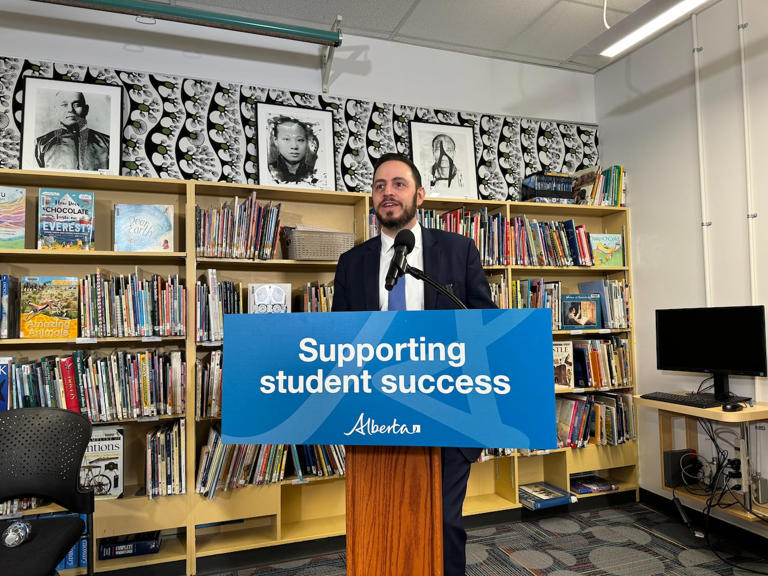
Education and Childcare Minister Demetrios Nicolaides announced in the spring that new rules would be coming to school libraries, after parents raised concerns to the government about four coming-of-age graphic novels — most of which show nudity and sexual 2SLGBTQ+ content — found in circulation in Edmonton and Calgary public schools.

Nicolaides signed a ministerial order, dated July 4, laying out the standards for school library materials and included definitions.


Among other things, the order states that school boards cannot allow explicit sexual content, which it defines as clear depictions of a sexual act, such as masturbation, penetrative sex, and the use of sex toys. But it holds caveats for depictions in religious texts, and non-explicit sexual content — depiction of a sexual act that isn't detailed or clear.

In the Edmonton Public Schools list, for example, The Great Gatsby by F. Scott Fitzgerald was flagged for non-explicit sexual content. The list says only students in grades 10 to 12 would be allowed to access the book, if it's "developmentally appropriate."

Government officials have reiterated that the directive is about protecting children and youth from mature content, not banning books. But Ira Wells, president of PEN Canada, an organization that fights against literary censorship, considers what is happening in Alberta the first — and largest — book ban of its kind in Canada.

A book ban, Wells said, happens when a book is removed from a public or school library shelf because someone, for example, deems it harmful or morally offensive.

"What the government of Alberta is doing here is book banning. It is literary censorship and we should use those words," he said.

"All parents — myself included — are concerned about the media that our children consume. We want to be sure that our children are consuming age-appropriate media.

"But here we have a case where partisan politicians are taking it upon themselves to determine what our children should read. That's a Rubicon that we don't want to be crossing."

During an unrelated news conference Friday morning, Nicolaides told reporters that he would be speaking with Edmonton Public Schools about its list, noting that he does have some questions about featured titles.

"Our primary interest with the ministerial order is to ensure that books that contain graphic depictions of sexual acts are provided to children in an age-appropriate way," he said.


"I want to get a better understanding of how these books were selected and what mechanisms and method the Edmonton Public Schools has used," he said, adding that he expects to get more information from the school board soon.

The Edmonton Public Schools staff spent the summer making sure "only books that directly met the criteria of the ministerial order" were added to the school board's list, the school board's spokesperson said Thursday.

John Hilton-O'Brien, executive director of Parents for Choice in Education, a parental rights group that raised concerns about the graphic novels back in the spring, is also baffled by the list.

"No reasonable person can take this seriously," Hilton-O'Brien told CBC News, accusing the school board of attempting "malicious compliance" to get out of removing content from their libraries.

"We wanted schools to pull things like graphic novels with explicit content. We didn't ask for them to play book-burning roulette with Margaret Atwood and Maya Angelou."

CBC News is reaching out to other school boards about their lists. Principals with the Edmonton Catholic School Division are reviewing their respective school library collections to ensure compliance with the ministerial order, a spokesperson said.

Fort McMurray Public Schools is figuring out its next steps per the ministerial order, a spokesperson said, but as of Friday afternoon, the four graphic novels flagged in the spring are the only ones so far that it is ensuring will not be in its libraries.

During her news conference, Smith said the Red Deer Public Schools may release its list Friday. But a school board spokesperson told CBC News that will not be the case.

It, too, is working to meet the requirements set out by the government and will be in compliance by Oct. 1, they said.

The Calgary Board of Education, that city's public school board, will share more with staff and families once its list's details are confirmed, a spokesperson said, adding that it is reviewing more than 500,000 titles and aligning library policies to the new regulations.

The Opposition NDP issued a statement Thursday from education critic Amanda Chapman, saying the United Conservative Party government is focused on banning books instead of preventing a teachers' strike.


The Handmaid's Tale among more than 200 books to be pulled at Edmonton public schools


Story by Emily Williams
CBC
Aug. 29, 2025.


Titles like The Handmaid's Tale, Brave New World, I Know Why the Caged Bird Sings and Perks of Being a Wallflower are to be pulled from library shelves at Edmonton public schools come fall, according to a document shared with CBC News.

An internally distributed list obtained by CBC News shows more than 200 books deemed sexually explicit are slated for removal from library shelves for students in kindergarten to Grade 12. It comes after a policy from Alberta's education minister outlines new rules governing books in school libraries as of Oct. 1.

"Following a division review process, the following books have been identified as containing explicit sexual content," reads the Edmonton Public Schools memo.

Beyond Canadian classics, contemporary authors like John Green and Emily Henry also have titles on the list. Books with 2SLGBTQ+ themes like Gender Queer and Two Boys Kissing are also deemed sexually explicit and will be removed.

The list became public Thursday after being distributed to some educators. Copies were being shared on social media. CBC News independently obtained the list.
'Several excellent books will be removed,' says board

The list has not been officially released by the Edmonton Public School Board. But in a statement to CBC News, EPSB chair Julie Kusiek said there is a list of books that will be removed from schools as a result of the government's ministerial order. Kusiek said the board shares concerns raised by community members and opposed the policy.

"As a result of the ministerial order, several excellent books will be removed from our shelves this fall," the statement read.

"Division staff worked over the summer to ensure that only books that directly met the criteria in the ministerial order were added to the division's removal list."

CBC asked if the list it obtained a copy of was the one Kusiek referenced, but an EPSB spokesperson refused to confirm it was the same list.
Government to review list

Education Minister Demetrios Nicolaides said the government is aware of the EPSB list banning books for students in K-12 and will be reviewing it.

"We have asked Edmonton Public to clarify why these books were selected to be pulled, and we will work with them to ensure the standards are accurately implemented. We did not provide this list to EPSB," the statement read.


Education Minister Demetrios Nicolaides is pictured announcing new school construction projects moving ahead this summer. (Janet French/CBC)

Nicolaides also said the list does not differentiate between high school students and other, younger students. However, the list obtained by CBC includes more information: a second section with over 50 titles that applies to K-9 students only.

Materials with "non-explicit sexual content" will be unavailable in libraries for K-9 students and this includes titles like 1984 and The Great Gatsby.

"They may be accessible to students in grades 10 through 12 if the content is developmentally appropriate for the students accessing the material," the EPSB memo reads.

Why some say it could create 'culture of fear'


Nicolaides has repeatedly said that the policy is not about banning books, but putting rules in place for schools that lack standards for age-appropriate material.

"I'm dismayed and disappointed. I'm not at all surprised," said Laura Winton, a former president of the Library Association of Alberta.

Winton said the policy leaves a great deal up for interpretation.

"The intention of this ministerial order was to remove materials from school libraries, and that's exactly what it's doing."


Winton said just because a book has sexually explicit material doesn't mean it's not developmentally appropriate for teenagers.

"What specific book-banning lists are going to do is limit the amount of material that's available to students, limit the amount of topics that can be discussed and just create a culture of fear in the classroom."


Thursday, October 02, 2025


New PEN America report reveals Stephen King is the most banned author in US schools

New report reveals who the most banned author is in US schools
Copyright Canva

By David Mouriquand
Published on 


The alarming new report by PEN America, titled "The Normalization of Book Banning - Banned in the USA, 2024-2025", offers a window into the extensive climate of censorship in the US.

It’s official – and very depressing: Stephen King is the most banned author in US schools, according to a new report on book bans.

PEN America’s "The Normalization of Book Banning - Banned in the USA 2024-2025”, published today, tracks 6,870 instances of books being temporarily or permanently pulled for the 2024-2025 school year across 23 states and 87 public school districts.

The report, which examines the climate of censorship between 1 July 2024 through 30 June 2025, states that in 2025, book censorship in the US is “rampant and common” and that “never before in the life of any living American have so many books been systematically removed from school libraries across the country”. 

The report adds: “Never before have so many states passed laws or regulations to facilitate the banning of books, including bans on specific titles statewide. Never before have so many politicians sought to bully school leaders into censoring according to their ideological preferences, even threatening public funding to exact compliance. Never before has access to so many stories been stolen from so many children.” 

Some 80% of the bans originated in just three states that have enacted or attempted to enact laws calling for removal of books deemed objectionable: Florida, Texas and Tennessee. 

The campaign to censor books is increasingly routine as individuals and boards capitulate to rapidly expanding pressures to remove books.
 PEN America report "The Normalization of Book Banning" - Banned in the USA 2024-2025 

Reasons often cited for pulling a book include LGBTQ+ themes, depictions of race and passages with violence and sexual violence.

PEN finds that an ongoing trend has only intensified: thousands of books were taken off shelves in anticipation of community, political or legal pressure rather than in response to a direct threat. 

“This functions as a form of ‘obeying advance,’” the report reads, “rooted in fear or simply a desire to avoid topics that might be deemed controversial.”

PEN America has also identified “a new vector of book banning pressure”: the federal government. 

“Since returning to office, the Trump Administration has mimicked rhetoric about “parents’ rights”, which, in Florida and other states, has largely been used to advance book bans and censorship of schools, against the wishes of many parents, students, families, and educators.” 

The report highlights that “under the guise of “returning education to parents,” President Trump has released a series of Executive Orders (EOs) mainly: 'Ending Radical Indoctrination in K-12 Schooling', 'Defending Women From Gender Ideology Extremism', and 'Ending Radical And Wasteful Government DEI Programs And Preferencing'.”

In addition to the efforts from the White House, the Department of Education ended an initiative by the Biden administration to investigate the legality of bans and has called the whole issue a “hoax”.

Th report was preceded by horror icon Stephen King taking to X and sharing: “I am now the most banned author in the United States – 87 books. May I suggest you pick up one of them and see what all the pissing & moaning is about?” 

He added: “Self-righteous book banners don’t always get to have their way. This is still America, dammit.” 

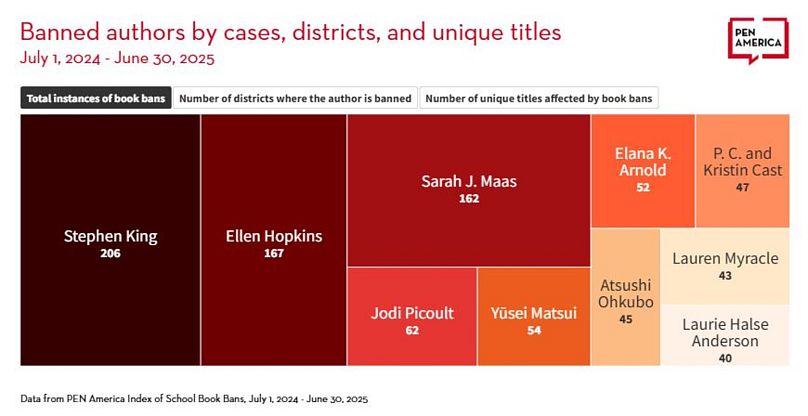
Indeed, King’s books were censored 206 times, according to PEN, with “Carrie” and “The Stand” among the 87 of his works affected. 

Ellen Hopkins, Sarah J. Maas and Jodi Picoult were some of the other most banned authors, with 167, 162 and 62 censored times respectively.  

PEN America’s report
PEN America’s report Screenshot "The Normalization of Book Banning - Banned in the USA 2024-2025”

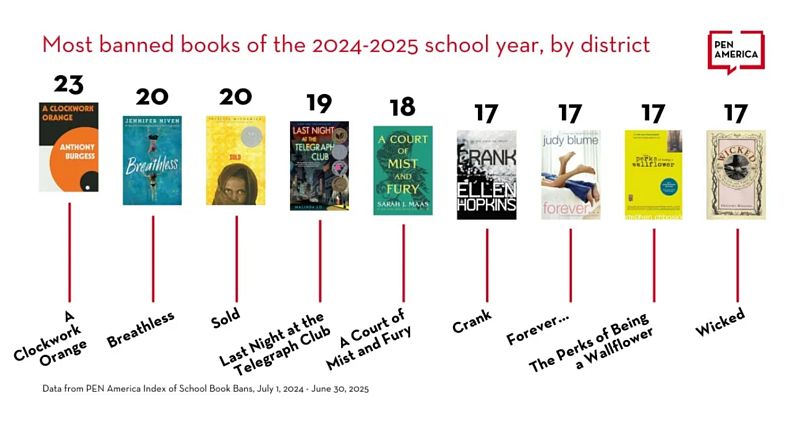
The most banned work of any author was Anthony Burgess’ dystopian classic “A Clockwork Orange,” for which PEN found 23 removals.  

Other books and authors facing extensive restrictions include Jennifer Niven’s “Breathless” (20), Patricia McCormick’s “Sold” (20), Malinda Lo’s “Last Night at the Telegraph Club” (19) and Sarah J. Maas’ “A Court of Mist and Fury” (18). 

The full and very alarming PEN America “Banned in the USA” report can be found here.

PEN America report
PEN America report Screenshot "The Normalization of Book Banning - Banned in the USA 2024-2025”
These attacks on students’ rights and educational institutions are the symptoms of a much larger disease: the dismantling of public education and a backsliding democracy.
 Extract from "The Normalization of Book Banning - Banned in the USA, 2024-2025" report 

King, who is having a big screen year in 2025, has overtaken Agatha Christie as the most adapted author. The prolific writer’s works have been transposed to both the big screen and the small screen for decades, with more than 55 book-to-feature adaptations since 1976’s Carrie. When also accounting for TV shows and miniseries, his stories have been brought to the screens well over 100 times. 

He is also a vocal critic of Donald Trump, and recently, in a new interview with The Guardian, compared Trump’s presidency to “a horror story”.

Answering a fan question “If you had to invent an ending for Trumpian America, what would it be?”, King answered: “I think it would be impeachment – which, in my view, would be a good ending. I would love to see him retired, let’s put it that way.”

He added: “The bad ending would be that he gets a third term and takes things over completely. It’s a horror story either way. Trump is a horror story, isn’t he?”


Wednesday, March 01, 2006

Ralph Klein Abuser


Was Colleen Klein fearing for her safety when she pushed hubby to go for a fourth term? Calgary Herald Columnist Don Braid thinks so.........

And Klein did admit it was Colleen who pushed him into seeking a fourth term which, in my view, may have more to do with her concern that he'll start drinking again once the public spotlight moves on.

And we know that alcoholics are abusive, even after they have gone sober, which may also explain why Colleen is so reluctant to appear in public.

Her foes insist she's become reclusive from political life.

That's true, too.

Homebody Colleen Klein rarely travels on trade missions anymore and refused, for example, to attend the premiers' conference in Banff last summer until a Klein bodyguard offered to take care of her pooch.

Klein proved he was abusive in the most public way in the infamous incident with the unemployed at the homeless shelter. Drunk in charge He swore off drinking but that was temporary, typical alcoholic behaviour.


It is odd that none of the journalists and politicians, save for Pannu, criticized Klein for drunkenly barging into to a homeless shelter. It seems that homeless baiting is an acceptable pursuit in Alberta, encouraged and practised by the premier himself. At least that is what I glean from the-excuse the cliché-conspiracy of silence regarding Klein's night at the homeless shelter. Ralph’s alcoholism a smokescreen

“Ashley Geddes, a colleague at The Edmonton Journal, had to wait a year to get a story in print in the early '90s about cabinet minister Steve West's shenanigans in local bars. References to West's sometime drinking buddy of the day, Klein, were removed.” Mark Lisac

Klein’s drinking habits have a long public history.

The stories of Klein and alcohol are endless. He drank openly as Mayor of Calgary in the 1980s. He made the St. Louis Hotel in Calgary a national institution. He drinks with reporters. When he decided to contest the Conservative Party leadership in 1992, he was asked about the drinking. His response: a guy can change. He didn’t.


He also has a gambling addiction. An addict is an addict. And those with addictions are the most common abusers.


King Ralph promotes liberalizing legislation for his addictions. The privatization of liquor, the expansion of VLT's and gambling, and of course the watering down of the provincial anti-smoking laws.

Smoking bill changes: Klein. Red Deer
Advocate, A6.

Alberta Premier Ralph Klein states that changes to a private member's bill that calls for a provincewide smoking ban will not weaken the proposed legislation. Amendments to the bill will allow smoking in bars, casinos, and bingo halls as they are locations where children are not allowed. Klein indicates that the amendments are due to concerns from rural residents and bar owners.

Ralphs sin taxes are a major source of government revenue, over and above even that paid by the oil industry.

Even for a family in which nobody smokes, gambles or drinks alcohol, this means a provincial tax bill of $1,029 per month. Mom and dad don’t see this $1,029 taken off of their pay cheques, but that is what the average Alberta family pays in provincial tax each month when you include both visible and hidden taxes.

What does not get paid for is Womens Shelters. Last year despite another record surplus, funding for womens shelters in Edmonton and Calgary were on the bottom of the governments social priorities.

It's something that neither Ralph nor Colleen talk about. Wonder why? Colleen who champions all sorts of causes has never once championed abused women in Alberta. Is it denial? Denial is common amongst abuse victims.

Alberta has the most cases of violent domestic crime in Canada. And native women in particular have less access to services and safe houses.
Why are First Nations Shelters worth less than other Shelters in Alberta? Being Metis you would think this would concern Colleen. Instead she focuses on meth addiction as Don Braid says in his article;

Besides, to argue Colleen Klein is in this for the transportation trappings of political royalty clashes with 25 years as a humble volunteer helping charities, particularly children, and her latest push to curb the spread of crystal meth addictions in youth.

Klein abused the disabled during the 2004 election, he publicly used those on AISH as a political punching bag, declaring they weren't Normal Albertans. Ironically his government was sued to payback AISH payments they had stolen from the disabled, widows and the poor. Klein Steals From The Poor And Disabled

Klein is an abuser in public. And this is just another of those incidents. Again behaviour associated with alcoholism.

Klein sorry after hitting page with tossed book
The genesis of the incident is a verbal exchange between the Tories and the opposition.CTV Edmonton reporter Dan Kobe said Klein told the Liberals in the provincial legislature that if they had any good ideas about health care, they should send them over to him.The Liberals used the invitation to send over a copy of their health policy red book, which a page took over to the premier. "The premier admits he threw it back at her and called it crap," Kobe said.

What is he like in private?

So ask why the media in Alberta which knows all about King Ralphs dark side have abetted in covering it up. Afraid of his wrath or is it the silence of compatriots, since he used to be one of them. Those in the media who know have been silent. Perhaps they are waiting to write the tell all biography after he retires, and is safely out of power.


Find blog posts, photos, events and more off-site about:
, , , , , , , , , , , , , ,

Tuesday, August 10, 2021

I SMELL A CON 


'Up to 1 million' bitcoin processors could be relocated to Alberta from China under energy firm's proposal

Proposed project would use huge amount of energy, require 24/7 armed guards


Joel Dryden · CBC News · Posted: Aug 10, 2021 
The Quirk Creek natural gas plant, located southwest of Calgary, could serve as the new home for 200,000 bitcoin mining machines relocated from China, according to a press release from Black Rock Petroleum Company. The Nevada-based company announced in July it had reached an agreement to operate up to one million bitcoin mining rigs in Alberta, but some experts question whether a bitcoin-mining operation of that size will be allowed to proceed. (Submitted by Rafal Komierowski)

Three natural gas-producing sites in southern Alberta could host "up to one million" bitcoin mining machines relocated from China under a deal proposed by Nevada-based Black Rock Petroleum Company amid Beijing's ongoing crackdown on cryptocurrency production and trading.

Bitcoin is a digital currency that can be sent between users without the need for a central bank, leveraging blockchain technology to maintain a decentralized ledger of transactions. Bitcoin's value has spiked in the last year.

The process of unlocking new bitcoin to add to the existing supply is called "mining." This requires the use of computers with powerful processors in an energy intensive process.

No timeline for the deal was immediately announced, though the contract term for using the natural gas sites is listed as 24 months, according to a press release from Black Rock Petroleum Company.

Earlier this year, Chinese authorities cracked down on bitcoin mining due to apparent environmental concerns and other issues, ordering miners to shut down.

Curious about cryptocurrency? Here's everything you need to know

Up to one million mining machines, or rigs, entering Alberta would represent a significant chunk of China's prior total mining capacity, experts say, with major impacts in energy consumption in the province.

A crypto mining farm operates in a former Soviet-era car factory warehouse in Moscow in 2018. (Maxim Zmeyev/AFP/Getty Images)

Alex de Vries, a researcher and economist who runs the cryptocurrency analytics website Digiconomist, said the move to Alberta would represent a multi-billion dollar investment using fossil fuels as a power source.

"In China, they were using hydroelectric power for at least part of the year, and then the rest of the year they would be using Chinese coal, instead," he said of the energy source powering the computers used in the mining process.

"But if they're coming to Alberta and start running on natural gas all year round, it's not improving the situation of this network, which is already responsible for more CO2 emissions than we are saving with all electric vehicles around the world combined."

As of Aug. 9, a single bitcoin was worth more than $46,000 US and the total market supply was worth more than $866 billion US, according to the price tracking website CoinMarketCap.
Proposal represents 1/3 of global mining capacity: expert

It's difficult to definitively determine how many computers make up the global bitcoin mining network; de Vries pegs that number at around three million.

In other words, the one million machines supposedly destined for Alberta could represent around a third of global mining capacity.

Though he's skeptical of the "astronomical" figures proposed in Alberta, Brandon Arvanaghi, a U.S.-based bitcoin mining engineer who is not connected with the Alberta project, said the full impact of China's crackdown is not yet fully understood.

WATCH | What is cryptocurrency?

Cryptocurrency is big business, but for many not in the tech sphere, it's still a big unknown. Here are answers to some questions you might have. 2:31

"Basically, every North American miner has started ramping up every facet of their mining operation. They've raised more money, they've procured more power, they've gotten more land, and they're ready to scale up," Arvanaghi said.

"As these new miners come in [to North America], you see more jobs coming in, IT staff, electricians, campus managers."

A death in Cryptoland: The story of Gerald Cotten and QuadrigaCX

Bitcoin, other cryptocurrencies plunge after China announces ban

Bitcoin processors can connect to the electricity grid or directly to an energy producer, such as a natural gas plant, to power their computer network.

While bitcoin miners tend to gravitate toward the cheapest sources of electricity, Arvanaghi said there are benefits to natural gas producers, too. Certain bitcoin mining companies utilize flare gas from oil drilling, saving it from being burned.

Why the rise of bitcoin could be the first shot in a currency revolution

Black Rock Petroleum Company, not to be confused with BlackRock, the giant New York-based investment firm, said in a release that the first 200,000 mining units would be hosted at the Quirk Creek gas plant, located near the southwestern hamlet of Millarville, Alta.

For a mining unit, picture a powerful computer with cooling fans. Each individual unit might not look too different from your home desktop PC processor — but the guts of this hardware are specifically designed to handle intensive and heavy-duty computing work.

Bitcoin processors solve complex mathematical problems to enable bitcoin transactions, and miners earn bitcoin for doing so. (Bahador Zabihiyan/Radio-Canada)

It's unclear what the project could mean for Alberta's tax base. Black Rock said the site would be staffed by Chinese and English speaking technicians and other employees, but it's unclear how many jobs the project would entail.

The logistics of bringing such a large number of mining rigs to rural Alberta would be challenging, Arvanaghi said.

"To facilitate that, you need a lot of land, you'll probably need a substation, you'll need internet connectivity out there, a lot of staff who know how to operate these miners … basically, there's a lot of things that can go wrong with this."

The Quirk Creek plant is operated by Calgary-based Caledonian Midstream Corporation, which was acquired by Black Rock in early July.

Charles Selby, president of Caledonian, said in an email that the company had entered into a non-binding letter of intent with Black Rock, which is subject to financing and other conditions.
Significant hurdles to clear

At this stage, Quirk Creek may not be equipped to handle the demands such a significant number of bitcoin processors would require.

"Given our current gas production, a more reasonable number of miners would be 10,000 rather than the 200,000 referenced in the press release," Selby said.

ANALYSISWhy cryptocurrency may be on its way to becoming the new gold

In a brief phone call, Black Rock chief executive officer Zoltan Nagy said additional energy generation to meet the company's needs would be achieved by adding generators to the site.

Nagy said additional details surrounding the financials of the deal would be forthcoming. Conducting a full interview at this time was premature, he said.

An illustration showing a representation of the virtual currency in front of China's flag. China has cracked down on bitcoin mining in recent months. (Dado Ruvic/Reuters)

He said his company had been pursuing the purchase of Caledonian before the opportunity to relocate the Chinese bitcoin units arose.

The top end of Black Rock's projections — one million mining machines — would suck up a gigantic amount of power in Alberta.

De Vries, the founder of Digiconomist, said depending on the exact equipment type, those machines would need between one gigawatt (GW) to 3.5 GW of power — which, by de Vries's calculations, would take up roughly 10 to 30 per cent of the total natural gas-based electricity production in Alberta.

"What they would need would represent such an enormous part of the power available in Alberta," de Vries said, adding that such projections make him skeptical of the plan as stated.

Black Rock Petroleum Company's website features two profiles — that of Philip Andrews, president of the subsidiary company Torrance Petroleum, and of Zoltan Nagy, the company's president, controlling executive officer, treasurer, secretary and director. Both profiles are illustrated, for the time being, with stock photographs. (Black Rock Petroleum Company)

Power plants in Alberta cannot be constructed or operated without approval from the Alberta Utilities Commission (AUC), and the province has other rules governing the production of electric energy.

The Quirk Creek plant would almost certainly need approval from the AUC to host the bitcoin machines.

Nagy said Black Rock hasn't reached out to provincial representatives but said the company was looking into it.

Questions around finances

Far more than a few computer towers in an office building, the sheer size of bitcoin mining facilities can be surprising. For example, in 2018, at the grand opening of Hut 8, a bitcoin mine in Medicine Hat, Alta., the facility started with 56 shipping containers each filled with 180 computer servers, operating around the clock.

Hut 8, which operates a bitcoin mine in Medicine Hat, Alta., says it is currently the biggest player from a bitcoin mining perspective in Canada, with 109 megawatts of installed power. (Kyle Bakx/CBC)

Black Rock Petroleum's filings with the U.S. Securities and Exchange Commission are limited, so its financial status is difficult to ascertain.

Alfred Lehar, an associate professor studying finance at the Haskayne School of Business at the University of Calgary, said it's hard to know definitively whether there is enough financial backing to make this deal happen.

"It's certainly a very junior company that does not have a lot of assets compared to big energy companies that we are used to here," Lehar said.
Armed guards

Under the terms of the Quirk Creek agreement, Black Rock's press release said, Black Rock would work in partnership with China-based Optimum Mining Host Ltd. (OMH), which would cover many of the costs anticipated to arise out of the arrangement.

Josh Goodbody is chief operating officer of Qredo, another cryptocurrency firm and a mining expert who used to work in China who has no connection to the Alberta project. He said consortiums of miners moving into North America have become increasingly common after China's crackdown.

WATCH | Engineer Brandon Arvanaghi discusses the recent exodus of bitcoin miners from China:


23 hours ago
0:30 Bitcoin mining engineer Brandon Arvanaghi discusses what sorts of environments might prove to be landing spots for bitcoin miners after China's recent crackdown

"Domestic miners [have] to internationalize themselves, set up an offshore or global presence, and do that in a place like North America," Goodbody said. "And [then], bring all of their hardware along with them."

According to Black Rock Petroleum, OMH would be responsible for providing 24/7 armed security guards at the site "with enforcement power."
Concerns over environmental impacts

Even if Black Rock Petroleum's proposal does not live up to its billing, the act of pairing natural gas and bitcoin mining is no new phenomenon.

Saeed Kaddoura, an analyst with the environmental think-tank Pembina Institute, called bitcoin mining a "parasitic process" — one that he characterized as being "energy gluttonous [while chasing] the cheapest electricity around the world."

LISTEN | From Bitcoin to QAnon: Why we're prone to mass delusions?


The Sunday Magazine20:07From Bitcoin to QAnon: Why we're prone to mass delusionsIn his new book, The Delusions of Crowds: Why People Go Mad in Groups, neurologist, financial theorist and historian William J. Bernstein explores humanity’s proneness to self-deception and mad beliefs on a massive scale. 

"We should be looking at the underlying technology of blockchain, and how can we utilize that to develop [the] technological sector in Alberta that supports the oil and gas industry," he said.

"But bitcoin mining in itself, I don't think that's something we should be attracting without any oversight."

As a way to store data securely, the blockchain is a decentralized ledger shared across multiple computer systems that publicly shares all transactions. Bitcoin uses the blockchain.

How blockchain, the technology behind bitcoin, could change your life

In a statement, a spokesperson with Alberta Environment and Parks said the provincial government was "encouraged that we continue to attract new investments from around the globe that support a diversified economy."

"Alberta has also significantly reduced electricity emissions since 2007 as one of the first jurisdictions in the world with an emissions compliance framework while emissions in countries like China increased," said Paul Hamnett in a statement.

"Our oil and gas industry is at the forefront of innovation and a diversified energy future with emerging opportunities like hydrogen, helium, geothermal development and petrochemicals."

On Monday, the UN climate panel sounded a dire warning, cautioning "irreversible" climate impacts and warning that humans were dangerously close to runaway warming.

De Vries of Digiconomist said that report raised warning flags for bitcoin mining projects around the globe.

"Even if these miners are not going to be in Alberta, they will probably end up in different locations, where they will probably run on fossil fuels regardless," he said.

ABOUT THE AUTHOR
Joel Dryden
Joel joined CBC Calgary in 2019. Reach him by email at joel.dryden@cbc.ca