Showing posts sorted by date for query THOMAS PAINE FREETHINKER. Sort by relevance Show all posts

Wednesday, August 05, 2026

Spiritual Politics

Why did the nation's founders suddenly fear a godless republic?

(RNS) — The founders' belief about religion and government changed fast — mostly because of what was happening overseas.

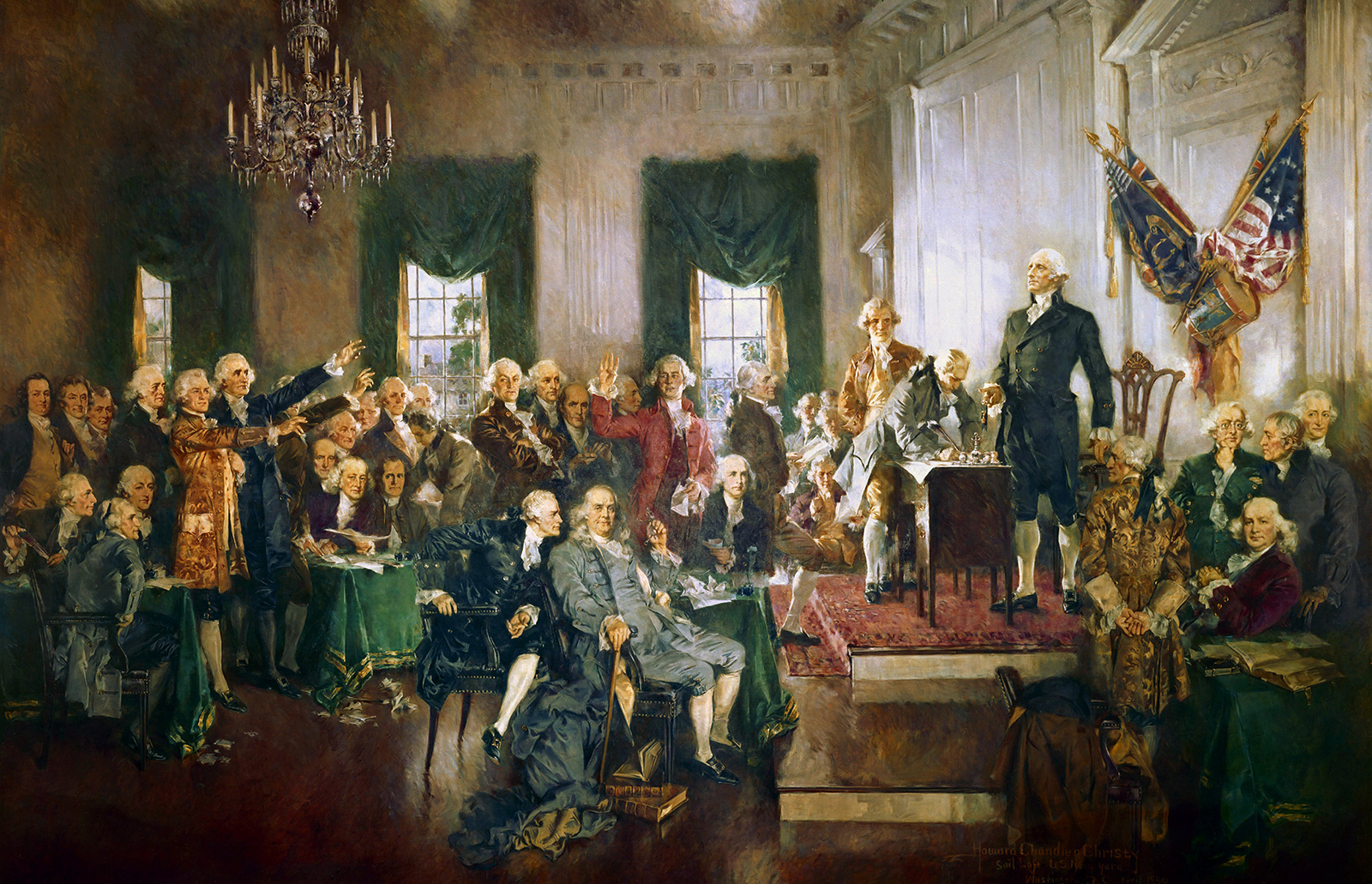
"Scene at the Signing of the Constitution of the United States" by Howard Chandler Christy, 1940. (Image courtesy of Wikimedia/Creative Commons)

(RNS) — As this month comes to a close on the 250th anniversary of the nation’s founding, it’s worth noting how little the founders talked about religion. And their blithe unconcern evolved into manifest anxiety not so much because of a change in philosophy so much as fear. 

Here, for example, is what John Adams had to say in his “Defence of the Constitutions of the United States,” which he wrote between 1787 and 1788 while serving as ambassador to England.

“It will never be pretended that any persons employed in [the designing American governments] had any interviews with the gods, or were in any degree under the inspiration of heaven, any more than those at work upon ships or houses, or labouring in merchandize or agriculture: it will forever be acknowledged that these governments were contrived merely by the use of reason and the senses.”

Ten years later, Adams, as president, sounded a different note in a letter to the officers of the Massachusetts militia. “Avarice, Ambition Revenge or Galantry, would break the strongest Cords of our Constitution as a Whale goes through a Net,” he wrote. “Our Constitution was made only for a moral and religious People.”

Similarly, in his letter to the Jews of Newport in 1790, George Washington declared that the “Government of the United States … requires only that they who live under its protection should demean themselves as good citizens in giving it on all occasions their effectual support.” But then, in his Farewell Address six years later, he warned:

“Of all the dispositions and habits which lead to political prosperity, religion and morality are indispensable supports. In vain would that man claim the tribute of patriotism who should labor to subvert these great pillars of human happiness, these firmest props of the duties of men and citizens. The mere politician, equally with the pious man, ought to respect and to cherish them … And let us with caution indulge the supposition that morality can be maintained without religion.”

It was Alexander Hamilton who drafted those words — the same Hamilton who, when asked previously why the customary invocation to God was not included in the Constitution’s Preamble, reportedly quipped, “We forgot it.”


A copy of the U.S. Constitution on the flag. (Image by Wynn Pointaux/Pixabay/Creative Commons)

To be sure, there were founders who argued that religious invocations and bonds were necessary features of a well-functioning polity. During the Constitutional Convention, Maryland delegate Luther Martin testily informed his state legislature that “a great majority of the convention” had voted, with little discussion, that there be no religious test for holding federal office — although “there were some members so unfashionable as to think, that a belief of the existence of a Deity, and of a state of future rewards and punishments would be some security for the good conduct of our rulers, and that, in a Christian country, it would be at least decent to hold out some distinction between the professors of Christianity and downright infidelity or paganism.”

What accounted for the subsequent shift in the attitude for the others? The French Revolution. 

In her history of the American revolution, published in 1805, Mercy Warren was at pains to demonstrate that the “skepticism and the late appearance of a total disregard to religious observances in France” had in no way resulted from “the democratic struggles” in America. To the contrary: “It may be observed in the character of more modern republics that religion has been the grand palladium of their institutions.” 

Simply put, when news of the anti-religious Reign of Terror in 1793 and 1794 reached American shores, it shook the founders’ unconcern with the place of religion in the new thing they had created. Their response was to emphasize the importance of Warren’s palladium. But it’s safe to say that the view that was fashionable in 1787 would in all likelihood have prevailed less easily if the Constitutional Convention had been held a decade later.

It’s worth pondering what this story means for the originalists and textualists who claim that the Constitution should be interpreted strictly according to the intent and the words of its authors. Should it matter if they later changed their minds?


MANY OF THE FOUNDERS WERE FREEMASONS WHO TAKE AN OATH DECLARING THEY ARE NOT ATHEISTS WHICH IN THE 18TH & 19TH CENTURIES WAS A HANGING CRIME

ONLY THOMAS PAINE WAS A FREETHINKER (ATHEIST)


Sunday, May 17, 2026

INTERNATIONALIST FREETHINKER 

Thomas Paine helped start America. In the Trump era, he's under fire.

In some ways, the debate over Paine's legacy today is a proxy for a much larger debate over whose vision gets to govern.


Jack Jenkins
May 13, 2026
RNS

(RNS) — Rep. Jamie Raskin, D-Md., was revving up a crowd of tens of thousands gathered in Philadelphia for the first major No Kings protest last June. His speech, like the demonstration itself, was focused primarily on pushback against President Donald Trump, whom critics such as Raskin likened to a would-be monarch.

But after railing against the president, Raskin paused to focus on one of his favorite Founding Fathers: Thomas Paine, an English-born political writer who supercharged the American Revolution with his wildly popular pamphlet “Common Sense” 250 years ago.

Noting that he named his own late son after Paine, Raskin recalled the corset-maker-turned-revolutionary’s dream of an America that would operate as “an asylum to humanity.” Paine, he told the crowd, envisioned “a place of refuge for people seeking freedom from religious and political and intellectual and economic repression from around the world” — and then helped spur a revolution to make it a reality.

Less than a month later, at the inaugural service of Christ Church DC — a congregation organized by self-described Christian nationalist Doug Wilson and attended by influential conservatives, including Defense Secretary Pete Hegseth — Pastor Jared Longshore delivered a sermon that held up Paine not as a hero, but a cautionary tale. Longshore dismissed Paine as someone who “exalted human reason to the place of a golden calf,” an apparent reference to Paine’s deism and his criticism of organized religion’s entanglements with political power.


Portrait of Thomas Paine by Laurent Dabos, circa 1791.
 (Image courtesy of National Portrait Gallery/Wikimedia/Creative Commons)

“Thomas Paine actually lost all of his old friends,” Longshore said, standing at a pulpit underneath an American flag. He then implied Paine’s fall from grace could be the ultimate fate of modern progressives, saying: “Only a few mourners came to his funeral, and even the Quakers wouldn’t let him be buried in their cemetery. That’s tough. Shows you how people used to think and how people are thinking now.”

The contrast captures not only Paine’s contested place in American memory, but the larger political and religious debate in the US over whose founding vision should govern.

Scholars say Paine’s historical importance is undeniable. A seminal and celebrated voice in the American Revolution, Paine was so influential that John Adams once referred to the late 1700s as “the age of Paine.” What’s more, in addition to his role in America’s founding, Paine, an Englishman, championed democratic values so fervently that he later became a leader in the French Revolution despite not speaking French.

But Paine ultimately proved polarizing in his own lifetime, largely because of his blistering critique of organized religion, historians say. Among other things, he helped initiate debates over the separation of church and state that continue to this day, resulting in a bifurcated legacy: Paine as a champion of freedom or Paine as the “Forgotten Founding Father” — embraced or dismissed, depending on who is doing the remembering.

That fissure appears to be growing amid ongoing celebrations of the 250th anniversary of the U.S., with left-leaning leaders who support the separation of church and state championing Paine even as he is derided by prominent Christian nationalist figures aligned with Trump. And as the Trump administration and its allies prepare a faith-themed event on the National Mall to “rededicate” America “as One Nation to God,” debate over Paine’s ideas — such as his passionate opposition to “mingling religion with politics” — is unlikely to abate.

Paine once enjoyed vocal bipartisan support in Washington. In 1992, bipartisan legislation, signed by President George H.W. Bush, authorized construction of a memorial, but the project stalled. A 2022 bill renewed the push for a Paine memorial that could be erected on the National Mall by 2030, but it is still awaiting approval from the U.S. Department of the Interior and, ultimately, Congress.


Rep. Jamie Raskin, D-Md., speaks during a protest against the shuttering of the United States Refugee Admissions Program, Feb. 4, 2025, in Washington. 
(RNS photo/Aleja Hertzler-McCain)

As the sponsor of the 2022 bill, Raskin is perhaps Paine’s most visible modern-day champion in Washington. The Maryland congressman told Religion News Service he first encountered Paine in high school by reading the revolutionary’s best-known works: “Common Sense,” “The American Crisis” and “The Rights of Man.” “I read Paine and I just felt like a light bulb went off,” Raskin said, noting that President Abraham Lincoln was also a fan of Paine. “(Paine) had this passionate and unwavering commitment to democracy as the system that will both protect people’s freedom and allow for mutual progress in society.”

Raskin often cites Paine in speeches and even pushed to name a congressional caucus he co-founded with Rep. Jared Huffman the “Thomas Paine Caucus.” The group, which boasts 36 members and is dedicated to both religious freedom and church-state separation, ended up being called the Congressional Freethought Caucus instead, although a portrait of Thomas Paine graces the group’s website.

“Tom Paine is still too radical a figure even in the 21st century, apparently,” Raskin joked.

Liberals, progressives and radicals across the globe have long claimed Paine as one of their own, often pointing to his progressive policy views for his day, such as opposition to slavery as well as support for public education and state-sponsored prenatal and postnatal care.

However, it is Paine’s views on religion — as well as how religion should interact with government — that have likely complicated his legacy. Raised in a Quaker home, Paine made several lengthy theological arguments in “Common Sense,” but ultimately declared himself a passionate deist.

“I believe in one God, and no more; and I hope for happiness beyond this life,” Paine wrote. “I believe in the equality of man, and I believe that religious duties consist in doing justice, loving mercy, and endeavouring to make our fellow-creatures happy.”

"The Age of Reason" by Thomas Paine was controversial, in part because of his blistering critique of organized religion. (Public domain image)

"Common Sense" by Thomas Paine is credited with helping to inspire the American Revolution. (Public domain image)

In 1793, Paine published “The Age of Reason,” a lengthy critique of organized religion — especially what he called “the adulterous connection of church and state.” Among other claims, he wrote that he believed the American Revolution would be followed by revolutions in the religious world.

Seth Perry, who teaches American religious history at Princeton University, told RNS the book was hardly met with the rapturous praise enjoyed by “Common Sense.” Part of the issue, Perry said, was timing: “The Age of Reason” was published just as religious revivals associated with the Second Great Awakening had already swept across the U.S., and Paine’s involvement in the chaotic French Revolution — during which Paine himself was imprisoned — gave his ideological opponents in the U.S. cause to condemn him.

“There’s good scholarship showing how the anti-religious vibe of the French Revolution was used by those at the time who wanted more religion in the government as a cudgel to push back on people like Thomas Paine, who were pushing against religion in the government,” Perry said.

In the 20th century, some prominent conservatives embraced Paine, particularly President Ronald Reagan, who often referenced Paine in public remarks. But these days, Paine has become a target among far-right intellectuals, particularly those aligned with Christian nationalism or Catholic integralism, an ideology similar to Christian nationalism that advocates for a less overt approach to exerting Christian influence over society.

“We can find in Paine antecedents for almost every political ideology we find today,” Ben Wright, a professor of American history at the University of Texas at Dallas, said in an interview. “It’s curious to see who decides to claim him and who doesn’t — and that changes over time.”

It's curious to see who decides to claim him and who doesn't — and that changes over time.Ben Wright, professor of American History at the University of Texas at Dallas

At last year’s National Conservatism Conference in Washington, Patrick Deneen — a professor at the University of Notre Dame who is associated with Catholic integralism — urged conservatives to distance themselves from Paine. After acknowledging Paine’s influence, Deneen argued far-right thinkers have overlooked Paine’s involvement in the French Revolution and his longstanding debate with Edmund Burke, a seminal conservative intellectual figure.

“Paine was no conservative, and nor, really, was his political theology,” declared Deneen, who went on to voice support for more public religious expression in government. “I would submit that by adopting this Painian, Rousseauan, French Revolutionary … political theology that conservatism has been equally the cause of woe and destruction to the values and the institutions that conservatives all along claimed to hold dear.”


Patrick Deneen addresses the National Conservatism conference, Thursday, Sept. 4, 2025, in Washington. (RNS photo/Jack Jenkins)

Gary Berton, president of the Thomas Paine Historical Association, acknowledges that Paine has long made some conservatives uncomfortable. But he insisted Paine’s criticisms of religion continue to inspire young people, many of whom are religiously unaffiliated: Berton said that, in recent years, young people often walk into the association’s building wanting to know more about Paine after reading “Age of Reason.”

Raskin, meanwhile, sees the hostility from conservatives in the Trump era as predictable.

“Monarchists and reactionary conservatives have always hated Tom Paine,” Raskin said, noting that Paine famously railed against the divine right of kings, the theology that monarchs answer only to God.

In the meantime, Raskin said, he is looking forward to a Paine memorial eventually being erected in Washington, and will continue to draw inspiration from a man he insists is unfairly maligned by those on the right.

“Democracy is always a controversial idea,” Raskin said. “Monarchy is obviously a betrayal of that idea. Aristocracy is a radical betrayal of that idea. Theocracy is just somebody dressing up their pretensions to power and dictatorship in religious garb.”


Friday, October 03, 2025

The Saga of Freethought and Its Pioneers: Religious Critique and Social Reform

by Fred Edwords

During the Reign of Terror of the French Revolution, one morning’s executions began with three men: a rabbi, a Catholic priest, and a freethinker.

The rabbi was marched up onto the platform first. There, facing the guillotine, he was asked if he had any last words. And the rabbi cried out, “I believe in the one and only true God, and He shall save me.” The executioner then positioned the rabbi below the blade, set the block above his neck, and pulled the cord to set the terrible instrument in motion. The heavy cleaver plunged downward, searing the air. But then, abruptly with a crack, it stopped only inches above the would-be victim’s neck. To which the rabbi said, “I told you so.”

“It’s a miracle!” gasped the crowd. And the executioner had to agree, letting the rabbi go.

Next in line was the priest. Asked for his final words, he declared, “I believe in Jesus Christ–the Father, Son, and Holy Ghost–who will rescue me in my hour of need.” The executioner then positioned this man’s head on the block. And he pulled the cord. Again the blade flew downward–thump! creak!–stopping just short of its mark once more.

“Halelujia,” shouted the priest. “Another miracle,” sighed the disappointed crowd. And the executioner for the second time had no choice but to let the condemned go free.

Now it was the freethinker’s turn. “What final words have you to say?” he was asked. But the freethinker didn’t hear. Staring raptly at the ominous engine of death, he seemed lost. The executioner had to poke him in the ribs and ask the question again before he would reply. But at length, the freethinker cried out, “You gullible, superstitious fools. Those weren’t miracles! You’ve got a blockage in the gear assembly, right there.”

That might explain why there are so few freethinkers today.

Of course freethought didn’t begin or end with the French Revolution. Nor has it been limited to the western world. Freethought has a long and ancient pedigree that has spanned centuries, continents, and cultures. But before we can trace its history we should first define what it is.

In his 1957 essay, “The Value of Free Thought,” philosopher and freethinker Bertrand Russell wrote:

What makes a freethinker is not his beliefs but the way in which he holds them. If he holds them because his elders told him they were true when he was young, or if he holds them because if he did not he would be unhappy, his thought is not free; but if he holds them because, after careful thought he finds a balance of evidence in their favor, then his thought is free, however odd his conclusions may seem.

By this definition, a wide range of people have been freethinkers: not only atheists and agnostics but also deists, liberal religionists, religious innovators, and those who have challenged the predominant orthodoxies in every field of endeavor, from science to politics to the arts. That adds up to a lot of people. And what it tells us is that almost every great individual in history had to, in some way or another, think free. That’s what made such people stand out. That’s generally why they became famous in the first place.

But I only have up to an hour to spend delivering this talk, so I won’t be able to regale you with biographical sketches of all the most significant contributors to human civilization who ever lived. I’ll need to narrow my topic some. Most dictionaries define a freethinker as one who has rejected authority and dogma, especially in religious thinking, in favor of rational inquiry. The term first came into use in England toward the end of the seventeenth century as a designation for those who inquired into traditional religious beliefs, tested them against experience, and dared to draw their own conclusions.

But with this understanding in hand, we can probe deeper into history, venturing into ancient times, and probe more widely, taking our search beyond England and Europe to include the whole world. And when we do this we discover that freethought has a rich and significant history.

Perhaps it began in ancient Egypt. Going back to the time of Cheops, builder of the Great Pyramid of Giza, who lived around 2550 Before the Common Era, we find that there were wisdom schools for the sons of wealthy men. Secular ideas were taught that provided practical instruction in maintaining emotional tranquillity, practicing social decorum, and getting ahead in politics. Out of this tradition grew the secular songs of the harpists who performed at banquets. And some of these songs brought critical thinking to bear on religious belief. Let me read from a translation by Miriam Lichtheim of some of the words from one of these pieces, lyrics from a papyrus in the British Museum dating back to 1300 BCE.

Since the time of our ancestors
Generations have come and gone and been replaced.
The gods who lived in former times, rest in their pyramids,
The dead nobles too are buried in their pyramids
And those who built the tombs-the places have disappeared
What has happened to them?
I have heard the words of Imhotep and Hordedef
Whose sayings men recite.
What has happened to their places today?
The walls are crumbled, and their places are gone.
And it is as if they had never been.
No one ever comes back from the beyond
To inform us about their condition
Or to tell us about their needs
Or to calm our hearts.
Until the time comes when we go where they have gone
Let your desire be strong
Let your heart forget funerary rites.
Follow your desires so long as you live.

How reminiscent this is of the Medieval Arabic wisdom in the Rubaiyat of Omar Khayyam, written in the year 1120 of the Common Era. Here are some relevant selections from the 1889 translation of Edward Fitzgerald.

Some for the Glories of This World; and some
Sigh for the Prophet’s Paradise to come;
Ah, take the Cash, and let the Credit go,
Nor heed the rumble of a distant Drum!

The Worldly Hope men set their Hearts upon
Turns Ashes–or it prospers; and anon,
Like Snow upon the Desert’s dusty Face,
Lighting a little hour or two–is gone.

Ah, make the most of what we yet may spend,
Before we too into the Dust descend;
Dust into Dust, and under Dust to lie,
Sans Wine, sans Song, sans Singer, and–sans End

Oh threats of Hell and Hopes of Paradise!
One thing at least is certain–This Life flies;
One thing is certain and the rest is Lies;
The Flower that once has blown for ever dies.

Strange, is it not ? that of the myriads who
Before us pass’d the door of Darkness through,
Not one returns to tell us of the Road,
Which to discover we must travel too.

The Moving Finger writes; and, having writ,
Moves on: nor all your Piety nor Wit
Shall lure it back to cancel half a Line,
Nor all your Tears wash out a Word of it.

The sort of secular wisdom schools that had thrived in Egypt thrived in ancient Israel as well. We see evidence of this in a number of biblical proverbs. In the Book of Ecclesiastes, written during the fourth century BCE, we find the same acceptance of the finality of death that was sung by the Egyptian harpists. Humanist biblical scholar Gerald Larue translates Ecclesiastes 4:19-21 thus:

—The fate of men and the fate of animals is the same; as one dies so dies the other for all have the same breath of life. Man has no superiority over the animal, both are void of meaning. Both go to the same place; all are from the dust and all return to dust. Who knows whether the life of man ascends upward and the life of beasts descends to the underworld?

As for humans after they are dead, Ecclesiastes 9:5-6 tells us:

—they know nothing at all, and they experience no rewards and (ultimately) they are not remembered. Their love, their hate, their passions have completely perished, and never more do they have any part in what happens beneath the sun.

These wisdom teachings of the ancient Middle East weren’t atheistic, however. But the situation was different in the Indian subcontinent. Some divisions that developed within Hinduism during and after the sixth century BCE were decidedly godless. For example, Makkali Gosali founded the Ajivaka sect. Picking up on freethought sayings found here and there in the Vedas and Upanishads, this leader rejected the concept of karma in favor of a random chance cause of events. His sect lasted until the thirteenth century of the Common Era. The Mimamsa and Samkhya schools of Hinduism may have appeared as early as 400 BCE and the Vendanta system emerged in the eighth century CE-all atheistic.

Breaking off from Hinduism in the sixth century BCE was Jainism, an atheistic ascetic philosophy that accepts the law of karma. It was developed by Mahavira. Some decades later Siddhartha Gautama became the founder of Buddhism, a nontheistic system of virtue and resignation. Jainism and Buddhism so effectively rejected the Hindu practice of animal sacrifice that Hinduism itself changed in this regard.

Around this same time, Lao-tzu developed Taoism in China, a quietist system of agnostic mysticism. And shortly afterwards Confucius emerged to offer secular wisdom teachings aimed at creating ethical integrity. His ideas were agnostic and humanistic. But they didn’t become widely accepted until three centuries later when they were merged with a system of social regimentation. From that time, Confucianism became China’s state ideology.

Meanwhile in ancient Greece the preSocratic Ionian philosophers were trying out a variety of new ways of accounting for the universe and explaining nature without reference to gods. They were materialists. Thales said that all things were reducible to water. Anaximander argued for apeiron, a basic and undefinable primary substance. Anaximenes said everything was reducible to air. Xenophanes chose both earth and water. And Heraclietus posited fire, viewing the universe as energy in a constant state of flux guided by a law of cosmic reason. Heracleitus wrote:

— This world that is the same for all, neither any god nor any man shaped it, but it ever was and is and shall be ever-living Fire that kindles by measures and goes out by measures.

Regarding theistic concepts, Xenophanes held that the gods had been created by humans in their own image. He wrote:

— But mortals think the gods are born and have the same clothes and voices and appearances as themselves. But if oxen or horses or lions had hands and could draw . . . the horses would draw the forms of gods like horses, and the oxen of gods like oxen, and each would give them bodies like its own.

Leucippus and Democritus, who florished around the year 400 BCE, developed an atomic theory of the universe. The word “atom” means “uncuttable” and refers to an irreducible “smallest thing.” These Atomists maintained that everything in the universe could be reduced to these particles of matter that are so tiny as to be invisible. They noted that objects can be worn down by weathering and so concluded that invisible atoms must gradually be dissipating in order for the weathering to occur. About a century later Epicurus added to the theory, trying to explain, if the atoms had all originally been falling downward, how it was that they could start bumping into each other and begin coalescing into objects. His answer was that atoms have a property which makes them inexplicably swerve now and then, resulting in interaction between them. This random behavior also provides the basis for free will in an otherwise deterministic system.

Now then, how were these thinkers able to step outside Greek mythology and offer such ideas? Perhaps part of the answer lies in the nature of that Greek mythology, itself. The Greeks were less inclined to worship their gods than to cut deals with them. They saw themselves at times almost the equal of their gods.

Furthermore, Greek mythology found a uniquely freethinking divinity in the Titan Prometheus, something that is rarely manifested in the mythologies of other cultures. Prometheus stands out because he was admired by ancient Greeks as the one who defied Zeus. He stole the fire of the gods and brought it down to Earth. For this he was punished. And yet he continued his defiance amid his tortures. This may be a root of the ancient freethought challenge to authority, something that not only gave permission to inquisitive materialists but allowed for the overthrow of monarchy and the creation of democracy.

The next time we see a truly heroic Promethean character in mythology it is Lucifer in John Milton’s Paradise Lost. But now he is the Devil. He is evil. Whoever would defy God must be wickedness personified. That seems to be a given of traditional religion. But the ancient Greeks didn’t agree. To them, Zeus, for all his power, could still be mistaken.

This willingness to stand up to religious tradition shows in Plato’s Euthyphro, wherein Socrates shows that God is not necessarily the source of good, or even good himself. Socrates asks if something is good because God ordains it, or if God ordains it because it is already good.

It was in this spirit, during the Golden Age of Athens, that a philosophic circle developed around the politician Pericles. This included Anaxagorus, Zeno, Protagoras, and Pericles’ mistress Aspasia. Aspasia seems to have been the real leader of the circle and Socrates declared that she taught him much of philosophy. She was by all accounts a freethinker as well as a woman who lived free in a society in which other women were usually cloistered almost as much as they are in some Muslim countries today.

But the one who is remembered as the historical exemplar of unfettered freethinking inquiry is still Socrates. It’s easy to see why. After all this time, he still stands out uniquely among all the famous saints, sages, and martyrs from antiquity to the present. Every religion has its sage. Judaism has Moses, Zoroastrianism has Zarathustra, Buddhism has the Buddha, Christianity has Jesus, Islam has Mohammad, Mormonism has Joseph Smith, and Bahai has Baha-u-lah. Every one of these individuals claimed to know the absolute truth. It is Socrates, alone among famous sages, who claimed to know NOTHING. Each devised a set of rules or laws, save Socrates. Instead, Socrates used a method–a method of questioning the rules of others, of cross-examination and philosophic irony. And Socrates didn’t die for truth; he died for freedom and the rule of law. For these reasons, Socrates is the quintessential skeptical freethinker. He stands as a symbol, both of Greek rationalism and the Humanist tradition that it inspired. And no equally recognized saint or sage has joined his company since his death.

One of those who Socrates spars with in Plato’s Dialogues is Protagoras, who said, “Man is the measure of all things,” setting forth a basic Humanist principle that came to underlie philosopher John Dewey’s instrumentalism. The Internet Encyclopedia says, “Protagoras’ notion that judgments and knowledge are in some way relative to the person judging or knowing has been very influential, and is still widely discussed in contemporary philosophy.” Ancient historians maintained that Progagoras was ultimately put on trail in Athens for impiety because he had written that it isn’t possible to tell if the gods exist or not. His books were burned as a consequence.

Another great freethinker and Humanist in ancient Athens was the tragedian Euripides. His dramas criticize religious fanaticism, superstition, male domination, war, and other evils.

For example, in The Bacchae, Euripides expresses in poetic drama all the seductions and dangers of cultic and fanatical religious belief. His characters suffer personal tragedy to the very extent that they allow themselves to become caught up in the Bacchic frenzy, or to dogmatically and undemocratically work to suppress the Dionysian cult. And Dionysus, in the end, is exposed as the cruel, capricious, and vindictive god that he is. Through him, all his promises of joy through faith are ultimately broken.

In Iphigenia at Aulis, a priest declares that Agamemnon has sinned against a god, and this is why the wind has not blown and will not blow to send his thousand ships to Troy. Only penance through the sacrifice of his daughter will restore the god’s good graces. So, reluctantly, Agamemnon orders the daughter seized and burned at the stake. She is courageous in the face of death, while her father’s cowardice before the altar of superstition unwittingly dooms him also–he will later be murdered by his wife to avenge the daughter’s death. But, for now, the priest lights the flame, and, ironically, not a moment too soon, because the winds have already begun to blow.

Across history freethought has been expressed through the literary arts in this way. The names are legion: Moliere, George Eliot, Ambrose Bierce, George Bernard Shaw, Henrik Ibsen, Sinclair Lewis, Kurt Vonnegut, Margaret Atwood, and Salman Rushdie, to name just a few. In the realm of music Mozart and Beethoven were just two of many creative freethinkers. There have been sculptors, painters, actors, and so many others. Isadora Duncan was a freethinker who brought innovation to modern dance. Gene Roddenberry was an atheist who created the Star Trek phenomenon. The list goes on. But let us return to ancient times.

Following Greece’s Golden Age was a period when a number of philosophical schools were established by Socrates’ pupils. One of them was the Cyrenaic school, founded by Aristippus of Cyrene. All of its philosophers were atheists who advocated that physical pleasure was the highest good.

Then came the Helenistic age, during which time numerous schools of philosophy flourished. One of them was the Epicurean. Epicurus was a quietist hedonist who held that mental pleasures could be superior to the physical ones advanced by the Cyrenaics. And instead of propounding atheism he advanced the view that the gods exist but, being immaterial, have no impact on nature and are unconcerned about human affairs. Philosophers of rival schools were quick to claim that this was a mere disguised atheism. But the philosophy flourished, debunking popular fears of eternal punishment after death, finding its greatest expression in Roman times through the epic-length naturalistic poem by Lucretius, On the Nature of Things.

Another school was that of the Skeptics. They held that no certain knowledge existed and therefore a totally agnostic approach to all issues was in order. Long after Plato’s death his Academy evolved toward this position but made the caveat that there was one thing you could know for certain and that was that you couldn’t know anything else for certain.

Greek Hellenistic philosophy was eventually transferred to Rome where it thrived. Specifically, the pantheistic, rationalist philosophy of the Stoics captivated those in positions of political influence. The skepticism of the New Academy influenced intellectuals like Cicero, whose book, On the Nature of the Gods, pitted Stoic, Epicurean, and Academic arguments against each other, leading the reader toward the conclusion that, though it is good and pious to worship the gods, there is no philosophical argument that can prove they exist. Cicero followed this book with On Divination, in which he vigorously debunked astrology, prophetic dreams, portents, auguries, and all the rest. Cicero wondered how two augurs could meet each other on the street without laughing out loud over the foolishness they were putting over on the public.

Seneca was a Roman Stoic philosopher who was critical of traditional religion and popular superstition. In the annals of freethought he is famous for saying: “Religion is regarded by the common people as true, by the wise as false, and by the rulers as useful.”

In the time of Augustus Caesar we have the poet Ovid, author of the Metamorphoses. He disguised his freethought in the mythical tales he told. Today scholars have figured out that the reason why so many of the first stories in his poem are the tales of rapes is because his aim was to subtly discredit belief in the gods.

Among freethinkers of Roman times who wrote in Greek, Lucian stands out. He penned numerous satirical essays and dialogues poking fun at mythology, the gods, miracle workers, and even philosophers. My personal favorite is “The Rival Philosophers,” a dialogue made up of arguments so structured that they could easily be turned to the purpose of undermining anyone’s religious convictions. The dialogue makes every reader ask, “Who has had time to give every belief a fair hearing before selecting the best and the truest one?”

In late antiquity one of the most surprising sources of persuasive freethought arguments is an early Christian writer by the name of Arnobius. His book, Against the Heathen, written about the year 305 of the Common Era, leveled a blistering series of attacks that thoroughly debunked the absurd beliefs of Roman paganism. He had hoped it would make him admired among Christian leaders of his time. But it didn’t. They all seemed to have understood something he had overlooked. His effective appeals to common sense could prove equally potent if turned against Christian doctrines! As a result, modern freethinkers have been among Arnobius’ most ardent readers.

These and other works are the sources which influenced the Christian humanists of the Renaissance and the freethinkers of the Elizabethan era and the Age of Enlightenment. Let us turn now to those freethinkers themselves.

Playwright Christopher Marlowe was the author of Dr. Faustus, The Jew of Malta, and Edward II, among others. He kept company with the leading intellectuals of London, many of whom were privately freethinkers. Then in 1593, when he began openly pointing out inconsistencies in the Bible, the government came to suspect him of heresy and conducted an investigation. They had his roommate tortured into giving evidence against him and Marlowe was to be brought before the Privy Council. But that never happened because he was killed in a tavern brawl that may have been set up to get him out of the way so he couldn’t testify against such important friends as Walter Raleigh.

As for Marlowe’s friend and competitor William Shakespeare, his plays clearly show his familiarity with freethinking ideas, both from the past and in his own time. But he kept the words in the mouths of his characters instead of expressing them himself.

It was in the eighteenth century, the Age of Enlightenment, where freethought truly came into its own. The French philosophes and other eighteenth century Enlightenment thinkers brought new ideas into the popular consciousness. The pen of Voltaire skewered the Roman Catholic church. Deism, the belief in nature’s God but not Judaism or Christianity, became popular among intellectuals in Europe and North America. But this revolution in thinking wasn’t only about beliefs. As with the Enlightenment itself, freethought went beyond religious critique to advance social reform. Freethinkers challenged the divine right of kings, sought an end to cruel and unusual punishments, and advanced civil and social rights–efforts that reached their peak, and excess, during the French Revolution. Out of that period come such freethinkers as Thomas Jefferson, Benjamin Franklin, Denis Diderot, and so many others. Thomas Paine’s Age of Reason strongly challenged the Bible’s claim of divine authorship and thus popularized biblical scholarship.

In an article, “Caffeine and the Coming of the Enlightenment,” published in the Summer 2003 issue of Rutgers University’s Raritan, Roger Schmidt tells us that a major force behind the European Enlightenment was coffee.

You see, in the mid seventeenth century, after the invention of mechanical clocks, people started caring more about time. And after improvements in artificial lighting (such as candles with wicks at both ends, Thomas Paine’s smokeless candle, improved oil lamps, and uses of mirrors behind a flame to spread more of the light) people started “burning the midnight oil” to get more work done. For many people, sleep ceased to be viewed as a spiritually purifying time-in 1630 John Donne had said that sleep was “shaking hands with God”-and became something to be rid of.

Short, O short then be thy reign
And give us to the world again!

wrote Samuel Johnson in 1753. But it wasn’t just secular intellectuals who endorsed this change of heart. As Schmidt’s article reveals:

In 1728, clergyman John Law denounced sleep as “the poorest, dullest refreshment of the body,” one that produced either “insensibility” or “the folly of dreams.” He excoriated the Christian who chose to “enlarge the slothful indulgence of sleep, rather than be early at his devotions to God.” A few years later, Benjamin Franklin famously reminded slugabeds that time is money.

Naturally then, because of their ability to maintain wakefullness, coffee and tea became an integral part of the Enlight­enment intellectual scene. Not only did thinkers stay up nights with it, but they met together in those great institutions of freethought, those catalysts of new ideas where great revolutions were hatched, the coffeehouses.

As we speak of Enlightenment thought and Enlightenment thinkers, we need to be aware that Enlightenment women are too often forgotten. So I want to make sure that we remember Mary Wollstonecraft (who was born in 1759 in London, England). Living in Paris with American Gilbert Imlay during the French Revolution, she was the first to pen a response to Reflections on the Revolution in France, the famous attack on the French and American Revolutions by British Member of Parliament Edmund Burke. Her A Vindication of the Rights of Man thus preceded Thomas Paine’s Rights of Man in upholding Enlightenment principles of human rights. She immediately followed with A Vindication of the Rights of Woman, considered the first feminist document. It argues vigorously not only for women’s rights but for the virtue of reason above organized religion and superstition. Part of the final chapter is even devoted to debunking fortune-tellers and faith healers, charlatans who often preyed on women.

In her various writings Wollstonecraft stood firmly against slavery and monarchy and for children’s rights, the value of breastfeeding, coeducational schools, animal rights, and other progressive ideas. As a deist she rejected the patriarchy of the church in favor of an unknowable but all-sufficient god of nature-though biographer Eleanor Flexner and others point to evidence that she died an agnostic. For her controversial views, some derided her as a “hyena in petticoats.”

Wollstonecraft had a daughter, Fanny, through Imlay, who she never married. Later she married William Godwin, who became the father of her second daughter, Mary, who grew up to wed atheist poet Percy Bysshe Shelley and write Frankenstein. But complications from that childbirth led to Wollstonecraft’s death in 1797.

In the early nineteenth century we find Richard Carlile who established himself as England’s leading atheist and, in 1826, published Every Woman’s Book, the first non-religious sex manual in English to promote contraception-a book that treated sexual enjoyment as natural and conversation about sex in mixed company as ethically appropriate. He was jailed for his various freethought and social reform activities.

But when one thinks of nineteenth century freethought what most often comes to mind are those who critiqued, debunked, or poked fun at religion. And certainly one of the best at this was Mark Twain, another atheist. In The Damned Human Race he tells this story of his scientific research.

Among my experiments was this. In an hour I taught a cat and a dog to be friends. I put them in a cage. In another hour I taught them to be friends with a rabbit. In the course of two days I was able to add a fox, a goose, a squirrel and some doves. Finally a monkey. They lived together in peace; even affectionately.

Next, in another cage I confined an Irish Catholic from Tipperary, and as soon as he seemed tame I added a Scotch Presbyterian from Aberdeen. Next a Turk from Constantinople; a Greek Christian from Crete; an Armenian; a Methodist from the wilds of Arkansas; a Buddhist from China; a Brahman from Benares. Finally, a Salvation Army Colonel from Wapping. Then I stayed away two whole days. When I came back to note results, the cage of Higher Animals [the dog and cat and so on] was all right, but in the other there was but a chaos of gory odds and ends of turbans and fezzes and plaids and bones and flesh — not a specimen left alive. These Reasoning Animals had disagreed on a theological detail and carried the matter to a Higher Court.

But there was also a positive, affirmative side to freethought that took pleasure in the liberation freethought brought to the individual, best expressed in these words of the popular American orator called the Great Agnostic, Robert G. Ingersoll:

When I became convinced that the universe is natural, that all the ghosts and gods are myths, there entered into my brain, into my soul, into every drop of my blood the sense, the feeling, the joy of freedom. The walls of my prison crumbled and fell. The dungeon was flooded with light and all the bolts and bars and manacles became dust. I was no longer a servant, a serf, or a slave. There was for me no master in all the wide world, not even in infinite space. I was free–free to think, to express my thoughts–free to live my own ideal, free to live for myself and those I loved, free to use all my faculties, all my senses, free to spread imagination’s wings, free to investigate, to guess and dream and hope, free to judge and determine for myself . . . I was free! I stood erect and fearlessly, joyously faced all worlds.

Enough to make a freethinker shout “hallelujah!”

Ingersoll was famous for both this positive expression as well as a good-humored debunking of faith. As Susan Jacoby writes in her 2004 book, Freethinkers: a History of American Secularism:

Even the most orthodox religious members of Ingersoll’s audiences were often charmed by his cheerful manmner and obvious enjoyment of his own jokes. A newspaper in Des Moines, Iowa, reported that a majority of those attending Ingersoll’s lecture “were strictly orthodox; and how they did roar. Foreordination laughs jostled freewill smiles; Baptist cachinations floated out to join apostolic roars, and there was a grand unison of orthodox cheers for the most unorthodox jokes.”

Back then there was a considerable latitude in public discourse on the subject of religion. In the nineteenth century, freedom of religion meant just that-the freedom to believe in and practice one’s creed. It did not mean that particular religious beliefs were exempt from public criticism or even from public ridicule.

But Jacoby goes on to note that

the journalistic emphasis on Ingersoll’s jibes at religion and the Bible . . . was almost never balanced by a fair exposition of the humanistic philosophical and ethical system with which he proposed to replace orthodox faith. . . . Then as now, the idea that an atheist or agnostic believes in nothing was a cornerstone of the orthodox mindset. . . . but he took his humanist creed very seriously and in all his speeches addressed the accusation that freethinkers had nothing to offer in place of religion.

But even with this, nineteenth century freethought wasn’t limited to just two options: to debunk and to be free. It’s primary efforts, in fact, were directed toward social change. Many of the freethought organizations were heavily involved in the labor movement and fought for social reforms like birth control and women’s rights. In this latter cause, one of the most outstanding leaders was Elizabeth Cady Stanton, who didn’t hesitate to argue how much the Bible was responsible for the subjugation of women. Freethinkers like Ingersoll also opposed slavery and racism, fought against child labor and unsafe living and working conditions. Freethinkers advanced public schools and promoted child-protection legislation. We see all this clearly in England in the work of Charles Bradlaugh, Annie Besant, and “Darwin’s Bulldog,” Thomas Henry Huxley.

In the United States, freethinking Darwinism played an important role in the development the first child protection legislation. The Society for the Prevention of Cruelty to Animals launched the effort, declaring that because an abused child was a member of the animal kingdom, such a child was entitled to all the protections the law already accorded to other animals. That’s how it came to be that we have laws against child-abuse today.

One of the greatest but almost forgotten exemplars of nineteenth century freethought was Moncure Daniel Conway. Born in 1832 in Stafford County, Virginia, just north of Fredericksburg, he moved in 1838 into a brick house along the Rappahannock River. (The address of this Federal Style house, by the way, is 305 King Street in Falmouth. The home has at long last been placed on the National Register of Historic Places, the Virginia Landmarks Register, and become a site on the Network to Freedom / Underground Railroad. A historic marker appears across the street telling about Conway).

In 1851, at age 19, Conway abandoned his father’s dream of him having a law career and, inspired by a Methodist anti-slavery tradition, became a Methodist circuit-riding minister. But Methodist doctrine couldn’t fully satisfy a man entranced with the writings of Ralph Waldo Emerson. So Conway’s sermons began raising eyebrows as they emphasized fulfillment on earth rather than in heaven. And when Conway wrote to Emerson, the great man advised that Conway take up study at Harvard Divinity School. This he did, becoming a Unitarian and befriending not only Emerson but Agassiz, Thoreau, Longfellow, Theodore Parker, Elizabeth Cady Stanton, and William Lloyd Garrison.

Conway gave his first public anti-slavery speech in 1854 at a rally where protesters against slavery didn’t burn the flag-they burned copies of the Constitution! And it needs to be noted that, in those days, abolitionists weren’t only opposed by Christian churches in the South but ignored by Christian churches in the North. This caused a high level of anti-clerical rhetoric among abolitionists, secular as well as religious ones. As a result, abolitionists were commonly decried by the public as “atheists.” How ironic it is, then, that, today, the abolition of slavery is viewed in the popular mind as one of the great accomplishments of Christianity.

That said, later in 1854, at age 22, Conway was hired as minister of the First Unitarian Church of Washington, DC, (which later became All Souls Church in Northwest). There, in 1856, as the conflict between abolitionists and proslavery forces in “bloody Kansas” dominated the news of the day, Conway began vigorously denouncing slavery from the pulpit. And within three months he was removed from his position.

Today, however, you can log onto the history section of the All Souls website at:

http://www.all-souls.org/socialjustice/history.htm

and find a special section devoted to the “Abolitionist Ministers” who this church now takes so much pride in. It reads:

Despite divisions within the congregation over the issue of slavery, many of the ministers who served the church in the years before the Civil War were abolitionists. These included Edward Everett Hale (1844), Samuel Longfellow (1847), Joseph Henry Allen (1847-1851), Moncure Daniel Conway (1854-1857), William D. Haley (1858-1861), and William Henry Channing (1861-1865).

In other words, this church went through a lot of ministers. The website goes on:

Over time, more and more of the congregation came to oppose slavery.

In his first sermon to the First Unitarian Church, Rev. Conway spoke about the church’s role in denouncing slavery:

“The Church must hold itself ready to pass free judgment on all customs, fashions, ideas, facts, on trade and politics, and in this country more especially . . . of all sins–human slavery.”

In any case, after being sacked by his congregants, only two months passed before Conway was welcomed to the Unitarian pulpit of the First Congregational Church of Cincinnati, Ohio. In Cincinnati he met and married Ellen Davis Dana, a Unitarian, feminist, and abolitionist, and came under the influence of the German free thinkers of the area. Soon he was questioning the veracity of biblical miracles, the divinity of Jesus, and even the Bible’s authority. This led, in 1859, to half of his congregation leaving to form a new church.

In 1860 Conway revived and edited the Transcendentalist periodical The Dial and in 1862 became coeditor of The Commonwealth, an antislavery weekly. Also, in the summer of 1862, Conway learned that, amid Civil War hostilities in Falmouth, 31 of his father’s slaves had escaped to Washington, DC. He immediately tracked them down in Georgetown and, in a daring adventure, got them on a train to Baltimore where, after they arrived, he had to help them dodge an angry mob to transfer them to another train that ultimately took them to Yellow Springs in the free state of Ohio. There the former slaves settled the “Conway Colony,” a name of their choosing. A historical marker indicates the site today.

Disillusioned with American Unitarianism, however, the Conways left the Cincinnati church and went to England to promote abolition and the cause of the North in the Civil War. While there, Conway abandoned theism completely and was hired as the minister of the South Place Chapel, a freethought church in London that had been founded as a Universalist congregation in 1793.

Living in London Conway befriended Charles Dickens, Charles Lyell, and Charles Darwin. There he became a prominent advocate of women’s suffrage, the scientific study of religion, and a wide range of social reforms. In 1888 the South Place Chapel became the South Place Ethical Society, a name it still bears, though it is now owned by the British Humanist Association. In 1892 Conway published what became a famous two-volume work on the life of Thomas Paine, which reintroduced Paine to Americans and the British. The death of his wife in 1897 brought Conway back to the United States, where he lectured on free religion and voting rights. He also spoke out against the imperialistic “spreadeaglism” of the Spanish-American War. Then, taking up residence in Paris, Conway, devoted the rest of his life to the peace movement, addressing the Paris Peace Conference in 1900 on ideas that presaged the United Nations. He died in Paris in 1907.

What Conway’s life shows, as do the lives of so many others like him, is that America’s fabled freethought forebears didn’t limit themselves to just searching out biblical contradictions and debunking paranormal claims. They were determined to show, as well, that a nontheistic worldview and a human-oriented system of ethics could make life better for all. They believed that, if the world is going to be made better, it is we who have to do it.

Such a focus on relevancy not only made freethought a powerful force in American social reform, it became one of the defining characteristics Ethical Culture. This movement emerged out of Reformed Judaism, free religion, and freethought to become a significant force in the northeast and St. Louis. And from its founding by Felix Adler it regarded notions of God irrelevant.

In 1877 Ethical Culturists established the first free kindergarten in New York and San Francisco. That same year, Ethical Culturists established the Visiting Nurse Service, the first of its type that did NOT do missionary work for organized religion but focused exclusively on the physical care of those in need.

In the 1880s, the Ethical Culture movement established schools for the children of the working class, engaged in relief work, founded the City Club to fight political corruption in New York City, established the first settlement house in the United States to address the social needs of urban slum communities, founded the Child Study Association to develop knowledge about the human nature of children, launched the Legal Aid Society, campaigned against child labor, worked for slum clearance and improved public health, and founded the Ethical Culture schools.

In the twentieth century, the movement advanced moral education for children, helped found the National Association for the Advancement of Colored People, engaged in union arbitration, helped launch the American Civil Liberties Union, aided refugees, developed adult education programs, and developed the Encampment for Citizenship, a progressive summer camp for youth later endorsed by Eleanor Roosevelt. It is activities such as these that gradually took the social reform momentum from the freethought movement and brought it to Humanism.

Freethinkers meanwhile remained active in the leading social reform movements of the late nineteenth and early twentieth centuries, including those for liberal studies in public schools (replacing theology and the classics), sex education, birth control, women’s suffrage, civil rights, animal protection, child protection, poverty relief, and improved labor conditions. A prominent freethought cause was and continues to be anti-censorship–an effort which has extended from the late eighteenth century to the present time.

But there were downsides and absurd offshoots as well. One of these was the penitentiary system. As an alternative to such things as capital punishment and placement in the stocks for the purpose of public humiliation, Quakers, Utilitarians, and freethinking social reformers advocated incarcerating wrongdoers in monastic-like prisons so they might meditate on their crimes and become reformed through penitence. Hence the name penitentiary.

Another development among freethinkers was the idea of scientific selective breeding of human beings: eugenics. This largely American movement readily led to an idealization of the characteristics of the ruling class and a delegitimization of those of lower classes. The ideas later found their way to Nazi Germany.

Among freethinkers as well as religious innovators emerged a variety of utopian experiments. And some freethinkers supported Bolshevism or forgave its excesses.

Beyond all this, there were freethinkers who left the fold, such as Lew Wallace, who had admired Ingersoll and would later write the following in his autobiography:

In 1875 . . . speaking candidly, I was not in the least influenced by religious sentiment. I had no convictions about God or Christ. I neither believed nor disbelieved in them. The preachers had made no impression upon me. My reading covered nearly every other subject. Indifference is the word most perfectly descriptive of my feelings respecting the To-morrow of Death, as a French scientist has happily termed the succession of life. Yet when the work was fairly begun . . .”

In what would become a famous novel, he adds, “I found myself writing reverentially, and frequently with awe.” This novel was completed in 1880 and entitled Ben Hur: a Tale of the Christ.

Another famous defector was the prominent British atheist Annie Besant, who went on to become a leading follower of Madam Blavatsky’s Theosophy and introduce the Indian mystical thinker Krishnamurti to the West.

In the opening years of the twentieth century an increasing number of liberal religionists, freethinkers, and academic philosophers began using the term “humanism,” a word borrowed from the Renaissance, to describe their human-focused, naturalistic world view. Then, around the time of World War I, two nontheistic Unitarian ministers, John Dietrich and Curtis W. Reese, joined together to promote humanism as a movement within Unitarianism. There it grew, as well as in academic circles, until the Humanist Fellowship was founded in 1927 at the University of Chicago, which became the Humanist Press Association in the 1930s, which reemerged as the American Humanist Association in 1941. Following World War II, three prominent humanists became first directors of major divisions of the United Nations: Julian Huxley of UNESCO, Brock Chisholm of the World Health Organization, and John Boyd Orr of the Food and Agricultural Organization.

Huxley, in particular, called for a global humanist vision. In his monograph, UNESCO: Its Purpose and Its Philosophy, he pointed out the necessity of transcending traditional philosophies, theologies, and political-economic doctrines and the importance of recognizing the evolutionary basis of culture. Science, he said, needs to be integrated with other human activities, and the general philosophy of UNESCO should be a scientific humanism, global in extent and evolutionary in background. But Huxley’s effort was only partially successful; representatives holding onto nationalistic and traditional views blocked and jettisoned the forthrightly humanist aspects of his proposal.

In postwar Europe, humanist secular organizations sprang up in a number of countries, particularly Belgium, Italy, and the Netherlands. In India, M.N. Roy launched the Radical Humanist Movement to reform Indian politics and Gora, an associate of Mohandas Ghandi, expanded the Atheist Centre, a humanistic social service institution he had established in 1940. Neru, the first prime minister of India, was an outspoken humanist. And Periyar led social reform activities in South India.

Then, in 1952, at the Municipal University of Amsterdam, Huxley chaired the first international humanist gathering. Over 200 humanist leaders from around the world, including Gilbert Murray of the U.K., Jerome Nathanson from the United States, and human rights activist V.M. Tarkunde of India met and formed the International Humanist and Ethical Union. Today this organization, representing over 3 million humanists worldwide, is involved in social action projects in various parts of the developing world and is active in the Council of Europe and the United Nations.

Speaking of the organization with which I have been most associated over the past thirty years–the American Humanist Association, first as a volunteer and then as a professional leader–activist involvements emerged almost from the AHA’s origin in 1941. Throughout the 1940s and 50s AHA humanists were involved in numerous civil liberties, birth control, and environmental protection cases tried in court. One of the most prominent of these Humanists was Corliss Lamont, a philosopher who successfully stood up to the House Un-American Activities Committee and Senator Joseph McCarthy. Another was Vashti McCollum; her U.S. Supreme Court victory in McCollum v. Board of Education established that American public schools must be religiously neutral. She was later president of the AHA. On the environmental front, a frequent issue was the value of restraint and how the environment is damaged by runaway population growth–matters which are still not adequately acted upon around the world.

Early in the decade of the 1960s the AHA became the first national membership organization to endorse elective abortion. Furthermore, many of the leading abortion-law reform groups that were established during this time were top-heavy with humanists. Also during the decade, the AHA and the American Ethical Union worked together to establish the rights of nontheistic conscientious objectors. Prior to this, one essentially had to be a Quaker to stay out of combat–humanists and atheists remained in the foxholes!

AHA leaders also actively worked to establish memorial societies that offered alternatives to the traditional mortuary-controlled burial arrangements dominant at the time. As a result of this humanist advance, cremation and humanistic memorial services became more widely available and less costly. Further in this connection, in 1974, the National Commission for Beneficent Euthanasia was established as an AHA program. It issued the groundbreaking statement, “A Plea for Beneficent Euthanasia,” a position paper signed by medical, legal, and religious leaders. It called for “a more enlightened public opinion to transcend traditional taboos and move in the direction of a compassionate view toward needless suffering in dying.” All of this was long before the activism of the Hemlock Society and Jack Kevorkian and before the current growth in interest in right to die legislation.

One of the things humanists have taken a particular interest in is social action programs that have been used in the past as tools of religious conversion. Thus, in the 1980s, American Atheists developed the American Atheist Alcohol Recovery Group (AAARG! for short), the Council for Secular Humanism developed Secular Sobriety, and the AHA developed Rational Recovery, three substance-abuse recovery programs that offered secular alternatives to the more traditional-religion based Alcoholics Anonymous. As a result, today, in many communities, the courts allow alcoholics and drug addicts more choices in the selection of a substance-abuse recovery program. And a newer humanistic program called SMART Recovery, promoted by many AHA chapters and affiliates, is spreading throughout the world.

Not all humanist or freethinking social reformers, however, have done their work through identifiably freethought or humanist organizations. A prime example of this would be Albert Einstein, who Time magazine named “Person of the Twentieth Century” at the beginning of 2000.

Although almost everyone knows that Einstein was a great physicist, few know he was a humanist social activist. Born March 14, 1879, to freethinking Jewish parents, he coauthored the Manifesto to Europeans in 1915, calling for an end to World War I; joined the advisory board of the First Humanist Society of New York in 1941; became chair of the Emergency Committee of Atomic Scientists in 1946; and published Essays in Humanism in 1950. Overall, his primary social action work was done individually or through issue-focused organizations. As his last act, Einstein joined Bertrand Russell in the Russell-Einstein Manifesto-issued over fifty years ago on July 9, 1955-which warned of “the perils that have arisen as a result of the development of weapons of mass destruction” and calling for the abolition of nuclear weapons along with an end to war. The document closed with these unifying words:

There lies before us, if we choose, continual progress in happiness, knowledge, and wisdom. Shall we, instead, choose death, because we cannot forget our quarrels? We appeal as human beings to human beings: Remember your humanity, and forget the rest. If you can do so, the way lies open to a new Paradise; if you cannot, there lies before you the risk of universal death.

This document was signed additionally by Max Born, Percy W. Bridgman, Leopold Infeld, Frederic Joliot-Curie, Herman J. Muller (1963 Humanist of the Year and president of the AHA), Linus Pauling (1961 Humanist of the Year), Cecil F. Powell, Joseph Rotblat, and Hideki Yukawa. Its issuance directly led to the emergence of the modern anti-war movement, in particular the Pugwash Conferences on Science and World Affairs. These take their name from the location of the first meeting, which was held in 1957 in the village of Pugwash, Nova Scotia, Canada, birthplace of philanthropist and humanist Cyrus Eaton, who hosted the meeting. Twenty-two eminent scientists from around the world were in attendance to begin the mission of bringing “scientific insight and reason to bear on threats to human security arising from science and technology in general, and above all from the catastrophic threat posed to humanity by nuclear and other weapons of mass destruction.”

More recently some of this work has been taken up by billionaire-philanthropist Ted Turner, the 1990 Humanist of the Year. When Turner accepted the award from the AHA, he spoke of his childhood religion, of being born again “about a hundred times,” but abandoning religion and belief in God when his sister died of leukemia. But he didn’t dwell on that. He dwelt on trying to save humanity and the planet, so he authored his proposed replacement for the Ten Commandments, called The Ten Voluntary Initiatives but nicknamed by the press as the “Ted” Commandments. They are as follows:

1. I promise to care for planet earth and all living things thereon, especially my fellow human beings.

2. I promise to treat all persons everywhere with dignity, respect, and friendliness.

3. I promise to have no more than two children.

4. I promise to use my best efforts to help save what is left of our natural world in its undisturbed state, and to restore degraded areas.

5. I promise to use as little of our non-renewable resources as possible.

6. I promise to minimize my use of toxic chemicals, pesticides, and other poisons, and to encourage others to do the same.

7. I promise to contribute to those less fortunate, to help them become self-sufficient and enjoy the benefits of a decent life, including clean air and water, adequate food, health care, housing, education, and individual rights.

8. I reject the use of force, in particular military force, and I respect the United Nations arbitration of international disputes.

9. I support the total elimination of all nuclear, chemical, and biological weapons, and ultimately the elimination of all weapons of mass destruction.

10. I support the United Nations and its efforts to improve the conditions of the planet.

To many all of this social action by nontheistic people makes no sense. They assume that freethought and humanism ought naturally to lead to nihilism–that if we live in an uncaring universe, a universe that provides no cosmically guaranteed values, then we ought to have lives every bit as value-free and value-less, every bit as uncaring, as we believe the universe to represent.

But, in reality, the exact opposite is the case. As freethinkers see it, if the external universe doesn’t care, then all caring is left up to us. If the universe provides no a-priori ideals of right and wrong, then we must find them within our collective selves. If we are ever to enjoy a better world than the one we were born into, we must roll up our sleeves and make it so. If there are no supernatural inducements, no beyond-the-grave carrots and sticks to inspire good behavior in others, we must initiate these inspirational activities ourselves. In other words, it is precicely BECAUSE freethinkers and humanists are without God-given guarantees, without resources for tapping into some supernatural milennial rescue effort, that they are motivated to take the matter into their own hands. If there is ever to be a heaven, humans will need to make it themselves. Life is a do-it-yourself job.

Thus in practice, freethought isn’t just a set of ideas, or critiques of the ideas of others. It is a commitment to the principle that, if it is to be, it is up to me.

Fred Edwords is a former executive with the American Humanist Association. This lecture is copyrighted © 2005 and 2006, being a slightly revised version of the original text as delivered Saturday, April 2, 2005, to the Washington Area Secular Humanists in Washington, DC. All rights reserved. The author may be contacted at fredwords@americanhumanist.org

Tuesday, January 25, 2005

Radical Robbie Burns, Peoples Poet

A'hae toast ya laddie with a wee dram.
It is Robbie Burns Day around the world.

A day to celebrate the common man, the common poet, of the common people; Robbie Burns. It's a day where we all become Scot's for a moment, drinking a wee dram of the namesake liquor in a toast to that countries greatest lover, poet and radical. Around the world there are Robbie Burns dinners and celebrations.

This unique popularity of Burns as the voice of the common people is not shared by any other poet. Other poets of the common people and their struggles, are not celebrated internationally by men and women of all nations as one of their own. As great a voice for their people as they may be.

The great Ukrainian poet
Taras Shevchenko is known as the Robbie Burns of the Ukraine. Some would say this is idle boasting but compare this final verse from Shevchenko's poetic eulogy, Zapovit (My Testament) with the last lines of Burns immortal; Scots Whae Hae, they both ring with eternal truth, that stirs the heart and brings a lump to the throat. A clarion call to revolution, and the fight for social justice for all.

Zapovit
Oh bury me, then rise ye up
And break your heavy chains
And water with the tyrants' blood
The freedom you have gained
And in the great new family,
The family of the free
With softly spoken, kindly word
Remember also me


Scots Whae Hae
Lay the proud usurpers low!
Tyrants fall in every foe!
Liberty's in every blow!
Let us do, or die!

"
Shevchenko's "ZAPOVIT," or "TESTAMENT," written in 1845, is considered sacred by Ukrainians around the world as it calls on Ukrainiansto arise and break the chains of oppression. In fact, when that work is sung, much like a hymn or national anthem, you will notice that the public stands in respect to the author and his message. "

Non Ukrainian scholars have noted the similarities between the two poets.
W.K Matthews* speaks of Shevchenko's affinity with Ukrainian folk poetry, proving at the same time through his analysis of Shevchenko's versification technique that the poet was not "a simple imitator of folk-songs." In his comparison of Shevchenko with Burns, the author stresses both similarities and differences between the two poets. Matthews feels that "the transition from Romanticism to Realism" may "be followed as plainly in Shevchenkospainting as in his literary work" and that Shevchenko's "patriotism plays a highly important part in his poetry and has been rightly chosen by nationally-minded Ukrainians for special emphasis, just as the rather less important social criticism in his work has been emphasized by those intent on proving his revolutionary affiliations."

*(professor of Russian at the University of London and head of the Department of Language and Literature at the School of Slavonic and East European Studies, was invited by the Association of Ukrainians in Great Britain to deliver an address on the occasion of the 90th anniversary of Shevchenko's death. The address was given at St. Pancras Hall, London, on 11 March 1951)


Like Burns, Shevchenko is accepted as a nationalist, but his revolutionary beliefs and convictions are dismissed as myth making by those on the left.
Shevchenko's revolutionary ardor cannot be dismissed by scholars writing during the hey day of the Cold War, speaking to a largely nationalist and reactionary Ukrainian community in exile.

"For a dialect poet, Burns has a wide appeal. Gerry Carruthers of Glasgow University points out that he was unusual in being appreciated by both sides in the cold war: Russians regarded him as a socialist icon, while Americans liked his republicanism."

Andrew Noble in the Scottish Left Review argues that more than 200 years of depoliticisation have presented Robert Burns, a radical political poet, as a writer of the safe and pastoral. As we will see below new revelations about Burns revolutionary convictions have been discovered.

Freedom was the cry for Wallace as it was for Burns and it was for Shevchenko, and Ivan Franko and all the great voices of the people and revolution, their appeal is not merely national but internationalist and a rallying cry against oppression everywhere. Which is the international appeal of the Burns dinners and celebrations.

Burns the freethinker speaking out against Calvinist religious hypocrisy against the tyranny of Church and State. For the love of women and their liberation. For the fight and victory of those that have
naught and shall be all. And for a day we can all be Scots, and celebrate their revolutionary history against the English Crown. Burns celebrates Wallace and the Bruce, and all the great Scots battles against the English Crown and their own comprador ruling class.

Ukrainians too share in the Scots sense of homeland and peasant rebellion, we celebrate the struggles of Cossack heros
Ivan Mazepa, Stenka Razin , and Nestor Makhno, against The Tsars, The Poles, the Tartars and the White Russians

Ukrainians outside of the Ukraine, were subject to a hundred year Diaspora. And so cultural survival was deeply imbued in Ukrainian diaspora politics, left and right. Ukrainian's who came to this country were treated with racist disdain by the British Canadian ruling classes, and may were deported from 1918-1930 for being revolutionaries.


The English ruling classes have always seen the Welsh, Irish and Scots as being their subjects, part of their Imperial domain the so called United Kingdom. And like all imperial states, they have played off them against each other. It is always a good reminder to those whom the English have oppressed to remind them that they have more in common with the colonized then their colonial masters.

And that despite bans on learning Gallic it thrived in Canada like Ukrainian did, the Scots and Ukrainians defending their cultural heritage against the culture of the ruling class. The oppressed of all lands hold their culture as a sacred trust in the face of imperalism.

It was the post-folk music revival that began in the late sixties that moved out of Traditional folk music into an understanding of World Music, beginning in their own backyard with the Celtic revival. It corresponded to the revival working class folk music by Ewan McColl and with such hits as Steeleye Span's, Hard Times in Old England.

Behind much of the Celtic revival were Ukrainians, always ready to subvert culture to undermine imperialism especially English imperialism. "1970-1980 Allan Stivell, An Triskell, Tri Yann, Gilles Servat and other musical groups were at the origins of the cultural rebirth of Brittany.Allan Stivell's producer was Ukrainian. And Stivell's work was the real source of much of the Celtic Revival which has grown with the world music movement.

Revolutionary poetry, the use of vernacular poetry or parables, arises when the Imperial states of the late medieval period dominate the countryside. The language of the colonized is rich in feminine vowels, rhythms and rhymes. The Imperialist languages are guttural and full of consonants, the masculine voice of command and authority, of State and place.


Poets like Shevchenko and Burns celebrated their cultures in the language and retelling of the stories of the oppressed in effect the feminine vowels and the bardic voice. In the vernacular of the colonized, whose language was always viewed as the authentic voice of a culture. Imperialism in its urge to unify all under the double eagle of the aristocracy, in its urge to create one unified autocratic state, begins by banning the language, the poetry, the expression of the common people. English Imperialism did it to the Scots, Irish and Welsh, Polish and Russian Imperialism did the same to the Ukrainians.

So lets join in the greatest secular holiday of the year, and toast not just to Burns, but to the brotherhood/sisterhood he advocated for. Auld Lang Sang.

Read on....


ROBERT BURNS: BIBLIOGRAPHY
Robert, son of William Burns, a Scotch farmer, was born near the town of Ayr, January 25, 1759. His father, though very poor, gave him a solid English education; and the boy read eagerly all books he could come at. But the life was hard, and at the age of 15 Burns was working as his father's head labourer. The father died in 1784, brought to great straits through the failure of a lawsuit. Burns, with his brother Gilbert, struggled on bravely, but with poor success. He was then in the first glow of his passion for Jean Armour, whom he finally married, and but for her parents' opposition would have married earlier. During the next two years many of his best poems were written, as the Cottar's Saturday Night, Holy Willie's Prayer, Address to the Deil, The Mouse, The Daisy, and others. In 1786, having published some of these to gain passage-money for the West Indies, an invitation to Edinburgh, then containing the most brilliant intellectual society in Britain, made him famous. He gained, however, nothing but the rather meagre appointment of exciseman, with which he settled in Dumfries. Like other brave spirits of his time, he was accused of sympathy with the French Revolution. It is the fact that in the spring of 1792, Britain being still at peace with France, he sent to the Legislative Assembly two guns that had passed into his hands from a captured smuggler. And two of his noblest lyrics, Scots wha hae, and A man's a man for a' that, written 1792-5, show that the fiery heat of the great crisis had reached him. His poetry was the outcome of his nature. His scathing satire of Calvanistic hypocrisy, the wild humour of Tam o' Shanter, the burning passion of his love-songs, will live as long as the language endures. Burns died at Dumfries, 21st July 1796.

Humanist, humourist and patriot --By 1801, a group of Ayrshire men were already honouring their friend at an annual dinner. This year, on the 239th anniversary of his birth, thousands of men and women will toast the immortal memory and drain a glass or two. When they do, they'll be furthering a cause that was near and dear to his heart. He held inebriation in high regard as he remarked: "Whiskey and freedom gang thegither". Imbibing a wee dram would have enhanced many of the things he loved best: sociability, earnest argument, music, dancing and, of course, the lassies! These shameless flirtations were so successful that he and his long-suffering wife raised at least three of his illegitimate children in the family home. He may have scandalized polite society, but despite, or perhaps because of, that, he had a phenomenal way of raising people's spirits and making them glad. He emphasized decency in a world that barely knew it, and fostered a sense of dignity and self worth in his all but broken people.

Lay the proud usurpers low!
Tyrants fall in every foe!
Liberty's in every blow!
Let us do, or die!
Burns on Robert the Bruce, relating to the song Robert Bruce's Address to His Troops at Bannockburn (Scots Whae Hae)

William Wallace & Robert Burns
This was a talk given to the Society of William Wallace at Elderslie Village Hall on Tuesday 19th February 2002 by David Brown
Wallace inspired the Scots of his day to follow his leadership. His memory has lived on and has motivated many generations of Scots, both before and after Robert Burns. Burns’ poetic genius captures the spirit of Wallace and will ensure that both of them will be remembered as Scots Patriots for many generations to come.

Robert Burns - An advocate for Scottish Independence
Various modern established media have tried to belittle Scotland's Bard and especially play down Burns desire for Scottish Independence. Just as the Tory and Labour parties tried to claim that Sir William Wallace fought for Scottish interests and the Scottish identity (none of them could bring themselves to utter Wallace's true cause - INDEPENDENCE), so too they have tried to play down Robert Burns nationalist spirit.

Burns, was employed latterly by the state as an exciseman, and undoubtedly received veiled threats concerning his political writings, indeed at one stage in 1794 he was threatened with the charge of sedition. To this end Burns started to temper his writing and even wrote letters and article under assumed names.

Can anyone question the cultural and economic nationalism of a man who penned the following ? A man for whom Liberty, Freedom and National Identity meant so much ?

"Alas, I have often said to myself what are the boasted advantages which my country reaps from a certain Union that counterbalance the annihilation of her Independence, and even her name !"

Burns was a supporter of the French Revolution and even used some of Tom Paine's radical words from "The Rights of Man" in "For a' That and a' That". (it has been suggested that this should be used as a Scottish National Anthem). After the outbreak of the French Revolution, Burns became an outspoken champion of the Republican cause. His enthusiasm for liberty and social justice dismayed many of his admirers; some shunned or reviled him. See: British poets and the French Revolution Part Five: Robert Burns Man, poet and revolutionary By Alan Woods

In 1859, at a centenary dinner in Boston, Ralph Waldo Emerson affirms that "The Confession of Augsburg, The Declaration of Independence, the French Rights of Man, & the 'Marseillaise' are not more weighty documents in the history of freedom than the songs of Burns." "It is for his songs that Burns is famous. More than any other one factor, they have sustained the cultural consciousness of Scotland. Burns gathered fragmentary songs & legends & transmuted them into something more wonderful & more socially powerful than the originals. As the revolutionary nationalist MacDiarmid also notes, Burns took folksongs of Scottish nationalism, of Stuart legitimism, & subtly altered them into something quite different. Jacobite becomes Jacobin. The songs of partisans filtered through Burns become battle songs of freedom, hymns to the integrity & independence of the individual.".. Kenneth Rexroth


Burns, the Freemason
The very mention of the name "Robert Burns" brings to mind images of red roses, starry-eyed lovers, Tam-O'-Shanter and the Cutty Sark, and the glens of bonnie Scotland. And while these images describe Scotland's "ploughman poet" to some extent, There is another side of Burns that is not as well known: Burns the radical--Burns, the supporter of the French Revolution--Burns, the critic of Religious hypocrisy and Puritanism--Burns, the Freemason.

On the 13th of January, 1787, we find him at a great Mason-lodge meeting, where the Grand Master proposed his health as Caledonia’s Bard, Brother Burns; and he, trembling in every nerve, made the best return in his power, and was consoled, while sitting down amidst the vehement applause of the audience, by overhearing the loud whisper of the Grand Master, "Very well indeed!" How we wish that Wilkie or some other genuine Scottish painter had given us this scene in colours—"Burns at a Grand Mason-lodge Meeting!" Alas! that of this splendid meeting, with all its grand worshipfuls and grand officers, nobles, lawyers, squires, and merchants, that one trembling figure, Brother Burns, sitting down bashful and blushing to the toe-points, and comforted by a friendly compliment accented aloud for his ear, is the only figure that would now be recognized!

Robbie Burns: Drink a toast to a progressive man
Barry McClatchie pays tribute to Scottish poet Robert Burns

Thousands of people, from all walks of life, all over the world celebrate
the immortal memory of Robbie Burns — the aristocracy, the gentry, the
military, the masonic order, political parties, Burns clubs, trade unions
and working people.

In Robert Burns we have a poet who straddles class barriers and who is
toasted by a great diversity of people who might agree with Burns when he
said: "Whisky and Freedom Gang Thegither".

They might all have a common liking for whisky, which many of us here do,
but, unlike Burns, some among the aforementioned have precious little
liking for freedom — especially the freedom for working people.

Burns suppers should not be used as an occasion upon which to hang
political theories nor to draw political parallels, but now, as in Burns'
time, nationalism and the role of the Scottish Parliament are major issues.

Burns was, on this issue and on every other, first and foremost a radical.
He knew and understood the national question.

Most of the current struggles are a continuation of past struggles. Take
the women's struggle. Over 200 years ago, Burns was declaring:

"While Europe's eye is fixed on mighty things"
"The fate of empires and the fall of kings"
"While quacks of state must each produce his plan"
"And even children lisp the Rights Of Man"
"Amid this mighty fuss just let me mention"
"The Rights of Women merit some attention."

We should honour Burns for his belief in a better future for humanity in
his inspiring words:

"The golden age we'll then revive"
"Each man will be a brother"
"In harmony we all shall live and"
"Share the earth together"
"In virtue trained enlighten youth shall"
"Love each fellow creature"
"And future years shall prove the truth"
"That man is good by nature"
"Then let us toast with three times three"
"The reign of peace and liberties."

Ian R Mitchell is stimulated by a new study of Robert Burns
Amongst the steady stream of works on our national bard, Liam McIlvanney's stands out as an ambitious and important study. His aim is to establish that Burns was "one of the great political poets of his own- or any- age." You might think there is nothing original in that, for we are all familiar with the barbs Burns aimed in his poems at the rich and powerful, and his sympathy for the poor. But MacIlvanney's point is this; the image of Burns as an "unlettered ploughman" has made his political ideas seem to be the often inconsistent outpourings of the poet's heart, rather than of his head. In contrast to which, this book argues that Burn's political ideas were a coherent and sophisticated philosophical whole, which - though certainly stimulated by the American and French Revolutions through which he lived - stretched back to an authentic British, and indeed, very Scottish, tradition of radical political thinking

Burns the Radical--- First full study of Burns politics

LIAM MCILVANNEY is Lecturer in English, University of Aberdeen. He is also currently the General Editor of the Association for Scottish Literary Studies

In politics if thou wouldst mix,
And mean thy fortunes be;
Bear this in mind, be deaf and blind,
Let great folks hear and see.

But Robert Burns did mix in politics, and very often it was the 'great folks' who suffered the invective of a poet with a keen satirical eye for political abuses. As a political poet, however, Burns has been ill served by a critical tradition which views him as a na-ve practitioner of rustic verse. In this, the first book-length treatment of Burns's politics, Liam McIlvanney looks behind the trivialising image of the 'heav'n-taught ploughman' to uncover the intellectual context of the poet's political radicalism. McIlvanney reveals Burns as a sophisticated political poet whose work draws on a range of intellectual resources: the democratic, contractarian ideology of Scottish Presbyterianism, the English and Irish 'Real Whig' tradition, and the political theory of the Scottish Enlightenment. Throwing new light on the poets education and his early reading, McIlvanney provides detailed new readings of Burns major poems. The book also offers new research on Burns links with Irish poets and radicals, providing a radical reinterpretation of the man who is coming to be recognised as the poet laureate of the radical Enlightenment.
Burns the Radical-Poetry and Politics in Late Eighteenth century Scotland'
Liam MacIlvanney, £ 16.99, Tuckwell Press ISBN 1 86242 177 9


The Culture of Glasgow
Freddy Anderson

Generally speaking, and with some few exceptions, it is obvious that indigenous Culture in Glasgow is finding it a very difficult struggle to make its way.

Why should this be when there is a wealth of literary and theatrical talent in Glasgow, including its huge peripheral housing-schemes? It is my opinion that the authorities, for all their lip-service to Culture, are very wary lest they open the flood-gates in Glasgow to an immense popular Culture, not Hollywood, Broadway or London-based, that will sweep away within a very few years the hackneyed, time-worn ideas that have been foisted on the people by a servile, manipulated media-machine for decades. I also contend that this suppression and distortion of truth began in Glasgow at the end of the eighteenth century with the appear­ance of Robert Burns' works in the Kilmarnock Edition.

These poems of Robert Burns were such a powerful exposure of the wickedness of the Establishment that it sent them scurrying for ways to undo the damage Burns was causing. Burns received not a single review in any Glasgow paper for his Kilmarnock Edition, but two mealy-mouthed letters that might have come from Holy Willie's pen appeared in The Mercury, signed Amicus by an obvious denigrator of Burns. Such is how the authorities in Glasgow hailed Scotland's greatest literary genius ever. I would not choose to mention this, had, after the great Edinburgh Edition of 1787, the City Fathers and Chamber of Commerce tycoons repented. They never did. Burns presented such a challenge to their philistinism, hypocrisy and 'North British' servitude, that they erected the highest monument in George Square to the loyalist minion, Sir Walter Scott, decades before the pennies of the Glasgow people paid for the much lower plinth of Rabbie Burns on the grass verge. And despite their sustained verbal accolades to Burns every January, they are still unrepentant. There is scarcely a plaque in the entire city to acknowledge the twenty or so links Burns had with Glasgow.

Robert Crawford, ed., Robert Burns and Cultural Authority.
Iowa City: University of Iowa Press, 1997. xiii + 242 pp. $29.95. (Hdbk; ISBN: 0-87745-578-3).1
Reviewed by Ian Duncan, University of Oregon

A. L. Kennedy's essay on Burns and sexuality tries to loosen the poet's writings (letters as well as verse) from the grim phallic monument into which his reputation has hardened; she arrives at a rueful, humane recognition of the ways, overdetermined but not perhaps predestined, in which writing is conditioned by the ideological investments of readers as well as writers. In "Burns and God" Susan Manning traces Burns's quarrel with religion with admirable deftness and sensitivity to register, although one of the hobgoblins of Burns criticism, the location of the poet's authentic voice, slips in and out of the argument. Marilyn Butler offers what is perhaps the most succinct and useful account of a complex topic, Burns's politics, to have been written, and I predict its frequent reappearance in course reading packets. Her essay was written before it could take account of the recent discovery in Scotland of a hitherto overlooked corpus of Burns's Radical writings, which looks likely to revise our sense of the matter, although perhaps it is too early to tell.


The Radical Tradition of Robert Burns
In particular through his book on the 'lost poems' (1), the independent Burns scholar Patrick Scott Hogg has done a great deal to demolish the myth that at the end of his life Burns had become just another disillusioned ex-radical. Patrick is also joint editor of the recently published The Canongate Burns (2), which has irked certain sections of the 'Burns establishment'. The following article is the text of a paper given by him at the Burns Now Conference at the University of Strathclyde on January 18, 2002.

Uncovered: After 205 years experts find lost Burns poems
Ten politically-explosive poems penned anonymously more than 200 years ago have been pronounced the work of Scotland’s national poet Robert Burns.

Five years of research by Scottish academics have proved the works were written by Burns, but were so radical he could have been hanged for treason had he put his name to them.

The ‘lost’ poems are to be published in major new book about Burns’s life, The Canongate Burns, which reveals that, contrary to popular belief, Burns was as radical in later life as he was as a young man.

Until now, it has been argued that when Burns became an Exciseman for the Crown in 1793 he abandoned radical political composition. However, the authentication of the poems, published in 18th-century London magazines, has led to a reassessment of his work after that date.
For the first time, all Burns’s songs, poems and other controversial work, such as the ‘Merry Muses of Caledonia’ - classified as pornography until the mid-1960s - will be printed in the order that they were first published.

Extensive footnotes will also place Burns in a much more radical light.

One of the researchers’ most significant finds was a note indicating that Burns had reworked a poem about revolution in America to give support to the cause of an independent Ireland.

In the new version, the poem, ‘Ode for Hibernia’s Sons’, openly criticises the British government and the royal family for their oppression of the Irish.

Hogg, who unearthed the new information, said: "This is explosively treasonable stuff. As an Exciseman he could well have been tried for treason which could have led to a noose around his neck."


Soapbox Girls Editorial
A few months ago, I turned the television on, switched it to PBS, and there was Maya Angelou, talking to a bunch of white folks. Very white folks. Like, the kind of white that you get from never seeing the sun. Sure enough, it turns out that they were Scottish. (Of all the bits of my mongrel heritage, Scots is the biggest, so I have an eye for that paler-than-the-undead look.)

As it happens, Dr. Angelou was visiting Scotland on a research mission, because she is a great lover of Robbie Burns. The documentary showed her laying her hands on a first-edition collection of Burns’ poems, and speaking with some professorial sort who clearly has near-daily access to it; chatting with a group of resident Burns experts, talking about his love of women and his political spirit; and most rivetingly, sharing in an evening of celebration of Burns’ life and work.

The celebration took place in a castle, in a room so large and dark you could barely make out the walls. The participants sat at tables, and took turns performing for one another. Some sang traditional Burns songs; others read favorite poems; still others sang and played their own compositions to Burns’ words. Maya Angelou told stories, and read poems, and talked, and she was simply her usual incredible self.

At one point, after a tall, burly man finished a spine-tingling rendition of “Scots, Wha Hae” Angelou rose from her seat, embraced the singer, and then turned to face the rest of the hall. She told them that they had a great deal in common, because their people had known slavery, and so had hers.

Tears sprang to my eyes. I didn’t know why, exactly, but I recognized that something very powerful had just passed before my eyes. The camera panned around the room, and intent gazes and nodding heads conveyed a long moment of mutual understanding. I realized that a connection had been made that affected me, personally-the history of my people was connected to other histories of oppression, and suddenly we were more alike than different. It was this abrupt and radical shift in perspective, combined with Angelou’s generous spirit of commonality, that brought intense emotions to the surface.

Toast to Caledonia
BURNS SUPPER - GLASGOW,Friday January 19, 2001
Afif Safieh The Palestinian General Delegate to the UK and the Holy See

On this night we also celebrate the brotherhood of all mankind, wherever
their homes or their exile be, "that man to man the warld o'er shall brothers
be for a'that"…

For me and my Palestinian compatriots to be regarded in this way, as Scots,
is a singular honour, deeply welcomed and cherished and I wish to reciprocate
it tonight. There is so much we can share - though a Scottish friend did
advise me that he would wish to spare me the Scottish weather…. As Burns
might have said, he told me,

'You wouldn't want to be 'dreekit, drookit an' drooned in Drumnadroket',

But questionable weather apart, how can one forget the human warmth we,
Palestinians encounter each time we move beyond Hadrian's Wall. It was
Scotland that pioneered in twinnings with Palestinian cities: Dundee with
Nablus and Glasgow with Bethlehem even when it was still perceived as
suicidal to be pro-Palestinian, even when it was seen as electorally
rewarding to be anti-Palestinian.

Scotland's vision for the future is informed by its political, social and
cultural traditions…its earnest desire -

For social inclusion,
justice,
fairness
equality
human rights
learning opportunities for all
better health services
new business opportunities and prosperity
information technologies
the love of your land and seas and the nurture they require
supporting Peace and Justice…

Lord Provost, my people will eternally be indebted to the Scottish friends of
Palestine, to the Trade Union friends of Palestine, to the
Scottish-Palestinian Forum and the newly established Scottish-Palestinian All
Party Parliamentary Committee for their dedication in raising awareness here
in Scotland about the dilemmas of the Middle East.
In Palestine, we still suffer, search and struggle, knowing where we wish to
go, knowing the freedom we desire…

The Immortal Memory By Len Murray
Toast At the World Burns Club

He lived in a world of either opulence or oppression.
By accident of birth all were born with privilege or in poverty.
With privilege there was wealth and position.
Without it, there was destitution and despair.
And it was that world of privilege and position, poverty and injustice that Burns hated and constantly condemned.

And the sentiments of change, drastic change in society, then being kindled in Europe, sentiments which would drive the Americans on to Independence and the French to Revolution, they were still anathema to huge swathes of the privileged in this country and elsewhere.
Burns, however, was above all a humanitarian, one who cared for the people like no one before him.
His sympathies were with the poor and the oppressed, the common folk, his fellow man.
And he had a love for all men that no other writer, before him or after, of any age, or of any country, had ever shown.
And so the pen of Robert Burns became the voice of the people; and he expressed the thoughts and the hopes of the people.
"God knows I am no saint. I have a whole host of follies and sins to answer for. But if I could, and I believe that I do it as far as I can, I would wipe all tears from all eyes."
"Whatever mitigates the woes or increases the happiness of others," he wrote, "this is my criterion of goodness; but whatever injures society at large or any individual in it, then this is my measure of iniquity."
No figure in world literature had ever written with such compassion for his fellow man.

But RB left one, a message for all men; for all nations and for all times.
It is a message of friendship; a message of fellowship; but above all else a message of love. It is a message that is just as relevant and just as vibrant today as when it was written over two hundred years ago.
"It's comin' yet for a that an' a' that,
That man tae man the world o'er shall brithers be for a' that."


Delivering Inaugural Robert Burns Memorial Lecture,
UN Secretary-General Annan Calls for Brotherhood, Tolerance, Coexistence among All Peoples

ONE might think there is an ocean of distance between the hard-nosed give-and-take of international diplomacy as it is practised at the United Nations in New York, and the lyrical verse of Robert Burns that emanated from rural Scotland two centuries ago. But look closer.

To take just one example, Burns was born into poverty, and spent his youth working on a farm. Burns’ poems dignify and illuminate the struggle faced by the vast majority of the world’s population today.

Burns has also been described as a poet of the poor, an advocate for political and social change, and an opponent of slavery, pomposity and greed - all causes very much supported by the UN.

But it is one of Burns’s most famous lines - "a man’s a man for a’ that" - that I should like to serve as the touchstone for my remarks. And in particular his prayer, in the same poem, that "man to man, the world o’er, shall brothers be for a’ that".

Living together is the fundamental human project - not just in towns and villages from Scotland to South Africa, but also as a single human family facing common threats and opportunities.

The year just past has seen dramatic challenges to that project. The war in Iraq, failed negotiations on opening up the global trading system and other events have revealed deep fissures. These are not just differences over cotton exports or compliance with UN resolutions. There are world-views at odds.

For many decades now, states and peoples have woven a tapestry of rules, institutions and principles that, it was hoped, would promote prosperity and protect the peace. Today, this fabric may be starting to unravel, and I sense a great deal of anxiety about that, around the world.


Scottish Government First Minister Jack McConnell, in a special video message to mark the 246th anniversary of Burns birth on January 25, 2005, says the poet's message of international brotherhood is as relevant today as it was more than 200 years ago.

Mr McConnell said:


"As Scotland prepares to welcome world leaders to the G8 summit in July, it is worth pausing for a moment to reflect on the message that lies at the heart of Burns work - a message that is truly international and knows no boundaries.

"He despised poverty that surrounded him in 18th century Scotland; relentless grinding poverty that stifles ambition and destroys lives.

"And he mocked the privileged few who prospered but then did nothing to try and alleviate the plight of the majority they left behind.

"If Burns had been alive today, he would certainly have been at the forefront of the campaign to make poverty history.

"The words of frustration he wrote on a banknote in 1786 could have been written today to describe the economic plight of the developing world.

I see the children of affliction
Unaided, through thy curst restriction

"Burns would have argued with passion for an end to the inequalities between nations that condemn millions across the globe to a life of misery while those of us living in Scotland and Europe prosper.

"He would have written, with unparalleled force about the plight of millions of children in Africa condemned to die a premature death from hunger, or Aids, or from 'man's inhumanity to man that makes countless thousands mourn'.

"And he would have spoken with great eloquence of common humanity, of the things that unite us regardless of race, colour or belief.

"2005 is a rare opportunity for the home of Burns to stand up and again proclaim the eternal message of the brotherhood of man.


Welcome to The Burns Encyclopedia online - the complete text of the definitive Robert Burns reference volume.

Burns's political allegiance has been claimed by supporters of every political party or faction from extreme right to extreme left. He was, in fact, a good example of Dr Johnson's dictum about the unwisdom of giving one's loyalty of mind to a
Single party in that his attitude to the political parties of his day changed as he grew older. In any case he was never wholly committed to either.

In a sense, however, Burns's involvement in the wider issues of politics — the values behind politics, of which political parties are necessarily so partial an expression — remained fairly constant, although, like sensitive Scots of his day (and, for that matter, our own) he had to try to balance seemingly irreconcilable opposites. Thus, on the face of it, Burns was at the same time a Jacobite and a Jacobin. But only 'on the face of it!'

His nationalism, his internationalism, and his radicalism never wavered. He believed constantly and passionately in Scotland, in 'the brotherhood of man' and in the rights of the ordinary man.

In his autobiographical letter to John Moore, Burns described his recognition of his feelings for Scotland: '... the story of Wallace poured a Scottish prejudice in my veins which will boil alang there till the flood-gates of life shut in eternal rest.'

His Jacobitism led him to write such songs as 'O Kenmure on and awa' ' and 'Scots wha hae'. It could lead him to send to the Editor of the Edinburgh Evening Courant a protest when a minister of religion, celebrating the Revolution of 1688, reviled the Stuarts:

'Bred and educated in revolution principles, the principles of reason and common sense, it could not be any silly political prejudice that made my heart revolt at the harsh abusive manner in which the Reverend Gentleman mentioned the House of Stuart, and which, I am afraid, was too much the language of that day. We may rejoice sufficiently in our deliverance from past evils, without cruelly raking up the ashes of those whose misfortune it was, perhaps, as much as their crimes, to be the authors of these evils... The Stuarts have been condemned and laughed at for the folly and impracticability of their attempts, in 1715 and 1745. That they failed, I bless my God most fervently, but cannot join in the ridicule against them... Let every man, who has a tear for the many miseries incident to humanity, feel for a family, illustrious as any in Europe, and unfortunate beyond historic precedent; and let every Briton, and particularly every Scotsman, who ever looked with reverential pity on the dotage of a parent, cast a veil over the fatal mistakes of the Kings of his forefathers.' Whatever his sentimental attachment to the Jacobites, Burns was aware that theirs was a lost cause. In 'Ye Jacobites by name', he advised:

"Then let your schemes alone,
In the State!
Then let your schemes alone,
Adore the rising sun,
And leave a man undone
To his fate!"

That he was keenly aware, however, of the inadequacies of the ruling representatives of the House of Hanover he showed in 'A Dream'.

"Tis very true, my sovereign King,
My skill may weel be doubted;
But facts are chiels that winna ding,
An' downa be disputed:
Your royal nest, beneath your wing,
Is e'en right reft and clouted,
And now the third part of the string,
An' less, will gang about it
Than did ae day."

Nor was he under any illusions as to the real nature of the political jobbery which accomplished the unpopular Treaty of Union of 1707:

"What force or guile could not subdue
Thro' many warlike ages
Is wrought now by a coward few
For hireling traitor's wages.
The English steel we could disdain,
Secure in valour's station:
But English gold has been our bane
Such a parcel of rogues in a nation."

Which of us today does not echo his protest: 'Nothing can reconcile me to the common terms, 'English ambassador, English court, & etc...'?

His internationalism and his radicalism were bound up with one another:

"For a that, and a' that,
It's comin' yet for a' that,
That Man to Man, the world o'er,
Shall brithers be for a' that."

What was coming, so far as Burns was concerned, was not only the brotherhood of Man, but changed social conditions where no longer hundreds would have to

"... labour to support
A haughty lordling's pride."

One aspect of his attitude prior to the French Revolution is perhaps summed up in 'The Twa Dogs', in which the manners of the rich are satirised much as Beaumarchais satirised them in The Marriage of Figaro. (Incidentally, the kin

Ship between Mozart and Burns, whose short lives coincided within a few years, is not unworthy of comment, since social satire lies behind not only Figaro, which appeared the same year as the Kilmarnock Poems, but also Cosi fan Tutte and Don Giovanni.)

Nor are his 'Lines on Meeting with Lord Daer' the toadying contradiction they are sometimes made out to be, for Daer sympathised with the Friends of the People, as did Burns. Besides,

"The fient o' pride, nae pride had he,
Nor sauce, nor state that I could see,
Mair than an honest ploughman!"

But after 1793, Burns's sympathy for France seemed to sharpen. Certainly, if 'The Tree of Liberty' is by him, there can be no doubt about his revolutionary sentiments:

"But vicious folk ay hate to see
The warks o' Virtue thrive, man;
The courtly vermin's bann'd the tree,
And grat to see it thrive, man!
King Louis thought to cut it down,
When it was unco sma', man;
For this the watchman crack'd his crown,
Cut aff his head and a', man."

This certainly accords with the sentiments in his letter of 12th January 1795 (the month in which 'Is there for honest poverty? was written) that so offended Mrs Dunlop:

'What is there in the delivering over a perjured Blockhead and an unprincipled Prostitute to the hands of the hangman, that it should arrest for a moment, attention, in an eventful hour, when, as my friend Roscoe of Liverpool gloriously expresses it -

"When the welfare of Millions is hung in the scale
And the balance yet trembles with fate!",

Nor is there much doubt about the significance of the 'Ode on General Washington's Birthday':

"Here's freedom to them that would read.
Here's freedom to them that would write!
There's nane ever fear'd that the truth should be heard
But they wham the truth would indite!"

So much for Burns's political attitudes. His actual political alignment can be gauged from his various election Ballads. Those written in 1789-90 — the 'Election Ballad for Westerha', 'The Five Carlins', and the 'Election Ballad at Close of the Contest for Representing the Dumfries Burgh, 1790' — are more or less Pittite in sentiment, and therefore pro-Tory. But in 1795, Burns had swung over to the Whigs with his four Ballads in support of Patrick Heron of Kerroughtree, which show, as Thomas Crawford puts it, Burns 'interpreting the French Revolutionary doctrines in terms of the general Whig demands for Parliamentary Reform'. The threat of French invasion may have induced doubts about the intentions of France:

"... For never but by British hands
Maun British wrangs be righted !"

but not about the original principles behind France's revolution: so, said Burns:

"...While we sing God save the King
We'll ne'er forget the People!"


"A Man's a Man For A' That"

Is there for honest Poverty
That hings his head, an' a' that;
The coward slave - we pass him by,
We dare be poor for a' that!
For a' that, an' a' that.
Our toils obscure an' a' that,
The rank is but the guinea's stamp,
The Man's the gowd for a' that.

What though on hamely fare we dine,
Wear hoddin grey, an' a that;
Gie fools their silks, and knaves their wine;
A Man's a Man for a' that:
For a' that, and a' that,
Their tinsel show, an' a' that;
The honest man, tho' e'er sae poor,
Is king o' men for a' that.

Ye see yon birkie, ca'd a lord,
Wha struts, an' stares, an' a' that;
Tho' hundreds worship at his word,
He's but a coof for a' that:
For a' that, an' a' that,
His ribband, star, an' a' that:
The man o' independent mind
He looks an' laughs at a' that.

A prince can mak a belted knight,
A marquis, duke, an' a' that;
But an honest man's abon his might,
Gude faith, he maunna fa' that!
For a' that, an' a' that,
Their dignities an' a' that;
The pith o' sense, an' pride o' worth,
Are higher rank than a' that.

Then let us pray that come it may,
(As come it will for a' that,)
That Sense and Worth, o'er a' the earth,
Shall bear the gree, an' a' that.
For a' that, an' a' that,
It's coming yet for a' that,
That Man to Man, the world o'er,
Shall brothers be for a' that.


For Hawk


Find blog posts, photos, events and more off-site about:
, , , , , , , ,

Tags