October 19, 2025
By Sagartirtha Chakraborty and Ankita Chakraborty
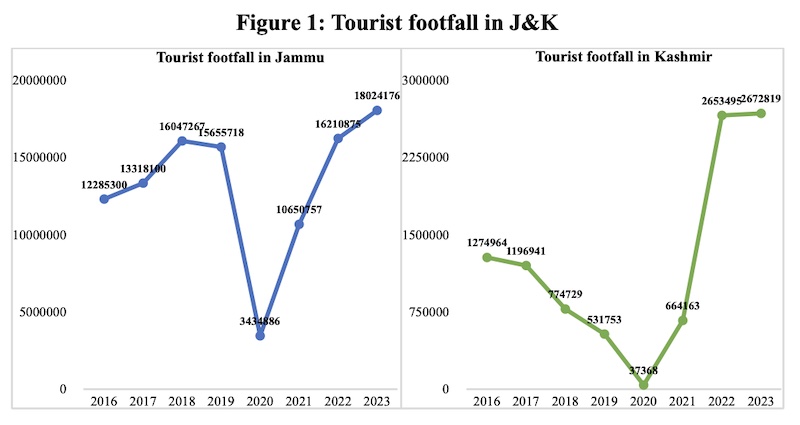
‘Paradise regained, or peril persisted?’ – Widely regarded as the ‘Paradise of Earth,’ Jammu and Kashmir (J&K) has found itself at the heart of a sharp paradox in recent years. The abrogation of ‘Article-370’ in 2019 is pitched as a new economic dawn for the region with promises of integration, development, and an open invitation to the rest of India. This has also led to a record influx of tourists in the region, crossing 15.5 million per annum for the first time since independence.
But beneath this surge, lies an unsettling reality that refuses to fade – the shadow of extremism that continues to induce fear throughout the valley. While both state and central governments have stepped-up efforts to bring stability, the larger question still lingers: ‘Can peace thrive when the guns haven’t fully fallen silent?’
Tourism and economic resurgence of J&K
In the years following the revocation of Article-370, tourist arrivals in J&K skyrocketed from a mere 1.19 million in 2011 to over 23.5 million in 2024. Kashmir alone accounted for nearly 15 percent of the total share in 2024. From Gulmarg to Sonmarg, Pahalgam to Patnitop; the tourism and hospitality sectors have flourished.
Source: Authors’ compilation from Government of J&K
This has resulted in a more than two-fold increase in the tourism-led employment figures from 1.78 million to 4.40 million during 2011-2024. Targeted schemes like‘Sustainable Promotion of Emerging Alternative Destinations’ have also been introduced to boost the tourism industry of the region, under which Rs.3.9 billion has been allocated. Such steps are also expected to push the tourism sector’s contribution in J&K’s GDP from current 7 percent to 15 percent by 2029-30.
Moreover, unemployment has dropped in the region by 0.6 percent after the abrogation of Article-370. This is aided by the establishment of over 40 thousand new business units under various self-employment schemes, and formal registration of over 3.53 million unorganised sector workers on the ‘E-Shram Portal’ till 2024. Complementing this, government programmes like ‘Mission Youth and Mission Yuva’ is also launched to establish 0.14 million new enterprises, which is likely to generate over 0.42 million jobs within next five years. With per-capita income rising at a rate of 8.3 percent, outpacing even Punjab and Delhi, and a projected state GDP growth rate of 7.06 percent in 2024-25, J&K’s economic growth is on an upward trajectory.
A tamer valley?
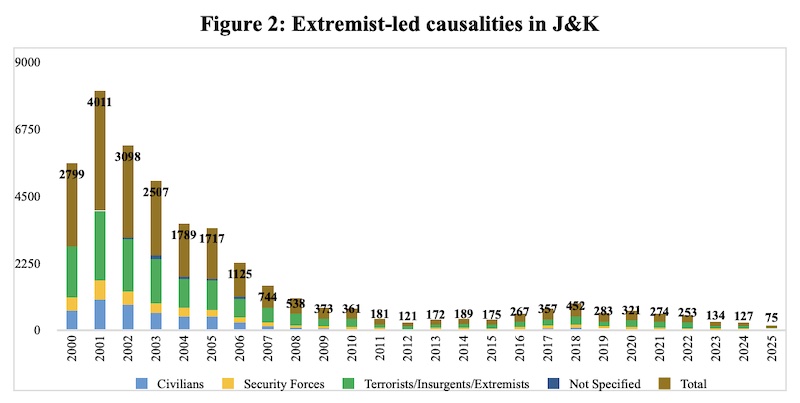
The numbers on militancy tell a cautious tale of hope. The valley has witnessed a noteworthy decline in the total number of extremist-led causalities since the abrogation of Article-370, which has dropped from 2799 to 283 during 2000-2019, and then further fell down to 75 by 2025. The region averaged 1063 casualties annually, including 241 civilians and 171 security personnel between 2000 and 2019. However, these numbers have sharply plunged to an average of 197, marking a decline of nearly 81 percent post-abrogation. Fall in both civilian and security force casualties by over 80 percent reflect an improvement in the region’s security landscape.
This has resulted in a more than two-fold increase in the tourism-led employment figures from 1.78 million to 4.40 million during 2011-2024. Targeted schemes like‘Sustainable Promotion of Emerging Alternative Destinations’ have also been introduced to boost the tourism industry of the region, under which Rs.3.9 billion has been allocated. Such steps are also expected to push the tourism sector’s contribution in J&K’s GDP from current 7 percent to 15 percent by 2029-30.
Moreover, unemployment has dropped in the region by 0.6 percent after the abrogation of Article-370. This is aided by the establishment of over 40 thousand new business units under various self-employment schemes, and formal registration of over 3.53 million unorganised sector workers on the ‘E-Shram Portal’ till 2024. Complementing this, government programmes like ‘Mission Youth and Mission Yuva’ is also launched to establish 0.14 million new enterprises, which is likely to generate over 0.42 million jobs within next five years. With per-capita income rising at a rate of 8.3 percent, outpacing even Punjab and Delhi, and a projected state GDP growth rate of 7.06 percent in 2024-25, J&K’s economic growth is on an upward trajectory.
A tamer valley?
The numbers on militancy tell a cautious tale of hope. The valley has witnessed a noteworthy decline in the total number of extremist-led causalities since the abrogation of Article-370, which has dropped from 2799 to 283 during 2000-2019, and then further fell down to 75 by 2025. The region averaged 1063 casualties annually, including 241 civilians and 171 security personnel between 2000 and 2019. However, these numbers have sharply plunged to an average of 197, marking a decline of nearly 81 percent post-abrogation. Fall in both civilian and security force casualties by over 80 percent reflect an improvement in the region’s security landscape.
Source: Authors’ compilation from South Asia Terrorism Portal
We should note that these numbers are more than just statistics. They are the outcome of Indian government’s assertive zero-tolerance approach, aiming at dismantling the militant ecosystem in J&K through sustained counter-insurgency operations, crackdowns on cross-border militant financing, intensified cordon-and-search operations, and strategic seizure of properties linked to extremist networks. Yet, isolated attacks, though less frequent, continue to haunt the state’s tourism, disrupt livelihoods, and deters economic growth by mounting waves of distress among the mass; making it essential for the government to double down on both counter-extremism and inclusive development.
The aftermath of Pahalgam massacre
The targeted Pahalgam massacre of April 2025 in the Kashmir region claimed 28 lives, including several foreign nationals, leaving behind a trail of grief and disbelief. What unfolded was not just an assault on civilians, but on the fragile sense of normalcy that Kashmir had painstakingly rebuilt over the past few years. Within days, the Valley’s blooming tourist season collapsed with hotel bookings being cancelled on mass, and tourist footfall being plunged by almost 90 percent.
Yet, amid the shock, the response was immediate and assertive from the Indian armed forces. They have successfully launched ‘Operation Sindoor’ and ‘Operation Keller’ within days from massacre. These counter-operations have not only neutralised cross-border extremist camps and infiltration module; but also have restored a sense of control and public confidence in the region’s security framework. This swift response symbolises resilience – a refusal to let terror dictate the rhythm of everyday life in Kashmir once again.
A way forward…
The decline of tourist footfall in Kashmir, immediately following the Pahalgam massacre underscores how fragile recovery remains in the face of violence. While counter-extremist operations have shown reckonable success, with such horrific incidents plummeting from over 2700 to 57 in the last 25 years, yet Kashmir’s recovery is still a tightrope walk, which demands strengthening of local police intelligence units and deploying drone surveillance across high-risk zones.
Equally important is the counter-radicalisation drive in border schools and madrassas, as a substantial share of new tech-savvy educated militant recruits come from vulnerable age groups from these districts. This may be accomplished by bolstering youth employment through tourism-linked entrepreneurship, effective PR-campaigns, and faster rollout of industrial schemes to dry-up recruitment pipelines for insurgents.
With extremist incidents at a 25-year low and infrastructure, investment, and education on the rise, J&K stands at the threshold of a historic transformation. The promise is real, but so is the peril. However, if the guns can fall silent for good, not just in papers, but in reality; then the vision of an extremism-free, prosperous J&K may no longer be a distant hope. Rather, it may well be the next success story of India.
About the author
We should note that these numbers are more than just statistics. They are the outcome of Indian government’s assertive zero-tolerance approach, aiming at dismantling the militant ecosystem in J&K through sustained counter-insurgency operations, crackdowns on cross-border militant financing, intensified cordon-and-search operations, and strategic seizure of properties linked to extremist networks. Yet, isolated attacks, though less frequent, continue to haunt the state’s tourism, disrupt livelihoods, and deters economic growth by mounting waves of distress among the mass; making it essential for the government to double down on both counter-extremism and inclusive development.
The aftermath of Pahalgam massacre
The targeted Pahalgam massacre of April 2025 in the Kashmir region claimed 28 lives, including several foreign nationals, leaving behind a trail of grief and disbelief. What unfolded was not just an assault on civilians, but on the fragile sense of normalcy that Kashmir had painstakingly rebuilt over the past few years. Within days, the Valley’s blooming tourist season collapsed with hotel bookings being cancelled on mass, and tourist footfall being plunged by almost 90 percent.
Yet, amid the shock, the response was immediate and assertive from the Indian armed forces. They have successfully launched ‘Operation Sindoor’ and ‘Operation Keller’ within days from massacre. These counter-operations have not only neutralised cross-border extremist camps and infiltration module; but also have restored a sense of control and public confidence in the region’s security framework. This swift response symbolises resilience – a refusal to let terror dictate the rhythm of everyday life in Kashmir once again.
A way forward…
The decline of tourist footfall in Kashmir, immediately following the Pahalgam massacre underscores how fragile recovery remains in the face of violence. While counter-extremist operations have shown reckonable success, with such horrific incidents plummeting from over 2700 to 57 in the last 25 years, yet Kashmir’s recovery is still a tightrope walk, which demands strengthening of local police intelligence units and deploying drone surveillance across high-risk zones.
Equally important is the counter-radicalisation drive in border schools and madrassas, as a substantial share of new tech-savvy educated militant recruits come from vulnerable age groups from these districts. This may be accomplished by bolstering youth employment through tourism-linked entrepreneurship, effective PR-campaigns, and faster rollout of industrial schemes to dry-up recruitment pipelines for insurgents.
With extremist incidents at a 25-year low and infrastructure, investment, and education on the rise, J&K stands at the threshold of a historic transformation. The promise is real, but so is the peril. However, if the guns can fall silent for good, not just in papers, but in reality; then the vision of an extremism-free, prosperous J&K may no longer be a distant hope. Rather, it may well be the next success story of India.
About the author

Sagartirtha Chakraborty
Sagartirtha Chakraborty is a Ph.D. Research Scholar in the Department of Economics at Cotton University, India. He has authored a book, titled ‘Research in Social Science: A Beginners’ Handbook’ and his peer-reviewed articles are published various journals and platforms, including in the London School of Economics & Political Science, Leiden Madtrics, Space & Culture, Statistical Atlas Assam, and over 15 edited volumes.

No comments:
Post a Comment