Second Ford-Class Carrier Heads Out on Builder's Trials
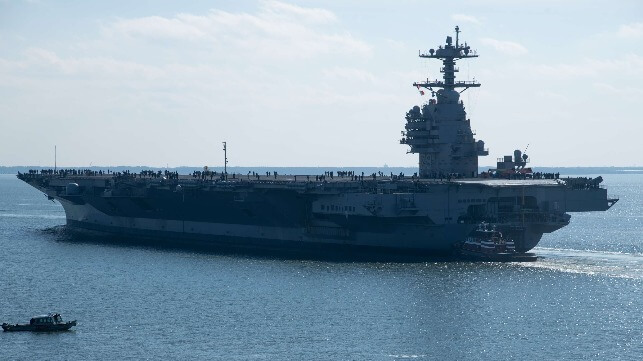
The U.S. Navy's second Ford-class carrier, USS John F. Kennedy, has headed out on builder's trials after 10 years of construction. The trials - and any additional work items identified while under way - are among the last steps before Navy acceptance, and give shipbuilder HII Newport News the opportunity to perform final checks.
Steelcutting for USS Kennedy began in 2011 for a delivery date in 2020. However, technical problems in the Ford-class program emerged as early as 2013, ultimately leading to multibillion-dollar cost overruns and multiyear delays on first-in-class USS Gerald R. Ford. The keel-laying for Kennedy was held in 2015, six years after contract award, and Kennedy's hull was physically completed in 2019.
In 2020, the Navy awarded HII a large contract to complete needed changes to accommodate the F-35 strike fighter into USS Kennedy in a single phase, before delivery - not in a second phase after delivery. The front-loading of the work moved Kennedy's delivery date back to mid-2025.
After further delays, Kennedy is currently on track to deliver in early 2027, 18 years after initial contract award.
USS John F. Kennedy is the second ship named after the former president, following the Kitty Hawk-class CV-57, the last fuel oil-powered aircraft carrier delivered to the U.S. Navy. The venerable CV-57 was decommissioned in 2007 and put in long-term layup at Bremerton; last year, she made the long voyage under tow to Brownsville, Texas to undergo demolition.
USS Zumwalt gets under way once more
Another famous ship conceived in the Oughts, the USS Zumwalt, has recently completed a new set of builder's trials at HII's other shipyard, Ingalls Shipbuilding. After three years of work, the yard has completed some deep modifications to the ship's weapons systems, enabling Zumwalt to carry the Navy's new hypersonic missile.
Zumwalt was originally designed to accommodate two specialized cannons on her bow, which were to be used for shore bombardment. When cost growth for the class forced its reduction to a series of three hulls, the cost per round for the munitions for these cannons became prohibitively high and they were canceled. The guns have now been removed from Zumwalt, replaced by launch tubes for the Conventional Prompt Strike (CPS) missile system.
Conventional Prompt Strike is a long range hypersonic boost-glide missile designed to evade enemy air defenses. This weapon class is proliferating among other sea services: China fields several types, Russia has its own (Zircon), and India unveiled similar missile system earlier this month. The Navy flight-tested CPS successfully in May 2025, including a cold-launch system that will eject the missile out of the tube prior to ignition, preventing damage to the ship from hot rocket exhaust.
The other two vessels in the Zumwalt-class, USS Lyndon B. Johnson and USS Michael Monsoor, will undergo the same transformation in the next several years. The future Block V Virginia-class subs will also carry CPS, with the first on schedule to deliver in 2028.

No comments:
Post a Comment