Philippines Path to ASEAN’s Ukraine?
In the past, PH targets comprised mainly the EDCA sites. Now they include the planned ammo manufacturing sites. Manila is moving from a US logistical enabler to a huge regional military hub, like Ukraine a few years ago.
Last week, the Pentagon disclosed that the US-led military manufacturing partnership (PIPIR) is assessing funding for a major new ammunition assembly and production line in the Philippines.
Under its ultra-conservative PM Sanae Takaichi, Japan is taking the lead to set up a new program to produce propulsion systems used in many guided weapons, while the Philippines is tasked to host a large new weapons facility. The bilateral cooperation has intensified for half a decade.
Meanwhile, defense secretary Gilberto Teodoro has been negotiating stronger defense cooperation with the NATO leaders in Europe.
Following these reports, China’s foreign ministry warned the United States against bringing “conflict and the chaos of war” to the Asia-Pacific. In Beijing’s view, a potential ammunition facility would destabilize the region.
Toward major instability
The new military tasks of the Philippines were recently promoted by the Center for a New American Security (CNAS). This US thinktank played a role in legitimizing Biden administration’s engagement in Ukraine, Israel’s Gaza “war”, and Iran mobilization.
From an international military standpoint, the Philippines is transforming itself to serve as a forward staging area for US forces, air and naval logistics hub, missile deployment sites, ISR (intelligence, surveillance, reconnaissance), sea lane control in South China Sea, and protection of Japanese/US military supply routes.
In some ASEAN countries, the concern is that these strategic moves could pave the way to major instability and possibly a major Asian war.
The following commentary draws only from public sources and discourses on EDCA locations, logistics plans, ammo sites, and targeting doctrines seen in Ukraine, Middle East, and NATO war-gaming.
US–Japanese weapons hub
In the Philippine bases, the possible US air force deployments include F-35 and F-16 fighters, P-8 maritime patrol, KC-135 and KC-46 tankers, C-17 and C-130 transports or AWACS radar aircraft.
The most sensitive issue involves missile systems. US has discussed deploying mobile missile units in the region. Possible systems feature HIMARS, Tomahawk land-attack missiles, SM-6 multi-role missiles and Naval Strike Missile (NSM). Japan is developing Type-12 anti-ship missiles and long-range cruise missiles.
Ostensibly, US ground troops would be mostly rotational, not permanent. They could feature US Marines, Army air defense units, special forces, engineers and logistics.
With naval forces, ports in Philippines could support US destroyers, submarines and amphibious ships.
Japan is also increasingly involved in radar systems to Philippines, coast guard ships, joint exercises and possible future troop access agreements.
The risk is that the Philippines is close to its perceived adversary’s missile range, has limited air defense and many bases near civilian areas.
High-priority targets
Among the primary targets, Northern Luzon is the primary operational zone. The EDCA sites include Lal-lo Airport, which is very close to Taiwan, is seen as a possible missile/transport hub, and thus a likely target for cruise or ballistic missiles.
Camilo Osias Naval Base is located near Luzon Strait. Since it could be useful for surveillance and naval staging, it is a likely high priority target. Basa Air Base could serve for fighter, tanker and ISR staging. It is a likely missile target.
Along with Northern Luzon, Palawan serves as the South China Sea axis where monitoring sites feature Antonio Bautista Air Base, which could support anti-ship operations. In turn, Balabac Island controls the passage between South China Sea and Sulu Sea. It could be useful for anti-ship missiles.
Then comes Central Luzon’s logistics core. Fort Magsaysay, the largest training base, and Mactan-Benito Ebuen Air Base, which remain relevant for training, staging and transport.
That’s the first-order military geography.
Ukrainian-style regional arms production
With the new arrangements, the new primary targets feature the Subic–Clark corridor, due to the ammunition production/assembly planned in Subic Bay Freeport. As a part of regional military-industrial cooperation, it is framed as a regional munition hub. This upgrades Subic from a “logistics port” to a war-sustaining industrial node.
The second new development involves the large US prepositioning storage. US Navy is seeking a huge storage facility likely near Subic-Clark, featuring vehicles, equipment, maintenance, and armories.
The planned forward stockpile hub is similar to US prepositioning in Europe and the Middle East. Think of US prepositioning and war reserve stocks in Kuwait, Qatar, Israel and Diego Garcia – the ones that are now under fire.
Here’s the main difference: Philippine targets will be far more exposed than those in Europe and the Middle East. And that makes Subic Bay and Clark Freeport primary targets.
A third development may be evolving in Batanes, in the north. Having opened in 2025, the Forward Operating Base in Batanes is the closest Philippine territory to Taiwan. It is seen as ideal for radar, ISR, and potentially missile staging.
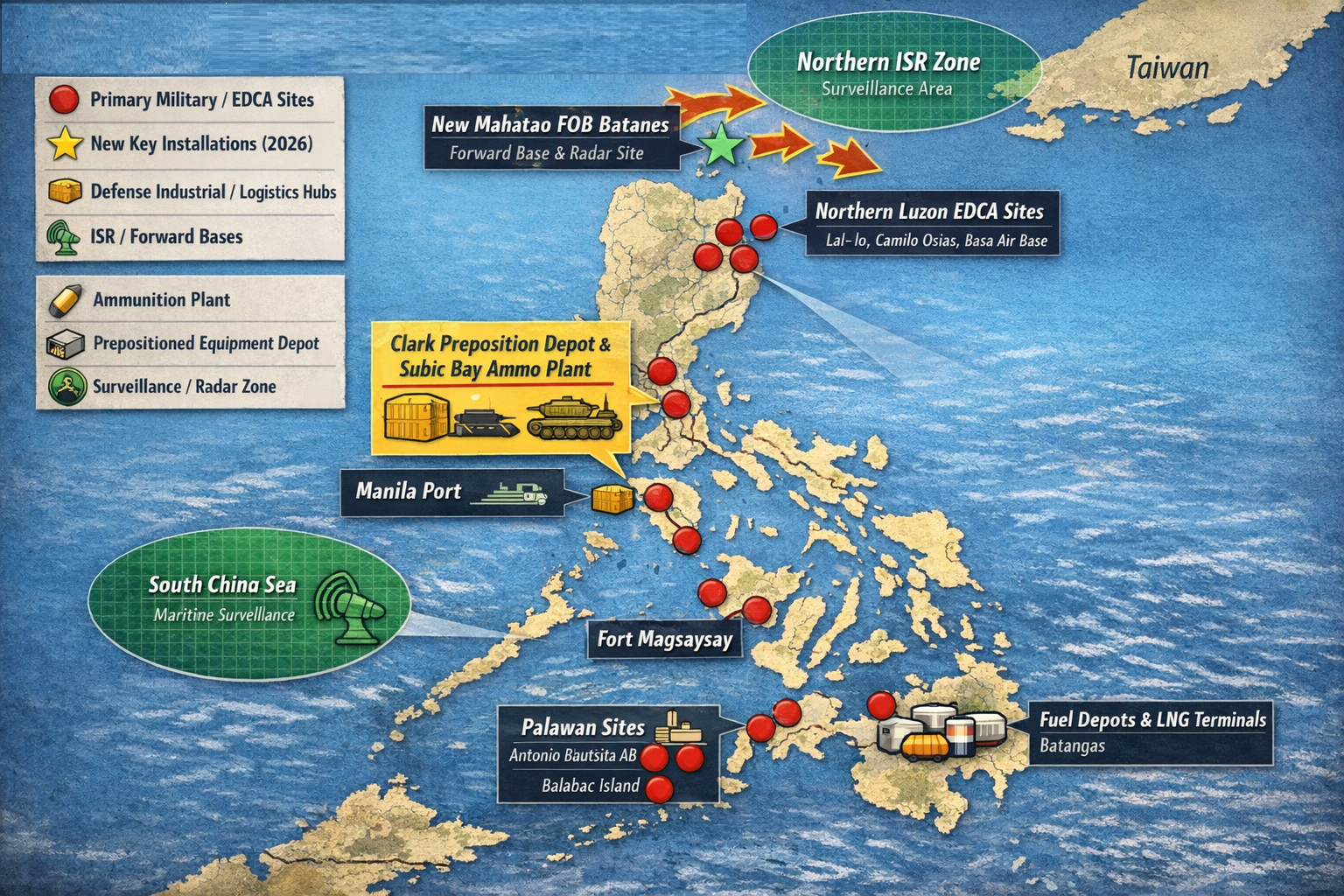
The expanding list of Philippines military targets
Living dangerously
A naval blockade or a strike in this “Golden Triangle” (Subic-Clark-Manila) could effectively trap the Philippine defense manufacturing capability in one small zone. A single incident or blockade could paralyze the capital’s supply chain.
The plan to build ammunition production and assembly facilities in the Philippines changes the targeting logic of the Taiwan-war scenarios. The country will no longer be just a staging platform.
Behind the fog of the corruption debacle and the energy crisis that it is highly exposed to, the Philippines is taking a huge leap from a logistical warehouse to a regional military hub – amid its greatest economic crisis in a generation.
The devastation of the outlined Philippines targets would not be just a crushing military loss. Their demise would disrupt the heartbeat of the Philippine economy and society.
In Ukraine, Gaza, Lebanon, Iran and the Middle East at large, such arrangements have served the interests of recent US administrations.
The question is, do they really serve to protect peace and prosperity in the Philippines interest?

No comments:
Post a Comment