Locals at epicentre of DR Congo Ebola outbreak storm hospital
Bunia (DR Congo) (AFP) – Locals at the epicentre of the Ebola outbreak in the DR Congo attacked the town hospital overnight, demanding the body of a religious leader who died from the virus, officials said on Monday.
Issued on: 25/05/2026 -

Mongbwalu, a large town in the unstable northeastern province of Ituri, is where the current outbreak of the viral haemorrhagic fever was first detected on May 15, since when it has killed more than 200 people in the Democratic Republic of the Congo.
"A group of young people attacked the hospital four times," a hospital official told AFP of the incident on Sunday night.
"They wanted to retrieve the body of a Catholic shepherd who had died of Ebola," the official said on condition of anonymity.
He said the victim had been "a well-known local figure, a religious leader from Mongbwalu", which is home to 130,000 people.
Soldiers intervened to disperse the crowd with warning shots, he said.
Ebola is a deadly viral disease that spreads through direct contact with bodily fluids. It can cause severe bleeding and organ failure.
There is no vaccine or treatment for the Bundibugyo strain responsible for the current Ebola outbreak, the 17th to plague the vast central African country of more than 100 million people.
Attempts to tackle the spread are forced to rely mainly on precautions and rapid contact tracing.
But in rural parts of the DRC, "loved ones are throwing themselves at the bodies, touching the corpses and the clothes of the deceased, while organising mourning rituals bringing together loads of people", Jean Marie Ezadri, a civil society leader in Ituri, told AFP last week.
"This... explains the many instances of contamination."
Distrust and incomprehension
Poorly served by roads and torn apart by violence, Ituri is one of the most troubled provinces in the DRC.
Hastily arranged burials of Ebola victims have been met with suspicion in a region already distrustful of the state.
An isolation tent near Mongbwalu hospital was torched on Friday night and the hospital official said his car had been stoned at the weekend.

The tensions were "hampering (Ebola) response efforts", he said.
Another hospital worker confirmed the incidents.
Mongbwalu medical centre is not the first in Ituri to have been attacked.
Tents used to isolate Ebola patients at the hospital in Rwampara, Ituri, were burned down on Thursday after the family of a deceased man was prevented from taking his body for burial because of the dangers of contamination.
Tonnes of medical supplies have been sent to Ituri, where teams from the World Health Organization are on the ground.
But the response has been slow to get off the ground in a province where state services have been largely absent from rural areas for decades.
One million of the province's estimated eight million inhabitants have been displaced by years of conflict and live cheek-by-jowl in cramped camps.
The WHO has issued an international health alert.
© 2026 AFP
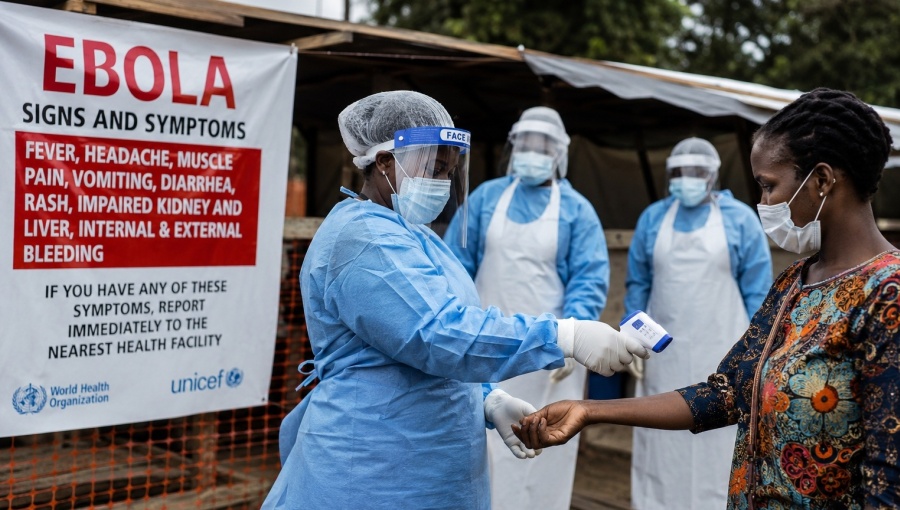
Health authorities across Central and East Africa are racing to contain a rapidly expanding Ebola outbreak centred in the Democratic Republic of the Congo (DRC) and Uganda, as the World Health Organization (WHO) warns that insecurity, weak health systems and the absence of an approved vaccine for the current virus strain are complicating containment efforts.
The outbreak involves the rare Bundibugyo strain of Ebola virus disease, a variant for which there is currently no approved vaccine or specific treatment. WHO on May 17 declared the outbreak a Public Health Emergency of International Concern (PHEIC), its highest global alert level.
According to the UN agency and the US Centers for Disease Control and Prevention (CDC), the outbreak was first officially confirmed in Ituri Province in northeastern DRC, near the borders with Uganda and South Sudan. Uganda later confirmed imported cases linked to cross-border transmission.
WHO Director-General Tedros Adhanom Ghebreyesus warned last week that he was concerned by the “speed and scale” of the outbreak as case numbers continue to rise.
As of late May, WHO, CDC and regional health agencies were reporting hundreds of suspected cases and well over 100 suspected deaths across affected areas in DRC and Uganda, although officials caution that figures remain fluid because surveillance and laboratory testing are still expanding.
Conflict and mistrust complicate containment
The outbreak is unfolding under particularly difficult conditions in eastern DRC, where armed conflict, population displacement and attacks on health facilities are hampering response efforts.
According to the Associated Press, angry residents in northeastern Congo last week stormed a hospital treating Ebola patients demanding the release of relatives’ bodies, while several treatment centres have been attacked in recent days amid growing mistrust toward health authorities.
“The more the outbreak spreads, the harder it becomes to control,” WHO officials warned during emergency briefings this month, while Africa CDC called for stronger regional coordination and cross-border surveillance.
The Bundibugyo strain presents additional complications because no licensed vaccine currently exists, unlike previous outbreaks involving the Zaire strain of Ebola.
WHO officials said promising vaccine candidates are under development but may not be ready for deployment for six to nine months.
“There is no vaccine available for the Bundibugyo strain currently spreading,” health officials told reporters as neighbouring countries intensified screening and preparedness measures.
Uganda has so far confirmed a limited number of cases linked to infected travellers from DRC. Authorities said aggressive contact tracing and border surveillance operations are underway to prevent wider community transmission.
Meanwhile, governments across the region have tightened health screening procedures at airports and border crossings. The US CDC has also introduced enhanced Ebola screening measures at selected international airports for travellers arriving from affected countries.
Medical groups including Médecins Sans Frontières warned that insecurity and shortages of protective equipment remain major obstacles to containing the outbreak.
“The outbreak is occurring in a challenging context,” WHO said, citing “humanitarian crisis”, insecurity and high population movement across affected regions.
Economic risks mount across affected countries
Beyond the immediate public-health emergency, economists warn the outbreak could inflict significant economic damage across affected countries if transmission accelerates further.
Previous Ebola outbreaks in West and Central Africa severely disrupted trade, tourism, mining operations and cross-border commerce as governments imposed movement restrictions and international investors delayed projects.
The World Bank estimated that the 2014-2016 West African Ebola epidemic cost Guinea, Liberia and Sierra Leone more than $2.8bn in lost economic output, while airlines, hotels and transport operators across the region suffered sharp declines in business activity.
Tourism operators in East and Central Africa are already monitoring the latest outbreak closely because of concerns that international travellers may avoid parts of the region if the crisis escalates. Airlines and border authorities have meanwhile increased health-screening procedures at several African airports.
African football calendars face disruption threat
The outbreak could also affect African football and regional sporting calendars if transmission spreads into major urban centres. During previous Ebola crises, Confederation of African Football (CAF) tournaments, World Cup qualifiers and domestic league fixtures were postponed, relocated or played behind closed doors because of health concerns and travel restrictions.
CAF and FIFA calendars over the coming months include multiple international windows that could be affected by any escalation in travel restrictions or cross-border health controls. African qualifiers for the 2026 FIFA World Cup are scheduled to continue during the September and October international windows, with decisive fixtures and playoff rounds due later in the qualification cycle.
Several African teams are scheduled to participate in high-profile 2026 FIFA World Cup fixtures beginning in June, increasing scrutiny around health protocols and cross-border travel measures.
The tournament opens on June 11 in the United States, Canada and Mexico, with African representatives including DRC, Morocco, Senegal and Nigeria national team expected to begin group-stage matches between June 12 and June 18, depending on final fixture allocations.
FIFA schedules also include African teams travelling across multiple North American host cities throughout June and July, raising logistical and health-monitoring concerns if the Ebola outbreak expands further across Central Africa.
The outbreak is already beginning to affect preparations linked to the 2026 FIFA World Cup. The DRC national team cancelled a planned pre-World Cup training camp in Kinshasa and moved preparations to Belgium because of the Ebola outbreak, according to FIFA and multiple media reports.
A FIFA spokesperson said the organisation was “aware of and monitoring the situation” and remained in “close communication” with the Congolese football federation regarding medical and security guidance.
US authorities have meanwhile imposed strict health protocols on the Congolese delegation ahead of the World Cup, which begins on June 11 in the United States, Canada and Mexico.
“We’ve been very clear to Congo that they should maintain the integrity of their bubble for 21 days,” Andrew Giuliani, executive director of the White House Task Force for the World Cup, told ESPN. “They need to maintain that bubble or they risk not being able to travel to the United States.”
According to FIFA schedules, DR Congo are due to play pre-tournament friendlies against Denmark on June 3 in Belgium and Chile on June 9 in Spain before entering the World Cup group stage later in June.
Health authorities in World Cup host cities are also preparing additional surveillance measures around the tournament. Toronto Medical Officer of Health Michelle Murti said officials were increasing infectious-disease monitoring ahead of the influx of international supporters.
“We are going to be doing extra wastewater surveillance at the games,” Murti said, while urging symptomatic supporters to avoid attending matches.
The Confederation of African Football is also preparing qualification campaigns and tournament schedules across several competitions during the second half of 2026, increasing pressure on football authorities to coordinate closely with regional health agencies over travel, crowd management and player safety protocols.
Several African football federations are reportedly reviewing contingency plans for upcoming CAF and FIFA fixtures, including the possible use of neutral venues, expanded medical screening and tighter travel protocols for players, officials and supporters travelling from affected countries.
Memories of the 2014-2016 Ebola crisis
Public-health specialists say the current outbreak is reviving memories of West Africa’s devastating 2014-2016 Ebola epidemic, which killed more than 11,000 people across Guinea, Liberia and Sierra Leone and exposed severe weaknesses in global outbreak preparedness.
However, WHO and Africa CDC stressed that the current outbreak does not meet the criteria for a pandemic and that the overall global risk remains low for now, despite elevated regional risk levels.

No comments:
Post a Comment