By AFP
May 14, 2026

Ukraine claims to be the world-leader in drone warfare
Barbara WOJAZER
Hundreds of AI-controlled robots operating in unison, talking to each other to autonomously attack targets — a dystopian vision of the future of war that Ukraine’s defence industry wants to make a reality.
Four years into the Russian invasion, the idea — known as swarm drones — is one of the hottest topics in military tech in a country that describes itself as the world-leader in drone warfare.
“There is a huge interest,” military expert Yury Fedorenko told the audience at the recent Drone Autonomy conference, held in an undisclosed location in the western Ukrainian city of Lviv.
“No matter who you speak to, they always say: show them to us. where are they, we want to see!” he added.
The conference was organised by Iron Cluster, a group of defence groups operating out of Lviv.
The prospect of drone swarms, groups of drones that can act together and fulfil set tasks without human intervention, has triggered both anxiety and excitement.
“We’ve been talking about swarm technology for a very long time, and we in the military have been waiting for it even longer,” said Volodymyr “Colt”, the head of civil-military cooperation at Ukraine’s 412th brigade.
“The only question is when it will happen,” he added.
– ‘A few years’ away –
Ukrainian military and defence industry figures told AFP Kyiv had made progress in getting the much-hyped technology off the ground.
Others cautioned it remains some way off and that swarm drones were just one part — albeit an eye-catching one — of the much broader race toward autonomous warfare.
The appeal is clear.
The swarms would allow a few operators to deploy dozens or hundreds of attack craft simultaneously — overwhelming enemy defences and helping Ukraine’s army offset Russia’s manpower advantage.
“The main purpose is to save the lives of our servicemen,” Andrii Lebedenko, deputy commander-in-chief, told AFP.
“Today we have such projects. They’re not large-scale, but they’re growing… mass deployment is possible in the coming years,” Lebedenko said.
– ‘Valid target’ –
Defence Minister Mykhailo Fedorov has championed the use of advanced technology to fend off Russian attacks, including launching the Defense AI Center A1.
Its head, Danylo Tsvok, told AFP “drone swarms are currently in the testing phase … there are a lot of things that we can’t say”.
Swarmer, a Ukrainian-US company, has emerged as a leader in the field, listing on the US Nasdaq exchange earlier this year.
US CEO Alex Fink told AFP the company had been deploying early swarm technology in combat since April 2024.
Its systems can autonomously deploy multiple drones to an area, after which human pilots step in to manually engage a target, or operators select targets and the drones carry out the strikes autonomously.
“It’s definitely not at the point where we can trust technology to make strategic decisions or even make tactical decisions about what’s a valid target,” Fink said in a telephone interview.
“We don’t want our systems to make that decision. We want the humans to be in charge.”
– ‘Manhattan Project’ –
At the AI defence conference in Lviv, there was some level of scepticism.
“Drone swarms are totally overhyped… because they make for a good sci-fi story and a visual image,” said Yaroslav Azhnyuk, head of the Fourth Law, which specialises in drone autonomy.
Autonomy, he argued, was about more than just drone swarms. It covered everything from navigation, target selection and attack execution — and could apply to all kinds of drones.
He compared autonomy to the development of Microsoft Word — concentrating on swarms was like obsessing over the button that makes text italic, instead of the whole programme.
“We’re focusing on massively scalable full autonomy,” he said.
“This is the Manhattan Project of our era,” he added — a reference to the US WWII initiative that produced the first nuclear weapon.
“Imagine if either the Nazis or the Russians got the nuclear bomb first. That would have been a very, very different world,” he said.
“Now imagine if they get the full autonomy first,” he said
Russia has set AI and drones as its top military priorities.
It has “likely fielded a fully autonomous unmanned system in combat”, according to an April 2026 report by Kateryna Bondar, an expert with the Center for Strategic and International Studies.
Anton Melnyk, co-founder of MITS Capital, set up to fund Ukraine’s defence industry, was blunt about the stakes involved.
“Either we will achieve this –- the Armed Forces of Ukraine, together with various NATO partners –- or the enemy will.”
Ukraine Strikes Black Sea Oil Terminals as Russia Unleashes Drone Barrage

Widespread attacks by both Russia and Ukraine followed the end of the temporary ceasefire for Russia’s Victory Day Parade. Ukraine reports it was able to inflict serious damage on Russia’s energy infrastructure, while reports said Russia launched the largest sustained drone barrage of the war.
Russia launched a total of 1,428 drones and decoys over a sustained 24-hour period from Wednesday into Thursday, reports The New York Times. It termed it the “largest sustained daylong drone attack” since the start of the war, by its calculations. Ukrainian President Volodymyr Zelensky later asserted that Russia had launched more than 1,560 drones since Wednesday, as well as at least 56 missiles.
The capital city of Kyiv was one of the primary targets, but the attacks struck multiple parts of the country. Odesa Administrator Oleh Kiper reported a large-scale drone attack on port infrastructure. He said there were two waves with the Russians damaging equipment, property, and vehicles.
Ukraine, in return, intensified its ongoing campaign against Russia’s energy infrastructure. Ukraine’s Special Operations Forces reported they had targeted a key export and transshipment facility near the Kerch Strait. They highlighted that it was more than 200 miles from the front line.
Bloomberg is reporting that Ukraine’s strikes on the Russian oil infrastructure reached a four-month high in April. It writes that there were at least 21 attacks on refineries, pipelines, and tankers.
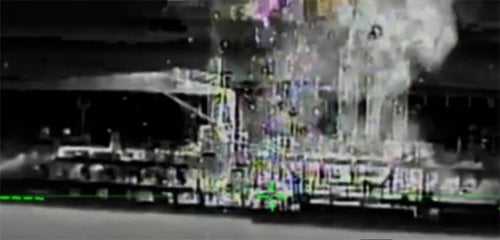
Pictures posted online showed large explosions at the Tamanneftegaz terminal, with reports of ongoing fires in the facility located near the Port of Taman, located on the Kerch Strait. Ukraine said the terminal is used for storage, transshipments, and exports of oil, fuel, diesel, and liquefied gases. There were two waves of attacks on Wednesday and again on Thursday at the terminal.
Ukraine also reported strikes on the Port of Taman and its energy terminal. They said the terminal could accommodate up to four ships at one time. They asserted that it was being used to provide fuel for Russian troops and as a major export hub.
Ukraine’s General Staff reported other energy-related strikes, including on the Yaroslavl oil refinery. They said it was used to produce gasoline, diesel, and jet fuel. They reported striking the primary oil refining units.
Russia’s oil production is projected to fall to a nearly 20-year low in 2026, according to reports in the Moscow Times. It writes that production levels in 2026 will be similar to 2009, citing the impact of the Western sanctions as well as Ukraine’s ongoing attacks.
Forest fire burns through Chernobyl
exclusion zone after drone crash
ByAFP
May 8, 2026
The site surrounding Chernobyl nuclear plant has been largely deserted since 1986, when the plant suffered a catastrophic meltdown
A large forest fire was burning through the Chernobyl exclusion zone on Friday following a drone crash near the defunct nuclear plant the previous day, Ukrainian authorities said.
Radiation levels at the site were within “normal limits”, authorities reported, adding that firefighters were working to contain the blaze.
An image published by Ukraine’s state emergency service showed a large column of white smoke billowing into the sky from the area, parts of which are closed off to the public due to high levels of radioactivity.
The site surrounding Chernobyl nuclear plant has been largely deserted since 1986, when the plant suffered a catastrophic meltdown.
“As of 10 a.m. (0700 GMT) on May 8, the approximate area of the fire was about 1,100 hectares (11 square kilometres, four square miles),” the Chernobyl nature reserve, which manages the site of the 1986 disaster, said.
The fire broke out on Thursday “as a result of a drone crash”, it said.
It did not say the origin of the drone.
Kyiv has repeatedly accused Moscow of recklessly attacking its nuclear sites, including the Chernobyl complex.
A Russian drone last year punctured a hole in one of the radiation shells covering the reactor unit that exploded in the 1986 disaster.
Ukraine’s state emergency service said rescuers were working to prevent the further spread of the fire.
“Due to strong gusts of wind, the fire is rapidly spreading across the territory, covering new sections of the forest,” it said.
“The situation is complicated by dry weather, strong winds and mine danger in certain areas of the territory, which significantly limits the possibility of extinguishing work.”
The exclusion zone suffered wildfires in 2020, which lasted several weeks and caused a spike in background radiation.
Ukraine only last month marked 40 years since the disaster.
ByAFP
May 15, 2026

The drones are designed to disable the attacker by flying right into him or her or spraying them with pepper gel - Copyright POOL/AFP Evan Vucci
Moisés ÁVILA
A new idea for combatting America’s horrific problem of school shootings is to unleash an unarmed drone to confront the attacker, like a giant buzzing insect.
It is the brainchild of a company called Campus Guardian Angel, which has pilot programs using the technology in Georgia and Florida, with growing interest in Texas. These drones have not yet been battle-tested, however.
The approach seems to reflect that part of America which says the way to address recurrent school shootings — part of the country’s broader gun violence epidemic — is not with stricter gun control laws but rather with weaponry, such as giving teachers guns.
The company says the new approach would work like this: when a potential shooter enters a school, a teacher hits an alarm on their cell phone to alert the police and as officers rush to the scene, a drone is activated from a pre-established position inside the school as a first line of defense.
These small, black, roughly square drones weighing about two pounds (one kilo) are piloted by humans in the Texas state capital Austin and can actually buzz around inside the school by navigating 3D maps that Campus Guardian Angel will have made beforehand.
The drones do not shoot bullets or any other kind of projectile.
Rather, they are designed to disable the attacker by flying right into him or her or spraying them with pepper gel.
Khristof Oborski, Campus Guardian Angel’s director of tactical operations, said the firm’s CEO Bill King observed that small drones were highly effective in attacks on the battlefield in the war in Ukraine.
“So he started thinking about how can you introduce this type of system to be able to combat a growing problem in the United States, with school shootings,” Oborski said.
Oborski explained that what the drone actually does depends on what the shooter or potential shooter does.
If a child with a gun is walking in a school corridor, the drone has two-way radio so human operators can talk to the attacker and try to persuade him or her to put down the weapon, Oborski said.
The operators are in constant contact with police so officers can, say, be guided to where the attacker is.
If the assailant is actually shooting people, “we go straight to either kinetic impacts or we use our less lethal JPX pepper gel on the suspect,” Oborski said.
In 2025, US schools endured 233 incidents involving firearms, according to a data base called IntelliSee.
One of the worst recent school shootings was in Uvalde, Texas in 2022, with 19 children and two teachers shot and killed. It took police 77 minutes to move in close enough to kill the attacker.
– ‘To be the nerd’ –
Campus Guardian Angel offers its services with yearly contracts, the fee depending on the size of the school and how many buildings it has.
Besides the pilot programs in Florida and Georgia, the company says some parents in Houston are interested in getting the drones set up in their kids’ schools.
“The best-case scenario is we put this in every single school in America and then never have to use it, right? Because it’s got a deterrent quality to it,” said King, a former Navy SEAL.
He said he is often asked if the drones are operated by artificial intelligence and the answer is no, which King said people find reassuring.
Alex Campbell, a 30-year-old operator in this system and professional drone-racing competitor, describes himself as more of a nerd than a soldier.
“To be the nerd behind the scenes, to help the heroes on this Earth saving us from the bad things happening, it’s really fulfilling to be able to have a hand in that,” Campbell said.

No comments:
Post a Comment