Something has quietly shifted in Russia. Not the social and economic meltdown Western pundits have been confidently predicting almost continuously for the last two decades. Or the imminent economic collapse following each bad data set. But something more subtle: the gradual collapse of the social bargain that held Russian society together through the first four years of the Ukraine war.
Alexander Baunov, a senior fellow at the Carnegie Endowment for International Peace, said in a recent paper when Putin launched the full-scale invasion of Ukraine in February 2022, he didn't ask Russians to support the war — he offered them something more modest: the right to live outside it. "You can live outside of the war, but you cannot be against it," went the unspoken deal.
For those who accepted the offer, the Kremlin would allow a way of life close to their pre-war existence. Many accepted it — some out of genuine indifference to others' suffering, some out of desperation, some simply because the alternative was unthinkable.
That bargain held, more or less, through 2024. The ruble didn't collapse. Borders stayed open. Wages rose. The sanctioned shelves were quickly restocked with parallel-imported goods. A curious wartime prosperity emerged from the rubble of the old life. Indeed, after the initial shock of the invasion of 2022, the following two years were amongst the most prosperous since the fall of the Soviet Union. The austerity of almost two decades of Putinomics was turned on its head and the spigot of massive state spending finally opened. A War middle class emerged and the war in the south had very little impact on everyday life. With it came what Baunov calls "everyday patriotism" — a fragile optimism built not on ideology but on the simple satisfaction of survival.
By spring 2026, the regime had shredded that arrangement. "The Russian regime had unceremoniously violated the terms of this compromise agreement one after another," Baunov writes, "and now society is angry. People did not agree to ignore the war only to become the target of prohibitions and repressions themselves and now feel cheated and deceived."
The war comes home
The war has finally arrived in the courtyards of regular Russians. As the military Keynesianism boom of 2023 and 2024 began to fade away as industrial capacity utilisation maxed out the economy was no longer able to absorb the torrent of military spending of around $140bn a year and prices rose. The personal income gains of the previous years were eaten away. The Central Bank of Russia (CBR) hiked interest rates to a crushing 21% to kill inflation, but it wouldn’t die. Then the regular began to clamp down on credits in an unorthodox experiment to deliberately slow growth to pull inflation down. It worked: inflation has fallen from a sticky 10% last year to 5.9% in April and is continuing to fall. The CBR has managed to put through 550bp of rate cuts but interest rates remain in double digits.
With consumption falling, borrowing impossibly expensive, and growth slowing, the slowdown is hitting small- and medium-sized enterprises (SMEs) particularly hard where sales are falling and driving many to the wall. It’s not a crisis yet, but dark clouds have rolled over the skies that were sunny before.
However, the biggest catalyst for the growing public anger is not the war itself or its effects on the economy — it is the internet blackouts.
As the war goes into its fifth year, Russian President Vladimir Putin has rolled out a more overt repression than ever before as the Kremlin finally tries to take full control of the Internet as part of a policy of digital sovereignty, modelled on China’s control of the online world.
During the Victory Day period in Moscow and St Petersburg, mobile internet went completely dark for over four hours on May 5, disabling banking apps, taxis, delivery services and SMS. Even services on Putin's own "whitelist" — which he had personally guaranteed would remain accessible — failed.
The response from a Russian model and popular blogger called Victoria Bonya illustrated the shift in public mood with unusual clarity. In a viral Instagram post she addressed Putin directly — not the state regulator Roskomnadzor, not some lower-level official, but Putin himself — and told him: "There is a lot that you don't know." She listed a range of problems, primarily internet blackouts, that officials are too scared to raise with him.
The post was remarkable on two levels. First, it identified Putin personally as the source of the problem, stripping away the usual deflection onto bureaucratic intermediaries. Personally criticising Putin by name is dangerous, as opposition leader Alexei Navalny found out at the cost of his life two years ago.
Second, it inverted the fundamental logic of the war's legitimacy. The entire "special military operation" rested on the premise that Putin has access to intelligence that ordinary Russians do not — plans for a Nato attack, hidden threats, secret knowledge justifying extraordinary measures, Baunov said. Bonya's message turned that premise inside out: we, the people, know about the country's problems, and perhaps the president doesn't. If he doesn't know about the internet blackouts, maybe he didn't know what he was doing in February 2022 either.
The regime's response was swift and harsh. The authorities have banned WhatsApp and Telegram – the two most popular messaging services – on the grounds they are "non-transparent". In their place the state is pushing a homegrown replacement — the Max app — whose transparency is of a rather different, less reassuring kind – unlike the privately-owned apps, the FSB has full access to all the users data and content as part of an expanding surveillance operation.
Simultaneously, the Finance Ministry has raised VAT from 20 to 22 per cent and introduced requirements to register a taxpayer identification number for bank transfers that previously required only a phone number. Russians now complain they have to completely declare, with documentation, the details of any transaction they make through the banking system.
The cumulative effect is an increasingly visible surveillance and extraction apparatus. Russians who accepted the wartime bargain accepted it on the understanding that the state would leave their private lives alone. The combination of communications monitoring, tax tightening and internet control and increasingly obvious repressions has demolished the social pact. Personal space — Baunov notes — is all that unfree people have left once the state has taken over public space. The regime is now encroaching on that too.
The fear beneath the surface
This would be the second time that Putin has reneged on his social contract with the people. When he took over in 2000 there was another simpler social contract with the people: you stay out of politics, and I will stay out of your everyday lives.
That deal held for much of the boom years in the noughties and life improved out of all recognition. The size of the economy doubled, companies boomed, wages were hiked by almost 10% every year for nearly a decade. But that boom too faded away after the 2008 global financial crisis. The petrostate economic model was exhausted by 2013. And the annexation of Crimea and the start of the sanctions regime in 2014. Throughout this period, the Kremlin slowly tightened the screws and introduced measures like the “foreign agents” bill that allowed the state to brand anyone it liked a de facto spy and close opposition parties and press.
Things came to a head with Navalny’s return to Russia from Germany where he had been recovering from an attempted state-sponsored assassination attempt. He was immediately arrested and sent to a high security prison in Russia’s far north. He was dead three years later.
Putin realised there was no recovering from these blows to civil liberties for the Kremlin's reputation. The gloves came off and Putin abandoned what commentator Mark Galeotti dubbed “repression-lite” for the real thing.
Fast forward to this year’s Victory Day parade, one of the most important events on the public calendar – an event that Putin has used to unify the Russian people in their shared pride of the defeat of the Nazis in what they call The Great Patriotic war.
This year it was held without rehearsals, without military hardware, with minimal personnel and with internet jammed across Moscow to prevent Ukrainian drones from navigating to the site. It was, as Baunov observed, not a demonstration of strength, but of fear.
"A military parade is intended as a demonstration of strength and bravery, but if it is held furtively, without rehearsals, and with the internet jammed, it demonstrates nothing but fear and weakness,” Baunov said.
Putin's approval rating has declined noticeably this year, but still remains above its pre-war highs. Usually the parade lasts hours with colourful troops marching with impeccable timing across the famous square. This year the whole event lasted barely 45 minutes and Putin’s speech was confused and rambling. His pre-war image — bare-chested, horse riding vigorous strong man has faded away to a bloated-faced bureaucrat that hides in bunkers from where he runs his wars. "Instead of a guarantor," Baunov writes, "he is becoming a liability."
The social tradeoff that sustained Russian acquiescence for four years was always fragile. It required the regime to keep its side of the bargain: let people live. The regime has stopped doing so. What comes next is the question that no model has yet answered — because what is happening now in Russia has no modern precedent.
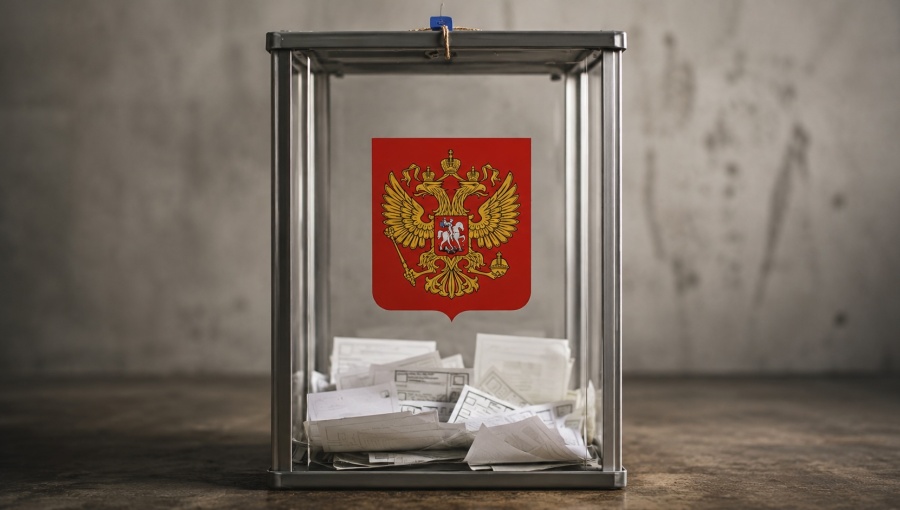
Russia goes to the polls on September 18-20 for its first State Duma elections since the full-scale invasion of Ukraine. All 450 seats in the lower house of the Federal Assembly are at stake, and the outcome — United Russia retaining its overwhelming majority — is not seriously in doubt. The real interest lies elsewhere: in what the shifting tectonic plates of Russian domestic politics reveal about the health of a regime that is simultaneously fighting a grinding war, managing a faltering economy and suppressing its own citizens' access to the internet.
The most striking development of the pre-election period is the emergence of the New People party as Russia's second most popular political force, overtaking the Communist Party — a shift that illuminates both the sources of public discontent and the Kremlin's increasingly anxious attempts to channel it and parse the electorate into the focused subsections.
Internet blackouts, rising prices and economic stagnation have created a pool of anger that someone in Russia's managed democracy had to absorb. The Kremlin's choice of vessel tells you something important about what Moscow's political managers fear.
The mood: souring, not revolutionary
Putin ended 2025 with approval ratings that remained high by international standards — around 74% in VTsIOM surveys. By spring 2026, that number had slid to 65.6%, its lowest level since the start of the war. The trigger was not the front lines or the economy alone, but something more visceral: the internet. Mobile communications blackouts during the Victory Day period, the blocking of WhatsApp and Telegram, and the clumsy rollout of a domestic replacement app called Max – basically a surveillance proxy for the FSB and everyone knows it – have infuriated ordinary Russians in a way that abstract macroeconomic data does not.
Russia's budget deficit ballooned to RUB4.6 trillion in the first quarter of 2026 — already 21% above the full-year target — as oil revenues collapsed before the Iran war's price boost. The economy is skirting stagnation. The Bank of Russia has kept interest rates sky high – currently 14.5% - to fight inflation, strangling the civilian economy. GDP growth has slowed to 1% and contracted by 0.3% in the first quarter. The war-driven boom definitively over.
Half of Russians now tell the independent Levada polling agency that the political situation is "tense," and 10% call it "critical." State pollster VTsIOM records Putin's approval at a seven-week consecutive low. None of this threatens the regime. But it shapes its choices as September approaches.
United Russia: The ruling party enters the campaign from a position of structural dominance but polling weakness. VTsIOM currently places it at around 27-34%, down sharply from its official 49.8% in the 2021 elections. As IntelliNews reported at the time, the vote was clearly fixed, but that was not enough to bring the people to the street as they did in very large numbers in 2011. Independent analysts estimating 13-16mn fraudulent votes were injected into the count. The party's real support in 2021, stripped of manipulation, was estimated at 31-35%. The trajectory since then has been downward.
The Kremlin's political managers face a dilemma. United Russia cannot campaign on the war — the September 2025 regional elections demonstrated that pro-war messaging actually depresses turnout and pushes voters toward other parties. Yet Putin's personal obsession with the conflict means the party cannot ignore it entirely. The compromise appears to be a campaign built on "development and stability" rhetoric, with plans to integrate veterans of the so-called special military operation as candidates — though the 2025 regional elections showed that war participants secured only 2.3-3.7% of mandates, far below the Kremlin's stated 10% target, according to Carnegie Endowment for International Peace.
Structurally, United Russia is a coalition of interest groups rather than an ideological party. The DumaBingo lobbying analysis project identifies clear factions representing Gazprom, Rostec, Russian Railways and regional bureaucracies, all operating within the party's formal structures. Russian Railways contractors alone donated RUB22bn rubles to the party in 2024. This heterogeneity is both the party's strength — it absorbs and manages elite interests — and its vulnerability, as internal conflicts routinely spill into regional politics. United Russia will win in September. The question is whether it will win with enough seats to maintain constitutional amendment capability.
New People: The most significant story of the 2026 election cycle is the rise of a party founded in March 2020 specifically as a Kremlin project — and which has now achieved a level of genuine popularity that its creators did not entirely intend. According to VTsIOM, New People has held second place in polls for four consecutive weeks with 13.4% support, up from 6.6% a year ago. The FOM polling agency, using face-to-face methodology, puts the figure at a more modest 6% — but even that represents dramatic growth for a party that entered the Duma in 2021 with barely 5.3% of the vote.
The mechanism of New People's rise is interesting. The party has opposed internet shutdowns and app blockings since 2022, when Russia blocked Instagram. Back then it was a niche position; now, with WhatsApp and Telegram blocked and Moscow's streets intermittently dark to mobile data like during the Victory Day parade last week, it is the central domestic political issue.
New People's ex-presidential candidate Vladislav Davankov pledged at the party's March 2026 conference that volunteers would use special backpacks to provide free Wi-Fi on the streets — a gesture that encapsulates perfectly the party's approach: channelling real discontent through theatrical opposition that never attacks the security services, never names the officials responsible, and never demands accountability.
The party is a project of Russia’s éminence grise and Yeltsin-era Prime Minister, Sergei Kiriyenko, now the deputy chief of staff of the presidential administration. He is in charge of domestic political policy and has long wanted to displace the Communist Party as Russia's second political force and replace it with something more manageable.
He appears to have succeeded. New People vote with the Kremlin 96.3% of the time in the Duma. Its opposition is performative, not structural. It belongs to the so-called “systemic opposition” which is effectively an extension of the Kremlin’s control over the Duma. But it is a performative opposition that resonates with urban, educated, internet-using Russians is exactly what the Kremlin needs to absorb discontent without allowing it to crystallise into a genuine opposition.
The party's weakness is its shallowness. Founded by Aleksei Nechayev as an extension of his Captains entrepreneurship programme, it has no real regional network, no ideology beyond vague modernising liberalism, and only a handful of recognisable names — Nechayev himself, former Yakutsk mayor Sardana Avksentyeva and Davankov. In many regional elections, its candidate lists are filled with random figures or apparatchiks who could just as easily run for United Russia. Its surge in support is real but fragile — built on a single issue. If internet restrictions ease, the surge may evaporate.
Communist Party of the Russian Federation (KPRF): The Communists enter September as a giant in decline and the weakest position they have occupied since the early 1990s. In the wild days of Yeltsin’s regime, the KPRF were a real force to be reckoned with and regularly defied the president with a large fraction in the Duma. After Russian President Vladimir Putin took over in 2000 he purged the Duma and starved of any real influence the Communist party has atrophied into a shadow of its former self. The leaders should have retired and given over control to the younger generation of more progressive members who have genuine popular appeal, doing well in regional elections when they are allowed to stand, but the old guard has clung to their cushy jobs instead and let the party stagnate.
In 2021 the KPRF officially won 18.9% and 57 seats on the party list — a result that even with significant fraud correction probably reflected genuine support of 25-27%, inflated by Alexei Navalny's Smart Voting project which directed protest voters toward the communist candidates by default as they were the only real challengers to the incumbents.
That coalition has collapsed. Navalny is dead. The urban liberal protest vote that briefly aligned with the Communists has nowhere to go. And the party's leadership — veteran leader Gennady Zyuganov, now in his 80s — gave unconditional support to the war in February 2022, alienating precisely the younger voters who had lent the party credibility.
The KPRF has opposed internet restrictions, but the position sits awkwardly alongside its pro-war, Stalinist image. In the 2025 regional elections, the party lost approximately 11 percentage points compared to 2021 results in the same areas. Its faction in Krasnodar shrunk from six city council deputies to one. The Communists failed to enter the parliaments of Vladimir and Lipetsk, and lost all seats in Magadan and Syktyvkar. Current VTsIOM polling puts the party at 8-10%. Zyuganov, Bondarenko and Grudinin still make the Levada list of most-mentioned politicians after Putin — testimony to the party's residual name recognition even as its electoral base erodes.
The Liberal Democratic Party of Russia (LDPR): the death of the party’s charismatic founder and leader Vladimir Zhirinovsky in April 2022 deprived Russia's oldest parliamentary party of the one resource it had in abundance: personality. His successor, Leonid Slutsky, is a competent operator without charisma who has responded to his inheritance by purging the party — removing notable figures Yaroslav Nilov, Vasily Vlasov and Alexei Didenko from party leadership in a series of moves that weakened the organisation's regional presence without strengthening central control. The party failed to protect prominent figures from law enforcement: former popular Khabarovsk governor Sergei Furgal was arrested in 2020, and Slutsky's response — sending a figure locals immediately dubbed "Zhirinovsky's bathhouse attendant" as replacement — surrendered whatever political capital the arrest had created.
The LDPR has experimented with anti-immigrant rhetoric ahead of September, permitted by the Kremlin as a way of pulling votes from the Communists. The tactic delivered second place in seven of eleven regional assembly votes in 2025. In national polls the party currently sits at around 10-13% — potentially ahead of the Communists in some surveys. Whether it can consolidate that position through September depends on whether Slutsky can campaign effectively or will be overshadowed by Nechayev's media machine.
A Just Russia: Twenty years of existence and four image reinventions have left Russia's social-democratic party in a state of institutional exhaustion. Setting out as a genuine liberal pseudo-institutional non-systemic opposition party, its most recent transformation — from moderately left-wing to ultra-patriotic — alienated a chunk of its regional base, including an entire faction that departed the St Petersburg Legislative Assembly rather than be associated with Yevgeny Prigozhin's imagery the late head of the Wagner PCM, which the party latched onto. Senior figures have departed or been arrested; the case of Vadim Belousov, whose company Makfa, Russia’s biggest pasta-maker and a global giant, was effectively nationalised into the orbit of the former head of the FSB, Dmitry Patrushev's associates, illustrates how exposure to power in Putin's Russia can end for those who lose their protection.
The party's ratings across all polling agencies hover near the 5% threshold needed to get into the Duma at all. Its survival in September depends substantially on the Kremlin's goodwill — whether the presidential administration chooses to allow it to cross the threshold, or permits it to fall below and lose its parliamentary presence entirely. Sergei Mironov has led the party through every iteration of its existence. The question is whether he leads it through one more.
Managed democracy, but anxious
Russia's September elections will produce a Duma dominated by United Russia and populated by compliant opposition parties. Voting will be held across three days — September 18-20 — including in occupied Ukrainian territories, where 11 new single-member constituencies have been created. Electronic voting will expand, reducing transparency. Golos, Russia's independent electoral monitoring organisation, will be systematically blocked. The result will be predetermined in its broad outlines.
What the pre-election period has revealed is a Kremlin that is managing discontent with increasing anxiety, deploying new instruments — New People, anti-immigrant rhetoric, leaked internal warnings to Putin via state media — precisely because the old ones are less reliable than they were. A United Russia that once absorbed everything now needs help. The party that once defined the system is becoming one of its components. Whether that is a sign of maturity or fragility in Russia's managed democracy is the question September will not fully answer — but will sharpen considerably.

No comments:
Post a Comment