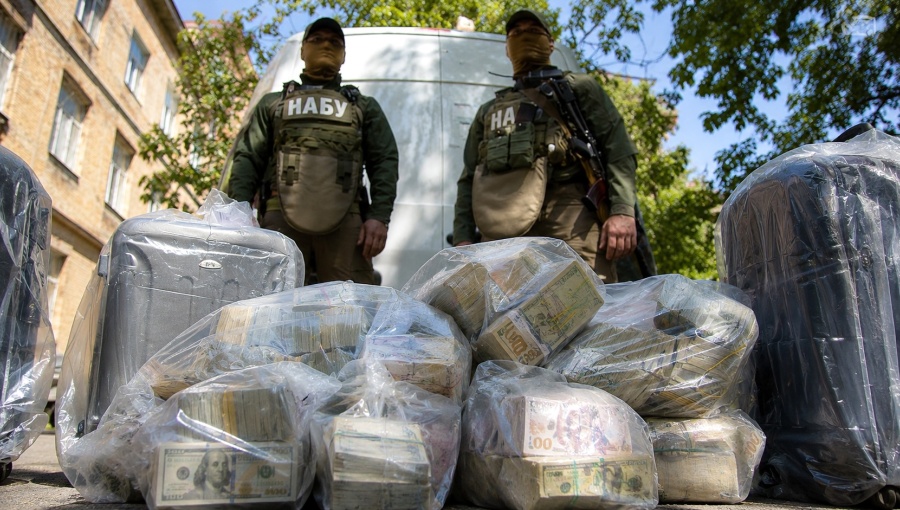
Charges brought against president Volodymyr Zelenskiy’s former chief of staff, Andriy Yermak, focus on four mansion houses in the luxury estate co-op called Dynasty. These are identified as R1, R2, R3 and R4 by the SAPO (anti-corruption prosecutor’s office) investigation which claims that the suspects laundered UAH460mn (close to €9mn) through this housing project.
The owners of the last three houses are easily identifiable from the released investigation materials - these are members of Zelenskiy’s immediate entourage, including Yermak. As for R1’s owner, the secret recordings leaked from investigators to their press suggested the person’s name is Vova, which is short for Volodymyr.
Anti-corruption prosecutors were careful to point out that the president Zelenskiy is not a subject of the ongoing investigation. But that’s only because presidents are immune from pre-trial investigations according to Ukrainian law. The impeachment procedure requires a two third majority in the parliament which Zelenskiy’s party currently controls.
For anyone focused on Ukraine, the Dynasty co-op immediately reminds of Mezhihyria, the infamous luxury estate of president Victor Yanukovych deposed by the revolutionaries in 2014. The second association is the Ozero (Lake) dacha co-op whose members, led by Vladimir Putin, turned Russia into their private corporation ruled by authoritarian means.
In a recent poll published by KIIS institute in Kyiv, Ukrainians placed corruption above the ongoing Russian aggression as the greatest threat to their country. This may sound irrational if you don’t understand to what extent corruption - Russian, Ukrainian and Western - was the main driving force behind the Russo-Ukrainian conflict.
Ukrainian foreign minister Andriy Sybiha recently said that a day of war costs Ukraine $450mn. Multiplying this figure by the number of days the war has lasted for, one gets the figure of almost $700bn burned in this furnace over four years. A lion’s share of that money was paid by Western taxpayers.
For the last three decades, the struggle against corruption was a slogan of Western liberal world order crusaders trying to impose their values on the post-Soviet space. So how come the idolised poster boy of anti-Russian resistance, Zelenskiy, appears to be mired in the same kind of corruption that keeps driving Putin’s regime in Russia to ever greater escalation? This question warrants a closer look at the history of anti-corruption struggle in the former Soviet Union.
Wild Capitalism’s Helpmate
For Western audiences, corruption in former Soviet countries is mostly perceived as a thing of the past, perhaps even Soviet legacy. But while there was plenty of petty corruption in the USSR - little bribes and gifts people were routinely handing to traffic policemen, doctors or university professors - top-level corruption was not really a Soviet story, with the exception of specific republics, like Uzbekistan. The way ageing Politburo members lived feels, by modern-day standards, ascetic.
When in the late 1980s, Boris Yeltsin attacked them for enjoying better lifestyles, he was focusing on “privileges”, such as chauffeured cars, not on luxury mansion houses or million-dollar kickbacks. He famously boarded a trolleybus to advertise new “non-corrupt” ways he was promoting. It feels ironic now that we know the extent of corruption during the years of Yeltsin’s own rule, unimaginable in Soviet times.
Corruption as we know it today was being conceived in the late 1980s at the level of district committees Komsomol (Youth Communist League), their comically crookish ways brilliantly described in Yury Polyakov’s book District-Level Emergency, popular at the time. This is the environment which produced such personalities as the future oligarch and Putin’s nemesis, Mikhail Khodorkovsky.
But it took the collapse of the Soviet system in 1991 for rampant, large-scale corruption to enter the scene - not just as a helpmate of wild capitalism, but even as a new ideology. The first pro-democracy mayor of Moscow, economist Gavriil Popov, promoted corruption as a necessary lubricant for a poorly regulated capitalist economy and called for legalising kickbacks.
The new business elite in Russia was formed out of businessmen closely connected to the government as well as organised crime. While capturing industries built by generations of Soviet people through fraudulent schemes like “loans for shares”, they were also capturing the Russian state. Despite outward adherence to democracy and universal values, their inherent instincts were predatory and authoritarian.
A good example is Pyotr Aven, minister of foreign trade in the shock therapy government of Yegor Gaidar, later one of Russia’s main oligarchs. Inspired by Reagan and Thatcher adoration club in the West, he promoted the idea of a “Russian Pinochet” - enlightened dictatorship that would resolve Russia’s economic hardships with an iron fist. After a few experiments, notably with Gen. Aleksandr Lebed, Russian reformers eventually produced what then was a suitable figure - Vladimir Putin.
Meanwhile in Ukraine, state capture was conducted by the new “red director” elite composed of former Soviet industrial managers and embodied by the country’s longest-serving president Leonid Kuchma.
Corruption vs Geopolitics
Anti-corruption activism in former Soviet countries came into being as soon as corruption itself. But it was only partly organic and locally rooted. Anti-corruption activism would soon become firmly intertwined with geopolitics.
The organic component is best represented by people like Aleksey Navalny or the presently forgotten 1990s anti-corruption crusader Yuri Boldyrev. The latter’s political trajectory is illustrative of the rift inside the anti-corruption movement.
Boldyrev emerged as a pro-democracy MP in 1990 and then a state auditor in the early days of Yeltsin’s rule. In one episode of his activities at the time, he insisted that the vice-mayor of St Petersburg, Vladimir Putin, should be suspended on suspicion of corruption pertaining to foreign trade. The request was rejected by none other than Aven.
Boldyrev went on to found the liberal Yabloko party but fell out with it in 1995 due to disagreements over the capture of Soviet industries and Russia’s vast mineral resources by oligarchs and foreign corporations. He was specifically opposed to the production sharing agreements between the Russian government and Western oil/gas giants which many thought provided outright robbery of Russian hydrocarbon resources. These disagreements sent Boldyrev on the course towards embracing Russian nationalism and eventually Putinism, despite his earlier attacks on Putin.
Western corporations benefited hugely from Russia’s rampant corruption and the flight of capital in the 1990s. But as their interests began clashing with those of the emerging Russian oligarchy, Western governments began championing anti-corruption causes in Russia, Ukraine and the rest of the former USSR.
The world’s best-known anti-corruption platform funded by Western governments and charities, Transparency International, arrived in Russia in 1999. If you look at Russia headlines around that time in Western media, business news was dominated by squabbles between the Russian governments and its Western corporate partners over the product-sharing agreements as well as the privatisation of Svyazinvest, Russia’s largest telecom holding.
In both cases, Putin’s new government sought to limit Western appetites or kick Western actors out of the scramble for Russian resources altogether. In the early 2000s, the emerging confrontation gradually switched to rival Russian- and Western-backed projects for supplying gas and oil into Europe. This is how the conflict turned geopolitical. Russia wanted to supply its gas to the newly-expanded EU, bypassing transit countries, especially Ukraine. Western corporations were pushing pipeline projects like Nabucco that were aimed at bypassing the Russian pipeline system and delivering directly from countries like Azerbaijan and Turkmenistan.
This is the point when anti-corruption activism and geopolitics grew inseparable, with the former being increasingly weaponised by Western actors against Russia. The anti-corruption agenda dominated the Georgian Revolution of Roses in 2003 and Ukraine’s first Maidan revolution in 2004. But while in Georgia, Mikheil Saakashvili’s new government did achieve a breakthrough in eliminating corruption – he sacked the entire traffic cop force and replaced it with student-hires - the Ukrainian revolution changed exactly nothing in that respect.
With geopolitics dictating the agenda and anti-corruption groups becoming overwhelmingly dependent on Western funding, the struggle against corruption became increasingly selective. Anti-corruption initiatives blasted Russian and perceived “pro-Russian” actors in former Soviet republics while turning a blind eye on shady oligarchs and outright mafiosi who were chummy with the West.
The anti-corruption struggle was so badly mired in geopolitics that by the time Navalny launched his FSK anti-corruption movement, he tried his best to avoid being seen as a Western pawn. He flirted with Russian nationalism and initially even avoided contacts with Western media. The movement he built was genuinely grassroots and organic. But the cause was already so strongly aligned with Western geopolitical interests that it was easy for the Kremlin to brand its flag-bearers as agents of the West.
The escalating conflict with the West gave Putin carte blanche to destroy Navalny’s movement and eventually kill its leader. It allowed him to consolidate the regime and outsource his domestic conflict to the neighbouring country, making him an all-round beneficiary of the continuing war.
Meanwhile, the simplistic dichotomy of corrupt Russia vs non-corrupt West, promoted by Western media, just didn’t square with people’s lived experience. Petty post-Soviet corruption which people encountered in their daily lives was largely eliminated during Putin’s years though digitalised and otherwise improved government services.
Corruption which Navalny opposed had long drifted to the highest echelons of power. It seemed grotesque by Western standards, but was it fundamentally different from the West's own corruption and what role did the West play in it becoming such a dominant phenomenon? While Western media kept drawing a primitive black and white picture, the reality felt like many shades of grey.
Corruption Export
The conflict over Ukraine exposed both the danger of unrestrained corruption on the one hand and the counter-productivity of anti-corruption activism with visible geopolitical strings attached on the other. The anti-corruption agenda was dominant at the beginning of the Euromaidan revolution, but it was soon overtaken by the geopolitical agenda of mafia state actors that were at least as corrupt as the previous regime, only more aggressive and backed by far-right thugs linked to security agencies.
Ukrainian political scientist Mikhail Minakov calls Euromaidan “a revolutionary attempt” which has never evolved into a genuine revolution, as in achieving a fundamental change of the system. The only thing that did change is the country’s geopolitical orientation.
Not only did the Western governments turn a blind eye on the aggressive redistribution of assets in the aftermath of the revolution, but they also embarked on exporting Western political corruption into Ukraine. US president’s son Hunter Biden offered his name and service to launder the reputation of Mykola Zlochevsky, a rich businessman who served as a minister in the government of the deposed president Yanukovych. President Joe Biden later forced through the resignation of Ukraine’s prosecutor-general to cover up this affair.
Biden’s arch-rival, Donald Trump, weaponised this scandal in the presidential elections of 2020, liaising with shady Ukrainian business figures and attempting to coerce the newly elected president Zelenskiy into joining the smear campaign.
That pressure may have played a significant role in Zelenskiy's abrupt U-turn on peace negotiations with Russia at the start of 2021 which coincided with Biden moving into the White House. Having reached a de-facto ceasefire by the time, Zelenskiy suddenly embarked on the Biden administration’s agenda of crossing all of Putin’s red lines - an ill-fated policy that precipitated Russia’s devastating all-out invasion of Ukraine.
That pattern of Western corruption export persists today, four years into the hot phase of the Russo-Ukrainian war. Just look at the other episode in the ongoing investigation of the Zelenskiy entourage. It focuses on the Ukrainian missile producer Fire Point which, as Ukrainian media allege, is linked to Zelenskiy’s key business associate Tymur Mindich. Guess who sits on its board? Former US State Secretary and CIA chief Mike Pompeo. Fire Point also enjoys a special relationship with the Danish government and runs a joint venture in Denmark.
Some commentators are trying to frame the current anti-corruption investigation almost as a triumph of anti-corruption forces in Ukraine. The investigation is being conducted by agencies created on the insistence of Western governments and with their direct involvement. But it’s hard not to notice the highly politicised nature of this affair, with charges and evidence in the form of taped conversations being presented in a strategic manner, with over-the-top dramatic effects aimed at discrediting top level suspects (like emphasising Yermak’s penchant for witchcraft) and leaked through opposition media and MPs.
Will it result in reducing corruption in Ukraine? The country’s post-Maidan history suggests it won’t. Does it serve as a means for achieving specific geopolitical outcomes? You bet.
INTERVIEW
A test for Ukraine, a dilemma for Zelensky: What's at stake in the Andriy Yermak corruption probe
The arrest of Ukraine President Volodymyr Zelensky’s former right-hand man Andriy Yermak Thursday in connection to a corruption scandal comes as a major test for both the Ukrainian government and the country's independent anti-corruption agencies. Yermak is accused of laundering 460 million hryvnia (more than $10 million) in dirty money through an elite real estate project outside of Kyiv – and of having used a secret phone to consult an astrologer on key government appointments.
Issued on: 15/05/2026 - FRANCE24

You’d think the fortune teller would have tipped him off. Ukrainian President Volodymyr Zelensky’s former chief of staff Andriy Yermak, who for years made key government appointments, drafted potential peace plans and held back-channel talks with both Washington and Moscow, was taken into pre-trial detention Thursday on money-laundering charges after a three-day hearing in Kyiv.
The 54-year-old lawyer and former film producer stands accused of being involved in laundering more than $10 million in embezzled funds through the construction of lavish private mansions in the village of Kozyn on the capital’s southern outskirts.
The court has set Yermak’s bail at $3.2 million, which he says he doesn’t have. He told reporters outside the court that his lawyer would work with his friends to scrape the funds together.
During the hearing, prosecutors also alleged that Yermak had kept a secret phone that he used to regularly contact a Kyiv-based astrologer known as “Veronika Feng Shui” – identified as 51-year-old Veronika Anikiyevich – to advise him on government appointments. Yermak allegedly shared candidates’ birth dates with the astrologer, who would in turn tell Ukraine’s second-most powerful man whose appointment the stars most favoured.

Yermak resigned last November after his offices were raided as part of a months-long investigation into a $100 million corruption scandal in the country’s energy sector.
The anti-corruption operation – dubbed “Midas” – accused Zelensky’s former business partner Tymur Mindich of leading a scheme to siphon off tens of millions of dollars in kickbacks from the country’s state-owned nuclear energy giant Energoatom.
The scandal, coming as Russia continued to hammer Ukraine’s energy infrastructure to starve the nation of heat and light, was met with public fury. An attempt by Zelensky last July to put Ukraine’s anti-corruption agencies under the control of a presidential appointee was abandoned following rare wartime protests.
Mindich, who like Yermak maintains his innocence, reportedly fled to Israel last year ahead of a raid on his house. Former deputy prime minister Oleksiy Chernyshov and former energy minister German Galushchenko have both been detained in connection to the probe.
Ukraine’s National Anti-Corruption Bureau (NABU) and the Specialised Anti-Corruption Prosecutor’s Office (SAPU) have said that Zelensky himself is not under suspicion.
But the mention of a “Vova” – a common diminutive of Volodymyr – in a leaked wiretap transcript of a conversation between Mindich and an unidentified woman about the Kozyn construction project has raised questions about just how deep into the president’s circle the corruption has spread. Sitting presidents are immune from prosecution by Ukrainian law enforcement – though they can be impeached if evidence of wrongdoing is found.
To better understand the significance of this sweeping investigation, FRANCE 24 spoke with Andrii Biletskyi, the administrative director of the National University of Kyiv-Mohyla Academy’s Anti-Corruption Research and Education Centre.
FRANCE 24: Just how significant is this latest development in the corruption investigation?
This is the continuation of the “Midas” operation that started last year, and which was one of the reasons why Yermak was fired from the presidential office. And we have different camps, to be honest, because some people were saying that Yermak was on these Midas recordings, and some people were saying to be careful, that he wasn’t there, it was impossible.
There are different views on this Midas operation, because some people are more sceptical about it – they are saying that this is just a political battle during the war. And some people see it as a positive thing, because it means nobody is untouchable and the anti-corruption authorities are doing their work.
Ukraine: Volodymyr Zelensy's former top aide arrested as corruption probe widens

01:13
I think it's a test not only for anti-corruption authorities in Ukraine, but also for the government and the country in general. Because the Ukrainian law enforcement system has never seen an official or ex-official of such a high level being prosecuted or being brought to criminal responsibility.
So, it's really a test for anti-corruption authorities to finish this task, or at least to bring this case to court. And for the Ukrainian government, it's a test whether to help Yermak to escape the responsibility – whether or not to interfere or to let the case go and be whatever it's going to be.
But it's really a dilemma for them, because the government needs to understand whether they want to lose their ex-friend, or current friend, Andriy Yermak, and just forget about him. It's really a struggle for them.
But for Ukraine in general, this is a huge case, and we've never seen anything like it.
FRANCE 24: With several close allies of Zelensky under suspicion, what impact is this investigation likely to have on the president’s own support?
Politically speaking, if we're talking about his personal ratings, he is going to be losing support. Not a lot, because he didn't interfere, he didn't comment on the situation, he didn't protect his close ally, or ex-ally. So it’s a manageable situation.
On the other hand, people still rate him because he's a war-time leader, and he is protecting us, he's the higher commander-in-chief, right? So it’s bit into his ratings, but not as much as it could have, for example, in normal times. Because if not for the war, if we had seen such a scandal, it would have been political suicide for him, and we would just be waiting for the opposition to come to power.

FRANCE 24: As someone who’s worked for years in the fight against corruption, how do you see the importance of Ukraine’s anti-corruption authorities being able to undertake an investigation of this magnitude?
For me personally, it's a positive sign. We as Ukrainians, and my colleagues from the anti-corruption centre, we have to talk a lot about how Ukraine is not really corrupt – we have a lot of corruption cases not because we have a lot of corruption, but rather because we have this system in place which can expose this corruption, and which can bring people to responsibility. Because of the fact that we have an independent system, which is not interfered with by political actors, they can do their job properly in a normal way, and they can expose a lot of corruption.
Of course it is [easier] not seeing corruption and not caring about it. When we don't have a lot of corruption scandals in the media, we don't know about them, and we simply don't care. We think of ourselves as good guys, and we think, okay, corruption is at a low level – if it's not being exposed, we have no problem with that.
So it’s really positive. Probably you remember that last year in July, we had huge protests in Ukraine during wartime because the government tried to neglect the procedural independence of the anti-corruption authorities. And a lot of people, a lot of young people, actually came to protest against this decision – and they won, because the government rolled it back.
And it was important for people to see that they did the right thing, so that they could see that they fought for the independence of something valuable. And by this investigation, NABU and SAPO are showing those people that it was the right call.
FRANCE 24: One of the more unexpected details of this three-day hearing has been the allegation that Yermak ran potential government appointments past an astrologer. What kind of reaction has that sparked?
Of course it was quite a surprise to hear that the chief of staff, the head of the presidential office, was consulting an astrologer for governmental appointments. It was really a surprise – I mean, it was ridiculous to hear that he was sending the birthdates of potential candidates.
It not only affects the reputation of Andriy Yermak himself, because he was already seen as this “shadow cardinal” in the office of the president, but it also brings a shadow on the presidential office in general, and the governmental system in general.
Because people have to know whether all the appointments have been going this way or not. It’s also that a bad thing for the public service in general. It was really ridiculous to hear.
This interview has been lightly edited for length and clarity.

No comments:
Post a Comment