Wednesday, July 05, 2023

TORIES LIE

UK
Leaked memo sets out ‘huge challenge’ to meet £11.6bn climate pledge


David Hughes, PA Political Editor
Wed, July 5, 2023 


Rishi Sunak’s promise to meet an £11.6 billion climate and nature pledge looks set be missed, according to a leaked internal memo.

The briefing note to ministers sets out that the international funding commitment would be a “huge challenge” and require backing for other aid projects to be slashed.

The Government insisted it is delivering on the pledge and said suggestions the commitment could be dropped are “false”.

The memo, obtained by the Guardian, says the commitment to provide £11.6 billion between April 2021 and March 2026 was made at a time when the Government was meeting its legally-enshrined target of spending 0.7% of national income on overseas aid.

That commitment was dropped to 0.5% as a result of the impact of Covid-19 on the nation’s finances.

The leaked document said meeting the climate pledge within this spending “would squeeze out room for other commitments such as humanitarian and women and girls”.

The promise was made by Boris Johnson in 2019 but the BBC reported the memo pointed to “subsequent turbulence” in the economy – such as the pandemic – which had “turned a stretching target into a huge challenge”.

Meeting it would require a “reorientation” of the budget on a scale which “has not previously been achieved”.

Ministers including Rishi Sunak have publicly declared the £11.6 billion commitment remains in place.

A Government spokesman said: “Claims that the international climate finance pledge is being dropped are false.


“As the Prime Minister set out at Cop27, the Government remains committed to spending £11.6 billion on international climate finance and we are delivering on that pledge.

“We spent over £1.4 billion on international climate finance over the course of the 2021/22 financial year, supporting developing countries to reduce poverty and respond to the causes and impacts of climate change.

“We will publish the latest annual figures in due course.”

Lord Goldsmith, who raised the issue when he resigned as a minister last week, said failing to meet the promise would be seen as a “betrayal” around the world.

“The PM is insisting he isn’t breaking his promise,” the peer said. “The figures show he is.”

He said the only way the commitment could be met is if the next government, in its first years in office, allocates “over 80% of all UK bilateral aid” to climate funding, at the expense of humanitarian, health and education schemes “which obviously it cannot do”.

“There will be some who welcome this,” Lord Goldsmith said.

“But they should consider the impact on the UK of breaking a promise that Commonwealth allies and countless others prize above all others.

“It will be seen as an act of betrayal on a profound level and will cause us irreparable reputational harm.”

Senior Tory Sir Alok Sharma, president of the Cop26 climate summit, warned against dropping the pledge.

“So hope the government is not planning to drop its climate finance pledge to some of the most climate vulnerable countries in the world,” he said on Twitter.

When Mr Johnson announced the commitment there was “spontaneous applause” and “it was a proud moment for the UK”, Sir Alok said.

Memo reveals pressure on UK climate finance pledge


Justin Rowlatt - climate editor, BBC News
Wed, July 5, 2023 

Prime Minister Rishi Sunak addressing delegates at last year's COP27 in Egypt after initially saying he would not attend the event

The government looks set to break its flagship £11.6bn climate and nature funding pledge for developing countries, an internal government document seen by the BBC says.

The document details how the government has consistently underspent and would now struggle to meet its 2026 target.

Some 83% of the total overseas aid budget would need to be reallocated to climate to catch up, it adds.

The government says it will honour promises made on climate finance.

"The government remains committed to spending £11.6bn on international climate finance and we are delivering on that pledge," a government spokesperson said.

Former Prime Minister Boris Johnson pledged in 2019 to double the amount spent on the UK's international climate finance (ICF) - aid for vulnerable nations to deal with the causes of climate change - to at least £11.6bn between 2021/22 and 2025/26.

But the document says "subsequent turbulence" - referring to economic shocks such as the Covid pandemic - "has turned a stretching target into a huge challenge".

Overall international aid spending has also since been cut to 0.5% of GDP, down from 0.7%.

Civil servants have calculated the government is now so behind on its spending promises it would have to spend 83% of the total foreign aid budget on climate to meet the ICF target by 2026.

That would require a "reorientation" of the budget on a scale which has "not previously been achieved", they say.

Doing so would also mean that there would be no cash left for other priorities such as projects "specifically targeted at helping women and girls", civil servants write.

World's hottest day since records began


A really simple guide to climate change


What does net zero mean?

The revelations follows Tory peer Lord Zac Goldsmith's resignation from Rishi Sunak's government last week over what he described as the prime minister's "apathy" towards climate change.

Lord Goldsmith has told the BBC that in his view, the low levels of expenditure so far combined with the decision to define our spending on Afghan and Ukrainian refugees here in the UK - something he says other countries have not done - means "it is going to be virtually impossible to honour the promise."

"Whoever is in government after the next election", he said, "would have to savagely slash humanitarian, education, health and other funding in order to hit the £11.6bn target."

Lord Goldsmith said he was worried that small island states in particular "will be left feeling utterly betrayed" and said the UK's reputation as a "reliable partner" will "simply be shredded".

That is a view that is echoed by many in the overseas aid community.

"Frankly it is embarrassing", a director of one UK aid agency told the BBC. "The cuts make it supremely difficult to credibly state the UK remains a climate change thought leader."

"There used to a be a huge amount of goodwill across Africa for the UK", he continued. "We were seen as the best in the sector, engaged and effective. This is no longer the case. The UK is now seen as an unreliable partner."

Mr Sunak insisted Lord Goldsmith had quit after being asked to apologise for comments he made about the Privileges Committee inquiry over the conduct of Boris Johnson and whether he had intentionally misled the House of Commons as PM.

But Lord Goldsmith denied this, instead saying his decision to step down had been a "long time coming".

The ICF refers to UK aid given to support vulnerable countries to deal with the causes of climate change, including preventing deforestation and reducing carbon emissions, as well as preparing for its effects.

It forms a part of the global commitment to spend $100bn a year on climate finance for developing countries.
UK

The Tories know the game is up – and mass migration proves it


Opinion
Sherelle Jacobs
THE TELEGRAPH
Mon, July 3, 2023 

Rishi Sunak onboard Border Agency cutter HMC Seeker during a visit to Dover

The end of political reigns – when they finally come – tend to be remorselessly uncomplicated. John Major failed to craft Thatcherism with a human face. New Labour was exposed as a vacuous, even sinister, movement based on lies and spin. And now the Tories are set to be booted out ultimately because they have betrayed the country on immigration.

The Conservatives know in their bones that it is over. No 10 has been keen to play down the implosion of its plan to send illegal immigrants to Rwanda. The argument goes that the Court of Appeal ruled against the Government’s policy last week on a mere detail about Rwanda’s immigrant processing standards; with a bit of diplomatic fudge from Kigali, it is claimed, the Supreme Court could be adequately reassured to overturn the ruling in Downing Street’s favour.

This smacks of delusion. No doubt, the president of the Supreme Court, Lord Reed – who is said to be more sensitive to claims of “judicial overreach” than his predecessor, Lady Hale – will give the Government a fair hearing. But countering the judgment that Rwanda is not a safe third country will be no easy task.

And even if the Government does win at the Supreme Court, it will come much too late. After 13 years in power, the Tories need to go into the next election with not merely a colourful plan for tackling the small boats, but a demonstrable record of doing so. One might challenge whether a proposal that, in its pilot phase at least, would have seen just 0.03pc of Channel crossers sent to Central Africa was ever a serious deterrent plan. Still the party’s last hope – of building the kind of populist momentum that voters might think twice about jeopardising with a change of administration – was, as far as politics goes, a reasonably coherent one. This hope has now been vanquished. The Rwanda policy is dead – and with it any pretence of a Tory plan for getting control of the country’s borders.


It is a similar story with legal migration. The Conservatives came to power in 2010 promising to bring net migration down to the tens of thousands. With the figure now over 600,000 a year, the scale of its failure is so preposterous as to verge on parody.

True, Boris Johnson did try to edge away from the vow, pledging instead to get a grip on migration by erecting a strict Australian-style points system. But the post-Brexit regime is a self-contradicting shambles. Higher processing fees are counteracted by low salary thresholds for visa sponsorship. Loopholes in the student visa programmes created a backdoor for the effective continuation of low to mid-skilled mass migration.

Retail giants have been thrilled to find that they are essentially free to import as many South Asian software developers to run their vast new warehouses as they like. Meanwhile, the Home Office’s flagship “Global Talent” visa scheme to fast-track the applications of world-leading scientists has been an embarrassing flop, receiving next to no applications amid uncertainty over science funding.

Some on the Right might charitably commend backbench calls this week for the Government to cut net migration by two thirds as a heroic last-ditch effort to avoid political carnage. But these are the panicked spasms of a party in its death throes. Tory MPs know full well that such a move, in the short term at least, would risk crashing the economy as well as the social care system and the NHS. They are in utter denial that the party missed its chance to reduce immigration in a steady, sustainable fashion. And now it’s game over.

Within the Westminster bubble, one hears all too often the fatalistic argument that the problems of the Channel crossings and mass immigration were always too intractable to solve. That might make MPs feel better about their failure, but it is simply not true. With the right attitude, the Tories could have fixed both. But they failed to grasp, upon coming to power, that their role was not merely to “clear up New Labour’s mess”. It was to address what has become nothing short of a civilisational challenge in the West: the implosion of an entire model of economic and political governance.

After the financial crisis, the consensus that wealthy countries could continue to grow, financing expansive public services with a consumption-based economic model fuelled by cheap credit and cheap labour, came crashing down. The Syrian civil war, meanwhile, exposed the fact that the whole global refugee system is defunct. More people are eligible to claim asylum in Western countries in line with international human rights law than such nations will ever realistically be willing or able to take.

Brexit was meant to be the great wake-up call that, in Britain, the status quo is not just economically terminal but politically unsustainable.

The Tories could have risen to this challenge. They could have done a serious deal with France some time ago to help nip the small boats issue in the bud. Paris mandarins have been sidemouthing for years that, with France processing twice as many asylum seekers as the UK, Emmanuel Macron would only be willing to step up on illegal boats if the UK agreed to take a larger share through legal channels. The Tories have had plenty of opportunity to bite the bullet and strike such a deal, making it more politically palatable with a robust plan to reduce the country’s dependence on economic migrants over time.

And contrary to widespread defeatism, they could have weaned the UK economy off its reliance on mass migration as well. They just decided that it was too hard and too expensive. Training more doctors and nurses and improved retention through reform of the NHS comes to mind; as does adapting Britain’s obsolete apprenticeship programme to one that befits a burgeoning services superpower. Eight years after David Cameron’s pledge to end the welfare “merry-go-round”, the Tories have had ample chance to tackle two of the biggest obstacles to getting millions of people off benefits and into work: the wreck of the social care system and an over-regulated, unaffordable childcare sector.

Instead, bewitched by the Blairite playbook, the Conservatives convinced themselves that their great task was not to reform a broken system but simply to manage it with a vague air of competence that they could continue to dominate the centre ground. Its leaders arrogantly gambled that the party could neglect the immigration quandary, instead riding on its reputation as the party of sound money. They called it wrong and they have gone bust. And many will think: good riddance.


Teachers in England on picket lines as strikes cause more school disruption


Eleanor Busby and Jacob Phillips
Wed, July 5, 2023

Teachers in England were back on picket lines on Wednesday as they staged another strike in a long-running dispute over pay.

Many schools are expected to either fully close or restrict access to pupils as a result of the walkouts by teacher members of the National Education Union (NEU), with another strike planned on Friday.

There are fears that pupils could miss out on end-of-year activities – including concerts, trips, sports days and opportunities to meet new classmates – during the strikes at schools and sixth-form colleges this week.

It is the seventh day individual schools in England have faced walkouts by NEU members since February.

Union leaders have warned that schools could face co-ordinated strike action by education unions in the autumn term if a deal over pay cannot be reached.

Speaking from a picket line outside Regent High School in north-west London, NEU general secretary-elect Daniel Kebede said teachers are taking up second jobs amid the cost-of-living crisis.

He told the PA news agency: “I’m certain (if other) education unions would like strike ballots in the autumn term there will be co-ordinated action.”

The NEU – alongside the NASUWT teaching union, the NAHT school leaders’ union and the Association of School and College Leaders (ASCL) – are balloting their members in England to take action in the new school year.

The Government offered teachers a £1,000 one-off payment for the current school year (2022/23) and an average 4.5% rise for staff next year after intensive talks with the education unions in March this year.

But all four education unions involved in the dispute rejected the offer and the decision on teachers’ pay in England for next year has been passed to the independent School Teachers’ Review Body (STRB).

Education union leaders have called on Education Secretary Gillian Keegan to urgently publish the STRB’s recommendation as they warned the hold-up is causing “anxiety” in schools and “frustrating headteachers”.


(PA Graphics)

Mr Kebede told PA: “Teachers are taking up second jobs to pay the mortgage, pay rent and to meet the cost of living. A friend was in an Uber yesterday and their Uber driver was a full-time teacher and a part-time Uber driver.

“The fact is teaching is not providing a decent standard of living anymore. We have a crisis in recruitment retention, we have schools struggling to retain teachers and recruit new teachers. We now have a million children taught in classes of over 31.”

Picket lines were mounted outside schools and sixth-form colleges across England on Wednesday morning, and a number of rallies are due to be held.

Striking teachers will march in Westminster in London before taking part in a rally in Parliament Square.

A poll by Teacher Tapp, of 6,952 teachers in England on June 19, found that only a third said there were no transition days, trips, sports days, concerts or performances, or work experience placements scheduled for the strike dates.

A picket line at Grestone Academy in Birmingham (Jacob King/PA)

Mary Bousted, joint general secretary of the NEU, said: “Teachers do not want to strike. They want to be doing what they do best – teaching and supporting their pupils.

“We regret the disruption caused to education by our strikes and we support the rearrangement of transition days where possible – as some local authorities such as Birmingham, Coventry and Warwickshire have confirmed.

“We grant exemptions to members involved in school trips that cannot be rearranged.

“However, the disruption to children and young people’s education occurs daily due to the running down of our education service by Government. This cannot go on.”

Members of the NEU went on strike across England on February 1, March 15 and 16, April 27 and May 2.

Regional walkouts by NEU members also took place between February 28 and March 2, where any individual school took one day of strike action across the three-day period.

During the most recent national strike action on May 2, Department for Education (DfE) data suggests that 50% of state schools in England were open but restricting attendance and 5% were fully closed.

Geoff Barton, general secretary of ASCL, said: “This week’s strikes are a problem of the Government’s making through its neglect of education and refusal to resume formal negotiations with unions.

“Unless the Government changes its approach then there will likely be further strikes in the autumn term.”

A DfE spokesperson said: “Any strike action is hugely damaging. We have made a fair and reasonable pay offer to teachers, recognising their incredible work and commitment.

“Thousands of schools received significant additional funding as part of the extra £2 billion of investment we are providing both this year and next.

“As a result, school funding will be at its highest level in history next year, as measured by the IFS (Institute for Fiscal Studies).”

NS Power plans to produce electricity with fuel oil until 2050 instead of with coal
FUEL/BUNKER OIL IS AS BAD AS COAL

The Canadian Press
Tue, July 4, 2023 


HALIFAX — Nova Scotia's power utility plans to convert a coal-burning electricity station in Cape Breton to burn heavy fuel oil once federal regulations phase out coal entirely in 2030.

The proposal has raised the eyebrows of one utility review board member and was characterized as “disturbing” by a climate policy expert.

Documents filed by Nova Scotia Power show that three of four coal-fired units at the Lingan Generating Station will be converted to heavy fuel oil in 2030 and are scheduled to operate until 2050.

“I have to say, I was a bit surprised,” Nova Scotia Utility and Review Board member Jennifer Nicholson said at a recent hearing. “It doesn’t really seem a lot cleaner.”


David Pickles, chief operating officer of the privately owned utility, responded to Nicholson by explaining that the company is required by federal regulation to stop burning coal by 2030.

In 2016, the federal government announced coal would be entirely phased out by 2030, a move estimated to reduce greenhouse-gas emissions by nearly 100 million tonnes over the following two decades.

Pickles told the hearing that it would be less expensive to produce electricity with oil than to replace its coal-burning generating station, as the Cape Breton station already has the capacity to run on oil. The emissions from coal and heavy fuel oil were comparable, he added, but the facility has “a really low utilization rate” and is usually only used to generate reserve electricity during the coldest days of winter.

Thomas Arnason McNeil, a climate policy co-ordinator with Halifax-based Ecology Action Centre, says the privately owned energy utility is “getting around'' coal restrictions by using a fossil fuel with comparable emission levels.

“It’s absolutely outrageous,” he said in an interview. “It would be laughable if it wasn’t so dire, I think, and disturbing, quite frankly.”


Nova Scotia plans to generate 80 per cent of its energy from renewable resources by 2030.

Preparing for “peak” energy usage during cold winter months requires “dispatchable power,” Arnason McNeil said, which can be achieved by storing energy generated from renewable resources on large-scale batteries.

“Why instead, are they choosing to take the money of ratepayers and spend it on expensive, polluting technologies?” he said. “It just represents a total lack of imagination, a total lack of ambition.”

Jacqueline Foster, a spokesperson for Nova Scotia Power, said in an email Tuesday that the electric utility is committed to helping the government reach the goal of having 80 per cent of the province's energy by 2030 come from renewables. Emissions from heavy fuel oil would be low and not impact the province's targets — which have been enshrined into law — because the Lingan coal-fired units would only be used in "limited situations."

"We know it will take a mix of energy solutions, including wind and solar, battery storage, and other generation sources to get there," she said about the province's energy goals. "The potential fuel conversion of three units at Lingan is just one small piece of the puzzle."

This report by The Canadian Press was first published July 4, 2023.

---

This story was produced with the financial assistance of the Meta and Canadian Press News Fellowship.

Marlo Glass, The Canadian Press

https://en.wikipedia.org/wiki/Fuel_oil

Fuel oil is any of various fractions obtained from the distillation of petroleum (crude oil). Such oils include distillates (the lighter fractions) and ...

https://www.ncbi.nlm.nih.gov/books/NBK531265

Fuel oil No. 1 is a light distillate intended for use in burners of the vaporizing type in which the oil is converted to a vapour by contact with a heated ...

https://www.forbes.com/sites/nishandegnarain/2020/08/14/what-is-heavy-fuel-oil-and-why-is-it-so-controversial-five-killer-facts

Aug 14, 2020 ... Heavy Fuel Oil is highly concentrated in sulfur (35,000 parts per million). This means global shipping accounts for 8% of global emissions of ...

https://en.wikipedia.org/wiki/Heavy_fuel_oil

Heavy fuel oil (HFO) is a category of fuel oils of a tar-like consistency. Also known as bunker fuel, or residual fuel oil, HFO is the result or remnant ...

https://www.sciencedirect.com/topics/earth-and-planetary-sciences/bunker-fuel

Bunker C: Bunker fuel is the colloquial term for fuel oil used by marine vessels. Bunker fuels A, B, and C are respectively downgrading ...


Researching changing tornado patterns in Canada

CBC News: The National

 Jun 30, 2023 #tornado #cbcnews #canadaTornadoes have not only become more common in Canada, but they’re also happening in different places. CBC’s Thomas Daigle hit the road with researchers trying to determine what’s causing the changes.


Alberta weekend tornado that damaged, destroyed homes rated rare, violent twister

The Canadian Press
Tue, July 4, 2023 


EDMONTON — A preliminary report on a weekend tornado in central Alberta says its winds were so violent they picked up a 10-tonne farm combine and tossed it half the length of a football field.

"(The combine) then rolled for another 50 to 100 metres after that," said the report, issued Tuesday by the Northern Tornadoes Project.

The report follows up on ground and drone surveys on the tornado that ripped through the rural area between the towns of Carstairs and Didsbury on Saturday.

Researchers rated the twister as a four on the Enhanced Fujita, or EF, scale of wind-damage intensity, one short of the maximum rating of five.

The storm destroyed three homes and damaged seven more, downed power lines, killed livestock, shredded trees and damaged vehicles.

The report said there was one injury — a cut to a first responder.

The estimated maximum wind speed was 275 kilometres per hour along a 15-kilometre path that stretched as wide as 620 metres.

It was the fiercest tornado to hit Alberta since the infamous “Black Friday” F4 storm in 1987, which killed 27 people and destroyed hundreds of homes in Edmonton.

And it’s the second EF4 storm to hit Canada since it adopted the EF damage scale a decade ago.

The first EF4 struck Alonsa, Man., in 2018, killing one person while destroying houses, farms and cabins.

“The Didsbury EF4 tornado enters some rarefied territory among Canadian tornado events,” said the report.

“Though this was a climatologically significant tornado, it thankfully won't enter the list of Canada's top 10 'worst' tornadoes due to the single minor injury and limited property damage.”

Northern Tornadoes Project, affiliated with Western University in London, Ont., completed the report with Environment and Climate Change Canada and the Arctic Storm Prediction Centre.

Area resident Elisa Humphreys recounted how she managed to flee just before the twister levelled her home and another building on her property.

Scores of volunteers showed up the next day with gift cards and helped find mementoes in the wreckage.

Environment and Climate Change Canada said Alberta typically sees 15 tornadoes per year, based on data collected between 1980 and 2009.

So far this year, the province has had up to 13.

This report by The Canadian Press was first published July 4, 2023.

Dean Bennett, The Canadian Press


A tornadic storm that hit Saskatoon is one of Sask.'s worst weather events

Randi Mann
Tue, July 4, 2023


This Day In Weather History is a daily podcast by Chris Mei from The Weather Network, featuring stories about people, communities and events and how weather impacted them.

--

On Thursday, July 4, 1996, aggressive thunderstorms hit Saskatoon, Sask. The storms produced several tornadoes. These Saskatoon thunderstorms are considered one of Saskatchewan's worst weather events.

At 4:50 p.m., thunderstorms started to develop just south-southwest of North Battleford. The storm cluster moved east and formed a supercell. The storm organized into a “hook echo” formation, which is a supercell that appears as hook-shaped on weather radar.


Courtesy CTV Saskatoon - lightning

At 5:45 p.m., the storm produced an F2 tornado. which is referred to as the “Maymont, Sask. F2 tornado." The tornado travelled for 13.6 km with a maximum width of 100 metres.

At 6:04 p.m., a hook formation produced an F3 tornado in Fielding, Sask., near the Yellowhead Highway.


*Courtesy of CTV Saskatoon - tornado

At 7:00 p.m., the hook was still active just north of Saskatoon. The storm produced around 11 tornadoes. Three of those tornadoes had a track longer than 10 km.

Overall, “severe thunderstorms on July 4 spawned at least eight tornadoes in Saskatchewan. Winds of 140 km/h and hail the size of golf balls produced $15 million in property damage,” reported by Environment and Climate Change Canada.

A Regina tornado on June 30, 1912, is considered Saskatchewan's worst weather event. The tornado is the deadliest twister in Canadian history. A total of 28 people died and hundreds were injured. It flattened homes and businesses, leaving 2,500 homeless.

The Regina tornado was featured on postcards and memorabilia in 1912.


sab gm r-a26933 wb
"View of Lorne Street, following the cyclone; two dogs can be seen on the road, as well as two unidentified women walking. (Postcard.)" Courtesy of Provincial Archives of Saskatchewan

To learn more about the July 4 Saskatoon tornado, listen to today's episode of "This Day In Weather History."

Subscribe to 'This Day in Weather History': Apple Podcasts | Amazon Alexa | Google Assistant | Spotify | Google Podcasts | iHeartRadio | Overcast'

Thumbnail: Courtesy of CTV Saskatoon
More than 900 Ryanair flights cancelled in June amid French strike action

Holly Williams, PA Business Editor
Tue, July 4, 2023 


About 160,000 passengers were impacted after Ryanair cancelled more than 900 flights last month amid disruption from air traffic control strikes across France, the low cost carrier has said.

French air traffic controllers staged a series of strikes last month, with the latest – a 34-hour walkout ending on June 30 – marking their 60th day of strike action this year.

The Dublin-based airline was among the most heavily impacted by the industrial action, with flights cancelled across a number of airports and other routes also disrupted by aircraft or crew in the wrong locations.

It said it operated more than 96,250 flights last month but that “regrettably” more than 900 flights were cancelled, “mainly due to ATC (air traffic control) strikes”.

The last French strikes in June were in response to President Emmanuel Macron’s plan to raise the country’s pension age from 62 to 64 and come as part of industrial action across a raft of sectors that has crippled the country since the start of the year.

The former boss of British Airways, Willie Walsh, recently called for a change in the rules to allow flights over France during air traffic control strikes.

He said their action was threatening to wreak havoc for British holidaymakers and impact travel to other European countries.

The law in France dictates that domestic flights must be able to continue during industrial action, but international flights are banned from flying over the country while air traffic controllers are on strike.

In its latest update, Ryanair said overall it carried 17.4 million passengers in June, up 9% year-on-year.

Rival low-cost airline Wizz Air said, in a separate traffic update also out on Tuesday, that it carried 22.5% more passengers year-on-year last month, at 5.3 million.

Wizz Air expanded its network in Albania with 10 new routes in June.
WORKERS CAPITAL
Chicago Pension Debt Rises to $35 Billion as Mayor Hunts for Fix

Shruti Date Singh
Mon, July 3, 2023


(Bloomberg) -- Chicago’s pension burden climbed last year after the city’s retirement funds lost money due to volatile markets, deepening the long-standing fiscal woes for new Mayor Brandon Johnson.

The net pension liability across the city’s four retirement funds rose about 5% to $35.4 billion as of Dec. 31 from $33.7 billion a year earlier, according to Chicago’s annual financial report posted to the city’s website.

The amount the city owes to its four pensions that pay benefits to retired firefighters, police officers, municipal workers and laborers increased “due to the short-term impact of the global market volatility on recognized investment income,” the report said. The city’s four funds range from about 19% to about 40% funded, according to the report. That’s far short of other municipal plans: around the US, funding ratios for the largest public pensions average above 70%.


“While the city still faces several long-term structural challenges, we are charting a better path forward for the city’s finances,” Johnson said in a June 30 letter attached to the report, “that will protect working families and develop actionable solutions to meet the city’s obligations to workers, retirees, and taxpayers.”

Decades of chronic underfunding helped balloon Chicago’s pension liability, weighing on the city’s budget and credit ratings. Recent state-mandated contribution increases helped the city earn rating upgrades in the last year, including one from Moody’s Investors Service in November that allowed it to shed its one junk rating.

Johnson, who took office in May, has set up a pension working group that is charged with finding sustainable solutions to the long-term challenge.

Spokespeople for the city didn’t respond to a request for comment.

Bloomberg Businessweek


Australia’s Top Pension Looks to Spend Cash Pile as Rates Bite

Amy Bainbridge
Tue, July 4, 2023


(Bloomberg) -- AustralianSuper, the nation’s largest pension fund, is preparing for an “opportunity rich” environment in global markets as high interest rates weigh heavier on asset prices.

The fund, which has seen assets under management surge to A$300 billion ($200 billion) thanks to rising inflows, has “a very large amount of money” to spend, Chief Investment Officer Mark Delaney said in an interview. Around 20% of its holdings are in cash and fixed income, one of the highest combined allocations yet, he said.

“We’re hopeful that there’ll be good opportunities emerging over the next two to three years as the effective high interest rates feed through to the economy,” said Delaney. “And we’ve got funding available to take advantage of it.”

AustralianSuper has started to redeploy some its cash into fixed interest, said Delaney, who told Bloomberg in March that he favored buying more bonds as a ballast against the coming economic downturn. The investment chief said on Wednesday that he’d be eyeing other opportunities in fixed interest, stocks, private equity, infrastructure and property “as they arise”.

The fund recently embarked on a hiring spree in New York and London, with a focus on recruiting staff across its private equity, private debt and infrastructure units.

A $185 Billion Australian Fund Ramps Up New York, London Hiring

AustralianSuper on Wednesday posted an 8.2% return for its main balanced fund for the fiscal year through June, largely thanks to strong growth in global equity markets. One of the rare weak performers was property, which has suffered from writedowns of up to 10% mainly in office towers, said Delaney. That included the fund’s stake in the massive King’s Cross redevelopment in London.

The fund’s closest rival, A$240 billion Australian Retirement Trust, this week told Blooomberg its office valuations were down as much as 20%, while A$73 billion pension fund Cbus has written down some real estate by as much as 10%, according to press reports last week.

Delaney said the fund’s core outlook was that the impact of high interest rates will “slow economic activity materially.”

“We’re starting to warehouse or build up cash with the idea that we can deploy that into other investments as pricing gets better over the next two to three years,” said Delaney.

NO BACK TO WORK ORDER
Strike at B.C. ports remains hinged on 'one sentence,' union says

Story by Naimul Karim • July 5,2023
 Financial Post

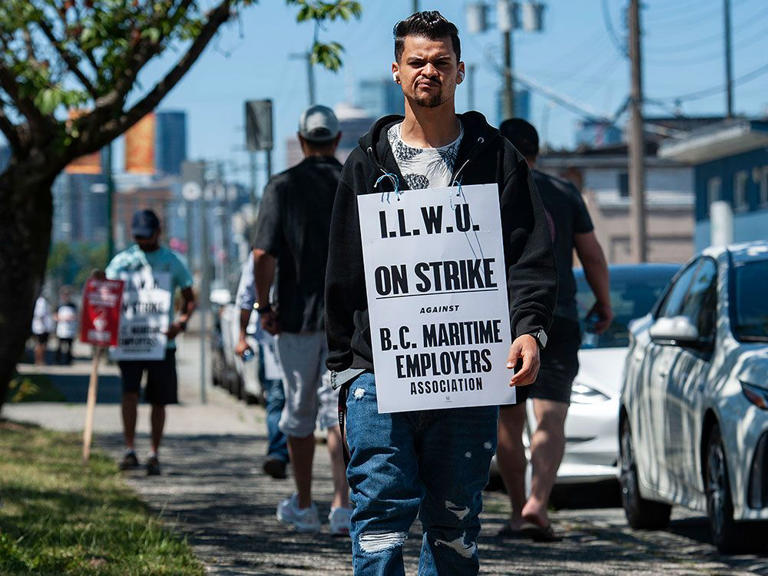
Striking port workers belonging to the International Longshore and Warehouse Union Canada walk the picket line near the Port of Vancouver’s entrance in Vancouver. 

The key issue that’s prolonging a workers’ strike at the ports of British Columbia is linked to a document that details the use of contractual workers and is complete except for one sentence, the union representing the workers said.

The International Longshore and Warehouse Union (ILWU), which represents thousands of workers who stopped working at the B.C. ports on July 1, said its authority over work that involves maintenance has been “aggressively eroded” by employers using third-party contractors.

“This is not an issue of cost for the direct employers because they already pay for this work to be done by maintenance contracting companies,” ILWU president Rob Ashton said in a statement on July 4. “Using ILWU skilled trades employees will be more cost effective and will result in a higher quality of work because of their industry experience and competency.”

But the British Columbia Maritime Employers Association (BCMEA), which represents 49 of B.C.’s private-sector waterfront employers, said the union is looking to “aggressively expand” its scope far beyond what is set out in the industry-wide agreement that has been in place for decades.

The association also said the ports experience significant labour shortages on a regular basis and that while the ILWU has the authority to exclusively supply workers in the current agreement, it has consistently been “unable to fulfill the trades work they have jurisdiction over.”

For example, the BCMEA said that, on average, 17 per cent of the jobs that needed to be filled through the ILWU were unfilled last year.

“This lack of labour supply has immediate impacts on terminal productivity,” BCMEA said in a statement on July 4.

In response, the ILWU said it has enough registered trade workers to meet employers’ demands, but BCMEA members refuse to use or train them as required.

The union’s other demands include higher pay to compensate for rising costs. The median salary for unionized port workers in B.C. last year was $136,000.

BCMEA members are collectively responsible for handling about 16 per cent of Canada’s total traded goods annually, so the strike at the ports has raised concerns among businesses about rising costs.

On July 3, Canada’s largest railway company, Canadian National Railway Co., said the damage inflicted could take months to correct.

The Retail Council of Canada warned that any delays caused by the strike could increase consumer prices since shipping companies charge for the time that goods are on ships, trains, trucks or in container terminals. It added that the impact could be North America-wide since many imported consumer goods enter Canada through B.C. ports.

The Canadian Federation of Agriculture, which represents about 190,000 farmers, said the longer the strike lasts, the worse the impacts will be because companies with vessels delayed in port charge demurrage fees and other penalties that are passed down to farmers.

Canada’s largest mining group, the Mining Association of Canada , said the port shutdowns have put the country’s reputation as a trusted producer of minerals in question.

Devin Dreeshen, Alberta’s minister of transportation and economic corridors, said he wants the federal government to recall Parliament to consider back-to-work legislation to end the strike.

But so far, the federal government hasn’t shown any such intention. Seamus O’ Regan, minister of labour, in a tweet on July 4 urged both parties to “immediately return to the bargaining table and remain there until a deal is reached.”

A quick look at the ongoing strike by British Columbia port workers

The Canadian Press
Tue, July 4, 2023 


VANCOUVER — About 7,400 workers have been on strike at ports along British Columbia's coast since Saturday morning.

Contract talks between the International Longshore and Warehouse Union Canada and the BC Maritime Employers Association broke down Monday.

Here are some key facts in the dispute:

— The union represents workers who load and unload cargo at terminals at more than 30 B.C. ports, including Canada's busiest, the Port of Vancouver.

— The association represents 49 private-sector employers and its website says the industry contributes $2.7 billion to Canada's GDP while handling roughly 16 per cent of the country's total traded goods.

— The union's previous contract expired at the end of March after negotiations aimed at reaching a new deal began in February.

— In early June, union members voted 99.24 per cent in favour of authorizing strike action if required.

— Workers walked off the job Saturday and contract talks stalled Monday, with the union saying the employers had changed their position on a key issue.

— A statement from the union on Tuesday said the key issue holding up a deal is the contracting out of maintenance work by employers. It said the employers' association and its member companies had refused to agree on a regular maintenance document that is complete except for one sentence.

— The employers' association said Monday that it didn't believe more bargaining would produce a deal and said the union was being unreasonable when it came to compensation.

— The union has previously said contracting out, port automation and the cost of living are key issues in the dispute.

This report by The Canadian Press was first published July 4, 2023.

B.C. port strike talks are deadlocked over maintenance, both sides say


The Canadian Press
Tue, July 4, 2023


VANCOUVER — Talks between maritime employers and the union involved in British Columbia's port strike are deadlocked over maintenance work, both sides say.

The union blamed the employers association for failing to agree on "one sentence" in a maintenance deal, while the association said the union was trying to "aggressively expand" control over work it was already unable to fulfil.

More than 7,000 workers at 30 ports across B.C. have been on strike since Saturday morning, leading business organizations as well as officials in both Alberta and Saskatchewan to call on Ottawa to step in.

In a statement issued Tuesday, a day after talks stalled, the International Longshore and Warehouse Union Canada said its jurisdiction over maintenance has been eroded by employers in the BC Maritime Employers Association who were using contractors.

"The key issue that is holding up getting a deal is contracting out of ILWU maintenance work by member employers of the BCMEA and the refusal of the association and its member companies to agree on a regular maintenance document that is all but complete — except for one sentence."

The employers association, meanwhile, said it had hoped Monday's pause "would act as a reset in negotiations" but "regrettably" the union had shown no willingness to modify its position.

"ILWU Canada is attempting to aggressively expand their scope and redefine regular maintenance work far beyond what is set out in the industry-wide agreement, which has been legally well established for decades," it said Tuesday.

It said the union exclusively supplies maintenance labour under the current collective agreement but "it has been consistently unable to fulfil the trades work they have jurisdiction over."

The union has previously said contracting out, port automation and the cost of living are key issues in the dispute.

Devin Dreeshen, Alberta's minister of transportation and economic corridors, said he wants the federal government to recall Parliament to consider back-to-work legislation to end the strike.

Dreeshen said he's frustrated the strike has continued, particularly because Ottawa used legislation in 2021 to end a walkout by Port of Montreal dock workers after one day.

"They used Parliament to resolve it. And that same amount of urgency is something that we're hoping that the federal government has in this case as well," he said.

Dreeshen said Tuesday that Alberta has asked federal Labour Minister Seamus O'Regan for daily updates on negotiations between the BC Maritime Employers Association and the International Longshore and Warehouse Union Canada.

"It's vitally important that the supply chain, this being a main critical component of it, remains open," he said.

O'Regan said Tuesday that federal mediators continue to support both sides in their negotiations.

"We encourage both parties to immediately return to the bargaining table and remain there until a deal is reached," he said on Twitter.

"Collective bargaining is hard work but it's how the best, most resilient deals are made."

In a separate statement responding to calls for back-to-work legislation, O'Regan's office said that it's "not looking past the bargaining table, because the best deals are made at the table."

Hartley Witten, a spokesman for the minister's office, said the primary difference between the situation in Montreal and the current strike is that there was an eight-month truce between the parties in Montreal before the strike.

"Here we had federal mediators that were involved for a number of months before, but I think to suggest there was the same sort of lead-up and we were caught flat-footed, is incorrect."

He said every collective bargaining situation has unique circumstances and B.C.'s case involves significantly more ports than the single location in Montreal.

Dreeshen said western ports, particularly the Port of Vancouver, are "incredibly important" to Alberta's economy. He said 80 per cent of exports that travel through the Port of Vancouver comes from the Prairies.

Jeremy Harrison, Saskatchewan's minister of trade and export development, said Tuesday that shippers in that province have warned the strike is already slowing down the flow of goods, and the current work stoppage will have long-lasting effects on the supply chain.

"It may take weeks or even months to fully recover from these disruptions. Strain on the supply chain leads to additional costs that end up being passed along to consumers, including those in Saskatchewan," he said.

"We encourage the government of Canada to do everything within its power to facilitate a resolution in the best interests of all Canadians.”

Dreeshen said Alberta has yet to see shortages of perishable goods on grocery shelves but that could come "very soon."

Groups representing Canadian businesses also want the federal government to intervene, with one organization calling for legal changes that would discourage future disruptions.

On Tuesday, Canadian Manufacturers & Exporters said designating ports and rail lines as essential infrastructure and limiting when and where labour and other disruptions can occur would provide manufacturers the stability they need.

"A strike of this magnitude not only disrupts the Canadian economy but damages our global trading reputation, hurts already fragile supply chains, and puts jobs at risk," the group said in a statement.

"Given that the federal government understands what is at stake, (Canadian Manufacturers & Exporters) urges them to intervene now to reassure manufacturers that they will not bear the brunt of a labour dispute that is beyond their control."

The group, which says its members account for about 82 per cent of total manufacturing production and 90 per cent of Canada's exports, estimates that the movement of $500 million worth of goods is being disrupted every day.

The Greater Vancouver Board of Trade is meanwhile asking Ottawa to "use every tool at its disposal" to ensure a deal is struck to resume activity at the city's port, including back-to-work legislation, if necessary.

This report by The Canadian Press was first published July 4, 2023.

Ashley Joannou, The Canadian Press

Further negotiations won't bring end to B.C. port workers strike, employers say

The Canadian Press
Mon, July 3, 2023 at 5:49 p.m. MDT·2 min read


VANCOUVER — The association representing employers in an ongoing strike at British Columbia ports says it doesn't think more bargaining is going to produce a collective agreement.

The BC Maritime Employers Association released a statement Monday afternoon saying it had gone as far as possible on core issues.

The International Longshore and Warehouse Union Canada, representing thousands of workers who load and unload cargo at terminals at more than 30 B.C. ports, walked off the job Saturday morning.

Both sides negotiated over the weekend and were at the table earlier in the day on Monday.

The association said it has advanced "reasonable proposals and positions in good faith" but said the union refuses to budge.

"ILWU Canada went on strike over demands that were and continue to be outside any reasonable framework for settlement. Given the foregoing mentioned, the BCMEA is of the view that a continuation of bargaining at this time is not going to produce a collective agreement," the statement read.

"ILWU Canada needs to decide if they are going to continue this strike with no hope of settlement, or significantly modify their position so a fair and balanced deal can be reached."

Union representatives could not immediately be reached for comment, but had previously accused the employers association of demanding "major concessions" despite amassing what the union described as record profits during the COVID-19 pandemic.

The strike led businesses organizations to issue warnings about wide-reaching implications across the country, with some pushing for the federal government to step in with back-to-work legislation.

The union, meanwhile, warned Ottawa not to interfere.

On Sunday, union president Rob Ashton suggested the employers association wanted Ottawa to step in. He said if that happened "there will never be labour peace on the waterfront."


That same day, federal Labour Minister Seamus O'Regan said the focus of negotiations "needs to be on the table."

The association represents 49 private sector employers operating in B.C. ports, and its website says the industry contributes $2.7 billion to Canada's GDP while handling roughly 16 per cent of the country's total traded goods -- amounting to $180 billion in 2020.

This report by The Canadian Press was first published July 3, 2023.
Canada’s West Coast Port Strike Seen Putting Country’s Reputation at Risk

Curtis Heinzl
Tue, July 4, 2023 


(Bloomberg) -- A strike by dockworkers on Canada’s west coast stretched into a fourth day, causing business groups to warn of a growing risk to the country’s economy and reputation.

An extended strike will primarily hurt Canada’s exports of steelmaking coal, copper concentrates and potash, Mining Association of Canada President Pierre Gratton said.

The bulk of Canada’s steelmaking coal is produced in British Columbia, mostly by Teck Resources Ltd., and shipped through Vancouver to countries including Japan and Korea, Gratton said. Teck said it can divert shipments through other terminals to mitigate the impact of the strikes, but Gratton said a disruption longer than a week would have “severe” consequences for Canada’s economy.

“Our reputation as a trading country that can be relied upon is at stake,” said Matthew Holmes, a senior vice president of the Canadian Chamber of Commerce. The chamber wants Parliament, which began its summer recess last month, to return and pass legislation bring the workers back, Holmes said.

Labor Minister Seamus O’Regan said federal mediators were still at work, and the government wants to see a negotiated deal.

About C$800 million ($605 million) of goods — a quarter of Canada’s imports and exports — pass through the affected ports each day. A strike means most of these goods must either wait in the port or be re-routed through the US.

Grain shipments have continued amid the strike as required by the Canada Labour Code.

A slowdown in exports could affect global supply chains, Fertilizer Canada Chief Executive Officer Karen Proud said. Canada is the world’s largest producer of potash — a group of potassium compounds used in fertilizer. The war in Ukraine has already complicated fertilizer availability from Russia and Belarus — which also are major producers — and a reduction in Canadian exports would further strain the supply, Proud said.

Canadian import and export infrastructure has been obstructed several times in the last few years, including during a railway strike in 2019, the blockage of a major trucking bridge in 2022 and interference by public-service workers at the Port of Montreal earlier this year.

“If these events continue to occur, it makes people think twice whether Canada is the place to move your product from,” said Brian Kingston, CEO of the Canadian Vehicle Manufacturers’ Association.

--With assistance from Jacob Lorinc.


Forest fires and industry are devastating last remaining caribou habitat


Local Journalism Initiative
Tue, July 4, 2023

On June 15, Ottawa announced Quebec will be granted “limited additional time” to devise a caribou protection plan due to a wildfire season that has burned over one million hectares of forest so far.

Ontario signed a similar agreement last year with the feds. In March, David Piccini, Ontario’s minister of environment, announced $29 million over five years to support habitat restoration, protection and monitoring of caribou.

Protection is more important than ever. Cumulative impacts of forestry in Quebec and forestry and mining exploration in Ontario are exacerbating the steady decline of caribou populations, a designated federal species at risk, Dave Pearce, senior forest conservation manager at the conservation organization Wildlands League, said.

Now, as wildland fire seasons lengthen and worsen in severity, the disturbance to caribou that thrive in dense, undisturbed forests is compounded with the effects of logging and mining, Pearce explained.

“[Caribou’s] superpower is that they can live in dense, large patches of dense forests that don't have a lot of food for other animals,” he said, pointing to the caribou’s love for lichen as a food source.

Caribou have lived with wildland fire for years, but mining exploration and logging roads create vulnerable conditions for the animals by making corridors for predators like bears and wolves. Caribou are not as fast as deer and are much weaker than moose, making them more vulnerable in younger forests that emerge from logged areas or the ashes of wildland fires.

Deer and moose also prefer younger, less dense forests that provide more food sources, which leads them into caribou territory after fires to compete for food, Pearce said.

Although wolves are often painted as the caribou’s greatest enemy, Pearce doesn’t see it that way. Instead, he sees forestry practices that don’t consider the needs of caribou and don’t recognize the importance of conserving dense brush that can mitigate threats to caribou.

However, it’s unclear how Ontario and Quebec protection efforts will materialize given the risk of damaging a northern economy dependent on forestry, and more recently, mining exploration. However, to protect caribou, a baseline of 65 per cent of undisturbed habitat is needed. It’s a target that might threaten historic forestry towns with mills that are sometimes several decades old.

The protection plans raise questions about current forestry practices that are criticized for unsustainability by researchers, as well as the risk to communities that rely on logging for their local economies. Those small towns could become casualties of the strategy, but it’s clear current forestry practices are not sustainable for caribou, prompting federal Environment Minister Steven Guilbeault to threaten both Quebec and Ontario with invoking a critical habitat protection order through the Species at Risk Act to take over the situation for both provinces.

Two Innu First Nations in Québec who saw an early draft of the agreement last month called out the National Assembly for its proposed caribou protection plan dubbing it a “strategy for extinction,” La Presse reports.

“For the current government, the issue is not the protection of caribou, [it’s] the economy,” Gilbert Dominique, chief of Pekuakamiulnuatsh First Nation, told La Presse in French.

The caribou hold cultural and spiritual importance for the Innu, with feasts and hunts revolving around caribou harvests.

The caribou is seen as a marker for the biodiversity and health of the boreal forest, said biologist Pier-Olivier Boudreault with the Canadian Parks and Wilderness Society Quebec.

Both Pearce and Boudreault agree that the more undisturbed protected areas each province can set aside, the better the chance caribou will have to recover and thrive.

“That’s why environmental organizations are putting so much effort on the species,” he explained. “It’s an iconic animal, but it’s really the idea that if we protect the species, we’re protecting this ecosystem.”

Natasha Bulowski, Local Journalism Initiative Reporter, Canada's National Observer