Romania About to Break Ground on Biggest Solar Farm in Europe
- Romania’s solar capacity is set to exceed 7 GW by early 2026, driven by strong demand, EU funding, and more than 290,000 residential and commercial users.
- The country is accelerating its energy transition, aiming to raise renewables to 30.7% of its energy mix by 2030.
- EU financing and policy support are fueling growth, with institutions like the EIB and EBRD backing projects.
Solar power has grabbed a foothold in Romania, with installed capacity expected to surpass 7 gigawatts in early 2026, driven by high demand, EU funding and over 290,000 commercial and residential consumers.
The Eastern European country is rapidly installing solar to transition away from coal, enhance energy security, and meet European Union decarbonization targets.
While it is not among the top European countries for installed solar power — that, in descending order, is Germany, Spain, Italy, the Netherlands and France — Romania is aiming for 8.2 GW by 2030. The government plans to increase the share of renewables to 30.7% by the same year, focusing on solar and wind to replace older, polluting sources.
Solar currently supplies about 5% of Romania’s electricity mix, with approximately 210 sunny days per year.
According to Wikipedia, the most important solar regions of Romania are the Black Sea coast, Northern Dobruja and Oltenia, with an average of 1,600 kWh/m2/year.
The Guardian says Romania has decoupled economic growth from pollution faster than anywhere else in Europe. The latest data shows its net greenhouse gas emissions intensity fell by 88% between 1990 and 2023.
While Romania turned to lignite coal and heavy oil for energy self-sufficiency during the reign of Nicolae Ceau?escu, after the dictator was tried and executed, factories closed, mines shut and power plants slashed their output, the newspaper explains:
Romania’s entry into the European Union in 2007 held polluters to higher standards and forced the closure of unprofitable factories propped up by state support. Its emissions trading system put a price on carbon and its modernisation fund brought back cash to clean up the energy system. Meanwhile, workers completed a nuclear power plant in Cernavod?, a town in the south-east of the country, which had been commissioned under Ceau?escu, and the government introduced a green certificate scheme to bankroll renewables.
EU solar reached a record 56 GW of new installations in 2023, accelerated by high electricity prices and the need for energy security. Poland, the Netherland and Greece were among European Union countries that saw massive increases.
Following a 1.7 GW addition in 2024, the Romanian market is reportedly booming with large-scale projects, including the largest solar farm in Europe — a 760 MW facility soon to start construction just outside Bucharest, that features a million solar panels backed by batteries. In the northwest, authorities have approved an even bigger plant with a capacity of 1 GW.
According to Seetaoe, the Dama solar project being jointly developed by Rezlov Energy and Monsson has a planned peak capacity of 1.04 GW and a 500-megawatt energy storage system. It is expected to be put into operation in the third quarter of 2028.
Financing for projects is being provided by the European Investment Bank and the European Bank for Reconstruction and Development, such as a €34 million loan for 190 MW of new photovoltaic plants in southwestern Romania.
Key players include OMV Petrom, which is installing 7 MW solar systems at industrial sites, along with developers active in large-scale projects such as Scatec, Enery and Rezlov Energy.
According to Balkan Green Energy, Norwegian company Scatec has reached financial close for 190 MW of solar power in Romania, enabling it to start construction.
“Reaching financial close and starting construction of our first projects in Romania is an important step and confirms the attractiveness of the Romanian market and the strength of the CfD [contracts-for-difference] framework. With long-term revenue visibility and a robust financing structure in place, the projects are well positioned for construction and delivery. We look forward to advancing the projects together with our partner Defic Globe and contributing to Romania’s energy transition,” said CEO Terje Pilskog.
A CfD is a leveraged financial derivative that allows traders to speculate on the rise or fall of asset prices without owning them.
By Andrew Topf for Oilprice.com
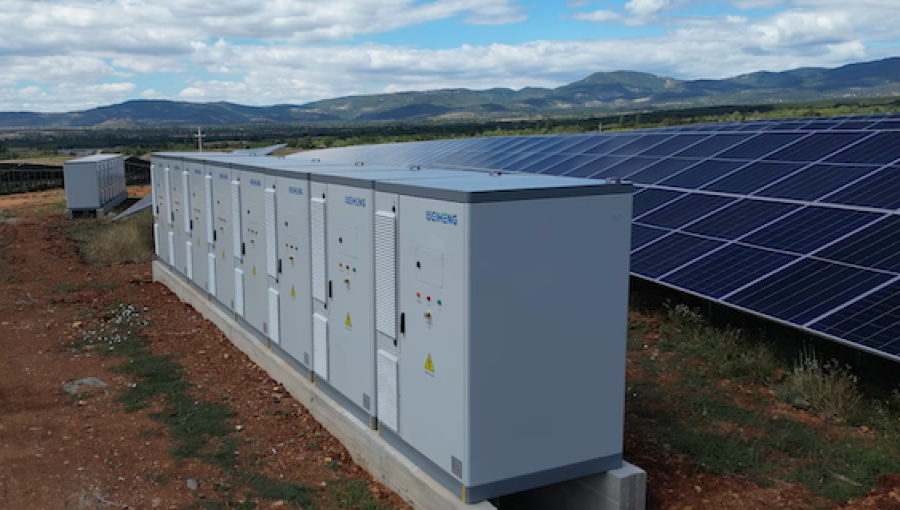
As renewables capacity expands in North Macedonia, the country is beginning to confront a common challenge: too much electricity at certain hours of the day and too little flexibility in the system. To address this, FeroInvest recently installed the first battery energy storage system in the country.
The battery system has been installed at the photovoltaic power plant in Ginovce, in Rankovce Municipality. The plant is partially owned by FeroInvest’s sister company Centralinvest, together with three other business partners.
“We installed a battery system there with a capacity of 6.1 MWh / 2.6 MW, which is managed daily by FeroInvest through our own programming and control system. We then installed batteries at another photovoltaic power plant. The second one, fully owned by us – FE Trkanje in Kochani – has a battery capacity of 10.5 MWh / 4.5 MW. At both locations, the battery systems are functioning excellently,” said Kočo Angjušev, owner and CEO of FeroInvest and BRAKO, in an interview with bne IntelliNews.
Preparations for the technology — new to the Macedonian energy market — had been underway at FeroInvest for several years, so when new legal provisions were adopted in 2025, the company was fully prepared to implement them.
“Personally, for more than four years, at numerous public events, I have been saying that battery systems are the next step and that this need will inevitably arise,” Angjušev said.
“I was saying this at a time when the dominant view was that the solution was simply to build as many photovoltaic plants as possible, while there was still no legal framework for battery systems. I have 20 years of experience in energy, renewables, and electricity trading. I always try to look five or ten years ahead, because without such an approach there is no long-term success.”
Battery systems significantly reduce the burden on transmission and distribution networks, especially during critical daytime hours when there is surplus production from photovoltaic plants.
“It was clear that the market would face serious imbalances between electricity production and consumption, especially due to the expansion of photovoltaic plants. The logic is simple: large supply means low prices, and shortages mean high prices,” Angjušev explained.
For this reason, FeroInvest began researching and investing in battery systems initially for its own projects, and today offers such solutions to other investors.
North Macedonia currently has more than 1,200 MW of photovoltaic capacity in operation and, according to annual investment plans and the new Energy Law, an additional 3,000-4,000 MW are expected. According to Angjušev, at least 2,000 MWh of battery capacity is needed for the existing photovoltaic plants, although even that would only partially solve the problem.
“This is no longer just an energy issue, but also a financial one, because existing projects without batteries will struggle to service their obligations to banks, which will also affect the banking sector,” Angjušev added.
FeroInvest currently has no direct investments in battery systems or photovoltaic plants in other countries, but has implemented turnkey renewable energy projects in Albania, Georgia, Kosovo and Serbia.
“Several new battery projects are being announced, both for our own plants and for clients — investors who already understand that batteries are an inevitable step. Our goal is for FeroInvest to become a leader in integrated energy solutions — production, storage and optimisation of electricity — not only in North Macedonia, but regionally as well,” said Angjušev, who is a professor at the Faculty of Mechanical Engineering in Skopje.
According to him, companies within the FeroInvest group have extensive experience and expertise in renewable energy sources, as well as in the processing and production of metal components and sweepers.
“FeroInvest – turnkey is an approach through which the company offers an individual solution for each client in the field of renewables, from the initial feasibility study, through final design, construction and installation, to commissioning and control of electricity production, with a 24/7 monitoring system and rapid response, purchase of renewable electricity, and placement of energy to end consumers,” Angjušev added. “This entire package provides security to investors as well as to the banks financing the projects. When purchasing energy, priority is given to power plants in whose construction we have been involved — that is, our clients have priority in energy off-take.”
The group’s factories manufacture state-of-the-art electric and hydrogen-powered vehicles for urban hygiene, mechanical assemblies, automation systems, wire products, hospital equipment and medical devices. Around 1,000 people are employed within the group, including 100 engineers from various technical fields.
Angjušev’s business career has not been without controversy.
In 2023, he was placed on a US sanctions list, with the US Department of State citing “involvement in significant corruption” in its decision. The statement said that “while serving as deputy prime minister, Angjušev abused his public office for his private business interests and undermined public trust in North Macedonia’s government institutions and public processes”. His wife and two children were also designated as generally ineligible for entry into the United States.
At the time, Angjušev denied all the allegations and announced that he would appeal the decision. He said that while serving in North Macedonia’s government from 2017 to 2020, he “worked with full respect for all laws and constitutional provisions of the state, and in the interest of the Macedonian economy and the democratic principles on which our country is based”.
“Four years after my voluntary withdrawal from the Government, there are no court proceedings regarding any aspect of my work, because there are no grounds for such proceedings,” Angjušev said in December 2023.
Asked by bne IntelliNews how the situation affected his businesses, Angjušev said: “I would like to emphasise that this does not involve [Office of Foreign Assets Control] OFAC sanctions, nor sanctions imposed by the US Department of Justice, which would have legal or commercial consequences. My company for electric and hydrogen sweepers, Green Machines, headquartered in California, USA, operates without any disruption. Our sweepers are even used to clean the White House.”
He stated that none of his companies, including FeroInvest, BRAKO and Green Machines, face restrictions or operational obstacles, and that the corporation exports to 60 countries worldwide.
“I will answer you honestly. I have said many times: my biggest mistake in life was accepting to enter politics and serve as deputy prime minister in the government of North Macedonia,” Angjušev told bne IntelliNews. “During that period, my businesses declined by 18%. You know, when you are a leader in a very important field such as energy… many enemies are created, along with many people whom you inconvenience and who want to become what you are.”
Angjušev argued that, according to sources he consulted, “the visa restriction imposed on me personally by the United States was an attempt to reduce my influence in Macedonian society and was initiated by several Macedonian politicians… even the most democratic administrations in the world… are not immune to making an oversight”.
A procedure is “underway to review the visa restriction decision before the competent US institutions,” Angjušev concluded, “and my US representatives in this process believe that the decision will be reversed, as there is no real need for it”.
Meanwhile, FeroInvest is continuing to expand its integrated model of electricity production, storage and optimisation, positioning battery systems as a central component of North Macedonia’s next phase of renewable energy development.

No comments:
Post a Comment