Saturday, July 12, 2025


Flooding And Social Sustainability: 

A Climate Justice Issue In Myanmar – Analysis
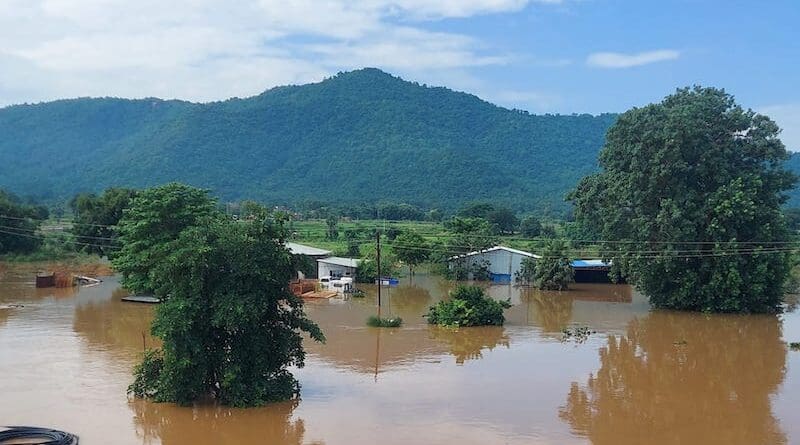
Flooding in Myanmar. Credit: The Sabai Times


By 

By Pyae Phyoe Mon


Flooding is one of the most serious consequences of Myanmar’s rising climate disaster. Urban and rural people have been affected by the frequent and severe flooding caused by annual monsoons and storms that are becoming stronger.

The article discusses how flooding in Myanmar addresses the climate justice issue, highlighting inequalities in vulnerability and access to resources. The analysis takes a social sustainability approach, focusing on how communities may cope and recover from environmental emergencies.

Key Takeaways:

  1. Flooding in Myanmar is an environmental concern and a climate justice issue that disproportionately impacts the most vulnerable communities.
  2. Climate disasters, political instability, and socioeconomic disparities due to poor governance, the country’s limited ability to recover and adapt, and the exclusion of unprivileged voices from climate policy-making threaten social sustainability.
  3. Inclusive, community-led, and rights-based initiatives are critical to building climate resilience and a sustainable future.

Understanding Climate Justice and Social Sustainability

The concept of climate justice acknowledges that not everyone is equally affected by the climate crisis. Vulnerable communities, such as low-income nations, indigenous people, people of color, women, ethnic and religious minorities, and people with disabilities who contribute the least to climate change, are disproportionately impacted by climate disasters like floods, droughts, wildfires, and rising sea levels. Additionally, these groups frequently lack institutional and financial resources to adapt or recover from the consequences of climate change, which exacerbates already-existing social and economic inequalities.

Social sustainability means creating resilient, inclusive, and equitable communities that can recover and adapt to challenging situations while ensuring that all people, especially marginalized communities, can access resources and meet their needs. It incorporates social well-being, environmental, and economic factors to promote sustainable development.

Indeed, climate change-related flooding and disasters disproportionately affect marginalised populations, such as rural communities, ethnic minorities, women, and children, who frequently lack adequate infrastructure, financial resources, and social support networks to respond and recover. Social sustainability implies specific efforts to reduce imbalances and ensure that vulnerable groups are not left behind.


Climate Justice in Myanmar: Who Suffers the Most?

Myanmar has faced catastrophic flooding due to monsoon rainfall and climate change since September 2024. Recent floods have ruined several places, causing damage to infrastructure, housing, and agriculture. The impact is particularly severe in conflict-affected areas, including Kachin, Sagaing, and Magway. Rising floodwaters cause damage to houses, cut off towns, and restrict critical supply routes. Farmers have experienced significant losses due to flooding, threatening their food security and livelihoods. The combination of broad devastation and ongoing civil war worsens the challenges these people face, hindering relief and recovery efforts. As a result, the socioeconomic consequences are expected to be significant and long-lasting.

Flooding in Myanmar raises a concern for climate justice that threatens social sustainability, has an unequal impact on vulnerable groups, and indigenous communities. Generally, these communities lack the basic flood protection, early warning systems, and infrastructure required to manage or predict extreme weather conditions or environmental changes. This difficulty is worsened by limited disaster preparedness, continuous conflicts, political instability, weak governance, superstitious beliefs in local communities, and historical injustices that have affected specific communities for so long. Flooding can also create long-term health, education, and economic stability challenges, as well as immediate risks to safety and livelihoods. Therefore, promoting inclusive, rights-based solutions that empower local communities and address the root causes of vulnerability is critical.

Furthermore, cultural and religious beliefs shape how societies perceive and react to climate-related challenges. While these beliefs can sometimes strengthen resilience, they may also hinder effective adaptation. A Study in Africa indicates that various communities in South Africa have distinct responses to climatic disasters, influenced by their religious perspectives. Some individuals may adopt a passive approach, interpreting disasters as divine will or punishment rather than as environmental events. In contrast, others may proactively adapt when faith-based organizations offer practical assistance and promote community support.

These two considerations underscore the necessity of integrating disaster risk reduction and climate adaptation strategies in Myanmar that reflect vulnerability’s social and spiritual aspects, alongside providing financial aid and technical support. Understanding and collaborating with local religious leaders and their beliefs in Myanmar is essential. Acknowledging these concepts and involving the community improve the development of more effective strategies for anticipating and alleviating the impacts of flooding, ultimately strengthening community safety and resilience in the long run. Although limited studies specifically address this issue in Myanmar, global research findings highlight the importance of incorporating local values and social contexts into the country’s response initiatives.

Social Sustainability in Myanmar Under Threat

Myanmar has struggled with social sustainability challenges since the military gained control in 2021. This is due to a dramatic increase in poverty, harsh economic conditions, ongoing conflicts, and climate-related disasters. The continuous conflict has displaced 3.5 million people, about one-third of whom live in Myanmar’s flood-prone southeast. Conflict and natural catastrophe events increase the cycle of displacement, undermining the coping strategies of already vulnerable populations. These communities also face greater unemployment rates and inadequate access to basic services such as healthcare and education. Meanwhile, weak disaster preparedness and poor governance create socioeconomic inequalities and weaken institutional trust from the public.

Traditional support networks collapse due to repeated shocks, including man-made and climate-related disasters, putting societal cohesion at risk. As these networks break down, communities experience disruptions that increase feelings of fear, distrust, and marginalization, threatening social stability and collective resilience.

Myanmar’s social fabric will keep getting worse in the absence of inclusive policies and community-led resilience efforts as a result of long-term instability and hardship. Therefore, to ensure social sustainability, we must address these interconnected vulnerabilities through adequate climate action, enhanced local governance, and investment in people-centered recovery.

Silenced Stakeholders: Indigenous Peoples and the Climate Crisis in Myanmar

Indigenous communities in Myanmar, particularly in regions such as Kachin, Chin, Tanintharyi, and Rakhine, are at the forefront of the climate issue; however, they are excluded from national climate policy and land governance frameworks.Indigenous land management considerably improves ecological resilience, yet contemporary legal institutions typically neglect and undermine indigenous groups’ rights. These communities employ traditional methods, such as terraced farming and forest conservation, which mitigate the effects of climate-related disasters, including floods. However, institutional interests’ land acquisitions and exploitative projects frequently force people to shift, threatening their cultural heritage and means of livelihood.

Despite facing man-made disasters caused by large-scale development projects, deforestation, and mining operations that threaten their lands and ways of life, indigenous people are often left out of the consultation, planning, and decision-making process for climate policies and environmental governance in Myanmar. Ensuring their rights and meaningful involvement is vital to the future of Myanmar’s just and sustainable climate. Without their voices, climate action is incomplete and unjust.

An Inclusive Path Forward: Recommendations for Climate Justice in Myanmar

Climate initiatives must prioritise fairness and inclusive, rights-based methods in Myanmar to achieve green security and social equity. This means identifying the disproportionate effects of floods on marginalised communities and addressing the underlying structural inequities that increase their vulnerability. Whether from foreign assistance or domestic investments, climate financing should prioritise community resilience-building activities while maintaining openness and accountability. Collaboration among government agencies, civil society, indigenous leaders, and global partners is critical. In addition, advancements in education, innovation, and the preservation of traditional ecological knowledge can all help to accelerate transformative development.

Creating the Loss and Damage fund, which was announced during COP27holds hope or opportunity for Myanmar. This global fund is intended to provide finance and necessary assistance to countries most vulnerable to climate impacts, climate-related losses, and damages. Accessing the Loss and Damage fund could significantly impact Myanmar’s efforts to support resilience and recovery in the areas most affected by climate change.

Conclusion

Flooding in Myanmar is more than just an environmental disaster; it provides an essential perspective on deeper climate justice issues, governance, and social sustainability. The combination of the country’s socioeconomic inequality and geographic vulnerability exacerbates the impact of climate disasters on marginalised populations.

Good governance is also critical to effectively implementing climate strategies and transparent and inclusive systems that bridge the gap between national policies and local needs, especially for vulnerable groups. In contrast, weak governance marked by corruption, poor coordination, and exclusion leads to ineffective disaster response and deepens inequalities.

To address the complicated nature of this scenario, solutions must be as diverse as the problems they seek to solve. Aside from providing urgent disaster relief, mitigating climate-induced flooding requires long-term measures that promote better land-use policies, sustainable infrastructure, and increased community involvement.

The reason for this is apparent: social equity and climate justice should be mutually reinforcing. Vulnerable communities frequently experience the most serious consequences, so policymakers and local leaders must ensure they receive the support and opportunities needed to adapt and rebuild. Focusing on these components can create a more just and resilient society for all, ensuring no one is left out when the storms rise.


Shwetaungthagathu Reform Initiative Centre

The Shwetaungthagathu Reform Initiative Centre (SRIc) is a hybrid think tank and consultancy firm committed to advancing sustainable development and promoting sustainability literacy in Myanmar. Through its Sustainability Lab, SRIc conducts public policy research and analysis to promote Sustainable Development in Myanmar and guide the country toward a sustainable future. SRIc also offers consultation, CSR strategy development, and Sustainability roadmaps focused on Environmental, Social, and Governance (ESG). SRIc equips individuals and organizations with actionable strategies for sustainable growth through capacity-building programs, customized training, publications like Sabai Times, and outreach initiatives such as webinars and podcasts. By merging research insights with practical consultancy, SRIc fosters responsible business practices, develops CSR strategies, and creates sustainability roadmaps, contributing to local and global sustainability efforts.
Comparative Study Of Reconciliation Efforts In Post-Conflict Societies – Analysis


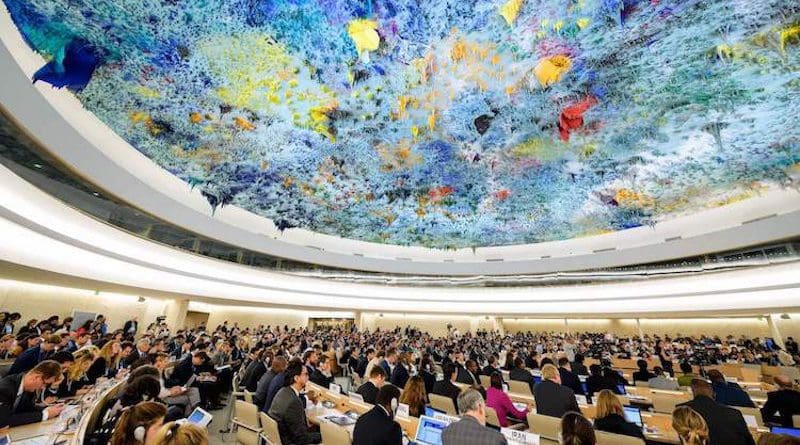
File photo of UN Human Rights Council in Geneva. Credit: Wikimedia Commons.

July 12, 2025 

By Prof Anis Bajrektarevic

Key Takeaways from selected regions of the world 
(African, American, Asian and European continent)

Reconciliation after violent conflict is neither a certain nor linear process—it requires time, patience, and constant efforts in understanding and appreciating the unique socio-political dynamics on national, sub-national and communal level. Countries and regions emerging from protracted violence often turn to cooling and reflection that leads further on to truth-telling, justice, community healing, and power-sharing as tools of post-conflict transformation. This mini comparative study explores how nine diverse regions: Northern Ireland, South Africa, Sri Lanka, Thailand’s Deep South, Canada, Mindanao, Austria, W Sahara, and Aceh—have approached reconciliation, offering valuable lessons for future peace processes worldwide.

Northern Ireland: Institutionalized Peacebuilding and Community-Led Dialogue


The Good Friday Agreement (1998) was a landmark in ending three decades of violent conflict in Northern Ireland, that exploited the pro-Irish and pro-British as well as Catholic and Protestant sentiments for political polarisation and conformation. These bloody decades are generally referred as The Troubles. This Acord established a power-sharing government between Unionists and Nationalists and introduced significant reforms in policing, civil rights, and cross-border cooperation with the Republic of Ireland.

Despite the political success, deep sectarian divisions remain. Post-agreement reconciliation has relied heavily on community-based organizations such as the Corrymeela Community, which fosters dialogue across religious and political divides. Educational institutions like Queen’s University Belfast also support peacebuilding through academic research and policy development.

Key takeaway: Sustainable reconciliation requires both top-down political structures and bottom-up social healing mechanisms. The Northern Ireland case shows that institutional peace must be supported by grassroots trust-building and continuous civic engagement.


South Africa: Truth, Justice, Forgiveness, and the Restoration of Moral


The Truth and Reconciliation Commission (TRC) of South Africa remains one of the most internationally referenced examples of restorative justice. Created after the fall of apartheid in 1994, the TRC allowed both victims and perpetrators to testify, often publicly, about atrocities committed during decades of racial segregation and oppression.

Chaired by Archbishop Desmond Tutu, the TRC emphasized truth-telling over punishment, acknowledging that uncovering the past was essential to forging a shared future. While widely admired for encouraging forgiveness and national dialogue, critics point out that structural inequalities, cultural and socio-economic injustices remain inadequately addressed.

Key takeaway: South Africa’s experience highlights the power of moral leadership, the importance of truth-telling, and the necessity of socio-economic redress to fully heal societies fractured by state-sponsored violence.


Sri Lanka: A Struggle Between Narrative and Justice

Following the end of a 26-year civil war between the Sinhalese-dominated government and the Tamil Tigers in 2009, Sri Lanka faced the urgent need to address ethnic grievances, war crimes, and mass displacement. The government created the Lessons Learnt and Reconciliation Commission (LLRC), which recommended several reforms including demilitarization, language rights, and transitional justice mechanisms.

However, the LLRC has been widely criticized for lacking independence and failing to hold perpetrators accountable. Progress has been further hindered by political denial of civilian casualties, slow justice processes, and a lack of international engagement.

Like with some other conflicts noted here as well, this refers to the so-called Dual Pressures. The coercion and abuse streams from the rival group- externally, but also from the ‘own’ group – internally. Hence, the ‘own’ group often conducts intimidation, kidnaping summary executions, forced taxation, or forced recruitments for the violent ends, including the (ritual) acts as a demonstration of loyalty. Dual Pressures eliminates neutral and sober voices. Ultimately, it complicates peace building between the waring groups as well as the confidence building measures within the civilian population.

Key takeaway: Without genuine political will and transparent accountability, truth and reconciliation processes risk being perceived as overly formal or even harmful. Reconciliation in Sri Lanka illustrates the dangers of state-controlled narratives that suppress rather than heal. Therefore, the community level civic involvement is detrimental. The big neighbour refrained from involvement, and thus helped the architecture of constructive surrounding.

Thailand’s Deep South: Cultural racial and religious sensitivities, Reconciliation localised

Thailand’s southernmost provinces—home to a Malay-Muslim majority, but also the Thai-Muslim minority of this predominantly Buddhist country —have experienced decades of low-intensity insurgency, driven by ethnic and religious marginalization. While the central government has occasionally engaged in mediation and reconciliation – on its own, or catalysed by the bilateral talks with Malaysia, most efforts have focused on community dialogue and local peace initiatives.

These include incorporating religious leaders, village heads, and Islamic schools in conflict mediation. Unlike in some other contexts, traditional and informal dispute-resolution mechanisms have been given prominence, which has helped build local ownership of peace.

Interestingly, the Thai-Muslim minority of Thailand’s Deep South often felt either excluded or disillusioned by both, Bangkok’s and Kuala Lumpur’s efforts. Their perception of inferiority vis-à-vis Malaya-Muslim minority (who, by their own perception, have the powerful supporter from ‘motherland’, hence more respect in Bangkok, too) must be addressed and adequately refuted.

Key takeaway: In culturally distinct and racially sensitive conflict zones, top-down approaches often fall short. Thailand’s experience suggests that reconciliation benefits from decentralized, context-sensitive models that respect local traditions and languages. Singular approach is also inadequate; the Thai-Muslim and Malaya-Muslim minorities deserve full recognition of their peculiarities.


Canada: Lessons learned, still to be (fully) lived

Truth and Reconciliation in Canada refers to the ongoing process of addressing the historical and intergenerational harm caused by the residential school system, which forcibly removed Indigenous children from their families in an effort to assimilate them into Euro-Canadian culture. The Truth and Reconciliation Commission of Canada (TRC), established in 2008, gathered testimonies from survivors and released its final report in 2015, including 94 Calls to Action aimed at redressing the legacy of residential schools and advancing the process of reconciliation. This effort seeks to foster healing, acknowledge past injustices, and build respectful relationships between Indigenous and non-Indigenous Canadians, with a focus on justice, education, and systemic change.

Key takeaways: The TRC teaches us that (i) the Regretacknowledgment is essential; (ii) through and fair listening of survivors matters; (iii) the reconciliation is a long-term process; (iv) (full and lasting access to) Education and justice is essential; and finally that the (v) sustained action on all levels must always follow words.


Mindanao, Philippines: Inclusivity and the Power of Gender-Sensitive Peacebuilding


The long-standing Moro insurgency in the southern Philippines resulted in decades of conflict, civilian strives and displacement. A significant breakthrough came with the Comprehensive Agreement on the Bangsamoro (CAB) in 2014, which granted autonomous governance to the Bangsamoro people.

One of the most notable aspects of this peace process was its inclusive nature, despite very sensitive Christian-Muslim clash trajectory. Women played a central role, both as negotiators—such as Miriam Coronel-Ferrer, the first female chief negotiator in a major peace process—and as grassroots mobilizers. Traditional communal leaders (datus) and religious authorities (ulama) also helped mediate and legitimize the agreements locally.

Key takeaways: Mindanao shows that inclusive participation across gender, religion, and community lines enriches the legitimacy and sustainability of peace agreements. The deliberate inclusion of marginalized voices increases public buy-in and supports a more comprehensive reconciliation. Powerful neighbours (although predominantly Muslim, Indonesia and Malaya) refrained from involvement, and thus helped the architecture of constructive surrounding, and final reconciliatory enterprise.


Aceh, Indonesia: Peace and Rebuilding in the Wake of Disaster

Aceh’s separatist conflict between the Free Aceh Movement (GAM) and the Indonesian government had persisted for nearly 30 years when the 2004 Indian Ocean tsunami devastated the province. Ironically and tragically enough, the natural disaster provided a rare opening for peace, as both sides recognized the necessity of cooperation during the colossal human catastrophe and massive humanitarian crisis.

The 2005 Helsinki Agreement granted Aceh special autonomy, including control over natural resources and local governance. Peace was reinforced through general amnesty and reintegration of ex-combatants, livelihood projects, and leveraging traditional customs such as “gotong royong” (mutual cooperation) for community rebuilding.

Key takeaways: Aceh illustrates how a non-man-made crisis (natural disaster) can catalyse socio-economic and politico-military reconciliation. Central government in Jakarta rapidly responded with the decentralisation notion. Subsequent customary practices and collective recovery efforts were central in restoring community cohesion and trust.

This is the first time in modern history that the cataclysmic environmental shock put all to the peace- and confidence- building trajectory.

Western Sahara: The Unfinished Struggle for Self-Determination


Western Sahara, a former Spanish colony in North Africa, remains one of the world’s longest-running and unresolved territorial disputes. After Spain’s withdrawal in 1975, Morocco claimed much of the region, prompting armed resistance from the Libya and Algeria-backed Polisario Front, which declared the Sahrawi Arab Democratic Republic (SADR) in pursuit of independence. A 1991 UN-brokered ceasefire promised a referendum on self-determination, but it has never materialized due to political deadlock.

Today, Morocco controls the majority of the territory, while the Polisario maintains a government-in-exile and refugee camps in Algeria. The region remains tense, with periodic clashes and stalled diplomatic progress. Morocco is often criticised for the poor human rights record and for altering demography of the contested territory.

Key takeaways: Western Sahara demonstrates that (i) decolonization can remain incomplete decades later; (ii) lack of political will can undermine international legal promises; (iii) unresolved status contributes to long-term humanitarian crises; (iv) external actors’ ambivalence weakens mediation; and (v) the credibility of international institutions suffers when agreed solutions are indefinitely delayed.


South Tyrol, Italy: Quiet Autonomy – Wisdom winning over emotional charge


South Tyrol (Alto Adige), a predominantly German-speaking province in northern Italy, experienced decades of ethnic tension following its annexation from Austria after World War I. Fascist-era policies of forced Italianization, contested by the post-Hapsburg monarchic legacy sparked deep resentment and, by the 1950s–60s, led to a violent autonomy movement, including bombings by German-speaking militants.

Back then, both leaderships – in Rome and in Vienna, exercised restrained and wisdom – agreeing (after the repeated attempts to resolve issue bilaterally) – that they disagree on all, and handed over the case to the United Nations. It led to the 1972 Autonomy Statute, which granted the contested territory of South Tyrol extensive self-governance. The agreement ensured proportional political representation, cultural and linguistic rights, and control over key areas like education and access to public services. Full implementation in the 1990s transformed South Tyrol into one of Europe’s most stable and prosperous regions.

Key takeaway: South Tyrol illustrates how deeply rooted identity-based (ethnic, cultural and linguistic) conflicts can be resolved through domestic restraint, external mediation, legal guarantees of cultural rights, and meaningful decentralization. De-escalation and management of the emotional charge through the reasonable and rational politics is a true study-case par excellence. The South Tyrol autonomy model remains a quiet but powerful example of a lasting peaceful coexistence.

Conclusion: Deescalate, Reflect, Reconcile, Build the Future

Reconciliation is more than a singular process. It is a long-term, evolving commitment to truth, justice, inclusion, and social cohesion of all societal stakeholders. It can be initiated and accelatered by the external force, but it can be only delivered domestically.

 Neighbours cannot clean up the house, it has to be done by the household members.

Each of the elaborated regional case studies offers unique insights:Northern Ireland emphasizes the importance of institutional reform alongside community dialogue.
South Africa offers a compelling case for truth-telling and moral leadership, though it shows that forgiveness alone cannot substitute for economic justice.

Sri Lanka warns of the pitfalls of state-dominated narratives and highlights the necessity for genuine transitional justice and community-level engagement.

Thailand’s Deep South presents a model for decentralized, culturally embedded reconciliation that respects local traditions and identities.

Canada underscores the importance of survivor-centered truth-telling, institutional accountability, and sustained, intergenerational commitment to justice, education, and healing.

Mindanao exemplifies the transformative role of inclusive, gender-sensitive negotiations, as well as the power of local leaders and religious actors in legitimizing peace.

Aceh illustrates how external shocks like natural disasters can open windows for reconciliation, and how traditional customs can support social rebuilding.

Western Sahara is a sobering example of how the powerful neighbours and failure of international community to deliver (similar like the post-Dayton Bosnia) entrenched cycles of displacement, marginalization, fragmentation and disenchantment.

South Tyrol demonstrates how deeply rooted identity conflicts can be transformed through restraint, international mediation, and legally protected autonomy—becoming a powerful case of peaceful coexistence within a multilingual and multicultural framework.

These examples make clear that there is no “one-size-fits-all” approach to reconciliation. Successful processes are those that are locally grounded, inclusive,truthful, andpolitically supported. They combine formal institutional reformswithinformal community-based efforts, and critically, they address the structural inequalities that often lie at the heart of conflict.

Ultimately, reconciliation is not just about ending violence—it is about transforming relationships. It requires a deliberate shift from a logic of exclusion and vengeance to a culture of coexistence, where multiple identities are not only tolerated but respected and empowered in the shaping of a shared future.

The above contrasted and compared cases do problematize the central dilemma: More/longer international presence in the post-conflict society, or more national re-building and sovereignty regain? It is safe to conclude that the longer international presence (with the governing prerogatives at its hand) remains, the more nationhood drifts and erodes, making the complete re-sovereignisation utterly unattainable.

To support that claim, see charts and the 30-year comparison data below.

Finally, before closing the tentative proposal for the future:

Proposals for Improving Post-Conflict Recovery: Prioritize Skilled National Workforce Over International Officials Recovery led by local professionals (currently at home or abroad) is cheaper, more effective and sustainable than externally driven efforts.

Example: The prolonged post-conflict stagnation in the Balkans highlights the limitations of international-led recovery.

Mobilize Skilled Diaspora for Nation Rebuilding
Engage diaspora professionals in rebuilding public administration, judiciary, and economic sectors.

These individuals bring both technical expertise and cultural competence critical for local governance, while relaxing tensions within the host countries.

Create Diaspora-Investment Hedge Funds
Establish funds that pool diaspora capital with resources from international development institutions. (We already developed our own model.)

Use these funds to invest in job creation, SMEs, and infrastructure—supporting socio-economic stabilization.

Offer Incentives for Western Unemployed Skilled LaborInstead of spending heavily on unemployment benefits, Western countries could offer voluntary opportunities for skilled professionals to contribute to rebuilding post-conflict countries.

This approach helps psychologically, socio-economically and politically by turning the domestic underemployment into a tool for global development.

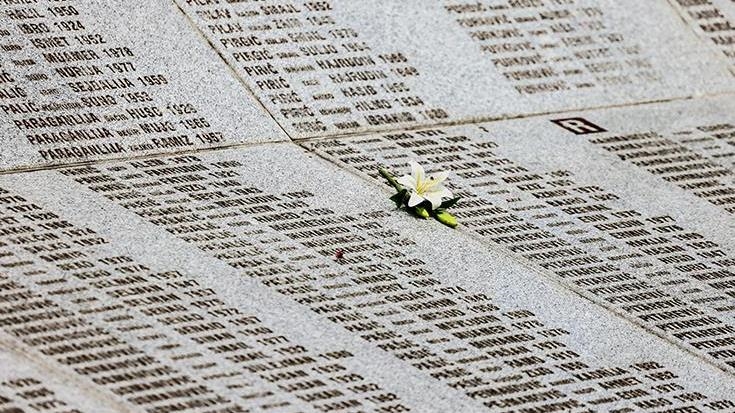
Above is the author’s keynote address at the UN Conference in Vienna to mark 11th July (Endorsed by the UN General Assembly as the International Day of Reflection and Commemoration of the 1995 Srebrenica Genocide).


Prof Anis Bajrektarevic

Prof. Anis H. Bajrektarevic, Geopolitics of Energy Editorial Member, Chairperson for Intl. Law & Global Pol. Studies. Former legal practitioner and the president of Young Lawyers Association of BiH Bar (late 1980s). Former MFA official and career diplomat (early 1990s). Research Fellow at the Institute for Modern Political-history analyses, Dr. Bruno Kreisky Foundation as well as the Legal and Political Advisor for CEE at the Vienna-based Political Academy, Dr. Karl Renner (mid 1990s). His previous book "Geopolitics of Technology – Is There Life after Facebook?" was published by the New York’s Addleton Academic Publishers. Just released is his newest book" Geopolitics – Europe 100 years later." contact: anis@bajrektarevic.eu
UK

Corbynism returns: a new party on the Left

Jeremy Corbyn and Zarah Sultana's breakaway progressive party has already got off to a shaky start


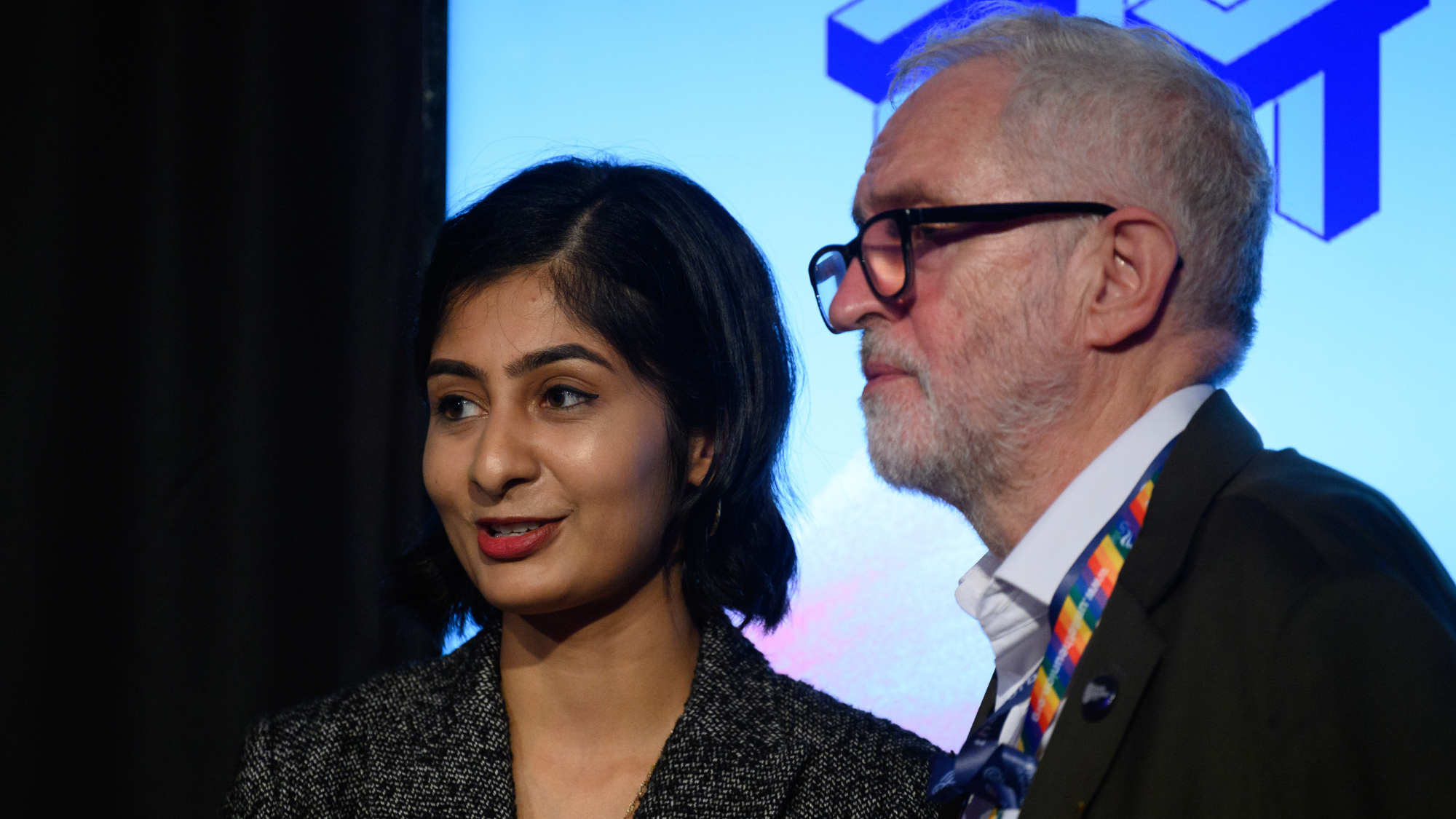
Zarah Sultana and Jeremy Corbyn speaking at the 2021 Labour Conference
(Image credit: Leon Neal / Getty Images)


By The Week UK
JULY 12, 2025

"To launch a political party is quite something," said Quentin Letts in the Daily Mail. "To bungle the launch of one," though, requires a special type of incompetence. This was on full display last week when firebrand Coventry South MP Zarah Sultana announced she was quitting Labour to co-lead a new left-wing party with Jeremy Corbyn - only for the whole project to collapse into farce within moments of its unveiling.


Sultana had proudly declared the (as yet unnamed) Leftist breakaway movement on X, saying that at the next election, voters would face a choice between "socialism or barbarism". Problem is, she appears to have "jumped the gun". "Comrade Corbyn" was reportedly blindsided by her post and furious; he refused to confirm he would be co-leading the party, only going so far as to say that a "real alternative" to Labour was coming. The chaos was an "absolute gift" to Keir Starmer, said Zoë Grünewald in The i Paper. Rocked by the biggest rebellion of his career over welfare reform, the PM should have been left "on the ropes" by the prospect of a credible left-wing alternative. Instead, it was his challengers who looked "confused and divided".

It wasn't the smoothest of debuts, said Peter Franklin on UnHerd, and the turbulence may continue. It has been reported that Corbyn and Sultana want their alliance to be based on opposition to the "genocide in Gaza" and on the cost of living. That will mean rallying support from among secular progressive Leftists and Muslim voters - which won't be easy. These factions "agree on foreign policy and largely on economics", but they're "worlds apart on social issues such as abortion".

But if the left-wingers do get their act together, said Andrew Grice in The Independent, it could spell catastrophe for Starmer. A Corbyn-led party would attract at least 10% of the vote, according to More in Common - more than enough to unseat scores of Labour MPs. Cabinet big-hitters such as Wes Streeting and Jess Phillips, whose constituencies have large Muslim populations, and who only just staved off challenges from "Gaza independents" at the last election, would very likely lose their seats if Corbyn's alliance comes to fruition. The Greens may well also be losers here - unless they form a pact with the left-wingers.


It seems the death of the Labour Left was exaggerated, said Aletha Adu in The Guardian. A year ago, riding high on electoral victory and having suspended Corbyn and removed the whip from Sultana, Starmer's team gloated that they'd buried the Left. But if the welfare rebellion and this alliance are anything to go by, it is "very much alive".
ASEAN Regional Forum urges nuclear weapon states to advance towards nuclear disarmament

Group discusses Myanmar's humanitarian situation, Gaza, North Korea's denuclearization, Ukraine war

Saadet Gokce |12.07.2025 - TRT/AA


ISTANBUL

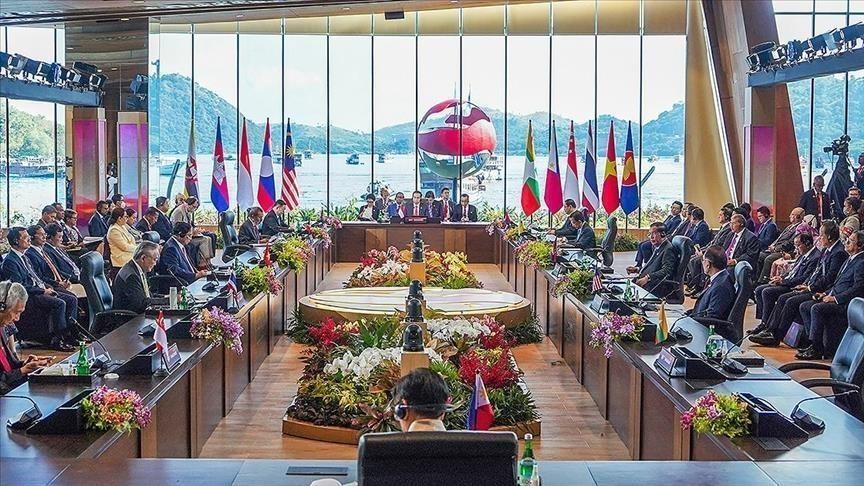
The Association of South East Asian Nations (ASEAN) Regional Forum meeting has urged the nuclear weapon states to "fulfil their obligations in advancing nuclear disarmament" and to "recognize the need to completely eliminate nuclear weapons."

ASEAN, along with several other nations, including the US, during the 32nd ASEAN Regional Forum in Malaysian capital Kuala Lumpur on Friday, reiterated "the importance of strengthening international and regional cooperative efforts in nuclear non-proliferation," according to a statement from the chair.

The meeting reaffirmed the group's commitment to "preserving the Southeast Asian region as a Nuclear Weapon-Free Zone."

It emphasized the importance of strengthening "mutual trust and confidence" and exercising self-restraint "in the conduct of activities that would complicate or escalate disputes and affect peace and stability, and avoid actions that may further complicate the situation" in the South China Sea.

The meeting also expressed "deep concern over the escalation of conflicts and humanitarian situation in Myanmar" and denounced "the continued acts of violence against civilians and public facilities," while also urging all parties to "take concrete action to immediately halt indiscriminate violence."

It stressed the importance of "resuming peaceful dialogue among all concerned parties in order to realize lasting peace and stability in a denuclearized Korean Peninsula," expressing its "grave concern over the recent surge in North Korean intercontinental ballistic missile testing and ballistic missile launches."

The meeting underscored the importance of "immediate cessation of hostilities and the serious engagement in a genuine dialogue for the peaceful resolution of the conflict" in Ukraine.

The meeting also urged an "immediate and permanent ceasefire" in Gaza and "the immediate and unconditional release of all hostages, especially women, children, the sick and the elderly," condemning "all attacks against civilians and civilian infrastructure."

It reaffirmed its "longstanding support for the inalienable rights of the Palestinian people, including the rights to self-determination, and to their homeland," and called on all parties "to work towards a peaceful resolution to the conflict with a view to realizing the two-State solution in accordance with international law."

The expanded security forum is attended by the US, China, Japan, South Korea, North Korea, and the EU, as well as other countries in South Asia and the Pacific in addition to the ASEAN members.

Notably, Pyongyang did not attend this year's session, for the first time since 2000, according to the Yonhap News.


ARF Members Express Concern over Korean Peninsula Security, Calls for 'Complete Denuclearization'

Written: 2025-07-12 

ARF Members Express Concern over Korean Peninsula Security, Calls for 'Complete Denuclearization'

Photo : Ministry of Foreign Affairs

Southeast Asian countries and Indo-Pacific partners, including South Korea and the United States, have expressed concern over the security situation on the Korean Peninsula, calling for efforts to achieve "complete denuclearization" of the peninsula.

In a Chairman's Statement adopted Friday at the 32nd ASEAN Regional Forum(ARF) in Kuala Lumpur, participants expressed serious concern over North Korea’s growing number of intercontinental ballistic missile (ICBM) and other missile launches, as well as the rising tensions on the peninsula.

Top diplomats from the participating nations urged the North to fully comply with all relevant UN Security Council(UNSC) resolutions, while calling for dialogue among the concerned parties to achieve lasting peace and stability on a denuclearized peninsula.

This year's statement only called for the North's denuclearization to be "complete," omitting the phrase "complete, verifiable, and irreversible" which had appeared in ARF statements over the past three years. Some observers see the softer tone as reflecting the new South Korean government's more conciliatory approach.

The ARF is an expanded security forum led by the ten-member ASEAN bloc and includes 17 other participants, such as South Korea, the U.S., China, Japan, the European Union, and North Korea.

However, North Korea did not attend this year’s forum for the first time, amid strained diplomatic ties with host country Malaysia.
China's Xi to visit South Korea for APEC summit, Trump yet to confirm: Report

South Korean president mulling over attending Beijing's World War II commemorative military parade in September, says journalist, citing president

Saadet Gokce |12.07.2025 - TRT/AA


ISTANBUL

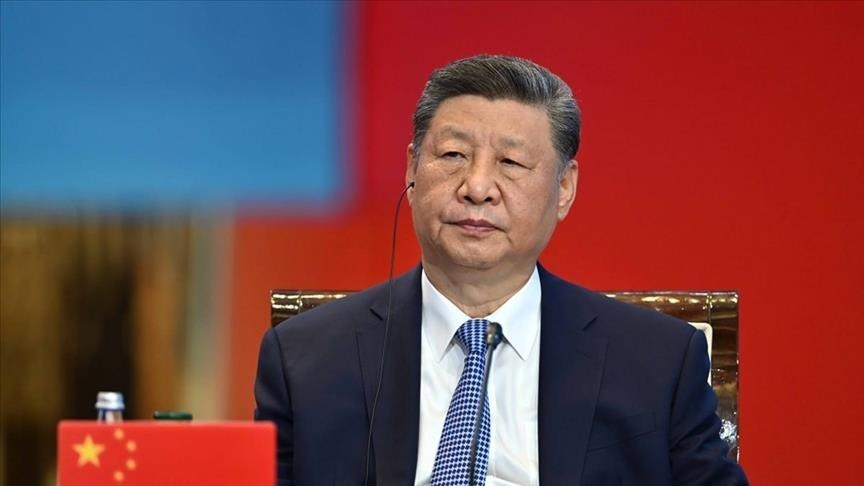
China’s President Xi Jinping is reportedly planning to attend the Asia-Pacific Economic Cooperation (APEC) summit later this year in South Korea, while US President Donald Trump has yet to make a decision, Yonhap News Agency reported Saturday.

The report cited journalist Jeong Kyu-jae, who shared details of his Friday luncheon meeting with South Korean President Lee Jae Myung on his YouTube channel.

“Xi Jinping will visit the APEC summit in Gyeongju,” Jeong quoted Lee as saying.

Lee "effectively said that US President Donald Trump also needs to attend, but a decision has apparently not been made yet,” Jeong added, according to the news agency.

The 2025 APEC summit is scheduled to be held in the South Korean city of Gyeongju between late October and early November.

Lee has not yet decided whether he will attend China’s military parade in September, which commemorates the 80th anniversary of the end of World War II, according to the report.

“I got the impression that he is considering the issue of attendance very carefully,” Jeong said, noting that former South Korean President Park Geun-hye faced displeasure from Washington after attending the same parade in 2015.
Bosnia’s missing persons institute offers hope, stands as global model

Nearly 80% of missing from 1990s war identified, but thousands still wait to be found

Vesna Besic |12.07.2025 -  TRT/AA


SARAJEVO, Bosnia and Herzegovina

In a country where tens of thousands disappeared during the 1992-1995 Bosnian war, Bosnia and Herzegovina’s Institute for Missing Persons has emerged as a beacon of hope, reuniting families with their loved ones and setting a model for post-conflict recovery worldwide.

The state-level institute, established to trace and identify those who vanished during the war, was made a permanent fixture in Bosnia, unlike other countries, which tend to rely on temporary commissions or international bodies.

Today, nearly 80% of the 32,000 people reported missing during the war have been found and identified — a rate unmatched globally — while more than 7,600 remain unaccounted for.

Around 1,300 unidentified remains are still held in mortuaries across the country.

Pioneering approach born of necessity

Amor Masovic, the institute’s former director and co-founder, said Bosnia began documenting missing persons as early as April 1992, during the first months of the conflict, recognizing the importance of systematic record-keeping.

“My advice to countries in conflict is clear: start documenting disappearances immediately, including locations and circumstances,” Masovic told Anadolu.

He emphasized that the missing are often victims of serious crimes, including war crimes and genocide, underscoring the urgency of their recovery for both justice and reconciliation.

After the 1995 Dayton Peace Agreement, Bosnia had three separate agencies working on missing persons cases which would frequently duplicate efforts or obstruct one another.

Determined to unify these efforts, Masovic enlisted the support of the International Commission on Missing Persons to create a single, coordinated body.

In 2004, Bosnia passed a groundbreaking law on missing persons — the first of its kind globally — which established the institute as a unified national body and granted legal rights to the families of the missing.

Model for world

The institute’s success has been recognized by the UN as a “colossal achievement.” Neighboring countries — including Croatia, Serbia and Kosovo — have adopted similar approaches, and the model is now being studied for possible use in Ukraine.

Emza Fazlic, a spokesperson for the institute, highlighted its exceptional track record, noting that while conflict-affected regions typically identify up to 30% of missing persons, Bosnia has identified nearly 80%.

“This institute has become a pillar of the search for the missing in our country,” Fazlic told Anadolu.

Despite these successes, however, challenges still remain.

Masovic explained that between 2,200 and 2,400 of the missing are believed to be among the unidentified remains stored in mortuaries but cannot be matched due to the absence of DNA from close relatives.

Others were misidentified in the immediate post-war years, complicating later efforts to establish identities.

To address these challenges, Masovic has proposed using DNA samples from deceased parents to match unidentified remains, allowing families to finally lay their loved ones to rest.

“The institute is a unique organization dedicated to finding missing persons from all backgrounds and has proven to be the most effective way to search for the missing,” Masovic said.
After decades of insurgency against Turkey, PKK begins disarming in step toward peace

Jul 11, 2025 
PBS NEWSHOUR 

By — Nick Schifrin
By —Zeba Warsi
By — Sonia Kopelev
By — Dan Sagalyn

For the first time in four decades, the Kurdistan Workers Party, known as the PKK, is laying down its arms and says it will end its insurgency against Turkey. The separatist group’s disbandment comes after its imprisoned leader announced an end to its 41-year armed struggle and a transition to democratic politics. Nick Schifrin reports.

Read the Full Transcript

Notice: Transcripts are machine and human generated and lightly edited for accuracy. They may contain errors.

Amna Nawaz:

Today, for the first time in four decades, the Kurdistan Workers Party, known as the PKK, is laying down its arms and says it will end its insurgency against Turkey. The separatist group's disbandment comes after its imprisoned leader, Abdullah Ocalan, announced an end to its 41-year armed struggle and a transition to democratic politics.

Today marks the PKK's first concrete steps toward peace.

Here's Nick Schifrin with more.


Nick Schifrin:

Today, they came down from the mountains. So rifles that for four decades have been drenched in blood can now be destroyed by fire.

Kurdish separatists hope their armed struggle for independence can now become peaceful, said 47-year-old Kurdish separatist leader Bese Hozat.


Bese Hozat, Co-Chair, Kurdistan Communities Union (through interpreter):

To wage our freedom, democracy and socialist struggle with methods of legal and democratic politics, we voluntarily destroy our weapons before your presence as a step of goodwill and determination.


Nick Schifrin:

For years, these fighters, often no older than 20, and their weapons targeted Turkish forces, as seen in their propaganda videos. Some 30 million Kurds live across Turkey, Syria, Iraq and Iran. And in Southeast Turkey and across the border in Iraq, the Kurdistan Worker's Party has been waging an insurgency, demanding greater rights and an independent state.

Their methods have been bloody and include terrorist attacks on civilian targets. Turkey says the 41-year conflict has killed more than 40,000 people.


Zubeyir Aydar, Executive Council Member, Kurdistan Communities Union (through interpreter):

The Kurds and the Kurdish movement took these steps for a peaceful solution and an honest solution. The Kurds took a risk, but this risk has been taken for a peaceful democratic solution.


Nick Schifrin:

Zubeyir Aydar heads the Kurdish separatist movement's political wing. Turkey put out a warrant for his arrest in 2009. He lives in exile. We spoke to him from Brussels.

A Turkish official today said this was a — quote — "irreversible turning point toward peace." Do you believe this is a pause in fighting or this is an irreversible step toward peace?


Zubeyir Aydar (through interpreter):

We don't want to be cheated or lied to and we don't want to cheat anyone. We deeply hope that the opposite side, the Turkish side, is honest as well in the peaceful negotiations.


Nick Schifrin:

For years, Kurdish protesters have accused the Turkish state of cracking down on Kurdish rights and culture. And, for years, the Turkish military has attacked the Kurdistan Worker's Party and its allies in Turkey and beyond with airstrikes that international humanitarian organizations say have violated human rights.

Turkey has set up military bases and outposts in Northern Syria, where Kurds backed by the United States have fought ISIS. Turkey's also created bases in Northern Iraq, where the Kurdistan region is semiautonomous. But, earlier this year, longtime Kurdistan Worker's Party leader Abdullah Ocalan called for peace.

And in a rare video this week, he said his group would disarm and expected Turkey to provide greater rights.


Zubeyir Aydar (through interpreter):

First of all, the Kurdish community should be constitutionally recognized in Turkey. The Kurds have been ignored for a very long time. The Kurds need to be able to live with their own identity and their own culture. Political prisoners must be released and the fighters need to have rights to live and do politics in Turkey.


Nick Schifrin:

And have you seen today Turkey take any of those steps?


Zubeyir Aydar (through interpreter):

Turkey says with words they will take these steps, but these steps haven't been taken. We hope that Turkey will not miss this opportunity, this peace opportunity.


Nick Schifrin:

Turkish President Recep Tayyip Erdogan has long advocated for harsh crackdowns on the Kurds, but this week he predicted peace.


Recep Tayyip Erdogan, Turkish President (through interpreter):

The winners of this will be the whole of Turkey, Turks, Kurds and Arabs. Then it will be our entire region and all our brethren in the region.


Nick Schifrin:

And I'm now joined by Jim Jeffrey, the former U.S. ambassador to Turkey, as well as to Iraq, who was most recently the special representative for Syria under the first Trump administration.

Ambassador Jeffrey, thanks very much. Welcome back to the "News Hour."

Bottom line, how significant is this event that we saw today? The Kurdistan Worker's Party burning their rifles, calling for their armed struggle to be now waged peaceful?

James Jeffrey, Former U.S. Ambassador to Turkey: This is a huge step forward of a process that began about six months ago. It signifies the end of a 40-year terrorist insurgent campaign in Turkey, Iraq and Syria against the Turkish state and at times against various other elements.

It is a dramatic move forward for the whole region and is something that will really stabilize the Northern Levant in very many important ways.


Nick Schifrin:

You heard President Erdogan say in the story that ran just before you and I started speaking, say that the winners of this will be the whole of Turkey.

Of course, he was not the one who really pushed this. It was actually a member of his coalition. Nonetheless, why has he come out and supported this, and why now?


James Jeffrey:

Well, why now is partially domestic politics in Turkey. Erdogan wants to move forward with changes in the Constitution.

And the PKK, besides a terrorist movement, has also an associated political party that has the third largest number of seats in Parliament. So, there is somewhat opportunistic political reason for this as well.

But, nonetheless, Erdogan, back more than a decade ago when I was in Turkey as ambassador, was working hard to try to get cease-fires and some kind of understanding with the PKK and other Kurdish groups.


Nick Schifrin:

In the story that we ran right before, you heard Zubeyir Aydar, the Kurdish separatist political leader, say a few things.

He said — quote — "The Kurds took a risk" and — quote — "We deeply hope that the opposite side, the Turkish side, is honest."

Do you believe that Turkey will proceed honestly going forward?


James Jeffrey:

I believe that the Turkish government, particularly the president, Erdogan, and the leader of the other coalition party, Bahceli, are very serious.

Now, what the Kurds are talking about is continued democratic processes that would give Kurds their rights, language rights, other equality within Turkey. And that is still something that we have to see how it develops on the ground.


Nick Schifrin:

Not only that. Zubeyir Aydar listed a few things that he expected Turkey to do. He said that the Kurdish community should be constitutionally recognized in Turkey, Kurds need to be able to live with their own identity, their own culture, political prisoners need to be released, and fighters need to have rights to live and do politics in Turkey.

Can all that really happen?


James Jeffrey:

That's a good starting list. I can see the Turks granting some of it because some of it's already been granted, Turkish identity, particularly in areas where they're the majority.

And the Turks are talking about reconciliation, but they're also talking about accountability. And some of these PKK fighters have verifiable charges of terrorism against them, and that's going to have to be worked out as well.


Nick Schifrin:

As you know better than anyone, these divisions here are deep. How can this peace really hold, given those divisions?


James Jeffrey:

Well, for two reasons.

First of all, the armed struggle hasn't worked. The PKK has been decisively defeated militarily. But, secondly, over the past 20-plus years, particularly since President Erdogan came to power, the Turkish state has been somewhat more open to Kurdish identity, Kurdish culture, Kurdish language, and other things.

It's not what many Kurds want, but it is a huge step forward from the Turkey that I knew in the 1980s and 1990s.


Nick Schifrin:

And, finally, Jim Jeffrey, the U.S, of course, has had a complex relationship with Kurds across the region, but have allied with Kurds, especially in Syria, against the Islamic State. How does a deal like this today affect the U.S. relationship with Kurds in the other countries, but especially Syria?


James Jeffrey:

It's huge.

Kurds, including the PKK Kurds and the many Kurds in Iraq and Turkey and elsewhere who are not part of the PKK, know that we were an honest broker. They know that we were pushing for both peace and, at the same time, helping Ankara fight terrorism. We also had people on the ground, Foreign Service offices, so important to our diplomacy, working with all sides, often in dangerous conditions, to try to move this forward.

Again, the credit goes to the Turkish people, the government, the PKK and their supporters, but the U.S. played a big role here also.


Nick Schifrin:

Ambassador James Jeffrey, thank you very much.


James Jeffrey:

Thank you.

Kurdish PKK fighters destroy their weapons at disarmament ceremony

ENDING THE ARMED STRUGGLE WITH TURKIYE


Last updated: July 11, 2025 


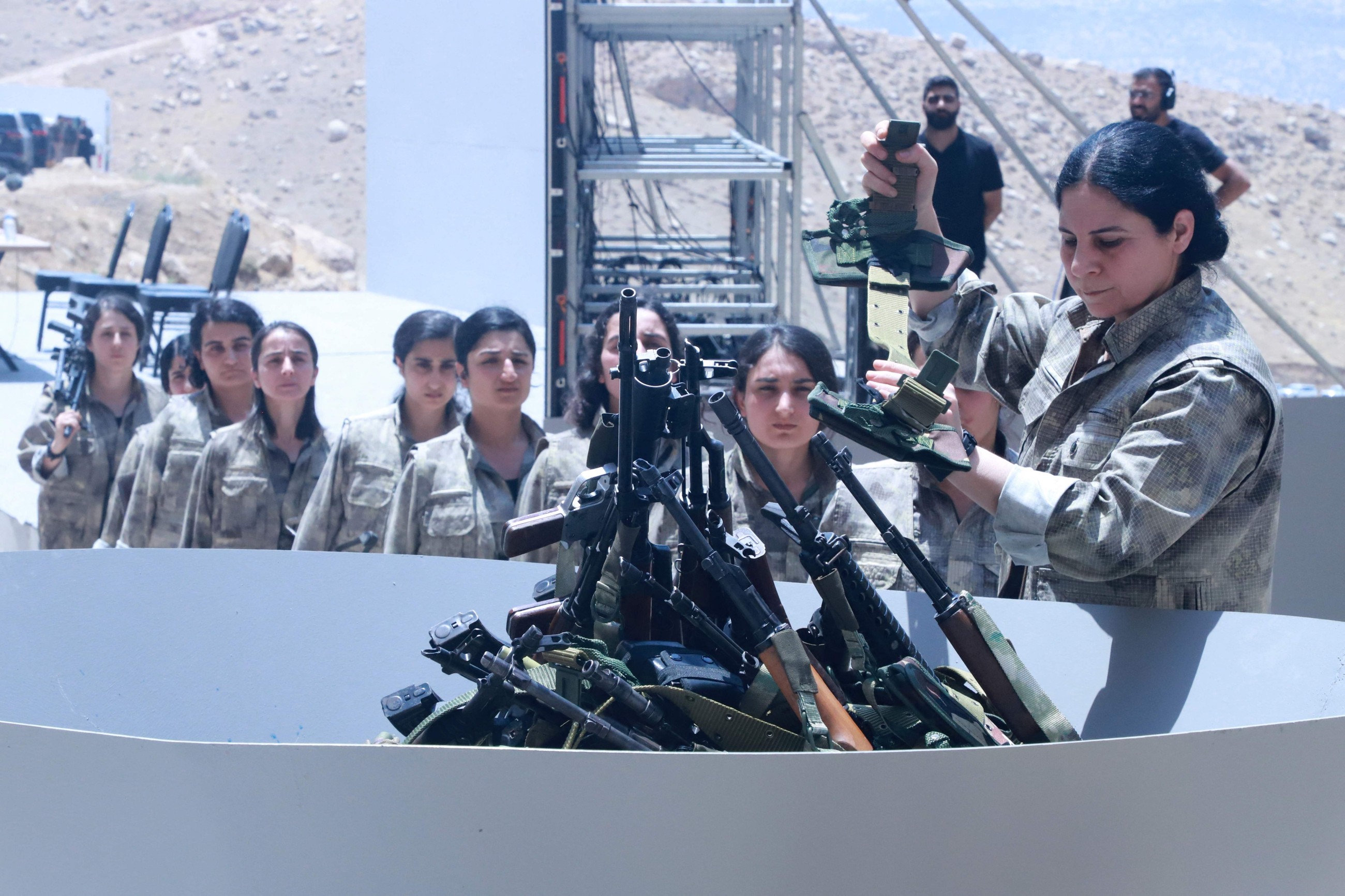
Fighters with the Kurdistan Workers' Party line up to put their weapons into a pit during a ceremony in Sulaimaniyah, Iraq, on Friday. AFP


Thirty PKK fighters destroyed their weapons at a symbolic ceremony in Iraqi Kurdistan on Friday, two months after the Kurdish rebels ended their decades-long armed struggle against the Turkish state.

The ceremony marked a major step in the transition of the Kurdistan Workers' Party (PKK) from armed insurgency to democratic politics, as part of a broader effort to bring an end to one of the region's longest-running conflicts.

Analysts say that with the PKK weakened and the Kurdish public exhausted by decades of violence, Turkey's peace offer handed its jailed founder Abdullah Ocalan a chance to make the long-desired switch away from armed struggle.

The PKK's disarmament also grants President Recep Tayyip Erdogan the distinction of being the Turkish leader who managed to draw a line under a bloody conflict that cost more than 40,000 lives and wrought havoc in Turkey and beyond.

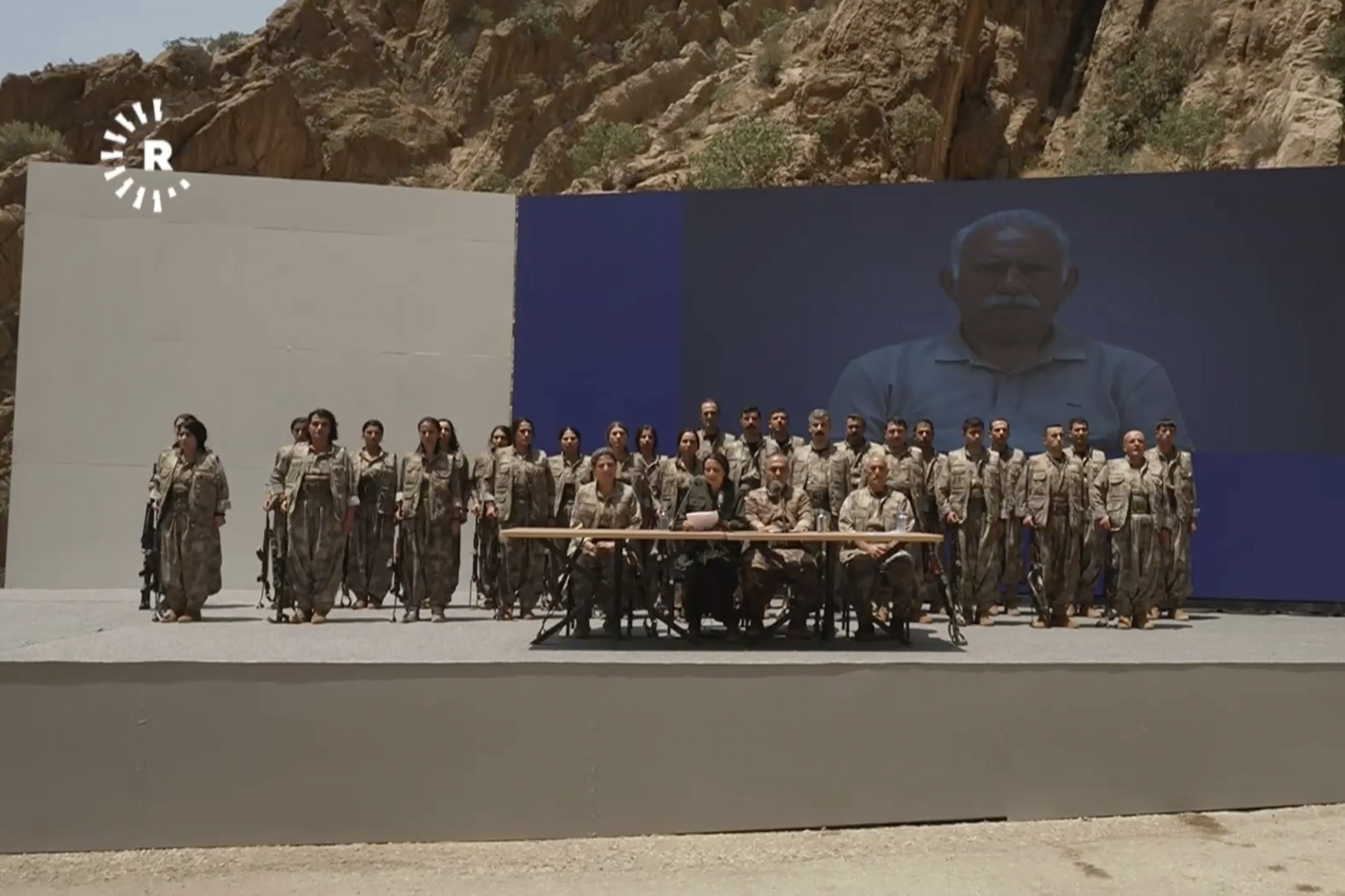
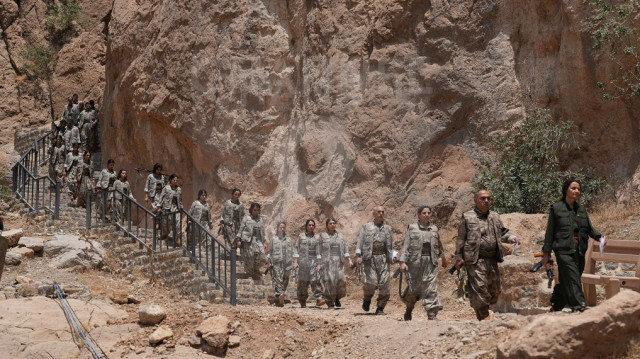
Outside the ancient cave of Casene, a group of 30 PKK fighters, men and women, gathered on a stage in khaki fatigues, their faces uncovered, in front of an audience of around 300 people, an AFP correspondent at the scene said.


This frame grab from video released by Rudaw TV shows PKK fighters standing next to a photo of their jailed leader Abdullah Ocalan during a symbolic disarmament ceremony. AP

One by one, they walked down to lay their weapons in a cauldron in which a fire was lit. Most were rifles but there was one machine gun and a rocket-propelled grenade launcher.

As they looked on, people in the crowd started cheering while others could be heard weeping

After the ceremony, the fighters returned to the mountains, a PKK commander said.

Speaking to AFP after the ceremony, the PKK's top female commander Bese Hozat said that for the process to succeed, it was essential to release Ocalan — known to his followers as 'Apo' — who has been serving life in solitary confinement since 1999.

"Ensuring Leader Apo's physical freedom via legal guarantees, is essential... he should be able to freely lead and manage this process. This is our primary condition and demand," she said.

"Without this development, it is highly unlikely that the process will continue successfully."

Erdogan hailed the ceremony as an "important step" on the path to a "terror-free Turkey", expressing hope it would lead to "the establishment of lasting peace in our region."


And a senior Turkish official source described it as a "concrete and welcome step." "We view this development as an irreversible turning point," he said, adding that the move to decommission weapons was part of a broader five-stage process.

The following steps would involve the legal reintegration of former fighters into society, the establishment of mechanisms for their lawful return and for justice, ensuring accountability and stability.


Agence France-Presse


PKK disarmament opens new page for Turkey, President Erdogan says

Erdogan said the recent steps to disarm have united Turkey, and now the parliament will help facilitate the disarmament process.

By REUTERS
JULY 12, 2025 12:41

Turkish President Recep Tayyip Erdogan on Saturday called for full support of the disarmament of Kurdish militants that began with a handover of the first batch of weapons by Kurdistan Workers Party (PKK) forces, a step he said opened a new page for the country.

Thirty PKK militants burned their weapons at the mouth of a cave in northern Iraq on Friday, marking a symbolic but significant step toward ending a decades-long insurgency against Turkey.

"As of yesterday, the scourge of terrorism has entered the process of ending. Today is a new day; a new page has opened in history. Today, the doors of a great, powerful Turkey have been flung wide open," Erdogan told members of his AK Party in Ankara.

He said the recent steps have united the nation, and now the parliament will play a critical role in setting up a legal framework for completing the disarmament process.

An armed PKK fighter places a weapon to be burnt during a disarming ceremony in Sulaimaniya, Iraq, July 11, 2025, in this screengrab obtained from a handout video. (credit: KURDISTAN WORKERS PARTY MEDIA OFFICE/Handout via REUTERS )

Turkey forms parlimentary commission for PKK disarmament"I hope that our parliament will support this process with the broadest possible participation," Erdogan said.

Ankara has taken steps toward forming a parliamentary commission that will oversee the disarmament and PKK's transition into democratic politics.

The PKK, locked in conflict with the Turkish state and outlawed since 1984, decided in May to disband, disarm, and end its separatist struggle after a public call to do so from its long-imprisoned leader Abdullah Ocalan.


What to Know about the Latest Effort to End Türkiye's 40-year Kurdish Conflict


FILED - 02 November 2041, Hesse, Frankfurt_Main: A man displays a flag with the image of imprisoned Kurdish leader Abdullah Ocalan at the Kurdish Newroz celebration in Frankfurt. Photo: Boris Roessler/dpa

Asharq Al Awsat
12 July 2025 
AD Ù€ 17 Muharram 1447 AH

A group of 30 Kurdish fighters clad in camouflage fatigues burned their weapons in a large cauldron in northern Iraq on Friday, in a symbolic gesture marking the first concrete step in an effort to end one of the Middle East’s longest-running insurgencies.

The ceremonial laying down of arms by members of the Kurdistan Workers’ Party, or PKK -- including 15 women — comes months after the group’s imprisoned leader, Abdullah Ocalan, called on it to disarm and disband as part of a new peace effort with Türkiye. Ocalan repeated that call in a video message to his fighters this week.

The process in Türkiye was initiated in October by Devlet Bahceli, a firebrand ultranationalist politician who has usually opposed any concessions to Kurdish identity or rights.

While Turkish officials have welcomed the first step toward the PKK’s disarmament, questions remain about the future of Kurdish fighters in Syria.

What is the PKK? The Kurdistan Workers’ Party, or PKK, has waged an armed insurgency against Türkiye since 1984, initially with the aim of establishing a Kurdish state in the southeast of the country. Over time, the objective evolved into a campaign for autonomy and rights for Kurds within Türkiye.

The conflict between militants and state forces, which has spread beyond Türkiye’s borders into Iraq and Syria, has killed tens of thousands of people. The PKK is considered to be a terrorist organization by Türkiye, the United States and the European Union.

Who is Ocalan? Abdullah Ocalan, who as a student of political science in Ankara became deeply involved in leftist movements, formed the PKK in 1978 as a Marxist organization. He fled to Syria in 1979, along with other PKK members, where he remained until 1998, when Syria expelled him under intense pressure from Türkiye.

Ocalan was captured in Kenya in 1999 and imprisoned on Imrali island in the Sea of Marmara, where he remains to this day. His death sentence for treason was commuted to a life term in prison after Türkiye abolished the death penalty.

The 76-year-old endures as a symbol for Kurdish independence and rights and continues to wield influence over the Kurdish movement, with past messages relayed through family members or lawyers resonating beyond Türkiye, in Iraq and Syria.

Push for peace

In October, Bahceli, a close ally of President Recep Tayyip Erdogan, suggested Ocalan could be granted parole if he renounces violence and disbands the PKK.

It was a major shift for the hardline politician who had previously strongly supported the state’s military action against the militant group and its affiliates in neighboring Syria and rejected any notion of negotiation.

In a message delivered through senior officials of the pro-Kurdish People's Equality and Democracy Party, or DEM, Ocalan called on the PKK leadership to take the decision to disband and disarm in February.

The PKK announced a unilateral ceasefire in March in response to Ocalan’s call and later announced its decision to disarm.

It was not immediately clear what concessions, if any, the Kurdish groups would get in return. PKK officials have said they expect former fighters to be given a path to integrate into the political system in Türkiye.

There are also concerns that some splinter groups may emerge within the PKK and that attacks may continue.

Soon after Bahceli's announcement, the PKK claimed an attack on Türkiye’s key aerospace company outside of Ankara that killed several people.

Previous attempts

There have been several peace efforts between the Turkish state and the PKK over the years, including secret negotiations held in Oslo, Norway from 2009 until 2011. However, none have yielded results.

The last attempt to reach a peace deal took place between 2013 and 2015 with a series of talks between Turkish officials and Ocalan, who declared a ceasefire and withdrew fighters to bases in northern Iraq.

Turkish officials took steps to improve Kurdish rights, including allowing Kurdish-language broadcasts. The process collapsed in July 2015, after a series of violent attacks, including one by the ISIS group that killed 33 pro-Kurdish activists.

Since then, Türkiye has cracked down on its pro-Kurdish movement and has jailed thousands of people, including the former leader of the main pro-Kurdish political party, Selahattin Demirtas, over alleged links to the PKK.

Reshaping the region

The latest peace effort comes at a time when Türkiye and the Kurds are both seeking security to face the challenges in the Middle East.

The renewed peace initiative unfolds amid fundamental changes reshaping the region, including the reconfiguration of power in Syria after the toppling of President Bashar Assad, the weakening of the Hezbollah militant movement in Lebanon, and the ongoing Israel-Hamas war in Gaza.

Türkiye strongly supports a deal reached between Syria’s new administration and the Kurdish-led and US backed Syrian Democratic Forces under which the SDF forces would merge with the new Syrian national army. The US envoy to Syria told The Associated Press this week that the sides remain at odds over the merger.

Hamish Kinnear, Senior Middle East and North Africa Analyst at risk intelligence company Verisk Maplecroft, said Ocalan’s decision to abandon the armed struggle coincides with a period when the PKK’s leverage is weak due to military setbacks and regional isolation.

“The PKK’s armed struggle was already faltering in the face of advances by Türkiye’s military, while its popularity among its traditional base was in decline,” Kinnear said. ”Ultimately, the peace talks were a useful off ramp in which improvement of Kurdish rights could still be pursued."

However, some believe the main aim of the reconciliation effort is for Erdogan’s government to garner Kurdish support for a new constitution that would allow him to remain in power beyond 2028, when his term ends.

Bahceli has openly called for a new constitution, saying it was essential to keep Erdogan in power for Türkiye’s future. Erdogan and Bahceli are reportedly seeking parliamentary support from the DEM.


US envoy urges PKK/YPG to act quickly on integration to avoid issues with Türkiye, Syria

'It's not unthinkable that whoever the constituency is for YPG or SDF has distanced themselves from PKK. So, I don't think it's a derivative. It's another organization,' Tom Barrack tells Anadolu

Serife Cetin and Serdar Dincel 
 |12.07.2025


'One country, one nation, one military is dictated by that nation, which we're now recognizing,' Barrack says about Syria

'I think issues that will arise is they're going to have disagreement with the Syrian government, they're going to have disagreement with the Türkiye government,' Barrack says about issues that may arise if PKK/YPG-led SDF does not act quickly on integration process into Syria's state institutions

US envoy says Washington will usher PKK/YPG-led SDF “to the point of vetting all of their issues, and we'll do the best job we can, making sure that there's a fair and accurate decision.”

'Intent is not to keep it (US military presence in Syria) forever,' says Barrack

NEW YORK/ISTANBUL

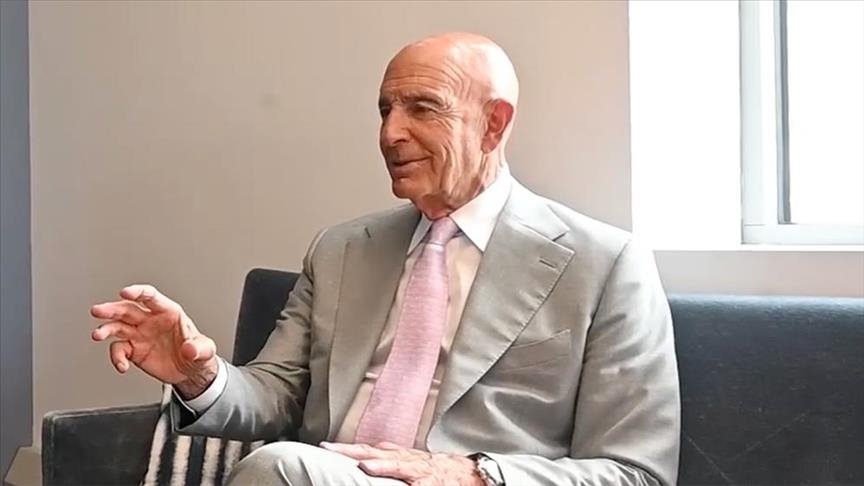
US Ambassador to Türkiye and Special Envoy for Syria, Tom Barrack, said that if the terrorist organization PKK/YPG in Syria does not act quickly on integration, it will face problems with the Turkish and Syrian governments.

"The US will do its best to ensure a fair and proper decision is made. If they want to come to America and live with us, they can do so." Barrack told Anadolu following his press conference in New York on Friday.

He explained the origins of the groups by saying, “The YPG emerged from various offshoots of the PKK, and the SDF emerged from various offshoots of the YPG.” When reminded of his previous statement that “the SDF is the YPG and the YPG is a derivative of the PKK,” he emphasized, “I have never said that the SDF is a derivative of the PKK.”

"It's not unthinkable that whoever the constituency is for the YPG or the SDF has distanced themselves from the PKK. So, I don't think it's a derivative. It's another organization," Barrack told Anadolu.

When reminded that the terrorist organization PKK/YPG, which uses the name SDF in Syria, has sent messages about the need to use time effectively in the integration process, and asked what problems might arise if they do not, Barrack responded:

“The problems that will arise are disagreements with the Syrian government and the Türkiye government. The US government has stated that it will review all their issues and do its best to ensure a fair and accurate decision. If they want to come to America and live with us, they can do so.”

On March 10, the Syrian presidency announced the signing of an agreement for the integration of the SDF into state institutions, reaffirming the country's territorial unity and rejecting any attempts at division.

Bashar Al-Assad, Syria’s leader for nearly 25 years, fled to Russia on Dec. 8, ending the Baath Party’s regime, which had been in power since 1963.

Ahmed al-Sharaa, who led anti-regime forces to oust Assad, was declared president for a transitional period on Jan. 29.

In its 40-year terror campaign against Türkiye, the PKK -- listed as a terror organization by Türkiye, the US and the EU -- has been responsible for the deaths of more than 40,000 victims, including women, children and infants. The YPG/PYD, which also uses the name SDF, is the PKK’s Syrian offshoot.

PKK terrorists often hide out in northern Iraq to plot cross-border attacks in Türkiye, while the YPG/PYD has tried to establish a terror corridor in northern Syria along Türkiye’s borders.

'One country, one nation, one military is dictated by that nation, which we're now recognizing'

Regarding the reasons why talks between the SDF and the Syrian government have not yielded results, Barrack said the actual issue is whether it will align with the Syrian Arab Republic.

"One country, one nation, one military is dictated by that nation, which we're now recognizing. So that's the issue. Forget about whatever the genetics are from where it came. All of these minority groups might lust for a federalistic environment.

"That's not what's being dictated to them to be invited into. That's not up to us. It's not up to us to referee the intellectual discussion. Is that the right thing? Is that the wrong? Do you want a parliamentary system? Do you want a republic? Do you want a confessional system? How do you blend and protect minority rights?

"All of us, the UN in particular, are cheering and saying this is really important if you want our help. These are the requirements that we want to see," said Barrack.

"We want to see what you're going to do with foreign fighters. Are you integrating them? Are you not integrating them? Are you sending them home or not?"

'Intent is not to keep it (US military presence) forever'

Regarding the US military presence in Syria, Barrack highlighted that the fight against ISIS continues, stating: "The intent is not to keep it forever.

"That as we combat ISIS and counterterrorism, over time we'll decide on reducing those troops, just as all the troops should be reduced if you have a new Syrian government which is going to be independent."

Highlighting the risks regarding the integration process in Syria, Barrack said: "I think it's this transition period where seven months in there's not alignment and there's fear that the vagaries of the past will continue in the future.

"That's what's happening is will there be fairness on the part of the Syrian government?"

He, however, added that Washington is there to "usher" it, not to "enforce" it.

Agreement between Syrian government, SDF not specific enough 'to have made it work'

When asked whether the forces in El Tanf will be integrated into the Syrian army as the Pentagon has requested a budget for the armed groups in the El Tanf region, Barrack said Washington does not intend to establish a permanent presence anywhere in Syria, and US bases have "defensive" purposes.

Noting that Syria needs an extensive military presence "both on the outside and on the inside," the US envoy stated: "So the logical thing to do is incorporate SDF, who are the best of a fighting class."

Barrack said the integration between the SDF and the Syrian government will take time "because there's no trust" between the parties. "There's not enough specifics in the agreement to have made it work."

He noted that the US is trying to "punctuate those specifications so they can come together."

Barrack also said he believes that the parties are going to "come together and that would be a beautiful marriage."

US envoy rules out independent SDF state, affirms YPG-PKK ties

ANKARA


U.S. Ambassador to Türkiye and Special Envoy for Syria Tom Barrack has stated that Washington owes no obligation to help establish an independent state for the Syrian Democratic Forces (SDF), while openly acknowledging the group's ties to the YPG, the Syrian branch of the PKK terrorist organization.


Haberin Devamı

In an interview with CNN Türk, Barrack addressed questions on topics ranging from PKK disarmament to broader U.S.-Türkiye relations.

“SDF is YPG. YPG is a derivative of PKK,” Barrack said in response to a question during a press briefing at the Foreign Press Center in New York. “YPG was a spin-off of PKK that we allied with to fight ISIS,” he said, using the alternative name for the ISIL.

“So there’s a big sentiment that, because they were our partners, we owe them. The question is, what do we owe them? We don’t owe them the ability to have their own independent government within a government,” he said.

He said the Syrian government rejects federalism and ruled out the attempts to divide the country along ethnic or sectarian lines as unworkable, adding: “You can’t have a separate Druze force dressed like Druze, separate Alawite force dressed like Alawites, separate Kurd force dressed like Kurds, and on and on. There’s going to be one entity.”

He noted a failed March agreement: "There was an agreement in March. They reached a principled understanding, but it didn't work. Why? Because everyone rushed to an accord without clarifying details. Details matter. Now it's time to clarify details, bring everyone together.

The SDF thinks the U.S. owes them. The U.S. says, 'We owe you reasonableness, but if you're not reasonable, other alternatives come into play.'"

Barrack noted that the U.S. is encouraging dialogue but made clear that it will not remain in Syria “forever.”

“We’ll bring you together, we’ll arbitrate, we’ll mediate, we’ll help, but we’re not going to stick around,” he said, adding: “If you guys don’t agree, don’t agree, but we’re not going to be here forever as the babysitter.”

The Turkish government has repeatedly stressed over the years that the so-called SDF is led by the YPG, the Syrian branch of the PKK, which is designated a terrorist organization by both the U.S. and Türkiye.

Successive U.S. administrations, however—including President Trump’s first term, as well as those of Presidents Obama and Biden—have regarded the SDF as their primary partner in the fight against ISIL in Syria.

Ankara has criticized U.S. support for the YPG under the SDF umbrella, arguing it threatens regional stability and Türkiye's security.

Türkiye's mediation role

Shifting to defense matters, Barrack hailed Türkiye's advancements.

"Türkiye's UAVs are probably the world's best. TB2s are being used in the Ukraine war."

He highlighted Türkiye's key role in Ukraine-Russia and Middle East affairs, crediting strong ties with all actors, including the U.S..

Barrack praised President Recep Tayyip Erdoğan, MİT chief İbrahim Kalın, and Foreign Minister Hakan Fidan for their pivotal contributions.

Barrack underscored Türkiye's constructive efforts in regional crises: "Türkiye played a major role in the Ukraine-Russia grain deal and Gaza ceasefire attempts. Diplomacy in the region couldn't proceed without Türkiye and Qatar. Türkiye became one of our strongest mediators on Gaza."

In closing, he affirmed the Trump administration's emphasis on redefining ties with Türkiye:

"Türkiye has NATO's second-largest army and is central. It has made significant progress in defense industry. If issues like S-400s are resolved, the F-35 process can return. President Trump showed flexibility on this. We believe our forward-looking cooperation with Türkiye will increase."

UN welcomes PKK terrorist group disarmament process

11/07/2025, Friday
TRT/AA

File photo

'We hope that it will encourage further steps towards lasting peace in region,' says spokesperson

The UN on Friday welcomed the start of the PKK terror group's disarmament process.

"I can tell you that we very much welcome the operationalization of the agreement, at least the first step of the operationalization," UN spokesperson Stephane Dujarric said at a news conference.

His remarks came after a group of 30 PKK terrorists, including 15 women, on Friday laid down their weapons and destroyed them in northern Iraq's Sulaymaniyah province.

The group of PKK terrorists gathered in a cave within the boundaries of the Surdas sub-district of Sulaymaniyah, emerged with their weapons, and then proceeded to a site prepared for the disarmament process.

"We hope that it will encourage further steps towards lasting peace in the region," Dujarric said, adding the UN's readiness to "support this in any way that we can, should we be asked."

In May, the terror group PKK decided to dissolve and lay down its arms. The announcement followed a February statement by jailed PKK ringleader Abdullah Ocalan, who called for the dissolution of the PKK and its affiliated groups, urging an end to the armed campaign that has lasted for more than four decades.

In its 40-year terror campaign against Türkiye, the PKK – listed as a terrorist organization by Türkiye, the US, and EU – has been responsible for the deaths of over 40,000 people, including women, children, infants, and the elderly.

PKK terrorists have used northern Iraq, near the Turkish border, to hide out and plan attacks on Türkiye.


Mass arrests and executions: Kurds in Iran bear the brunt of war with Israel

As Iranian forces crack down on Kurdish regions in the wake of the war with Israel, locals face arrests, executions and rising repression, with activists and analysts warning of deepening isolation and a broader struggle for democratic change

Lior Ben Ari|
Ynetnews


The war with Israel has deeply affected the lives of Kurds in Iran. Kurdish regions made headlines during the war, primarily because they lie along the country’s western border—seen as a gateway for Israeli strikes. Following the outbreak of war, the regime began arresting Kurds for allegedly aiding Israel.

Razaneh, a Kurdish international relations researcher who lived in Iran until 2020 and now resides in Europe, spoke to Ynet about the complex situation facing Iran’s Kurdish population and the impact of the recent war. “Under the Islamic Republic, the Kurdish population numbers between 9 and 12 million, representing 12–17 percent of Iran’s total population,” she said.

Kurds in Iran are concentrated in the northwest, in the region of Iranian Kurdistan, which also spans northern Iraq, southeastern Turkey and northeastern Syria. “Most Iranian Kurds live in the western provinces,” Razaneh explained, citing Kurdistan, Kermanshah, West Azerbaijan, Ilam and Lorestan, with smaller communities in northeastern Khorasan. They speak various Kurdish dialects. Most are Sunni Muslims, though there are also Shiite Kurds and followers of other faiths.


“Kurds in eastern Kurdistan (Iran), like others across Kurdistan, are generally not radical in their religious outlook,” she noted. “Most are more secular in their lifestyles and beliefs. The Kurdish political parties are not religious and tend to adopt leftist or social-

Razaneh noted that during times of crisis—such as the war with Israel or the 2022 mass protests in the wake of Mahsa Amini’s killing—a sense of shared identity arises among Kurds that often sparks calls for unity and solidarity across the four parts of Kurdistan. However, she added, tensions persist among Kurds in Iran, Iraq, Turkey and Syria, with differences in ideological goals—some advocating federalism, others independence.


Mahsa Amini
(Photo: Getty Images Europe /Leon Neal)


Iraqi Kurds protesting the death of Mahsa Amini
(Photo: AFP)

She also highlighted that some Iranian Kurds have connections with diaspora communities in Europe and the U.S. These communities play a vital role in raising awareness of Kurdish issues, organizing protests and engaging with foreign governments.

Friends to all peoples in the Middle East

During the Israel–Iran war, Iranian military sites in Kurdish-populated areas — including missile storage and launch facilities — were targeted. Those tracking Persian-language reports and Iran’s air defense activity could clearly follow the strikes.
According to Razaneh, Tehran also carried out multiple military operations in these regions, especially near the border — a move she says helped the regime tighten its grip on eastern Kurdistan.


Kurds celebrate Yalda Night in Tehran
(Photo: AP Photo/Vahid Salemi)

“Some of the Israeli targets included military bases in Kurdish cities such as Mahabad, Kermanshah and Urmia,” she told Ynet. “Security oversight increased, as did arrests by the Iranian government. Following the start of the war, the regime became stricter in Kurdish areas, arresting hundreds for alleged cooperation or spying with Israel. At least three Kurdish men were executed in Urmia,” she added, also noting “new checkpoints and house and phone searches were deployed.”

“Exiled Kurdish parties in northern Iraq watched the war closely,” Razaneh said. “Some, like the PAK, saw it as an opportunity to strike back at the Iranian regime. Others, like Komala, urged restraint and patience. Many Kurds inside Iran hope the war will lead to future change.”

Kurds in Iran remain almost unable to communicate directly with Israeli officials or media — especially now — but one source in Sanandaj, Karwan (a pseudonym), told Ynet: “[Economically, socially and in terms of security,] the recent Iran–Israel conflict has directly affected all Iranians, including Kurds. In recent weeks, prices of basic goods have skyrocketed, widespread arrests have surged and death sentences and executions have increased. Iranian cities have become heavily militarized, with arbitrary arrest measures intensifying.”


Kurds in Iran
(Photo: AP Photo/Vahid Salemi)

Karwan said Iran has used the allegation of “collaboration with the enemy” to justify its crackdown. “Iranians, including Kurds, aspire to democratic change in their country. Kurds see themselves as friends to all peoples in the Middle East and hope for free, dignified and peaceful lives for all its inhabitants.” He added that Kurdish regions have long been neglected due to Iran’s centralizing policies.

On Kurdish political activity, Karwan observed: “Because of high political awareness and organization in these territories, they have historically been centers of pro-democracy and freedom-driven movements — and are thus subjected to heavy security repression. Kurdish activists frequently face threats of arrest, imprisonment or execution.”