Why Spain is offering amnesty to 500,000 undocumented migrants
As countries on both sides of the Atlantic ramp up deportations of undocumented migrants, Spain’s left-wing government is preparing to give legal status to hundreds of thousands of irregular workers. Prime Minister Pedro Sanchez has championed the amnesty as a way to not only give informal workers legal protections, but to also bring more money into a social security system increasingly under stress by the country's ageing population.
Issued on: 28/01/2026
FRANCE24
By: Paul MILLAR

Spanish shepherd Ãlvaro Esteban and Sudanese shepherd Osam Abdulmumen head to gather a sheep herd in Los Cortijos, central Spain © Bernat Armangue, AP
With a few scratches of a pen, Spain’s Socialist-led government is preparing to grant legal status to roughly half a million people now living and working in the country without documentation.
Foreign nationals with clean criminal records who arrived before the end of 2025, and who can prove they’ve lived in Spain for at least five months, will soon be eligible for renewable one-year residence permits. People who applied for asylum in the country before December 31 will also be able to apply. Migration Minister Elma Saiz said Tuesday that she expects applications to open April through June.
This extraordinary mass regularisation – the first in Spain in more than 20 years – was born from a citizen-backed proposal signed by some 700,000 people and supported by hundreds of civil society groups, including the Catholic Church.
While most immigrants in Spain have legal status, the country’s booming economy has also drawn hundreds of thousands of largely working-age people from across the world to work in the country’s underground economy. Undocumented migrants work on construction sites, on farms, in shops and restaurants or in people's homes, cooking and cleaning and caring for children.
Spain bets on migration to drive economic growth, bucking European trend
With a few scratches of a pen, Spain’s Socialist-led government is preparing to grant legal status to roughly half a million people now living and working in the country without documentation.
Foreign nationals with clean criminal records who arrived before the end of 2025, and who can prove they’ve lived in Spain for at least five months, will soon be eligible for renewable one-year residence permits. People who applied for asylum in the country before December 31 will also be able to apply. Migration Minister Elma Saiz said Tuesday that she expects applications to open April through June.
This extraordinary mass regularisation – the first in Spain in more than 20 years – was born from a citizen-backed proposal signed by some 700,000 people and supported by hundreds of civil society groups, including the Catholic Church.
While most immigrants in Spain have legal status, the country’s booming economy has also drawn hundreds of thousands of largely working-age people from across the world to work in the country’s underground economy. Undocumented migrants work on construction sites, on farms, in shops and restaurants or in people's homes, cooking and cleaning and caring for children.
Spain bets on migration to drive economic growth, bucking European trend

FOCUS © FRANCE 24
04:36
The bulk of these workers come from the country’s former colonial holdings across Latin America and North Africa such as Venezuela, Colombia, Ecuador and nearby Morocco.
And while footage of migrants scrambling over the barbed-wire fences surrounding Spain’s North African exclaves or lurching towards the Canary Islands in flimsy dinghies weigh heavily on the public imagination, the reality is usually less dramatic.
Most undocumented migrants are people who entered Spain legally, going on to overstay their visas and find cash-in-hand work in what has become known as the country’s “black economy”.
04:36
The bulk of these workers come from the country’s former colonial holdings across Latin America and North Africa such as Venezuela, Colombia, Ecuador and nearby Morocco.
And while footage of migrants scrambling over the barbed-wire fences surrounding Spain’s North African exclaves or lurching towards the Canary Islands in flimsy dinghies weigh heavily on the public imagination, the reality is usually less dramatic.
Most undocumented migrants are people who entered Spain legally, going on to overstay their visas and find cash-in-hand work in what has become known as the country’s “black economy”.
Bucking the trend
The decision sits in stark contrast to a hardening approach to irregular immigration that has flourished across Europe and the US in recent years as the far right gains ground.
Despite declining numbers of irregular arrivals, European Union states in December last year backed harsher migration measures that would allow rejected asylum seekers to be deported to offshore “return hubs” or countries with which they have no connection.
In France, last year’s figures show rising numbers of deportations paired with fewer cases of undocumented migrants being granted legal pathways to work.
Prime Minister Pedro Sanchez has maintained that – far from being a drain on the country’s social services as critics claim – migrants play a crucial role in keeping the country’s welfare state standing. Bringing half a million workers into the formal economy, he argues, will only strengthen the country’s social security system.
Migration Policy Institute Europe deputy director Jasmijn Slootjes said that Spain’s decision was partly in response to fears that the ageing native-born population won’t be capable of sustaining the kind of workforce the country needs to thrive.
“If you look at the demographic decline, the fertility rate in Spain is the lowest in Europe – so it's really, really low,” she said.
“There were a lot of skill shortages, labour shortages, and de facto a lot of irregular migrants are working, although in informal work. And through regularising you can, of course, get more tax payments, and you also get better matching [to] their skills – because people can actually work at their skill level. So it’s a very pragmatic approach.”
She said that the Sanchez government – which announced this decision as part of a deal struck with its erstwhile coalition partners, the leftist PODEMOS party – was championing migration as a fundamental driver of the country’s flourishing economy.
Official data released on Tuesday indicated that 52,500 of the 76,200 people who raised employment numbers in the final quarter of 2025 were born overseas, with that same quarter marking Spain's lowest unemployment rate in 18 years.
“That’s really something that's being mentioned time and again – this link to the economy, maintaining social welfare access and a healthy, competitive country. That is really a core argument in all of this, and the evidence is indeed pointing that way,” Slootjes said.
“I think one quote of [Sanchez's] is very clear in clarifying their approach – he says, ‘Spain needs to choose between being an open and prosperous country, or a closed-off and poor country’,” she said.
Migrant deaths at Melilla border post: Three years on, truth remains elusive

Billet retour © France 24
16:51
16:51
Since the last mass regularisation in 2005 – the sixth such amnesty since the fall of the Franco dictatorship – Spain has pursued a less dramatic approach to undocumented migrants, offering them a step-by-step pathway over several years towards gaining a legal right to live, work and eventually become a Spanish citizen.
'Sanchez hates the Spanish people'
Despite a turbulent 20 years of boom and bust as Spain weathered the 2008 global financial crisis and then the Covid-19 pandemic, the country has largely avoided the rising anti-immigration sentiment that has pushed far-right parties into prominence – and sometimes power – across Europe and beyond.
That changed in 2018 with the arrival of Vox on the political scene. Born out of a broader backlash to Catalan separatism, the far-right party won the third-most seats in parliament in 2019 on an increasingly anti-immigration platform.
Unsurprisingly, Vox party leader Santiago Abascal was incensed by the announcement.
“The tyrant Sanchez hates the Spanish people. He wants to replace them,” he posted on social media, adding that Sanchez wants to "accelerate the invasion”, echoing oft-repeated right-wing narratives.
Abascal instead called for “remigration” – another far-right rallying cry that champions the mass deportation of people born overseas, sometimes including naturalised citizens.
READ MORESpain's far-right resurgence raises spectre of Franco 50 years after his death
Alberto Nunez Feijoo, leader of the conservative People’s Party – which oversaw several of the amnesties in previous decades – has also criticised the decision, as the party struggles to head off rising support for the anti-immigration Vox.
Support for immigration remains 'largely stable'
Slootjes said that while Spain was not immune from the rising tide of nativist sentiment, levels of anti-immigration feeling had not reached the same heights as in other parts of Europe.
“Spain is also witnessing similar trends that we’ve been seeing in other countries in Europe and also across the Atlantic, of course, which is this increasing restrictive narrative around migration and a rise of support for the far right,” she said.
“This is really a moment where Vox is very vocal and really pushing this issue. So for those who are anti-migrant and agree with them, of course this can bolster their support."
Spanish think-tank Funcas in May last year found that local support for immigration was among the highest in Europe, with just 28 percent of respondents favouring restricted immigration in 2024. Those attitudes appeared to endure even as the country reeled from mass unemployment in the wake of the 2008 crash.
"Even during years when unemployment exceeded 25 percent, support for immigration remained largely stable," the report said.
And with more and more countries across Europe facing similar demands for workers, giving those people already practicing their livelihoods without legal protections a pathway out of precarity could well be a way forward, she noted.
“It's food for thought for policymakers across Europe and across the world, especially as this competition for talent and skill shortages, and ageing and demographic decline are plaguing our economies and societies, and it will all ramp up,” she said. “So it's going to be interesting to see how this may become more of a tool in the future, maybe if the tides are shifting and Spain is really testing it out and really creating this evidence to build future policies on how to do it – and how to do it well.”
Responding to the deadly US crackdown, one Spanish leftist leader said, “If they kidnap children and murder, we give papers.”
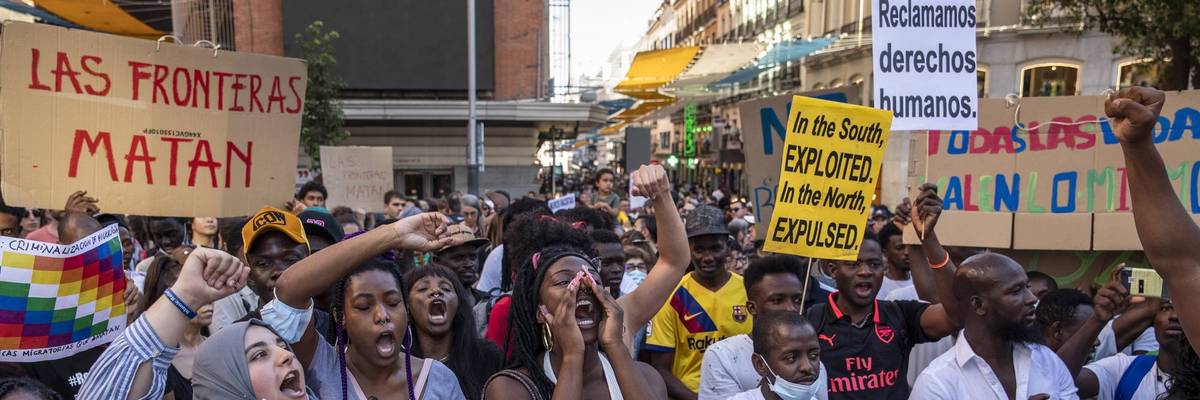
Immigrants and supporters march, shout slogans, and hold placards with messages including, “Borders Kill” and “We Are Reclaiming Human Rights,” during a July 1, 2022 protest in Madrid.
(Photo by Pablo Blazquez Dominguez/Getty Images)
Brett Wilkins
Jan 27, 2026
COMMON DREAMS
As President Donald Trump terrorizes immigrants and Americans alike with his deadly mass deportation blitz while warning European leaders to tighten their borders by raising the racist specter of “civilizational erasure,” Spain’s government is moving against the xenophobic tide by offering hundreds of thousands of migrants a chance at permanent legal residency.
The Spanish Socialist Workers’ Party (PSOE) government of Prime Minister Pedro Sánchez and the leftist Podemos party reached an agreement Monday following the collection of more than 700,000 petition signatures in favor of a legislative initiative to legalize up to 500,000 undocumented migrants.
‘A Travesty’: Trump Suspends Processing of Immigrant Visas From 75 Nations

Trump DHS Post Calling for ‘100 Million Deportations’ Suggests Intent to Kick Out Nonwhite Citizens
Those who can prove that they were in Spain for at least five months before December 31, 2025 and have no criminal record will be eligible for permanent legal residency with permission to work.
Spanish Migration Minister Elma Saiz (PSOE) said during a press conference that “today is a historic day” for starting the process of legalizing hundreds of thousands of immigrants in a country that has made great strides in overcoming its legacy of racism and xenophobia.
The far-right Vox party called the legalization plan “madness” that promotes “barbarity.”
However, Saiz said that legalization will help Spain “recognize, dignify, and give guarantees” to people who already live and work in the country.
“We’re reinforcing a migratory model based on human rights, on integration, and on coexistence that’s compatible with both economic growth and social cohesion,” she added.
Responding to arguments that legalizing so many migrants would severely strain Spain’s social safety net, Podemos Secretary General Ione Belarra said on social media, “What overwhelms public services are your cuts and privatizations.”
Belarra also said that some opponents of legalization are angry that they will no longer be able to exploit migrants by paying them less than legal workers.
Podemos Political Secretary Irene Montero said Tuesday that “we have a legal obligation to guarantee [migrant] rights and that is what this regularization is, which we hope will reach all the people without papers in Spain who were here before December 31, 2025.”
Spain’s population is approximately 49.4 million. Legalizing half a million immigrants would be the equivalent of granting permanent residency to about 3.6 million migrants in the United States. There were believed to be about 7.1 million foreign nationals living in Spain at the beginning of last year, of whom an estimated 840,000 were in the country without authorization.
Sánchez’s PSOE-led government has been supportive of immigrants since coming to power in 2018, offering safe harbor for migrants arriving in Europe by sea when other European Union nations have moved to restrict their entry. More than 10,000 migrants died trying to reach Spain in 2024, according to the Spanish advocacy group Caminando Fronteras (Walking Borders).
Meanwhile, Trump’s latest National Security Strategy, released last month, urges the US to “cultivate resistance” to immigration in Europe, espousing racist “great replacement” ideology while warning of “the real and stark prospect of civilizational erasure.”
“Should present trends continue, the continent will be unrecognizable in 20 years or less,” the document states.
European nations including Denmark, Germany, Greece, Poland, Sweden, and the United Kingdom have recently tightened their migration and asylum policies, in some cases partially due to pressure from Washington.
Responding to Trump’s deadly anti-immigrant crackdown—which has killed both immigrants and US citizens—Montero said Tuesday that “in the United States at the moment there are millions of people who are afraid in their own homes because Trump’s migration policy enters people’s homes and takes them away.”
“We cannot accept that there are people who live in fear and without rights,” she added. “We cannot accept racist violence. Racism is answered with rights. If they kidnap children and murder, we give papers.”