Monday, February 23, 2026

'No thanks': ​Greenland leader gives icy reception to Trump's bizarre hospital ship plan


Alexander Willis
February 22, 2026   

RAW STORY


Johannes Hansen poses with his hunting rifle in Kapisillit, Greenland, January 21, 2026. "People here are interested in the day that is coming. Is there food in the fridge? Fine, then I can sleep a little longer. If there is no food, then I will go out and catch fish or go out and shoot a reindeer," said Vanilla Mathiassen, a Danish teacher in Kapisillit who has worked in towns and villages across Greenland for 13 years.
 REUTERS/Marko Djurica 

President Donald Trump’s bizarre plan to deploy a hospital ship to Greenland drew a chilly response Sunday from Greenland Prime Minister Jens-Frederick Nielsen, who politely told the president “no thanks” to his unusual proposition.

On Friday, Trump made the strange announcement that he would be sending a “hospital boat” to Greenland on an apparent humanitarian mission, which he said would help “take care of the many people who are sick, and not being taken care of there.” There is no documented health crisis in Greenland, and its citizens are all entitled to universal health care.

Nielsen apparently caught wind of Trump’s plan and issued the president a soft rejection in a social media post on Sunday, writing that such help wasn’t needed on the arctic island.

“That will be ‘no thanks’ from us,” Nielsen wrote in a post on Facebook, The Guardian reported. “President Trump’s idea to send a US hospital ship here to Greenland has been duly noted. But we have a public health system where care is free for citizens.”

Trump’s announcement came amid his ongoing campaign to acquire Greenland for the United States, and is theorized by some to be a direct response to an incident that unfolded on Friday just hours before the announcement.

Earlier on Friday, Danish forces evacuated an American service member aboard a U.S. submarine after they had fallen ill, and took him to a Greenland hospital. As to why Trump would respond to such an incident by deploying a hospital ship to Greenland, critics were mostly left baffled by the apparent connection.


Greenland does not need US hospital ship: Danish minister


By AFP
February 22, 2026


There are five regional hospitals across the vast Arctic island, with the Nuuk hospital serving patients from all over the territory - Copyright AFP/File Jonathan NACKSTRAND

Greenland does not need medical assistance from other countries, Denmark’s defence minister said Sunday, after US President Donald Trump claimed he was sending a hospital ship to the autonomous Danish territory that he covets.

“The Greenlandic population receives the healthcare it needs. They receive it either in Greenland, or, if they require specialised treatment, they receive it in Denmark. So it’s not as if there’s a need for a special healthcare initiative in Greenland,” Defence Minister Troels Lund Poulsen told Danish broadcaster DR.

In Greenland as in Denmark access to healthcare is free. There are five regional hospitals across the vast Arctic island, with the Nuuk hospital serving patients from all over the territory.

The Greenlandic local government signed an agreement with Copenhagen in early February to improve the treatment of Greenlandic patients in Danish hospitals.

Trump on Saturday posted on his social media platform Truth Social that “we are going to send a great hospital boat to Greenland to take care of the many people who are sick, and not being taken care of there”.

“It’s on the way!!!” he added.

Trump has said the US must control Greenland to ensure its security, though he has backed off earlier threats to seize it after striking a “framework” deal with NATO Secretary General Mark Rutte to ensure greater US influence.

Lund Poulsen told DR he was not aware of the hospital ship’s possible arrival.

“Trump is constantly tweeting about Greenland. So this is undoubtedly an expression of the new normal that has taken hold in international politics,” he said.

Earlier Saturday, Denmark’s Arctic Command announced that it had evacuated a crew member of a US submarine off the coast of Nuuk after the sailor requested urgent medical attention.


Critics say Trump's 'frankly unreal' Greenland post shows he's 'suffering from dementia'

Alexander Willis
February 22, 2026  
RAW STORY


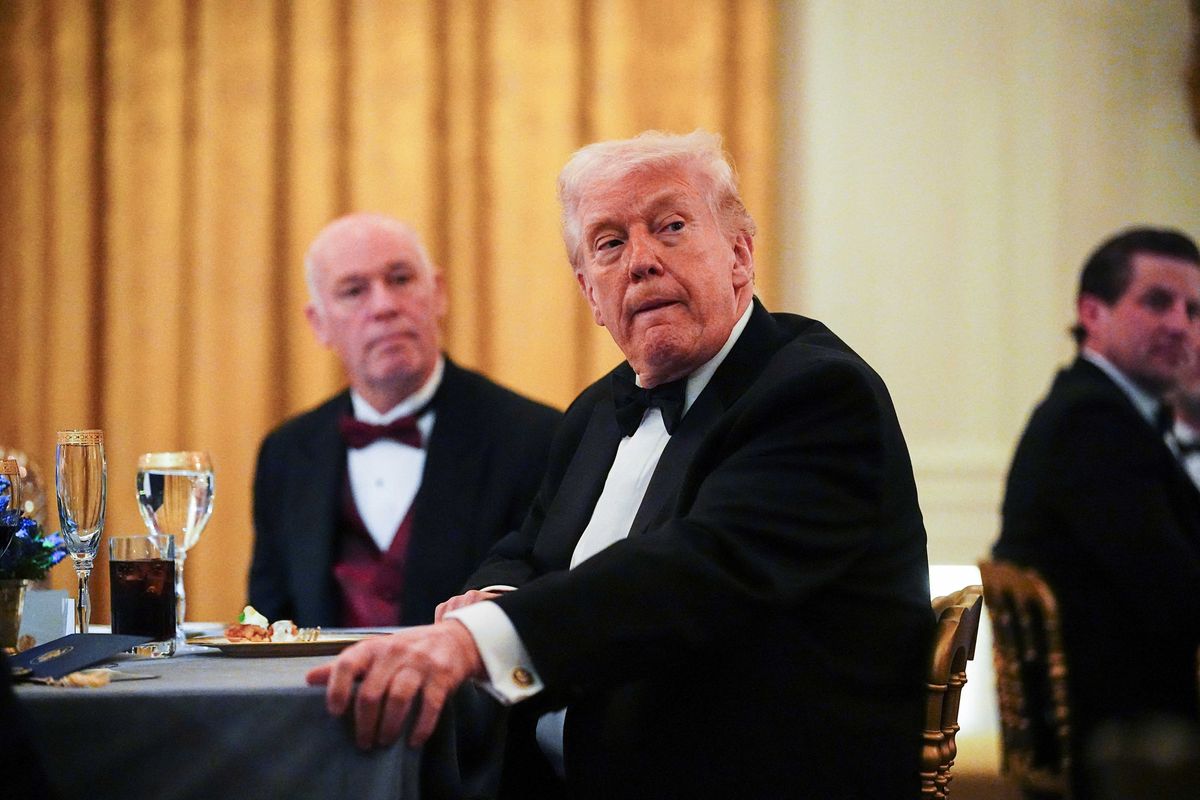
U.S. President Donald Trump attends a Governors Dinner at the White House in Washington, D.C., U.S., February 21, 2026. REUTERS/Aaron Schwartz

President Donald Trump made the bizarre announcement Saturday that he would be sending a hospital ship to Greenland on an apparent humanitarian mission, and with no explanation for what prompted the expedition – but critics have zeroed in on what they say is “almost certainly” the cause for the president’s confusing statement.

There is no documented health crisis in Greenland, a territory of Denmark, with all of its citizens entitled to universal health care that’s free at the point of service, as it is in most moderately wealthy nations other than the United States. Nevertheless, Trump suggested that he would be deploying the USNS Mercy to the arctic island, and that the hospital ship was already “on the way.”

As noted by critics, the peculiar announcement came within hours of an incident in which an American service member aboard a U.S. submarine off the coast of Greenland was evacuated by Danish forces and taken to a hospital after falling ill.

“I've now seen a number of comments on this mysterious Truth Social post from Donald Trump,” wrote Lars Christensen, a Danish economist, to their more than 32,000 followers on X.

“It demonstrates with absolute clarity that the man is suffering from dementia and cannot grasp the most basic connections. Why do I say this? Because what his post is almost certainly prompted by is the fact that the Danish navy evacuated a sick crew member from an American submarine near Greenland within the last few days.”

Trump’s announcement comes amid his ongoing and increasingly threatening campaign to acquire Greenland for the United States, which has included the deployment of a submarine off the coast of the arctic island.

Whether the USNS Mercy can even depart to Greenland is another open question, with maritime expert Mike Schuler noting in a report Saturday that the hospital ship is currently sitting in a dry dock in Alabama undergoing maintenance, maintenance that appears scheduled to continue through July.

“This Trump post is frankly unreal in its cynicism and gaslighting. He posted this because a US nuclear submarine – whose very presence near Greenland is already deeply provocative given the context – was just rescued by Danish military forces after one of its sailors fell ill,” wrote Arnaud Bertrand, an entrepreneur and frequent political commentator, in a social media post on X to their more than 380,000 followers.

“Denmark graciously rescued the sailor and evacuated him to treat him in a hospital in Greenland. The cherry on the cake is that there's no ‘great hospital boat’ coming to Greenland because both U.S. hospital ships – the USNS Mercy and the USNS Comfort – are currently incapacitated, undergoing maintenance. So ‘It's on the way!!!’ is simply a bold face lie.”


After Danish Medevac, Trump Sends Hospital Ship to Greenland

USNS Mercy
USNS Mercy during a COVID-era deployment (USN file image)

Published Feb 22, 2026 8:07 PM by The Maritime Executive


On Saturday, the Danish Navy medevaced a sailor from a U.S. Navy submarine and delivered the individual for urgent medical treatment in Nuuk, Greenland. Hours later, U.S. President Donald Trump announced that he would be dispatching a U.S. Navy hospital ship to Danish-governed Greenland, where politicians insist that the assistance is not needed. The president has frequently expressed a desire to annex the island, and relations with Denmark are at a historic low. 

The exchange began Saturday when a U.S. Navy submarine requested a medevac for a crewmember. The individual needed urgent attention. Luckily, the sub was located just seven nautical miles off Nuuk, the capital of Greenland and home of the largest hospital on the island. A helicopter from the patrol vessel HDMS Vaedderen (Aries) picked up the patient and delivered them to shore for treatment. 

The nature of the submarine's mission so close to Greenland's capital - and the condition of the crewmember in question - were not immediately disclosed. The U.S. Navy and the White House have declined to confirm the incident.

Hours after the medevac, U.S. President Donald Trump announced that he was ordering a U.S. Navy hospital "boat" to Greenland. The message was accompanied by an illustration of USNS Mercy, a 1,000-bed hospital ship typically deployed for medical diplomacy and natural disasters. 

"We are going to send a great hospital boat to Greenland to take care of the many people who are sick, and not being taken care of there. It’s on the way!" Trump said. Louisiana Governor and White House Greenland envoy Jeff Landry, who has previously said that he will help "make Greenland a part of the U.S.," has been tasked with organizing the hospital ship mission. 

Of the places USNS Mercy has been tasked to assist over the last 40 years, Greenland has one of the more generous public healthcare systems. Under Danish governance, Greenland provides free medical care and free prescription drugs to all citizens, and it maintains a network of clinics and medical centers with no-charge access. Inhabitants of the farthest-flung settlements have to travel long distances to get care, and the central hospital is said to be due for renovation, but modern services are provided at no charge. For advanced medical care beyond that available on the island, patients are flown to Copenhagen for further free treatment. Greenlandic and Danish leaders have noted the differences between their system and American health care in pointed statements. 

“We have a public healthcare system where treatment is free for citizens. That is a deliberate choice — and a fundamental part of our society. That is not the case in the United States, where seeing a doctor comes at a cost," retorted Jens Frederik Nielsen, Greenland's prime minister.  

Both of the Navy's hospital ships are currently in Mobile for shipyard maintenance, and it was not immediately clear if either was in condition to get under way promptly. The vessels are converted single-hull oil tankers, and are now more than 50 years old (including their early years served in tanker configuration).  

The mission to Greenland means that one of these advanced hospital ships will be removed from Alabama, where more than 400,000 state residents lack health insurance coverage. The difference between the two locales was picked up by Danish politicians. 

"I am happy to live in a country where there is free and equal access to healthcare for all. Where it is not insurance and wealth that determine whether you get proper treatment," Danish prime minister Mette Frederiksen wrote on Facebook. "There is the same approach in Greenland."

This key factor is fueling rampant inequality under Trump

Robert Reich
February 22, 2026  
RAW STORY


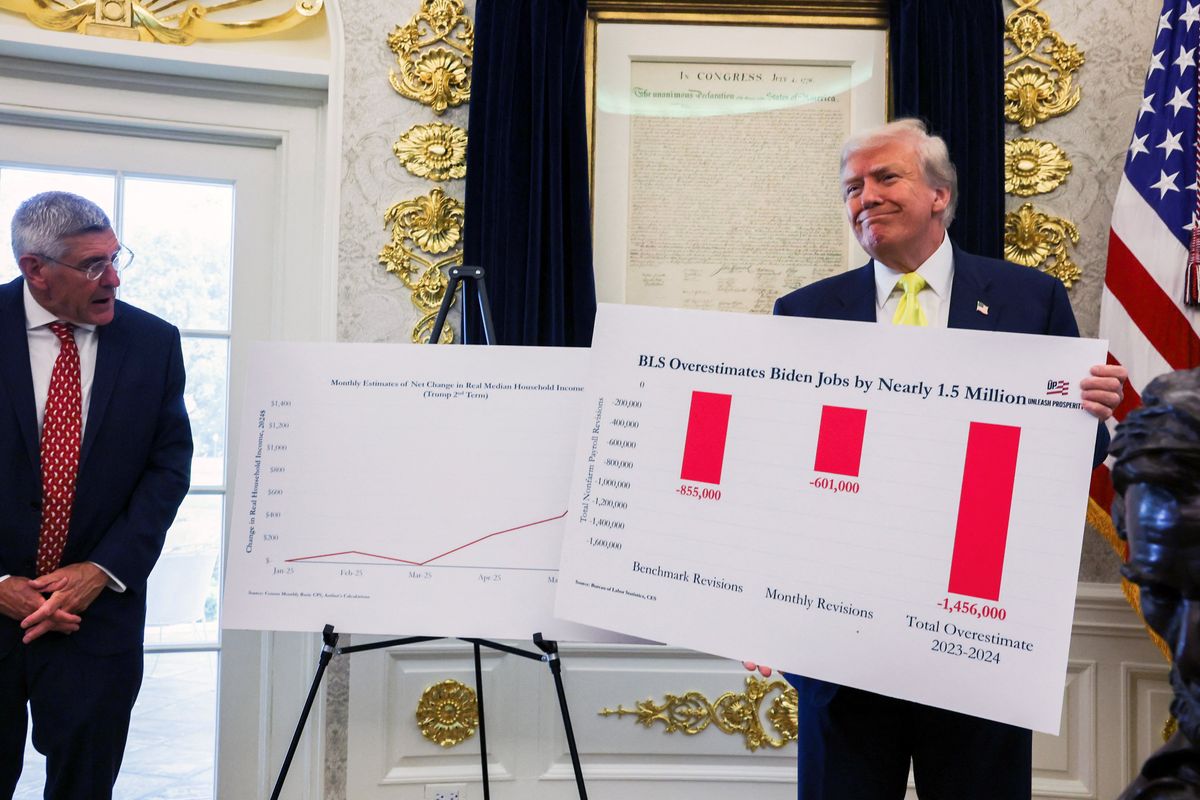
Donald Trump holds a board sourced from Bureau of Labour Statistics. REUTERS/Jonathan Ernst

I was secretary of labor 30 years ago when the U.S. economy was producing an average of 200,000 new jobs a month.

I remember holding news conferences on “jobs days” each month. I felt confident about the strength of the economy. What worried me then was that the new jobs didn’t pay well. (A disgruntled worker once called out to me, “Sure, Mr. Secretary, lots of new jobs. I’m doing three of them to make ends meet!”)

Last Wednesday, the Labor Department reported that the United States produced an average of just 15,000 new jobs per month last year — a record low. And most paid sh--.

January showed an uptick in jobs, but almost all of the new jobs were in health care and construction. The rest of the economy seems to be shrinking. And wages are still stuck in the mud.

Profits of big corporations have soared. The stock market values attached to these profits have risen even more. Yet average workers are barely making it.

The U.S. economy is more distorted than ever.


The widening gap between corporate profits and average workers — between capital and labor — helps explain the disconnect between a buoyant economy and pessimistic households. Consumer confidence is in the basement.

The gap was widening before Donald Trump was elected. It explains in part the rise of MAGA and why Trump won in 2016 and again in 2024.

But Trump hasn’t done a thing to alter these trends. In fact, since he became president again, corporate profits (and the stock market) have done even better than before, while average workers have seen almost no gains in jobs or wages.

“I think we have the greatest economy actually ever in history,” Trump said in an interview with Fox Business’s Larry Kudlow that aired Tuesday.

That’s not what most Americans think. Even most young men — central to Trump’s wins in 2016 and 2024 — now believe they were better off under Joe Biden.

We’re not powerless to alter these trends. The “free market” doesn’t run on automatic. The rules of the economy depend on political decisions — such as tax laws, antitrust laws, and labor laws.

Since Ronald Reagan was president, the nation has lowered taxes on the wealthy and raised them (especially Social Security and state sales taxes) on average Americans.

America has also allowed big corporations to monopolize the economy — which has given them the power to raise prices without worrying that a competitor will grab consumers away.

And what about labor laws?


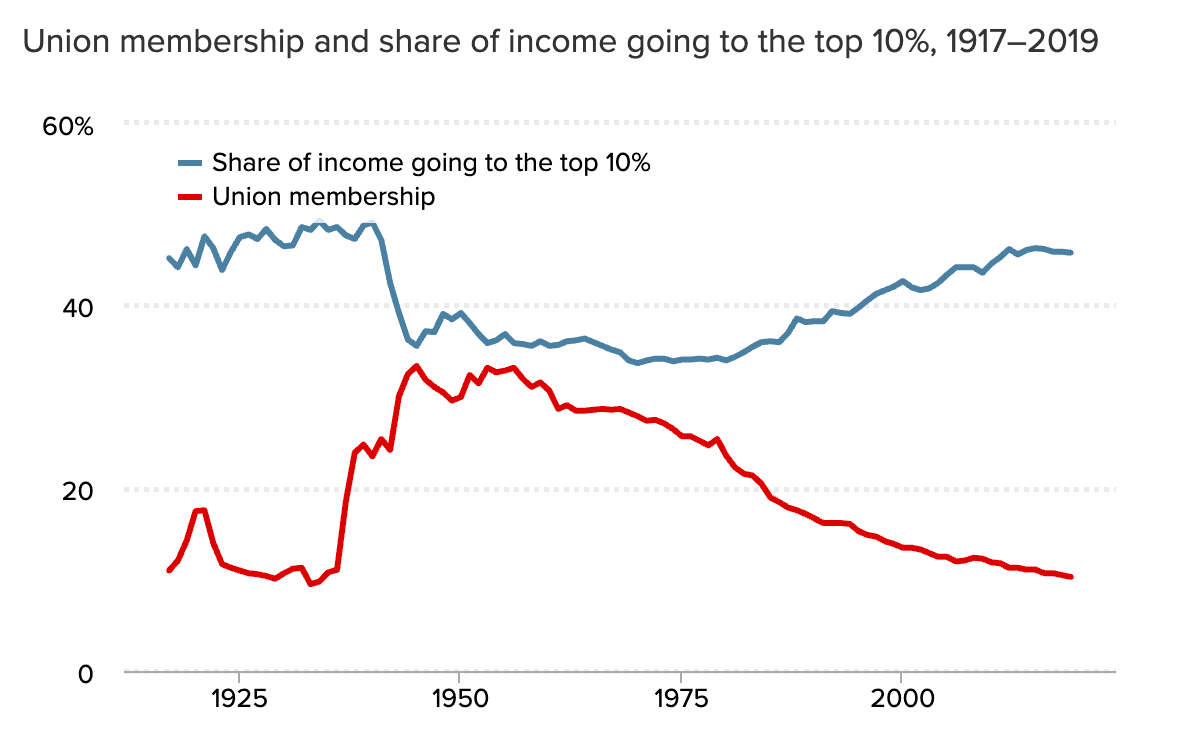
Take a look at this chart.


The blue line represents the percentage of the national income going to the richest 10 percent — that is, how much of every dollar earned in the United States goes into the pockets of the wealthiest tenth of Americans.

The red line represents the percentage of workers that belong to a union.

Notice a pattern?

The 1940s and 50s saw a dramatic rise in union membership. Laws and public policies encouraged unionization.

That was also a time when a growing portion of the nation’s income went into the pockets of ordinary working people instead of the pockets of the richest 10 percent.

That’s because unions give workers more bargaining power to get a larger share of the profits they helped generate. The benefits of unions helped nonunion workers too. In order to attract workers, corporations that didn’t have unions had to increase the pay of their workers, too.

As a result, by the mid-1950s, America’s economy was powered by the biggest middle class this nation had ever seen. Racial and gender disparities were still a big problem, but America was making progress on them as income inequality trended downward.

So what happened?

As you can see, union membership started to decline in the 1970s.

That was after Lewis Powell — soon to be a justice on the Supreme Court, then an attorney in Richmond, Virginia — urged the U.S. Chamber of Commerce and the leaders of American corporations to pour great wads of money into American politics.

Corporations doubled-down on busting unions, while their allies in government weakened labor laws.

Then, starting with Reagan in the early 1980s, corporate attacks on unions got turbocharged. Reagan fired the striking air-traffic controllers. Legally, they had no right to strike, but Reagan’s move legitimized a far broader assault on American unions.

Since then, unions have steadily shrunk, and the gap between the rich and everyone else has taken off. I saw it when I was secretary of labor in the 1990s. I was worried then. I’m far more worried now.

Today, the top 10 percent are doing okay, largely because they own 92 percent of the value of all the shares of stock owned by Americans, and the stock market is doing just fine. The real wealth of the nation has now concentrated in the richest one-tenth of 1 percent.

And the bottom 90 percent are barely holding on.

My friends, this is not bad only for the bottom 90 percent. It’s also bad for the economy and dangerous for our democracy. If unaddressed, it could lead to more demagogues like Trump as far as the eye can see.

As the great jurist Louis Brandeis is reputed to have said: America has a choice. We can have great wealth in the hands of a few, or we can have a democracy, but we cannot have both.

If we want to make sure our economy works for everyone, not just the super-rich, we need to build back union power.

A resurgence of labor unions would go a long way toward fighting inequality, rebuilding a large and vibrant middle class, and making life better for all Americans.

Which is why it’s vital that we support unions.


Please take a look below, and share:


Robert Reich is an emeritus professor of public policy at Berkeley and former secretary of labor. His writings can be found at https://robertreich.substack.com/. His new memoir, Coming Up Short, can be found wherever you buy books. You can also support local bookstores nationally by ordering the book at bookshop.org

Economist calls out Trump while dropping stark warning about US dollar: 'Will happen soon'

David McAfee
February 22, 2026
RAW STORY


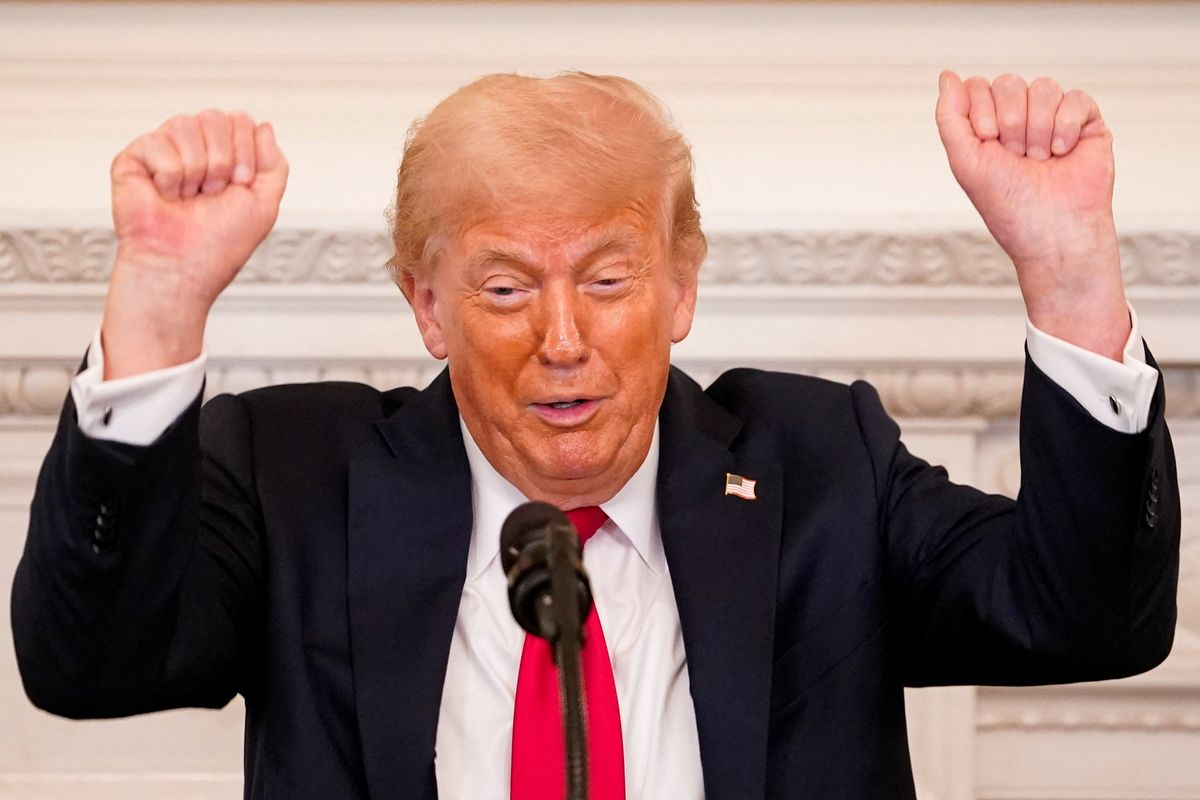
U.S. President Donald Trump gestures during the White House Faith Office Luncheon at the White House in Washington, D.C., U.S., July 14, 2025. REUTERS/Nathan Howard

An economist said on Sunday that Donald Trump was wrong to claim he "can destroy the economy of any foreign country" using various trade embargos.

Peter Schiff, a financial commentator and radio personality who has been raising alarms about America’s affordability crisis, weighed in over the weekend. Previously, Trump himself went nuclear when Schiff did an appearance on Fox News.

“Why would Fox and Friends Weekend (of all things?) put on a ‘Stockbroker’ named Peter Schiff, a Trump hating loser who has already proven to be wrong. Either the show made a mistake, or it is heading in a different direction,” Trump wrote in December.

More recently, Schiff issued an ominous prediction to the president.

Now, stockbroker Schiff is dropping a correction.

"Trump claims that he can destroy the economy of any foreign country by putting an embargo on our imports," Schiff wrote. "If Trump cuts off American consumers, there is an entire world of foreign consumers who would gladly buy what Americans can’t. It’s the U.S. economy that would be destroyed."

When a detractor said to Schiff, "No country in the world has the consuming power of the US!" the economist responded with, "They will as the dollar falls and their currencies rise. Ultimately consuming power comes from producing power, which foreign countries have and America lacks. Supply creates its own demand."

Another user asked, "If foreign companies have so many other buyers lined up, then why don’t they walk?" to which he replied, "They should and they will. But not until the dollar tanks, which will happen soon."

In a separate post, he added, "The Trump administration is threatening to use presidential authority to impose full embargoes that prevent Americans from buying any imported products from particular countries or from all countries. This would be even more harmful to Americans and the U.S. economy than tariffs."


'Literally a lie': Economist thrashes Trump's 'best story' about the economy


Robert Davis
February 22, 2026 
RAW STORY

A prominent economist thrashed President Donald Trump's "best story" about the U.S. economy during a new interview on Sunday.

Last week, Trump claimed that he had "won affordability" during a speech in Rome, Georgia. But that claim appears to contradict the latest economic data released by his administration, which showed that U.S. economic growth slowed to 2.2% in 2025 from 2.8% in 2024, according to the Bureau of Economic Analysis. Meanwhile, inflation increased more than expected in December, Reuters reported.

Justin Wolfers, economics and public policy professor at the University of Michigan, said during an interview on MS NOW's "Alex Witt Reports" that the data proved Trump's story about the economy is "literally a lie."


"We all know it's a lie," Wolfers said.

"There are people in his White House who are printing signs with lies for people to hold up, because a lie is the best story that they've got to tell right now," he continued, referring to signs Trump supporters have held up at rallies declaring that prices for consumers are coming down.

"Morally, I find lying disgusting," Wolfers added. "Economically, I think the answer here is very simple, which is he's losing on affordability. He always declares victory. I'm not going to give the man's words any credence, but the reality is utterly clear to every one of us who goes to the store."


OP-ED

Minneapolis resonated more than past outrages. Why?

The Conversation
February 22, 2026 


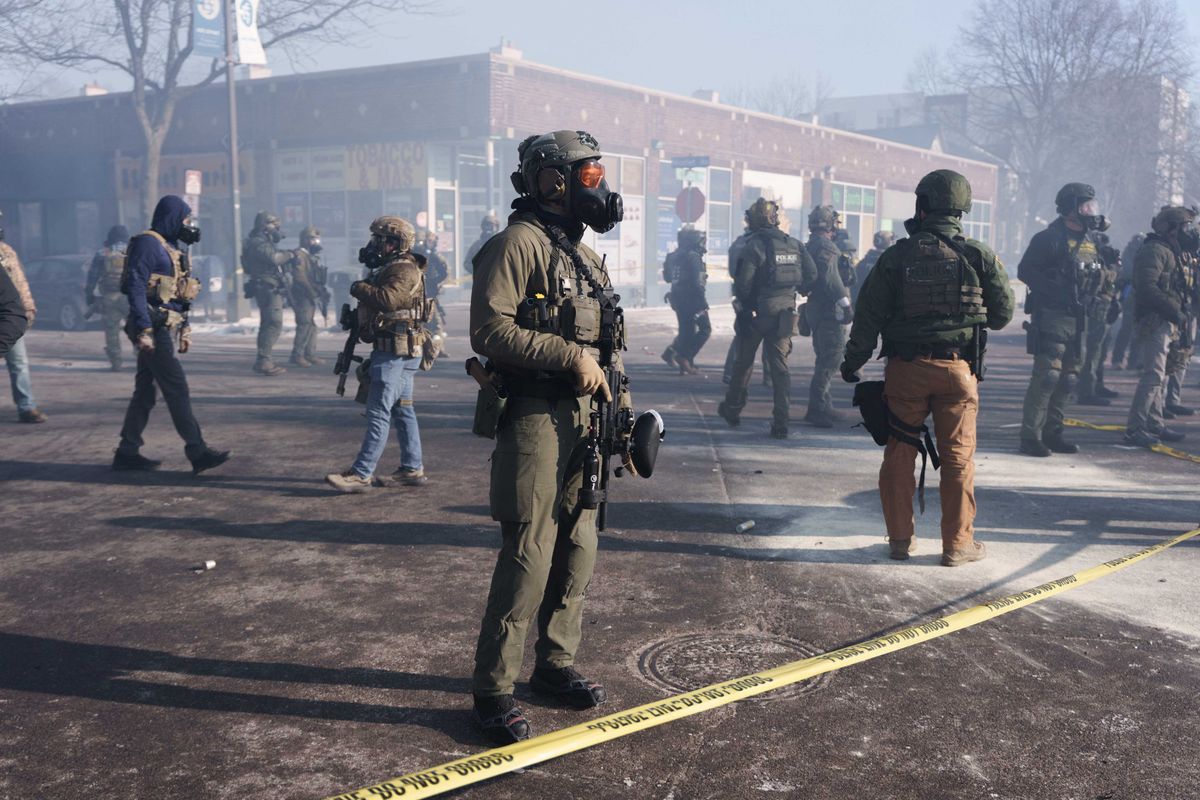
Federal agents stand amid teargas in Minneapolis, Minnesota. REUTERS/Tim Evans

By Gregory P. Magarian, Thomas and Karole Green
 Professors of Law, Washington University in St. Louis.

The president announces an aggressive, controversial policy. Large groups of protesters take to the streets. Government agents open fire and kill protesters.

All of these events, familiar from Minneapolis in 2026, also played out at Ohio’s Kent State University in 1970. In my academic writing about the First Amendment, I have described Kent State as a key moment when the government silenced free speech.

In Minneapolis, free speech has weathered the crisis better, as seen in the protests themselves, the public’s responses — and even the protest songs the two events inspired.

Protests and shootings, then and now

In 1970, President Richard Nixon announced he had expanded the Vietnam War by bombing Cambodia. Student anti-war protests, already fervent, intensified.

In Ohio, Gov. James Rhodes deployed the National Guard to quell protests at Kent State University. Monday, May 4, saw a large midday protest on the main campus commons. Students exercised their First Amendment rights by chanting and shouting at the Guard troops, who dispersed protesters with tear gas before regrouping on a nearby hill.

With the nearest remaining protesters 20 yards from the Guard troops and most more than 60 yards away, 28 guardsmen inexplicably fired on studentskilling four and wounding nine others.

After the killings, the government sought to shift blame to the slain students.

Nixon stated: “When dissent turns to violence, it invites tragedy.”

Minneapolis in 2026 presents vivid parallels.

As part of a sweeping campaign to deport undocumented immigrants, President Donald Trump in early January 2026 deployed armed U.S. Immigration and Customs Enforcement and Customs and Border Protection agents to Minneapolis.

Many residents protested, exercising their First Amendment rights by using smartphones and whistles to record and call out what they saw as ICE and CBP abuses. On Jan. 7, 2026, an ICE agent shot and killed activist Renee Good in her car. On Jan. 24, two CBP agents shot and killed protester Alex Pretti on the street.

The government sought to blame Good and Pretti for their own killings.

Different public reactions

After Kent State, amid bitter conservative opposition to student protesters, most Americans blamed the fallen students for their deaths. When students in New York City protested the Kent State shootings, construction workers attacked and beat them in what became known as the “Hard Hat Riot.” Afterward, Nixon hosted construction union leaders at the White House, where they gave him an honorary hard hat.

In contrast, most Americans believe the Trump administration has used excessive force in MinneapolisMajorities both oppose the federal agents’ actions against protesters and approve of protesting and recording the agents.

The public response to Minneapolis has made a difference. The Trump administration has announced an end to its immigration crackdown in the Twin Cities. Trump has backed off attacks on Good and Pretti. Congressional opposition to ICE funding has grown. Overall public support for Trump and his policies has fallen.

Protests, recordings and songs

What has caused people to view the killings in Minneapolis so differently from Kent State? One big factor, I believe, is how free speech has shaped the public response.

The Minneapolis protests themselves have sent the public a more focused message than what emerged from the student protests against the Vietnam War.

Anti-war protests in 1970 targeted military action on the other side of the world. Organizers had to plan and coordinate through in-person meetings and word of mouth. Student protesters needed the institutional news media to convey their views to the public.

In contrast, the anti-ICE protests in Minneapolis target government action at the protesters’ doorsteps. Organizers can use local networks and social media to plan, coordinate and communicate directly with the public. The protests have succeeded in deepening public opposition to ICE.

In addition, the American people have witnessed the Minneapolis shootings.

Kent State produced a famous photograph of a surviving student’s anguish but only hazy, chaotic video of the shootings.

In contrast, widely circulated video evidence showed the Minneapolis killings in horrifying detail. Within days of each shooting, news organizations had compiled detailed visual timelines, often based on recordings by protesters and observers, that sharply contradicted government accounts of what happened to Good and Pretti.

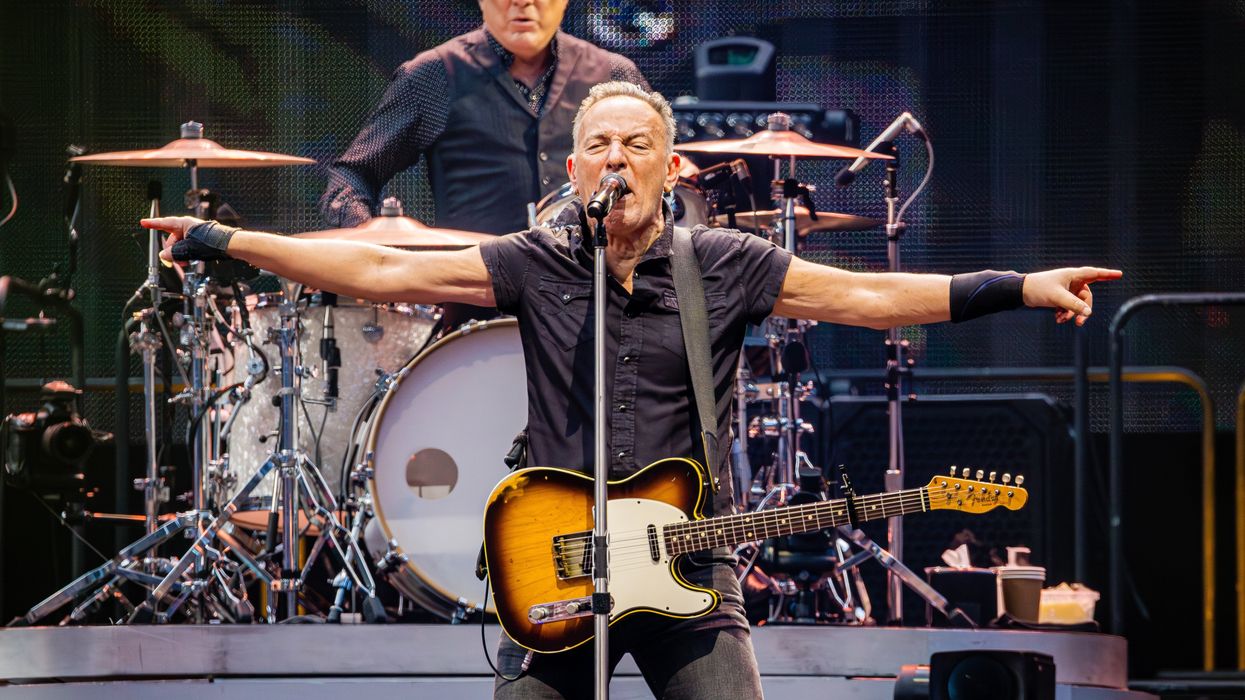
Finally, consider two popular protest songs that emerged from Kent State and Minneapolis: Crosby, Stills, Nash & Young’s “Ohio” and Bruce Springsteen’s “Streets of Minneapolis.”


Crosby, Stills, Nash & Young recorded, pressed and released “Ohio” with remarkable speed for 1970. The vinyl single reached record stores and radio stations on June 4, a month after the Kent State shootings. The song peaked at No. 14 on the Billboard chart two months later.

Neil Young’s lyrics described the Kent State events in mythic terms, warning of “tin soldiers” and telling young Americans: “We’re finally on our own.” Young did not describe the shootings in detail. The song does not name Kent State, the National Guard or the fallen students. Instead, it presents the events as symbolic of a broader generational conflict over the Vietnam War.

Springsteen released “Streets of Minneapolis” on Jan. 28, 2026 — just four days after CBP agents killed Pretti. Two days later, the song topped streaming charts worldwide.


The internet and social media let Springsteen document Minneapolis, almost in real time, for a mass audience. Springsteen’s lyrics balance symbolism with specificity, naming not just “King Trump” but also victims Pretti and Good, key Trump officials Stephen Miller and Kristi Noem, main Minneapolis artery Nicollet Avenue, and the protesters’ “whistles and phones,” before fading on a chant of “ICE out!”

Critics offer compelling arguments that 21st-century mass communication degrades social relationshipselections and culture. In Minneapolis, disinformation has muddied crucial facts about the protests and killings.

At the same time, Minneapolis has shown how networked communication can promote free speech. Through focused protests, recordings of government action, and viral popular culture, today’s public can get fuller, clearer information to help critically assess government actions.

Gregory P. Magarian has written and taught for 26 years about constitutional law, specializing in the freedom of expression and with secondary interests in gun regulation, law and religion, and regulations of the political process. He wrote Managed Speech: The Roberts Court's First Amendment (Oxford University Press, 2017) and has published dozens of academic articles, book chapters, and general audience essays. He has taught at Washington University since 2008 and previously taught at Villanova University. He clerked on the U.S. Supreme Court for Justice John Paul Stevens and on the U.S. District Court (D.C.) for Judge Louis Oberdorfer, and earned his law degree magna cum laude from the University of Michigan, where he was editor-in-chief of the Michigan Law Review. He received his undergraduate degree summa cum laude from Yale.

John Paul Filo. Kent State, May 4, 1970. Prints and Photographs Division, Library of Congress (38.00.00) © John Paul Filo/Nalley Daily

JOHN FILO. Kent State, 1970

On May 4, 1970, fourteen-year-old Mary Ann Vecchio screamed over the body of twenty-year-old Kent State student Jeffrey Miller who was fatally shot by the Ohio National Guard during a protest against the U.S. invasion of Cambodia during the Vietnam War. Members of the Guard fired into a crowd of Kent State University demonstrators, killing four and wounding nine. The impact of the shootings was widely publicized and triggered a nationwide student strike that forced hundreds of colleges and universities to close.

‘Which Side Are You On?’ American protest songs have emboldened social movements for generations


Singer/Songwriter Bruce Springsteen (Shutterstock)

February 19, 2026 

The presence of Department of Homeland Security agents in Minnesota compelled many people there to use songs as a means of protest. Those songs were from secular as well as religious traditions.

On Jan. 8, 2026, the day after Immigration and Customs Enforcement agent Jonathan Ross killed Minneapolis resident Renée Good on Portland Avenue, an anonymous post appeared on Reddit that featured an uncredited text clearly adapted from the lyrics of a Depression-era protest song from Appalachia, “Which Side Are You On?” The Reddit text criticized the recent federal presence in Minnesota and implored Minnesotans to take a stand.

In our town of Minneapolis,
There’s no neutrals here at home.
You’re either marching in the streets
or you kill for Kristi Noem
Which side are you on,
Oh which side are you on?
Which side are you on,
Oh which side are you on?
ICE is a bunch of killers
who hide behind a mask.
How do they get away with this?
That’s what you have to ask.
Which side are you on …


For centuries, songs have served as vehicles for expressing community responses to sociopolitical crises, whether government repression or corporate exploitation. “Which Side Are You On?” resonated with Minnesotans, in part because it has been recorded by numerous artists over the decades.

The song dates back to another societal struggle that occurred in another part of the United States during another crisis moment in American history. “Which Side Are You On?” has consoled and empowered countless people for generations during struggles in red as well as blue states. It has also inspired people to write new protest songs in the face of new crises.

Birth of a protest anthem

“Which Side Are You On?” was composed in 1931, a woman’s spontaneous response to a coal company’s effort to prevent miners in Harlan County, Kentucky, from joining the United Mine Workers of America. Those miners hoped the labor union would improve their working conditions and overturn imposed reductions to their wages.

In support of the coal company, sheriff J. H. Blair and armed deputies broke into the house of union organizer Sam Reece to apprehend him and locate evidence of union activity. Reece was in hiding elsewhere, but his wife, Florence, and their children were present. After ransacking the house, the sheriff and deputies left.

Florence tore a page out of a calendar and jotted down lyrics for an impromptu song, which she recalled setting to the melody of a Baptist hymn “I’m gonna land on the shore.” Others have observed that the melody in Florence’s song was similar to that of the traditional British ballad “Jack Monroe,” which features the haunting refrain “Lay the Lily Low.”


Woody Guthrie, one of America’s most celebrated folk singers of the 20th century, sang many protest songs. Al Aumuller, via the Library of Congress


“Which Side Are You On?” channeled Florence’s reaction to that traumatic experience. Throughout the 1930s, she and others sang the song during labor strikes in the Appalachian coalfields, and the lyrics were included in union songbooks. Then, in 1941, the Almanac Singers, a folk supergroup featuring Woody Guthrie and Pete Seeger, recorded the song, and it reached many people beyond Appalachia.

Since then, a range of musicians – including Charlie Byrd; Peter, Paul and Mary; the Dropkick Murphys; Natalie Merchant; Ani DiFranco; and the Kronos Quartet – performed “Which Side Are You On?” in concert settings and for recordings. A solo live performance with a concert audience joining the chorus was a focal point of Seeger’s “Greatest Hits” album in 1967.


The Academy Award-winning documentary film “Harlan County U.S.A.” (1976) included a clip of Florence Reece singing her song during a 1973 strike. “Which Side Are You On?” was translated into other languages – a testament to its universal theme of encouraging solidarity to people confronting authoritarian power. Florence Reece sings ‘Which side are you on?’ four decades after she wrote the song.

Protest songs of the modern era

While the American protest song tradition can be traced back to the origins of the nation, “Which Side Are You On?” served as a prototype for the modern-era protest song because of its lyrical directness. Many memorable, risk-taking protest songs were composed in the wake of, and in the spirit of, “Which Side Are You On?”

Noteworthy are numerous protest classics in the folk vein, epitomized by a sizable part of Guthrie’s repertoire, by early Bob Dylan songs like “Masters of War” (1963), “The Times They Are a-Changin’” (1964) and “Only A Pawn in Their Game” (1964), and by Phil Ochs’ mid-1960s songs of political critique, such as “Here’s to the State of Mississippi” (1965).

But protest songs have hailed from all music genres. Rock and rhythm and blues, for instance, have spawned many iconic recordings of protest music: Sam Cooke’s “A Change Is Gonna Come” (1964), Buffalo Springfield’s “For What It’s Worth” (1966), Creedence Clearwater Revival’s “Fortunate Son” (1969), Edwin Starr’s “War” (1970) and Crosby, Stills, Nash and Young’s “Ohio” (1970) among many others.

Blues, country, reggae and hip-hop have spawned broadly inspirational protest songs, and jazz too has yielded classic protest recordings, such as Abel Meeropol’s “Strange Fruit” (1939), popularized by Billie Holiday, and Gil Scott-Heron’s 1971 recording of the jazz-poem “The Revolution Will Not Be Televised.”

Indeed, there are so many enduring contributions to the American protest song canon that a list like Rolling Stone’s recent “100 Best Protest Songs of All Time” is only the tip of the iceberg. Regardless of the genre, effective protest songs retain their power to move and motivate people today despite having been composed in response to past situations or circumstances. And protest songs from the past are often adapted to help people more effectively respond to the crisis of the moment.


Songs for this moment

“Which Side Are You On?” was sung – and its theme invoked – in Minnesota throughout January 2026. On Jan. 24, shortly after Border Patrol agents killed Alex Pretti on Nicollet Avenue, Minneapolis Mayor Jacob Frey referred to the song’s title during a public address to his constituents: “Stand up for America. Recognize that your children will ask you what side you were on.” That same day, the grassroots organization 50501: Minnesota posted online an appeal to those in power: “[E]very politician and person in uniform must ask themselves one question – which side are you on?”

The next day, Minnesota Gov. Tim Walz acknowledged divisions in the U.S. during a televised briefing, urging citizens in his state and across the nation to consider the choice before them: “I’ve got a question for all of you. What side do you want to be on?”

People protesting ICE and Customs and Border Protection actions in Minnesota and elsewhere have been singing “Which Side Are You On?” and other well-known protest songs, but musicians have also been writing new protest songs about the crisis. On Jan. 8, the Dropkick Murphys posted on social media a clip of “Citizen I.C.E.,” a revamped version of the group’s 2005 song “Citizen C.I.A.,” augmented by video of the Jan. 7 fatal shooting of Renée Good. On Jan. 27, British musician Billy Bragg released “City of Heroes,” which he composed in tribute to the Minneapolis protesters.

Following suit was Bruce Springsteen, a longtime champion of the protest song legacy. On Jan. 28, Springsteen released online his newly composed and recorded “Streets of Minneapolis.” Millions of people around the world heard the song and saw its accompanying video.


On Jan. 30, Springsteen made a surprise appearance at the Minneapolis club First Avenue, performing his new song at the “Defend Minnesota” benefit concert, organized by musician Tom Morello to raise funds for the families of Good and Pretti. Bruce Springsteen’s ‘Streets of Minneapolis’ rages against the killings of Renée Good and Alex Pretti.


Making a difference

On the day Pretti was shot dead, hundreds of Minneapolis protesters attended a special service at Minneapolis’ Hennepin Avenue United Methodist Church. Pastor Elizabeth MacAuley, in a televised interview with CNN’s Anderson Cooper, reflected on the role of song in helping people cope: “It’s been a time when it is pretty tempting to feel so disempowered. … [T]he singing resistance movement … brought out the hope and the grief and the rage and the beauty.”

Cooper asked: “Do you think song makes a difference?” MacAuley replied: “I know song makes a difference.”

Ted Olson, Professor of Appalachian Studies and Bluegrass, Old-Time and Roots Music Studies, East Tennessee State University

This article is republished from The Conversation under a Creative Commons license. Read the original article.


Counting the cost: Minnesota reels after anti-migrant ‘occupation’

By AFP
February 20, 2026


Copyright AFP Charly TRIBALLEAU
Gregory WALTON, with Romain FONSEGRIVES in Los Angeles

The Trump administration has framed its divisive push to round up undocumented migrants in Minnesota as a win for his mass deportation agenda, despite a major backlash and decisive local opposition.

Minneapolis Somali community organizer Mowlid Mohamed said the announcement the massive federal deployment was winding down was “good news, however we don’t know how true it is. It’s hard to believe anything from this administration.”

Local leaders insist the anti-migrant sweeps galvanized opposition which quickly organized to protect vulnerable people who were too terrified to venture out for fear of arrest and deportation, and to monitor and track immigration officers.

The killings of two US citizens, Renee Good and Alex Pretti, alongside the shooting of an unarmed Venezuelan and the arrest of a photogenic five-year-old, proved to be watershed moments.

Hamline University politics professor David Schultz said those developments were what it took “to turn the tide of public opinion against the operation nationally.”

He said that “massive overreach” by the Trump administration helped rally opposition to the deployment — but that “if Trump’s goal was to scare immigrants, he did win — absolutely.”

Criticism led to an apparent re-think by the White House which swapped out the top commander overseeing the operation which was wound down last week.

The sight of detachments of disguised federal officers marauding around the Midwestern Democratic stronghold sparked wide-ranging local action to counter the sweeps.

Initial claims Good and Pretti were “domestic terrorists” were widely condemned — including from within Trump’s own Republican party.

Officials subsequently announced they would pull back on the unprecedented weeks-long surge, nonetheless touting over 4,000 arrests in the state that they say included “worst of the worst” criminals.

Just one-in-10 of the arrests could be reliably tracked using public data, making it difficult to assess how many of those swept up were truly serious criminals.


– ‘Better in our own country’ –


But nationwide data for 2026 shows just over a quarter of people currently in immigration detention nationwide are convicted criminals, and 47.4 percent are completely innocent.

Trump’s border pointman Tom Homan, who has said a limited detachment of agents will remain behind in Minnesota, claimed the withdrawal was because of improved cooperation with local authorities.

But the Democratic sheriff who oversees Minneapolis’s largest county jail has insisted no policy has changed.

Minneapolis Mayor Jacob Frey, outspoken in his criticism of the surge, claimed victory, saying, “they thought they could break us, but a love for our neighbors and a resolve to endure can outlast an occupation.”

Minneapolis authorities estimated the cost of the operation at $203 million — including losses to the economy, community livelihoods, neighbors’ mental health, and to food and shelter security.

Chelsea Kane, a local who joined a network tracking ICE patrols, said the grassroots response was “something that our city is going to be proud of forever.”

“Tyranny tried to come here, tyranny tried to choke us out, and we stood up and said ‘no’.”

The software engineer, 37, said she hoped other cities could follow Minneapolis’s example in standing up to ICE.

Kane, a former soldier, also stressed that while “it’s slower on detainment in Minneapolis, they’ve just moved to the suburbs… ICE has not left the Twin Cities.”

Many local people told AFP the invasive sweeps in the state had left behind “generational trauma,” a description echoed by a Mexican migrant, Carlos, who has effectively been confined to his home since early December.

Since the announcement of the withdrawal he has left his home only twice, to work.

“I don’t go to the supermarket, or anywhere else,” said the man in his 40s who requested to use a pseudonym for fear of retaliation.

Carlos and his wife now dream of returning to Mexico, even after calling Minneapolis home for more than a decade.

“We came here fleeing our country because we had no safety there,” he said softly.

“(If) we find ourselves in the same situation here, then I think it’s better in our own country.”

Israel Is Expanding Control in West Bank Under Guise of “Heritage Preservation”

New changes could undermine Palestinian sovereignty and pave the way for further illegal settlements in the West Bank.


February 21, 2026

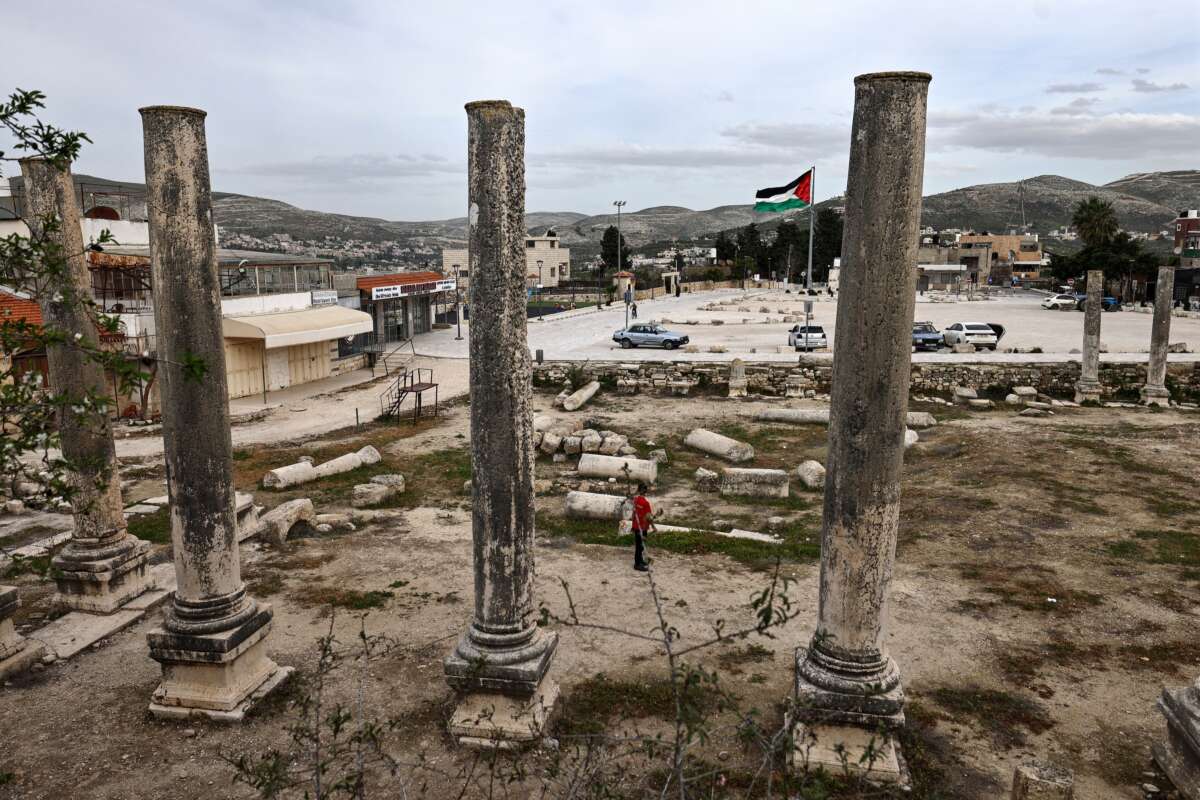
This picture taken on February 12, 2026, shows a view of the archaeological site of Sebastia, west of the occupied West Bank city of Nablus.
Zain JAAFAR / AFP via Getty Images

Ramallah — On February 8, the Cabinet of Israel approved a slew of changes to further undermine Palestinian self-rule in the West Bank.

While still awaiting final approval by the Knesset, the changes, according to a statement released by Finance Minister Bezalel Smotrich, “will continue to bury the idea of a Palestinian state.”

Under the Oslo Accords, Areas A and B of the West Bank — which together comprise 40 percent of the West Bank — fall under the control of the Palestinian Authority.

However, due to the new changes approved by the Cabinet of Israel this month, the Israeli Civil Administration, which is in charge of civil affairs in the Israeli-occupied West Bank, will now claim jurisdiction in Areas A and B under the guise of environmental and archaeological protection.

Archaeological preservation of Jewish heritage in the West Bank has long been used as a justification for the assertion of Israeli sovereignty and the expansion of Israeli settlements there, which are illegal under international law.


Palestinians Displaced in West Bank by Israeli Settlers Ask: Where Can We Go?
Settlers have destroyed homes in the West Bank, forcibly displacing Palestinians from nearly 50 Bedouin communities. By Theia Chatelle , Truthout August 9, 2025


The Cabinet decisions build on the 2023 antiquities bill, which created a body called the Israel Antiquities Authority that was given expanded legal authority to extend into parts of the West Bank, in order to assert responsibility for archaeological sites there. Now, Israeli politicians are seeking to establish a new Israeli body called the West Bank Heritage Authority, which would have even more invasive power, regulating vast swaths of Palestinian territory and representing another step toward de facto annexation.

The Tomb of the Patriarchs, located in Hebron, and the Palestinian city of Sebastia, which independent journalist Jasper Nathaniel has reported on as emblematic of Israel’s use of religiously significant sites to justify expulsion and land theft, are two sites that have been subject to varying degrees of Israeli control; under new legal frameworks, including the antiquities bill and Israeli Cabinet decisions, they are increasingly incorporated into Israeli-managed heritage development.

The slew of changes by the Israeli Cabinet also opened the Palestinian land registries, which document land claims across the West Bank. These registries had previously been kept confidential due to concerns that Israeli settlers and settlement organizations would use the information to assert fraudulent claims to Palestinian land.


“Everywhere here has heritage. It’s just an excuse to expand settlements and take Palestinian land.”

Allowing, for the first time, Israelis to purchase land directly from Palestinians in Areas A and B could open up the potential for the establishment of illegal Israeli settlements in the middle of Palestinian cities like Ramallah, which have served as the last strongholds of Palestinian self-rule in the West Bank.

Ubai Aboudi, the director of BISAN, a human rights organization based in Ramallah, told Truthout in an interview that the spate of Cabinet decisions is about continuing the farce of a legal regime enforced by the Israeli occupation in the West Bank that is meant to legitimize the settlement enterprise.

At face value, the changes might appear to be piecemeal and far from solidifying the path to legal annexation, as many headlines have proclaimed. But the changes, if nothing else, are just another step by the Israeli government to undermine Palestinian sovereignty in the West Bank.

While the Oslo agreements created the framework of Palestinian self-rule in the Israeli-occupied West Bank, the constant drumbeat of settlement expansion and Israeli military activity in the territory has shattered any hope of Palestinian self-rule in the short term, according to Shawan Jabarin, the director of Al-Haq, a Palestinian human rights organization that has frequently been targeted by Israeli authorities, who joined Truthout for an interview at the organization’s offices in Ramallah.

He emphasized that this “farce” of a legal regime serves Israel’s interests in that it justifies expansion and violations of international law beyond simply expelling Palestinians from their land.

“For example, when it comes to house demolitions, they demolish the home because you did not get a permit. ‘But you did not give it to me,’” Jabarin said.

On February 15, the Israeli Cabinet also announced, for the first time since 1967, that it would begin a process of registering Palestinian land in Area C, which is under the civil and military control of Israel. Under this new change, invalid property claims, to be decided by the Israeli Civil Administration, will lead to “vacant” land being claimed as Israeli state property.

Allowing the Israeli Civil Administration jurisdiction in Area A, which per the Oslo Accords should be under the full civil and military control of the Palestinian Authority, not only undermines the limited degree of Palestinian self-rule in its fragmented scattering of municipalities but also legally justifies the almost constant intervention by Israeli forces within Area A — which includes escorting Israeli settlers into religious sites such as Joseph’s Tomb in Nablus.

Jabarin said, “If you look at all of these things and put them together, you will see the complete picture: ‘We do not want Palestinians there. We do everything in our capacity in order to push them out and bring in settlers and replace the Palestinians with settlers.’”

For Aboudi, environmental and archaeological protection are simply a means to an end for Ministers Smotrich and Itamar Ben-Gvir to put into reality Israel’s Decisive Plan, which Smotrich published in 2017. It calls for a continual expansion of settlements and Jewish sovereignty in the West Bank, including the forcible expulsion of Palestinians.

“Everywhere here has heritage. It’s just an excuse to expand settlements and take Palestinian land,” Aboudi said.

The Israeli NGO Emek Shaveh, which advocates for access to religious sites for both Palestinians and Israelis, said in a statement, “Taken together, these developments constitute a fundamental turning point. Empowering an Israeli civilian authority to carry out enforcement measures, expropriations, and excavations deep inside Palestinian Authority Areas B and A effectively dismantles the framework established under the Oslo II Accords.”

At least 1,050 Palestinians, including at least 230 children, have been killed by Israeli forces in the West Bank between October 7, 2023, and January 27, 2026, according to a UNRWA situation report. Israeli forces on Feb. 17 invaded a village just south of Jenin, chasing local Palestinian journalists with a military vehicle.

The Palestinian Ministry of Foreign Affairs said in a statement, “The ministry stresses that these measures amount to de facto annexation of Palestinian land and directly contradict the declared position of U.S. President Donald Trump rejecting annexation and settlement expansion.”

Whether the Trump administration would put that relationship in jeopardy during what appears to be an increasingly likely conflict with Iran — as the U.S. reportedly shifts military assets into the Gulf — is unlikely.

At play is also a careful calculus on the part of the Israeli government to continue the project outlined by Smotrich, but without drawing the ire of the Trump administration, which has stated that it opposes Israel’s annexation of the West Bank.

But on the ground in Ramallah, many Palestinian residents who spoke with Truthout did not appear concerned about the Israeli cabinet decisions, with many stating that these changes do little to change the reality for most Palestinians.

The Palestinian economy is on the brink. Since October 7, 2023, Palestinians have been largely banned from working inside Israel, cutting out a significant source of income, with daily wages in the West Bank hovering at 125 shekels instead of 250 in Israel.

With the start of Ramadan on Tuesday, festivities are muted. Where there would typically be lights dangling from apartments in downtown Ramallah al-Tahta, this year, despite the ceasefire in Gaza, which one resident described as “in name only,” celebrations remain subdued.

These changes by the Israeli Cabinet are just another step that cements what Jabarin called “a complete war on Palestinian life on the West Bank meant to kill any hope for self-determination.”


This article is licensed under Creative Commons (CC BY-NC-ND 4.0), and you are free to share and republish under the terms of the license.


Theia Chatelle  is a conflict correspondent based between Ramallah and New Haven. She has written for The Intercept, The Nation, The New Arab, etc. She is an alumnus of the International Women’s Media Foundation and the Rory Peck Trust.


CHRISTIAN ZIONISM
Trump's Israel ambassador ignites international firestorm with 'deranged' 
new remarks

Huckabee has appeared to endorse the idea of “Greater Israel”  referring to the territorial aspirations of some Israelis to significantly expand the nation’s borders.


Alexander Willis
February 22, 2026 
RAW STORY


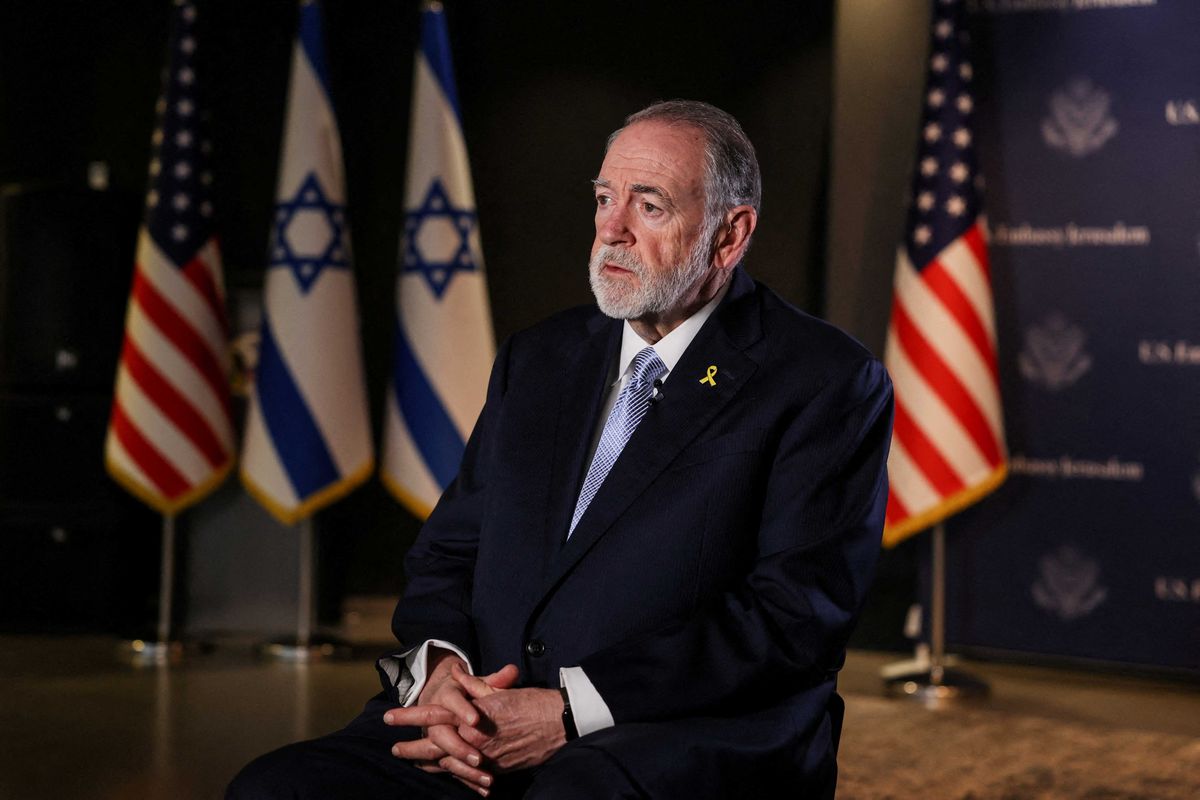
U.S. Ambassador to Israel Mike Huckabee looks on during an interview with Reuters in Jerusalem, September 10, 2025. REUTERS/Ronen Zvulun/File Photo

U.S. Ambassador to Israel Mike Huckabee ignited an international firestorm this weekend after appearing to endorse the idea of Israel taking control of the entire Middle East, remarks that prompted a swift response from more than a dozen Arab nations, including the United States’ own allies.

Huckabee sat down with conservative media figure Tucker Carlson recently for a lengthy interview that was published on Saturday, during which, Carlson pressed the former Arkansas governor on specifically what regions in the Middle East he believed Israel to be Biblically entitled to.

“Does Israel have the right to that land?” Carlson asked, making reference to what he described as “basically the entire Middle East,” including Jordan, Syria, Lebanon, and sizable portions of Saudi Arabia, Iraq and Jordan.

“It would be fine if they took it all,” Huckabee responded.


The comments drew an immediate backlash from more than a dozen Arab nations in the Middle East and North Africa, all of which signed onto a joint statement condemning the remarks as “extremist and lacking any sound basis,” NBC News reported Sunday.

Saudi Arabia, a U.S. ally, described Huckabee’s remarks as “extremist rhetoric,” and Egypt called them a “flagrant breach” of international law, NBC News reported.

Huckabee has appeared to endorse the idea of “Greater Israel” in the past, with “Greater Israel” referring to the territorial aspirations of some Israelis to significantly expand the nation’s borders. Israeli Prime Minister Benjamin Netanyahu – who was indicted by the International Criminal Court for war crimes last year – said as recently as last August that he “absolutely” subscribed to a “vision” for “Greater Israel.”“I don’t think we have fully [realized] how deranged the people driving US policy truly are,” wrote Bruno Macaes, an author, writer and geopolitical analyst, in a social media post on X Sunday in response to Huckabee’s remarks.


Battered by Gaza war, Israel’s tech sector in recovery mode


By AFP
February 20, 2026


US chip giant Nvidia said in December it would create a massive research and development centre in northern Israel - Copyright AFP Idrees MOHAMMED
Delphine MATTHIEUSSENT

Israel’s vital tech sector, dragged down by the war in Gaza, is showing early signs of recovery, buoyed by a surge in defence innovation and fresh investment momentum.

Cutting-edge technologies represent 17 percent of the country’s GDP, 11.5 percent of jobs and 57 percent of exports, according to the latest available data from the Israel Innovation Authority (IIA), published in September 2025.

But like the rest of the economy, the sector was not spared the knock-on effects of the war, which began in October 2023 and led to staffing shortages and skittishness from would-be backers.

Now, with a ceasefire largely holding in Gaza since October, Israel’s appeal is gradually returning, as illustrated in mid-December, when US chip giant Nvidia announced it would create a massive research and development centre in the north that could host up to 10,000 employees.

“Investors are coming to Israel nonstop,” Prime Minister Benjamin Netanyahu said at the time.

After the war, the recovery can’t come soon enough.

“High-tech companies had to overcome massive staffing cuts, because 15 to 20 percent of employees, and sometimes more, were called up” to the front as reservists, IIA director Dror Bin told AFP.

To make matters worse, in late 2023 and 2024, “air traffic, a crucial element of this globalised sector, was suspended, and foreign investors froze everything while waiting to see what would happen”, he added.

The war also sparked a brain drain in Israel.

Between October 2023 and July 2024, about 8,300 employees in advanced technologies left the country for a year or more, according to an IIA report published in April 2025.

The figure represents around 2.1 percent of the sector’s workforce.

The report did not specify how many employees left Israel to work for foreign companies versus Israeli firms based abroad, or how many have since returned to Israel.


– Rise in defence startups –


In 2023, the tech sector far outpaced GDP growth, increasing by 13.7 percent compared to 1.8 percent for GDP.

But the sector’s output stagnated in 2024 and 2025, according to IIA figures.

Industry professionals now believe the industry is turning a corner.

Israeli high-tech companies raised $15.6 billion in private funding in 2025, up from $12.2 billion in 2024, according to preliminary figures published in December by Startup Nation Central (SNC), a non-profit organisation that promotes Israeli innovation.

Deep tech — innovation based on major scientific or engineering advances such as artificial intelligence, biotech and quantum computing — returned in 2025 to its pre-2021 levels, according to the IIA.

The year 2021 is considered a historic peak for Israeli tech.

The past two years have also seen a surge in Israeli defence technologies, with the military engaged on several fronts from Lebanon and Syria to Iran, Yemen, Gaza and the occupied West Bank.

Between July 2024 and April 2025, the number of startups in the defence sector nearly doubled, from 160 to 312, according to SNC.

Of the more than 300 emerging companies collaborating with the research and development department of Israel’s defence ministry, “over 130 joined our operations during the war”, Director General Amir Baram said in December.

Until then, the ministry had primarily sourced from Israel’s large defence firms, said Menahem Landau, head of Caveret Ventures, a defence tech investment company.

But he said the war pushed the ministry “to accept products that were not necessarily fully finished and tested, coming from startups”.

“Defence-related technologies have replaced cybersecurity as the most in-demand high-tech sector,” the reserve lieutenant colonel explained.

“Not only in Israel but worldwide, due to the war between Russia and Ukraine and tensions with China”.