Friday, April 03, 2026


Venezuela opens for business, but investors weigh promise against reality
Venezuela opens for business, but investors weigh promise against reality
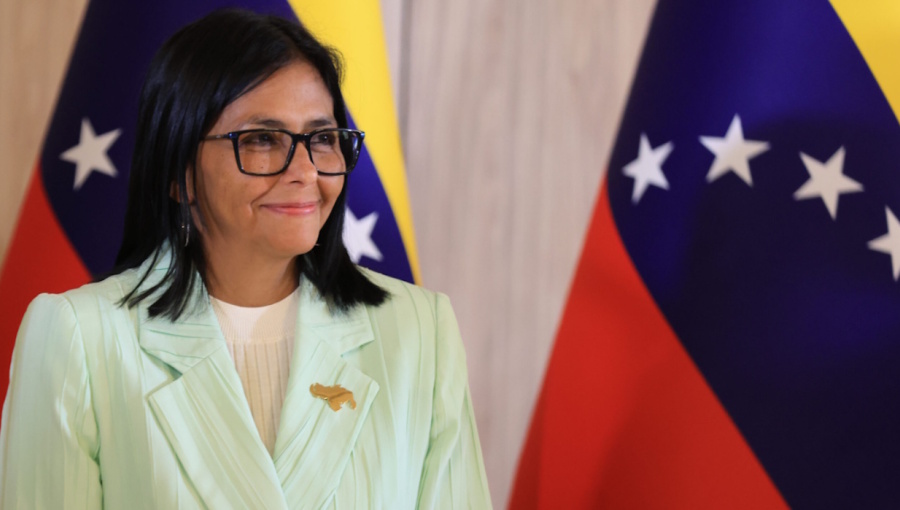
Delcy Rodríguez has moved swiftly to court foreign investors and overhaul the country's legal framework and military leadership since Nicolás Maduro's ouster in January, but questions over her democratic intentions persist.
By Marco Cacciati April 1, 2026

The months since Nicolás Maduro's capture have brought Venezuela closer to the global economy than at any point in a generation. New laws, a US sanctions rollback and a resumption of international engagement have redrawn the investment landscape with striking speed. Yet for many of the large Western corporations and institutional investors Washington is courting, the reforms remain a foundation still under construction, according to Caracas-based boutique advisory Orinoco Research.

Since taking office, acting president Delcy Rodríguez has presided over a cascade of legislative activity. Forsaking decades of rabid anti-imperialist rhetoric, the National Assembly has approved reforms to the hydrocarbons law that give international companies greater freedom to manage production and market crude independently. A new mining law has received initial approval, designed to establish private mining concessions and streamline bureaucratic processes. Meanwhile in Washington, the Treasury Department's Office of Foreign Assets Control has issued a general licence that effectively permits almost any foreign entity to enter and invest in Venezuela's oil and gas sector without first obtaining individual clearances. And separate OFAC licences have since extended similar terms to the minerals trade, including gold.

The broader legal overhaul also includes an amnesty law that is being used, in part, to reform Venezuela's deeply compromised judiciary and bureaucracy. According to Orinoco Research, this aims to jump-start a transformation considered essential to building investor confidence, as well as to advancing democratic governance and human rights.

Alongside these long overdue reforms, the Banco Central de Venezuela (BCV) recently published updated balance of payments figures after seven years without comprehensive official data, itself a telling signal of the opening under way. The release, welcomed by economists as a rare increase in transparency from an institution long criticised for limited disclosure, offered the first systematic view of Venezuela's external accounts in nearly a decade. For investors, the figures reveal both the scale of the opportunity and the depth of the hole the country must climb out of.

Rodríguez, who has earned the praise of US President Donald Trump, has also overhauled the military leadership entirely since January, replacing the minister of defence, the joint chiefs of staff and all regional commanders, and has reshuffled roughly half of her cabinet. The concentration of decision-making authority over the new laws in Rodríguez's direct economic team has driven the pace of reform, though it has also reinforced concerns about the discretionary application of the new framework.

Investor appetite: a two-speed market

Orinoco Research views the current investor universe as sharply segmented. Companies already present in Venezuela – notably Chevron, which maintained its joint ventures with state oil firm PDVSA throughout the Maduro era, Repsol and Shell, which kept a local office in Caracas – have wasted no time, positioning themselves to take over oil fields and pursue new agreements. Shell has entered discussions over natural gas projects with Trinidad and Tobago. Repsol has said it plans to triple its gross crude output in Venezuela to 150,000 barrels per day within three years.

A second group, composed primarily of high-net-worth individuals from emerging markets, has also moved in, drawn by a high risk tolerance and the prospect of outsized returns from a deeply distressed market. These investors have been most active in real estate, agriculture and early-stage commercial opportunities.

Large US corporations and institutional investors, by contrast, wait in the wings. Orinoco Research expects companies such as ExxonMobil and ConocoPhillips to require at least a year, possibly more, before committing capital. ConocoPhillips chief executive Ryan Lance has publicly dismissed recent legislative changes as "woefully inadequate." Chevron's chief executive Mike Wirth acknowledged reforms are moving in the right direction but said further steps are needed before investment at the desired scale materialises.

The key catalyst for this group, the consultancy argues, will be concrete precedents rather than further legal change. If a major company secures an attractive, transparent deal with demonstrably favourable terms – low royalties, clear contract provisions, reliable enforcement – it is likely to trigger a “FOMO effect” among peers. In the meantime, the ambiguity that persists in the new hydrocarbons law, particularly the wide royalty band of between zero and 45%, continues to give large investors pause.

Oil sector: the numbers and the scenarios

The BCV data lays bare the magnitude of Venezuela's oil sector collapse, which began in the early 2000s under the tenure of former president Hugo Chavez. Export revenues fell to $4.8bn in 2020, a historic low, before recovering to $18.2bn in 2025, broadly in line with 2024 levels but a fraction of the $93bn recorded in 2012, when a single year's oil income matched the combined total of the entire 2019–2025 period. Between 2014 and 2016, revenues halved and then fell a further quarter; a 55% decline in 2019 was followed by a 67% collapse in 2020, leaving Venezuela's hard-currency earnings capacity roughly 95% below its peak. Current production stands at around 1mn barrels per day, against 2.5mn in the mid-2010s.

Oil has nonetheless remained the backbone of Venezuela's external sector, accounting for an average of 67% of total exports since 2019. Analysts caution, however, that this share reflects the contraction of other sectors rather than diversification, and that current export levels are still insufficient to meet Venezuela's import needs.

Orinoco Research sets out three scenarios for the oil sector in 2026. In the conservative case, production remains flat, oil prices stay low and OFAC applies licences restrictively, with fiscal pressure holding royalty rates near the top of the permitted band. Oil sector GDP would grow by around 11.5% from a base of approximately $12bn, a modest expansion offering little macroeconomic relief.

The base case assumes production rising to between 1.2mn and 1.3mn barrels per day, with some flexibility in the fiscal framework for new greenfield investments, including reduced royalty rates. This scenario is regarded as the most probable near-term trajectory, particularly if current engagement between Washington and Caracas continues.

In the optimistic scenario, a prolonged conflict involving Iran sustains elevated oil prices, Trump administration pressure intensifies and Venezuela's fiscal terms become more competitive. Production could reach 1.4mn barrels per day or beyond, with oil sector GDP expanding by up to 25%. Orinoco Research suggests that, as a rough rule of thumb, the broader economy grows at roughly half the rate of the oil sector, implying that double-digit overall GDP growth is achievable under favourable conditions. A significant additional upside factor, even without production increases, is the narrowing of the discount applied to Venezuelan crude relative to benchmark prices.

The balance of payments presents a structural challenge that higher oil revenues alone will not resolve. Goods and services are currently almost in balance, with a net surplus of just $94mn on tens of billions in flows, meaning nearly every dollar earned from oil exports is recycled into imports. Breaking this cycle will require resolving the multiple-exchange-rate distortions that have historically incentivised importers at the expense of domestic producers. Orinoco Research notes that the interim leader has spoken of establishing a sovereign wealth fund to set aside oil revenues, but regards her commitment to doing so as unproven.

Inflation remains a persistent structural problem. The widely circulated figure of around 600% bears little resemblance to economic reality, given Venezuela's semi-dollarised economy. Even in dollar terms, effective inflation is running at 30 to 40%, among the highest in the world, and will require higher oil export revenues and fiscal discipline to bring down. Full dollarisation is not on the current agenda, though partial measures are not off the table.

Mining and beyond

Washington's push to open Venezuela's mining sector, an explicit priority raised by energy secretary Chris Wright and interior secretary Doug Burgum during visits to Caracas, has gathered momentum. The Orinoco Mining Arc, a 112,000-square-kilometre zone holding important reserves of gold, diamonds, bauxite, coltan and rare earth elements, has been associated historically with armed groups and organised criminal networks, complicating due diligence and operating conditions for incoming investors. Legal changes are taking shape, with private mining concessions introduced for the first time, though the security dimension will weigh on decision timelines for major players.

Orinoco Research also points to early-stage opportunities in electricity, real estate, agriculture, tourism and financial services. Venezuela's financial system operates with a money supply of only about 3% of GDP, meaning the credit market is almost entirely absent, no meaningful mortgage market exists, and corporate lending is negligible. This makes for an enticing opportunity for financial sector investors willing to operate in a high-risk environment. The advisory also notes that state-owned assets across multiple sectors, from hotels and steelworks to farmland, are likely to come to market through outright sales rather than the public-private partnership arrangements that characterised the Maduro era. The Centre for International Investment, led by Calixto Ortega, is expected to drive this process.

A reassignment of oil contracts previously awarded under the “anti-blockade” law has already begun. Several fields previously operated by Chinese companies, some of which were separately sanctioned by the US for alleged dealings with Iran, have been transferred to Western-aligned operators following a US-requested review. This process has proceeded quietly, without significant public disclosure, but Orinoco Research says it has been substantive in scope.

Political outlook: transition or consolidation?

Despite the economic opening, Orinoco Research believes the democratic transition remains the most consequential and least certain variable in the investment calculus.

Rodríguez has used her consolidation of military and cabinet control to advance an agenda of economic reform, but whether this reflects a genuine commitment to democratic transition or merely a strategy for long-term retention of power remains a matter of debate. The amnesty law, intended to accelerate judicial and institutional reform, is being implemented slowly and selectively, generating frustration among civil society. Protests have increasingly been driven by labour groups, students and civil society organisations reflecting frustration over stagnant living standards and limited freedoms. And despite signs that hardline chavistas are losing ground, interior minister Diosdado Cabello remains, for now, in place.

Opposition leader María Corina Machado, the 2025 Nobel Peace Prize laureate, has not yet returned to Venezuela despite a second meeting with Trump and ongoing communication with Secretary of State Marco Rubio. Her vision for Venezuela's economic future is considerably more ambitious than what is currently on offer: she has put the country's long-run oil production ceiling at 5mn barrels per day, contingent on $150bn in capital and a wholesale transformation of the legal and institutional framework – none of which, she argues, can be secured before a free presidential election is held. She has also backed continued US control over Venezuelan oil revenues, arguing that the Treasury's handling of those funds since January serves as a necessary check against graft and a source of leverage over Rodriguez.

Within Venezuela, opposition leaders recently released under the amnesty have resumed on-the-ground political activity, and Machado’s own Vente Venezuela party’s headquarters in Caracas were allowed to reopen, an unthinkable development under ousted president Maduro.

Orinoco Research outlines three key political risks that investors should monitor. First, whether the Trump administration sustains effective pressure for democratic change, or is consumed by domestic political turbulence, including the possibility of impeachment proceedings following the US midterm elections, that diverts attention from Venezuela. Second, whether the opposition can manage a political transition without provoking the instability or repression that would derail economic recovery. Third, whether chavista factions accept electoral defeat, should elections take place in late 2026 or 2027, or whether Venezuela reverts to a contested result as occurred in 2024.

In the event of protracted US political distraction, Orinoco Research considers it plausible that Rodríguez quietly consolidates power without proceeding to elections, producing what the advisory labels as an intermediate scenario: more business-friendly than the Maduro regime, but falling well short of a full democratic transition. As multiple analysts have observed, the central challenge for Venezuela is ensuring that the current transition leads to a fully democratic system, not merely an economically open one.

For investors, Orinoco Research's overall message is that the Venezuela opportunity is real but front-loaded with risk. The prize – a country with 17% of the world's proven oil reserves, untapped mineral wealth and a deeply suppressed domestic economy – is considerable. So are the obstacles: legal ambiguity, institutional inertia, an unresolved political transition and structural economic distortions that decades of mismanagement have entrenched.

The companies best placed to benefit in the near term are those already in the country. Everyone else is watching closely, and the next twelve months will be the test of whether Venezuela's promise translates into investable reality.


 

COMMENT: Taiwan’s worship of America could be its downfall

COMMENT: Taiwan’s worship of America could be its downfall
/ Lisanto - UnsplashFacebook
By Mark Buckton in Taipei April 2, 2026

In Taiwan’s ever pugnacious political debate, few orthodoxies are quite as deeply embedded by the ruling Democratic Progressive Party (DPP) as the conviction that alignment with the United States is both natural and the only real way to counter Chinese takeover threats.

From defence procurement to television news bulletins, American primacy is treated less as a choice than as an inevitability to which there is no alternative. Yet this instinctive deference which at times can border on cultural self-effacement, risks leaving Taiwan both economically constrained and intellectually diminished at the exact moment it needs to demonstrate clear and effective resilience.

The island’s security relationship with the United States is indispensable. In that there is no real dispute. The Taiwan Relations Act coupled to arms sales and high-level visits have long provided a deterrent in the face of mounting pressure from China. Few serious observers would ever argue that Taipei can realistically afford to distance itself from Washington. However, as has become increasingly evident in recent years, dependence is not the same as strategy, and cap-doffing deference is not the same as agency.

In Taiwanese cultural and in particular media spheres, Americanisation often goes unquestioned. For local radio stations, “foreign news” means developments in Washington rather than in Warsaw, Pretoria or Singapore. European elections and African trade blocs barely register and major Latin American political shifts in recent months rarely make the cut - unless of course seen through US eyes. The result across the nation is a dangerous narrowing of the world the neighbours in the Philippines, Japan and South Korea get to see.

This has consequences. Taiwan is not merely a frontline in the ongoing US-China rivalry even if it has been played this way in US media. Taiwan is a vibrant society with its own multilayered history, shaped by numerous forms of Indigenous culture, early Spanish and Dutch efforts at colonialism, Qing Dynasty rule in some areas, a 50-year period of Japanese control into the mid-20th Century, as well as post-war authoritarianism.

Yet public discourse can appear disproportionately animated by US culture wars, US electoral cycles and US policy fashions. Foreign sports coverage on local media essentially means stateside NBA or Major League baseball coverage. In falling so deeply for the belief that working with the US on defence requires the full-on adoption of all things American, Taiwan is overlooking its own distinct strengths – not least its technological prowess and democratic evolution.

This imbalance is most acute in defence policy. Taiwan has spent billions of dollars on American hardware which include F-16 upgrades to missile systems and tanks. Yet, while these purchases send political signals to China, and ensure at least a degree of interoperability with US forces should the time ever come, they also reflect a slave-like belief that Taiwan must tether itself to Washington’s industrial base and timelines. In doing so, military purchases from across the Pacific are more designed for US expeditionary warfare, rather than an island nation living under threat of attack by a much bigger neighbour across the Taiwan Strait.

Beijing has had many decades to study US military hardware, as well as doctrine. The People’s Liberation Army (PLA) is well aware of American air, naval and missile capabilities. There is little on the Taiwanese defence manifesto the Chinese have not prepared to face many times over.

It would be wholly naïve to assume that weapons publicly debated in the US Congress and showcased in American export catalogues are a mystery to Chinese military planners.

In knock-on effect, the belief that runways would not be among the first Chinese targets in any conflict scenario as part of moves to cripple Taiwan’s air force before it can take off would be gullibility personified. Conventional aircraft in wartime are some of the easiest to ground.

But Taipei’s aviation investments do not reflect this weak spot. Instead, the island’s mountainous terrain could be an asset in developing dispersed, hardened and vertical or short take-off and landing (VSTOL) capabilities. The experience of the United Kingdom with its former Harrier fleet (retired in 2010) in the 1982 Falklands War, and even India’s now-retired naval Harriers (2016), offer lessons in operating from austere environments.

As such, rather than relying overwhelmingly on conventional runways and imported and outdated F-16 fighter jets that first went into service in the 1970s, upgrades notwithstanding – Taiwan could and should invest more heavily in indigenous research and development tailored to its own unique geography. A modern VSTOL capability - whether through adaptation with the US, UK, Japan or Italy who all operate the F-35B – a VSTOL capable modern aircraft – or simply domestic innovation, would prove a huge complication to Chinese targeting calculations. So too would a greater emphasis on drones, mobile missile batteries and decentralised command structures which to some extent are being brought into play sources indicate.

Of course, funding such a shift requires political courage at home. At present, Taiwan’s tax burden remains comparatively low when held up alongside other countries, and fuel prices are often politically massaged to avoid public backlash. But if national survival is truly at stake, then petrol should be priced at realistic market levels, and land and property taxes reformed to reflect soaring urban values. Taiwan as a society that expects security without sacrifice risks discovering the limits of external guarantees.

In addition, diversification should extend beyond current military doctrine and to this end, Taiwan is making progress. As of early 2026, Taipei's unofficial and official ties stretch far beyond Washington with Taipei maintaining diplomatic relations with a small but symbolically significant group of states, and significant economic even if technically unofficial links with major economies across Europe and Asia.

Yet too often are these relationships framed as supplements to, rather than pillars worthy of standing alongside, the American connection.

Taiwan under the DPP has the scope for much more structured military interaction with European partners including spheres such as joint training and intelligence-sharing. But is the government of President William Lai willing to move even slightly away from US influence in defence sector spending? European states have long grappled with hybrid warfare and energy coercion – most recently as a close neighbour to the conflict in Ukraine. These are all issues that resonate with Taiwan’s experience as regards China, and a much broader web of security relationships would signal to all that Taiwan’s defence is not simply a bilateral financial favour to the US.

Taiwan must recognise that the nation’s fate cannot rest solely on the electoral calendar of a foreign power. US politics is highly volatile – never more so than now with commitments that have seemed ironclad under one administration now being questioned under the Trump White House.

A Taiwan that raises the revenue necessary for its own defence, works to develop systems suited to its hard to penetrate terrain and takes steps to nurture its own distinct cultural voice will be a more formidable partner – and a harder target for China to knock out.

Thursday, April 02, 2026


MOSCOW BLOG: Pax Americana exposed as a paper tiger

MOSCOW BLOG: Pax Americana exposed as a paper tiger
The war in Iran has not only laid bare America's military weaknesses, but it is destroying the last vestiges of trustworthiness as a security guarantor. The big winner is Ukraine, which is preparing to step into that role, albeit wearing smaller shoes. / bne IntelliNewsFacebook
By Ben Aris in Berlin April 2, 2026

Superficially the war in Iran has dealt Ukraine a huge blow. The White House is now completely distracted, and the Trump administration seems to have abandoned, or at least paused, the ceasefire negotiations with Russia. Trump is in a rush and told Zelenskiy: give up Donbas and we can do the deal. Zelenskiy said no. Again.

More pragmatically, the US is burning through its weapons at an unbelievable rate. In one month, it shot off three to five years’ worth of its production capacity of Patriots and THAAD interceptor missiles. The Nato alliance was short of these missiles before the start of the Iran war but now there's simply none left. Reportedly, Israel the skies are now open as it also used up all of its defensive interceptor missiles.

At the same time Ukraine is facing a macroeconomic collapse in a few months as the EU's €90bn loan has been tied up by a Hungarian veto. EU foreign policy chief Kaja Kallas was in Kyiv yesterday and made it clear that it's not just Hungary who's objecting to lending the money. As we reported, the disunity in the EU is growing and the faith in the US is faltering as it's clear the “special relationship” is dead.

However, Bloomberg opinion editor Marc Champion (and my first ever editor when I was briefly on the Moscow Times) pointed out in an op-ed that Ukrainian President Volodymyr Zelenskiy doesn't seem to be particularly fazed.

Stepping back and taking a bird's eye view, Trump appears to be rapidly and comprehensively destroying America's standing in the world both diplomatically and militarily.

Since the end of the Second World War the US has been the backbone of the International Security order. Its overwhelming military might and its cornucopia of high quality weapons has underpinned the security of numerous countries. First and foremost, in Europe America maintains some 500 military bases as well as in Japan where the occupation never ended. However, its reach goes far beyond these two poles and the Middle East has also bought billions of dollars of US arms as well as set up 13 military bases throughout the region.

A month into the Iran war and it appears those weapons don't work anymore. Air fence missiles are not just running out, the Patriot PAC-3 interceptors don’t stop Iran’s best missiles. And those 13 bases? They have all been destroyed by Iran in a matter of days.

That came as a shock to everyone. Increasingly desperate for interceptors the Gulf states, in particular, have started to cast around for alternatives. Reportedly going into the war Saudi Arabia had 2800 missiles but has used in the first month 2400. With the production backlog meaning that the US won’t be able to replace them until 2028 at the earliest, nobody feels particularly secure any more. That's obviously useless because new missiles are needed yesterday.

Cue Ukraine. Kyiv already has the most advanced anti-drone weaponry in the world. When Zelenskiy was trying to get money out of Trump last year, trading Patriot missiles for Ukraine interceptor drone tech in a $50bn deal, Trump told him to talk to the hand. More recently when Zelenskiy repeated the offer, he said more explicitly “We don't need any help”

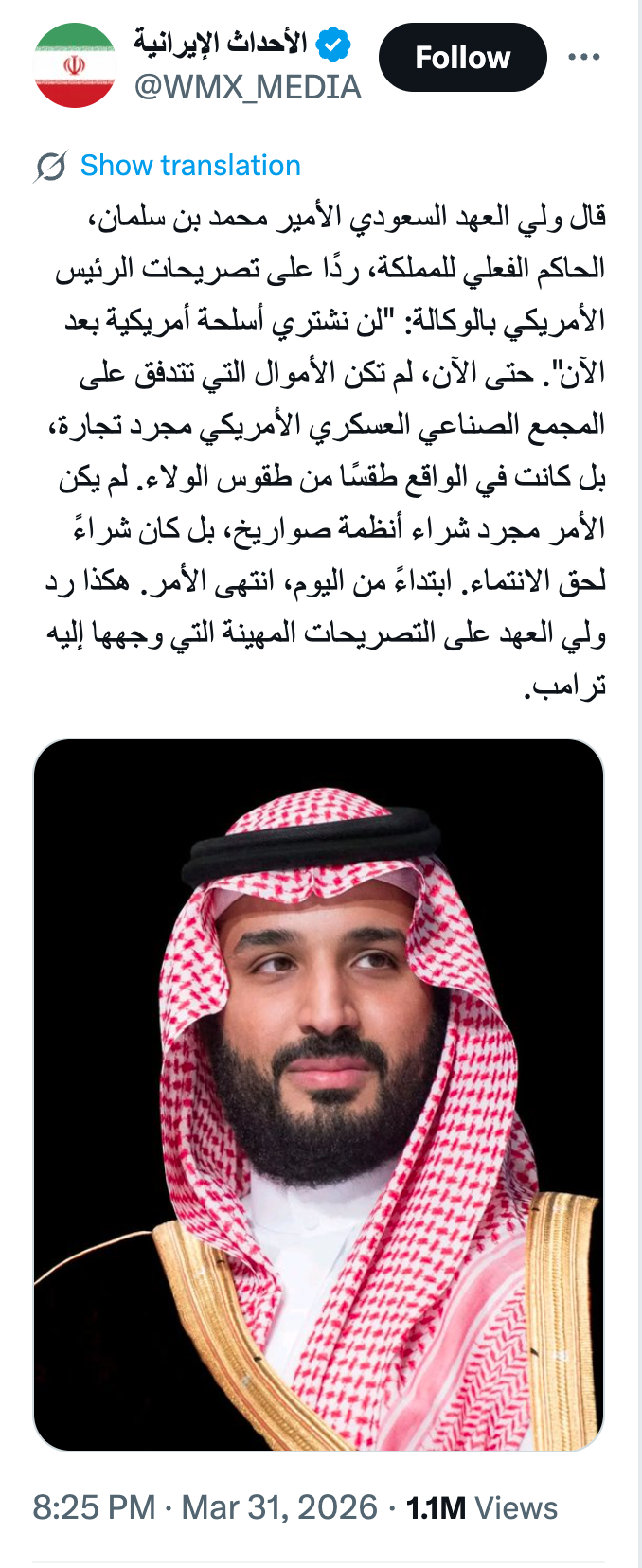
Saudi Crown Prince Mohammed bin Salman (MbS) is taking a different view. It is very clear that they do need help, and they need help right now. He invited Zelenskiy to Riyadh and signed a defence pact. Reportedly Ukrainian drones are already in use and have shot down “hundreds” of Iranian Shahed drones in just the last week. Moreover, Ukraine has a large idle production capacity to make more. Zelenskiy just needs some investment capital…

The White House was not happy about this deal. Trump said that the Kingdom can look after itself and the MbS can “kiss my ass.” That wasn't a clever thing to do. I am not an Arabist, but I've been told you do not insult Arabs. They do not take it kindly. MbS quickly followed up from a conversation with Secretary of State Marco Rubio and said defence cooperation with the US is now over.

"We will no longer buy American weapons," Mohammed bin Salman  said in a post on social media. "Until now, the money that flowed into the US military-industrial complex was not merely a matter of trade, but in reality was a ritual of allegiance. It was not simply about purchasing missile systems, but about buying the right to belong. From today, that is over."

The Kingdom will look for its weapons amongst its “regional partners.”

It looks very much like Zelenskiy suddenly has a new partner, a very rich partner, who can take over from the non-existent help Ukraine is getting from the US and the unreliable help Ukraine isn't getting from the EU.

More generally, the US security umbrella, which has been so important to the world order for 70 years, is also looking increasingly like a paper tiger.

The US involvement in the Middle East has been to include the Gulf states under the US security umbrella. But now it started a war with Iran, a war that it's clearly losing, that security deal seems to be pretty worthless. Trump has put himself in a position where the Gulf states, in particular, as well as Ukraine, are increasingly ignoring him as he has been unable to deliver on the promise of peace and prosperity. In fact, Trump has delivered on exactly the opposite.

The Arab states are incredibly angry at Trump. Without consulting them, or even taking their interests into account, instead of investing and helping them promote their “Vision” programmes to diversify away from their hydrocarbon dependence, he set the match to the biggest conflagration in the region in many years.

It appears in the space of a month Trump has totally dismantled what was left of America's reputation as a bastion of freedom and democracy and the guarantor of peace and prosperity. Pax America is over.

Trump has clearly been shocked and frustrated by his fading authority. He called on his so-called Nato allies to come to his military help in order to extricate himself from the Strait of Hormuz imbroglio and they refused. He said twice now that he's going to pull the US out of Nato. What has changed in the last week or two is nobody cares. The US presence is not going to make enough of a difference. It's now fairly clear that the US would not automatically prevail in a war with either Russia or China as they both have the same drone and missile tech that Iran does.

That is another giant geopolitical blunder Trump has made. After the annexation of Crimea, many analysts pointed out the sanctions on Russia were driving it into China’s arms and an alliance between Moscow and Beijing was not in the US interests. In this war it is becoming increasingly clear that all three of the other CRINK (China, Russia, Iran, and North Korea) members are providing Iran with weapons and intel. Until now, the Sino-Russian relation was largely economic, but now the CRINK alliance is a military alliance to add to the existing economic one. Collectively, the four CRINK countries have just under half of all the world's soldiers serving in standing armies.

Instead of singling out his enemies and picking them off one by one – first Russia, then Iran and next possibly China – the US has pushed all four CRINK countries together into a single military bloc that are now actively militarily cooperating by supplying Iran. If the US attacks China – or China simply takes advantage of America’s revealed lack of clothes and blockades Taiwan – then the US would find itself fighting a war in three major geographical theatres simultaneously: Europe, the Middle East, and Asia. It’s only ally? Europe. Maybe. And just in Europe.

Through a mixture of arrogance, ignorance and incompetence, Trump and his team have completely failed to understand how radically the nature of war has changed. As we have been spelling out in detail, it’s no longer the “Command of the Commons” where overwhelming might carries the day, a doctrine that has been in place for decades, but now is “Command of the Reload”. Cheap and plentiful $20,000 drones can, if not defeat, they can easily neutralize the most powerful navy and air force in the world. The US-Israeli coalition has armed themselves for the wrong war. The Fifth Fleet is currently standing about 3,000km off the shores of Iran, terrified to go anywhere near it. A ground invasion of Iran is a fantasy. The US has command of the skies, but it can’t find Iran’s men and weapons that are safe in mountainous caches after the IRGC triggered its Decentralized Mosaic Defence doctrine (DMD) in the first days of the war. Tehran has been preparing for this war for decades. Trump apparently decided to go in on a whim at JD Vance’s prompting.

America’s role as Global Policeman is over. Countries are now looking for alternatives who can provide them with real security guarantees. And the country they are turning to is? Ukraine.

That's pretty shocking. That has changed in just a few weeks. That is why Zelinsky is looking, if not happy, he is looking a lot more relaxed. Having MbS as a friend is not a bad bet at all. And everyone wants it as everyone realises they need to ditch Trump and the US’ empty promises.

As Henry Kissinger famously said: ““It may be dangerous to be America's enemy, but to be America's friend is fatal.”

Iran's NZ embassy fires back at Trump 'stone age' taunt with AI-generated mockery

Iran's NZ embassy fires back at Trump 'stone age' taunt with AI-generated mockery
Iranian embassies have recently found their voice after years of following the party line. / bne IntelliNewsFacebook
By bnm Gulf bureau April 2, 2026

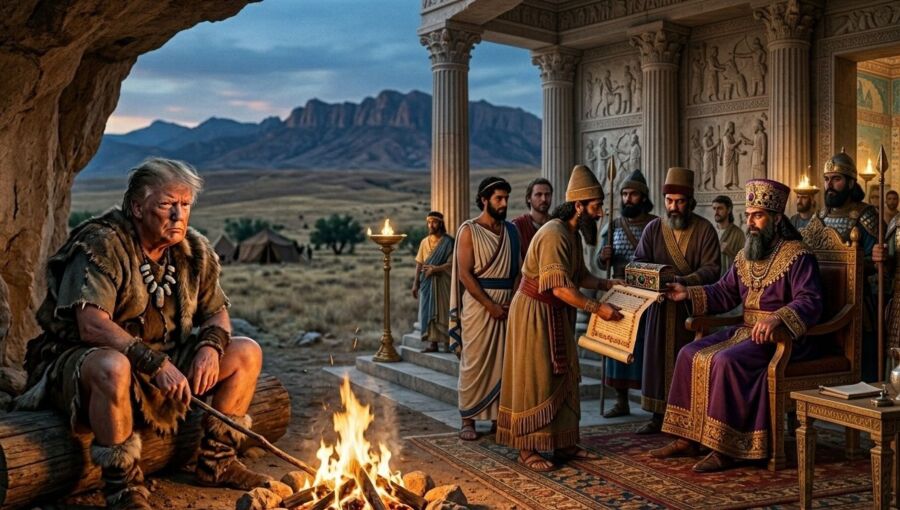
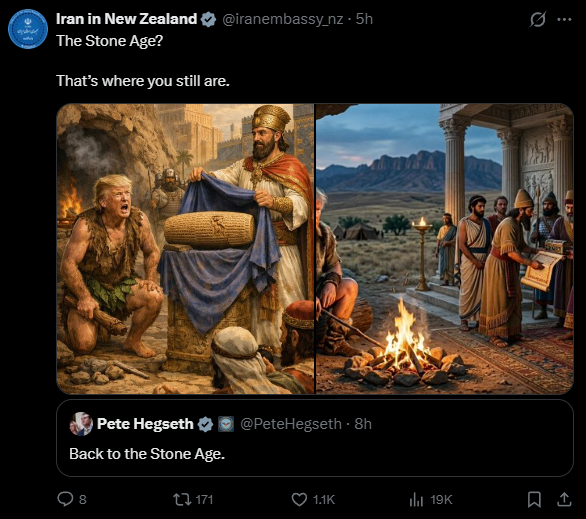
Iran's embassy in New Zealand hit back at President Donald Trump's threat to bomb the country "back to the stone ages" with an AI-generated image posted on X on April 2 depicting Trump as a caveman cowering before an ancient Persian king.

The Gemini-generated post was a direct response to US Secretary of War Pete Hegseth, who had posted "Back to the Stone Age" on X following Trump's primetime address. The embassy quote-tweeted Hegseth with the caption: "The Stone Age? That's where you still are."

The image showed Trump crouching in animal skins beside a figure resembling an Achaemenid-era Persian ruler holding the Cyrus Cylinder, widely regarded as the world's first declaration of human rights, dating to 539 BC. A second panel depicted Persian nobles gathered in a grand palace while primitive figure of Trump sat around a campfire.

The post had drawn 19,000 views, 1,100 likes and 171 reposts within five hours.

The embassy's response taps into a vein of Iranian national pride that Trump's remarks have inflamed. Iran's civilisational history stretches back more than 5,000 years, predating the United States by millennia. Former Foreign Minister Javad Zarif made a similar point on X, writing that "Iran had a GREAT civilization during the stone age, where he and his Sec of War belong."

Trump's "stone age" line, delivered during his first primetime address on the war, has become one of the most politically charged moments of the conflict. US Congresswoman Yassamin Ansari called the remark "vile, horrifying, evil," while former Republican ally Marjorie Taylor Greene said the speech contained nothing but "WAR WAR WAR."

Iran's diplomatic missions have increasingly used social media to wage an information war alongside the military campaign, with Parliament Speaker Mohammad Bagher Ghalibaf's "#Israelfirst" taunt and Foreign Minister Abbas Araghchi's outreach to Gulf states among recent examples.

The latest media responses by the Iranian missions across the globe come as the country continues to up the ante against the US and Israel on social media site X and Telegram with specific channels showing AI-generated videos. In Iran's AI-generated propaganda campaign, built around Lego figurines, meme culture and a running fixation on Donald Trump's ties to the Jeffrey Epstein files.

Iran's state-run Revayat-e Fath institute fired the opening salvo shortly after the February 28 strikes that killed Supreme Leader Ayatollah Ali Khamenei, releasing a two-minute Lego-style animation that has since garnered tens of thousands of likes and shares across Meta platforms and X.

Emerson Brooking of the Atlantic Council's Digital Forensic Research Lab told NPR that war was increasingly being absorbed into the attention economy. "It's like this commodification of war, becoming part of the attention economy, which is a very strange and discomfiting experience," he said.

The campaign did not emerge in a vacuum. It accelerated after the White House itself released a media mashup early in the war, blending NFL tackle highlights with footage of missile strikes on Iran.

Iran's output has broadly outpaced it in terms of viral reach, with one Reddit post describing the Lego videos as resembling a video game cutscene and praising the visual design even among those opposed to the conten

DEDOLLARIZATION

Gold overtakes US Treasuries in central bank reserves

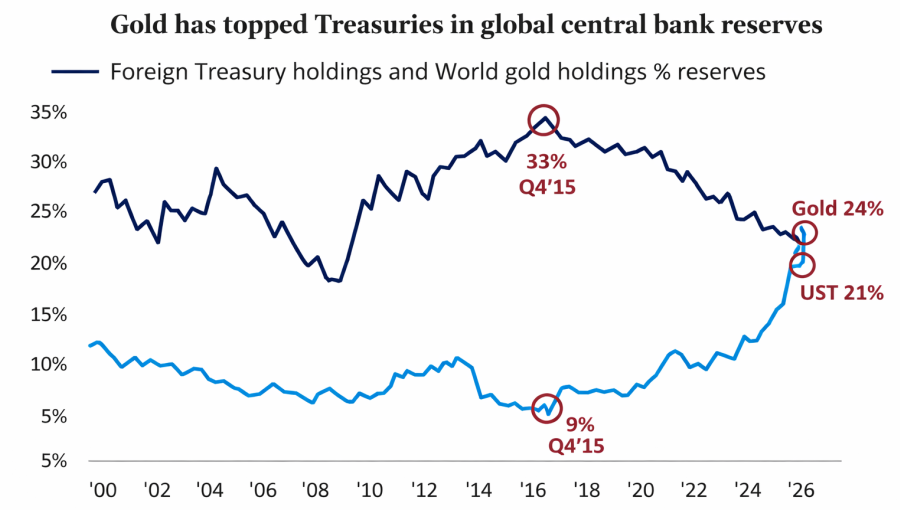
Gold has overtaken US Treasuries as the largest component of global central bank reserves for the first time since the mid-1990s

Gold overtakes US Treasuries in central bank reserves
Gold has overtaken dollars to become the main currency reserve unit as the US treasury bill sell off continues. / bne IntelliNewsFacebook
By bne IntelliNews April 2, 2026

Gold has overtaken US Treasuries as the largest component of global central bank reserves for the first time since the mid-1990s, marking a significant shift in the structure of the international monetary system, Bloomberg reports.

Gold now accounts for 24% of global central bank reserves, compared with 21% for US government debt, according to the data cited. The change represents a sharp reversal from the final quarter of 2015, when Treasuries made up 33% of reserves and gold just 9%.

“Gold now makes up 24% of global central bank reserves, surpassing US Treasuries at 21% for the first time since the mid 1990s,” the data shows.

The reallocation reflects both sustained central bank buying and a sharp rise in gold prices over the past decade. “Gold as a % of central bank reserves has NEARLY tripled over the last decade, driven by both aggressive central bank purchases and surging gold prices,” the figures indicate.

Central banks, particularly in emerging markets, have accelerated purchases in recent years as part of a broader diversification strategy. At the same time, holdings of US Treasuries have declined steadily, with China playing a prominent role in reducing exposure.

As IntelliNews Lambda reported, China and the leading BRICS countries have started to sell off their treasury bill holdings, selling that started in earnest in 2022 after the US weaponised the dollar by seizing Russia’s central bank reserves but accelerated in April last year after the Trump administration launched the Liberation Day tariffs scheme. The selling of T-bills is expected to gain further impetus have the start of Operation Epic Fury that is expect to have widespread negative economic consequences and has undermined the US reputation as a reliable partner.

The shift points to an accelerating de-dollarisation, long the cornerstone of global reserves. While the US dollar remains dominant in trade and finance, reserve managers were unsettled by the seizure of the Central Bank of Russia (CBR) reserves and are now actively reducing the share of dollars in the basket.  Gold is no longer an alternative reserve asset; it has replaced the dollar as the major reserve asset.


COMMENT: Win or lose, Orban has broken Hungary’s democracy

COMMENT: Win or lose, Orban has broken Hungary’s democracy
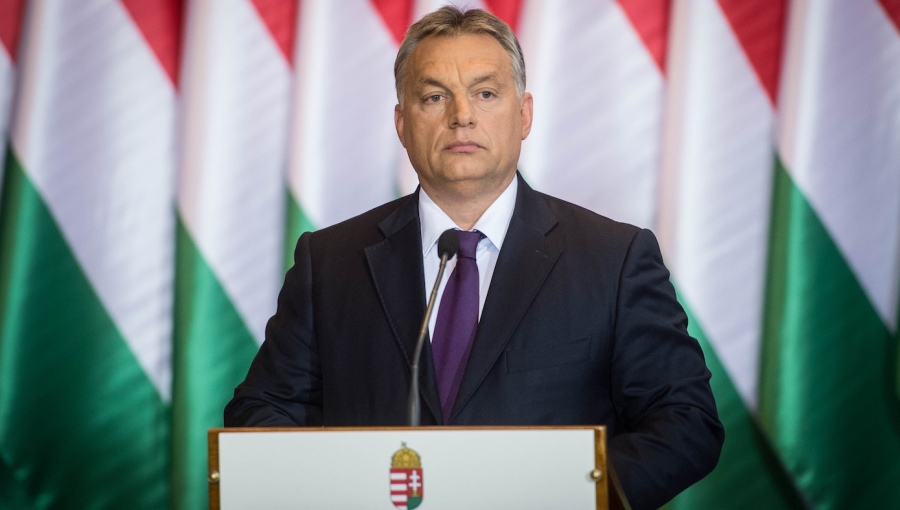
Hungarian Prime Minister Orban is fighting a dirty election campaign. On paper the opposition candidate Tisza party leader Peter Magyar has a clear lead. In practise, Orban's control of the state media and his fearmongering tactics mean this is not a fair fight. / bne IntelliNewsFacebook
By bne IntelliNews April 2, 2026

Hungary’s parliamentary elections on April 12 would, under normal democratic conditions, point towards a change of government, but the country’s political system no longer operates on conventional terms, Zsuzsanna Szelényi, a Research Fellow at Central European University’s Democracy Institute.

“If Hungary were a normal European democracy, the conclusion would be straightforward,” Szelényi said in a note for Carnegie Endowment for International Peace. “A government that has trailed its main challenger in the polls for months would be heading toward defeat.”

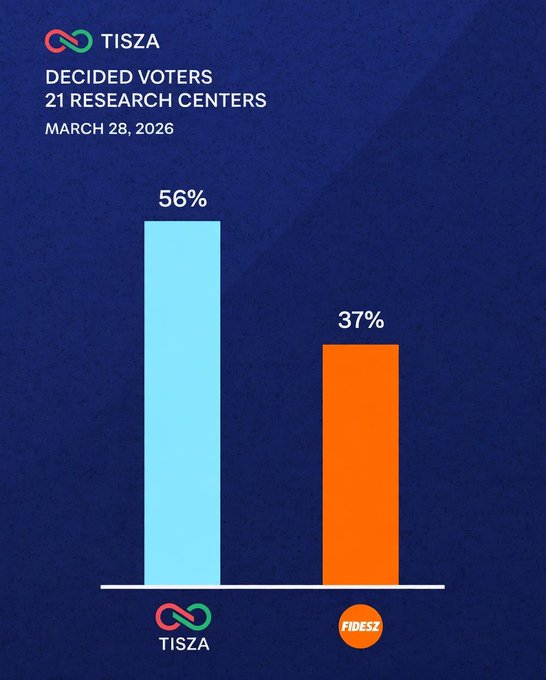
The insurgent Tisza party, led by Péter Magyar, has maintained a consistent lead over Prime Minister Viktor Orban’s ruling Fidesz.

“The largest gap so far has also been measured by the 21 Research Centre, in favour of TISZA. The tipping point has been reached. The Hungarian countryside has turned against Orbán and his allies’ corrupt and inhumane rule,” Magyar said in a social media post on April 2.  Now comes the most important phase of the campaign. There are 11 days left until this decisive election. Onwards to victory!”

“In a democratic political system, such a gap would ordinarily suggest an imminent transfer of power,” she said, adding that Hungary’s institutional landscape has been fundamentally altered by what she described as “total state capture”.

Despite leading the only credible challenge to Orbán in years, Magyar has been denied even a token appearance on public television. The state media has worked tirelessly to amplify government messaging and Orban personally. A massive AI-powered campaign has flooded social media with anti-Tisza messaging and pro-government propaganda.

“The separation of powers has been hollowed out, institutional neutrality has disappeared, and the machinery of the state is deployed to partisan ends,” she said. As a result, “polling alone cannot tell the full story” in an electoral environment where “the battlefield is structurally tilted”.

“State institutions, public money, regulatory authority, and government-affiliated media now function as political tools,” she said.

However, a broader shift is under way. “A social and psychological barrier seems to have broken,” she said, citing growing opposition support beyond Budapest and the emergence of whistleblowers alleging corruption and intelligence service misuse.

Regardless of the outcome, “Hungarian politics will not return to business as usual,” she said, arguing that even a Fidesz victory would reflect weakened public consent.

The abuse of the “administrative resources” has poisoned the campaign which increasingly relies on fearmongering  and external “enemy at the gate” narratives, with Ukraine cast as the main villain and EU leaders turned into symbolic adversaries. “The point is not coherence but fear,” she said. This is not a democratic debate on the pros and cons of each candidate’s policy platforms.

“The election is no longer a fair contest,” Szelényi added. “It is a domain of information warfare, institutional sabotage, and managed disorder.”

On paper Magyar and Tisza should win. What actually happens will only be known after April 12.