It’s possible that I shall make an ass of myself. But in that case one can always get out of it with a little dialectic. I have, of course, so worded my proposition as to be right either way (K.Marx, Letter to F.Engels on the Indian Mutiny)
Tuesday, April 28, 2026
Europe paid for the weapons. America kept them.
US delivery delays on contracted arms to Baltic and Scandinavian allies expose a structural flaw in European defence procurement — and accelerate a rethinking of reliance on Washington / bne IntelliNewsFacebook
The contracts were signed. The funds were transferred. The weapons were manufactured. Then came the notification that they would not be arriving on schedule — because the US needed them elsewhere.
In mid-April, Washington informed a series of European allies that previously contracted weapons deliveries, including badly-need supplies to Ukraine under the Prioritised Ukraine Requirements List (PURL) programme, would be delayed as Operation Epic Fury in Iran was consuming American munitions stockpiles at an extraordinary rate.
Ukraine wasn’t the only victim. The affected countries include nations in the Baltic region and Scandinavia — several of them sharing a border with a militarised Russia, and all of them having paid for the equipment under the US Foreign Military Sales programme, the government-to-government mechanism through which allied nations purchase American-made arms.
Lithuania's Defence Ministry confirmed the notification. "Lithuania was informed by Pentagon officials of possible delays in the delivery of ammunition purchased from the US due to the conflict in the Middle East," the ministry told Lithuanian public broadcaster LRT on April 17.
At a joint press conference the same day, Estonia's Prime Minister Kristen Michal said: "Yes, the US has informed us of the situation, and we understand the reasoning and the circumstances. And we are in close contact with them for discussions on how to address these supply challenges. The US remains our biggest ally. The troops are here, connections are strong."
Lithuanian Prime Minister Inga Ruginienė stated that while her government does not see "a big problem so far" with regard to the planned deliveries, Vilnius had also been informed of changes to supply schedules.
Latvian Prime Minister Evika Siliņa said her cabinet had "not been officially informed yet" of changes to the delivery schedule. "But, sure, we all can read news, and we are looking very closely at what's going on," she added.
What is being delayed — and at what cost
Cut off from US arms is a big problem for little countries. Too small to build up significant arms industries, they are almost entirely dependent on imports, and the US is the world’s weapons Walmart.
Estonia's primary concern is ammunition for its M142 High Mobility Artillery Rocket System, known as HIMARS, and Javelin anti-tank missiles. The value of munitions on hold expected to arrive this year and next is in the "tens of millions of euros," said Defence Minister Hanno Pevkur, adding that under the contract terms, there is no obligation for the US to pay a penalty for the delay.
Pevkur spoke by phone with US Defence Secretary Pete Hegseth about the situation. "The initial understanding is that this is on hold for as long as the war in Iran continues," he said. "But if it were to last even longer, then we would certainly have to review our decisions."
As IntelliNews reported, the US and Israel have burnt through an extraordinary number of weapons in just the first few days of what has turned into an asymmetrical war where Iran has the higher cost-to-kill ratio allowing the smaller nation to face down a superpower.
The Royal United Services Institute has estimated that the US and Gulf states expended more than 1,800 Patriot interceptors in the first 16 days of the Iran operation alone, far outstripping annual production capacity. The scale of consumption has raised the prospect of European allies losing access not only to their own contracted deliveries, but also to weapons they have already funded for allies.
In March 2026, the Washington Post reported that the Pentagon was weighing whether to redirect air defence interceptors procured through Nato's PURL scheme, an initiative under which European nations pool funds to purchase US-made arms for Kyiv. The diversion could amount to roughly $750mn worth of ally-funded missiles redirected to replenish US inventory in the Middle East.
The Pentagon signed a seven-year framework agreement with Boeing (NYSE: BA) to triple production of the PAC-3 interceptors, identified as the primary manufacturing bottleneck, and the US Army awarded Lockheed Martin (NYSE: LMT) a $4.76bn PAC-3 MSE contract in April, with 94% of the funding drawn from Foreign Military Sales accounts. But reaching an annual production rate of 2,000 interceptors will take seven years — far longer than the current wars are expected to last.
The strategic calculation
In the face of the new asymmetric war tactics that have emerged from the Ukraine conflict, where it is the ability to make millions of cheap drones quickly and cheaply that gives the advantage over the slow and expensive sophisticated US weapons, military planners are being forced to radically recalculate their strategy. Purchasing US weapons through the US Foreign Military Sales programme provides no guarantee of delivery timing, and no penalty mechanism if Washington's own operational requirements take precedence.
European worries that the delays could undermine their defence readiness, particularly for countries near Russia. As Russia is also producing millions of drones and ramped up its own missile production, the issue for Europe is not the quality of US countermeasures but the quantity and availability of replacements. The Iran war has dramatically underlined that the issue is not what is in your stockpile but how many weeks you can sustain a defence until those stockpiles are depleted. With replacement production timelines running into years, a sustained attack can leave the defender defenceless in a matter of weeks even if they significantly outgun their opponent on paper.
Estonia, Latvia and Lithuania sit within artillery range of Russian forces in Kaliningrad and Belarus. The countries have been accelerating defence spending since 2022 — Estonia now spends approximately 3.4% of GDP on defence, among the highest in Nato — precisely in anticipation of a deteriorating security environment.
Pevkur noted that Estonia has also signed a contract for South Korea's Chunmoo multiple rocket launcher system, which is similar to HIMARS — a hedging move that now looks prescient, Newsweek reports. The diversification of supply chains away from sole reliance on US systems has been discussed in European defence ministries for years. The Iran war's consumption of American stockpiles has accelerated that conversation into something approaching urgency.
Some European officials are increasingly looking at weapons systems made within the continent, a trend that predates the Iran war but has now been accelerated by it, TheKyiv Independent reports The European Commission's defence industrial strategy, which seeks to increase the share of European procurement sourced from European manufacturers to 50% by 2030 and 60% by 2035, takes on new salience when allied deliveries can be suspended without notice or financial consequence.
How America bought Peru's air force over its president's head
What the episode ultimately reveals is where Washington has concluded Peru's real centre of gravity lies – and it is not with whoever occupies the presidency, a position still contested after the disputed April 12 election.Facebook
When Peru's Air Force quietly inked a contract with Lockheed Martin at Las Palmas Air Base on April 20, the country's interim president, José María Balcázar, was simultaneously telling the national press that no such agreement existed.
Balcázar, 83, had publicly refused to authorise the purchase days earlier, arguing that a transitional government lacking any democratic mandate had no business committing the state to a decade-long, multibillion-dollar obligation. His position was constitutionally coherent. It was also entirely inconvenient for Washington and Peru's senior military command.
Defence Minister Carlos Díaz overrode the president, authorised the Air Force commander to proceed, and Colonel Carlo Rey Benavente, head of the FAP's Technical Supply Service, signed the contract in a closed ceremony with Lockheed Martin representatives. The Ministry of Economy subsequently transferred the first payment instalment of $462mn. The supreme commander of Peru's armed forces had been circumvented by his own cabinet.
To understand why the United States cared enough about this procurement to deploy diplomatic hardball, one must begin not with the aircraft but with a huge port built and operated by Beijing.
Chancay, completed in November 2024 at a cost of $1.3bn and located 80 kilometres north of Lima, is 60% owned by COSCO Shipping, the Chinese state-owned shipping giant. With a capacity of 1mn containers per year, it is already the most strategically significant port on South America's Pacific coast. The White House's concern about its potential dual-use military capacity was already well-documented; in January, Peru's First Constitutional Court sharpened that concern dramatically by upholding an amparo action filed by COSCO Shipping that ordered Ositrán, Peru's national transport infrastructure regulator, to refrain from exercising supervisory, regulatory, inspection, and sanctioning powers over the terminal. The US State Department publicly expressed alarm that Peru may be unable to oversee its own port. Peru has announced an appeal, but the legal process will take time.
Washington's countermoves were swift. Also in January, the United States approved a $1.5bn plan to modernise Peru's naval base at Callao, widely read as a direct strategic counterweight to Chinese infrastructure, with up to 20 US experts expected to be stationed in Peru for up to a decade. President Donald Trump upgraded Peru's alignment that same month by designating it a Major Non-NATO Ally.
Against that backdrop, the F-16 procurement carried a strategic premium for Washington well beyond replacing Peru's ageing Mirage 2000s and MiG-29s — though that operational justification is real, with the fleet facing near-total grounding by 2027. F-16 operators are structurally bound to US-controlled maintenance chains, software update cycles, and weapons certifications under the Arms Export Control Act. Buying the aircraft is, therefore, a long-term geopolitical commitment. Former Foreign Minister Hugo de Zela articulated the underlying formula with unusual candour: strategic alliance with the United States, economic alliance with China.
The deal's origins were murky long before the constitutional crisis erupted. Under former interim president José Jerí, who held office between October 2025 and February 2026, the procurement was classified as a military secret and the formal competition de facto abandoned. That competition had included France's Dassault (Rafale F4) and Sweden's Saab (Gripen E/F) alongside Lockheed Martin's offering. Peru's own Technical-Operational Evaluation Committee had ranked the Rafale first, the Gripen second, and the F-16 third. The Jerí administration disregarded those rankings and moved to sole-source negotiations with Lockheed Martin, citing "geopolitical and strategic reasons" in a February Air Force resolution. Dassault and Saab were never formally notified of their elimination.
The role of US Ambassador Bernie Navarro was, by any diplomatic standard, unusually direct. He presented his credentials to Jerí on February 3 and, within days, posted a photograph of the two men sharing hamburgers at his residence, a conspicuously informal image widely read as Washington's endorsement of Jerí's political survival at a moment when the president faced congressional censure motions.
Navarro also secured a dramatic revision of Lockheed Martin's original offer, which had covered only 12 aircraft at $3.42bn. The revised package doubled the quantity to 24 for a marginal increase to $3.5bn, a concession without obvious precedent: Lockheed Martin had quoted Colombia $4.2bn for an equivalent 24-aircraft package the same year. The deal structured the 24 F-16 Block 70s across two tranches of 12. The first — ten single-seat F-16Cs and two twin-seat F-16Ds — was contracted at $1.54bn, with a further $460mn for ground support, logistics, simulators, training, and an initial weapons package.
The scheduled signing ceremony on April 17 collapsed when Balcázar announced on radio that he would not authorise the purchase. His refusal was grounded in a principle that would resonate in any constitutional democracy, as a caretaker government with no electoral mandate should not bind its successors to decade-long obligations of this scale.
The US response was immediate and undisguised. Ambassador Navarro took to social media the same day, warning that anyone who "negotiates in bad faith with the United States and undermines American interests" should expect Washington to deploy "all available tools" in response. Peruvian media reported this included implicit threats to revoke visas from officials involved in blocking the purchase, signalling a level of public pressure that would be remarkable directed at any ally, let alone a government in the midst of a democratic transition.
Two sources with direct knowledge told La República that electoral calculations sharpened the urgency. With leftist candidate Roberto Sánchez having overtaken far-right rival Rafael López Aliaga in the vote count five days earlier, the military feared a Sánchez presidency might freeze or revisit the purchase. Sánchez was not categorically opposed to fleet modernisation but had questioned the timing, which for Washington and the FAP brass amounted to the same thing. "It was now or never," one military official said.
On April 20, Díaz authorised the Air Force commander to proceed. Balcázar, constitutionally supreme commander of the armed forces, was informed after the fact.
When De Zela and Díaz resigned publicly last week, accusing Balcázar of lying to the nation about the contract's status, the crisis shifted from a procurement dispute to a question of who actually governs Peru. Premier Luis Arroyo, who had backed the purchase throughout, remained in post in open defiance of the president. Balcázar subsequently offered the remarkable defence that, having not participated in the negotiations, he could not be accused of lying about them.
The episode exposes a structural problem no single administration can fix. Peru has had eight presidents in a decade. Balcázar, governing for barely two months before this crisis broke, had no electoral mandate and limited institutional leverage.
What the episode ultimately reveals is where Washington has concluded Peru's real centre of gravity lies – and it is not with whoever occupies the presidency, a position still contested after the disputed April 12 election. The US Ambassador met the premier at the Palace of Government without the president present. Public threats were issued. Commercial lobbying was conducted openly on behalf of an American defence contractor. None of it was directed at the head of state, because none of it needed to be. The presidency was, in effect, treated as an obstacle to be routed around rather than a counterpart to be persuaded. In a country cycling through governments at the rate Peru has, that calculation may even be rational. That it is also a quiet verdict on the state of Peruvian democracy is a conclusion the Trump administration appears entirely comfortable leaving unspoken.
UAE Exits OPEC, Casting Shadow Over the Oil Cartel's Future
The United Arab Emirates has announced a decision to leave the Organization of Petroleum Exporting Countries (OPEC), a major blow to the supply cartel that has exerted influence over global oil prices since 1960.
"The UAE’s decision to exit from OPEC reflects a policy-driven evolution aligned with long-term market fundamentals," said UAE energy minister Suhail Mohamed Al Mazrouei in a statement. "We thank OPEC and its member countries for decades of constructive cooperation. We remain committed to energy security, providing reliable, responsible, and lower-carbon supply while supporting stable global markets."
The UAE has been a member of OPEC for nearly 60 years, and is one of its most important swing producers. Like Saudi oilfields, the UAE's wells can vary their production rates without suffering long-term damage, giving national oil company ADNOC the ability to increase or decrease output as desired to affect global supply levels - and influence global prices. But in recent years, Emirati leaders have chafed at the restrictions that OPEC places on their ability to make sovereign decisions about export sales, and tensions have been brewing for some time. While the announcement of the country's exit was sudden, it was not unexpected.
"The country wants to increase output capacity and actually use it, rather than keep production capped, especially after the war ends and Hormuz [opens]," commented UAE-based Middle East energy analyst Amena Bakr, a senior researcher at Kpler. "The UAE is positioning itself as a more flexible, market-responsive producer and wants to tap into the capacity it’s invested in without constraints."
The move may strengthen the UAE's earning potential, and give it more flexibility to invest in pipeline capacity to loading ports on the Gulf of Oman - a desperately-needed backup, since Iran has demonstrated an ability to close the Strait of Hormuz to Emirati tanker traffic. ADNOC maintains a pipeline to Fujairah for export of its regional benchmark Dubai grade, but it is not large enough to accommodate full-rate production; this has forced the UAE to curtail output by shutting in wells, an undesirable choice that will take months to reverse when the conflict ends.
For OPEC, the UAE's exit is a blow, warns Bakr. For now it will have little market effect, as much of OPEC's output is already trapped west of Hormuz and there is little prospect of increasing supply in the near term. But the Emirates were the third-largest producer in the bloc, and their swing capacity made them an influential member. "It shakes group cohesion and makes everyone wonder who will leave next," Bakr said in a social media post. "Is this the end of market management?"
The United Arab Emirates has announced its withdrawal from OPEC and the broader OPEC+ alliance, effective May 1, 2026, stripping the cartel of one of its highest-capacity and lowest-cost producers.
According to Emirates News Agency (WAM), the decision stems from the UAE's long-term strategic and economic vision, including accelerating investment in domestic energy production. The country joined OPEC in 1967 through the Emirate of Abu Dhabi and continued its membership following the federation's establishment in 1971. Still, UAE Energy Minister Suhail Al Mazroui affirmed in a press statement that the decision was taken unilaterally, with no input from Saudi Arabia or other countries.
The UAE has increasingly chafed under OPEC+ production constraints in recent years, having secured a higher baseline quota in 2021 following a protracted dispute with Saudi Arabia. Abu Dhabi National Oil Company (ADNOC) has since pushed aggressively toward a production capacity target of 5mn barrels per day by 2027, a trajectory difficult to reconcile with the coordinated output cuts that have defined OPEC+ policy since 2022.
The Emirates News Agency (WAM) cited ongoing near-term geopolitical volatility in the Arabian Gulf and disruptions in the Strait of Hormuz as additional factors informing the timing, framing the withdrawal as a response to market need rather than a departure from cooperative principles. The UAE will continue gradually increasing production in line with demand and market conditions following its exit.
The departure raises immediate questions about cohesion within OPEC+, where Saudi Arabia has shouldered a disproportionate share of voluntary cuts. With the UAE now free to produce at will, pressure on other members to reassess their own quota commitments is likely to intensify ahead of the group's next ministerial meeting.
"The UAE withdrawal marks a significant shift for OPEC. Alongside Saudi Arabia, it is one of the few members with meaningful spare capacity, the mechanism through which the group exerts market influence," Rystad Energy analyst Jorge Leon told Reuters.
“While near-term effects may be muted given ongoing disruptions in the Strait of Hormuz, the longer-term implication is a structurally weaker OPEC. Outside the group, the UAE would have both the incentive and the ability to increase production, raising broader questions about the sustainability of Saudi Arabia’s role as the market’s central stabiliser, and pointing to a potentially more volatile oil market as OPEC’s capacity to smooth supply imbalances diminishes," Leon concluded.
United Arab Emirates says it will leave OPEC in a blow to the oil cartel
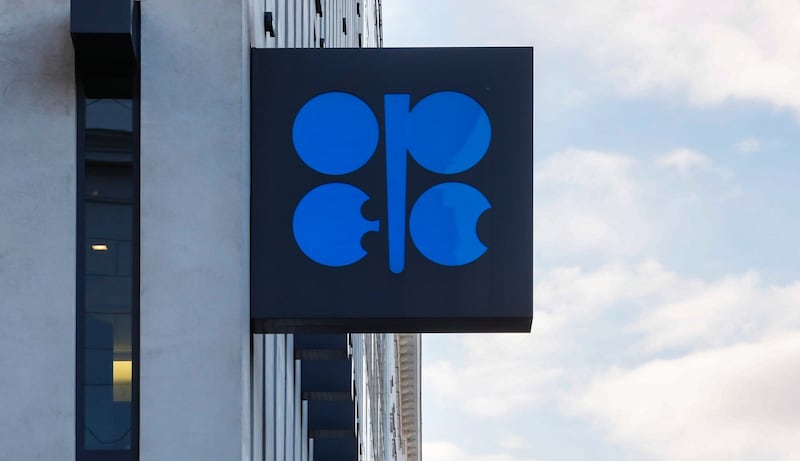
The logo of the Organization of the Petroleum Exporting Countries (OPEC) is seen outside of OPEC's headquarters in Vienna, Austria, March 3, 2022. (AP Photo/Lisa Leutner)
DUBAI, United Arab Emirates — The United Arab Emirates said Tuesday it will leave OPEC effective May 1, stripping the oil cartel of its third-largest producer and further weakening its leverage over global oil supplies and prices.
The UAE’s decision had been rumored as a possibility for some time, as it pushed back in recent years against OPEC production quotas it felt had been too low — meaning it wasn’t able to sell as much oil to the world as it had wanted.
“Having invested heavily in expanding energy production capacity in recent years, the bigger picture is that the UAE has been itching to pump more oil,” Capital Economics wrote in an analysis. “The ties binding OPEC members together have loosened,” it said, particularly after Qatar withdrew from the cartel in 2019.
Regional politics are also likely at play. The UAE has had increasingly frosty relations with Saudi Arabia, OPEC’s largest producer, over political and economic matters in the Mideast, even after both came under attack by fellow OPEC member Iran during the war.
No immediate impact likely for world oil markets
The UAE’s withdrawal from OPEC won’t necessarily have any immediate effects in markets. That’s because world oil supplies are sharply constrained by the war in Iran, which has closed off the Strait of Hormuz, a waterway through which one-fifth of global oil supplies — including much of the UAE’s — is transported. On Tuesday, Brent crude, the international benchmark, traded above US$111 a barrel, or more than 50 per cent above its prewar price.
OPEC accounts for roughly 40 per cent of the world’s oil output, but its market power had been waning in recent years as the United States ramped up production. While Saudi Arabia had been producing more than 10 million barrels of oil a day before the war, the U.S. pumps more than 13 million barrels a day.
U.S. President Donald Trump has been a steady critic of the cartel during his two terms in the White House.
The UAE, which joined OPEC through its emirate of Abu Dhabi in 1967, had been producing around 3.4 million barrels of crude a day just before the U.S.-Israeli war with Iran began on Feb. 28. Analysts say it has capacity to produce roughly 5 million barrels a day.
In its announcement on Tuesday, made via its state-run WAM news agency, the UAE said it also would leave the wider OPEC+ group, which Russia had led to try to stabilize oil prices.
“This decision reflects the UAE’s long-term strategic and economic vision and evolving energy profile, including accelerated investment in domestic energy production,” the UAE said, adding that it would bring “additional production to market in a gradual and measured manner, aligned with demand and market conditions.”
The UAE’s withdrawal removes one of OPEC’s few members with the ability to quickly increase production, said Jorge Leon, head of geopolitical analysis at Rystad Energy.
“A structurally weaker OPEC, with less spare capacity concentrated within the group, will find it increasingly difficult to calibrate supply and stabilize prices,” he said.
Saudi Arabia, UAE increasingly at odds
Saudi Arabia and the UAE increasingly have competed over economic issues and regional politics, particularly in the Red Sea area. The two countries had jointly fought against Yemen’s Iran-backed Houthi rebels in 2015. However, that coalition broke down into recriminations in late December, when Saudi Arabia bombed what it described as a weapons shipment bound for Yemeni separatists backed by the UAE.
As tensions rose in recent months, Saudi broadcasters long based in Dubai, the economic hub of the UAE, have pulled back to the kingdom.
“This exit of OPEC fits into the UAE need for flexibility with key energy consumers as well -- including a future relationship with China and a more competitive relationship with Saudi Arabia,” said Karen Young, a senior research scholar at Columbia University’s Center on Global Energy Policy.
While Saudi Arabia and OPEC had no immediate reaction, Emirati Energy Minister Suhail al-Mazrouei insisted his country’s decision did not stem from any dispute with its Gulf neighbor.
“We’ve been working together for years and years. We have the highest respect for the Saudis for leading OPEC,” al-Mazrouei told CNBC.
However, the UAE sent its foreign minister rather than its ruler to a Gulf Arab leaders’ meeting held Tuesday in Jeddah, Saudi Arabia, hosted by Saudi Crown Prince Mohammed bin Salman.
The UAE hosted the United Nations COP28 climate talks in 2023, a conference that ended for the first time with a pledge by nearly 200 countries to move away from planet-warming fossil fuels. But the UAE still plans to increase its production capacity in the coming years, even as it pursues more clean energy at home, a move decried by climate activists.
“The demand for power is going to go up and up and up,” U.S. Interior Secretary Doug Burgum told an Abu Dhabi oil conference in November. “Today’s the day to announce that there is no energy transition. There is only energy addition.”
He drew widespread applause from his Emirati hosts.
___
Jon Gambrell, The Associated Press
Associated Press writer David McHugh in Frankfurt, Germany, contributed to this report.
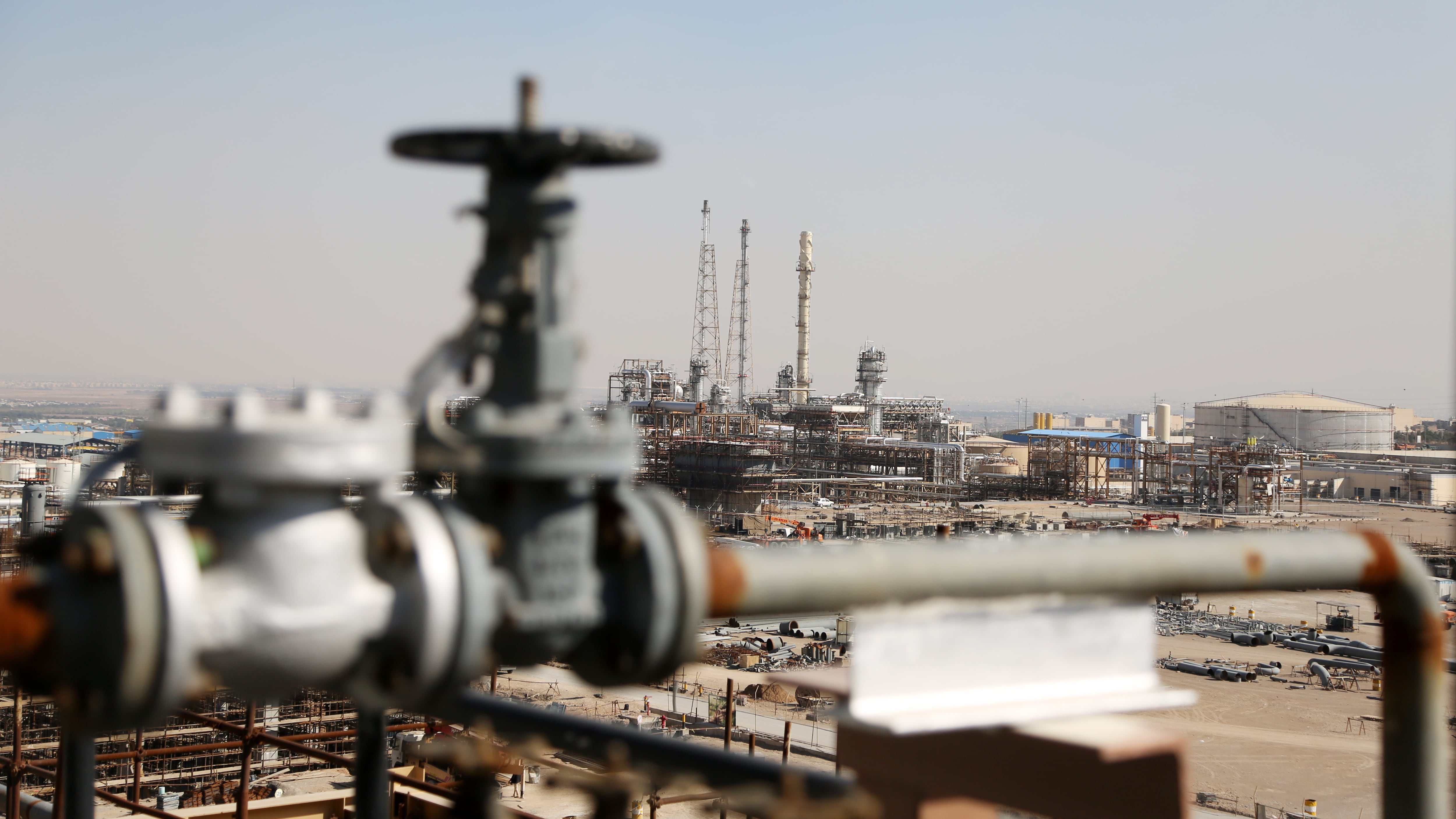
A general view of Isfahan Refinery, one of the largest refineries in Iran and is considered as the first refinery in the country in terms of diversity of petroleum products in Isfahan, Iran on November 08, 2023. The products of this refinery include liquefied gas, gasoline, gas oil, aviation fuel types, kerosene, solvents, crude oil and sulfur. (Photo by Fatemeh Bahrami/Anadolu via Getty Images)
LONDON - The United Arab Emirates, one of OPEC+’s largest producers, will leave the oil producers’ alliance on May 1, it said on Tuesday.
The Organization of the Petroleum Exporting Countries and allies, including Russia, are known collectively as OPEC+. Last year, the group produced nearly 50 per cent of the world’s oil and oil liquids, according to International Energy Agency estimates. The UAE is the fourth largest producer in OPEC+.
OPEC was founded in 1960 in Baghdad by Iraq, Iran, Kuwait, Venezuela and Saudi Arabia with the aims of coordinating petroleum policies and securing fair and stable prices. Today, it includes 12 countries, mainly from the Middle East. The UAE joined in 1967.
The UAE is the fourth producer to leave the group in recent years, and by far the biggest. Angola, which joined OPEC in 2007, quit the bloc at the start of 2024, citing disagreements over production levels. Ecuador quit OPEC in 2020 and Qatar in 2019.
The group produced over half of global crude in the 1970s, according to Reuters calculations, before the onset of non-OPEC supply sources such as the North Sea.
In later decades, OPEC’s share stood at between 30 per cent and 40 per cent but record output growth from rivals such as the United States has steadily eaten into that share.
OPEC in 2016 sought to regain influence by forming an alliance with 10 non-members, including Russia, which it called OPEC+.
As a result, its market share increased to around 51.15 million bpd, or nearly 50 per cent of global oil and oil liquids production, in 2025, according to the International Energy Agency. In March, a month into the Iran war, that share fell to about 44 per cent. U.S.-Iran war reduces UAE production
Before the start of the U.S.-Iran war at the end of February, the UAE was producing 3.3 million bpd and had capacity to be able to produce as much as 4.5-5.0 million bpd of crude and oil liquids.
Its importance in OPEC in the past was increased because, together with leading OPEC member Saudi Arabia, it had spare capacity that it could add to the market if required.
That has become academic since the unprecedented oil market disruption caused by the effective closure of the Strait of Hormuz since the Iran war.
Gulf OPEC+ crude oil production fell by nearly 8 million barrels per day in March versus February as Saudi Arabia, the UAE, Kuwait and Iraq cut output, according to OPEC.
The cuts were necessary because they were limited in how much they could export, although both have some ability to bypass the Strait of Hormuz.
Saudi Arabia has a 7 million bpd pipeline to the Red Sea while the UAE can export 1.5-1.8 million bpd through a pipeline to the port of Fujairah. OPEC and global oil prices
OPEC+ says it cuts and raises oil production to balance the markets.
Its critics say the group manipulates prices, which OPEC denies.
During the 1973 Arab-Israeli War, Arab members of OPEC imposed an embargo against the United States in retaliation for its decision to re-supply the Israeli military, as well as other countries that supported Israel. The embargo banned petroleum exports to those nations.
The oil embargo pressured an already strained U.S. economy that had grown dependent on imported oil. Oil prices jumped, causing high fuel costs for consumers and fuel shortages. The embargo also brought the United States and other countries to the brink of a global recession.
U.S. President Donald Trump has accused the organization of “ripping off the rest of the world” by inflating oil prices. Trump has also linked U.S. military support to the Gulf with oil prices, saying that while the U.S. defends OPEC members, they “exploit this by imposing high oil prices.”
However, it was Trump who helped to convince OPEC+ to cut output in 2020 during the COVID pandemic as crude oil prices slumped and U.S. oil producers suffered.
In 2025, OPEC crude exports accounted for about 47 per cent of global crude seaborne exports, according to Kpler. In March, that share shrunk to 34.7 per cent, Kpler data show. Which countries are OPEC members?
The current members of OPEC are: Saudi Arabia, United Arab Emirates, Kuwait, Iraq, Iran, Algeria, Libya, Nigeria, Congo, Equatorial Guinea, Gabon and Venezuela. The UAE said it would leave the group on May 1.
Non-OPEC countries in the global alliance of OPEC+ are represented by Russia, Azerbaijan, Kazakhstan, Bahrain, Brunei, Malaysia, Mexico, Oman, South Sudan, Sudan and Brazil, which joined in early 2025.
Sources: Reuters News, World Economic Forum website, OPEC website, U.S. Department of State website, the International Energy Agency.
Reporting by Ahmad Ghaddar and Yousef Saba; Editing by Barbara Lewis.

.jpeg)
.jpeg)