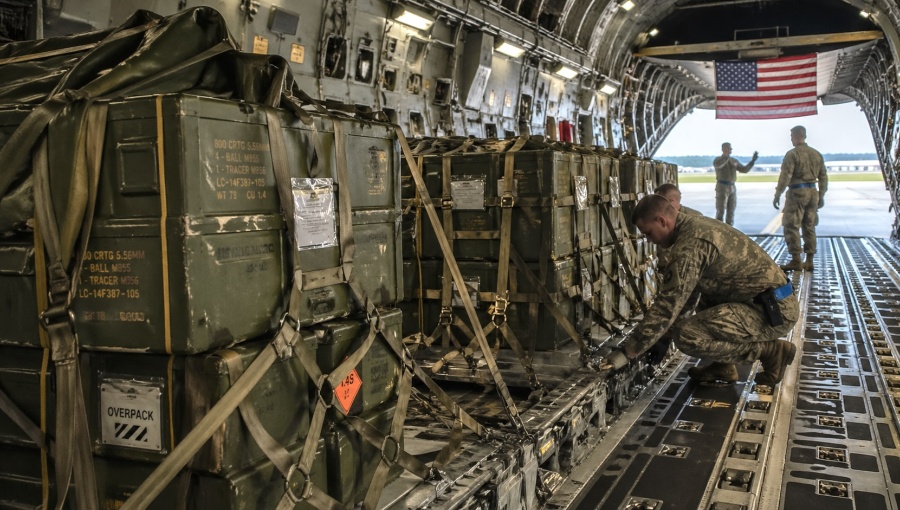
The contracts were signed. The funds were transferred. The weapons were manufactured. Then came the notification that they would not be arriving on schedule — because the US needed them elsewhere.
In mid-April, Washington informed a series of European allies that previously contracted weapons deliveries, including badly-need supplies to Ukraine under the Prioritised Ukraine Requirements List (PURL) programme, would be delayed as Operation Epic Fury in Iran was consuming American munitions stockpiles at an extraordinary rate.
Ukraine wasn’t the only victim. The affected countries include nations in the Baltic region and Scandinavia — several of them sharing a border with a militarised Russia, and all of them having paid for the equipment under the US Foreign Military Sales programme, the government-to-government mechanism through which allied nations purchase American-made arms.
Lithuania's Defence Ministry confirmed the notification. "Lithuania was informed by Pentagon officials of possible delays in the delivery of ammunition purchased from the US due to the conflict in the Middle East," the ministry told Lithuanian public broadcaster LRT on April 17.
At a joint press conference the same day, Estonia's Prime Minister Kristen Michal said: "Yes, the US has informed us of the situation, and we understand the reasoning and the circumstances. And we are in close contact with them for discussions on how to address these supply challenges. The US remains our biggest ally. The troops are here, connections are strong."
Lithuanian Prime Minister Inga Ruginienė stated that while her government does not see "a big problem so far" with regard to the planned deliveries, Vilnius had also been informed of changes to supply schedules.
Latvian Prime Minister Evika Siliņa said her cabinet had "not been officially informed yet" of changes to the delivery schedule. "But, sure, we all can read news, and we are looking very closely at what's going on," she added.
What is being delayed — and at what cost
Cut off from US arms is a big problem for little countries. Too small to build up significant arms industries, they are almost entirely dependent on imports, and the US is the world’s weapons Walmart.
Estonia's primary concern is ammunition for its M142 High Mobility Artillery Rocket System, known as HIMARS, and Javelin anti-tank missiles. The value of munitions on hold expected to arrive this year and next is in the "tens of millions of euros," said Defence Minister Hanno Pevkur, adding that under the contract terms, there is no obligation for the US to pay a penalty for the delay.
Pevkur spoke by phone with US Defence Secretary Pete Hegseth about the situation. "The initial understanding is that this is on hold for as long as the war in Iran continues," he said. "But if it were to last even longer, then we would certainly have to review our decisions."
As IntelliNews reported, the US and Israel have burnt through an extraordinary number of weapons in just the first few days of what has turned into an asymmetrical war where Iran has the higher cost-to-kill ratio allowing the smaller nation to face down a superpower.
The Royal United Services Institute has estimated that the US and Gulf states expended more than 1,800 Patriot interceptors in the first 16 days of the Iran operation alone, far outstripping annual production capacity. The scale of consumption has raised the prospect of European allies losing access not only to their own contracted deliveries, but also to weapons they have already funded for allies.
In March 2026, the Washington Post reported that the Pentagon was weighing whether to redirect air defence interceptors procured through Nato's PURL scheme, an initiative under which European nations pool funds to purchase US-made arms for Kyiv. The diversion could amount to roughly $750mn worth of ally-funded missiles redirected to replenish US inventory in the Middle East.
The Pentagon signed a seven-year framework agreement with Boeing (NYSE: BA) to triple production of the PAC-3 interceptors, identified as the primary manufacturing bottleneck, and the US Army awarded Lockheed Martin (NYSE: LMT) a $4.76bn PAC-3 MSE contract in April, with 94% of the funding drawn from Foreign Military Sales accounts. But reaching an annual production rate of 2,000 interceptors will take seven years — far longer than the current wars are expected to last.
The strategic calculation
In the face of the new asymmetric war tactics that have emerged from the Ukraine conflict, where it is the ability to make millions of cheap drones quickly and cheaply that gives the advantage over the slow and expensive sophisticated US weapons, military planners are being forced to radically recalculate their strategy. Purchasing US weapons through the US Foreign Military Sales programme provides no guarantee of delivery timing, and no penalty mechanism if Washington's own operational requirements take precedence.
European worries that the delays could undermine their defence readiness, particularly for countries near Russia. As Russia is also producing millions of drones and ramped up its own missile production, the issue for Europe is not the quality of US countermeasures but the quantity and availability of replacements. The Iran war has dramatically underlined that the issue is not what is in your stockpile but how many weeks you can sustain a defence until those stockpiles are depleted. With replacement production timelines running into years, a sustained attack can leave the defender defenceless in a matter of weeks even if they significantly outgun their opponent on paper.
Estonia, Latvia and Lithuania sit within artillery range of Russian forces in Kaliningrad and Belarus. The countries have been accelerating defence spending since 2022 — Estonia now spends approximately 3.4% of GDP on defence, among the highest in Nato — precisely in anticipation of a deteriorating security environment.
Pevkur noted that Estonia has also signed a contract for South Korea's Chunmoo multiple rocket launcher system, which is similar to HIMARS — a hedging move that now looks prescient, Newsweek reports. The diversification of supply chains away from sole reliance on US systems has been discussed in European defence ministries for years. The Iran war's consumption of American stockpiles has accelerated that conversation into something approaching urgency.
Some European officials are increasingly looking at weapons systems made within the continent, a trend that predates the Iran war but has now been accelerated by it, The Kyiv Independent reports The European Commission's defence industrial strategy, which seeks to increase the share of European procurement sourced from European manufacturers to 50% by 2030 and 60% by 2035, takes on new salience when allied deliveries can be suspended without notice or financial consequence.

No comments:
Post a Comment