Wednesday, April 29, 2026


Ukraine says it shot down 33,000 Russian drones in March, a new monthly record

Rescue workers put out a fire after a Russian drone strike on Odesa region, 15 April, 2026
Copyright AP Photo

By Gavin Blackburn
Published on 

Ukraine has developed cutting-edge and battle-tested drone technology that has proved essential in holding back Russia’s bigger army and has drawn military interest from around the world.

Ukrainian interceptor systems shot down more than 33,000 Russian drones in March, a record monthly figure since Moscow launched its full-scale invasion in 2022, Ukraine’s defence minister said.

Meanwhile, Ukraine’s domestically-developed long-range attack drones struck a Russian oil refinery and terminal on the Black Sea for the third time in less than two weeks, prompting the evacuation of local people as a precautionary measure.

Ukraine has developed cutting-edge and battle-tested drone technology that has proved essential in holding back Russia’s bigger army and has drawn military interest from around the world.

Interceptor drones as part of a comprehensive air defence system are now being sought by countries in the Middle East and Persian Gulf amid the Iran war, according to Ukrainian officials

Ukraine is scaling up supplies of interceptor drones to thwart Russian aerial attacks and its military has introduced a new command within the air force to boost the country’s capabilities, Defence Minister Mykhailo Fedorov said in a post on Telegram late Monday.

Ukraine's offensive capabilities have also improved, with the Defence Ministry saying on Tuesday that the country’s forces have more than doubled the range of their deep-strike capabilities since Russia's February 2022 invasion.

At that time, Ukrainian forces were able to hit military targets about 630 kilometres away, it said. They are now striking targets as far as roughly 1,750 kilometres behind enemy lines, the ministry said in a statement.

That improvement has allowed Ukraine to hit Russian oil installations that provide crucial revenue for Moscow's war effort. It has also targeted manufacturing plants that supply Russia’s armed forces.

Ukraine struck a Russian oil refinery at the Black Sea port of Tuapse for the third time this month in a coordinated operation involving multiple branches of the country’s defence and security services, Ukraine’s Unmanned Systems Forces said on Tuesday

The two strikes earlier this month destroyed 24 oil storage tanks and damaged four others, it said. Independent verification of the claims was not possible.

The Russian Defence Ministry said on Tuesday its air defences intercepted 186 Ukrainian drones overnight over Russian regions, the annexed Crimea and the Black and the Azov seas.

Police officers inspect fragments of a Russian drone after an air attack in Kyiv, 28 April, 2026 AP Photo

Europe may need Ukraine

With Russia posing a threat to all of Europe, the continent may need Ukraine more than Ukraine needs Europe, Finnish President Alexander Stubb said on Tuesday, noting Kyiv's large and increasingly modern military.

"Instead of us thinking that Ukraine needs Europe, perhaps we should think that we in Europe need Ukraine more," Stubb told reporters at a joint press conference with his Estonian counterpart Alar Karis.

"It is the largest, most efficient and most modern military in Europe."

Europe has ramped up its defensive capabilities in the face of the invasion and Moscow's "hybrid" attacks on European countries, including drone overflights, alleged sabotage and misinformation.

Estonia's President Alar Karis, left, and Finland's President Alexander Stubb attend a press conference in Helsinki, 28 April, 2026 AP Photo


Both Stubb and Karis expressed support for Kyiv's desire to join both the European Union and NATO.

"We need to seriously start to think how much Europe actually needs Ukraine, whether it's EU membership or, as a matter of fact, NATO membership," Stubb said.

European leaders broadly back Ukraine's EU membership aspirations but there is little appetite to fast-track Kyiv to full membership, despite urgent appeals from President Volodymyr Zelenskyy.

Kyiv officially obtained EU candidate country status in December 2023.

Stubb meanwhile argued that the tide was turning in Ukraine's favour in the war with Russia.

"If you look at the past four months, Ukraine is actually doing much better than Russia," he said.

"We have seen the figures of both dead and wounded soldiers increase to 30,000 to 35,000 per month on the Russian side at a hit ratio of one Ukrainian to five Russians," Stubb added.

"On top of that, Ukraine now has the capability to launch more missiles and drones into Russia than vice versa. The pace at which Russia is advancing is actually minimal, at a cost of roughly 250 dead per square kilometre."


Ukraine says it will open arms exports with 'Drone Deals,' but not to all countries

drones at the front line in the Kharkiv region, 14 March, 2026
Copyright AP Photo
By Sasha Vakulina
Published on 

President Volodymyr Zelenskyy announced on Tuesday that Ukraine is set to open its arms exports via so-called drone deals, but not all countries will have access to Kyiv's battlefield tested expertise.

In a much anticipated step, Ukraine is opening up its arms exports to global markets, President Volodymyr Zelenskyy announced on Tuesday evening

"The export of Ukrainian weapons will become a reality, we have approved all the details at the level of our state institutions," Zelenskyy said in a statement.

"Currently, our security expertise and weapons, which have been tested in modern warfare, are of interest to all partners capable of ensuring a real level of protection for their statehood and the lives of their citizens."

Zelenskyy clarified that exports will be open to countries that have supported Ukraine and will take the form of so-called “Drone Deals."

These are special agreements on both the production and supply of Ukrainian drones, missiles, ammunition and other in-demand types of weaponry, military equipment and software, as well as the "provision of our expertise and the technological exchange needed by Ukraine.:

Zelenskyy said also that he approved on Tuesday "the areas for this interstate work and the development of automatic permits for businesses regarding arms exports."

"The algorithm is absolutely clear: at the interstate level, based on the principle of reciprocity, we define the framework for security cooperation through the relevant agreement."

Then the process continues at the level of state institutions and manufacturers. In order to streamline exports, Kyiv will simplify bureaucratic procedures, "maintaining an adequate level of export control, and launching practical operating mechanisms for companies."

Controlled export

Both Ukraine’s foreign partners and domestic weapons producers have been waiting for Kyiv to open up an arms exports procedure.

Approximately 800 arms producers are currently operating in Ukraine and many of them have ramped up their production to a significant surplus.

According to the most recent reports, Ukraine is now producing over 4 million drones annually and could double that number with sufficient funding.

Domestic arms producers had been asking Zelenskyy for a year to lift restrictions on selling their domestically-produced military-grade equipment, particularly drones, to generate more revenue.

An engineer collects FPV drones of "General Cherry" company at the workshop in Ukraine, on Dec. 4, 2025. AP Photo


For over half a year, Kyiv had been working on what it had defined as the "controlled export" of weapons.

On Tuesday, Zelenskyy said with the clear export structure Ukrainian companies "will receive a real opportunity to enter partner countries' markets," but pointed out that the Ukrainian military will get absolute priority in terms of supply needs.

"A surplus of production capacity in Ukraine for certain types of weapons reaches 50% and this is a direct result of our state investment in Ukraine's defence industry and our cooperation with partners."

Another condition is that only those countries who have supported Ukraine since the beginning of Russia's full-scale invasion in 2022 will have the opportunity of getting a piece of its battlefield-tested arsenal.

Zelenskyy said he instructed the Foreign Ministry together with the intelligence services and Ukraine's Security Service (SBU) to determine the list of countries "to which exports of our weapons are not possible due to their cooperation with the aggressor state."

"This is a serious challenge – to prevent our technologies and weapons from falling into Russian hands," he said.

Soldiers from Ukraine's Khartia brigade operate drones from the Kharkiv region, 30 February, 2026 AP Photo

Gulf region first in line

Zelenskyy confirmed that the format of "Drone Deals" has already been implemented by Kyiv in its cooperation with countries in the Middle East, the Persian Gulf, Europe and the Caucasus.

He also confirmed that Ukraine has "a proposal on the table with American partners."

"The terms must be favourable to Ukraine, there must be clear oversight, and the proceeds from exports must help Ukraine defend itself. That is exactly how it will be."

Kyiv recently signed 10-year defence partnership deals with three Gulf countries, which include maritime drones, electronic warfare and interception technology.

Ukraine's naval drone fleet has been expanding in recent years and Ukrainian sea drones have proven effective in inflicting heavy losses on Russian military sites and ships in the Black Sea, such as the Magura-V5 drones, which have been used to target the Russian fleet.

Some of these systems can help unblock the crucial Strait of Hormuz, Zelenskyy said in March.

Ukraine is also trying to use the momentum of the Iran war and the escalation in the Middle East as a window of opportunity to strengthen its geopolitical role and transition from a recipient of security aid to a provider.

EU 'ready' to sanction Israel over Russian vessel carrying stolen Ukrainian grain


By Jorge Liboreiro
Published on 

A diplomatic crisis has erupted between Ukraine and Israel following the arrival in Haifa of a Russian vessel reportedly carrying stolen Ukrainian grain. Brussels says it is ready to sanction those involved.

The European Union has warned Israel that it is ready to impose sanctions on those aiding and abetting the trade of Ukrainian grain stolen by Russia in the occupied territories, after a new ship loaded with the cereal arrived in the city of Haifa.

"The EU has taken note of the reports that a Russian shadow fleet vessel carrying stolen Ukrainian grain has been allowed to unload at Haifa port in Israel, despite previous contacts of Ukraine with Israeli authorities on the subject," a European Commission spokesperson told Euronews.

"We condemn all actions that help fund Russia's illegal war effort and circumvent EU sanctions, and remain ready to target such actions by listing individuals and entities in third countries if necessary," the spokesperson added.

"We have approached the Israeli Ministry of Foreign Affairs on the issue."

The arrival of the Panama-flagged vessel in Haifa has escalated tensions between Ukraine and Israel. The vessel, named Panormitis and allegedly carrying over 6,200 tonnes of wheat and 19,000 tonnes of barley, has yet to unload. However, a shipment of stolen Ukrainian grain was allowed to proceed earlier this month.

Ukrainian President Volodymyr Zelenskyy has urged Israel to reject the Russian vessel and said his government would start preparing "relevant sanctions", in coordination with Europeans, against those "attempting to profit from this criminal scheme".

Kyiv previously asked Brussels to deploy "all possible instruments" to cripple Moscow's global sales of plundered grain, including using Frontex, the bloc's border control agency.

Israel's Foreign Minister Gideon Sa'ar said the Panormitis would be "examined" and national authorities would "act in accordance with the law".

EU-level sanctions require unanimity among the 27 member states, and several Russian individuals have already been blacklisted over the seizure of Ukrainian grain. In 2024, the bloc agreed to slap tariffs on grain products from Russia and Belarus to crack down on the trade of stolen merchandise.

Unanimity, however, has been hard to secure in cases involving Israel, where sharp divisions remain among member states.

The news comes at a fraught time in EU-Israel relations over the war in the Middle East. The Israeli offensive in Lebanon, currently paused under a fragile ceasefire, has revived the debate about suspending the EU-Israel Association Agreement.

Spain, Ireland and Slovenia are among thosecalling for punitiveaction in response to the deadly strikes on Lebanese cities. However, Germany and Italy remain on the fence, and their support would be key for the qualified majority needed to partially suspend the pact.

Israel's recent move to introduce a law applying the death penalty targeted at Palestinians has also raised questions about whether the country is abiding by Article 2 of the agreement, which sets binding obligations to respect human rights.

Last year, an internal review by the European External Action Service (EEAS) found that Israel had breached Article 2 through systematic violations of international law in Gaza.


Ukraine-Israel row deepens over Russian shipments of stolen grain

FILE - Russian soldiers at am occupied field of wheat in Ukraine’s Zaporizhzhia, southeastern Ukraine, June 14, 2022
Copyright AP Photo

By Sasha Vakulina
Published on 

In a continuation of the ongoing diplomatic uproar, Zelenskyy publicly criticised Israel on Tuesday for considering a purchase of Ukrainian grain stolen by Russia from temporarily occupied territories in southern Ukraine.

A diplomatic scandal between Ukraine and Israel over the shipment of alleged stolen Ukrainian grain being sold by Russia escalated on Tuesday, as President Volodymyr Zelenskyy criticised what he called is an illegitimate business.

“In any normal country, purchasing stolen goods is an act that entails legal liability,” Volodymyr Zelenskyy said in a post on X the day after a heated public exchange between the foreign ministers of Ukraine and Israel.

“Another vessel carrying such grain has arrived at a port in Israel and is preparing to unload. This is not – and cannot be – legitimate business,” Zelenskyy said on X.

Israeli Foreign Minister Gideon Sa'ar said on Monday that "evidence substantiating the allegations have yet to be provided," as he insisted that Kyiv did not "even submit a request for legal assistance before turning to the media and social networks."

Zelenskyy responded, stating that “Ukraine has taken all necessary steps through diplomatic channels to prevent such incidents.”

The vessel in question is the Panama-flagged Panormitis, which reached waters close to Haifa on 25 April, according to the marine traffic monitoring services.

Panormitis is allegedly carrying over 6,200 tonnes of wheat and 19,000 tonnes of barley.

Kyiv calls on Israel not to let it dock and not to unload the stolen cargo.

Kyiv has summoned the Israeli Ambassador Michael Brodsky on Tuesday morning to urge action over Panormitis.

Earlier cases of stolen grain arriving in Israel reported

An investigation by Israeli news outlet Haaretz found that at least four shipments of stolen Ukrainian grain have been unloaded in Israel this year.

Kyiv insists Israel can easily verify and identify both the vessel and the origin of the shipments.

“The Israeli authorities cannot be unaware of which ships are arriving at the country’s ports and what cargo they are carrying,” Zelenskyy said on Tuesday.

“Russia is systematically seizing grain on temporarily occupied Ukrainian land and organizing its export through individuals linked to the occupiers. Such schemes violate the laws of the State of Israel itself.”

According to Ukrainian investigative journalists, Russian bulk carriers are being loaded with grain from occupied Ukrainian territories, transferred into shadow fleet vessels, before departing from Russian ports with the cargo.

According to Kyiv's estimates, at least 15 million tonnes of Ukrainian grain have been stolen by Russia since the start of the full-scale invasion in 2022.

Public spat continues

Ukraine’s Foreign Minister Andrii Sybiha first took to X on Monday evening, calling on Israel to reject the stolen Ukrainian grain on board thePanormitis near Haifa.

His Israeli counterpart Sa'ar was quick to respond, asking Kyiv to refrain from conducting diplomatic relations on social media.

But for Ukrainian officials, public space might seem like a more efficient means of communication after diplomatic channels proved ineffective in past incidents.

Russian bulk carrier Abinsk delivered nearly 44,000 tonnes of stolen Ukrainian wheat to Israel a few weeks ago, causing a sharp diplomatic response from Kyiv.

Ukraine’s foreign ministry stated at the time it had informed Israeli officials in advance about the Abinsk earlier this month, and yet the grain was unloaded.

According to Kyiv, Ukrainian officials informed Israel on 23 March that the Abinsk cargo contained grain from the temporarily occupied territories of Ukraine.

Ukraine says “assurances were received regarding an appropriate response.”

Yet Abinsk was allowed to unload at the port of Haifa on 12-14 April.

“We see that yet another such vessel has not been stopped,” Zelenskyy said on Tuesday.


Kyiv vows response as Russia ships stolen grain to multiple countries

FILE - A dump track unloads grain in a granary in the village of Zghurivka, Ukraine, on Aug. 9, 2022
Copyright AP Photo
By Sasha Vakulina
Published on 


As the diplomatic row between Ukraine and Israel continues to escalate, Kyiv said there are also other countries buying its stolen grain from Russia-occupied territories.

Ukraine is tracking multiple vessels carrying grain it says Russia stole from the occupied territories and shipped to at least four countries, as the diplomatic row over Ukraine and Israel over another stolen grain purchase rumbles on.

The Ukrainian foreign ministry confirmed on Tuesday that Moscow's sales of stolen grain are not limited to Israel, and that the total number of countries that have bought its shipments is likely bigger.

"Such shipments arrived in Turkey, Egypt, Algeria and some other countries. These are only the cases I can recall from memory that happened earlier," foreign ministry spokesperson Heorhiy Tykhyi said.

“We see everything and will not leave it without attention,” Tykhyi said. “This will not remain without a proper response.”

The foreign ministry emphasised that Ukraine maintained its approach not only toward Israeli companies, but also toward anyone who “participates in illegal trade and effectively helps Russia finance its war efforts against Ukraine.”

Ukraine to demand explanations from Egypt

Panama-flagged bulk carrier Asomatos docked in Egypt on Tuesday, reportedly carrying over 25,000 tonnes of wheat loaded in Feodosia in Russia-annexed Crimea.

Another vessel, the Russia-flagged Victoria, had departed from Mariupol earlier this month and then unloaded over 7,000 tonnes of Ukrainian wheat from temporarily occupied territory in Egypt. The vessel is under Ukrainian sanctions.

In early April, Ukrainian President Volodymyr Zelenskyy said he addressed the issue with his Egyptian counterpart Abdel Fattah El-Sisi.

“President (El-Sisi) informed me that Egypt will no longer accept grain exported by Russia from our temporarily occupied territories and is, at the same time, interested in increasing imports of grain from Ukraine,” Zelenskyy posted on X on 3 April.

Kyiv said it would “approach” Egypt regarding a new case of a vessel arriving with grain that was exported by Russia from the occupied territories of Ukraine.

Egypt is the world's largest wheat importer, and the biggest buyer of Russian wheat. According to estimates from rail carrier Rusagrotrans, it has bought about 7.6 million tonnes of ​Russian grain so ​far this season, ⁠around the same level as last year.

On 2 April, Russian President Vladimir Putin announced that Moscow and Cairo were exploring plans to create a joint “grain and energy hub” on Egyptian territory.

Russia has been ⁠seeking new ways of distributing its energy and commodities exports in ​response to waves of Western sanctions over its war in Ukraine.


Finland becomes first in Europe to run full lithium mine-to-refinery cycle


By Lucy Davalou & AFP
Published on 

Europe’s first complete lithium mine begins operating in Syväjärvi in western Finland. The strategic resource is critical for manufacturing modern electronics.

Finland has become the first country in Europe to host a full lithium production cycle, from mine to refinery, according to the Geological Survey of Finland.

The Syväjärvi open-pit mine in Kaustinen will produce battery-grade lithium hydroxide, a critical material for modern electronics, ranging from electric vehicles to smartphones.

The appetite for lithium is often compared to the demand for oil at the dawn of the 20th century — and Finland holds some of Europe's largest reserves of it.

Reducing reliance on Asian and Australian imports

Keliber CEO Hannu Hautala said the project would reduce Europe's dependence on lithium imports from Asia and Australia.

"It develops and increases the independence from imports from, for example, Asian countries and Australia," he said.

The mine is scheduled to be fully operational within two years. Trucks will transport ore to a nearby concentrator plant, producing a sand-like concentrate that is then taken to a refinery to make battery-grade lithium hydroxide.

"The lithium hydroxide will go to the European battery industry," Hautala said, declining to name any specific clients.

The €783 million project is operated by Keliber Oy, a Finnish mining and battery-materials company.

Sibanye-Stillwater, the South African mining giant, owns 80% of its shares, with the remaining 20% held by the Finnish state-owned Finnish Minerals Group. The European Investment Bank has also provided €150 million in financing.

Sibanye-Stillwater CEO Neal Froneman called the mine "quite small" but said it was "very, very important" from a strategic and technological standpoint, representing the company's first major investment in Europe.

The Keliber project covers more than 500 square kilometres and includes six additional mining sites planned in the area, alongside Syväjärvi.

Locals divided on the project

In the nearby town of Kaustinen, home to just over 4,000 people, feelings about the project are mixed.

"From an employment perspective, it has been positive," said local music teacher Pilvi Järvelä. "But of course, people are also worried about the environmental impact and things like that."

Hautala said the operation is expected to employ around 300 people.

At the refinery, technical director Sami Heikkinen said test runs with water had already begun. If all goes to plan, "we will pack the first bags at the end of this year," he said, describing the final product as resembling "white sugar crystals," stored in 500-kilogram or 1,000-kilogram bags ready for transport.

Once fully operational, the refinery is expected to produce around 15,000 tonnes of battery-grade lithium hydroxide annually, roughly 10% of Europe's current demand according to Langbacka, meaning imports will continue to play a significant role. China currently dominates global lithium supply.

While countries such as Portugal and the Czech Republic hold reserves, the Finnish site is the first to bring the entire production chain within a 43-kilometre radius, with the mine, concentrator and refinery all in close proximity.

UK PM Starmer avoids parliamentary probe over Mandelson appointment as US envoy

Britain's Prime Minister Keir Starmer delivers a speech in north-west England, 27 April, 2026
Copyright AP Photo

By Gavin Blackburn
Published on 

Starmer denies allegations that his office applied pressure on the foreign ministry to approve Mandelson's appointment as Britain's ambassador in Washington despite having failed security vetting.

Embattled UK Prime Minister Keir Starmer survived a bid by opposition politicians on Tuesday to subject him to a parliamentary probe over his controversial appointment of Peter Mandelson as ambassador to the US.

Members of parliament voted against referring Starmer to a committee to consider if he misled parliament over giving Mandelson, an ex-associate of late US sex offender Jeffrey Epstein, the plum diplomatic post.

It was the latest development in an unrelenting scandal that has plagued Starmer's Labour government for months, hampering its work and leading to calls for him to resign.

After a debate lasting more than five hours, 335 lawmakers voted against launching an investigation compared to 223 for, a majority of 112 in the 650-seat parliament.

The probe would have been held by the cross-party privileges committee, which investigates potential breaches of parliamentary conduct.

Leader of Britain's Conservative party Kemi Badenoch speaks during a debate in the House of Commons in London, 28 April, 2026 AP Photo

Opposition Conservative party leader Kemi Badenoch who led the move for the probe, said it was "very obvious" that what Starmer had told the House of Commons regarding Mandelson's 2024 appointment was "not correct."

"It's clear that full due process was not followed," she told MPs.

Starmer denies allegations that his office applied pressure on the foreign ministry to approve Mandelson's appointment as Britain's ambassador in Washington despite having failed security vetting.

Earlier this month, Starmer sacked the most senior civil servant in the foreign office, Olly Robbins, for not telling him or other ministers that Mandelson had not passed the checks.

Starmer, who branded the probe motion "a political stunt" ahead of local elections in England, Scotland and Wales next week, commands a large majority in the lower house of parliament.

MPs from his ruling Labour party were ordered to vote against the motion, meaning it was always unlikely to pass.

Several Labour MPs dissented however, highlighting their discontent with the prime minister.

Brian Leishman, a frequent Labour rebel, said Starmer should have referred himself to the committee and was voting for the motion

Lawmaker Emma Lewell said the government's instruction to vote against "played into the terrible narrative that there is something to hide."

Peter Mandelson outside his home in London, 20 April, 2026 AP Photo

'Serious mistake'

Starmer sacked Mandelson in September 2025 after a fresh batch of revelations came to light about the extent of the latter's friendship with Epstein, who died in prison in 2019.

But the row has only escalated since, with Starmer's former chief of staff Morgan McSweeney and ex-communications head Tim Allan forced to step down earlier this year.

Starmer's cause has not been helped by the fact that UK police are investigating Mandelson over allegations he committed misconduct in office while serving as a Labour minister more than a decade ago.

Mandelson is accused of leaking sensitive information to Epstein. He denies wrongdoing.

On Tuesday, McSweeney told parliament's foreign affairs committee that he made a "serious mistake" in advising Starmer to appoint Mandelson.

A document that was included in the US Department of Justice release of the Jeffrey Epstein files, 10 February, 2026 AP Photo

But he denied telling officials that Mandelson's vetting checks "should be cleared at all costs."

Earlier, Robbins' predecessor at the foreign office, Philip Barton, told MPs it was unusual for an appointment to be announced before the vetting process was completed.

The privileges committee was responsible for former prime minister Boris Johnson's exit from frontline politics after it investigated him for misleading parliament over the so-called "partygate" breaches of COVID-19 laws.

Johnson quit as an MP in 2023 before the committee published a report recommending his suspension.

Tuesday, April 28, 2026

Europe paid for the weapons. America kept them.

Europe paid for the weapons. America kept them.
US delivery delays on contracted arms to Baltic and Scandinavian allies expose a structural flaw in European defence procurement — and accelerate a rethinking of reliance on Washington / bne IntelliNewsFacebook
By Ben Aris in Berlin April 28, 2026

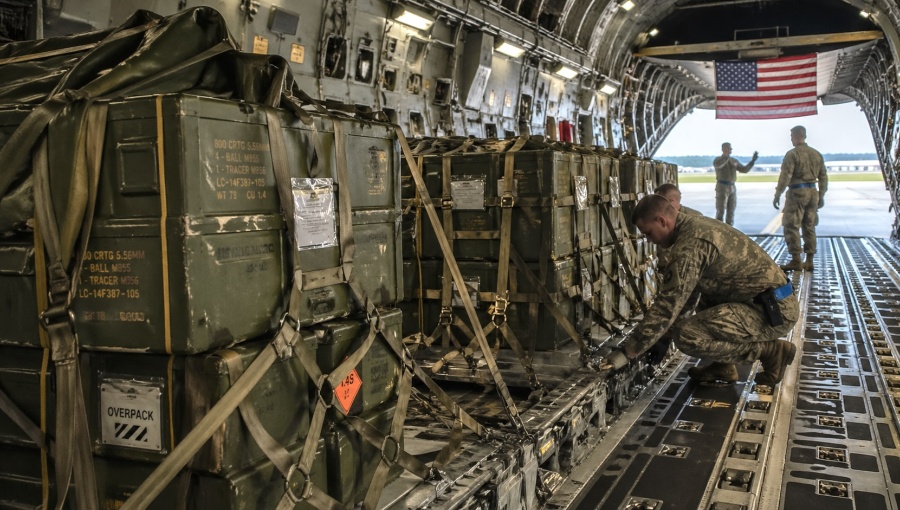
The contracts were signed. The funds were transferred. The weapons were manufactured. Then came the notification that they would not be arriving on schedule — because the US needed them elsewhere.

In mid-April, Washington informed a series of European allies that previously contracted weapons deliveries, including badly-need supplies to Ukraine under the Prioritised Ukraine Requirements List (PURL) programme, would be delayed as Operation Epic Fury in Iran was consuming American munitions stockpiles at an extraordinary rate.

Ukraine wasn’t the only victim. The affected countries include nations in the Baltic region and Scandinavia — several of them sharing a border with a militarised Russia, and all of them having paid for the equipment under the US Foreign Military Sales programme, the government-to-government mechanism through which allied nations purchase American-made arms.

Lithuania's Defence Ministry confirmed the notification. "Lithuania was informed by Pentagon officials of possible delays in the delivery of ammunition purchased from the US due to the conflict in the Middle East," the ministry told Lithuanian public broadcaster LRT on April 17.

At a joint press conference the same day, Estonia's Prime Minister Kristen Michal said: "Yes, the US has informed us of the situation, and we understand the reasoning and the circumstances. And we are in close contact with them for discussions on how to address these supply challenges. The US remains our biggest ally. The troops are here, connections are strong."

Lithuanian Prime Minister Inga RuginienÄ— stated that while her government does not see "a big problem so far" with regard to the planned deliveries, Vilnius had also been informed of changes to supply schedules.

Latvian Prime Minister Evika Siliņa said her cabinet had "not been officially informed yet" of changes to the delivery schedule. "But, sure, we all can read news, and we are looking very closely at what's going on," she added.

What is being delayed — and at what cost

Cut off from US arms is a big problem for little countries. Too small to build up significant arms industries, they are almost entirely dependent on imports, and the US is the world’s weapons Walmart.

Estonia's primary concern is ammunition for its M142 High Mobility Artillery Rocket System, known as HIMARS, and Javelin anti-tank missiles. The value of munitions on hold expected to arrive this year and next is in the "tens of millions of euros," said Defence Minister Hanno Pevkur, adding that under the contract terms, there is no obligation for the US to pay a penalty for the delay.

Pevkur spoke by phone with US Defence Secretary Pete Hegseth about the situation. "The initial understanding is that this is on hold for as long as the war in Iran continues," he said. "But if it were to last even longer, then we would certainly have to review our decisions."

As IntelliNews reported, the US and Israel have burnt through an extraordinary number of weapons in just the first few days of what has turned into an asymmetrical war where Iran has the higher cost-to-kill ratio allowing the smaller nation to face down a superpower.

The Royal United Services Institute has estimated that the US and Gulf states expended more than 1,800 Patriot interceptors in the first 16 days of the Iran operation alone, far outstripping annual production capacity. The scale of consumption has raised the prospect of European allies losing access not only to their own contracted deliveries, but also to weapons they have already funded for allies.

In March 2026, the Washington Post reported that the Pentagon was weighing whether to redirect air defence interceptors procured through Nato's PURL scheme, an initiative under which European nations pool funds to purchase US-made arms for Kyiv. The diversion could amount to roughly $750mn worth of ally-funded missiles redirected to replenish US inventory in the Middle East.

The Pentagon signed a seven-year framework agreement with Boeing (NYSE: BA) to triple production of the PAC-3 interceptors, identified as the primary manufacturing bottleneck, and the US Army awarded Lockheed Martin (NYSE: LMT) a $4.76bn PAC-3 MSE contract in April, with 94% of the funding drawn from Foreign Military Sales accounts. But reaching an annual production rate of 2,000 interceptors will take seven years — far longer than the current wars are expected to last.

The strategic calculation

In the face of the new asymmetric war tactics that have emerged from the Ukraine conflict, where it is the ability to make millions of cheap drones quickly and cheaply that gives the advantage over the slow and expensive sophisticated US weapons, military planners are being forced to radically recalculate their strategy. Purchasing US weapons through the US Foreign Military Sales programme provides no guarantee of delivery timing, and no penalty mechanism if Washington's own operational requirements take precedence.

European worries that the delays could undermine their defence readiness, particularly for countries near Russia. As Russia is also producing millions of drones and ramped up its own missile production, the issue for Europe is not the quality of US countermeasures but the quantity and availability of replacements. The Iran war has dramatically underlined that the issue is not what is in your stockpile but how many weeks you can sustain a defence until those stockpiles are depleted. With replacement production timelines running into years, a sustained attack can leave the defender defenceless in a matter of weeks even if they significantly outgun their opponent on paper.

Estonia, Latvia and Lithuania sit within artillery range of Russian forces in Kaliningrad and Belarus. The countries have been accelerating defence spending since 2022 — Estonia now spends approximately 3.4% of GDP on defence, among the highest in Nato — precisely in anticipation of a deteriorating security environment.

Pevkur noted that Estonia has also signed a contract for South Korea's Chunmoo multiple rocket launcher system, which is similar to HIMARS — a hedging move that now looks prescient, Newsweek reports. The diversification of supply chains away from sole reliance on US systems has been discussed in European defence ministries for years. The Iran war's consumption of American stockpiles has accelerated that conversation into something approaching urgency.

Some European officials are increasingly looking at weapons systems made within the continent, a trend that predates the Iran war but has now been accelerated by it, The Kyiv Independent reports The European Commission's defence industrial strategy, which seeks to increase the share of European procurement sourced from European manufacturers to 50% by 2030 and 60% by 2035, takes on new salience when allied deliveries can be suspended without notice or financial consequence.