Friday, May 22, 2026

Navy's Unmanned Tanker Jet Has Been Approved for Production

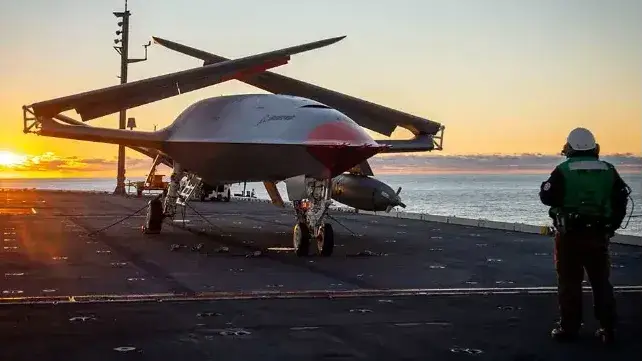
An MQ-25A with a refueling "buddy" pod, stowed for transit (Boeing)

Published May 21, 2026 4:24 AM by The Maritime Executive

After eight years of development, the U.S. Navy has given authorization for Boeing to begin production of its long-awaited unmanned tanker aircraft, the MQ-25A Stingray. The $200 million aircraft can carry about 15,000 pounds of jet fuel aloft from the deck of an aircraft carrier, automating the routine duty of refueling strike fighters in midair - an essential task that currently falls to other strike fighters. 

In operation, the Stingray will free up all of a carrier air wing's F/A-18 Super Hornets to carry out more combat missions by taking them off of tanking duty. It is also expected to augment the carrier's reach by flying along with fighter squadrons on strike missions, bearing extra fuel to extend their range. 

The authorization announced Tuesday approves Stingray to pass a key development milestone and enter low-rate initial production, initially set at three airframes in the first year. The design's first carrier qualification trials are scheduled for the end of 2026.

"Moving the MQ-25A Stingray to Milestone C and into production is arming our warfighters with a capability that increases the lethality of our Carrier Strike Groups. This is a decisive advantage that delivers our warfighters what they need to fight and win," said Acting Secretary of the Navy Hung Cao in a statement. 

The MQ-25 is unarmed, but its stealth and ultra-long range would make it a natural fit for future carrier-based strike missions. Boeing appears to have confirmed this possibility in 2024 when it displayed a scale model of the unmanned jet carrying two LRASM stealth antiship missiles under its wings. The basic hardware for the weaponization of the tanker may already be in place: the existing underwing pylons for the aerial refueling system appear to support the carriage of other external stores, potentially including the high-end LRASM (with integration). 

The concept has been a long time in coming: the Navy's unmanned fighter procurement effort began in 2000, and it culminated in the X-47B carrier-capable unmanned combat aerial vehicle in 2011. However, despite success in testing, the X-47B was suspended without entering production in 2015, and the Navy began the search for an unmanned tanker design instead. 

IMO Passes Non-Mandatory Safety Code for Autonomous Ships

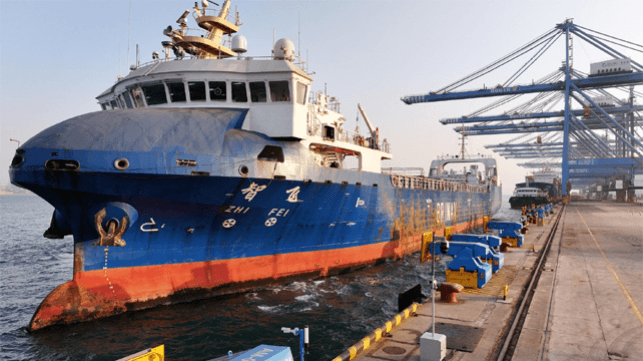
Zhi Fei
Zhi Fei, the first ship to accomplish a fully autonomous end-to-end container cargo voyage

Published May 21, 2026 7:12 PM by The Maritime Executive


The IMO has taken a new step forward towards comprehensive regulation of unmanned shipping, building upon years of debate and detailed development work. At the latest meeting of the Marine Safety Committee, delegates approved a final text for the non-mandatory Maritime Autonomous Surface Ships code (MASS code), which codifies a set of safety standards for unmanned vessels in international trade. While the code is only a guideline for now, it is on track to become mandatory as early as 2028, and it gives a sense of what the requirements for unmanned shipping might soon look like in operation. 

According to IMO, the purpose of the code is to regulate emerging technology and maintain safety while also enabling innovation. Autonomous ships - which entail scaled-up size and risk compared to autonomous boats - are still in their infancy, and this is the first set of specifications that applies globally to their development. 

The MASS Code text has not yet been released, but a marked-up final draft from February shows the committee's intent. For now, the rules are largely goal-based, without the proscriptive specificity of a SOLAS regulation on lifeboat design or a VDR installation.

Safe navigation is the first item on the list for evaluating autonomous shipping. The MASS code incorporates by reference the familiar collision avoidance rules of COLREGS, with its human-focused recognition requirements for sounds, lights, shapes and vessel classes. To complement the standard COLREGS lookout requirement, the MASS code institutes a situational awareness requirement that the ship's self-navigation system must "continuously monitor all information necessary for safe navigation." More specific standards - like an ability to evaluate audible sounds and VHF hails, which most autonomous navigation systems cannot currently perform - are as-yet not part of the code. 

The rules do outline a long list of equipment requirements that would be unique (and perhaps technically challenging) for unmanned ships. Without crew aboard, unmanned vessels would need to be designed differently for safety and for emergency response, including fallback operations in "reasonably foreseeable degraded states." This implies different standards for "structure, subdivision, stability and watertight integrity, fire protection, fire detection and fire extinction, life-saving appliances and arrangements, security, search and rescue, cargo handling, towing and mooring, machinery installations, electrical installations and external support systems." 

Some of these standards will be challenging to achieve and maintain in a harsh marine environment, just as they are for current equipment. For safety reasons, anchor windlasses will have to be capable of raising and lowering autonomously or remotely during an emergency, without crew to remove the devil's claw or fan the windlass brake. Emergency tow arrangements will have to be configured to be made up without a crew to handle heaving lines and hawsers in rolling seas. Much of the supplier R&D work needed to meet the requirements will continue for years to come. 


Driver Arrested on Boating-Safety Charges for a Lake Trip in a Cybertruck

Grapevine, Texas
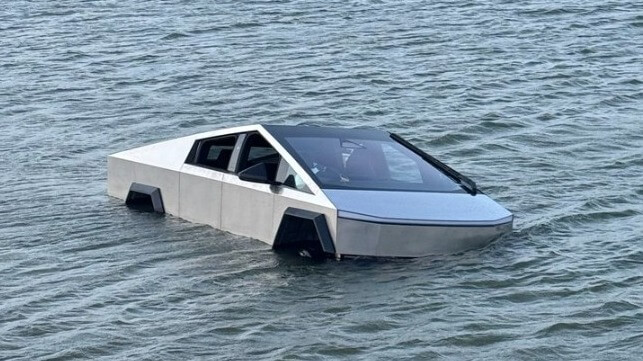
Courtesy Grapevine Police Department

Published May 20, 2026 10:43 PM by The Maritime Executive


The Tesla Cybertruck is capable of safely submerging up to a maximum depth of 32 inches, suitable for driving on flooded roadways and shallow streambeds. Though it does not in fact float, the $70,000 vehicle's "wading" ability has tempted some owners to try it out in the water - potentially running afoul of laws on boating safety, as one Texas driver-turned-skipper found out this week. 

According to police in the Dallas suburb of Grapevine, Texas, a man identified as Jimmy Jack McDaniel, 70, attempted to drive a Cybertruck near shore at Grapevine Lake on Monday evening - with two passengers aboard. At some point after driving off the boat ramp, the vessel began to take on water and became inoperable. Bystander photos from the scene show that it was submerged up to the sill of the driver's side window. 

Officers with the Grapevine Police Department responded to the scene at about 2000 hours and found McDaniel, who had safely abandoned the grounded vessel along with his two passengers. He informed the officers that he had entered Grapevine Lake intentionally in order to test out the Cybertruck's "Wade Mode," the police reported.

He has been arrested and charged with operating a vehicle in a closed section of a park, operating without lifejackets aboard, operating without a fire extinguisher, and operating without a valid boat registration.  

McDaniel told local station KTVB 7 that he had taken the Cybertruck into water before, including saltwater, without having any difficulties. The issue this time was his improper assessment of the water depth, he said. He identified the likely downflooding point as the electric charging port, located on the driver's side above the rear wheelwell. 

Salvage operations began shortly after McDaniel's arrest, and a wrecking truck and the local fire department extracted the Cybertruck from the lake. 


A nearly identical Cybertruck navigation attempt occurred at the same lake in March 2025. It is unclear if it was the same operator.  

While the Cybertruck does not come with a stability booklet, Tesla does provide an extensive set of precautions to consider when wading. First and foremost, damage caused by driving in water is not covered by the vehicle's warranty, exposing the owner to the full cost of any repairs. The operator is also advised to keep to calm waters; not to exceed a water depth of 32 inches; and to be wary of hazardous bottom conditions like soft sediment and debris. The special-purpose Wade Mode - which pressurizes the battery pack and raises the suspension - must be engaged. 


Tanker Near Somalia Fires Warning Shots to Chase Off Suspicious Approach

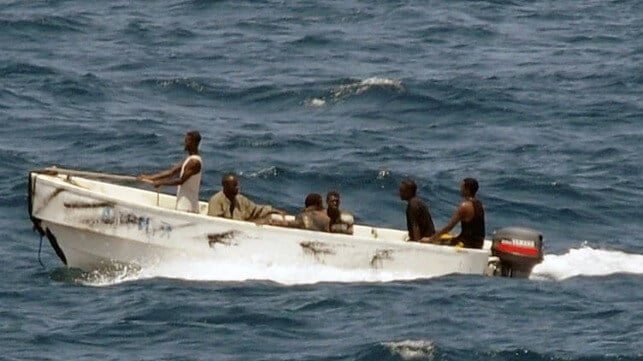
pirate group in small boat
Small boat approached a tanker marking the third incident in a week (USN)

Published May 22, 2026 12:30 PM by The Maritime Executive


A tanker sailing in the Gulf of Aden reported on May 22 that its security team was forced to fire warning shots during a suspicious approach. It was the latest in the ongoing incidents in the region being linked to several active groups of Somali pirates.

The company security officer for the unidentified tanker reported the incident to the UK Maritime Trade Operations. The tanker was underway when it was approached approximately 98 nautical miles from Socotra, an island controlled by Yemen.

A small craft with five people aboard was detected approaching the tanker. The armed security team fired warning shots, which caused the small boat to change course.

It was the third approach in the last week, according to data from the EU’s Maritime Security Center for the Indian Ocean (MSCIO). On May 18, a skiff operating near Bosaso, Somalia, was reported to the EU’s Operation Atalanta. It was believed to be a pirate group seeking a merchant ship target. Three days earlier, on May 15, a suspicious high-speed boat was reported to have stopped a fishing vessel. The people aboard the boat were carrying weapons resembling AK-47 rifles.

Three vessels also remain under the control of pirate groups and are being held off the coast of Somalia. The tanker MT Honour 25 was seized on April 21, the general cargo ship Sward was seized on April 26, and the tanker Eureka was seized on May 2. The pirates are reported to be demanding $3 million for the release of the Eureka.

UKMTO warns that the piracy threat level remains severe along the Somalia coast and in the Somalia Basin. MSCIO specifically cited the highest risk to the north near the Puntland region and in the Gulf of Aden. It also rates the risk as moderate along the Somali coast. Vessels have been warned to remain at least 150 nautical miles off the coast, or to avoid the region if possible.


Seven Crewmembers from MSC Elsa 3 Casualty Seek Release from India

containership sinking
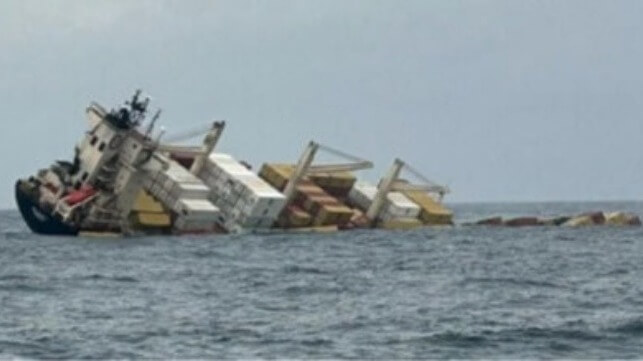
Seven crewmembers remain detained in India a year after their ship sank (DGS)

Published May 22, 2026 2:29 PM by The Maritime Executive


A year after the MSC Elsa 3 containership rolled onto its side and sank off the Indian coast, seven officers and crewmembers from the vessel remain detained in India. They are asking the High Court in Kerala for the return of their passports and permission on humanitarian grounds to return to their home countries.

The MSC Elsa 3 had listed onto its side on May 24, 2025, and later sank around 14.6 nautical miles off the Kerala coast. The Indian Coast Guard organized a rescue mission and brought all 24 crewmembers safely into the port. However, the crew says that the Mercantile Marine Department in Kochi issued a notice directing that no crewmember should leave Kochi without written permission.

The police later filed papers for charges against the vessel and its owner/operator, while the local government and the Indian authorities have filed court claims for more than $1 billion in compensation. In addition, the cargo owners filed admiralty claims, while the local fishing community and others have also filed claims in the court against MSC.

The crew told the court that the police had seized their passports. Yet they highlight that only the master of the ship was named in the police indictment. They assert that they have cooperated with the investigation and should now be released to return to their homes. They note that the Director General of Shipping allowed 15 crewmembers to depart India in August 2025.

The remaining crewmembers, including the master, chief officer, chief engineer, and second engineer, filed papers with the High Court asking for the return of their passports and contending they are being illegally detained. The crewmembers are from Russia, Ukraine, Georgia, and the Philippines.

The court held an initial hearing on the petition, and it asked for responses from the Indian government and the local government in Kerala. A follow-up hearing has been scheduled for next Friday, May 29.

Media reports are also highlighting that a year after the casualty, the shoreline continues to be polluted by the cargo. The vessel was carrying 643 containers, some transporting calcium carbide and plastic nurdles. Days after the ship sank, some of the containers began to wash ashore or break open. Around 630 metric tons of debris were recovered during a shore cleanup while a diving program sought to drain the oil from the hulk.

An environmental group is now saying that despite the government ending the cleanup, it is still finding nurdles on the beaches. It reports finding a “persistent presence of the pellets on beaches” while warning that the pellets will be a persistent threat. They theorize that strong waves and weather conditions could also be stirring up debris that remained at sea and driving it to shore.

Maersk Center Downsizes Amidst Uncertainty on Path to Decarbonization

MMCZCS
An ammonia bunkering simulation at Port of Rotterdam, conducted in partnership with the Maersk Mc-Kinney Møller Center for Zero Carbon Shipping (MAGPIE / MMMCZCS)

Published May 21, 2026 9:54 PM by The Maritime Executive


Amidst uncertainty about the form and timing of shipping's green transition, the A.P. Moller Foundation's Maersk Mc-Kinney Møller Center for Zero Carbon Shipping has quietly reduced its headcount by about 30 percent. Chief technology officer Torben Nørgaard has also confirmed that he is departing to join a commercial venture. 

"Far from retreating, the Center is adapting so that we can continue to deliver on our mission, together with our partners and the wider maritime ecosystem," said CEO Bo Cerup-Simonsen in a statement earlier this week. "Drawing on the insights and experience we have gained, we are deepening our focus and directing our energy to where our impact can be greatest."

Going forward, the center plans to focus on its technical work - researching energy efficiency measures and low-carbon propulsion - and supporting the development of regulations and policies. 

Simonsen said that he is optimistic about the long-term future of the IMO's carbon emissions regulatory process. Many of the member states that are skeptical of aspects of the Net Zero Framework have reservations about implementation, but are still committed to the broader idea of the 2023 IMO Greenhouse Gas Strategy, he said - encouraging for the prospects of working out a deal down the road. 

"These [MEPC] meetings have left us in a constructive, if fragile, position. Member states are now preparing to find a way forward that can secure broad support while living up to the ambition of the 2023 IMO GHG Strategy," Simonsen said. 

The downsizing may also reflect a financial reality. With new geopolitical headwinds facing decarbonization in general, the center has shed several commercial sponsors since the start of 2025. Notable departures from the public partnership list include big names in energy, classification, shipping and marine technology, but 18 core sponsors remain. 

Report: US Treasury Allows Demolition Sale for Four Sanctioned Ships

Shipbreaking
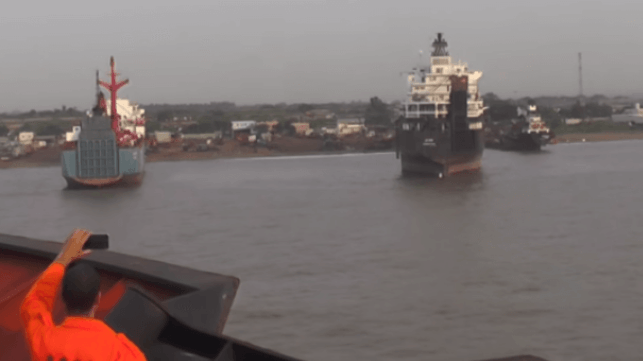
Ships in various stages of demolition at the beach in Alang (file image)

Published May 22, 2026 5:06 AM by The Maritime Executive


The U.S. Treasury has authorized a demolition sale for four sanctioned vessels linked to the Shamkhani shipping network, a large-scale smuggling organization that has moved millions of barrels of Iranian oil to market. The anonymous owners of these four ships will receive millions of dollars in payment for the scrap value, cash buyer GMS confirmed to the Wall Street Journal, under special approval from the Trump administration. 

According to the Treasury, the ships belonged to the network of Iranian "shadow fleet" industry leader Mohammad Hossein Shamkhani, son of senior Iranian advisor Ali Shamkhani, who was killed in an airstrike in February. The administration has sanctioned more than 50 of the Shamkhani network's ships in multiple well-publicized actions, including the four vessels now authorized for sale, identified by the WSJ as the Yogi, Timon, Rantanplan and Bigli.

Sanctioned vessels are not easy to sell, since the reach of U.S. enforcement is global and the consequences are high. Substantial numbers of sanctioned "shadow fleet" vessels have been reaching the beach at Alang in recent months under fake documentation, according to cash buyer Wirana, but the firm says that India has begun cracking down on the practice with more detailed document checks. U.S. Treasury authorization for a sanctioned ship sale - like that granted to GMS this week - would make it easier for a shipbreaker to buy and import the hull. 

If shadow fleet shipowners want to exit sanctioned trades, there are several non-revenue-generating options, like abandoning the vessel and crew - a practice which is occurring at record-high rates. But for a revenue-generating exit that recoups some of the capex cost of the ship, a demolition sale is often the owner's only option for vessels in the shadow fleet, which skews heavily towards older tonnage. Sanctioned ships are sold for scrapping at discount rates, according to Wirana, and are therefore a desirable source of steel for shipbreakers.

GMS argues that there are owners who would like to get out of sanctioned trades but cannot afford to do so because the Treasury prohibits them from selling their blacklisted ships. Since the start of the year, according to the WSJ, it has sought a license from the administration to legitimately and legally purchase sanctioned shadow fleet tonnage for resale to shipbreakers, generally in Bangladesh, India and Pakistan. That general license has not been granted, but the ship-specific licenses for buying Yogi, Timon, Rantanplan and Bigli could set a precedent for other sales.


With AUKUS Risks and Aging Fleet, Australia Eyes Japanese Subs as Backup

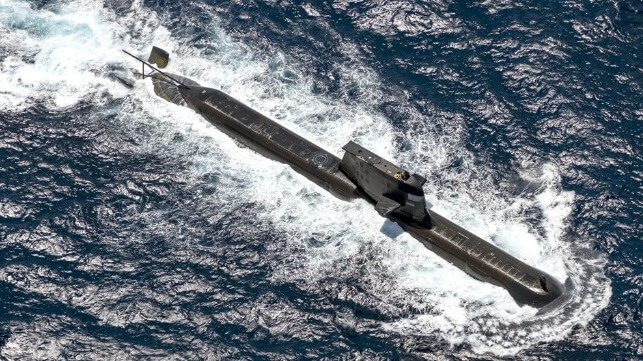
Collins-class submarine HMAS Rankin: Yuri Ramsey/Department of Defence.

Published May 21, 2026 3:32 PM by The Strategist


[By Richard Gray]

The reduced Collins-class submarine Life-of-Type Extension (LOTE) program, announced on 19 May, will cost more than previously expected and deliver less capability. The government’s decision to cut back the scope of the work also increases the risk to Australia’s possession of a modern, crewed submarine capability in the next decade.

AUKUS remains the best partnership for Australia to acquire the nuclear-propelled submarines necessary for Australia to manage the most dangerous era since World War II. But the now elevated risk of losing adequate conventional submarine capability in the meantime strengthens the case for preparing a Japanese fallback option.

Canberra should approach Tokyo to see how it could buy or lease Japanese submarines should they be required in the 2030s.

The Collins-class LOTE program as originally planned was always highly risky, so cutting back what will be done to the six submarines to keep them going is an understandable and responsible move. Instead of a more extensive LOTE, equipment on the submarines will be repaired and replaced as judged necessary for each boat. Sensors and weapons will be replaced where possible. The focus will be on maintenance and safety rather than enhanced capability. Replacement of the diesel engines and generators will be done only if judged to be critical.

The cost of the reduced LOTE is estimated at around A$11 billion, double what had been estimated for the full LOTE. This is likely not just because the previous costs were probably greatly underestimated but also because old equipment on the submarines will be increasingly expensive to maintain. Critical elements such as the hulls and in some cases the propulsion systems will be approaching or possibly exceeding 40 years of service by the end of the next decade, increasing the risks to safety and likely requiring intensive monitoring and maintenance.

This raises the question of value for money. Even if all goes according to the new plan, Australia will pay around A$1.8 billion per boat to keep roughly its current level of conventional submarine capability, at best. In all capability aspects this does not compare favourably with new, modern conventional submarines. For example, Japan’s Taigei?class submarines cost about A$600 million to A$700 million each. If further reductions to the scope of the LOTE occur – and the announcement yesterday leaves this prospect open, pending further engineering studies – a future government might decide that the running cost of an increasingly fragile and shrinking capability is not worth it and cut its losses. This could mean rapid retirement of older Collins-class vessels and even deciding not to extend the lives of some units, leaving a smaller and rapidly ageing submarine force until the arrival of nuclear boats.

The government plans that at any time three Collinses will be in deep maintenance, which will include life-extension work. Two of the remaining three are to be available for operations. Even assuming this can be achieved in what’s still likely to be a risky and technically challenging program, the life-extended submarines will possibly be less stealthy and probably have less endurance than previously planned. They will progressively fall behind newer regional competitors and probably be less able to undertake the full suite of required missions.

The reduction in planned submarine capability as a result of the de-scoped LOTE program increases the importance of achieving the remaining two key steps of the AUKUS Optimal Pathway, delivery to the Royal Australian Navy of US Virginia-class nuclear attack submarines (SSNs) and local construction of the follow-on Anglo-Australian SSN-AUKUS class.

The Virginias are due to arrive in the early 2030s, almost certainly not before 2032. But there is a significant risk that deliveries could be delayed – or even withheld if the US judges that it has too few SSNs for its own requirements. Since the Collins class is losing its competitiveness with age, delays to the Virginias and SSN-AUKUS could leave Australia without a modern crewed submarine capability for a decade or more – hence the need to get ready now for the Japanese fallback option.

As the ASPI report Hedging our Bets recommends, it is more than prudent to prepare now for the future contingency of rapidly buying or leasing conventional submarines from Japan (or even another partner) should these risks to Australia’s submarine capability emerge. The reduction in the LOTE program and resulting reduction in planned capability is a clear reminder that such risks are very real.

Richard Gray is a resident senior fellow at ASPI.

The opinions expressed herein are the author's and not necessarily those of The Maritime Executive.


Australia ‘disappointed’ by Chinese owner’s resistance to forced port sale


By AFP
May 21, 2026


Private Chinese company Landbridge acquired a 99 year lease to Darwin Port in 2015, prompting criticism of Australia from then-US President Barack Obama 
- Copyright AFP Jung Yeon-je

Australia’s defence minister Richard Marles said Thursday that Canberra was “disappointed” the Chinese leaseholder of the strategic Darwin Port was challenging efforts to return it to local ownership.

Private Chinese company Landbridge acquired a 99 year lease to Darwin Port in 2015, prompting criticism of Australia from then-US president Barack Obama.


Prime Minister Anthony Albanese pledged last year to return the northern port — which sits across the harbour from a defence base hosting 2,000 US Marines annually and tarmacs upgraded for US bomber aircraft — to Australian ownership.

In April, Landbridge’s billionaire owner Ye Cheng lodged a complaint in the World Bank’s tribunal for investment disputes, alleging Australia’s push for the company to sell the port had breached its free trade agreement with China and was taking a discriminatory approach.

“We’re committed to putting the Port of Darwin back into Australian hands,” Marles told reporters Thursday on a visit to Darwin.

“We’re disappointed about the steps that have been taken to put this toward the place of an international tribunal. Obviously, we will do everything in our power to defend that matter,” he said.

Marles also noted the US military was committed to “doing more from Darwin”.

Darwin is Australia’s closest port to Asia, and cargo shipments of commodities including iron ore and liquefied natural gas to China have dominated trade ties.

In January, China’s ambassador to Australia Xiao Qian warned if Landbridge were forced to leave the port it could impact wider trade and investment between China and Australia.


Australian Police Intercept a Diesel Generator Filled With Multiple Drugs

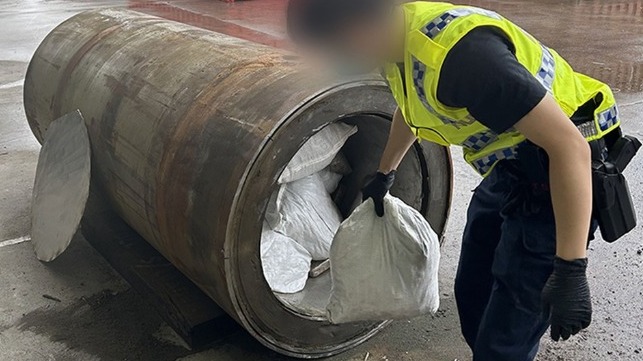
Drug packages within an apparent cylinder bore (AFP)
Drug packages encapsulated within an apparent cylinder liner, post-disassembly (AFP)

Published May 21, 2026 9:32 PM by The Maritime Executive


The Australian Federal Police are calling on diesel repair specialists to help with a rare technical problem: the agency has confiscated a used diesel generator that someone packed full with nearly every kind of illegal stimulant on the market, and it needs to find the people responsible for the shipment.

Early this year, Australian Border Force inspectors at Port Botany were conducting routine X-ray inspections of imported cargoes when they noticed something off about a heavy-duty diesel generator, which had arrived from Mexico by way of Malaysia. 

This generator was special: it appeared to have packages inside. The ABF contacted the AFP, who brought in specialists to have a closer look. Over the course of three days, they disassembled the generator and found a total of about 370 kilos of drugs inside; photos suggest the consignment was stashed in a cylinder bore.

Unusually, the shipment was very diverse. Large-scale imports typically have just one or two drug classes, but this one had about 120 kilos of cocaine, 250 kilos of methamphetamine, three kilos of MDMA and 800 grams of 2CB ("pink cocaine"), a lab-made club drug with stimulant and psychedelic effects.  

"This mixed bag of illicit drugs was likely destined for several different criminal groups, to be sold into a range of communities. Despite the elaborate attempt to conceal such a large quantity of drugs, the coordinated efforts of law enforcement ensured these substances never reached Australian streets," said Detective Acting Superintendent Stuart Kimbell in a statement. 

Kimbell said that the AFP is looking for tips from the public - particularly from anyone who might have been approached about storage space for a generator, or spare parts vendors or diesel engine technicians who may have fielded inquiries about repairs. (The make and model of the engine were not released.)

According to ABF, this intercept ranked high on the list for technical complexity and detection difficulty. "ABF officers are highly skilled at identifying anomalies across all forms of incoming cargo, no matter how elaborate the concealment," said ABF Superintendent Jared Leighton.

Separately, the AFP announced that it had busted the alleged ringleader of an insider smuggling network at Port Botany. The 29-year-old suspect stands accused of organizing multiple drug pickup attempts at the port, including a 500-kilo shipment last year. The organizer allegedly paid a competitive wage to entice co-conspirators, up to US$140,000 per person per pickup - nearly three years of earnings for a typical Australian worker. 

Australia is the world's leading per-capita consumer market for cocaine and methamphetamine, and import prices are accordingly high. While wholesale prices fluctuate with availability, cocaine typically attracts more than US$100,000 per kilo on the Australian market. 

Philippines orders arrest of fugitive senator sought by ICC

By AFP
May 21, 2026


Protesters call for the start of the impeachment trial against Philippine Vice-President Sara Duterte and the arrest of Philippine Senator Ronald "Bato" Dela Rosa outside the Senate in Manila - Copyright AFP Jung Yeon-je

The Philippine government on Thursday ordered police to arrest a senator wanted by the International Criminal Court over his role in ex-president Rodrigo Duterte’s deadly drug crackdown.

Senator Ronald “Bato” Dela Rosa, who served as the nation’s police chief, was the enforcer of the drug war that killed thousands of people in the Philippines.

Dela Rosa is on the run after fleeing the Senate building last week, hours after a shooting incident between government agents and senate security personnel.

“I would like to confirm that the Philippine law enforcement agencies… are now tasked to effect the arrest of Senator Ronald ‘Bato’ dela Rosa,” Justice Secretary Fredderick Vida told reporters.

The ICC last week unsealed an arrest warrant against Dela Rosa, accused along with Duterte and other “co-perpetrators” of the crime against humanity of murder.

After a dramatic chase up the senate stairs on the same day, government agents who failed to arrest him later paused the effort as the senate leadership gave him sanctuary.

The Philippine Supreme Court’s interim ruling on Wednesday denying the Philippine ex-police chief’s bid for a temporary restraining order means the ICC warrant can now be enforced, Vida added.

“We’re pursuing this so that the ends of justice may be achieved,” Vida added, warning that “there are consequences” to anyone who would try to help Dela Rosa avoid arrest.

His lawyer said Wednesday he will appeal the Supreme Court ruling.

Former president Duterte was arrested last year and is awaiting trial by the ICC in The Hague on charges stemming from the drug crackdown.

The drug war left thousands of people dead, mostly drug users and low-level traffickers from urban slums according to human rights monitors.

Philippine police say more than 6,000 drug suspects were killed in legitimate police operations during the Duterte presidency in 2016-2022.

Dela Rosa served as national police chief from 2016 to 2018 during the early phase of Duterte’s anti-drug campaign and was elected to two successive six-year terms in the Senate after retiring from the force.
INTERVIEW


‘They’re afraid’: Nicaraguan writer Gioconda Belli on fighting censorship


By AFP
May 21, 2026


Giconda Belli is one of Latin America's most influential literary voices
 - Copyright AFP Jung Yeon-je


Juan José Rodríguez

Exiled Nicaraguan writer Gioconda Belli said on Wednesday that the government censored the publication of her latest novel in her home country because it is “afraid” to hear the truth.

Belli, one of Latin America’s most influential literary voices, said husband-and-wife co-presidents Daniel Ortega and Rosario Murillo fear voices that expose their betrayal of the leftist Sandinista revolution that toppled the US-backed right-wing regime of Anastasio Somoza in 1979.

Belli served in the early administrations of Ortega, then a Sandinista guerrilla icon, but the United States has since branded his government a dictatorship, accusing it of seizing total power with a constitutional rewrite and crushing dissent.

Belli, who lives in Spain after the government stripped her of her Nicaraguan nationality in 2023, explores the theme of betrayal in her novel “A Silence Full of Whispers.”

The writer sat down with AFP in Panama, where she is attending the Centroamerica Cuenta literary festival.

Question: How do you view the evolution of Central American literature?

Answer: On one hand, it’s still vibrant, but on the other, I feel it has suffered greatly due to the political context we’re living through in Central America.

In a way, that suffering is the very thing that generates literature. It is truly a region that has endured great sacrifice. But at the same time, even under the cruelest dictatorships, it has still managed to produce fine literature.

Q: What role can literature play in this context?

A: Literature is a tremendous asset for Central America. It brings visibility to the region and it creates dreams, promises and possibilities. Literature cannot topple an authoritarian regime on its own, but it can encourage people to reflect on authoritarian tendencies and what that can mean for their own lives.


– ‘Lost battle’ –


Q: This is how censorship can occur.

A: Power has always feared the written word, and above all, the written word that speaks the truth. Dante was exiled, Victor Hugo was exiled. The written word compels you to think and a heightened conscience is one of the essential elements required to bring about change.

We’re not going to end a dictatorship with poetry. However, if a poem leads you to a state of understanding, of awareness, and above all, aspiration, then you start to think about a different life, you want to live differently.

Q: Why do you think your novel was censored?

A: Because we hold a critical stance. Because we emerged from within Sandinismo, we know what Sandinismo originally set out to achieve, and we can’t tolerate what they’ve done with it, how they have debased and manipulated it.

They know that we have the capacity, the moral authority and the background to expose and uncover exactly what they’re doing. They’re afraid of us.

Q: You’ve said that this book seeks to exorcize the power structure in Nicaragua.

A: It’s a novel about the relationship between a mother and a daughter, but it’s also a novel about disillusionment. The mother, having dedicated her entire life to the revolution, is left with the crushing sensation that her dream has been betrayed.

Q: In North Korea, films from South Korea still manage to find their way into the country despite censorship.

A: We have ways to communicate nowadays. I’ve sent a PDF of my book to my friends and asked them to distribute it. They can’t control everything, no matter how much they want to. They’ve already lost that battle.

Q: Is there self-censorship in the region?

A: Being censored by others is one thing but I do not censor myself. I believe that one of my roles, as someone harmed by this regime and now living in exile, is to speak out on behalf of those who have no voice, to talk about what’s happening.

There are so many people living in exile who fled with absolutely nothing left to their names. I have a name, a body of work, but there are people who are jobless, stripped of their pensions and left in a state of utter abandonment.


— ‘Intoxicated with power’ —


Q: Do you see any immediate possibility of being able to return home?

A: I don’t see it as imminent, but I could be mistaken, and that’s where my hopes lies. You never know what the future holds. I do see the end in sight. Both Ortega and Murillo are becoming intoxicated with power and doing reckless things. They’re very afraid, more afraid than we are. I believe they’re wearing themselves down considerably.

Q: What do you miss about Nicaragua?

A: It fills me with great sadness to think that I’ve lost my home, a place I loved deeply because I felt like a guardian of the landscape. Seeing the lake, the volcanoes, the vegetation, the flowers, I miss all of that.

Q: Did you ever imagine this would happen back when you were part of the Sandinista movement?

R: I never, ever imagined that this could happen. They have committed the most despicable and vindictive acts against the very people who risked everything for the revolution.