Thursday, May 28, 2026

U.S. slaps duties on fresh Canadian mushrooms over subsidy claims


Published:

In this Sept. 16, 2011, file photo, a mushroom grows at Winslow Park in Freeport, Maine. Maine. (AP Photo/Robert F. Bukaty, File)

WASHINGTON — The United States has put countervailing duties on fresh mushrooms grown in Canada following a U.S. Department of Commerce investigation which the Canadian industry has called “deeply flawed.”

The change, posted in the federal register on Monday, will slap most fresh mushrooms with tariffs of 2.84 per cent.

Two companies received separate duties: Champ’s Fresh Farms Inc. was hit with a tariff rate of 1.62 per cent and Farmers’ Fresh Mushrooms Inc. was hit with a tariff rate of 4.97 per cent.

Separate anti-dumping duties are expected to be added later this month.

The preliminary Commerce investigation said Canadian mushroom producers received unfair government subsidies.

Mushrooms Canada CEO Ryan Koeslag said last week that Canadian growers haven’t engaged in unfair trade practices and producers are not receiving special treatment.

In a news release, Koeslag said the Commerce department’s justification is linked to mainstream agricultural tax treatment, including provincial sales tax exemptions available to farmers generally.

“Treating broad-based agricultural tax measures as unfair subsidies is contrary to common sense and unfairly penalizes Canadian mushroom growers for participating in programs available across the agricultural sector in any number of countries,” Koeslag said.

Mushrooms Canada said under U.S. trade law, a subsidy must meet specific legal requirements before it can be countervailed and the group does not believe those requirements have been met.

“It is difficult to reconcile Commerce’s preliminary approach with the fact that comparable agricultural tax treatment exists in the United States,” Koeslag said.

The Commerce department launched the investigation in January after receiving a complaint from the U.S.-based Fresh Mushrooms Fair Trade Coalition. The group said tax exemptions meant Canadian mushrooms were unfairly subsidized and claimed Canadian mushroom imports had grown in recent years while domestic mushroom consumption remained relatively flat.

Giorgio Mushroom Co., which is part of the U.S. coalition, said in a news release Monday that the duties are an important step.

“For years, American mushroom growers have faced enormous pressure from unfairly subsidized mushroom imports that distorted competition and threatened domestic production,” said Giorgio Mushroom CEO Mark Currie.

William Pellerin, a partner in international trade at McMillan LLP, said the Commerce investigation would not look at the specific agriculture subsidies that U.S. producers might be receiving — even if it is similar to what Canadian companies get.

Pellerin, who is not involved in the mushroom case, noted the preliminary subsidy amount is extremely low but the Commerce investigation into Canadian mushrooms is still ongoing.

When Canadians think of countervailing and anti-dumping duties they often look to lumber tariffs. Those tariffs, which predated the Trump administration, have also increased in the last year.

Pellerin said Commerce investigations like the one around fresh mushrooms generally are not U.S. administration-led tariffs.

The Canadian mushroom industry would be able to push back on the countervailing duties under the appeal mechanism through the Canada-U.S.-Mexico Agreement on trade, better known as CUSMA.

Countervailing and anti-dumping duties are separate from U.S. President Donald Trump’s massive tariff agenda. Trump has used different tools to hit countries around the world with tariffs and Canada is also being hammered by his sector-specific duties on things like steel, aluminum, automobiles and cabinetry.

But Trump’s push to realign global trade through tariffs may see more agricultural industries in the United States follow the mushroom coalitions’ lead and push for Commerce investigations, Pellerin said.

“I think that’s going to be not just the United States,” Pellerin said. “We are seeing them in Canada vastly increase also where Canadian associations are bringing cases against agricultural products from around the world.”

This report by The Canadian Press was first published May 18, 2026.

Kelly Geraldine Malone, The Canadian Press


Canadian mushroom growers warn new U.S. tariffs could ‘flood’ domestic market


Updated:

With a July 1 deadline to review the Canada-U.S.-Mexico Agreement (CUSMA) around the corner, new U.S. tariffs are set to take effect next week, this time on Canadian mushrooms.

“This is about 4,300 square feet of growing space,” said Mike Medeiros, owner of Carleton Mushroom Farms in Osgoode, Ont., as he toured his facility Saturday.

It is a massive and modern, but family-run, mushroom farm that grows, harvests and packages mushrooms in house.

An impressive “300,000 pounds per week” is how much Medeiros’s farm produces, making it one of the bigger players in the Canadian mushroom market.

But new U.S. tariffs set to be imposed on Canadian mushrooms Monday will take a toll on his business, even though his mushrooms stay in Canada.

“Forty per cent of the mushrooms in Canada are shipped to the U.S., and so what’s going to happen is as tariffs increase going to the U.S., there might be more mushrooms in Canada and then it would flood our market,” said Medeiros.
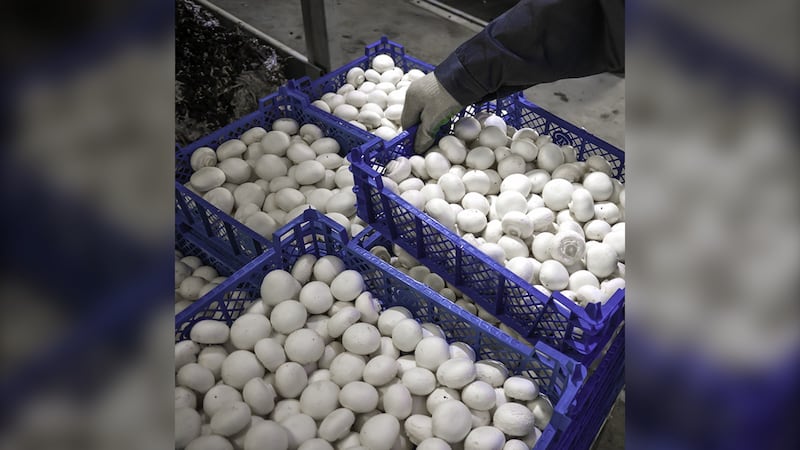
Canadian mushroom farmers say new tariffs could lead to layoffs and reduced output. (Credit: Carleton Mushroom Farms)

A fact sheet released this week by the U.S. Department of Commerce showed Canadian mushrooms will face new tariffs of up to five per cent, citing unfair government supports.

“They’re the same in the U.S. as they are in Canada,” said Ryan Koeslag, the executive vice-president of the Canadian Mushroom Growers’ Association, in an interview with CTV News.

“We’ve always been operating under the rules and regulations of fair trade between Canada and the U.S., and so the reason they identified this, I think, is they haven’t been able to find anything else.”

Known as countervailing duties, the same measures used to tariff Canadian softwood lumber, the tariffs are imposed on imports the U.S. deems are being unfairly subsidized.

But Canadian mushroom farms are just the latest example of a clear signal being sent by the Trump administration, targeting Canada’s agricultural sector.

“Ultimately the U.S. farmer is very powerful politically,” said William Pellerin, an international trade lawyer with McMillan LLP in Ottawa.

“There’s a broad trend to look at agricultural products coming into the United States and apply tariffs where the U.S. deems it’s important to do so,” he said.

Medeiros says the move could force him to start producing less.

“Once we start cutting back production, we would definitely have to look at cutting back staff to keep payroll in check,” added Medeiros.

Canadian mushroom farmers export almost exclusively to the U.S., and while industry says it will fight the new tariffs – that will still take time.

Jeremie Charron

Opens in new window

Journalist, CTV National News


A small group of cities drove Canada’s progress on diversifying trade away from U.S., report says


Updated:

OTTAWA — A small group of cities across the country drove Canada’s progress on diversifying trade in 2025, while others fell behind, says a new report from the Canadian Chamber of Commerce.

The report says Calgary, Ottawa-Gatineau, Toronto, Saskatoon and Kelowna, B.C., are the cities that made the strongest gains in export diversification beyond the U.S. market last year.

Of the cities surveyed, Calgary and Ottawa-Gatineau posted the largest increases in exports to non-U.S. markets between 2024 and 2025 — 64.67 per cent and 64.04 per cent, respectively.

Toronto’s non-U.S. exports increased by 32.82 per cent, followed by Saskatoon (32.04 per cent) and Kelowna (28.63 per cent). Non-U.S. exports increased by 16.8 per cent countrywide.

“Together, this relatively small group of cities account for a disproportionate share of Canada’s recent export diversification gains, reinforcing how uneven the country’s trade adjustment remains across regions,” says the report.

Results across regions

The report says many other cities didn’t see the same gains. It says manufacturing regions in Ontario continued to face weaker overall trade performance and “limited diversification momentum.”

“Highly U.S.-integrated manufacturing regions, including Oshawa, London and Kitchener-Cambridge-Waterloo, are showing some of the clearest signs of trade-related economic stress,” says the report.

“These cities remain heavily tied to the U.S. market, while growth in exports outside the U.S. has been limited or insufficient to offset broader weakness in trade activity and local economic conditions.”

The report says the data points to a “growing divergence” in local trade performance across Canada.

“Some cities are successfully expanding into global markets and building more diversified export bases, while others remain more exposed to U.S. demand, trade disruptions and policy uncertainty,” it says.

The chamber released a report last year that said Calgary; Saint John, N.B.; and Windsor, Ont., were the Canadian cities that would be hit the hardest by U.S. tariffs. That report said some Canadian cities, including Victoria and Halifax, were less exposed to tariffs because they export more to Asia and Europe.

“A year later, that exposure is seemingly showing up in economic outcomes locally, although it was not an exact match with who we expected could have been worst hit,” says the new report. “As expected, Canadian cities with greater exposure to U.S. trade are experiencing more local economic stress.”

The federal government has set out to double non-U.S. exports over the next decade. The government’s spring economic update said non-U.S. goods and services exports increased by $33 billion in 2025 over 2024.

Canada’s exports shift

While the Canada-U.S.-Mexico Agreement on trade is due for a review this year, U.S. President Donald Trump has used different tools to hit countries around the world with tariffs. Canada is being hammered by Trump’s sector-specific duties on steel, aluminum, automobiles and cabinetry.

The chamber’s new report says recent Statistics Canada data on business responses to U.S. tariffs suggests many Canadian firms are “adapting cautiously” rather than fundamentally repositioning their operations.

The report says that while exports to non-U.S. markets rose sharply between 2024 and 2025, much of that growth came from existing exporters expanding their reach rather than new firms entering global markets. The number of Canadian exporters selling to non-U.S. markets increased by just six per cent year over year.

“While fewer businesses report taking no action compared to a year ago, relatively few are actively diversifying sales or suppliers outside the U.S.,” the report says. “Instead, firms are more likely to be raising prices, increasing domestic sourcing or delaying expansion plans.”

The report says data suggests many businesses still expect Canada-U.S. trade conditions to stabilize, despite signs that the global trading environment is “becoming more fragmented and less predictable.”

It says trade conditions are likely to remain more volatile, more uncertain and more uneven going forward. The ability to adapt, it says, depends on where firms operate, what they produce and how dependent they are on a single market.

The report also says about 90 per cent of non-exporting Canadian businesses still describe their operations as “local.”

“The risk is that Canadian firms may be underinvesting in longer-term diversification at precisely the moment when resilience and market expansion are becoming more important to competitiveness and growth,” says the report.

“If Canada wants diversification to become structural, more firms — especially (small and medium-sized enterprises) — will need to participate in global trade.”

Candace Laing, president and CEO of the Canadian Chamber of Commerce, said in a news release that Canada’s trade relationship with the United States will “always matter deeply” but the research shows resilience increasingly depends on the ability to diversify.

“Some Canadian cities are adapting quickly to this era of repeated global economic shocks, while others remain highly exposed to U.S. policy and demand uncertainty,” she said. “Canada does not just need more trade — it needs more traders.”

This report by The Canadian Press was first published May 27, 2026.

Catherine Morrison, The Canadian Press

Carney set to deliver remarks, pitch Canada as investment hub in New York


Published:

Prime Minister Mark Carney speaks during the Board of Trade breakfast in Vancouver, on Wednesday, May 20, 2026. THE CANADIAN PRESS/Ethan Cairns

NEW YORK — Prime Minister Mark Carney is in New York City Thursday to meet with business leaders as the relationship between Canada and the United States remains rocky ahead of a review of the continental trade pact.

The Prime Minister’s Office has not identified the CEOs, entrepreneurs, business leaders and money managers Carney is expected to meet with to pitch Canada as an investment destination.

Carney is also set to deliver remarks at the Economic Club of New York outlining Canada’s new economic strategy and the progress made so far.

The trip comes as Mexican and American officials meet this week for negotiations on the Canada-U.S.-Mexico-Agreement on trade, better known as CUSMA.

The United States has not officially launched CUSMA negotiations with Canada.

U.S Trade Representative Jamieson Greer said Tuesday there are significant trade issues with Canada but he has been in regular contact with his Canadian counterparts.

The CUSMA review sets up a three-way choice for each country to make in July. They can renew the deal for another 16 years, withdraw from it or signal both non-renewal and non-withdrawal — which would trigger an annual review that could keep negotiations going for up to a decade.

Greer has suggested the Trump administration is unlikely to rubber-stamp a renewal and the three countries are preparing for lengthy trade talks.

U.S. President Donald Trump froze negotiations with Canada last year because he was angered by an Ontario-sponsored ad quoting former president Ronald Reagan criticizing tariffs.

While the relationship appeared to thaw in March after a meeting between Greer and Canada-U.S. Trade Minister Dominic LeBlanc, no official negotiations have been launched.

Greer said Tuesday most countries “begrudgingly” accepted that some level of tariffs would remain but Canada is in a “different spot” and it’s “hard to see where that ends.” He said tariffs would remain on Canada and Mexico, despite the trade agreement.

As the Trump administration continues to signal a turbulent path forward for the bilateral relationship — it paused the long-standing Permanent Joint Board on Defense earlier this month — Carney has focused on securing investment and deepening Canadian ties with other countries.

On Wednesday, Carney announced the federal government is entering into contract negotiations with Sweden’s Saab to buy a fleet of surveillance aircraft for the Royal Canadian Air Force.

This report by The Canadian Press was first published May 28, 2026.

Kelly Geraldine Malone, The Canadian Press