Wednesday, May 27, 2026


Codelco and SQM budget $3 billion for lithium project in Chile
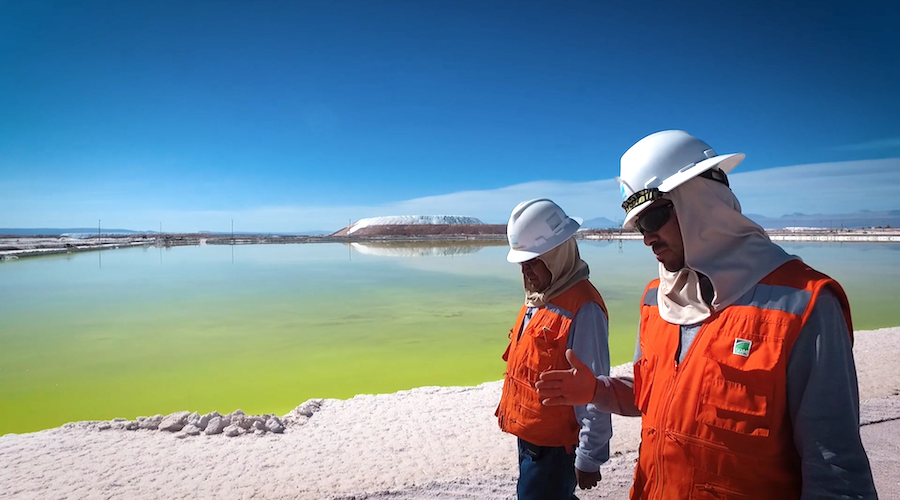

Codelco and SQM are advancing their Nova Andino JV in Chile’s north. (Image courtesy of SQM.)

Chilean mining companies Codelco and SQM are budgeting $3 billion to deploy new extraction technologies at their lithium joint venture in the Atacama Desert.

Their Novandino Litio partnership set its latest projection after wrapping up design work on a project to introduce more direct ways to recover lithium from brine under the Atacama salt flat in northern Chile, environment manager Julio Garcia said. The venture plans to submit an environmental impact study to regulators in June.

After years of testing, Novandino is advancing toward commercial operations of technologies known in the industry as direct lithium extraction, or DLE. They are touted as cleaner and faster than the traditional evaporation method, in which vast quantities of salty water get vaporized in one of the driest places on Earth, raising concerns about microbial ecosystems.

But large-scale commercial success for direct extraction remains largely unproven. The Atacama is a high-stakes proving ground: if DLE works there, it helps de-risk the technology globally. One key facet of the new process is reinjection, in which lithium-depleted brine is returned to the salt flat to preserve hydrological and geochemical balance.

“It will be rigorously monitored to determine that it not only delivers the recovery rates it promises, but also does not generate any type of impact,” Garcia said in an interview from Novandino’s Santiago offices.

The company has completed years of testing and engineering work on the technologies as it seeks to scale up output to meet demand for electric vehicles and large battery storage, while lowering environmental impacts. The approach combines nano-filtration and mechanical evaporation, along with other technologies already in use at its refinery.

Subject to environmental and other permitting, construction at the project dubbed Salar Futuro will start toward the end of the decade, with full implementation extending into the mid-2030s, Garcia said. Novandino has yet to make a final investment decision. Its previous guidance for the project cost was $2 billion-plus.

The project would gradually replace part of the traditional evaporation system, while maintaining some ponds for potassium production and pre-concentration. Freshwater extraction would eventually end.

Novandino was formed late last year after lithium supplier SQM agreed to hand over a majority stake in its Chilean brine assets to state-owned Codelco in exchange for extending operations.

(By James Attwood)


SQM posts surge in quarterly profit as lithium market tightens
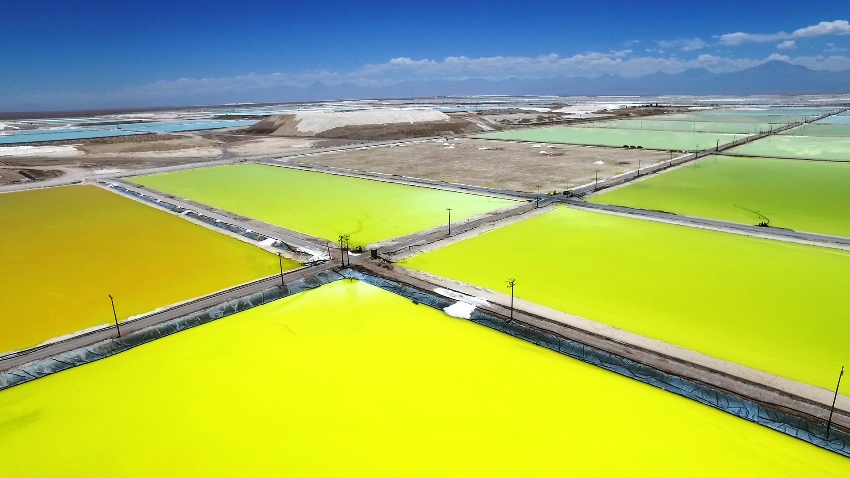

Lithium brine ponds in northern Chile. (Image courtesy of SQM)

Chilean lithium producer SQM posted on Tuesday a jump in first-quarter profit and revenue, helped by higher prices and stronger sales volumes on robust demand for electric vehicle batteries and energy storage.

The world’s second-largest lithium producer, said net income more than doubled to $365 million in the quarter from January to March quarter, but missed an estimate of $426 million from analysts polled by LSEG.

Revenue climbed 70% to $1.76 billion, beating analysts’ forecast of $1.62 billion, while adjusted EBITDA more than doubled to $837 million, also topping the LSEG estimate of $787 million.

SQM said revenue from the lithium and derivatives business, its largest unit, surged to $1.19 billion, driven by a rebound in prices and a 25% increase in sales volumes.

Chief executive Ricardo Ramos said the company sold about 69,000 metric tons of lithium carbonate equivalent (LCE) during the quarter as it ran at full capacity to satisfy strong customer demand.

SQM said its average realized lithium price rose about 95% from a year earlier to roughly $17.8 a kg, reflecting a tight market turnaround after a slump from record highs in 2022.

Prices for the battery metal came under pressure as supply growth outpaced demand, hurting margins for global producers including SQM and US-based rival Albemarle.

But demand has recently been supported by rapid growth in battery energy storage systems, alongside continued electric vehicle adoption.

Reflecting that improvement, SQM said it now expects its total lithium sales volumes to grow about 15% in 2026, up from a previous forecast of 10%, and estimated global lithium demand could exceed 1.9 million metric tons of LCE this year.

SQM also highlighted progress in its partnership with Chilean state miner Codelco, through their Nova Andino Litio venture, which aims to expand lithium production in the Atacama salt flats.

Ramos said the partners were finalizing documentation to begin environmental permitting for the Salar Futuro project in the coming months.

SQM, one of only two companies producing lithium in Chile, also makes specialty plant nutrients, iodine and industrial chemicals.

(By Kylie Madry; Editing by Daina Beth Solomon and Clarence Fernandez)


Gold miner set to reboot Hong Kong listing type not seen in 12 years


Stock image.

Indonesian gold miner PT Merdeka Gold Resources is gearing up for a Hong Kong stock-market debut with a listing structure that’s fallen out of favor for more than a decade, a sign of the city’s booming market for fundraising drumming up interest across Asia and beyond.

The Jakarta-listed company, a unit of PT Merdeka Copper Gold that went public in Jakarta in 2025, is planning a second float in Hong Kong as soon as June to raise at least $500 million, people familiar with the matter said, asking not to be named to discuss nonpublic information. It plans to sell Hong Kong depositary receipts, according to the people and as suggested by the listing paperwork. 

Listings in Hong Kong are on the upswing, with proceeds this year on track to surpass the four-year high of 2025. While mainland Chinese and Hong Kong companies have dominated recent fundraising activity, the stock exchange has been pushing to bring issuers to the market from further afield, including less capital-rich regions like Southeast Asia.

The surprise in the Merdeka deal is the potential reboot of the instrument known as HDR for the first time in 12 years. The listing would test investor appetite for the securities as well as for non-Chinese listings — with some prospective issuers closely tracking its success as they weigh their options.

Deliberations, including on the size and timing, are ongoing, the people added. The proceeds raised would ultimately depend on gold prices, some of the people said. A Merdeka Gold representative declined to comment.

The Hong Kong exchange introduced HDRs in 2008, which represent underlying shares, as an alternative listing route for companies from markets that prohibit share issuance or the maintenance of a share register abroad. But unlike American depositary receipts — a similar way for foreign companies to list in the US — HDRs have struggled to gain traction.

After an initial wave of listings, interest gradually faded as trading volumes declined and several companies delisted, including Coach parent Tapestry Inc. and commodity-trading giant Glencore Plc. Only clothing brand Uniqlo’s owner Fast Retailing Co. still has HDRs trading in Hong Kong since its 2014 debut — the city’s last such listing.

Trading activity in Fast Retailing’s HDRs shows that decline. About 8,600 HDRs were traded daily on average last month, down from more than 198,000 in their first year. That compares with about 1.2 million shares traded each day on the Tokyo Stock Exchange, according to data compiled by Bloomberg.

“In the absence of active trading, investor attention actually tends to decline further over time,” said Kenny Ng, strategist at China Everbright Securities International Co. “In the short term, I expect this low-trading-volume situation may continue.”

To see a meaningful revamp, HDRs would need more high-profile companies to adopt such listings, Ng said.

Companies exploring the securities have typically been those that needed to overcome home market restrictions on issuing shares abroad, said Jeckle Chiu, a partner advising on transactions at the law firm Johnson Stokes & Master.

Hong Kong Exchanges & Clearing Ltd. in 2023 struck a cooperation agreement with the Indonesia Stock Exchange to explore cross-border listings in both markets, part of a broader effort to woo non-Chinese companies to list in the Asian financial hub. Firms in the pipeline for a Hong Kong listing include PT MNC Digital Entertainment, part of an Indonesian conglomerate led by a founder with ties to US President Donald Trump, and the China-based business of Italian equipment-parts maker Carraro Group.

For Merdeka Gold, the listing would also offer an alternate venue at a time when Indonesia’s stock market is under pressure. The benchmark Jakarta Composite Index is the world’s worst performing major stock gauge this year, having lost 28.9% as fiscal discipline concerns compound risks of an MSCI Inc. market reclassification and a potential credit rating downgrade. Hong Kong’s Hang Seng Index is down 0.1% in the same period.

“The MSCI issue has highlighted Indonesia’s free-float, liquidity and transparency challenges, so a Hong Kong listing can help strong Indonesian companies broaden their investor base and reduce reliance on domestic market liquidity alone,” said Mohit Mirpuri, a partner at SGMC Capital Pte.

Merdeka Gold shares, though, have outperformed the market. They have risen 151% since their Jakarta listing in September 2025, giving the company a market capitalization of $6 billion, but have come off their peak in March. The price of bullion has fallen since the start of the Iran war.

(By Dave Sebastian)

Uzbekistan resumes gold export with $1.5 billion through April


Credit: Navoi Mining and Metallurgical Company

Uzbekistan, one of the world’s largest gold producers, has resumed full-scale gold exports in April after a half-year pause.

The nation exported about $1.5 billion of non-monetary gold in the first four months of the year, the National Statistics Committee reported Tuesday, indicating that most of it was sold in April.

The country, which mines about 130 tons of gold a year, effectively stopped exports after September, while its central bank emerged as one of the world’s biggest buyers of the precious metal.

Yellow metal exports were zero in January and February this year and totaled just $30 million in March, according to earlier reporting. At the same time the central bank’s reserves fell by about 100,000 troy ounces in April, signaling sales, according to reserve statistics disclosed on May 8.

Uzbekistan’s exports resumed even as the US-Israel war with Iran weighs on the global economic outlook, though Central Asian economies have so far appeared relatively resilient to the shocks.

Gold remains a key buffer for Uzbekistan’s economy and a major source of export and budget revenue. The metal’s prices hit a record this year and averaged about $4,800 per ounce this year.

Russia, another major global gold producer, has also accelerated its gold sales.

(By Yuliya Fedorinova)

Copper startup in IPO talks ahead of Peru mining expansion

Copper startup Quilla Resources Inc. is in discussions with prospective advisers about listing shares in Toronto as it weighs expansion plans in Peru.

The company led by veteran Peruvian mining executive Victor Gobitz is considering an initial public offering next year after restarting the idled Chapi mine in southern Peru, Gobitz said.

“In Toronto there is an ecosystem specialized in mining,” he said, referring to the preference for a Canadian listing. “If Quilla continues growing, hopefully we will graduate to New York in a few years.”

Gobitz, the former boss of a mine owned by BHP Group and Glencore Plc, is pitching investors on a project that builds on an existing operation rather than a greenfield development. That means it can be expanded faster and at lower cost as miners struggle to bring on new supply for the energy transition and data centers. His team is also watching for other opportunities that may arise in Peru.

For now, the focus remains on restarting Chapi and advancing exploration across the broader land package near a major Freeport-McMoRan Inc. mine to determine whether a much larger deposit lies beneath the current operation. Quilla is arranging a new capital raise ahead of its anticipated IPO.

Chapi began ramping up in February and is expected to reach full capacity in the fourth quarter. Eventually, Gobitz wants to raise annual output to 30,000 metric tons, a plan that would require an investment of $200 million to $300 million. Tapping the deposit’s full potential could mean a new owner with deeper pockets, he said.

(By James Attwood and Carla Samon Ros)


Eramet partially restarts mineral sands production in Senegal after fire damages


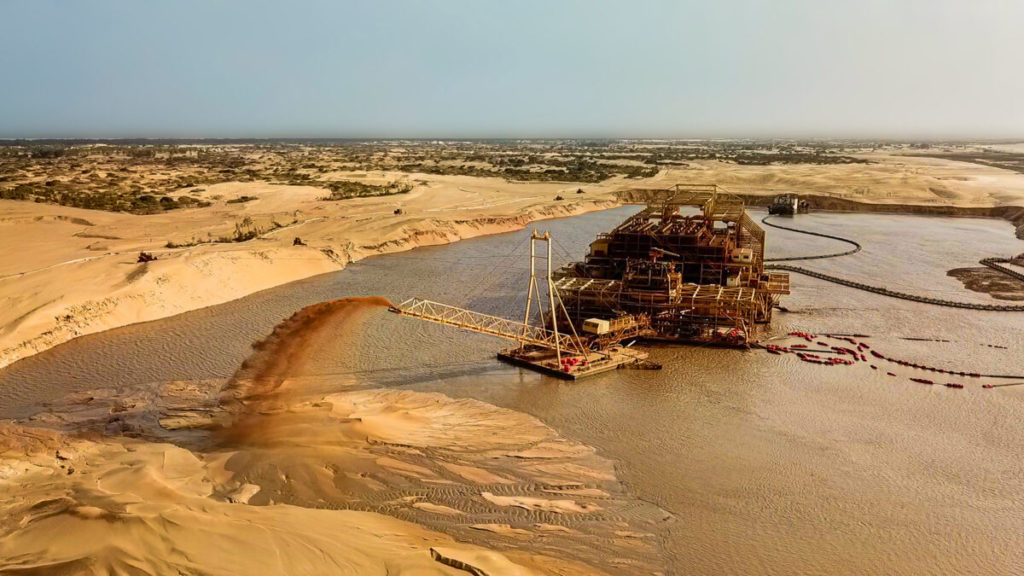
Eramet Grande Côte extracts sand from the dunes located along the Atlantic coast. Credit: Eramet

French mining and metallurgic group Eramet on Wednesday said it had partially restarted production of heavy mineral concentrate at its plant in Senegal, as it seeks to mitigate a hit to its revenue from a fire that occurred in February.

The company said the affected plant now operates at around one-third of its nominal capacity. It aims to return to full production level by the first quarter of 2027, following reconstruction of damaged facilities.

Having paused its original mineral sands production target, Eramet now sees an output of between 300,000 and 400,000 metric tons of heavy mineral concentrate in 2026, versus 900,000 tons before the fire.

The company’s shares fell around 1.5% in early trading, pushing their year-to-date losses to 5.3%.


(By Mateusz Rabiega; Editing by Milla Nissi-Prussak)

P3 PUBLIC PENSIONS FUND PRIVATIZATION

AustralianSuper says possible Glencore listing on ASX would be positive

Stock image.

Pension fund AustralianSuper on Wednesday said if Glencore decides to list shares on the Australian Securities Exchange, it would be “positive” for both the bourse and the Swiss-based commodities trader and miner.

“If they were to list here we think it would be positive for Glencore and for the Australian stock exchange,” AustralianSuper portfolio manager Luke Smith said at the Australian Financial Review mining summit in Perth.\

The move would suit Glencore because “we believe the Australian share market is the best and most informed mining share market in the world,” Smith said, which would offer its shares a better chance to reflect the company’s worth. He added the fund had discussed the topic with Glencore and a listing on the ASX would offer more choice to investors such as itself.

Glencore has said it is open to considering a secondary listing in Australia.

Glencore and Rio Tinto earlier this year explored a possible merger that would have forged a $240 billion company, but Rio walked away saying it could not see sufficient cost advantages. There is speculation that Glencore is still interested in a tie-up.

Some mining CEOs like Glencore CEO Gary Nagle have argued that the industry needs to grow in size to become more relevant and influential – and to attract interest from a wider audience.

Smith said AustralianSuper was cautious about mining companies getting bigger because even if a large company emerged, “it’s still not going to be anywhere near the major tech companies.”

“We always approach cautiously, M&A, and if we can see it’s going to create value, we’ll be open-minded about it,” he said.

BlackRock portfolio manager Olivia Markham earlier said that she saw merit in “sensible” M&A as a way for miners to grow and attract generalist investors to fund large and complex projects.

“Australian Super has got a bit of a track record of sometimes saying yes and sometimes saying no, but it’s all about not looking just to this transaction and instant gratification of maybe a share price rise of 20% or 30%,” Smith said.

“We’re always looking for three to five years. What is the company’s … intrinsic worth in three to five years’ time? And is this appropriate price being paid today?”

(By Helen Clark; Editing by Christian Schmollinger and Thomas Derpinghaus)


BlackRock sees merit in large-scale mining M&A

Credit: Rio Tinto

BlackRock would back consolidation among large miners because it would open the sector to generalist investors at a scale that would make it easier to bring on large and complex projects needed for new supply, a portfolio manager said on Wednesday.

The mining industry has an issue around scale, especially compared to other sectors such as technology, said Olivia Markham, speaking at the Australian Financial Review (AFR) conference in Perth.

“When you speak to a US generalist investor, they want large, liquid equities to invest in. Bigger companies have better access to capital, they typically trade at a better multiple, and I think within the context of the mining sector, bigger companies have also got the teams and the people to go and build all these complex projects,” she said.

“We’ve had a wave of M&A, but I see merit in more,” she said.

Among major miners, Glencore and Rio Tinto explored a possible merger earlier this year that would have forged a $240 billion company and tied together Glencore’s marketing business and copper assets with Rio Tinto’s operational expertise.

Rio Tinto walked away saying it could not see sufficient cost advantages for the deal. However, there is speculation that Glencore CEO Gary Nagle is still interested in in the Anglo-Australian miner and may look to reopen talks if the Swiss miner’s share price continues to outpace Rio’s.

BlackRock holds stakes in both miners, as well as top global miner BHP.

Demand accelerating

Major investments in supply are needed as commodity demand speeds up, underpinned by trends including electrification, AI and defence spending, Markham said.

“Commodity demand is simply accelerating, and the commodity intensity of GDP growth continues to go up, and when you look at every exciting theme that’s going on in the market… it all leads back to mining,” she said.

“At the same time, you’ve got a supply side that is massively underinvested, so there’s just no immediate supply response…. we’re going to have to keep having commodity prices move up to incentivize more and more supply to come on line,” she said.

Markham also said that the closure of the Strait of Hormuz was driving a push towards energy independence that would support alternative energy sources. “We are going to be thinking much more about uranium,” she added.

BlackRock’s exposure to Australia has declined across the past five years as it has looked to invest in jurisdictions that have greater copper exposure and as Australia becomes less cost competitive with other countries since Covid, she added.

(By Helen Clark and Melanie Burton; Editing by Stephen Coates and Lincoln Feast)


Defense Metals signs rare earth MOU with Hanwha

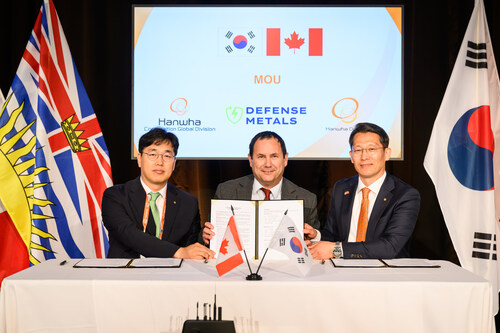
Jung Jae Hyo, VP Hanwha Corporation (left); Mark Tory, President and CEO Defense Metals (centre); and Jeong Sung Kyun, VP Hanwha Ocean Co. Ltd. (right) (CNW Group/Defense Metals Corp.)

Defense Metals (TSXV: DEFN) has signed a memorandum of understanding (MOU) with Hanwha Ocean, a South Korea-based shipbuilding and marine engineering company, to explore the supply of rare earth elements.

Under the MOU, which is non-binding, the companies will evaluate a potential agreement where Defense Metals would sell rare earth materials from its Wicheeda project in British Columbia to Hanwha, supporting the company’s manufacturing and supply chain.

Hanwha is also considering an investment in Defense Metals, subject to due diligence and further negotiation.

“This MOU is an important step in advancing a made-in-Canada critical minerals supply chain supporting strategically important defence and maritime industries,” Defense Metals CEO Mark Tory said in a news release.

“Rare earth elements are increasingly recognized as foundational materials for next-generation defence technologies and advanced manufacturing,” he added.

A spokesperson for Hanwha said the company is looking to strengthen its ties to Canada’s critical minerals sector as the federal government moves to modernize its naval fleet.

The agreement comes as Hanwha competes for Canada’s multibillion‑dollar submarine program and follows other Canadian partnerships, including MOUs with the Automotive Parts Manufacturers’ Association and Algoma Steel.

Quad partners unveil $20B critical minerals plan


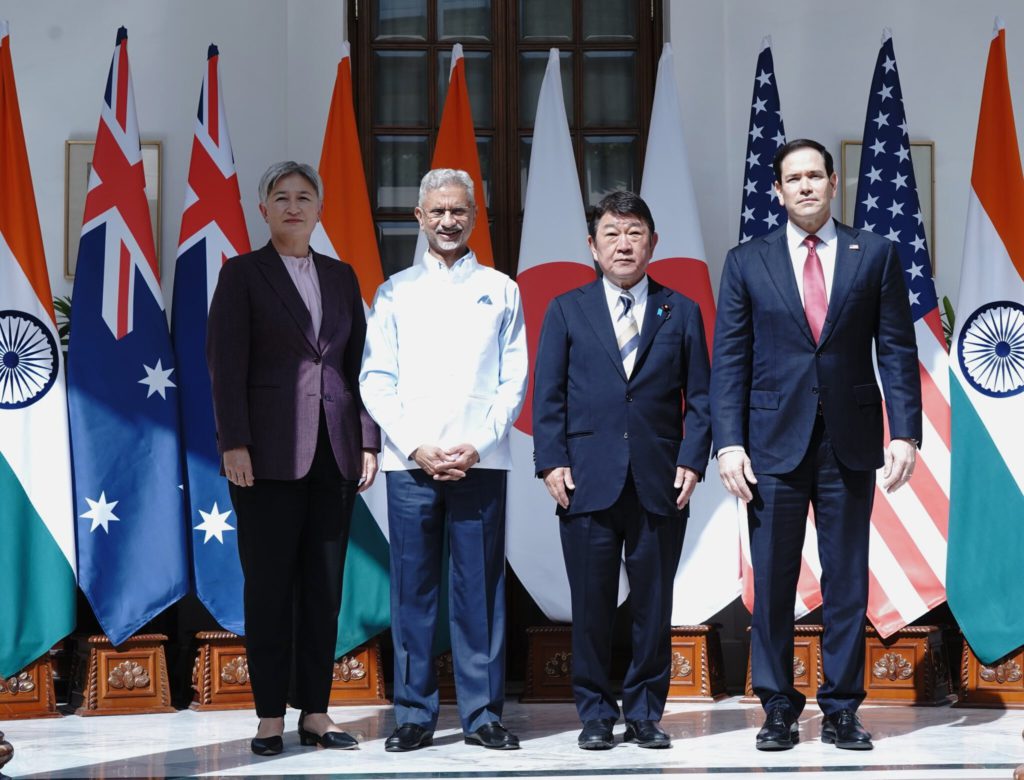
Foreign ministers at this week’s meeting in New Delhi. Credit: Dr. S. Jaishankar | X

The Quad partner nations — United States, Japan, Australia and India — unveiled plans to invest $20 billion to further support the buildout of a reliable critical minerals supply chain in an effort to counter China’s dominance.

The Quad Critical Minerals Initiative announced on Tuesday sets out the framework for the nations to work together through economic policy tools and coordinated investment to accelerate the development of a secure supply chain of minerals powering advanced technology, defense systems, batteries and AI.

To support this initiative, the Quad partners intend to mobilize $20 billion in government and private-sector funding of the entire critical minerals supply chain, which includes mining, processing and recycling, the US Department of State said in a statement.

This, the Department said, would entail identifying projects with a so-called “Quad nexus” — those located in partner countries, operated by companies headquartered in Quad partner countries, or supplying Quad markets — that could fill gaps in the critical minerals supply chain.

The funding would involve various mechanism such as export credit agencies, development finance institutions, mobilization of private capital, or other public supporting tools, including guarantees, loans, equity participation, insurance, subsidies and offtake agreements.

Under the initiative, the Quad nations would share information on good practices and technical approaches to permitting, licensing and regulatory processes, cooperate on technology development and capacity building related to geological mapping and resource assessment, and consider coordinated measures to address non-market policies and unfair trade practices.

On the recycling front, the partners will also work together to improve the recovery and use of critical minerals from e-waste and other scrap materials.

The announcement came on the back of a meeting in New Delhi between the nations’ foreign ministers. In addition to the critical minerals initiative, the Quad partners also entered an Indo-Pacific energy security pact aimed at strengthening regional fuel and energy supply chains. Earlier that day, US and India also signed a framework agreement on critical minerals.

A warning to critical minerals buyers: avoid butter mountains, aluminum floods


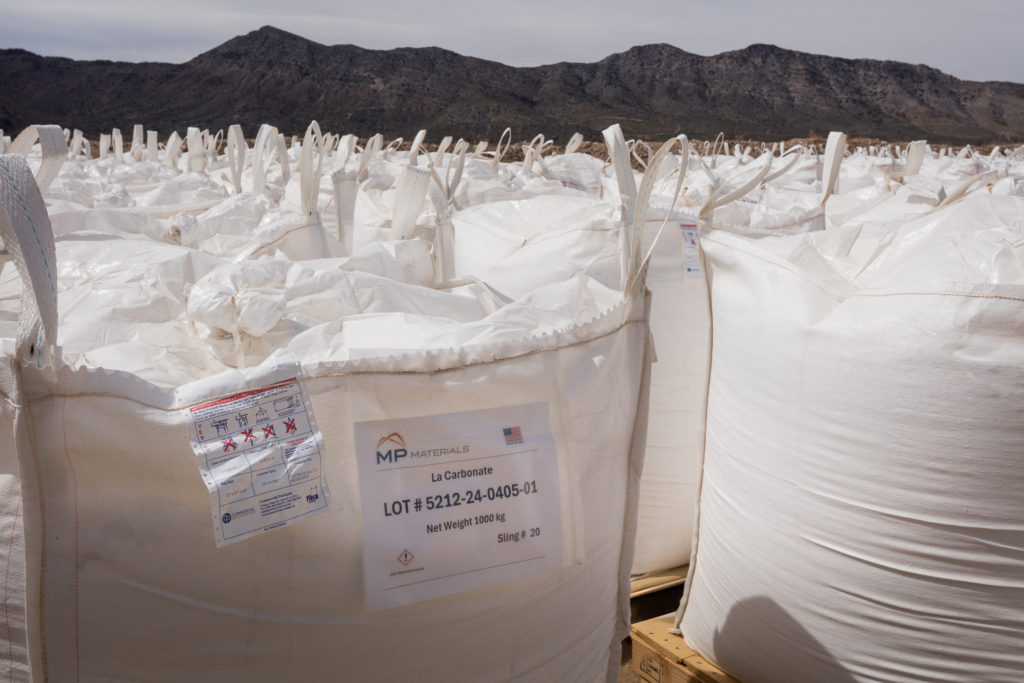
Individual slings of La Carbonate, a secondary product produced at MP Materials. Photo by Michael Tessler, MP Materials


Western governments, currently ploughing tens of billions of dollars into critical minerals in an effort to break their reliance on China, could look to history to see how well-intentioned efforts to prop up commodity sectors can backfire.

As efforts to ​build stockpiles and combat China’s dominance gather pace, a dozen industry executives, investors and analysts interviewed by Reuters pointed to the risk of a repeat glut scenario.

“There needs to ‌be some coordination between Western governments as they seek to incentivise new production,” said Brett Beatty, a partner at Resource Capital Funds, a mining-focused private equity firm that supplies the US government with niobium and tantalum via its holdings in Global Advanced Metals.

“The biggest risk is we all do our own thing,” Beatty added. “We all generate multiples of volumes the world needs and then you just crush everything, because you’ve got an oversupply.”

The US has allocated upwards of $20 billion to support its critical minerals ​sector across multiple programs and financing tools, including $10 billion for its stockpile, Project Vault. Australia has earmarked at least A$13 billion ($9.42 billion) to support critical minerals development across at least five programs including ​its own reserve.

Rare earths are a small piece of the $320 billion critical minerals market that the International Energy Agency expects to double by 2040. The rare earths ⁠sector that produces strong magnets used in defence technologies, advanced manufacturing and medical equipment was worth about $6.4 billion in 2024, according to IEA figures.

And yet the US, European Union, Australia and Japan have promised ​combined financial aid to rare earths projects globally that is already beyond that market value, Reuters calculations show.

Containing oversupply risks

In the 1980s and early 1990s, subsidies, cheap energy and price guarantees fuelled massive overproduction of European dairy – ​dubbed “butter mountains” – Russian aluminum “floods” and Australian wool, which flooded global markets, sent prices into a tailspin and spread pain far beyond national borders.

The wave of Western investment is already set to tip some rare earths, a group of 17 metallic elements, into surplus in the coming years, according to David Merriman of Project Blue, a consultancy. He added, however, that he did not expect large surpluses to develop because governments could temper support.

“Government-led stockpiles can stop purchasing, which can have a market-balancing impact ​and there is only limited capacity supported by price floors or guaranteed purchasing by governments at present,” he said.

For now, stockpiles do not present any risk of swamping markets, said Amanda Lacaze, the CEO of Lynas ​Rare Earths, the world’s top rare earths producer outside China, on May 6.

“I’m pretty alert to how much rare earths are sitting in stockpiles around the world right now and it’s not very much,” she said.

Australian Minister for Resources ‌Madeleine King told ⁠Reuters earlier this year that the country’s support for its stockpile was “very different from the wool situation.”

“This is about a targeted, project-based investment to make something work, for creating secure supply chains for Australian manufacturing, but also for our neighbours and like-minded partners,” she said.

Some global coordination is afoot. The Group of Seven countries are in talks to create a permanent secretariat to make sure plans to increase critical mineral supplies survive beyond their rotating presidencies, five sources familiar with the discussions said earlier this month.

The DRC and Indonesia

Government intervention has yielded notable success for some, including the Democratic Republic of Congo (DRC), which has stockpiled cobalt and set export quotas to boost ​its mining revenue.

In the near term, the policy lifted ​global prices, helping to fill government coffers, but ⁠prolonged restrictions risk accelerating the shift to substitutes as buyers seek more reliable supplies, said Geraud-Christian Neema, the Africa editor at the China Global South Project, a non-profit focused on Beijing’s role in emerging economies.

Authorities now face a difficult balance: easing quotas could trigger export surges from players like China’s CMOC and erase gains, ​while keeping them tight risks a long-term erosion in demand, he said.

The DRC followed a path forged by Indonesia, which in 2020 banned nickel ore exports ​to encourage in-country processing and ⁠increase revenue from its resources.

Within three years, production trebled and it entrenched its position as the world’s dominant producer. But it has since cracked down on mining quotas to stem overproduction and falling prices – and last week, it unveiled a plan to centralize control of commodity exports.

One way to lower the risk of oversupply would be to add processing capacity at existing operations so that target metals are produced as byproducts, rather than following price signals, said Huw ⁠McKay, a visiting ​fellow at The Australian National University who previously served as BHP’s chief economist.

That model is underway in Western Australia with Alcoa ​and Japan’s Sojitz, which includes backing from the Japanese, Australian and US governments. They are adding a plant to extract gallium at Alcoa’s alumina operations near Perth. Trafigura has moved to extract antimony from its Nyrstar lead smelter in South Australia.

Given the capex of large ​miners, McKay said Western government investments were “more like seed funding.”

($1 = 1.3795 Australian dollars)

(By Melanie Burton, Maxwell Adombila and Fransiska Nangoy; Editing by Veronica Brown, Praveen Menon and Thomas Derpinghaus)

MP Materials accuses USA Rare Earth of magnet tech theft


An aerial view of MP Materials’ Mountain Pass rare earths mine photographed in 2022. Credit: MP Materials.

MP Materials (NYSE: MP) has filed a lawsuit against USA Rare Earth (NASDAQ: USAR) alleging that its rare earth mining rival stole its proprietary magnet technology through an ex-employee, Bloomberg reported.

According to the lawsuit filed in a Texas court last Friday and seen by Bloomberg, MP said one of its former employees had shared “grain boundary diffusion” formulations with USAR, which later disclosed the information to a third-party technology company.

“USA Rare Earth has exhibited a pattern of recruiting employees from other companies and then using those employees to misappropriate trade secrets to accelerate USA Rare Earth’s own development,” MP alleged in the suit.

The Las Vegas, Nevada-based miner also claimed USAR had failed on multiple operational milestones and questioned the validity of the mineral resources being touted at the latter’s flagship Round Top deposit in Texas.

In an emailed response to MINING.COM, USAR said MP Materials’ complaint “has misrepresented our company, our culture, and our people,” adding that the company will defend against those accusations and respond “appropriately”.

Shares of USA Rare Earth fell over 3% during the early hours of trading, sending its market capitalization below $6 billion. MP Materials also fell 3%, trading at a market capitalization of $11.6 billion.

Key US rare earth players

MP — the only producer of rare earths in the US — has developed its own technology to turn the extracted minerals from its Mountain Pass mine in California into permanent magnets used in electric vehicles, defense systems and advanced electronics.

USAR is also looking to follow the same path by developing its Texas deposit, which it calls “the largest heavy rare earth deposit” in the US, and has already commissioned a magnet manufacturing facility in Stillwater, Oklahoma. It also has ambitions to expand abroad through building another plant in France and recently announced a $2.8 billion acquisition of Serra Verde Group, which owns Brazil’s only rare earth mine.

Both companies are seen as key players in the US government’s plans to establish a domestic rare earth supply chain to reduce its dependence on economic rival China. To facilitate this strategy, the Trump administration has made large financial commitments to both, including a $400 million equity investment in MP in July, followed up by a $1.6 billion agreement with USAR this year.

MP’s lawsuit places USAR under further scrutiny, as the latter’s deal with the White House had already received pushback from lawmakers, while the Serra Verde deal remains under review. USAR, however, has said it is not concerned by questions surrounding the government’s investment.

“At USA Rare Earth, we are focused on the real challenge: China’s dominance of the rare earth supply chain. The American people, our allies and investors are counting on us–all of us in this industry–to deliver a secure Western, rare earth value chain to protect our national and economic security,” USAR said in its statement to MINING.COM.

Ionic Rare Earths, AML ink MoU for US permanent magnet supply  


Stock image.

Ionic Rare Earths (ASX: IXR) has signed binding sales agreements with Florida-based Advanced Magnet Lab to supply magnet rare earth oxides, specifically neodymium/praseodymium oxide and dysprosium oxide, under AML’s recently awarded US Defense Logistics Agency (DLA) contract for domestically produced high-grade sintered NdFeB permanent magnets for defence applications.  

Both companies have signed a non-binding Memorandum of Understanding (MOU) for the collaboration on both the supply of magnet REOs and recycling of swarf and pre-consumer waste. 

The news is a step forward in IonicRE’s strategy to establish secure, sovereign, and sustainable rare earth supply chains across the US and Europe, while expanding the company’s global refining and magnet recycling footprint, it said. 

The partnership has the potential to support increasing requirements from the U.S. Department of War (DoW) linked to the ramp up of domestically manufactured military drone motors and other critical defence equipment requiring secure, traceable, and domestically sourced rare earth permanent magnets, amid increasing geopolitical instability, the companies said.  

Under the program, IonicRE will provide critical rare earth oxide feedstock to support AML’s PM-Wire manufacturing platform, designed to enable scalable, traceable, and high performance permanent magnet production in the United States.  

AML’s DLA-supported initiative includes alloy optimisation, advanced manufacturing development, and integrated supply chain collaboration across Western-aligned partners.  

“IonicRE’s patented, made-in-Belfast magnet recycling technology offers an innovative solution for the supply of magnet REOs, and working with several Western magnet manufacturers, and now AML, we are building an integrated, ex-China rare earth supply chain across the Western world and beyond,” IonicRE CEO Tim Harrison said in a news release. 

AML president Wade Senti added that the partnership will help ‘close the loop’ on supply for critical inputs to the US industrial base. 

Defence-driven demand powers surge in US listings by mining firms

The Pentagon, headquarters of the US Department of Defense. Credit: Wikipedia under public domain licence

There has been a surge in mining companies seeking US listings this year, but even more striking is the change in language as firms explicitly target defence-related demand for critical minerals.

At least 18 companies, mostly Canadian and Australian but ​also some US startups, have completed or are pursuing dual US listings this year, versus just three in 2025, according to exchange filings and company disclosures reviewed by Reuters.

They span ‌in value from about $25 million to $7.5 billion and mark a shift in how critical mineral producers seek access to capital markets as listings explicitly pitch for defence end-use applications.

Defence focus

This year’s transactions have brought producers of antimony, rare earths, tungsten and uranium to the NYSE and Nasdaq – all minerals designated strategic by the Pentagon and used in fighter jets, missiles and radar systems.

The firms are positioning themselves as suppliers of munitions, armour-piercing materials and of inputs for US weapons systems, ​their public filings show, departing from traditional mining IPO language focused on supply-demand fundamentals and long-term price cycles.

“Our goal is to cover direct defence demand for tungsten,” Guardian Metal Resources , CEO ​Oliver Friesen told Reuters, estimating US military annual demand at 2,000 to 3,000 metric tons.

Guardian aims to help the US rebuild its domestic tungsten supply ⁠chain, citing uses in armour-piercing ammunition. It has received $6.2 million from the Pentagon and has applied for additional funding from the US military that would be worth at least $100 million, Reuters reported in March.

United States ​Antimony secured a $245 million Defense Logistics Agency contract to supply antimony for the defence stockpile, where the metal is used in munitions and other military applications.

Rare earth developers are also emphasising defence uses. REalloy Inc ​said its project contains dysprosium and terbium used in magnets for advanced weapons systems, while Rare Earth Americas, backed by Australia’s Gina Rinehart, partly focused its IPO on “defence applications”.

Most companies have raised modest sums so far. Guardian secured $68.3 million, Rare Earth Americas $63.3 million, and Atlas Critical Minerals about $11 million, according to filings.

But several have secured government funding through Pentagon-linked programs, suggesting the listings are as much about unlocking strategic financing and investor access as upfront capital raising, analysts and lawyers said.

CompanyUS ListingPrevious / ​ConcurrentDate
Atlas Critical MineralsNasdaq: ATCXOTCQB (Jupiter Gold)Jan. 13
Blue Moon MetalsNasdaq: BMMTSXV, Frankfurt, OTCQXJan. 26
Santacruz SilverNasdaqTSX-VJan. 21
Mayfair GoldNYSE American/ NYSETSX-V → TSXJan. 27
Aris MiningNYSE: ARMNTSXFeb. 19
Versamet RoyaltiesNasdaqTSXV / private precursorMar. 6
Highlander SilverNYSE American: HSLVCSE / TSXVMar. 11
U.S. Antimony CorpNYSE (uplist)NYSE ​AmericanMar. 11
Guardian Metal ResourcesNYSE AmericanLSEMar. 20
OceanaGoldNYSE: OGCTSX, ASXApr. 7
The Metals RoyaltyNasdaq: TMCRTSX-VApr. 8
Nicola MiningNasdaq ADSs: NICMTSX-VApr. 13
Compiled by Clara Denina

Equity stakes, project funding

Some Canadian-listed miners, including Lithium Americas and Trilogy Metals, are tapping US defence-linked financing through equity ‌stakes and ⁠project funding as part of Washington’s push to secure key minerals.

That push follows a series of crises that left the United States and other Western nations racing to rebuild domestic mineral supply chains and reduce their dependence on China’s dominant production and processing.

China imposed export controls on antimony in August 2024, tightening global supply of a mineral used in military equipment and raising concerns about US defence supply chains.

By December 2025, the US military had begun testing small-scale refineries for critical minerals, shifting from funding projects to building processing capacity itself.

A 2025 Chinese export ban on tungsten has limited feedstock for US refineries built in ​the 1950s for filament light bulbs, which have production ​capacity of about 18,000 tons but are ⁠operating significantly below that, Guardian’s Friesen said.

In November 2025, China issued a one-year suspension of its export ban on antimony, gallium, germanium, and super-hard materials to the US, but kept restrictions on military users, easing commercial supply but leaving the Pentagon reliant on domestic sources.

In addition to China’s export curbs, Washington has faced restrictions on cobalt exports ​from the Democratic Republic of Congo and other risks.

CompanyUS Plan
Resolution MineralsNasdaq
Am. Rare EarthsNasdaq H2’26
Sunshine SilverNYSE (SSMR)
McEwen CopperIPO Q4’26
Jindalee / USENasdaq SPAC H2’26
Barrick / NA BarrickNYSE/TSX vehicle
Compiled by ​Clara Denina

Capital follows policy

Private capital ⁠has also responded. JPMorgan, for example, said in October it could invest up to $10 billion in sectors tied to national economic security, including critical minerals.

In February, US President Donald Trump launched “Project Vault”, a $12 billion strategic minerals stockpile initiative backed largely by the US Export-Import Bank.

The administration has also taken equity stakes in mining firms including MP Materials, USA Rare Earth and Korea Zinc.

Investors say US government equity offers more than capital, giving companies access ⁠to defence-linked contracts, ​subsidies and policy backing, and helping protect them from price cyclicality.

Still, caution remains.

“There’s absolutely a lot of money going into ​defence-driven exploration, but a lot of it is also very speculative right now,” said Rick Werner, co-chair of the capital markets and securities practice at law firm Haynes Boone.

“As long as you can gain access to the mines and the resources, I ​don’t see why they can’t break China’s chokehold over it,” Werner said, “but it’ll take time and money.”

($1 = 1.3754 Canadian dollars)

(By Clara Denina and Ernest Scheyder; Editing by Veronica Brown and Jason Neely)