Thursday, May 28, 2026

Artists pull out of Trump-backed concert for America’s 250th birthday

Artists pull out of Trump-backed concert for America’s 250th birthday
Copyright 250 Freedom Instagram - AP Photo - Canva

By David Mouriquand
Published on

While a cage fighting ring is being built on the White House lawn, a new event celebrating the 250 years of the USA is set to take place at the National Mall in Washington, D.C. The line-up has been called “a parody”, and some acts have already pulled out.

You may have heard that this year marks the United States of America’s 250th birthday, and Donald Trump is going all out when it comes to “250 Freedom” events.

Construction has begun on an Octagon-shaped cage on the White House south lawn, which is set to host a controversial UFC (Ultimate Fighting Championship).

The mixed martial arts extravaganza has already rubbed people up the wrong way, with many comparing it to the Hunger Games and highlighting that cage matches may not be the best way to spend money when Americans are struggling with healthcare cuts, soaring inflation, and rising fuel prices.

“Elect a clown, expect a circus,” as one X user put it.

Now, a new event has been announced: The Great American State Fair, which will take place from 25 June – 10 July at the National Mall in Washington, DC.

The musical line-up has been revealed and it’s... charitably, very 90s. Absolutely nothing wrong with that. We missthe decade and its music output. However, when you peruse the headliners, it's a different story. Less charitably, it’s a set of has-beens who rely on nostalgia tours.

The performers include Vanilla Ice, Martina McBride, C+C Music Factory, Young MC, Morris Day, Poison’s Bret Michaels, Flo Rida and Fab Morvan - the surviving member of the lip-syncing duo Milli Vanilli.

Girl, you know it’s true...

Less true is the announcement that Morris Day, best known as the lead singer of The Time (a group associated with Prince), will be performing.

Day took to Instagram, writing: “Contrary to rumor, Morris Day & The Time will not be performing at the ‘Great American State Fair.'” adding, “It’s A No For Me.”

Fair enough. We’re sure that Kid Rock will be very happy to step in as a replacement.

Young MC has also dropped out, after being included on the bill, posting: I HAVE INFORMED MY AGENTS THAT I WILL NOT BE PERFORMING AT THE FREEDOM 250 EVENT,” adding: “The artists were never told about any political involvement with the event.”

The line-up has been blasted online, with many referring to it as “a joke”, “pathetic” and “a parody”. One Instagram commenter stated: "Milli Vanilli?! Like the 80’s band that got caught not singing a single word of their own music? Fitting."

Elsewhere, the celebration will apparently “unite and showcase all 56 U.S. states and territories in a single World’s Fair-scale event”.

According to the website: “This is an opportunity for visitors from across America to experience an unforgettable celebration of the people and traditions that define our nation. Our nation unites diverse states and territories to form the strongest country in the world. This once-in-a-generation celebration will feature live music, carnival rides, and dozens of hands-on partner activations, where visitors can taste, touch, and experience what makes each state and territory unique.”

“Freedom 250” is funded through a public-private partnership with funding from Trump-aligned tech firms Palantir and Oracle and federal contractors Deloitte and Lockheed Martin, among others. It is facing growing scrutiny from watchdog groups and members of Congress over the use of federal dollars for Trump-aligned events.

Consumer advocacy group Public Citizen is calling for congressional investigations after The New York Times reported that donors to Freedom 250 were offered access to the president if they donated $1 million.

The Great American State Fair starts on 25 June.

Aid agency: Every fourth Ebola death in Congo is a child

28.05.2026, DPA


Photo: Kitsa Musayi/dpa


At least one in four confirmed Ebola deaths in the Democratic Republic of the Congo is a child, the aid agency Save the Children said on Wednesday.

Four of the 17 Ebola patients whose deaths have so far been confirmed in the central African country were children, a spokesman said in a statement.

The true number is likely to be significantly higher given there have been over 240 deaths in the current wave which are suspected to be due to Ebola. The lack of laboratory capacity in the particularly hard-hit Ituri region means confirming Ebola infections is proving difficult.

"I have responded to several Ebola outbreaks over the years, but this is the fastest spread I have ever seen," said Babou Rukengeza, head of Save the Children's Ebola emergency response in Congo.

Many countries have cut their aid funding and Rukengeza believes fatal consequences are being felt on the ground.

Rukengeza also said children in the region, which is affected by poverty, armed conflicts and malnutrition, are currently exposed to another risk - deaths from malaria are rising.

The first symptoms of the mosquito-borne disease, such as fever, aching limbs and malaise, resemble those of Ebola. But many people are avoiding health centres out of fear of infection.

Maintaining obstetric care in the midst of the Ebola outbreak is also challenging, experts say.

UN Women, which champions gender equality and female rights, recently pointed out that the share of women and girls among those affected in previous Ebola outbreaks had been disproportionately high.

WHO: Ebola Outbreak In DR Congo Collides With Conflict And Hunger


A health worker at an Ebola treatment centre in Beni, Democratic Republic of Congo (DRC), disinfecting a doctor after he had been contact with Ebola patients during an outbreak in 2019. A new outbreak in the DRC is raising international alarm.
 Copyright: Vincent Tremeau / World Bank (CC BY-NC-ND 2.0)

May 28, 2026 
UN News
By Vibhu Mishra

The UN World Health Organization (WHO) on Wednesday warned that eastern Democratic Republic of the Congo faces a “catastrophic collision of disease and conflict” as a fast-spreading Ebola outbreak outpaces containment efforts in a region already battered by armed violence, mass displacement and acute hunger.

WHO Director-General Tedros Adhanom Ghebreyesus said the Ebola Bundibugyo virus outbreak in Ituri province was spreading in an environment where insecurity, attacks on health facilities and population movements were making it “nearly impossible” to trace contacts and isolate cases.

“We cannot build community trust or isolate the sick while bombs are falling,” he said.

The Bundibugyo strain of Ebola, first identified in Uganda in 2007, has no approved vaccine or treatment.

DRC has reported nearly 1,000 suspected Ebola cases and more than 220 suspected deaths, according to figures from health agencies and partners, although only one death has been laboratory confirmed. In neighbouring Uganda, health authorities have reported seven confirmed cases linked to the outbreak, including two healthcare workers and one confirmed death.

Rapidly evolving outbreak

WHO warned that the outbreak was continuing to spread geographically, with evidence of ongoing cross-border transmission.

The outbreak is centred in Ituri province but has now spread across 11 health zones, with cases also reported in North Kivu – including in Butembo and Goma – and in South Kivu, according to the UN Children’s Fund (UNICEF).

Health officials say the virus is spreading through family clusters and health facilities, with infections linked to caregiving, family gatherings and unsafe funeral practices.

Conflict undermining response

Efforts to contain the outbreak are unfolding in one of the most volatile regions of eastern DRC, where humanitarian access has long been constrained by conflict involving multiple armed groups, including the Allied Democratic Forces (ADF), CODECO militias and the Rwanda-backed M23 armed group.

A December 2025 report by the UN peacekeeping mission MONUSCO documented persistent violence across Ituri and North Kivu, including attacks on villages, health facilities and displaced communities that killed hundreds of civilians and forced widespread displacement.

Active fighting and restrictions imposed by armed groups also hampered humanitarian operations, limited civilian movement and disrupted access to essential services.

Hunger and disease collide


The violence has compounded an already severe humanitarian crisis. According to the latest analysis by IPC – the UN-backed global food security monitor – nearly 10 million people across Ituri, North Kivu, South Kivu and Tanganyika are facing acute hunger between January and June 2026.

At the national level, an estimated 26.5 million people in DRC are experiencing high levels of acute food insecurity.

“Hunger and disease are old companions,” Tedros said. “People weakened by hunger are far more vulnerable to infections.”

Poor roads, damaged infrastructure


WHO said conflict, poor infrastructure and insecurity were limiting the movement of aid and access to health services.

“In many affected areas, health facilities are either non-functional or operating under severe constraints due to insecurity,” Tedros said. “Poor road conditions further restrict the movement of goods and humanitarian assistance.”

Children are also being heavily affected, not only through infection but through the disruption of health, nutrition and education services, UNICEF warned. It added that children affected by Ebola outbreaks often face the loss of parents and caregivers, while stigma and fear can leave them isolated within their communities.

Building trust

WHO is at the centre of a UN systemwide response, deploying emergency personnel, medical supplies and funding to help contain the outbreak.

The agency is also working with community leaders in Bunia to build trust and counter misinformation. It has developed public information messages and awareness materials adapted to local contexts and translated into local languages for wider reach.

“Community trust is the foundation of effective public health response,” said Julienne Ngoundoung Anoko, a WHO Community Engagement Officer deployed in Bunia. “Without community support, outbreak control measures cannot succeed.”
Calls for ceasefire

Tedros appealed for an immediate ceasefire to allow humanitarian and medical teams safe access to affected communities.

“Stopping this Ebola transmission depends entirely on humanitarian access,” he said.


International Rescue Committee warns Ebola outbreak could become 'deadliest on record'

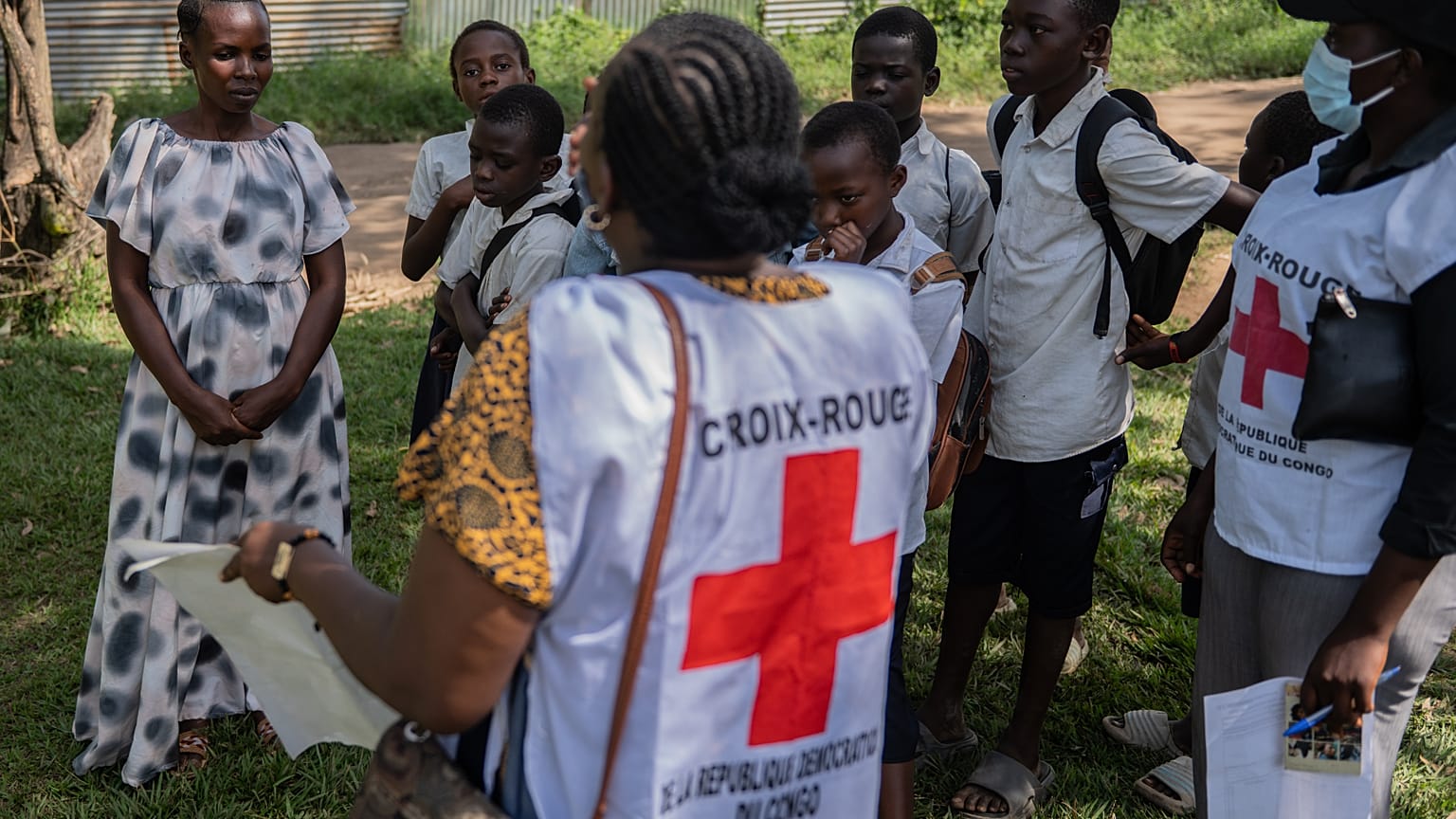
Vanny Birungi, a Red Cross volunteer, speaks to people during a house-to-house sensitisation campaign amid the Ebola outbreak in Bunia, Congo, Monday, May 25, 2026.
Copyright Copyright 2026 The Associated Press. All rights reserved


By Nathan Rennolds
Published on

The International Rescue Committee said the outbreak was spreading faster than response efforts in the Democratic Republic of the Congo.

The International Rescue Committee (IRC) has warned that the Ebola outbreak in the Democratic Republic of the Congo could become the "the deadliest outbreak on record" unless urgent international action is taken.

The World Health Organization said earlier this week that there were now more than 900 suspected cases of Ebola and 220 suspected deaths in the DRC. The outbreak has also spread to neighbouring Uganda, where there are seven confirmed cases, including one confirmed death.

The epidemic is being driven by the rare Bundibugyo virus, which has no proven vaccine, making efforts to contain the spread particularly difficult.

In a press release, the IRC, a New York-based humanitarian aid organisation founded in 1933, called for "urgent international funding and coordination" to tackle the outbreak, warning that regional conflict and aid cuts were impacting attempts to control it.

“The warning signs are flashing red,” Bob Kitchen, the IRC's vice president of Emergencies, said.

“Eastern DRC is confronting this outbreak more fragile and less prepared than during the 2018-2020 outbreak that killed more than 2,000 people- and with fewer resources to fight it," he continued. "Increased conflict and cuts to global aid funding have dismantled defenses at exactly the wrong moment. The lesson from every previous outbreak is clear: delays cost lives."

Last week, three volunteers working for the Red Cross in the DRC died from suspected cases of Ebola in Ituri Province, the epicentre of the Ebola outbreak in the country.

The Red Cross said that volunteers Alikana Udumusi Augustin, Sezabo Katanabo and Ajiko Chandiru Viviane were believed to have contracted the Ebola virus while managing dead bodies.

Ebola is a deadly illness first identified in 1976. Symptoms can include fever, weakness, diarrhoea, vomiting, and sometimes bleeding.


Three monkeys return after group of macaques escapes in Germany

28.05.2026, 

dpa 

Photo: Uwe Anspach/dpa


By Florentine Dame, dpa

Three monkeys have returned after a group of rhesus macaques escaped in the town of Witten in western Germany earlier on Thursday, according to police.

The highly intelligent but shy animals are presumed to have scraped mortar out of brick wall at an animal sanctuary, enabling them to break out, a police spokesman said. 

The broadcaster WDR reported that the group consisted of six so-called temple monkeys.

They had been housed in the sanctuary for animal welfare reasons. They are said to pose no danger to the public, so the local emergency services are not actively searching for them.

Three monkeys had returned on their own by Thursday afternoon, a police spokesman said, citing the sanctuary.

The fate of the other fugitives remains unclear.

"Anyone who sees a monkey in their garden can, however, contact the police or the fire brigade," said the police spokesman. Details will be passed on to the those responsible, who will ensure the animals are caught, he said.

Ousted BP head says he called out ‘excessive’ spending like limousines

28.05.2026, DPA


Photo: Ian West/PA Wire/dpa


The ousted chairman of BP has rejected “lies” about his conduct and said his views on cost-cutting and calling out “excessive expenditure” on things like a limousine or private flight were not shared by others at the firm.

Albert Manifold issued a statement in response to reports about his conduct after BP’s board removed him with immediate effect on Tuesday.

The board had cited “serious concerns” related to this conduct, oversight and governance at the oil giant.

Media reports following the move cited sources close to the company who said Manifold had engaged in bullying and aggressive behaviour towards other staff.

Manifold said he accepts the board’s decision to remove him, but added: “What I do not accept is that lies can be told about me, nor that anyone should be allowed to hide behind anonymity when commenting on my time at BP.”

Responding to the reports, he said: "Is it possible that in my determination to drive change on costs, performance, the balance sheet and shareholder communications, I pushed hard and challenged people directly? Yes, it is.

"But there is a considerable distance between driving an organisation with urgency and the characterisation of my conduct that is now being put about.

"At no point in my tenure as chairman of BP has anyone raised with me any issue about my conduct or my relationship with my colleagues."

Manifold, who had joined BP last October as it sought to drive an improvement in its performance, said he felt his priorities as the company’s chairman, particularly regarding shareholder interests, differed to others within the group.

This involved driving significant cost-cutting across the business, including “laying off thousands of people,” he said.

Manifold said he wanted to “set an example” at a time of cutbacks and that included calling out “unnecessary or excessive expenditure.”

“I had no interest in having a dedicated chauffeur-driven limousine at my beck and call on the occasions that I was in London,” he insisted.

“I had no interest in taking private aviation nor in availing myself of corporate tickets for sports events.

“I made my own coffee, bought my lunch in the local café. I sat in a small office, eschewing the grand corner-office privilege of previous chairmen.”

BP’s board has appointed Ian Tyler as interim chairman and launched a search process for a permanent replacement.

Amanda Blanc, senior independent director at BP, said on Tuesday: “Albert has helped bring a welcome focus and pace to BP’s transformation.

“However, the board has been surprised and disappointed to learn of governance oversight and conduct issues it deems unacceptable and has taken decisive action.”

Manifold’s removal came a month after almost a fifth of BP shareholder votes were cast against his election.

Shareholder advisory group Glass Lewis had called for investors to vote against him because of concerns over governance.

Russia's "Syria Express" Convoys May Be Combining Multiple AIS Tricks

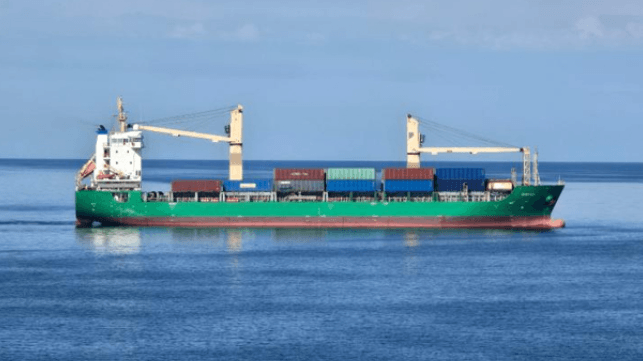
The notorious sanctioned cargo ship Sparta IV (VesselFinder)

Published May 27, 2026 8:58 PM by Peter Boerstling, Giangiuseppe Pili and Gary C. Kessler


After withdrawing significant military assets from Syria after the fall of Bashar al-Assad at the end of 2024, Russia appears interested in reestablishing its historical foothold in the port of Tartus. Here is a recent case study illustrating how Russia is using sanctioned commercial vessels to deliver military matériel to the port, and how Automatic Identification System (AIS) manipulation is used in an attempt to conceal the activity.

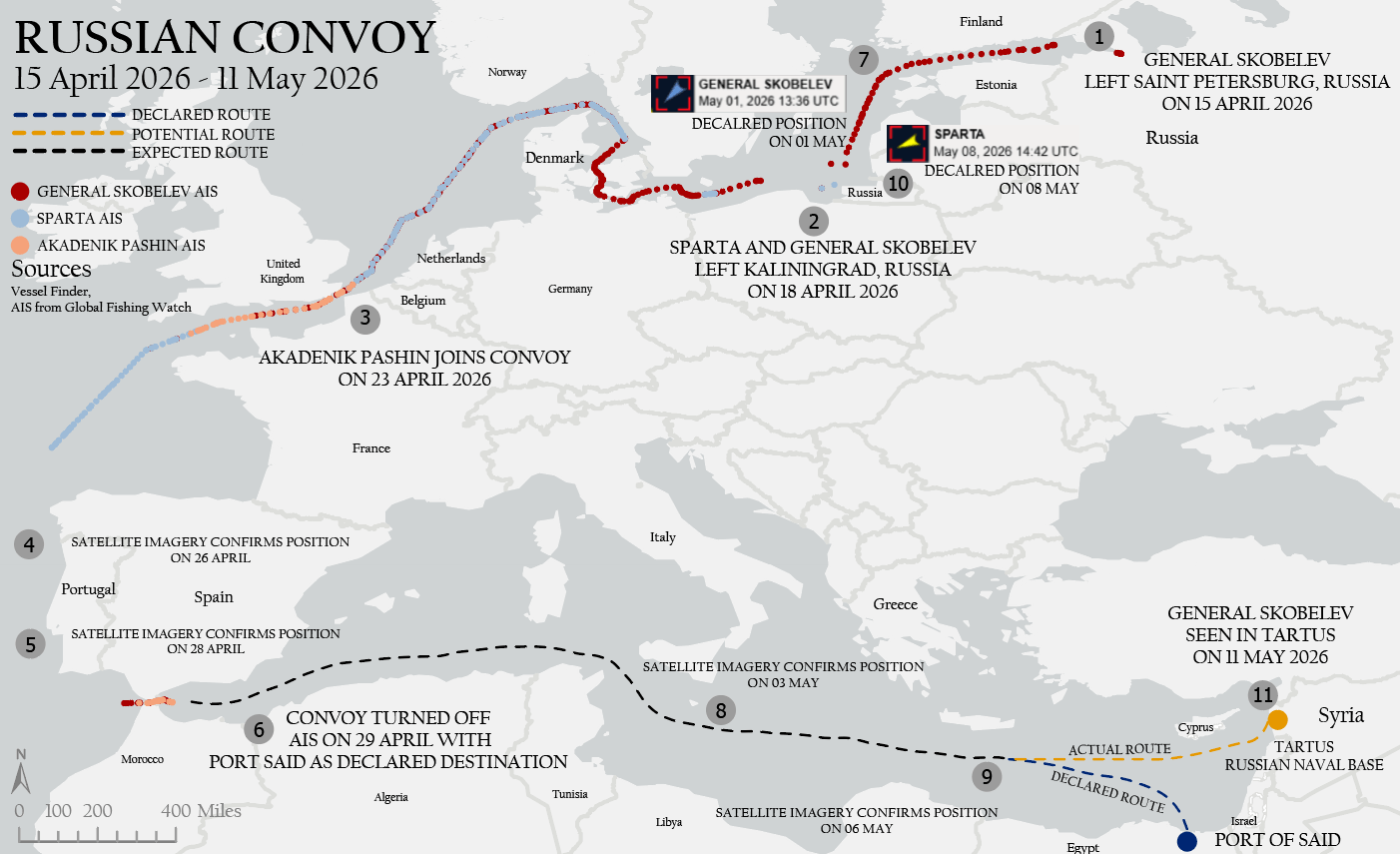
Two sanctioned Russian vessels and a naval replenishment oiler set sail from Baltic ports in April 2026, bound for Tartus, Syria. The sanctioned Russian-flagged oil products tanker General Skobelev (IMO 9503304), sanctioned cargo vessel Sparta (IMO 9268710), and replenishment oiler Akademik Pashin (IMO 9778193) departed from Saint Petersburg, Kaliningrad, and Murmansk, respectively, on April  15, 18, and 23. They were under the escort of the Gorshkov-class frigate Admiral Kasatonov, declaring Port Said, Egypt as their destination. After having likely turned off their AIS transponders, the vessels were later spotted in Tartus, Syria on May 11, possibly completing the first delivery to the base since Sparta IV (IMO 9743033) was reported in Tartus in May 2025.

On April 15, General Skobelev departed Saint Petersburg, Russia, sailing south to Kaliningrad, where it joined with the Sparta - one of the sanctioned Oboronlogistics-operated vessels. NATO navies began monitoring the convoy as it transited the Baltic Sea. The convoy was then followed in the English Channel by the Dutch Navy's DSS Galatea and the UK Royal Navy’s RFA Tideforce to monitor the convoy's movements.

Meanwhile, the Russian replenishment oil tanker Akademik Pashin transited south from the North Sea, joining the convoy as it passed Dover Strait on 23 April. The same day, the Russian Gorshkov-class frigate Admiral Kasatonov took over as the primary escort through the Channel.

Figure 1: Russian convoy to Tartus, April 15 to May 11

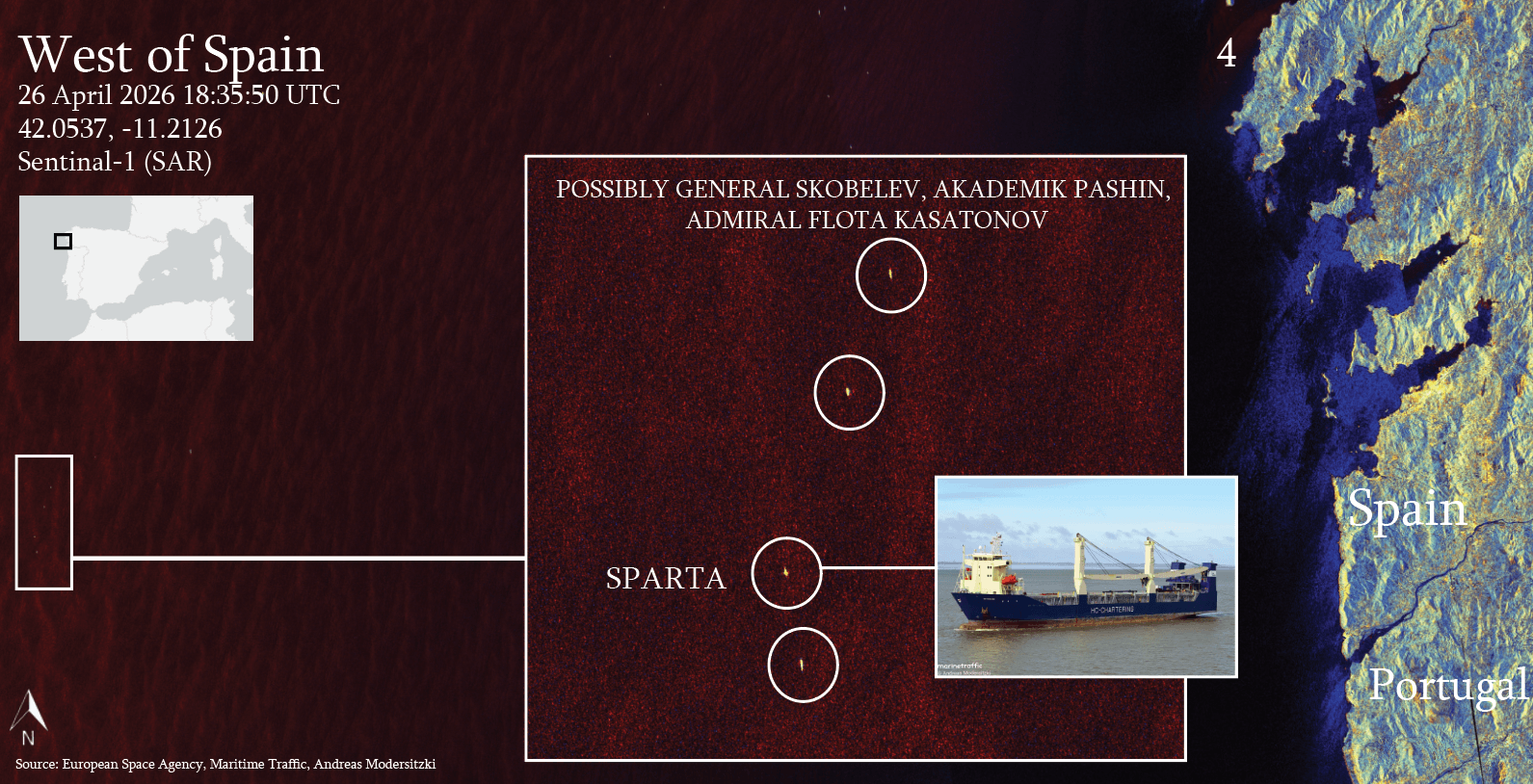
Satellite imagery acquired west of Portugal on 26 April confirmed the convoy's position in the Atlantic, possibly capturing General Skobelev, Sparta, Akademik Pashin, and Admiral Kasatonov still sailing together in close formation. After passing the English Channel, General Skobelev and Akademik Pashin likely turned off their AIS on April 24. Sparta’s AIS signals appeared until April 26 before possibly going dark.

Figure 2: Sparta and the convoy

As the convoy went through the Strait of Gibraltar, they briefly reappeared on AIS trackers. Once through the strait, both vessels possibly went dark again.

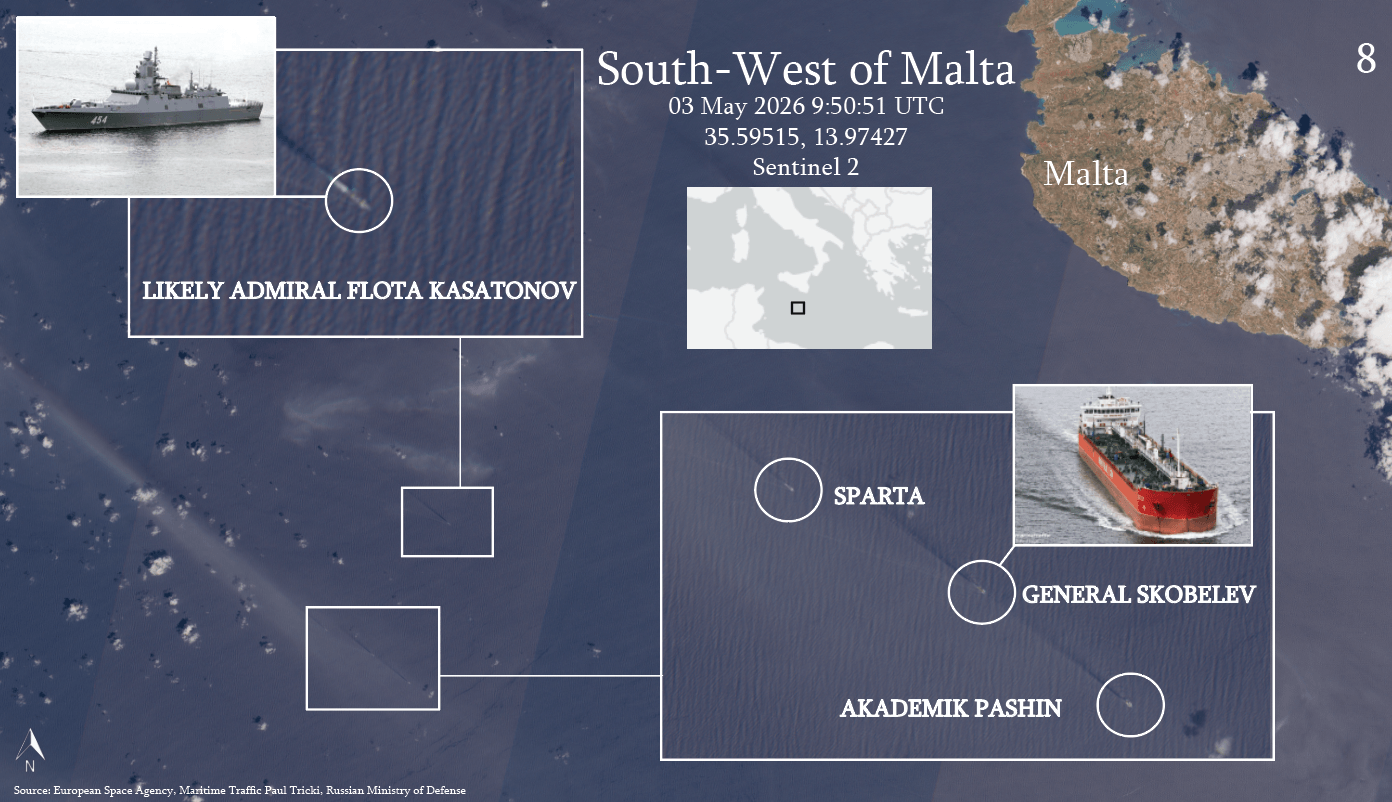
 In addition, on May 1 at 13:36 UTC, General Skobelev's AIS appears to have been spoofed, showing its position near Estonia. Similarly, on May 8, Sparta’s AIS signal showed it in Kaliningrad while broadcasting a speed of 49.8 knots, far beyond the capability of a vessel of its size. Two days later, satellite imagery captured all four vessels southwest of Malta in international waters, heading east into the Mediterranean.  

Figure 3: The convoy near Malta in international waters

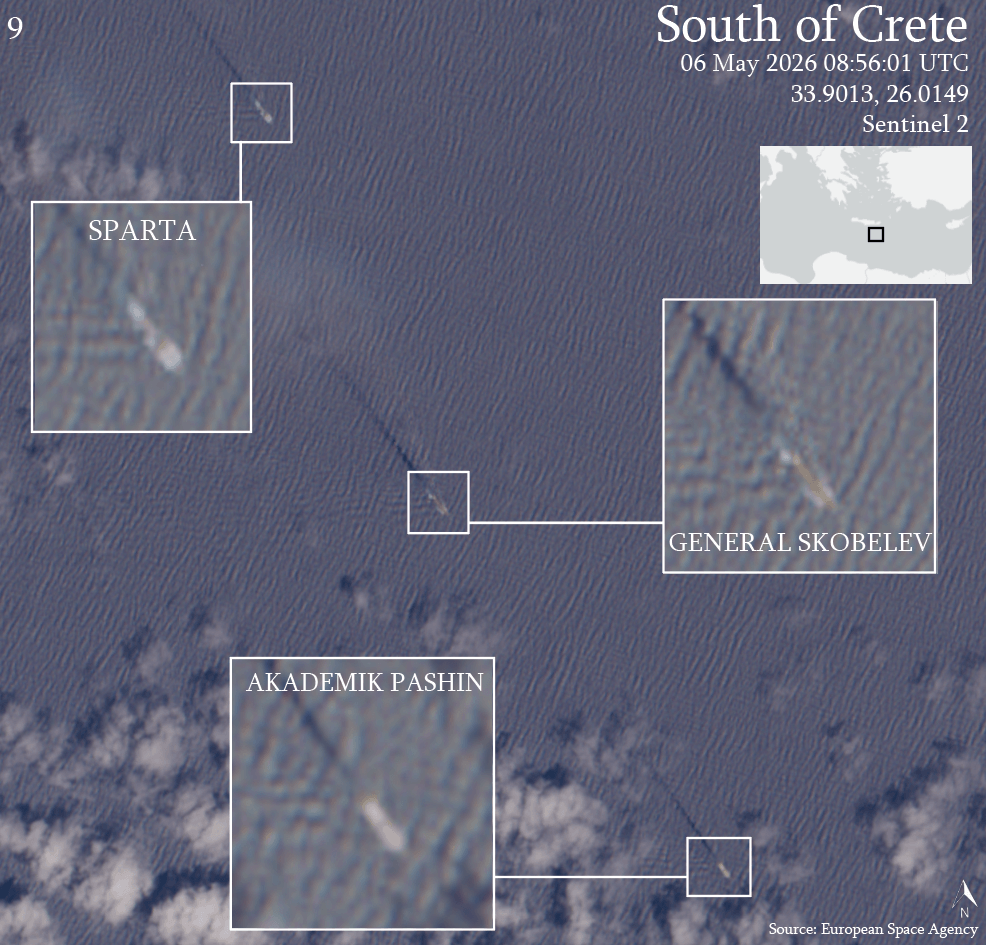
Figure 4: The convoy near Crete in international waters

Satellite imagery shows the movements of the convoy on the south coast of Crete, Greece, as well as the Admiral Kasatonov likely operating north of Tartus, confirming the convoy was approaching its true destination (Figure 4) and not Port Said.  

The first confirmed imagery of the convoy at Tartus was acquired on May 11. Images from May 13 appear to confirm Sparta, General Skobelev, Akademik Pashin, the Russian Navy Altay-class oil tanker Yelnya, and the bulk carrier Akson Serin all at berth. The exact cargo is unknown, though Sparta has historically functioned as a core asset for moving military logistics assets.

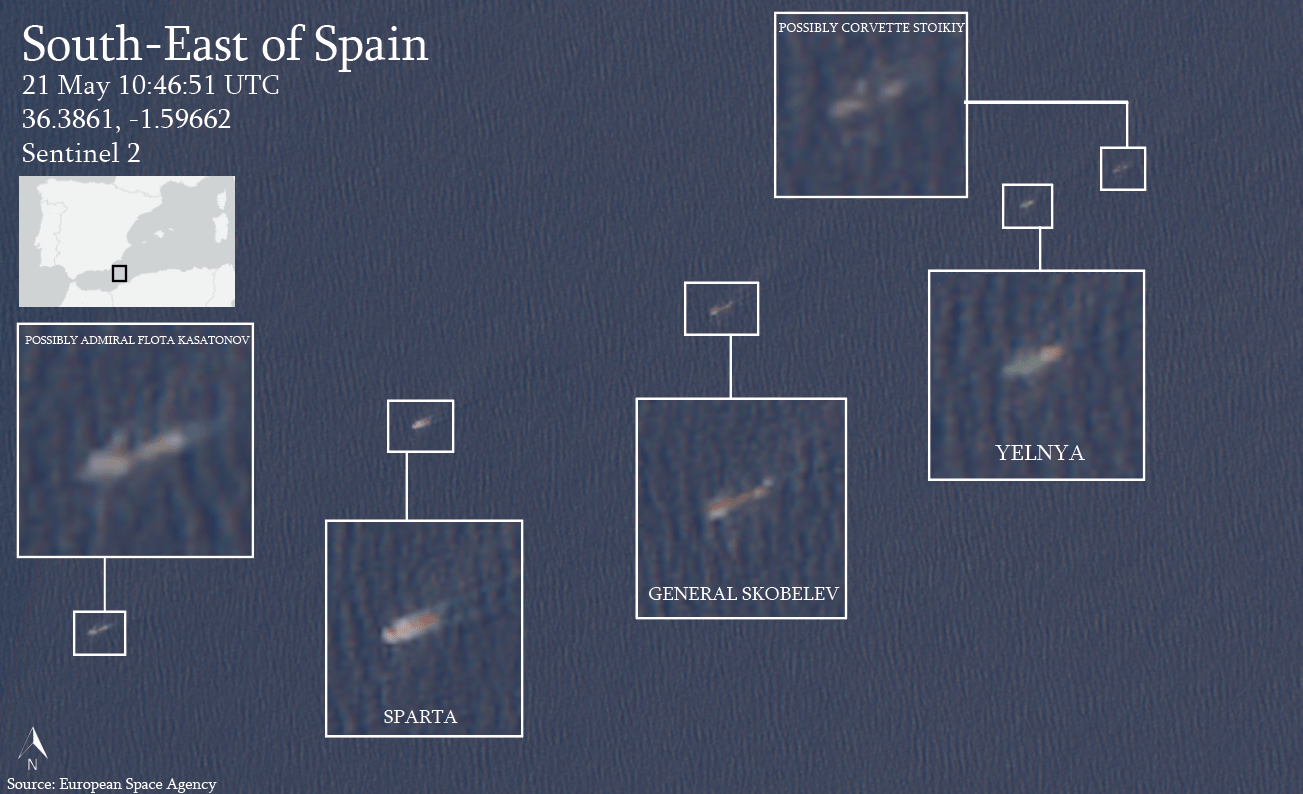
After eleven days, satellite imagery acquired southeast of Spain pictured the Sparta, General Skobelev, Yelnya, and corvette Stoikiy sailing together on the return voyage  westbound, with a fifth vessel, potentially identified as Admiral Kasatonov, also present.

Figure 5: The Convoy Returning

On May 22, Sparta reappeared on AIS at 05:29 UTC and General Skobelev at 05:30 UTC, transiting the Strait of Gibraltar westbound and escorted by corvette Stoikiy and tanker Yelnya. Once through the strait, Sparta kept its AIS on while General Skobelev deactivated again, with Sparta heading to Kaliningrad and General Skobelev to Saint Petersburg - both returning to their ports of origin.

New Ships and Changing Tactics in the Mediterranean

The convoy likely used established evasion tactics including AIS darkness, possible AIS spoofing, and partial change of route. Although these are all well-known individual ruses, they have not been seen together in a single transit by the ships related to the ‘Syrian Express’, which so far have limited themselves to AIS darkness when close to Tartus. This time, instead, the possible deceptive tactics are significantly increased in sophistication. Moreover, the composition of the convoy changed to include the frigate Admiral Kasatonov. Interestingly, these are naval vessels far below the military capacity of the most recent Russian Mediterranean Squadron, already deliberately kept minimal.

Peter Boerstling studies at James Madison University, Intelligence Analysis Program, School of Integrated Sciences.

Giangiuseppe Pili (PhD) is an Assistant Professor, James Madison University; Senior Associate Fellow, NATO Defence College; Associate Fellow, Royal United Services Institute; and Regional Director, International Association for Intelligence Education.

Gary C. Kessler, Ph.D., is president of Gary Kessler Associates, providing maritime cybersecurity education, research, and consulting, and co-author of Maritime Cybersecurity: A Guide for Leaders and Managers, 2/e. He is also a retired professor of cybersecurity and on the advisory boards of Cydome and the CyberBoat Challenge.

Top image courtesy VesselFinder.

Witnesses accuse the Israeli army of arbitrary arrests in Syria

The Israeli army has arrested at least 197 men in southern Syria since late 2024. A lawyer confirmed that 43 of them are still being held in what he says is arbitrary detention in Israeli prisons. The Israeli army, for its part, says they are targeting “suspected terrorists”.


Issued on: 27/05/2026
The FRANCE 24 Observers/
Ahmed ALMASSALMAH

These three photos show Israeli soldiers carrying out patrols and manning checkpoints in Quneitra province in southern Syria. © Observers

The place is Beit Jinn, in the countryside to the west of Damascus. It’s the night of November 28, 2025. Israeli soldiers launch a ground offensive. While bombs fall from the sky and artillery is fired at homes, clashes break out between Israeli soldiers and some villagers. A video posted online by the Israeli army shows soldiers arresting brothers Nidal Akasha Akasha and Muhammad Akasha Akasha in the fray. In a statement, the Israeli army claims that Nidal and Muhammad have ties to the Islamist group Al-Jamaa al-Islamiya.

The FRANCE 24 Observers team interviewed a number of Syrians who had been arrested and then detained in an Israeli prison for months before being released. We also spoke to the families of those still detained. We also analysed rare images posted online by the Israeli army, which claims that they have been arresting “suspicious persons” or those “linked to armed groups”. Through our research, we identified three different arrest operations carried out by the Israeli army in 2025.

A total of 13 villagers died, and more than 25 were wounded in the attack on Beit Jinn, according to medical sources. For its part, the Israeli army claims to have "eliminated several terrorists". Six Israeli soldiers were wounded, three seriously.

This is a screenshot taken from a video shared by the Israeli army showing the arrest of two brothers, Nidal Akasha Akasha and Muhammad Akasha Akasha, on November 28, 2025, in the Syrian village of Beit Jinn, located in the countryside to the west of Damascus. The Israeli army said these two men had links with the Islamist group Al-Jamaa al-Islamiya. © Israeli army

‘My father has no links to an armed group’

Alia (not her real name) is the daughter of one of the men arrested during the raid on November 28, 2025. She told us her version of events:

"That night, around 3:30am, we heard someone trying to force open the door. My father got closer to see what was happening, but the Israeli soldiers were already there. They immediately pinned him to the ground. Then, they went upstairs and arrested my uncle. They gathered all of us in the courtyard, including my mother and I, and they pointed their weapons at us. They forced us to our knees.

My father is 52 years old, he’s a farmer. We lived in Lebanon for 12 years when we fled the war in Syria. We’ve only been back for a year. He has no links with any armed groups. That night, they searched everything, broke things, destroyed a door.

Since then, we’ve had almost no information. After several months, an organisation told us that they were being held in Israel, one of them in the Sde Teiman prison, the other in Nafha prison. But other than that, we don’t have any information."

It is not possible for our team to independently verify that the two men who were arrested don’t have any links to armed groups. According to the Israeli army, their brother was part of the group Al-Jamaa al-Islamiya. He was killed during a drone strike, likely carried out by Israel, on September 21, 2023, in Beit Jinn. Al-Jamaa al-Islamiya is a Sunni Islamist organisation with close links to the Muslim Brotherhood. The group, mainly based in Lebanon, blends political, religious and social activities, supports the Palestinian cause and has intermittent links with Hamas. Al-Jamaa al-Islamiya, for its part, denies any link to the activities carried out in Beit Jinn.

The Israeli army did not respond when we asked what charges the brothers were facing. They did not respond to our questions about the charges faced by any person mentioned in this article.
This image was taken from a video posted online by the Israeli army showing the arrest of Nidal Akasha Akasha the night of November 28, 2025, in Beit Jinn, a village located in the countryside to the west of Damascus. © Israeli army


Since the beginning of its operations in Syria in December 2024, Israel has maintained that it is arresting people with links to armed groups.

When we spoke to other families across southern Syria, they described similar scenes to Beit Jinn: arrests carried out in the middle of the night, homes raided and family members threatened or immobilised. And, according to family members and other witnesses, the arrest of people who were not taking part in activities hostile to Israel.


At left, Hiyam, who lives in Ghadir al-Bustan in southern Syria, shows her right arm, which she said was bitten by a dog when Israeli soldiers raided her home. The image at right is a photo taken by the UN mission that went to her home the next day and documented the events. © Facebook

‘The dogs attacked me’

Israeli soldiers raided the home of a woman named Hiyam on February 16 in the village of Ghadir al-Bustan. Hiyam said she was attacked by the soldiers’ dogs and her two sons were arrested:

“It was February 16, 2026, in the village of Ghadir al-Bustan. It was 2:10 in the morning. We were sleeping when they burst into the home. The dogs immediately attacked me. They bit my face and hands. You can still see the marks now.

They took my sons while I was injured. My oldest son, Hamza al-Aryan, is 19. They stripped him and threw him on the ground and a dog was on him. He was screaming for them to get the dog off him. My other son was tied up in another room.

They shut me and my 13-year-old daughter in a room and wouldn’t let us out. They didn’t even treat my wounds. They searched the whole home, broke down the doors, destroyed our belongings. There were perhaps around 50 soldiers and cars parked out in the street. People later told us that there were even drones flying overhead.

I haven’t had any news of my sons since that day. It’s been more than a month. They are students, one of them was studying for his final high school exams. Their father died 10 years ago. They are all I have left. I don’t understand why they took them.

All I want is for them to come back. Nothing else is important.”

Our team spoke to a spokesperson for the United Nations Disengagement Observer Force (FNUOD), the force tasked with maintaining the ceasefire between Israel and Syria in the Golan Heights buffer zone since 1973. She said that when she was alerted by locals, she went to the village "to meet the mukhtar (village leader) and the residents of the home [that had been raided]”. She added that they provided first aid to the residents of the home, who “had injuries on their arms and faces”.

The Israeli army has published photos and videos of police dogs accompanying soldiers during a number of raids carried out in Syria.

The image at left shows a police dog during a raid carried out in September 2025 in southern Syria, according to the Israeli army. The image at right shows a police dog accompanying Israeli soldiers during a raid carried out in southern Syria in July 2025, according to the Israeli army. © Israeli army

The Israeli army installs 10 bases

The Israeli army’s operations are taking place against a specific security backdrop. After the fall of longtime Syrian president Bashar al-Assad’s regime in December 2024, Israel announced the collapse of the 1974 disengagement agreement, which established the buffer zone between the Israeli-occupied Golan Heights and Syria. Since then, the Israeli army has deployed troops in the buffer zone and made an increasing number of incursions into Syrian territory, setting up at least 10 military bases – six in the buffer zone and four on Syrian soil.

The Israeli army has established at least 10 military bases in Syria since the fall of Bashar al-Assad’s regime in December 2024. The largest of the bases is in Jubata Al-Khashab. © FMM graphics studio


We spoke to six men who were arrested and detained by the Israeli army. They said they were initially held in one of the new Israeli military bases built on Syrian soil in the villages of Jubata Al-Khashab, Tel Ahmar or Sirriyeh al-Jazira. Some were held for just a few hours before being released, while others were held for days. Some of them were transferred to Israeli prisons before being released.
The prison central to many of the accounts

We also spoke to seven people who live in the region. One of them, who hails from Kodna, a village near Quneitra, said that he has been arrested three times by the Israeli army, most recently in late April 2026, when he was held for 24 hours. The six others all said that they were taken to Sde Teiman, a prison in the Negev desert in southern Israel, and held there for periods ranging from two to six months. In July 2024, footage circulated showing Palestinian prisoners being mistreated in Sde Teiman, which is located on an Israeli military base nearly 200 kilometres from the Syrian border. Based on our interviews, there are at least 35 Syrians currently being held in this centre.

Abu Kinan al-Sayed, a former detainee, told us his story:


"I was arrested along with my son, my brother and my nephew at my farm in Jubata Al-Khashab, in the Quneitra region.

Right from the start, they take away your humanity. You no longer have a name, just a number. I was held in solitary confinement at Sde Teiman for around 55 days, while they were interrogating me.

They separate the Syrians and the Palestinians right from the start. After a week, they transferred us into group cells, each containing about 15 people. Everyone in my cell was Syrian, though we came from different regions: Ghouta, Beit Jinn, Quneitra and Deraa.

Life in detention was an endless stream of humiliation. They forced us to sleep on our stomachs on the concrete floor, sometimes for an hour at a time, in the middle of the night or during the day. They would enter at 3am or 8pm and set off stun grenades. They would force us to remain on our knees, our heads on the ground, immobile, while they were aiming guns with lasers at us.

I was finally released on January 19, 2026, after 65 days. But I left behind people who had been held there for more than a year. These were civilians, people with families.

During one of the interrogations in Sde Teman, I asked the interrogator why I was there, and they said that they had received information that I had links to Hezbollah and that I was running groups that threatened the security of Israel.”

The Israel Defence Forces (IDF) told our team that "any harm to detainees, whether during their arrest or interrogation, constitutes a violation of the law and IDF regulations and is therefore strictly prohibited".

FNUOD reported that locals regularly contact them about these nighttime operations and arrests, though the UN has not directly observed one take place.
Increasing numbers of arrests and accusations of torture

Lawyer Ahmad al-Moussa, who is based in Germany and working on behalf of a number of these families, says that the number of Syrians detained in Israel has drastically increased since December 2024.


"Before December 2024, there were just four Syrians detained in Israel. At the beginning of May 2026, there were 39, four of whom were minors when they were arrested.

We have contacted a number of international bodies, including the UN Human Rights Council and the UN Committee on Enforced Disappearances, to denounce the arbitrary arrests, conditions in detention and the acts of torture that these detainees have endured. But we are still waiting for a response.

The people we spoke to said that both physical torture and forced confessions were taking place.

Some had already spent five or six years in prison and were only released when the Syrian regime fell. Then, less than a month later, they were arrested by Israel.”

According to the Sijil Centre, a group that works to document the Israeli army’s activities in Syria, at least 197 people have been arrested in less than a year and a half. While most were released after a few days, the centre reported that 43 people are still being held in Israeli prisons, most often in Ofer, Nafha or Sde Teiman.

When questioned by the FRANCE 24 Observers team, the Israeli army responded: “The Israel Defence Forces have apprehended individuals where there was reasonable suspicion of their involvement in terrorist activity against the State of Israel, including activity carried out by Iran and terrorist organisations such as Hezbollah and Hamas operating in Syria. In appropriate cases, continued detention is carried out for preventive security purposes, in accordance with Israeli law and the applicable rules of international law."
Minors amongst the detained

Saddam was arrested on April 25, 2024, when he was just 17 years old. Hassan Ahmad is his father:


"My son was on our farm, like all the other days. But then, soldiers arrived and arrested him. I saw it happen: they blindfolded him and took him by force.

They called me from his phone to ask me to turn myself in and, in exchange, he would be released. I refused because I was afraid. Since then, I’ve only had one visit from the International Committee of the Red Cross. It’s been nearly two years, and I still don’t know where he is or what state he is in.

Saddam is innocent. He was 17 when he was arrested. What could a minor of that age do, other than study and play with his friends?"
At left is Saddam’s identity card, which says he was born in 2007, meaning that he was a minor when he was arrested. At right is a permit for Saddam to enter into the buffer zone in the Golan Heights, where he was arrested on April 25, 2024. Saddam’s father provided us with these documents. © Observers

This is a screengrab taken from a video shared with us by Saddam’s father. The video, filmed by friends, shows when the Israeli army arrested Saddam on April 25, 2024. Saddam was blindfolded with a white bandage. © Observers


Siraj, a group of Syrian investigative journalists, published an investigation in August 2025 that mentions Saddam’s arrest and identifies where the video was filmed.
An ill man detained

According to the Israeli army, forces from the "Alexandroni" brigade, led by the 210th division, carried out a night raid on June 12, 2025, to arrest members of Hamas who were active in the region of Beit Jinn in Syria.

Mohammed Hamada was one of the people arrested during this operation. We contacted his wife, who said that her husband is a farmer who underwent back surgery on November 16, 2024, at the Damascus University Hospital. She showed us a medical report indicating that he was experiencing serious health problems and that the operation led to partial paralysis. She says that a humanitarian organisation in the West Bank informed her several days ago that her husband is being held in Nafha Prison in Jerusalem. She is worried that his health will deteriorate in detention.

At left is an image of the detainee after his operation. At right is a photo of the medical report documenting his poor state of health. © Observers

‘They want to make us leave, but it is our land’

The arrests seem to fall into two main categories: either people are being arrested during violent raids on their homes, often at night, or farmers are being arrested when they are near the ceasefire line. In some cases, civilians were targeted by gunfire.

A resident of Quneitra, who has been arrested three times, told their story:

“Each time, they’ve come at night. They surround the house, blindfold me and accuse me of filming their positions. The next day, they let me go. They want us to leave, but it is our land.”

This article has been translated from the original in French by Brenna Daldorph.