Monday, February 23, 2026


Turkiye Ladder Truck Saves Six Crewmembers From Sinking Ferry

Sea Star Tilos (file image courtesy VesselFinder)

Published Feb 22, 2026 10:04 PM by The Maritime Executive


Last week, Turkish firemen used novel means to save the crew of a stricken ferry at a shipyard in the town of Gialova, Turkey. 

The ferry Sea Star Tilos, which ordinarily operates an international route between Rhodes and Fethiye, was moored alongside at the Altinova Shipyard in Gialova for repairs. The vessel began taking on water in poor weather conditions, and it began to sink. 

In an unorthodox and inventive move, the local fire department dispatched a ladder truck to the scene. The firemen lowered the ladder's elevation to near-horizontal and extended it out over the water. Each crewmember hopped into the manbasket at the far end of the ladder, and the fire engine crew brought them back in to shore by retracting the ladder. 

All six crewmembers from the Tilos were rescued safely and given a medical evaluation. No injuries were reported. However, the ferry went down near its berth, raising the possibility of pollution. 

Sea Star Tilos is a small twin-hulled surface effect ship (SES), a rare vessel class that has the speed of a hovercraft and the stability of a catamaran. 

Top image courtesy VesselFinder


Barge Defaced at Cargill Terminal in Protests Over Amazon River Dredging

Amazon watch
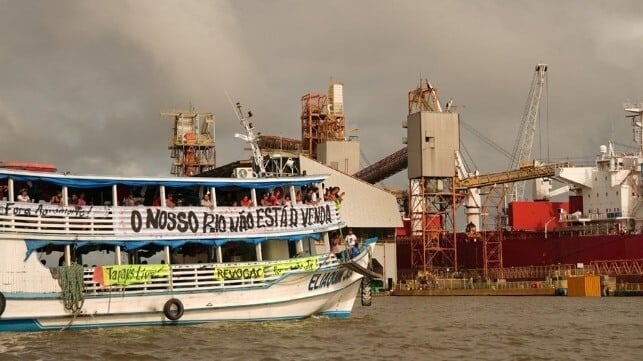
Apoema Cultural Collective / Amazon Watch press handout

Published Feb 22, 2026 6:49 PM by The Maritime Executive


Indigenous protesters and environmental activists in Brazil are showing resolve in their push to stop government projects which they believe will destroy Amazonian rivers and the rainforest, with U.S grain-trading giant Cargill caught in the middle of the controversy.

On February 19, about 400 activists in four boats intercepted a grain barge that was docked at Cargill’s terminal in Santarém. The protesters approached the barge on the urban stretch of the river while it was docked at the terminal, with the police moving in to impede their boats prompting many to jump into the river and managed to board the barge and inscribe the words “The Tapajós River isn’t for sale” and “Revoke the Decree of Death.”

The defacing of the barge, which is part of the soy supply chain operating through the Northern Arc logistics corridor, came on the day when a Brazilian court issued a second order to the government to remove protesters who have been staging a blockade at Cargill’s terminal over the past two weeks. 

The indigenous protesters have vowed not to relent in the push to demand the repeal of a decree by the federal government last year that saw the Madeira, Tapajós, and Tocantins Rivers included in Brazil’s National Privatization Program. The protestors are also demanding the immediate annulment of plans to dredge the Tapajós River, which they reckon will have adverse impacts on the Amazonian rivers and the rainforest ecosystem.

According to the protesters - led by non-governmental organization Amazon Watch - the government is using the Tapajós River dredging project as a central piece of a much larger project that is being pushed by agribusiness and global commodity traders, whose aim is to transform Amazonian rivers into industrial export corridors for soy and corn. They argue the project comes when the Northern Arc export corridor is already driving deforestation and eroding socio-biodiversity.

“It is essential to take a critical look at the cumulative impacts of the Northern Arc project. Ferrogrão, the expansion of private grain ports, and the Tapajós waterway together could increase soy volumes by five to seven times, intensifying pressure on traditional territories,” said Renata Utsunomiya, transportation policy analyst at GT Infraestrutura, a coalition of civil society organizations.

Utsunomiya added that the consequences of the project go beyond impacts on the Tapajós River because it will likely accelerate deforestation and threaten Brazil’s own climate commitments to reduce forest loss. The project could instigate land speculation and grabbing, soy expansion deeper into the Amazon, water contamination, changes in river flow dynamics and escalating violence along the soy transport routes, Utsunomiya warned.

Brazil remains as the world’s largest soybean exporter with record-breaking shipments in 2025 totaling 109 million tonnes, a 12 percent increase from 2024. China remains the dominant buyer, purchasing nearly 70 percent of the country’s total exports.


Report: Israeli Regulator and Union Threaten Sale of Zim to Hapag

Zim containership
Zim has been viewed as a national asset in its 80 year history (file photo)

Published Feb 19, 2026 8:12 PM by The Maritime Executive


Reports from Israel continue to cite pockets of opposition to the agreement to sell Zim to Hapag-Lloyd in a deal valued at $4.2 billion and then split it into domestic and international operations. Zim has long held a unique position, viewed as a national asset, and many believe it is critical to the security of the Israeli state.

Zim dates back to the formation of Israel, and in its 80-year history, it has been a means of transporting cargo for the Jewish state. In the early days, Zim brought immigrants and the displaced people of Europe to settle in Israel. It maintained passenger service into the 1970s and grew as cargo and then container shipping company. While it has been restructured and went public in 2013, it has remained an Israeli asset.

The news outlet Calcalist, which broke the news of the agreement with Hapag-Lloyd, continues to report on the pockets of opposition, including from critical segments of the government. It writes that Transportation Minister Miri Regev may be attempting to block the transaction. Regev is also seeking, it says, inter-ministerial discussions with the Government Companies Authority, the holder of the Golden Share in Zim.

As part of the agreement to let the company go public just over a decade ago, the Government received the Golden Share, which gives it the authority to approve any sale or change in control of the company above 35 percent ownership. Key stipulations include that Zim must remain an Israeli company, with its headquarters and operational center in Israel. The CEO and chairman must also be Israeli citizens. The company has to have at least 11 vessels, which can be requisitioned by the state in times of emergency.

Calcalist reported on February 19 that it has seen a draft position paper from the Government Companies Authority that concludes “the state may not be able to approve the deal.” Calcalist notes that the final terms have not been submitted for approval to the authority, but based on media reports, there is concern that the terms are “inconsistent with the Golden Share.”

Hapag’s solution is to split Zim with a deal to sell the 16 company-owned vessels, the brand, and the Israeli operations to the country’s largest private equity fund manager, FIMI. A new Zim would be created for the trade routes serving Israel, and with access to Hapag and the Gemini Cooperation with Maersk. 

FIMI founder and CEO Ishay Davidi is reported to be saying they recognize the strategic importance of Zim. They are committed to building a stable Israeli company.

The news outlet, however, says there are concerns about the change in the legal structure of the company. Analysts also note that the new Zim would be a small company, dependent on its international relationships, at a time when the industry is consolidating in the hands of a few giants. News reports also highlight the investments by Qatar and Saudi Arabia in Hapag-Lloyd.

At the same time, the union representing about 800 Zim employees in Israel fears large layoffs. It says it received minimal commitments for possibly as few as 120 people, with the others all facing layoffs. The union asserts that the board was not responding to it in the last two weeks, and it was given a last-minute notification without securing job protection.

The union immediately started a two-day “warning strike,” and despite assertions in the media that Hapag was protecting the jobs, the union says it moved to a full strike as of February 18. 

Oren Caspi, chairman of the workers’ union, told Calcalist, “Ships are already standing idle, and damage is accumulating. We will paralyze the company if necessary.”

Calcalist reports that the general strike includes office workers in Israel. It says it has also expanded to disruptions across the company’s operations, including loading and unloading of vessels.

BRANDING

Florida airport to be renamed after US President Donald Trump


By AFP
February 20, 2026


Workers on an aerial lift watch after installing a new banner featuring an image of US President Donald Trump on the facade of the US Department of Justice headquarters building in Washington, DC - Copyright AFP Brendan SMIALOWSKI

An airport in Florida will soon be renamed after US President Donald Trump, after a bill proposing the change was approved by the state’s legislature on Thursday.

Trump, a real estate mogul who has plastered his name on buildings around the world, has sought to leave his mark on the country in an unprecedented image and building campaign.

Florida’s Republican-led legislature approved a bill to rename the Palm Beach International Airport as the “President Donald J. Trump International Airport,” state records show. Governor Ron DeSantis, once a Trump opponent, is expected to sign the measure into law.

The airport in Palm Beach, a town known for its sandy beaches and luxurious estates, is just minutes away from Trump’s Mar-a-Lago residence.

The airport renaming will also require the approval of the Federal Aviation Administration.

It would then become the latest institution to be renamed after Trump.

The president’s handpicked board of the Kennedy Center, an arts complex and memorial to late president John F. Kennedy in Washington, voted in December to rename itself the “Trump-Kennedy Center.”

The same month, the State Department added Trump’s name to the US Institute of Peace.

Trump has also sought to rename New York’s Penn Station and Washington’s Dulles International Airport after himself, according to US media reports, although those efforts were rebuffed.

The Treasury Department has confirmed reports that drafts have been drawn up for a commemorative $1 coin featuring Trump’s image, even though there are laws against displaying the image of a sitting or living president on money.

On Thursday, a large blue banner featuring Trump’s face was draped across the headquarters of the Justice Department, an agency traditionally seen as outside the reach of political influence.
Belarus frees opposition politician Statkevich: wife


By AFP
February 19, 2026


Statkevich had been an active member of Belarus's opposition since the 1990s - Copyright AFP Daniel LEAL

Belarus has released opposition politician Mikola Statkevich from prison, five months after he refused to leave the country in a US-brokered prisoner release, his wife said Thursday.

He suffered a stroke behind bars and is having difficulty speaking, she added.

“Dear friends! Mikola is home! He had a stroke. He is now recovering. For now, he is having problems with speech. Otherwise, everything is fine. Everything will be okay,” Marina Adamovich said on Facebook.

Statkevich, 69, had been an active member of Belarus’s opposition since the 1990s and ran against the country’s longtime leader Alexander Lukashenko in a 2010 presidential election.

He was due to be freed and deported alongside dozens of other political prisoners last September but refused to leave the country, prompting Belarus to put him back in jail.

He had been in jail for five years prior to that.

More than 1,000 political prisoners remain behind bars in Belarus, according to the Viasna human rights group.

Many were detained during a brutal crackdown on opposition in the wake of Lukashenko’s disputed 2020 re-election and prosecuted on what rights groups have described as politically motivated charges.

Lukashenko has ruled the country since 1994, crushing domestic opponents and forging a tight alliance with Russian President Vladimir Putin.

Belarusian opposition leader Svetlana Tikhanovskaya welcomed Statkevich’s release, saying in a post on X that she was “relieved”.


Starlink loss a blow to Russian forces in Ukraine: experts


By AFP
February 19, 2026


Ukraine is battling Russia in the east - Copyright AFP Tetiana DZHAFAROVA
Fabien Zamora with Barbara Wojazer in Kyiv

US tech titan Elon Musk’s move to cut Russian access to his Starlink satellites over Ukraine has probably disrupted Russian forces’ tactical command and restricted their offensive capacity, but the war goes on.

Here is what we know about the importance of Starlink to Russia and in the Ukraine conflict:


– Critical command and control role –


Linking Russian drones to the Starlink satellites operated by Musk’s SpaceX company makes them more accurate, extends their range and makes them more difficult to block.

The satellites are also important for Russia’s command and control, “the organisation of the operational chain that allows the military at the top to give orders to all levels of responsibility, down to the combatants,” said a western military source.

“All armies that have a little money and need bandwidth use Starlink. It’s flexible, it’s not expensive, and it complements military systems that do not allow for increased bandwidth,” the source added.

In the Ukraine conflict, the US satellites “gave Russian units real-time control over their forces and drones, to have an overview of the line of contact” so they could make better decisions, Yuriy Fedorenko, commander of the Ukrainian 429th Achilles Drone Brigade told Freedom TV.

The satellites are even more important as there is no real front line where the Russia and Ukrainian armies are in contact, according to a high-ranking European officer.

“It is a ‘kill zone’ several kilometers (miles) wide, patrolled by drones, where small mobile squads operate, trying to strike here and there,” the officer told AFP.

“Many Russian soldiers constantly move through the area. These are critical points,” Serhii Beskrestnov, a technology advisor to the Ukrainian defence ministry, told AFP.


– Blackout fallout –


Ukraine says that blocking Starlink has an enormous impact on Russian forces. AFP has not been able to independently assess the fallout.

“For the Russians, this is not just a problem, it is a catastrophe,” said Beskrestnov. “We knew that they used Starlink on the front”, but “we did not believe that it was this crucial.”

The Russian side played down the consequences. Valery Tishkov, a communications official for the Russian military, said that Starlink was only used marginally and that the army “has all modern, domestically-produced communication services. The operations control system functions reliably and ensures the command and control of troops at the front.”


– How will Russia adapt? –


According to several Ukrainian sources, Russia has sought to pay Ukrainians to organise legitimate Starlink accounts that it can then use for its drones at the front. Ukraine’s SBU security service has warned that this is a crime punishable by a sentence jail of life.

Russia has deployed alternative solutions, according to the Ukrainian sources, but these are not as reliable as Starlink’s low orbiting network. Russia has instead used its Yamal and Express geo-stationary satellites that are higher up and there are fewer of them.

“They need a satellite receiver equipped with a large parabolic antenna,” said Beskrestnov.

These are now a prime target for Ukrainian forces and Russia has had to move back the antennae by 10-15 kilometers (six to nine miles) and deploy reinforced wi-fi from the receivers to the front lines.

“We are trying to locate these terminals,” said the advisor.


– Decisive in conflict? –


Ukrainian forces regained territory from Russia in February, a rare occurrence during the four years of war when they have gradually lost terrain amidst bitter battles that have cost thousands of lives.

On February 5, Russian military observers reported disruption of the Starlink internet terminals used by Moscow on the front lines after Musk took measures following a request from Kyiv.

A senior Ukrainian military official said that counter-attacks had been launched all along the front line in a single day, but gave no further details.

The US-based Institute for the Study of War says that Ukrainian forces are probably taking advantage of Russia’s loss of Starlink.

But so far there have been no dramatic changes. The European military source said that “very few troops are making direct contact with opposing soldiers, and there is no mechanised combat (which could force a breakthrough), so progress is very slow.”
NASA delivers harsh assessment of botched Boeing Starliner test flight

By AFP
February 19, 2026


NASA duo Butch Wilmore and Suni Williams were stuck on the ISS for nine months - Copyright AFP/File TED ALJIBE


Charlotte Causit and Maggy Donaldson in New York

NASA on Thursday blamed what it called engineering vulnerabilities in Boeing’s Starliner spacecraft along with internal agency mistakes in a sharply critical report assessing a botched mission that left two astronauts stranded in space.

The US space agency labeled the 2024 test flight of the Starliner capsule a “Type A” mishap — the same classification as the deadly Challenger and Columbia shuttle disasters — a category that reflects the “potential for a significant mishap,” it said.

The failures left a pair of NASA astronauts stranded aboard the International Space Station for nine months in a mission that captured global attention and became a political flashpoint.

“Starliner has design and engineering deficiencies that must be corrected, but the most troubling failure revealed by this investigation is not hardware. It’s decision-making and leadership,” said NASA administrator Jared Isaacman in a briefing.

“If left unchecked,” he said, this mismanagement “could create a culture incompatible with human spaceflight.”

The top space official said the investigation found that a concern for the reputation of Boeing’s Starliner clouded an earlier internal probe into the incident.

“Programmatic advocacy exceeded reasonable bounds and place the mission, the crew and America’s space program at risk in ways that were not fully understood at the time,” Isaacman said.

He said Starliner currently “is less reliable for crew survival than other crewed vehicles” and that “NASA will not fly another crew on Starliner until technical causes are understood and corrected” and a problematic propulsion system is fixed.

But the administrator insisted that “NASA will continue to work with Boeing, as we do all of our partners that are undertaking test flights.”

In a statement, Boeing said it has “made substantial progress on corrective actions for technical challenges we encountered and driven significant cultural changes across the team that directly align with the findings in the report.”


– ‘We failed them’ –


Isaacman also had harsh words for internal conduct at NASA.

“We managed the contract. We accepted the vehicle, we launched the crew to space. We made decisions from docking through post-mission actions,” he told journalists.

“A considerable portion of the responsibility and accountability rests here.”

In June 2024 Butch Wilmore and Suni Williams embarked on what was meant to be an eight-to-14-day mission. But this turned into nine months after propulsion problems emerged in orbit and the Starliner spacecraft was deemed unfit to fly them back.

The ex-Navy pilots were reassigned to the NASA-SpaceX Crew-9 mission. A Dragon spacecraft flew to the ISS that September with a team of two, rather than the usual four, to make room for the stranded pair.

The duo, both now retired, were finally able to arrive home safely in March 2025.

“They have so much grace, and they’re so competent, the two of them, and we failed them,” NASA associate administrator Amit Kshatriya told Thursday’s briefing.

“The agency failed them.”

Kshatriya said the details of the report were “hard to hear” but that “transparency” was the only path forward.

“This is not about pointing fingers,” he said. “It’s about making sure that we are holding each other accountable.”

Both Boeing and SpaceX were commissioned to handle missions to the ISS more than a decade ago.
UN chief decries global rise of ‘rule of force’


By AFP
February 23, 2026


UN Secretary-General Antonio Guterres (L) addresses the audience at the opening of the UN Human Rights Council - Copyright AFP Fabrice COFFRINI


Nina LARSON

The United Nations leader warned Monday that “the rule of force” was spreading, as the powerful trample on international law and wield artificial intelligence and other technologies to attack human rights.

“Human rights are under a full-scale attack around the world,” Antonio Guterres told the opening of the UN Human Rights Council’s annual session in Geneva.

“The rule of law is being outmuscled by the rule of force.”

The UN secretary-general stressed that “this assault is not coming from the shadows, or by surprise. It is happening in plain sight — and often led by those who hold the greatest power”.

He did not mention specific situations, although he did voice outrage at Russia’s war in Ukraine, where he said more than 15,000 civilians had been killed in four years of violence.

“It is more than past time to end the bloodshed,” he said.

Guterres also highlighted the “blatant violations of human rights, human dignity and international law in the Occupied Palestinian Territory”.

He charged that the trajectory in the conflict-torn territories under Israeli occupation was “stark, clear and purposeful: the two-state solution is being stripped away in broad daylight”.

“The international community cannot allow it to happen,” he insisted.


– Rights attacked ‘deliberately, strategically’ –


In his final in-person address to the UN’s top rights body, Guterres said the worst conflict-hit areas were not the only places where rights were eroding.

“Around the world, human rights are being pushed back deliberately, strategically and sometimes proudly,” he said.

“We are living in a world where mass suffering is excused away, where humans are used as bargaining chips, where international law is treated as a mere inconvenience.”

UN rights chief Volker Turk echoed the concerns.

In a “deeply worrying trend”, he warned that “domination and supremacy are making a comeback”.

“A fierce competition for power, control and resources is playing out on the world stage at a rate and intensity unseen for the past 80 years,” he warned.

“The use of force to resolve disputes between and within countries is becoming normalised.”

Turk highlighted how “the gears of global power are shifting”, calling for people to band together to protect rights and create “a strong counterbalance to the top-down, autocratic trends we see today”.


– ‘Democracies eroding’ –


While the UN says that conflicts are multiplying, impunity is spreading and humanitarian needs are exploding, its traditional top donor, Washington, has dramatically slashed its foreign aid spending since President Donald Trump’s returned to power last year. Other major donors have followed.

“When human rights fall, everything else tumbles,” Guterres warned.

The crisis of respect for human rights “mirrors and magnifies every other global fracture”, he said, pointing out that “inequalities are widening at staggering speed.

At the same time, “climate chaos is accelerating, and technology, especially artificial intelligence, is increasingly being used in ways that suppress rights, deepen inequality and expose marginalised people to new forms of discrimination both online and offline”, he warned.

Turk meanwhile lambasted leaders, without naming them, who seem to believe “that they are above the law, and above the UN Charter”.

“They claim exceptional status, exceptional danger or exceptional moral judgement to pursue their own agenda at any cost,” he said, pointing to how “some weaponise their economic leverage”.

“They spread disinformation to distract, silence and marginalise,” he charged.

What is clear, Guterres warned, was that “across every front, those who are already vulnerable are being pushed further to the margins”.

“Democracies eroding… migrants harassed, arrested and expelled with total disregard for their human rights and their humanity. Refugees scapegoated,” he pointed out, also highlighting how “LGBTIQ+ communities (are) vilified, minorities and indigenous peoples targeted, religious communities attacked”.

Guterres, who is to step down this year after a decade at the UN helm, called for urgent action to reverse the trend.

“Do not let power write a new rulebook in which the vulnerable have no rights and the powerful have no limits,” he said.


UN’s Sudan probe finds ‘hallmarks of genocide’ in El-Fasher


By AFP
February 19, 2026


The war in Sudan has killed tens of thousands of people - Copyright AFP Daniel LEAL


Robin MILLARD

The United Nations’ independent fact-finding mission on Sudan said on Thursday the siege and capture of El-Fasher by a paramilitary group bore “the hallmarks of genocide”.

Its investigation concluded that the Rapid Support Forces’ (RSF) seizure of the city in Darfur state in October had inflicted “three days of absolute horror” and called for those responsible to be brought to justice.

The mission warned that “urgent protection of civilians is needed, now more than ever” in neighbouring Kordofan state, the flashpoint of fighting since the RSF’s capture of El-Fasher, which was marked by ethnic massacres, sexual violence and detention.

“The scale, coordination and public endorsement of the operation by senior RSF leadership demonstrate that the crimes committed in and around El-Fasher were not random excesses of war,” said mission chairman Mohamad Chande Othman.

“They formed part of a planned and organised operation that bears the defining characteristics of genocide.”

Since April 2023, the conflict between Sudan’s army and the paramilitary RSF has killed tens of thousands and forced 11 million people to flee their homes.

It has triggered what the UN says is one of the world’s worst humanitarian crises.

The UN Human Rights Council established the Independent International Fact-Finding Mission for the Sudan in October 2023, to begin gathering evidence of violations.

Its investigation into the takeover of El-Fasher, following an 18-month siege, concluded that thousands of people, particularly from the Zaghawa ethnic group, “were killed, raped or disappeared”.

The Zaghawa is one of the area’s largest non-Arab ethnic groups.

Chadian President Mahamat Idriss Deby Itno, who has been widely accused of funnelling support to the RSF on behalf of their patrons, the United Arab Emirates, is also Zaghawa, which has led to tension among Deby’s people across the border.


– Widespread rape –


The mission interviewed 320 witnesses and victims from El-Fasher and the surrounding areas, including in investigative visits to Chad and South Sudan.

It authenticated, verified and corroborated 25 videos.

Survivors spoke of widespread killings, including indiscriminate shootings, and mass executions at exit points.

They described seeing roads filled with the bodies of men, women and children, the mission said.

The report also detailed detention, torture, humiliation, extortion, ransom and disappearances.

Widespread sexual violence targeted women and girls from non-Arab communities, particularly the Zaghawa, it added.

“Women and girls ranging from seven to 70 years old, including pregnant women, were subjected to rape.”

Many survivors reported being raped in front of their relatives, the report said, with sexual violence frequently accompanied by extreme physical brutality.

“In one case, a 12-year-old girl was raped by three RSF fighters in front of her mother, shortly after her father had been killed while trying to protect her. The girl later died from her injuries,” it said.

Rape was often committed in locations where mass killings had taken place, including at El-Saudi Hospital and at El-Fasher University.

“Witnesses recounted the RSF violently and publicly gang-raping at least 19 women in rooms filled with corpses, including the remains of their own husbands,” the report said.


– Impunity –


Concluding that the RSF had acted “with genocidal intent”, the mission found “at least three underlying acts of genocide were committed”.

These included killing members of a protected ethnic group and causing serious bodily or mental harm.

“The RSF acted with intent to destroy, in whole or in part, the Zaghawa and Fur communities in El-Fasher. These are the hallmarks of genocide,” said investigator Mona Rishmawi.

The mission said such levels of atrocity had been reached because the perpetrators acted with impunity.

Reacting to the report at the UN Security Council on Thursday, UN Under Secretary General Rosemary DiCarlo said: “Strong action by the Security Council is more important than ever.”

Chairing the meeting, British Foreign Secretary Yvette Cooper said: “There’s page after page of the most distressing accounts imaginable. It is horrific.”


New research indicates how to combat the growing level of global hate


By Dr. Tim Sandle
SCIENCE EDITOR
DIGITAL JOURNAL
February 19, 2026


In Istanbul, protesters clashed with police who tried to prevent a demonstration 
 in solidarity with Kurds in northern Syria - Copyright AFP Yasin AKGUL

A global team of researchers, led by the University of St Andrews the Canadian Institute For Advanced Research (CIFAR), have produced a new World Bank Working Paper offering an integrative analysis of how collective hate develops and the strategies that can be used to counter it.

The researchers describe a self-reinforcing “cycle of hate” which produces division and conflict within societies, thereby threatening social welfare and economic development worldwide.

Drawing on evidence spanning psychology, economics, political science, sociology, and history, the team of international researchers show that hate is not an inevitable aspect of human nature. Rather it is systematically built, mobilised and justified across generations. Critically, by understanding how hate is built, we can identify the most effective ways of intervening to dismantle it and to restore social cohesion.

The research paper proposes four components in the cycle of hate: the use of history to identify certain groups as an ‘eternal enemy’; the structure of the current context, which positions certain groups as competitors and threats; the role of leaders and the media in creating a narrative of enmity; and the justification of hate as something inevitable and even desirable to defend ‘our values’.

When activated, this cycle leads to rising prejudice, discrimination, dehumanisation, and, in extreme cases, violence and conflict. The authors highlight that hate can unravel years of progress by eroding social trust, weakening institutions, and disrupting cooperation long before violence becomes visible.

“Intergroup hate is not an external shock,” note the authors in the paper. It is deeply intertwined with development trajectories,” For instance, economic policies that benefit some groups more than others, or institutional reforms that are perceived as unfair, can trigger or accelerate the cycle of hate. On the other hand, hatred can disrupt economic development, impede growth, and destroy human potential.

By identifying the key phases in the cycle of hate, the researchers highlight points where interventions will be most effective in disrupting that cycle. The paper provides a novel and comprehensive inventory of ways to challenge hatred.

These include: Designing school history textbooks to promote inclusive historical narratives and foster tolerance. Facilitating Intergroup contact and cooperation, such as mixed sports teams or collaborative workplaces, to reduce competition and threat. Promoting positive leadership and media narratives that frame a broader sense of “we-ness” amongst different groups and challenging disinformation that promotes threat beliefs. Humanisation and empathy-building between groups to highlight the human consequences of hate.

These are not simply alternatives. Multi-level interventions which work simultaneously at psychological, institutional, economic, and political levels hold the greatest promise for durable intergroup cooperation. Policies focused solely on growth or service delivery may unintentionally worsen intergroup tensions if they fail to account for identity boundaries, perceptions of unfairness, or local histories.

The researchers argue that social progress must be measured not only through economic indicators but also through the strength of social relationships across groups, and the degree to which societies remain inclusive, peaceful, and resilient.

Professor Reicher, who led the research, concludes: “Hatred is not something bred in the bone. It is made by humans in society and hence – if we understand how – it can equally be unmade. Even as we look around and see the rise of intolerance and polarisation across the globe, it is up to us to replace indifference and hatred with compassion and cooperation. Indeed, the health of our societies depends on us doing so. This paper is intended as a road map to help identify the best way to succeed in doing so.”

The paper, “The Cycle of Hate, and What We Can Do About It” is published as World Bank Policy Research Working Paper 11304 by the Development Research Group, Development Economics.


US Supreme Court to Rule on Exxon's $1 Billion Cuba Assets Claim

The U.S. Supreme Court will be hearing on Monday arguments by ExxonMobil, backed by the Trump Administration, about the scope of a law allowing American companies to claim damages for seized assets in Cuba.

U.S. supermajor Exxon is seeking compensation upwards of $1 billion for assets seized by the Cuban government in 1960. At the time of the confiscation of the assets, then belonging to subsidiaries owned by Standard Oil, they were worth $70 million. 

However, Exxon wants $1 billion in the current claim because interest has accrued and there is potential of enhanced damages. 

Legislation from 1996, the Cuban Liberty and Democratic Solidarity Act, also known as the Helms Burton Act, allows U.S. nationals to bring lawsuits in federal court against anyone who “traffics in property which was confiscated by the Cuban Government on or after January 1, 1959.” 

Three U.S. Presidents since 1996 -- Bill Clinton, George W. Bush and Barack Obama – suspended parts of the Helms-Burton Act to avoid diplomatic conflicts with allies like Canada and Spain whose companies have invested in Cuba. But President Trump lifted the suspension in 2019 during his first term in office.

Exxon sued three entities owned by the Cuban government in federal court in Washington, D.C., in 2019 under the Helms-Burton Act, contending that they violated the law by trafficking in confiscated property owned by Exxon. 

A U.S. district court ruled in 2021 that Cuban state-owned entities facing Helms-Burton Act lawsuits can invoke the Foreign Sovereign Immunities Act, which generally bars lawsuits in U.S. courts against foreign governments and their “agenc[ies] and instrumentalit[ies].”  

Exxon then turned to the Supreme Court to rule on the scope of the Helms-Burton Act and whether it trumps the Foreign Sovereign Immunities Act. 

A Supreme Court ruling in favor of Exxon could open the door to other claims for compensation over the expropriation of assets in Cuba after 1959.   

By Tsvetana Paraskova for Oilprice.com


Cuban Americans keep sending help to the island, but some cry foul


By AFP
February 21, 2026


People line up with packages and items to send to Cuba at a Cubamax store in Florida - Copyright AFP GIORGIO VIERA

Gerard MARTINEZ

In the early morning, Florida resident Gisela Salgado headed to a local store with a bag stuffed with clothes, coffee and powdered milk to send to her brother in Cuba. She was not alone.

Even though some shipping agents in the Sunshine State have restricted the mailing of packages to the nearby crisis-wracked, Communist-ruled island due to logistical problems caused by fuel shortages there, customers keep showing up.

In the Miami area, the economic and energy emergency in Cuba has revived an old debate: should Cuban Americans keep sending remittances and basic goods to loved ones, or cut off shipments seen by some as keeping the government in Havana afloat?

After the ouster of Venezuelan leader Nicolas Maduro, US President Donald Trump’s administration has forced Caracas to halt oil shipments to Cuba, and threatened tariffs on other countries who would step in to send crude, effectively creating a blockade.

At the main office of the Cubamax company in Hialeah, northwest of Miami, which handles remittances, shipping and travel, about 10 customers lined up before opening time.

Some were carrying bags or pushing carts filled with basic necessities, while others just had envelopes filled with cash.

In Hialeah, where nearly three out of four residents are of Cuban descent, there is no question that shipments are a must.

“Things there are terrible. People are starving, there’s nothing,” said Salgado, a 72-year-old who emigrated to the United States four decades ago.

“As long as my brother is there, I’ll keep sending him things. He has nothing to do with the government, and if I don’t send him anything, how will he eat?”

Standing near her, 81-year-old Jose Rosell is at Cubamax to send food and toiletries to his 55-year-old son, a taxi driver in Santiago de Cuba who lost his job due to the fuel shortage.

Rosell said he is worried that he won’t be able to keep helping him.


– Total blockade? –


Last week, Cubamax — one of the main agencies facilitating shipments and remittances to the Caribbean island nation of about 10 million people — suspended deliveries to residences and began enforcing a one package per customer limit, due to lack of fuel.

Some of those restrictions have since been lifted, but customers are still fearful that the pipeline to their relatives could soon be cut off entirely.

Other businesses such as Supermarket23, which sells packages of food and basic goods for delivery to Cuba, have said they will no longer accept new orders until further notice.

Shipments of basic necessities are possible due to an exemption to the US trade embargo on Cuba that allows for exchanges between family members.

But many in the Cuban diaspora have targeted businesses specializing in these transactions.

Three US lawmakers with Cuban roots — Mario Diaz-Balart, Carlos Gimenez and Maria Elvira Salazar — asked the Trump administration to revoke the licenses of US businesses they say are dealing with entities controlled by authorities in Havana.

Alex Otaola, a Cuban American influencer and activist, advocates cutting off all support to the island, even from family members, with his “Stoppage” campaign — an initiative that is hotly debated on social media.

For Emilio Morales, who leads the Havana Consulting Group, which specializes in the Cuban economy, cutting off shipments “won’t change the equation.”

The government in Havana has very little access to remittances, because they usually arrive via private travelers known as money “mules,” he told AFP.

And packages sent from abroad only help a small minority of Cubans, with little overall effect islandwide.

At a cafe in Hialeah, 59-year-old Reina Carvallo said critics need to make a clear distinction between the government and regular people like her two brothers, to whom she sends medication and other items.

“The regime should be beheaded, which is what it deserves,” Carvallo said. “But the people should not have to suffer.”


US Attacks in Venezuela and Greenland Lay Groundwork for Billionaire Fiefdoms

Trump’s foreign interventions may pave the way for techno-fascist city-states to seize sovereignty.
February 21, 2026

Aerial view of Pier Juan Griego in Margarita Island, Nueva Esparta State, Venezuela, on November 25, 2024. A blockchain-based residential settlement called CryptoCity spans 35 hectares on Margarita Island and is promoted to German and other foreign investors as a highly exclusive enclave.
JUAN BARRETO / AFP via Getty Images


Truthout is an indispensable resource for activists, movement leaders and workers everywhere. Please make this work possible with a quick donation.

On January 3, 2026, Tim Stern, a German investor, was sleeping peacefully at his Venezuela residence when the phone on his small bedside table suddenly went wild. As he explained to Timothy Allen of the “Free Cities Podcast,” calls streamed in immediately after news broke that the United States had bombed Caracas in the early hours of the morning. Within hours, it was clear that Venezuelan President Nicolás Maduro had been captured and was being sent to the United States — a change, Stern said in the podcast, that “is going to be the start of an absolute bonanza here in Venezuela.”

Oil interests were at the center of the U.S. invasion of Venezuela; U.S. President Donald Trump has made clear his intentions to reclaim nationalized Venezuelan oil for U.S. companies and to oversee the sale of Venezuelan crude. However, Stern is not involved in the oil industry. Instead, he’s the co-founder of a blockchain-based residential settlement called CryptoCity, a luxury real estate development spanning 35 hectares on Venezuela’s Margarita Island. Margarita, an island with duty-free port status and a population of around 490,000, depends largely on the tourism industry and has suffered hardships due to Venezuela’s economic crisis. However, CryptoCity is promoted to German and other foreign investors as a highly exclusive enclave. It boasts of luxury living for “high net-worth” entrepreneurs fully vetted and selected through a rigorous process. All transactions in the zone must be made in crypto, and residents form part of a “brain pool” aimed at generating joint business ventures through a Decentralized Autonomous Organization (DAO).

CryptoCity is one example of how Trump’s foreign policy is benefitting a venture-capital fueled private city and “network state” movement. The project is featured on the page of the Free Cities Foundation, a leading private city promotor led by German economist Titus Gebel that has also championed the crypto-libertarian movement’s flagship project, a self-governing jurisdiction in Honduras called the Próspera ZEDE (Economic Development and Employment Zone). According to Stern, property in Margarita sold so rapidly after the U.S.’s attack on January 3 that their company was running out of apartments to sell. Property values shot up, properties for $20,000-$30,000 were nowhere to be found, and CryptoCity experienced an influx of investors interested in visiting the island, he maintained.

While libertarians have long fantasized about sovereign, “free-market” enclaves, a movement for so-called private cities, built in highly autonomous special jurisdictions, gained new momentum after the 2008 economic crisis. Palantir co-founder Peter Thiel is one of the most prominent backers of the movement. The billionaire first backed the Seasteading Institute — an organization promoting ocean colonization — and then VC firm Pronomos Capital, an early investor in Próspera. In 2022, crypto investor Balaji Srinivasan took the tech-futurist and land-hungry movement to the next level, coining the idea of the “network state.” A network state refers to an online community that pools capital, forms a blockchain “nation,” and then crowdsources land and exploits legal exemptions to build para-national territories.

Military Bases Could Open Doors for Private Sovereignty

At the end of the recent World Economic Forum in Davos, Switzerland, Trump’s rhetoric on Greenland took a sharp turn, easing concerns over potential military conflict or crushing tariffs against European countries. Trump now claims to have reached a framework for a deal with NATO over Greenland and the Arctic, rumored to include sovereign territories for U.S. military bases, similar to the arrangement the U.S. holds in Guantánamo, Cuba.

Although official details have not been released and a larger conflict seems to have been averted, small territorial concessions in Greenland are still aligned with the interests of Trump’s tech oligarch allies and present a serious threat to the island. This is because even small pockets of U.S. territory could pave the way for venture capitalist interests in private jurisdiction development under the “network state” rubric.

Early in Trump’s second term, a rising network state project called Praxis — in fact a self-proclaimed “network empire” — enthusiastically backed Trump’s resolve to annex Greenland from Denmark, declaring plans to make it the first physical site for their digital nation. A week after Trump’s election, Praxis co-founder Dryden Brown announced that he had visited Greenland “to try to buy it.” Meanwhile Trump’s support for “Freedom Cities” within the United States (later named “Acceleration Zones”), an offshoot of Honduras’s Economic Development and Employment Zones (ZEDEs) like Próspera, moved from a campaign promise to official policy. Praxis — also backed by a group of mega tech and crypto investors including Pronomos, Balaji Srinivasan, Patri Friedman of the Seasteading Institute, Palantir co-founder Joe Lonsdale, Sam Bankman-Fried’s trading firm Alameda Research, and Apollo Ventures (the VC firm of OpenAI’s Sam Altman) — circulated a White House X post on November 5, 2025, that featured President Trump inside a pattern resembling the Praxian flag, adding a note: “Praxians in control.” The image leaves little room for doubt of Trump’s alliance with the right-wing network nation.

As the prospect of a full U.S. takeover of Greenland has grown increasingly remote, the idea of a Greenland-based “Freedom City” has understandably faded from view — but it has not disappeared entirely. An expanded U.S.–Denmark military base agreement could still create openings, depending on how its terms are structured. This possibility is underscored by Praxis’s focus on military defense and space exploration and its affinity towards designing cities adjacent to military installations.

In June 2025, Praxis proposed Atlas, a “defense-focused spaceport city on 3,850 acres at the Vandenberg Space Force Base,” in California, demonstrating its will to merge military development with network state plans. Praxis proposes launching Atlas first as a beachside industrial town to attract elite technical talent. Its close proximity to Department of Defense assets and Space Force installations on the base would enable “rapid test-to-deployment cycles” for AI-driven defense technology innovation. Estimated to attract 50,000 residents and produce $35 billion in income, Praxis promotes Atlas as a way to “defend the West on Earth and beyond.”

Danger of Expansion

In Honduras, small extensions of land were used by private city investors as a foothold to claim sovereignty and resist government oversight. The legislation backing ZEDEs was designed for these small footholds to grow over time. Honduras’s ZEDE law, which was passed in 2013, repealed in 2022, and ultimately ruled unconstitutional by the Honduran Supreme Court in 2024, contained a few key articles that insured the private territories would be difficult to contain. For instance, the law designated entire coastal areas with low population density as subject to the special ZEDE regime without a plebiscite or congressional approval, while also allowing new territory to be easily merged into the special jurisdiction if sold or voluntarily incorporated by a private landowner. The Próspera ZEDE, located on the Honduran island of Roatán, set a precedent for this when it purchased the Satuye Port, a non-contiguous territory on mainland Honduras, and placed it under the jurisdiction of the Próspera government. Próspera continued to operate as a self-governing territory and raise investment even after the Supreme Court’s ruling struck the ZEDE framework from the Honduran Constitution.

Praxis is a particularly extreme player in the network state movement. Western chauvinism is mixed with Mars colonization fantasies and allusions to white supremacist ideology in Praxis’s online discourse. One Praxis X post, for example, invokes the imperative to save the “corpse of Albion” — a term that refers to a fictitious independent island nation in the gaming world, but is also used by some ethnonationalist and neo-Nazi groups to reference a mythical, pre-modern, and “pure” Britain. Commenters responded to the post with “HAIL Praxis.” On February 6, 2025, Praxis boosted an X post titled “Make Rhodesia Great Again,” featuring a series of videoclips of colonial violence, and added “Praxians, are you ready for action?” Rhodesia, a former settler-colonial state in present-day Zimbabwe known for its systematic domination of the Black majority, is a widely recognized symbol of white nationalism. Praxis deploys other pre-fascist cultural concepts that were later adopted by European fascists and the Nazi Party, such as that of the “eternal city” and the “Faustian spirit.”

Taken together, Trump’s open disregard for the sovereignty of other nations does more than disrupt diplomatic norms; it paves the way for private city and network-state projects that revive long-standing logics of colonialism. If the Honduras case is any example, the legal details of an agreement between the United States and Denmark will be instrumental in determining the extent of the damage done to the island of Greenland and the self-determination of its people.

This article is licensed under Creative Commons (CC BY-NC-ND 4.0), and you are free to share and republish under the terms of the license.


Beth Geglia is an anthropologist and documentarian focused on urban political economy, land politics, and tech-futurist territorial movements. She holds a Ph.D. from American University and is based in Washington, D.C. and Barcelona.

Op-Ed

Peter Thiel Is Unleashing a Neocolonial Billionaire Fantasy in Honduras

Tech billionaires want to create their own city-states. Hondurans pay the price.


By Edith Romero , 
February 16, 2026

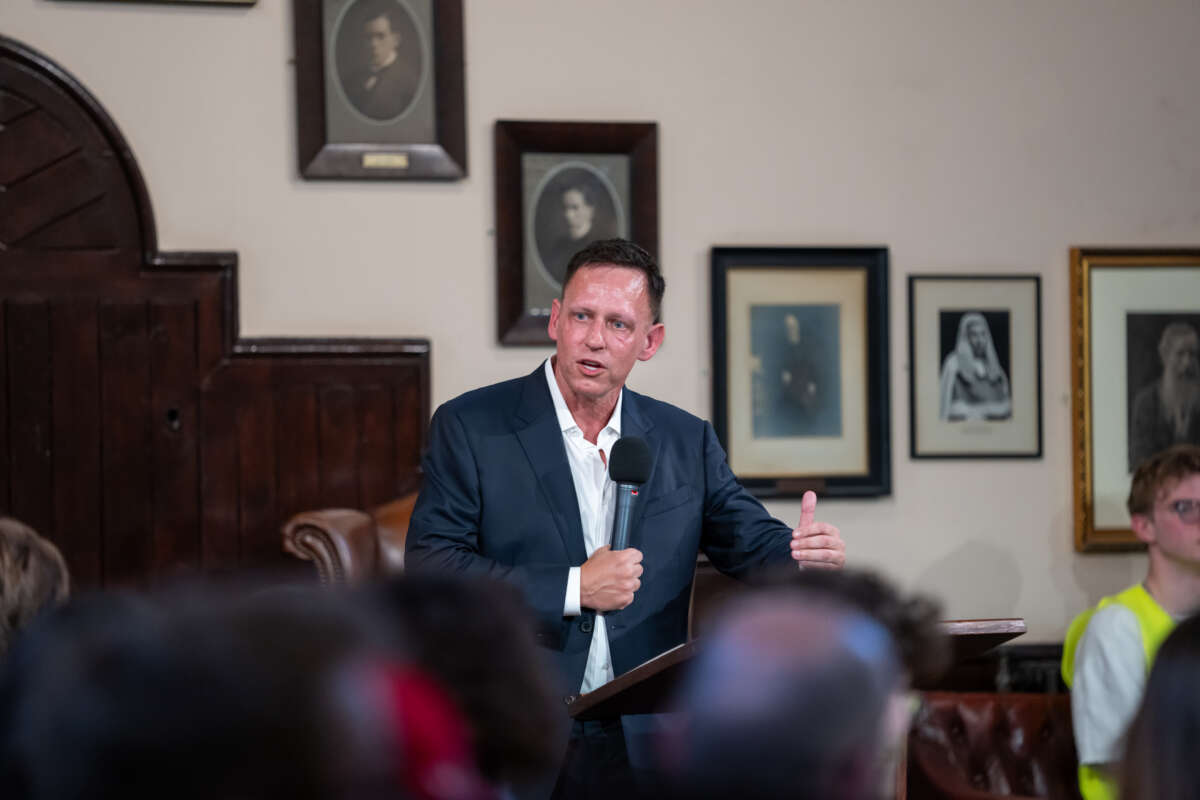
Peter Thiel speaks at The Cambridge Union on May 8, 2024, in Cambridge, Cambridgeshire, England.
Nordin Catic / Getty Images for The Cambridge Union

In April 2025, Peter Thiel’s Palantir made headlines after documents were released detailing its partnership with Immigration and Customs Enforcement (ICE) to create ImmigrationOS, a massive database of information gathered from a variety of sources including the IRS, in order to surveil, detain, and deport immigrants. Thiel is not new to spearheading endeavors that aim to dehumanize and attack people of color. In fact, the tech mogul is one of the billionaires leading our modern-day version of tech neocolonialism, the new-yet-old imperial monster that colonizes land, extracts resources, exploits natives, and is happy to profit off of their suffering.

As a Honduran immigrant myself, I would know.

In 2009, Honduras found itself in turmoil after a military coup destabilized the country leading to unprecedented levels of violence and repression. Taking a page out of the “shock doctrine” playbook, the elite political actors behind the coup (including narco-dictator Juan Orlando Hernández, now pardoned by Donald Trump after being sentenced to 45 years in prison for drug trafficking and weapons charges) watered down environmental protections on Honduran land and approved illegal contracts to sell Indigenous and protected land to the highest bidder.

Among other corrupt dealings and land grabs, the government approved a law that enabled the creation of Peter Thiel’s Zones for Employment and Economic Development (ZEDEs). ZEDEs derive from the idea of “charter cities.” Proposed by former World Bank executive and economist Paul Romer, these proposed cities are enclaves within lower-income nations that “promote economic growth” through privatization and the disposal of national regulations, while gifting major tax incentives for foreign nations to invest in businesses. Special economic zones in Kenya, Bangladesh, and Ethiopia have faced criticism due to low wages, harsh working conditions, and threats to rights to free association and collective bargaining. Romer, one of the initial proponents of ZEDEs in Honduras, expressed criticism in 2015 regarding the Honduran ZEDEs and their lack of accountability to local laws, and anti-democratic governance.

These ZEDEs are a project of Praxis, a tech billionaire-funded start-up that aims to create libertarian city-states to “restore Western Civilization.” The ZEDEs are allowed to have their own government, police force, courts, laws, and any taxes collected would not be paid to the Honduran government but to the ZEDEs themselves. ZEDEs are a tech billionaire’s dream: unbridled power, tech fantasy, and resource hoarding, where the government is run by AI and cryptocurrency is the main currency.


Who Gained the Most During Trump’s First Year? Billionaires and Corporations.
Big banks saw their stocks skyrocket by 29 percent during Trump’s first year. Here’s who else cashed in. 
By Derek Seidman , Truthout January 20, 2026

Próspera (one of the three ZEDEs in Honduras) even has a Bitcoin center paired with tech companies that offer $25,000 gene therapy and “subdermal implantation services and a variety of cybernetic upgrades.” Próspera is located in Roatan, a Honduran island named one of the World’s Greatest Places in 2023 by TIME magazine. Roatan is a Caribbean tropical beauty surrounded by the second-largest coral reef in the world, and home to rich Afro-descendant culture, the Garifuna people who have been fighting threats to their sovereignty for centuries. A sought-after spot for foreign luxury tourism and investment, Roatan saw the foundation of Próspera in 2017 with funding from the likes of Peter Thiel and Pronomos Capital led by Patri Friedman, a grandson of Milton Friedman, seen by many as the father of neoliberalism, deregulation, and privatization.

There are endless reasons why ZEDEs are dangerous for the Honduran people. Human rights organizations have rung the alarm on how they have been displacing Indigenous communities who have ancestral ties to the land and expropriating their territory.

Greicy, an Indigenous Garífuna woman from Triunfo de la Cruz on the coast of Honduras, identifies similarities between the ZEDE in Próspera and other illegal land grabs and land dispossession in her ancestral hometown. Due to safety concerns, Greicy is only sharing her first name for this article.

“Even though they say otherwise, I see that only the rich are benefiting, knowing full well that we Garífuna people live off the beach, we live off tourism, we live off fishing, and we also live off growing our own food, cultivating our own food, harvesting and planting our own food. Right? But now we don’t have any land left,” she said.

Harassment, violence, and threats from the Honduran police force led Greicy to migrate North to New Orleans, standing as a living testimony of how neocolonialism has displaced millions of families in the Global South.

Greicy’s family was part of the 2015 Inter-American Court ruling that found the state of Honduras guilty of violating the rights of the Garifuna people in Triunfo de la Cruz and Punta Piedra, and ordered the state to pay restitution for their communal land rights. Despite the ruling, the Honduran state has not started any process of restitution, with threats and violence towards Garifuna leaders persisting. Greicy sees ZEDEs as the ultimate tool to dispossess the Garifuna people of their ancestral homeland.

“In Honduras, the ruling has not been carried out, the demands have not been met. And I imagine there would be even more land dispossession [with more ZEDES], dispossession not only of homes, but of people’s very means of survival. Yes, it would be worse because we know that all these special economic development zones benefit high-ranking officials, wealthy individuals with investments, and foreign investors who attend political meetings. And how does this benefit the people? Not at all. Exactly,” she explained.

Concerns regarding ZEDEs and neocolonialist dispossession of communities on the North coast of Honduras often involve drug-trafficking activity, including money laundering, says Greicy.

“Those who are going to invest there are Americans. One reason is to bring in their prohibited substances, because we know that’s also included in the deal. Money laundering is also involved, right? When they go to the beaches, supposedly for tourists, and all that, that’s also money laundering, because the beach is a free zone, merchandise is smuggled there, everything is sold there. And someone like me, living in the town, just stays quiet because of fear…. If I were in Honduras, I tell you, I wouldn’t be telling you this,” she said.

Greicy’s fear is not unfounded: Research on special economic zones such as the ones in China has documented “economic gray zones” inside the enclaves where drugs, money laundering, and human trafficking abound. Others are concerned about how ZEDEs have the power to create inhumane labor laws to exploit Hondurans, but let’s take a moment to look at the big picture.

ZEDEs are the tech billionaire representation of neocolonialism; taking hold of Honduran land, resources, and a workforce to build playground empires for tech billionaires to avoid constitutional protections, government accountability, or even human rights protections.

In 2022, the new government of Honduras repealed the ZEDEs law, which led to a $10.7 billion lawsuit from Thiel’s Próspera that could bankrupt an already struggling country. Unfortunately, the ZEDEs law has a loophole that has allowed the so-called “digital nations” like Próspera to continue.

In December 2025, Honduras concluded a presidential election completely tainted by U.S. intervention via Donald Trump’s public support for the right-wing Nationalist Party candidate Nasry Asfura, as well as Trump’s threats to cut U.S. aid to Honduras if another candidate won. The connection of special interests between Trump, his tech billionaire friends, and ZEDEs are clear, and Nasry stands as the champion that will do Trump’s and Thiel’s bidding at the expense of the lives and rights of the Honduran people.

Greicy explained the dire position of immigrants facing dispossession in their ancestral homeland — and detention, surveillance, and violence in the United States at the hand of the same powerful forces.

If the expansion of more ZEDEs in Honduras were to happen, “immigration is going to get worse, because we know that those of us who are here want to leave, and the people who are there are being forced out and will come here. They will come seeking political asylum, something that will be denied to them,” she said.

It is not the first time Thiel has used people of color in crisis as a laboratory for his monstrous oligarchic fantasies. Thiel’s Palantir is one of the main providers of advanced AI targeting software and hardware to Israeli forces; the technology is used to target, surveil, and murder Palestinians. As a genocide continues under a ceasefire that has not been respected by Israel, Palantir continues to, as its CEO Alex Karp said in an understatement, “occasionally kill people.” Palantir not only provides the technology to massacre Palestinians but also trained its AI models with secretly received National Security Agency raw data of emails and phone conversations between Palestinians in occupied territories and their family in the U.S.

In 2020, Karp admitted that Palantir “[finds] people in our country who are undocumented,” referring to contracts with the Department of Homeland Security to use Palantir to surveil undocumented immigrants. Thiel and his billionaire gang are building a new profit frontier off of the livelihoods of people of color. The theft of land and resources, the mass surveillance and endless data collection — Thiel’s pet projects regard immigrants and people of color as expendable. We are one more resource they will gladly extract, whether it is our land, labor, data, or our own lives. As data centers gobble up resources in the form of drinkable water and energy, the technology they house exploits people of color, whether it’s through biased facial recognition tech or predictive policing technology that tries to criminalize us.

Just like the Spanish colonized Latin America through forced labor, extraction of resources, and subjugation of the Indigenous peoples, Peter Thiel and his gang of tech billionaires are drafting up plans to re-colonize Latin America, occupying land, displacing native inhabitants, and then profiting from surveilling and incarcerating them after they are forced to flee to the United States. Thiel, conveniently, has lately been preaching the coming of an “antichrist” in the guise of environmentalism, guardrails on technology, and international agencies, even singling out Greta Thunberg as the possible antichrist. On the topic of the libertarian utopia of “charter cities” like Próspera, Thiel has said “the nature of government is about to change at a very fundamental level.”

Ultimately, Palantir’s ImmigrationOS is a weapon that ICE and other government agencies use to detain kidnapped immigrants under inhumane conditions and force them to perform manual labor in detention centers. A trans detainee in a Louisiana ICE jail denounced this forced manual labor in 2025 — in his case, he was force to carry cinder blocks — and then faced sexual harassment after speaking out against this unsanctioned practice. As Palantir facilitates forced labor schemes, Thiel amasses power through his investments in Facebook, Donald Trump, and ZEDEs.

From the U.S. to Honduras, tech billionaires are waging a war on people of color. These oligarchs are employing the old and overused re-packaging of neocolonialism and repression as “development” and “progress” — even labeling AI tech as “inevitable.” When feeling overwhelmed by the power and influence of tech billionaires who care not about our lives or the planet but only about endless profit, I remind myself that they are quite literally a 1 percent. We are an undeniable winning force if we come together.

Tech billionaires are not the future. They are just another colonizer looking for a scheme to grow power and wealth on our backs. To start, we can always hit them where they care the most, their money — boycott generative AI, fight against data centers, fight against and denounce Palantir contracts being paid with our tax money, and support Indigenous communities fighting against ZEDEs. Let’s ditch the glorification of billionaires like Thiel and Musk who care only about power and profit. Let’s call them what they are: colonizers that see us, people of color, as their new profit frontier.


This article is licensed under Creative Commons (CC BY-NC-ND 4.0), and you are free to share and republish under the terms of the license.

Edith Romero is a Honduran community organizer, researcher, writer, and a Public Voices fellow of The OpEd Project, The National Latina Institute for Reproductive Justice, and the Every Page Foundation.


Pëtr Kropotkin The State: Its Historic Role 1896 Note for the marxists ... plain PDF A4 imposed PDF Letter imposed PDF EPUB (for mobile devices) ...