Thursday, April 02, 2026

AU CONTRAIRE

Amnesty International Defends US Regime-Change NGOs: Venezuela, Nicaragua, and Cuba


by  and  | Apr 2, 2026 | antiwar.com

Why are many Latin American countries shutting down nonprofit organizations? Amnesty International claims it has the answer: in every case, it’s part of a drive to restrict human rights and “tear up the social fabric.”

Amnesty’s new 95-page report (in Spanish, with an English summary), criticizes governments across the political spectrum for attacking what it calls “civil society organizations.” But Amnesty ignores the history of many such organizations and therefore why governments might be justified in closing them.

Here we focus on the report’s deficiencies in relation to Nicaragua, Venezuela (two NGOs interviewed in each) and Cuba (none).

Data-light analysis supports preconceived conclusions 

Amnesty’s report is strikingly thin. Unlike many other Amnesty investigations, this one provides scarce case studies or incidents, almost no statistics, few named victims or affected organizations, and little discussion of specific crackdowns. In most cases, substantive content about a particular country is assumed to apply to all countries.

Amnesty conducted interviews with only 15 non-governmental organizations (NGOs) across six countries: Nicaragua, Venezuela, Paraguay, Peru, El Salvador and Ecuador. Its analysis extended to two more, Guatemala and Cuba, where no interviews took place. Yet the six countries alone have around 40,000 NGOs between them, making Amnesty’s sample minuscule. In none of the countries did Amnesty do any direct fieldwork.

Amnesty did not consult with any government sources or individuals close to governments, resulting in a one-sided narrative. According to Amnesty, the issues “should not be interpreted as… differentiation between the countries analyzed.” Thus, countries as politically different as Ecuador and Nicaragua are painted with the same brush.

While claiming to expose the real purpose of these laws, Amnesty fails to explain their political context, despite the widespread and documented use made of NGOs by the US to destabilize countries.

The authors emailed Amnesty with our key criticisms. In a lengthy response, Mariana Marques, Amnesty’s South America Researcher & Advisor, claimed that “the report intentionally prioritizes depth and comparability [between the chosen countries].” However, this is difficult to accept given that the report’s sweeping generalizations are mechanically applied to all six.

The authors also asked Amnesty if they had considered evidence that NGOs in Venezuela, Nicaragua and Cuba have indeed engaged in political activities – that would very likely be illegal in Western countries such as the US? Did they consider whether allegations that NGOs provoked political violence or other criminal activities might be true? In response, Ms. Marques wrote: “The report does not adjudicate case‑by‑case allegations about individual organizations.”

Nevertheless, the report apparently identified “selective enforcement” and “sanctions” that were “disproportionate.” But how could they reach an impartial judgment on the fairness of a government’s actions without considering whether the alleged infractions might have actually occurred?

Destabilization claims go unexamined 

If governments justify their laws as efforts to halt foreign-funded destabilization, surely Amnesty should ask whether such claims have merit. Here are some examples that Amnesty might have considered:

  • In Cuba, the U.S. Agency for International Development (USAID) spent $15.5 million from 2009 through 2012 running “civil society” programs aimed at secretly stirring up anti-government activism. Then in just one year (2020), the National Endowment for Democracy (NED) – a reported CIA cutout itself masquerading as an NGO even though it is largely funded by the US government  – financed 40 civil-society projects in Cuba with sums up to $650,000. According to the Cuban government, these groups were directly involved in violent demonstrations that affected Cuba in July 2021.
  • In Nicaragua, which suffered a major coup attempt in 2018, Global Americans reported that the NED was “laying the groundwork for insurrection” even as the violence was taking place. NED and other bodies bragged to Congress about their regime-change efforts, and the Council on Hemispheric Affairs described in detail how NGOs indoctrinated young Nicaraguans.
  • In Venezuela, USAID corroborated the use of NGOs to further US regime-change activities; since 2017 it provided “more than $158 million in humanitarian aid in Venezuela” through questionably “impartial” organizations.

Well-substantiated examples of Washington’s huge investment, extending over many years, to create or infiltrate NGOs in the three countries and use them to provoke anti-government violence, were of no interest to Amnesty researchers.

Rather, the report focuses on restrictions on access to foreign funding, which allegedly have “chilling effects on legitimate human‑rights work.” Amnesty’s refusal to “map individual donors” prevents scrutiny about the purpose of Washington’s funding for NGOs, which are often framed in vague terms such as “promoting democracy” or “strengthening civic society.”

Had the researchers talked to actual NGOs doing humanitarian work, they might have heard testimony such as this one from Rita Di Matiatt with Master Mama, a Venezuelan NGO dedicated to offering support to breastfeeding mothers: “NGOs that conspire against the stability and rights of a nation or its citizens, as well as everything that does not comply with the norms and laws of a country must be held accountable.” Venezuelan National Assembly deputy Julio Chávez expressed concern about such NGO’s working “to generate destabilization.”

And, indeed, the current NED president, Damon Wilson, recently confirmed that Nicaragua, Cuba and Venezuela are his highest priorities in the region.

Comparison with other countries 

Amnesty claims a “global” trend toward laws resembling Russia’s “foreign agents” legislation. However, a more relevant comparison is the US Foreign Agents Registration Act (FARA) which is really the model.

The US has some of the world’s strongest and most detailed regulatory powers governing NGOs. Indeed, the US typically closes around 44,000 nonprofits annually that fail to comply. This is not unusual. The Charity Commission in Britain closes around 4,000 nonprofits each year. New regulations have led to large-scale closures in India, Turkey, South Africa and elsewhere.

Washington’s foreign agents act is not unique: The Library of Congress has examples of 13 countries with similar legislation. In Britain, the government has consulted on the introduction of a “Foreign Influence Registration Scheme,” which is similar to FARA, as are regulations which apply in the European Union.

However, it does not suit Amnesty’s narrative to make comparisons with Western countries that might caste the laws in Cuba, Nicaragua and Venezuela in a different light.

Amnesty’s longstanding bias 

Amnesty has a long history of bias against countries such as Venezuela, Cuba, and Nicaragua. Ecuadorian-Canadian journalist Joe Emersberger documents how Amnesty minimizes the impact of US sanctions – illegal under international law – which target all three countries.

While Amnesty refused to recognize Nelson Mandella as a prisoner of conscious, because he failed to renounce violence in self-defense against the South African apartheid regime, Amnesty readily bestowed the honor on Leopoldo López, who fomented a number of violent coup attempts in Venezuela.

María Corina Machado is arguably Amnesty’s most lauded Venezuelan. Her legitimacy is based largely on her victory in an opposition primary.  However, the contest was conducted by her personal NGO, Súmate, rather than the official Venezuelan electoral authority as is customary. This is relevant to NGO law, because Súmate received NED funds. Machado won that privately run primary by an incredible 92% landslide in a crowded field of eight candidates. When the runner-up, Carlos Prosperi, cried fraud, the ballots were destroyed to prevent an audit of the vote. 

Camilo Mejia, a US military resistor and an Amnesty “prisoner of conscience,” published an open letter expressing his “unequivocal condemnation of Amnesty International with regards to the destabilizing role it has played in Nicaragua, my country of birth.” 

Amnesty has long been accused of bias on an international scale. Journalist Alexander Rubinstein documented Amnesty’s collaboration with US and UK intelligence agencies dating back to the 1960s. Francis A. Boyle, human rights law professor and founding Amnesty board member, observed: “You will find a self-perpetuating clique of co-opted Elites who deliberately shape and direct the work of AI and AIUSA so as to either affirmatively support, or else not seriously undercut, the imperial, colonial, and genocidal policies of the United States, Britain, and Israel.

NGOs and the “human rights industry” 

Alfred de Zayas, former UN independent human rights expert, argues in The Human Rights Industry that there are few fields that are “as penetrated and corrupted by intelligence services” as NGOs. “The level of NGO interference in the internal affairs of states and their destabilizing impact on the constitutional order has become so prevalent that more and more countries have adopted… legislation to control this ‘invasion’ of foreign interests, or simply to ban them.”

While de Zayas recognizes Amnesty International when it does good work, he points out that in Latin America it ignores the struggle of sovereign nations “to shake off the yoke of US domination.” In a general comment that might apply specifically to Amnesty’s Tearing Up the Social Fabric, de Zayas condemns “entire reports… compiled from accounts of US-backed opposition groups.”

Nicaragua-based writer John Perry publishes in the London Review of Books, FAIR, CovertAction and elsewhere. Roger D. Harris is with the Task Force on the Americas and the Venezuela Solidarity Network. Both authors are active with the Nicaragua Solidarity Coalition.

Philippines Path to ASEAN’s Ukraine?

The move toward a regional military hub

by  |Apr 2, 2026 | antiwar.com


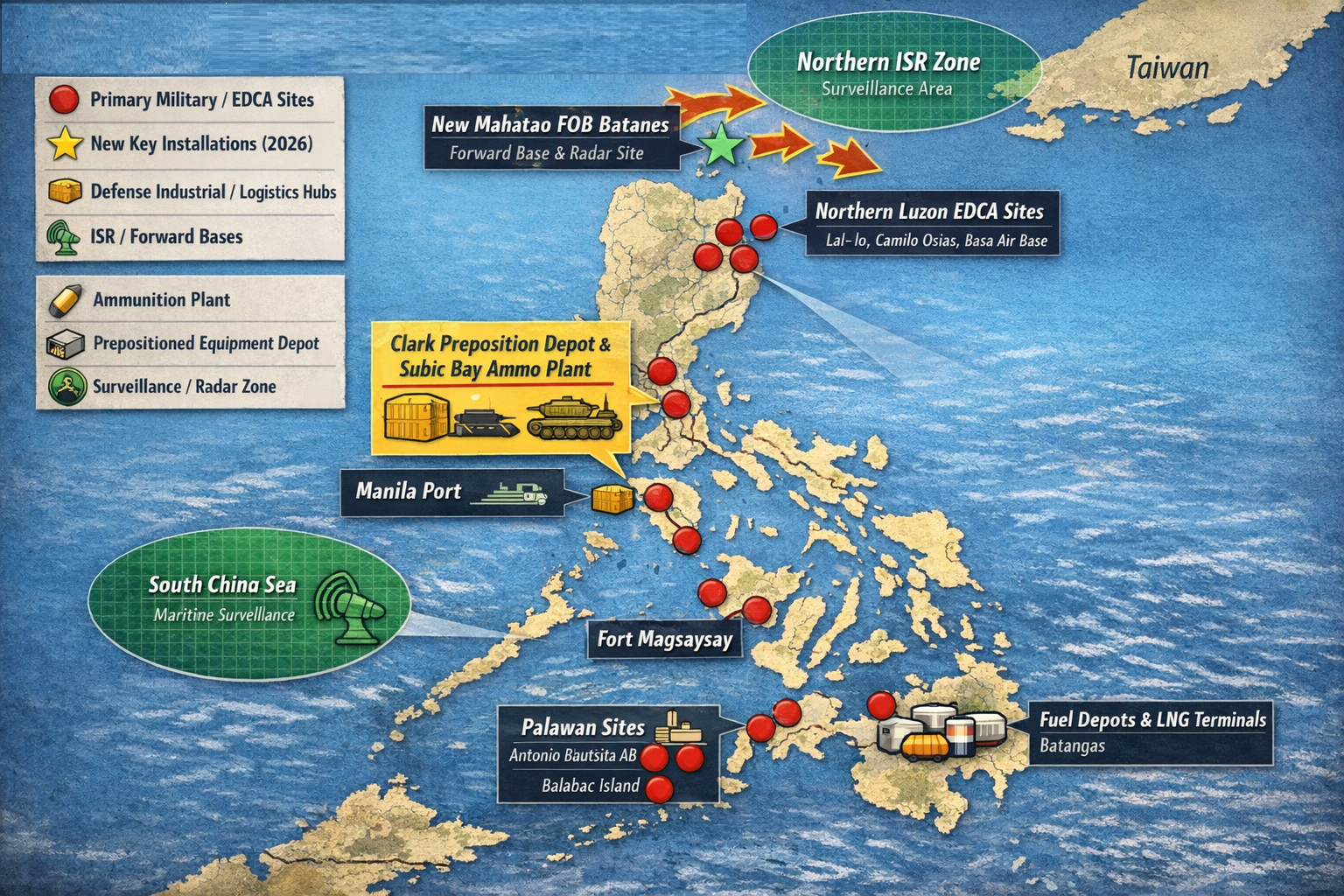
In the past, PH targets comprised mainly the EDCA sites. Now they include the planned ammo manufacturing sites. Manila is moving from a US logistical enabler to a huge regional military hub, like Ukraine a few years ago.

Last week, the Pentagon disclosed that the US-led military manufacturing partnership (PIPIR) is assessing funding for a major new ammunition assembly and production line in the Philippines.

Under its ultra-conservative PM Sanae Takaichi, Japan is taking the lead to set up a new program to produce propulsion systems used in many guided weapons, while the Philippines is tasked to host ⁠a large new weapons facility. The bilateral cooperation has intensified for half a decade.

Meanwhile, defense secretary Gilberto Teodoro has been negotiating stronger defense cooperation with the NATO leaders in Europe.

Following these reports, China’s foreign ministry warned the United States against bringing “conflict and the chaos of war” to the Asia-Pacific. In Beijing’s view, a potential ammunition facility would destabilize the region.

Toward major instability

The new military tasks of the Philippines were recently promoted by the Center for a New American Security (CNAS). This US thinktank played a role in legitimizing Biden administration’s engagement in Ukraine, Israel’s Gaza “war”, and Iran mobilization.

From an international military standpoint, the Philippines is transforming itself to serve as a forward staging area for US forces, air and naval logistics hub, missile deployment sites, ISR (intelligence, surveillance, reconnaissance), sea lane control in South China Sea, and protection of Japanese/US military supply routes.

In some ASEAN countries, the concern is that these strategic moves could pave the way to major instability and possibly a major Asian war.

The following commentary draws only from public sources and discourses on EDCA locations, logistics plans, ammo sites, and targeting doctrines seen in Ukraine, Middle East, and NATO war-gaming.

USJapanese weapons hub       

In the Philippine bases, the possible US air force deployments include F-35 and F-16 fighters, P-8 maritime patrol, KC-135 and KC-46 tankers, C-17 and C-130 transports or AWACS radar aircraft.

The most sensitive issue involves missile systems. US has discussed deploying mobile missile units in the region. Possible systems feature HIMARS, Tomahawk land-attack missiles, SM-6 multi-role missiles and Naval Strike Missile (NSM). Japan is developing Type-12 anti-ship missiles and long-range cruise missiles.

Ostensibly, US ground troops would be mostly rotational, not permanent. They could feature US Marines, Army air defense units, special forces, engineers and logistics.

With naval forces, ports in Philippines could support US destroyers, submarines and amphibious ships.

Japan is also increasingly involved in radar systems to Philippines, coast guard ships, joint exercises and possible future troop access agreements.

The risk is that the Philippines is close to its perceived adversary’s missile range, has limited air defense and many bases near civilian areas.

High-priority targets  

Among the primary targets, Northern Luzon is the primary operational zone. The EDCA sites include Lal-lo Airport, which is very close to Taiwan, is seen as a possible missile/transport hub, and thus a likely target for cruise or ballistic missiles.

Camilo Osias Naval Base is located near Luzon Strait. Since it could be useful for surveillance and naval staging, it is a likely high priority target. Basa Air Base could serve for fighter, tanker and ISR staging. It is a likely missile target.

Along with Northern Luzon, Palawan serves as the South China Sea axis where monitoring sites feature Antonio Bautista Air Base, which could support anti-ship operations. In turn, Balabac Island controls the passage between South China Sea and Sulu Sea. It could be useful for anti-ship missiles.

Then comes Central Luzon’s logistics core. Fort Magsaysay, the largest training base, and Mactan-Benito Ebuen Air Base, which remain relevant for training, staging and transport.

That’s the first-order military geography.

Ukrainian-style regional arms production     

With the new arrangements, the new primary targets feature the Subic–Clark corridor, due to the ammunition production/assembly planned in Subic Bay Freeport. As a part of regional military-industrial cooperation, it is framed as a regional munition hub. This upgrades Subic from a “logistics port” to a war-sustaining industrial node.

The second new development involves the large US prepositioning storage. US Navy is seeking a huge storage facility likely near Subic-Clark, featuring vehicles, equipment, maintenance, and armories.

The planned forward stockpile hub is similar to US prepositioning in Europe and the Middle East. Think of US prepositioning and war reserve stocks in Kuwait, Qatar, Israel and Diego Garcia – the ones that are now under fire.

Here’s the main difference: Philippine targets will be far more exposed than those in Europe and the Middle East. And that makes Subic Bay and Clark Freeport primary targets.

A third development may be evolving in Batanes, in the north. Having opened in 2025, the Forward Operating Base in Batanes is the closest Philippine territory to Taiwan. It is seen as ideal for radar, ISR, and potentially missile staging.

The expanding list of Philippines military targets

Living dangerously          

A naval blockade or a strike in this “Golden Triangle” (Subic-Clark-Manila) could effectively trap the Philippine defense manufacturing capability in one small zone. A single incident or blockade could paralyze the capital’s supply chain.

The plan to build ammunition production and assembly facilities in the Philippines changes the targeting logic of the Taiwan-war scenarios. The country will no longer be just a staging platform.

Behind the fog of the corruption debacle and the energy crisis that it is highly exposed to, the Philippines is taking a huge leap from a logistical warehouse to a regional military hub – amid its greatest economic crisis in a generation.

The devastation of the outlined Philippines targets would not be just a crushing military loss. Their demise would disrupt the heartbeat of the Philippine economy and society.

In Ukraine, Gaza, Lebanon, Iran and the Middle East at large, such arrangements have served the interests of recent US administrations.

The question is, do they really serve to protect peace and prosperity in the Philippines interest?

Dr. Dan Steinbock is an internationally recognized visionary of the multipolar world and the founder of Difference Group. He has served at the India, China and America Institute (US), Shanghai Institutes for International Studies (China) and the EU Center (Singapore). For more, see https://www.differencegroup.net 

The FBI’s FOIA Blacklist

by  | Apr 2, 2026 | antiwar.com


The Freedom of Information Act was designed to empower citizens to hold their government accountable. But evidence suggests the Federal Bureau of Investigation (FBI) has quietly adopted a practice that turns that principle on its head: labeling some of the people who file Freedom of Information Act (FOIA) requests as “vexsome.”

In effect, the agency has created a FOIA-specific blacklist. Yet when asked, it denies having done so.

The FBI has maintained what it calls a list of “vexsome” FOIA filers for years. The label itself is odd — the proper term would be “vexatious” — but the implication is clear enough. Certain individuals and organizations who file frequent records requests are flagged internally as troublesome.

That practice is deeply at odds with the very text of the Freedom of Information Act. FOIA exists because the late Representative John Moss (D-CA) spent 10 years encountering delays, evasions, and outright refusals by federal agencies and departments to give him information he needed for oversight purposes. Moss understood that many citizens and watchdog groups asked the same kind of persistent questions of executive branch officials as he did, but they lacked a statutory basis to force such information disclosures. It’s why Moss worked so hard to get FOIA into law. Investigative journalists, transparency organizations and researchers often file dozens — sometimes hundreds — of requests in pursuit of public records. The law anticipates and protects that behavior.

There is nothing in the FOIA statute authorizing federal agencies to maintain lists of “vexatious” requesters or to single out particular citizens for special scrutiny because they use the law frequently. The statute’s presumption is exactly the opposite: that access to government records belongs to the public, and that agencies must justify withholding them.

Yet internal records obtained through FOIA requests by transparency researcher John Greenewald, who runs the document archive The Black Vault, show that the FBI has indeed categorized certain requesters in this way.

The Cato Institute learned this firsthand when the FBI labeled it a “vexsome” FOIA requester during the previous administration. More recently, when I filed a FOIA request seeking records explaining how the FBI defines or uses that designation, the Bureau responded that it could find no records responsive to the request — even though records labeling individuals or groups as “vexsome” were previously available to Greenewald.

The FBI cannot both maintain a category of “vexatious” requesters and simultaneously claim no records exist describing how that category is used. That’s why Cato has filed a new FOIA lawsuit to force the FBI to produce the records at issue.

The deeper problem is what such labeling represents. FOIA was enacted in 1966 to prevent federal agencies from deciding which members of the public deserve access to government information. Congress deliberately structured the law so that requests are judged by their legal merits — not by who submits them or how often they do so. Indeed, the statute has been updated multiple times over the past 60 years in response to agency or department tactics designed to evade the statutes’ very purpose.

Once agencies begin categorizing requesters as nuisances or troublemakers, they create a de facto enemies list composed of the very taxpayers and citizens they are sworn to serve. A system meant to promote transparency risks becoming one in which the government quietly tracks and stigmatizes those who seek to hold it accountable for its conduct — or misconduct.

Agency and department heads routinely claim that FOIA is administratively burdensome — yet they never ask Congress for line-item appropriations to ensure processing is quick and efficient. Agencies process hundreds of thousands of requests each year — and in tens of thousands of cases invoke one or more of FOIA’s nine exemptions to keep information secret that in most cases should never have been withheld in the first place. Those tactics alone force requesters to retain lawyers capable of litigating through the delays, obfuscations, and denials. The FBI’s “vexsome FOIA filer” program takes this bureaucratic game to a whole new level.

It’s worth noting that one of Trump’s earliest public instructions to Attorney General Pam Bondi was a Presidential Memorandum directing her to seek sanctions against attorneys and law firms filing “frivolous, unreasonable, and vexatious” lawsuits against the federal government. Trump’s memo exhorted Bondi to go after lawyers or law firms working in the immigration arena, and Cato has active FOIA lawsuits on that topic, one going all the way back to Trump’s first-term “Muslim ban” executive order.

The language in Trump’s memo to Bondi is sweeping enough to place lawyers working on FOIA lawsuits in the administration’s legal crosshairs, and certainly enough for unwelcome FOIA requests to receive “special” disfavored treatment. Cato’s new FOIA lawsuit will hopefully yield answers to those and related questions.

The FBI is charged with upholding the Constitution and federal laws, but its latest actions suggest a troubling departure from both. The Freedom of Information Act exists so citizens can hold their government accountable without resorting to guesswork or suspicion.

Labeling FOIA requesters as “vexatious” not only turns that idea upside down, but it also violates the law. In a system that values transparency, asking persistent questions is not the problem. It is the point.

Patrick G. Eddington is a senior fellow at the Cato Institute. He is a former CIA analyst and ex-House senior policy adviser and the author of “The Triumph of Fear: Domestic Surveillance and Political Repression from McKinley through Eisenhower.”

France: Local elections create springboard for left division

Thursday 2 April 2026, by Léon Crémieux


Local elections were held in France on 15 March (first round) and 22 (second round). The confusion that has emerged, one year before the presidential election, is a sign of a fragmentation of the central bloc and the right, which is likely to produce a shift towards the far right and, in the face of this, a splintering of the forces of the Nouveau Front populaire (New Popular Front - NFP) which compromises the construction of a unitary alternative.

Each political party is now obsessed with preparing for the presidential and legislative elections which, barring any mishaps, will take place from April 2027. So, each political leader – and especially each future presidential candidate – impatient to put an end to the Macron years, has taken stock of these municipal elections by affirming, each with equal certainty, that they strengthen their political strategy to prepare for the major institutional deadline of 2027. These municipal elections were therefore obligatory, in their eyes, to be a “warm-up tour” and, following their results, each party wanted to read the augury of its own success in 2027. There has been a cacophony for a week, between and within many parties, with many contradictory insights into the results.

Specificity of local elections

It is nevertheless surprising to claim to draw a “lesson” from these elections – and even less the legitimization of a strategy for 2027 – because local elections have their own characteristics and, moreover, the results are largely mixed for both sides. There is not “one lesson” from the local elections.

In France, local elections (the election of local councils in municipalities) take place every six years, in each of the country’s 34,875 municipalities. These municipalities are the result of a division made during the French Revolution of 1789, essentially modelled on the map of Catholic parishes of the time. Since 1884, each has elected a municipal council, more or less numerous depending on the size of the municipality, and a mayor. In Europe, such a large number of municipalities is exceptional (the Spanish State, Germany and Italy have between 8,000 and 10,000 municipalities). But 32,000 of them have less than 3,500 inhabitants, in rural areas which now account for only 20.8% of the French population. 33,173 municipalities had their mayor elected in the first round on 15 March, so mainly in these rural areas where, two times out of three, there was only one “unlabelled” list.

Growing abstention

The clashes of political lists and their outcome therefore mainly concern municipalities with more than 3,500 inhabitants, which account for 69% of the population in 3,189 cities. First of all, it is important to highlight the constant increase in abstention, in all elections in general, and in local elections in particular. There were 42.7% abstentions this year, as turnout has been falling steadily for decades: they were less than 30% until 1997; in 2014 they were still only 37.8%. All elections in France (regional, European, local) now have an increasing abstention rate, around one in two voters. Only the presidential election has a higher turnout, but abstention is also steadily increasing, with more than one in four voters in 2022. Moreover, according to INSEE studies, more than 10% of the electorate is not, or does not believe itself to be, registered on the electoral rolls.

The only notable exception in this abstention curve was in 2024 the early parliamentary elections (which followed the dissolution decided on by Macron) and which resulted in the victory of the NFP lists: abstentions had fallen from 53% in 2022 to only 33% in the two rounds of this election. The broad mobilization present during this election was obviously out of step with the growing distance from the electoral processes. For these local elections, abstention was higher among young people aged 18 to 25 (56%), 25 to 34 (60%), the electorate having an income of less than €1250 (60%).

Erosion of PS and Republican results

The other specific point of these elections is the gap between the deep crisis of the traditional mainstream parties (the Parti socialiste (PS) and the Republicans) at the national level over the past 10 years and the maintenance of their presence in local institutions. But erosion is very present.

If we refer to the last twenty years, in towns with more than 30,000 inhabitants, the Republicans have gone from 102 town halls (120 with the “plural right”) in 2014 to 48 (97 with the “plural right”) in 2026. The same phenomenon applies to the PS, which has gone from 98 town halls (106 with the “plural left”) in 2008 to 30 in 2026 (52 with the “plural left”). The downward trend of the two old traditional parties is therefore obvious. Moreover, it should be noted that the “plural left” and “plural right” tend to be as important as the mayors affiliated to the Republicans or the PS.

For its part, the Macronist “central bloc” (Horizons, Renaissance, Modem) with 43 town halls maintains the weight that the centre-right already had in the 80s (Bayrou’s Modem or Borloo’s UDI). What is notable is that this “Macronist” current, since 2017, has not structured itself as a national party and has been unable to supplant the traditional parties at the local level.

In towns of more than 30,000 inhabitants, the RN won 12 municipalities and France Insoumise 6 (the French Communist Party (PCF) has 19 municipalites – 25 in 2014). So for these medium-sized and large cities, there is a slow but gradual loss for the Republicans and the Socialist Party.

The Republicans and the break-up of the “central bloc”

These elections take place in two rounds and the lists can merge with each other or remain if they have won more than 10% of the vote. Bruno Retailleau, president of the Republicans, was able to congratulate himself on the evening of the second round by declaring that “the Republicans and their allies have won the largest number of votes and elected representatives. We are still the leading local political force in France.” To invoke such figures, it is necessary to mobilize the results in all cities with more than 3,500 inhabitants where, in fact, the right has elected 1267 mayors and 8.7 million votes. The PS and the “plural left” only have 829 town halls, but 9.2 million votes.

The LR is struggling to hide a serious failure in the big cities, Paris, Lyon, Marseille. The Republicans can only have as trophies the election of three mayors of the “central bloc” which they support: Jean Luc Moudenc in Toulouse (a member of the small France audacieuse group, close to Edouard Philippe’s Horizons party), Thomas Cazenave in Bordeaux, a Macronist from the very beginning, and Antoine Armand in Annecy, both members of Renaissance (Macron’s party). The largest city led by a Republican is Clermont Ferrand, the 24th largest city in France, with 146,000 inhabitants.

Rachida Dati lost in Paris. Martine Vassal was largely outdistanced by the RN in Marseille and a union around the socialist Benoit Payan. There was also a failure in Lyon where Jean Michel Aulas, former president of the Olympique Lyonnais football club, supported by the entire right, was defeated by the outgoing Green mayor Grégory Doucet, whose list had merged with that of LFI. Finally, in Nice, while the Macronist Estrosi was officially supported by LR, Retailleau clearly stated his refusal to support him, sending him back to back with Éric Ciotti, former president of the LR, defector to the far right and now allied with the RN with his new small party UDR. Several LR elected officials from the South-East, such as the mayor of Cannes, have clearly shown their support for Ciotti.

So Retailleau’s triumphalist discourse on “LR being the biggest party in France” (LR gathered 4.8% in the 2022 presidential election and 4.3% in the 2024 parliamentary elections) serves the LR leadership to justify the forward march announced to the party’s Political Bureau: the designation of an LR candidate (either Retailleau directly, or through an internal primary), following this, the party would perhaps propose a common primary for LR and the parties of the central bloc (Renaissance and Horizons). This position is opposed to that of the party’s other main leader, Laurent Wauquiez, who would clearly like to open up to a primary integrating the far-right Reconquête (Knafo/Zemmour) party, a small party that is a member of the ENS group in the European Parliament with the German AfD and the anti-Semites and anti-Roma of the Hungarian MHM.

The real lesson concerning the LR is that this party, already heavily weakened, comes out of these elections clearly fragmented, underestimating the low electoral weight of their party for a presidential election, in the face of Horizons, Edouard Philippe and the remnants of Renaissance on the one hand, and the RN on the other. All this for an organization that is increasingly porous to the themes of the RN and to alliances with the far right. Being a substitute for an Edouard Philippe candidacy or fraying in the face of the RN are the two risks that threaten LR, which nevertheless sees itself as a rallying point with the “central bloc” of the Macronists.

In this camp of the Macronist centre-right and the right, there are nearly a dozen contenders, declared or not, for the presidential election, all wanting (there are no women candidates for the moment in this current) to turn the page on Macron, hoping to cover the same political space that had allowed the surprise victory, in 2017, by Emmanuel Macron. In any case, the central bloc and the right have not yet found the means not to run in 2027.

Rassemblement national

The Rassemblement national did not “turn the table upside down” in these local elections, but with its ally the UDR of Éric Ciotti, it won 57 town halls in the 3,060 cities with more than 3,500 inhabitants, compared to 9 in 2020. Its local weight is still derisory compared to its weight in national elections, but it has reached a real level. The victory in Nice is symbolic, but has difficulty erasing the failure suffered in Marseille and Toulon where a very good score in the first round gave hope of a victory. The RN came up against a front from the right in Toulon and a front from the left in Marseille. Only one RN elected official remains in a city of more than 100,000 inhabitants, Louis Aliot in Perpignan.

However, the RN is making progress in its institutional anchoring, particularly in the Var and the Nord region with several medium-sized municipalities won and now these results may allow the election of several senators. [1] This is one more step in a normalization where the party is nibbling away at votes on the right, the most spectacular image being the place taken by its candidate in Marseille, Frank Alisio, gathering 35% of the vote in the first round, three times more than the LR candidate, Martine Vassal, who appeared to be the favourite in the polls a few months before the election.

All in all, here again, despite everything, these results show the specificity of the local elections and the gap between the real results and the comments of Jordan Bardella, who presented them as “the expression of a profound shift (...) the end of an old world at the end of its rope”. The RN continues its race towards the presidential election with Bardella or Le Pen, if she is not declared ineligible this summer. The municipal elections have shown both the banalisation of this neo-fascist party (and the banalisation also assumed by the right of the small Reconquête party, of Sarah Knafo and Éric Zemmour) and the growing porosity of the electoral base of the hard right and the far right.

Splintering of the NFP

The real problem manifested by these municipal elections is the taking of a further step in the fragmentation of the components of the Nouveau front Populaire (NFP). Local elections have always been the most solid foundation, the network of institutional political life in France (it is essentially the municipal councillors who elect the Senate), and each traditional party has always wanted to “take care” of its presence at this level. La France Insoumise (LFI) had, until then, not been concerned about its municipal presence. After its victory on the left with the New Ecological and Social Popular Union (NUPES) in 2022, LFI had tried to negotiate agreements with its socialist, ecologist and PCF partners to obtain at least one senatorial position in the elections of the same year. Its weak weight in the municipal councils and a shopkeeper logic of the leaders of its allied parties led to a refusal and the continued eviction of LFI from the Senate.

In 2020, LFI only had two mayors in cities with more than 5,000 inhabitants. Beyond this first reason to have a strong influence in 2026, the announced strategy of LFI was to make these elections a springboard for the candidacy of Jean-Luc Mélenchon in 2027. The consequence was the choice to present more than 500 LFI-labelled lists in all cities with more than 100,000 inhabitants and in 80% of cities with more than 30,000 inhabitants, sticking to the areas where the presidential and parliamentary elections had given the best results. It was therefore clearly a choice of apparatus, but also linked to a strategy for 2027 aimed at making the most of the balance of power to impose itself as having the only candidate who could pass the first round. It was therefore out of the question for Mélenchon to present NFP lists again. LFI’s campaigns were, on radical bases taking up the NFP’s program, an affirmation without a unitary approach.

For the PS, the choice was diametrically opposed. To try to rely on the remaining strength of this party at the level of its local presence to give it back national visibility and build a sufficient balance of power, either for an autonomous socialist candidacy in 2027 (with the possibility of a choice of the PS-Place publique with Raphaël Gluksmann), or to participate in a primary of the left with the other components of the NFP (without Mélenchon) as was proposed in Tours in January 2026 by a joint announcement by Olivier Faure, Marine Tondelier, Clémentine Autain, François Ruffin.

In parallel with these preparations, the weeks leading up to the local elections saw the multiplication of centrifugal forces. Alongside the system set up by LFI, the rest of the NFP parties have built alliances of variable geometry, according to local configurations. But while the Ecologists and the PCF left the door open to alliances with LFI against the right, the leadership of the PS, under pressure from the right of the party (Jérôme Guedj and François Hollande, in particular), affirmed “no national agreement in the second round with la France Insoumise”, rejecting LFI as part of the “respectable” left (while leaving the possibility of local agreements quietly). This came after the leaders of the PS multiplied the denunciations of LFI, resuming the despicable campaign of the right after the death of the neo-Nazi Quentin Deranque and the multiplication of the denunciation of Mélenchon as an anti-Semite.

La France insoumise semblait donc mise sur la touche de ces élections et la physionomie du reste de la gauche unie semblait donner du crédit aux partisans d’une recomposition d’une unité de la gauche « à l’ancienne » sous domination sociale-démocrate. Malgré tout, des dynamiques militantes unitaires se sont construites, par exemple à Saint-Denis ou à Toulouse.
The right wing of the party thus seemed to have sealed the party line, forcing Faure to close the page on the NFP and even to rule out an open primary on the left with forces like the Greens and Après (which had rejected the PS’s line in the Assembly of support for the budgets of the Lecornu governments and had voted for censure several times). Marseille and Paris seemed to represent this line of unity of the NFP without LFI since the unity of all the other components (Ecologists, PCF and Après) was achieved behind Emmanuel Grégoire in Paris and Benoit Payan in Marseille.

La France Insoumise therefore seemed to be sidelined in these elections and the physiognomy of the rest of the United Left seemed to give credence to the supporters of a recomposition of an “old-fashioned” left-wing unity under social democratic domination. Despite everything, unitary activist dynamics have been built, for example in Saint-Denis or Toulouse.

The results of the first round of the elections and the days that followed have belied this scenario. If the PS had garnered good results, the spectacular breakthrough came from LFI, which won Saint-Denis, the largest municipality in the Paris region, was in a clear position to win in Roubaix, and came out as head of the left in Toulouse, in particular. The lists made more than 10% in 60% of the suburban municipalities, in 96 cities. These very good local results reduced the press campaign of reaction to nothing and made LFI appear as a local popular force, an essential component of the left.

LFI, reversing its position of isolation from the first round, nationally proposed the merger with the other lists of the left to create an “anti-fascist front2, in practice to defeat the right. Despite the decision of the PS leadership, PS/LFI agreements multiplied in many cities, such as Toulouse, Nantes, Tulle, Limoges, Clermont-Ferrand, signed in several cases by socialists close to Hollande and Guedj, as in Tulles and Nantes. The entire campaign and the positioning of the PS seemed to collapse like a house of cards and the unity of the left was to be rebuilt. But above all, the PS confused its own voters, to whom most of the party’s leaders had repeated that it was impossible to ally with Mélenchon’s party. In Paris and Marseille, the heads of the socialist lists refused to merge the lists. In Marseille, this refusal seemed incomprehensible when the list of the socialist Benoit Payan was only ahead of that of the RN by 1.6%, that the LFI list had gathered 11.94% and that, in any case, many voters of the LR candidate (12.41%) would turn to the RN in the second round, giving the mayoralty to the far right. Despite the sectarian refusal of Benoit Payan, LFI had the intelligence to prefer to withdraw its list, even without a merger, rather than offer the city to the RN.

But the most serious thing is obviously that, in total, the divisions of the first round campaign, the surge of a hateful campaign against LFI and a strong mobilization of the right will have prevented the victory of the LFI candidate at the head of the merged lists in Toulouse and Limoges and a real percentage of PS voters will not have followed the movement. It should be noted that it was only after the first round, in Toulouse for example, that the unions (CGT, FSU, Solidaires) called for a vote for the merged list on the left. These mergers and the voluntary withdrawal of LFI in Marseille have led to victories on the left as well as in Nantes and Lyon. But the majority of the merged LFI/PS lists were defeated, allowing a new offensive within the PS to block any approach to unity on the left.

In total, LFI won its bet of local implantation by winning the elections in 8 cities, including 7 with more than 30,000 inhabitants, mainly in the working-class suburbs of the Paris region, in the North and around Lyon. However, this campaign will have put the left on a track that can only derail it in 2027. The main parties of the left see their action in the coming months only on the institutional terrain, with the electoral preparation of 2027, without any joint campaign on social or democratic issues. In addition, the fragmentation of the left-wing parties has largely slowed down the construction of unitary approaches with the social and trade union movement. The difference with June/July 2024 is obvious from this point of view. On the electoral question, a sad symmetrical game is being played. Olivier Faure has just publicly rejected “any national agreement between the PS and LFI for the presidential and legislative elections”. A statement unimaginable two years ago and demoralizing for tens of thousands of activists of the social and trade union movement who see the arrival of the RN in 2027. On the side of la France Insoumise, all the statements that followed the second round rule out any reference to the NFP, detailing the party’s march towards the presidential election and calling on left-wing currents to join it without proposing any common approach by the NFP parties.

The way therefore seems closed to the construction of a unity on the left on the basis of a break with austerity policies and no social lever appears for the moment that can reverse the centrifugal dynamics, while the popular classes are still suffering new attacks with the increase in the cost of living due to speculation on oil products and in the background, The climate, ecological, health and social crises continue to worsen, boosted in particular by the wars in the Middle East and Eastern Europe, inter-imperialist rivalries and the arms race. It is therefore an imperative necessity, in the face of the programmed victory of Bardella/Le Pen, to build such a unitary alternative of a rupture with neoliberal capitalist policies, a construction that would require the united mobilization of all the forces of the workers’ and democratic movement, as was achieved in 2024, barely two years ago.

Source: Viento Sur

Footnotes

[1The Senate has 348 seats. It is elected by indirect suffrage by 162,000 grand electors, 95% of whom are delegates from municipal councils, plus other regional elected officials, deputies and senators.