Tuesday, April 28, 2026


Ukraine Summons Israel's Ambassador Over Second Shipload of Stolen Grain
Haifa
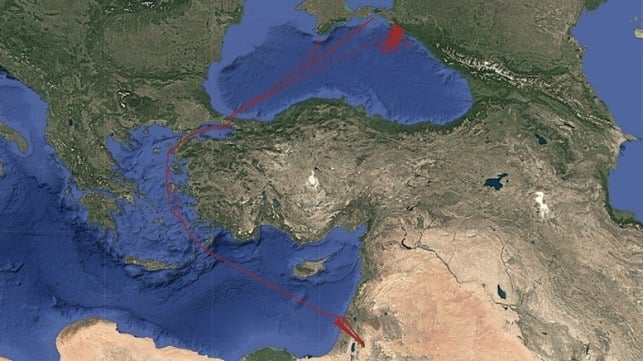
The AIS track of the bulker Panormitis on two voyages between Haifa and Russian-controlled sectors of the Black Sea. Clear patterns of GPS disruption are visible off Israel and Novorossiysk (Pole Star Global)

Published Apr 27, 2026 11:19 PM by The Maritime Executive


In mid-April, Ukraine's foreign ministry took the Israeli government to task for allowing a ship carrying allegedly stolen grain from Russian-occupied territories to unload at the port of Haifa. On Monday, Ukrainian foreign minister Andrii Sybiha said that he had summoned the Israeli ambassador to present a formal note of protest: a second shipload of allegedly stolen grain has arrived off Haifa, without action by the local authorities - and Kyiv wanted an explanation. 

"It is difficult to understand Israel’s lack of appropriate response to Ukraine’s legitimate request regarding the previous vessel that delivered stolen goods to Haifa," said Sybiha. "Now that another such vessel has arrived in Haifa, we once again warn Israel against accepting the stolen grain and harming our relations."

The EU seconded the sentiment, in gentler terms. In a statement to the Times of Israel, an EU spokesperson said that "we condemn all actions that help fund Russia’s illegal war effort and circumvent EU sanctions, and remain ready to target such actions by listing individuals and entities in third countries if necessary."

The vessel has been identified by Israeli media as the Panormitis (IMO 9445201), a Greek-owned bulker that recently anchored off Haifa. Her exact position is unknown: due to the heavy GPS spoofing found in Israeli airspace, Panormitis' AIS system shows (falsely) that the vessel is located in a cluster of ships at Queen Alia International Airport in Amman, Jordan, 80 miles inland. 

It is not Panormitis' first call in Haifa. AIS data provided by Pole Star Global shows that the ship spent about four weeks in the northeast (Russian) corner of the Black Sea in February through March, then transited to Haifa. She returned northwards to call again in the same region in April, potentially reaching the Kerch Strait, then transited back to Haifa once again. The vessel operated with AIS turned off for a significant part of her voyage in the Black Sea, a common practice in the region. 

According to Haaretz, the Russian export system for ex-Ukrainian wheat revolves around ship-to-ship transfers, conducted near the southern entrance to Kerch Strait. Shuttle vessels move grain from Sevastopol and other Russian-occupied loading ports to a designated granary ship - in several cases, the bulker Glendale - which then transloads the grain onto the internationally-trading bulkers that carry it to market. In this account, based on satellite imaging, some of the ships that carry stolen grain abroad never call in a Russian port; they load offshore, and can therefore deny connections to the Russian occupation economy. Suspect voyages of this type between the Kerch Strait and Israel have been identified as far back as 2023, with multiple vessels implicated. 

Israeli foreign affairs minister Gideon Sa'ar said in a statement that "evidence substantiating the allegations [about Panormitis] have yet to be provided," and he claimed that Ukraine had not reached out privately before broadcasting the complaint on social media. Sa'ar suggested that the matter would be handled locally as an administrative issue. 

 

Stolen Ukrainian grain is being unloaded in Haifa, EU threatens sanctions

Stolen Ukrainian grain is being unloaded in Haifa, EU threatens sanctions
A Haaretz investigation and Ukrainian diplomatic protests reveal a pattern of Russian-looted wheat reaching Israeli ports, triggering a summons of Israel's ambassador and EU sanctions threats — while exposing the uncomfortable contradictions of Israeli neutrality. / bne IntelliNews


By Ben Aris in Berlin April 28, 2026

Ukraine summoned Israel's ambassador to Kyiv on April 27 and filed a formal protest after a second shipment of grain allegedly stolen from Russian-occupied Ukrainian territories docked at the port of Haifa, in a diplomatic escalation that has thrust Israel's policy of studied neutrality toward the Russia-Ukraine war into uncomfortable public scrutiny.

The démarche followed a major investigation published by the Israeli newspaper Haaretz on April 26, which documented a sustained pattern of Russian-looted Ukrainian grain reaching Israeli ports. An internal log obtained by Haaretz from Russian authorities in occupied Ukrainian ports lists more than 30 shipments of stolen grain with Israel listed as the destination — a figure that dwarfs the individual incidents that have so far become public.

The paper trail: Ukraine warned Israel on March 23

The most damaging element of the story for Israel is not the grain itself but the documentary record of what it knew and when. An official statement published on April 16 by Ukraine's Ministry of Foreign Affairs — issued before the Haaretz investigation was published — laid out the timeline with precise dates.

Ukraine informed Israeli partners on March 23 about the vessel ABINSK and the possible origin of its cargo from temporarily occupied Ukrainian territories, and "emphasised the inadmissibility of import operations with such products." According to the Ukrainian MFA statement: "Assurances were received regarding an appropriate response."

"It is concerning that despite the information provided and contacts between the parties, the vessel was allowed to unload at the port of Haifa on April 12-14," the statement continued.

Ukraine classifies the ABINSK as a vessel "involved in the activities of the 'shadow fleet', which the aggressor state uses to illegally export, transport and sell stolen Ukrainian grain from the temporarily occupied territories and, ultimately, finance the war against Ukraine." A Ukrainian court issued an arrest warrant for the vessel and its cargo within criminal proceedings. Ukraine immediately sent a formal request for international legal assistance to Israel on the basis of that court decision, asking Israeli authorities to apply the relevant legal mechanisms under Israeli jurisdiction.

The MFA statement expressed hope for "fruitful and constructive interaction" and said Ukraine's embassy in Israel was "in constant contact with the Ministry of Foreign Affairs of Israel and the competent Israeli authorities in order to ensure appropriate steps." Those steps, as subsequent events confirmed, were not taken.

The ABINSK and the Panormitis

The ABINSK delivered nearly 44,000 tonnes of stolen Ukrainian wheat to Haifa. A second vessel, the Panama-flagged bulk carrier Panormitis, arrived in Haifa Bay on April 26 and was awaiting permission to berth as the diplomatic storm was breaking. According to Ukrainian investigative journalist Kateryna Yaresko from the SeaKrime project, who first broke the story, the Panormitis was loaded with grain from occupied Ukrainian territories via transfers from other ships and departed from the Port of Kavkaz in Russia's Krasnodar region, with a large portion of the cargo transferred from the occupied Ukrainian city of Berdyansk on the Sea of Azov coast.

Ukrainian Foreign Minister Andrii Sybiha said Ukraine values its relationship with Israel but warned that Russia's illegal trade in stolen agricultural products should not undermine bilateral ties. A Ukrainian diplomatic source said that if Israel did not reject the latest cargo, Kyiv would "reserve the right to deploy a full suite of diplomatic and international legal responses" and that Israel had "essentially shrugged off" Kyiv's previous demands. "Frankly, this feels like a slap in the face given the strategic goodwill Ukraine has extended — from designating the IRGC as terrorists to criminalising antisemitism," the source said.

Israeli Foreign Minister Gideon Sa'ar told Sybiha that Ukraine had provided no evidence to support allegations that the grain was "stolen" and accused him of conducting diplomacy through the media — a claim directly contradicted by Ukraine's published MFA statement documenting the March 23 notification and Israel's assurances. A community note was subsequently added to Sa'ar's social media post pointing out that "Ukraine provided evidence and formal requests for legal assistance to Israel regarding previous shipments of alleged stolen grain since March, including ambassadorial meetings and a judicial cooperation request, despite claims to the contrary."

The scale of the operation

Russia established the State Grain Operator in the occupied city of Melitopol in May 2022 as the primary vehicle for monetising looted Ukrainian agricultural production. The SGO exported 212,000 tonnes of Ukrainian grain in 2023 alone, estimated at $46mn, operating through a network of shell companies. According to Kyiv's estimates, at least 15mn tonnes of Ukrainian grain have been stolen by Russia since the start of the full-scale invasion.

The Haaretz investigation, drawing on the internal Russian port logs, documents more than 30 shipments of stolen grain destined for Israel, a figure that places the ABINSK and Panormitis incidents not as isolated events but as part of a systematic commercial relationship between Russia's occupation economy and Israeli grain importers.

Israel is a major destination but not the only one. Egypt, Turkey, Bangladesh and Libya are also significant recipients, with approximately 70 countries receiving some volume of stolen Ukrainian grain according to tracking data. The EU is now weighing sanctions against individuals involved in the smuggling operation.

The broader policy context

Russia effectively supplies 70 to 80% of Israel's wheat imports, according to $A data. Israel has not joined international sanctions against Russia, has declined to supply Ukraine with weapons including the Iron Dome missile defence system, and Netanyahu has sought throughout the war to maintain a neutral stance between Moscow and Kyiv. That neutrality has become harder to sustain as Russia has deepened its support for Iran during the US-Israel war, providing critical intelligence to Tehran against Israeli forces.

The grain scandal has brought that unspoken tension into the open at the worst possible moment — as Israel simultaneously seeks Ukrainian diplomatic support in the Iran war and continues to import Russian wheat taken from the Ukrainian soil that Russian troops are occupying. The MFA documents make clear that this is not a question of ignorance. Israel was told. Israel gave assurances. Israel allowed the ship to dock.

Ukraine Destroys Sea Drone as Russia Strikes Odesa Ports and Cargo Ships

sea drone exploding
The Ukrainian Navy destroyed a Russian sea drone before it could reach the port of Ukraine (Ukrainian Navy)

Published Apr 24, 2026 12:11 PM by The Maritime Executive


Ukrainian officials report that Russia continues to target the port infrastructure in the Greater Odesa region in an effort to disrupt commercial trade. They assert the recent strikes on commercial shipping are deliberate acts by the enemy.

Overnight, another cargo ship was struck while sailing in the corridor that Ukraine has maintained for two and a half years for commercial shipping. According to the reports, it was the third commercial ship struck recently, however the Ukrainian Navy also released images of a successful interdiction of a sea drone attempting to attack one of the ports in the Greater Odesa region.

The brief video released by the Navy shows a sea drone approaching when it is hit and explodes. The Navy said they had been able to detect and track the approaching drone and destroyed it before it was able to reach one of the ports in the Greater Odesa area.


The ship that was hit overnight was only identified as a bulker registered in St. Kitts and Nevis. It was struck by two drones, which started a fire on the ship. None of the crew was injured, and they were able to extinguish the fire. The ship was heading toward the Odesa ports.

On Wednesday, the Seaports Administration of Ukraine reported that the port infrastructure was attacked overnight. It said a drone had caused a local fire that damaged warehouse facilities. They also said a cargo ship was hit in the area of its hold and reported a fire.

Media reports said it was the latest in a series of recent attacks. Another ship registered in St. Kitts and Nevis had also been recently struck. A Syrian crewmember was killed, and the assistant captain was injured on a Comoros-flagged bulker that was carrying soy. The Seaports Authority reports the port infrastructure remains operational. It, however, continues to operate with safety restrictions.

Earlier in the week, Oleksiy Kuleba, Vice Prime Minister for the Reconstruction of Ukraine, highlighted that the ports had met 98 percent of their target of over 21 million tons for the first quarter of the year despite the ongoing attacks. He said since the beginning of the year, the ports have been attacked on average every five days, with 193 infrastructure facilities and 25 civilian vessels damaged. Despite that, they handled over 11.6 million tons of grain and 1.2 million tons of steel and metal products. Container handling increased by 43 percent to over 63,000 TEU during the quarter.

Since the start of the Ukrainian Sea Corridor in September 2023, Kuleba says it has processed over 190 million tons of cargo, of which over 110 million tons are grain.


Drone strike triggers fire at Russia's Tuapse oil refinery in latest attack on Black Sea facilities
Drone strike triggers fire at Russia's Tuapse oil refinery in latest attack on Black Sea facilities
/ bne IntelliNewsFacebookTwitter
By bne IntelliNews April 28, 2026

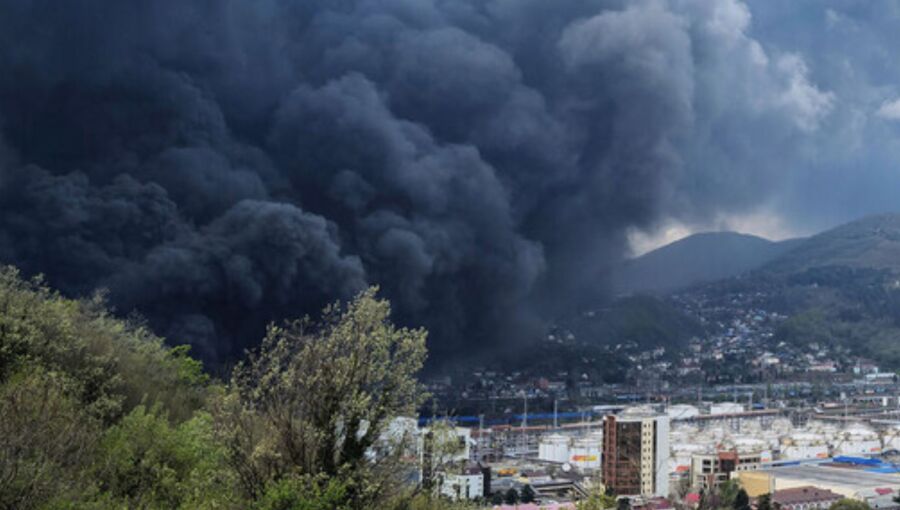
A fire broke out at the Tuapse oil refinery in Russia's Krasnodar Krai on April 28 after a drone strike, the regional operational headquarters said, Kommersant reported.

Falling debris from unmanned aerial vehicles caused the blaze on the refinery's territory. There were no immediate reports of casualties.

A total of 122 personnel and 39 units of equipment have been deployed to contain the fire, including units from the Krasnodar Krai branch of Russia's Emergencies Ministry and other specialist services.

The incident is the third major drone attack on Tuapse infrastructure in recent weeks. Drones struck the city's seaport on the night of April 20, with the resulting fire taking until April 24 to extinguish. An earlier attack on the maritime terminal on the night of April 16 caused another fire that burned until April 19.

The repeated strikes have led to environmental damage. Following the series of fires and subsequent heavy rainfall, oil products from the terminal entered the Tuapse River and then the Black Sea coastal waters. Emergency response work has been organised to contain further contamination.

A petroleum products collection system has been deployed on a section of the river downstream, with simultaneous cleanup work on the coastal strip and in the marine area. By the morning of April 27, 4,200 cubic metres of soil contaminated with petroleum products and water-fuel oil mixtures had been collected from three sites.

Emergency services continue firefighting operations at the refinery and are monitoring conditions in the city and at adjacent industrial facilities. Further information on the scale of the fire and the consequences of the incident is being clarified.

Tuapse, located on Russia's Black Sea coast, is home to one of the country's principal oil export terminals and a refinery operated by Rosneft. The facility processes around 12mn tonnes of crude per year and serves as a key outlet for Russian crude and refined products to international markets via the Black Sea.

The site has been a recurring target of Ukrainian long-range drone strikes throughout the war, with attacks intensifying through 2025 and 2026 as Kyiv has sought to disrupt Russia's hydrocarbon export revenues.

The damage at Tuapse forms part of a wider pattern of strikes on Russian refining infrastructure that have periodically tightened domestic fuel supply and contributed to retail price rises in some regions.

Reclassifying marijuana as a less dangerous drug might only be the first step for Trump

By The Associated Press
Published: April 24, 2026


SEATTLE — U.S. President Donald Trump’s decision to reclassify state-licensed medical marijuana as a less dangerous drug is a boon for the industry: It gives dispensaries a big tax break, eases some barriers to researching cannabis and could even allow the export of marijuana to other countries.

But that might only be Trump’s first step. A new administrative hearing slated for the end of June could result in the reclassification of marijuana more broadly, granting tax and other benefits to state-licensed recreational markets, too.

“This is a signal that this administration means business on getting this done,” said Boston-based cannabis industry attorney Jesse Alderman, of the firm Foley Hoag.

The order issued Thursday does not legalize marijuana for medical or recreational use under federal law, and it is likely to face legal challenges.

But it does change the way marijuana is regulated, shifting licensed medical marijuana from Schedule I — reserved for drugs without medical use and with high potential for abuse — to the less strictly regulated Schedule III.

A long-sought shift

It was a significant policy shift for a U.S. government that has been steadfast in its prohibition of pot, even as all states but two — Idaho and Kansas — have approved cannabis in some form since California became the first to OK the medical use of marijuana in 1996.

Two dozen states plus Washington, D.C., have authorized adult recreational use of marijuana, raising billions in tax revenue. Forty have medical marijuana systems, and eight others allow low-THC cannabis or CBD oil for medical use.

The order noted that regulation of medical marijuana has come a long way, with comprehensive licensing polices from cultivation to sales in most states.

Douglas Hiatt, a longtime Seattle marijuana defence attorney, recalled the height of the AIDS epidemic in the 1980s and ’90s, when police regularly raided grow operations designed to support patients.

He joined one client, a disabled medical marijuana activist named JoAnna McKee, as she met in the woods with members of the Hells Angels motorcycle club to procure cannabis for other patients after a police raid — just one example of the desperate lengths that were sometimes required to procure pot back then, he said.

“We were watching all these guys die from this horrible disease, and the only thing that helped them keep their pills down was marijuana, and the cops were going after anyone who helped them get it,” Hiatt said in a phone interview Thursday. “It was crystal clear from the beginning that it had medical uses. For the feds to admit that now is great. It’s surreal.”
Critics express doubts

Some health experts have suggested that legalization in the states has led to stronger and stronger cannabis products, which need to be researched rather than categorized less strictly than before.

Taking marijuana from a Schedule I drug to a Schedule III drug implies that it’s useful as a treatment, but there are no “massive medical indications for cannabis,” said Dr. Smita Das, an addiction psychiatrist at Stanford University. Further, cannabis use disorder — which affects about 3 in 10 people who use pot, according to the U.S. Centers for Disease Control and Prevention — has been on the rise, she said.


“We’ve already had kind of a decrease in risk perception related to cannabis over the years with the state legalization,” Das said. ”This will probably just add to that.”

The reclassification is a far cry from what many critics of the drug war still long to see: full legalization, with measures to address the harms caused by prohibition, especially in minority communities that were disproportionately affected. Many states have already taken steps such as expunging criminal records.
There is confusion for some dispensaries

Now, state-licensed medical operators can finally deduct business expenses on their federal taxes, a crucial financial benefit.

But in a number of recreational pot states, licensed dispensaries serve both markets — making it an accounting nightmare to ascertain how much of their business expenses might stem from the medical side, and thus be deductible.

“If this artificial distinction between medical and recreational is maintained, it raises all sorts of questions,” noted sociology professor Josh Meisel, who co-founded the Humboldt Institute for Interdisciplinary Marijuana Research at California State Polytechnic University, Humboldt.

Trump told his administration in December to work as quickly as possible to reclassify marijuana, following up on stalled efforts launched during the Biden administration. On Saturday, as the Republican president signed an unrelated executive order about psychedelics, he seemed to express frustration that it was taking so long.
‘Giving a tax break to Big Weed’

The president of the American Trade Association for Cannabis and Hemp, Michael Bronstein, called the order “the most significant federal advancement in cannabis policy in over 50 years.”

But marijuana legalization opponent Kevin Sabet, CEO of Smart Approaches to Marijuana, said that while marijuana research is necessary, “there are many ways to increase our knowledge without giving a tax break to Big Weed.”

Trump has made his crusade against other drugs, especially fentanyl, a feature of his second term, ordering U.S. military attacks on Venezuelan and other boats the administration insists are ferrying drugs.

___

Gene Johnson, The Associated Press

Johnson reported from Seattle.

Associated Press reporter Laura Ungar contributed.
GM expects a $500 million tariff refund from Trump levies the Supreme Court struck down


ByThe Associated Press
April 28, 2026 

The General Motors logo is displayed at its headquarters in Detroit on April 24, 2024. (AP Photo/Paul Sancya, File)

NEW YORK (AP) — General Motors is expecting a $500 million tariff refund after the Supreme Court struck down some of President Donald Trump’s most sweeping levies.

That’s boosted the Detroit auto maker’s outlook for 2026. On Tuesday, GM said it’s now looking to rake in $13.5 billion to $15.5 billion in earnings before interest and taxes this year — up from previous forecasts of $13 billion to $15 billion.

The refund is set to ease the company’s total tariff expenses some. GM anticipates paying $2.5 billion to $3.5 billion in tariff costs for 2026, the company said Tuesday, down from an original estimate of $3 billion to $4 billion.

“We are clearly operating in a very dynamic environment, which isn’t unusual for this industry,” CEO Mary Barra wrote in a letter to shareholders. Still, she maintained the company was seeing solid growth and a strong balance sheet “to achieve our long-term goals.”

For the first quarter of 2026, GM reported earnings of $2.63 billion and a revenue of $43.62 billion.


GM confirmed to The Associated Press that it hasn’t received the refund yet, and doesn’t have a specific estimate for when it will, but $500 million is what it expects following the decision from the Supreme Court. The court in February ruled that the levies Trump imposed using the International Emergency Economic Powers Act, or IEEPA, were illegal.

Companies both big and small are seeking refunds for IEEPA tariffs they’ve already paid. The Customs and Border Protection agency launched an online system for claims last week.

If CBP approves a claim, it will take between 60 and 90 days for a refund to be issued, the agency said. But the system is being rolled out in phases, and only some tariff refunds will be returned in the first phase.

CBP said in court filings that over 330,000 importers paid a total of about $166 billion on over 53 million shipments.

The now-overturned IEEPA tariffs included so-called “reciprocal” tariffs that Trump slapped on nearly every country in the world a year ago and “trafficking tariffs” on imports from Mexico, Canada and China — as well as separate duties on countries like Brazil and India, all of which the president imposed by declaring a national emergency.

February’s Supreme Court decision marked a significant blow to Trump’s economic agenda. But many other tariffs remain in effect — including punishing sectoral levies that Trump imposed using another law (Section 232 of the 1962 Trade Expansion Act) on foreign steel, aluminum, cars and other products. And companies like GM are continuing to pay those costs.

The administration has also signaled that more new duties are on the way.

Trump has publicly attacked companies who have warned of price hikes spanning from tariffs — and at times used the threat of new import taxes to strike deals. Last week, the president also said he’ll “remember” those that do not seek refunds from his IEEPA tariffs.

“I think it’s brilliant if they don’t do that,” Trump told CNBC of companies that hadn’t yet sought reimbursements. “If they don’t do that, they got to know me very well.”

____

AP Business Writer Mae Anderson in New York contributed to this report.


Wyatte Grantham-philips, The Associated Press

U.S. signs energy and AI deals with Balkan countries as its influence widens


Published: 

The White House is seen from the Washington Monument, Monday, April 20, 2026, in Washington. (AP Photo/Julia Demaree Nikhinson)

DUBROVNIK, Croatia - The United States and U.S. companies signed deals worth billions of dollars with Balkan countries on Tuesday, boosting Washington’s energy presence in the region and backing AI development.

The U.S. is seeking to deepen ties and counter the influence of Russian oil and gas in southern Europe, having signed a long-term deal last year to export liquefied natural gas to Greece.

“President Trump is opening a new era of cooperation with southern, and central and eastern Europe,” U.S. Energy Secretary Chris Wright told reporters at the Three Seas Initiative business forum in Dubrovnik, Croatia.

In Tirana, U.S. ambassador to Greece Kimberly Guilfoyle signed a $6 billion, 20-year agreement between Venture Global VG.N and Aktor LNG USA to export LNG to Albania.

“This commitment strengthens energy security - and national security - across the entire region,” Guilfoyle said on X.

The deal came as Wright confirmed U.S. backing for an agreement between Bosnia and Herzegovina and Croatia to build a gas pipeline carrying U.S. natural gas from an LNG terminal on the Croatian island of Krk to Bosnia.

The project, which aims to diversify Bosnia’s energy supplies and reduce its reliance on Russian gas, will be financed and led by U.S. company AAFS Infrastructure and Energy LLC. The company is run by Jesse Binnall, a former Trump lawyer, and Joseph Flynn, the brother of Trump’s former national security adviser Michael Flynn.

AAFS has said it would invest about 1.5 billion euros ($1.8 billion) in the project.

Croatia and the U.S. also issued a joint statement on cooperation in civilian nuclear energy.

Separately, Croatian engineering company Rade Koncar and U.S.-based investment group Pantheon Atlas LLC signed a letter of intent to participate in an AI development and data center project in central Croatia, estimated to be worth 50 billion euros.

The plans envisage a facility with 1 gigawatt of power capacity for AI computing and cloud services, with construction tentatively due to start in 2027 and operations by 2029, subject to permits and grid upgrades.

(Reporting by Antonio Bronic in Dubrovnik, Ivana Sekularac in Belgrade and Daria Sito-Sucic in Sarajevo. Writing by Edward McAllister. Edited by Mark Potter)

Qualcomm surges on report of OpenAI tie-up for AI smartphone processors


Published: 


The Qualcomm logo is seen on a screen at the Nasdaq MarketSite in New York on Feb. 14, 2018. (Richard Drew / AP Photo)

Qualcomm shares jumped 13 per cent in premarket trading on Monday after an analyst said OpenAI was working with the chip designer and Taiwan’s MediaTek to develop smartphone processors.

Qualcomm and MediaTek are co-development partners for an AI-first smartphone that the ChatGPT creator is planning, with mass production likely in 2028, TF International Securities analyst Ming-Chi Kuo said in a post on social media platform X.

China’s Luxshare, an Apple supplier, is the exclusive system design and manufacturing partner for the device, according to Kuo, who is based in Taiwan and known for his accurate predictions on Apple’s products.

The companies did not immediately respond to requests for comment.

OpenAI has been exploring consumer AI devices for years and last May acquired Jony Ive’s startup io Products for US$6.5 billion, tapping the former Apple designer to lead the efforts.

But media reports have indicated that the planned device would not be a smartphone. Altman told employees it would be a “third core device” alongside phones and laptops, the Wall Street Journal reported last year.

The loss-making startup has also pulled back from side projects to focus on coding tools for businesses - one of the few AI areas with clear commercial traction.

Launching a smartphone would pit OpenAI directly against deep-pocketed rivals Apple and Samsung, which together command about a 40% share of the global market for the device.

It would also add to signs that the smartphone would likely retain its central role in people’s lives in the AI era, after Reuters reported last month that Amazon was planning a fresh push into the handset market.

Apple shares were down 1.7 per cent. The company last week named long-time hardware chief John Ternus as CEO, a sign that devices would continue to play a central role in its business even as it looks to catch up in offering AI to users.

(Reporting by Deborah Sophia in Bengaluru; Editing by Arun Koyyur)

Musk’s social media use questioned as he, Sam Altman arrive for OpenAI trial


ByReuters
Updated: April 28, 2026
Elon Musk arrives at the U.S. District Court in Oakland, Calif., Tuesday, April 28, 2026. (AP Photo/Godofredo A. Vásquez)

OAKLAND, California — A trial that could help shape the future of artificial intelligence begins on Tuesday, with billionaires Elon Musk and Sam Altman at odds over the evolution of ChatGPT maker OpenAI from a nonprofit to a profit-seeking juggernaut worth hundreds of billions of dollars.

Musk and Altman arrived at the Oakland, California, federal courthouse early for opening statements in Musk’s civil lawsuit against OpenAI and Altman.

Even before jurors were ready to be seated, there was conflict between both sides, with OpenAI lawyers raising concerns about tweets by Musk on X, in which he assailed Altman as “Scam Altman” and accused him of having stolen a charity

OpenAI has argued that Musk was motivated by jealousy in trying to undermine its growth and prop up his own xAI, which he founded in 2023 shortly after OpenAI launched ChatGPT.

It has said Musk was involved in discussions to create OpenAI’s new structure and demanded to be CEO.

Microsoft has denied having colluded with OpenAI and says it teamed up with OpenAI only after Musk left.

OpenAI faces growing competition from rivals including Anthropic, and is spending billions on computational resources. A potential IPO could value the company at US$1 trillion, Reuters has reported.

Musk’s xAI trails far behind OpenAI in usage. He has folded that business into his rocket company SpaceX, whose own potential IPO this year could be the largest ever.

Last fall, OpenAI overhauled its structure again to become a public benefit corporation, in which the nonprofit and other investors including Microsoft hold stakes. The nonprofit holds a 26 per cent stake, plus warrants if OpenAI hits certain valuation targets.

A public benefit corporation could make OpenAI more investor-friendly while retaining its charitable origins.

---

Reporting by Deepa Seetharaman in Oakland, California; Editing by Daniel Wallis and Nick Zieminski


ByThe Associated Press
Published: April 28, 2026 


OAKLAND, Calif. — Elon Musk, the Tesla CEO, world’s richest man and OpenAI cofounder, took the stand Tuesday in a high-stakes trial revolving around a bitter feud between himself and former friends Sam Altman and Greg Brockman that could reshape the future development of artificial intelligence.

The bickering billionaires’ appearances at the Oakland, California, federal courthouse foreshadow the start of a legal drama that is expected to brim with intrigue and potentially embarrassing details about the two tech moguls. Musk filed the lawsuit against Altman and Brockman along with Microsoft over its investments in OpenAI, in 2024.

“Fundamentally, I think they’re going to try to make this lawsuit...very complicated, but it’s actually very simple,” Musk said. “Which is that it’s not OK to steal a charity.”

The jury was elected Monday and the trial is scheduled to take three weeks.

Opening arguments began with Musk’s attorney, Steven Molo, who quoted OpenAI’s mission statement when it was created as a nonprofit for the benefit of humanity as a whole and not constrained by the need to generate financial enrichment for anyone.


Altman and his top lieutenant Brockman, aided by Microsoft, “stole a charity,” Molo said, “a charity whose mission was the safe, open development of artificial intelligence.”

In the civil lawsuit, Musk accuses Altman and Brockman of double-crossing him by straying from the San Francisco company’s founding mission to be a steward of a revolutionary technology. He is seeking damages and to fund the altruistic efforts of OpenAI’s charitable arm and Altman’s ouster from OpenAI’s board.

OpenAI has brushed off Musk’s allegations as an unfounded case of sour grapes that’s aimed at undercutting its rapid growth and bolstering Musk’s own xAI, which he launched in 2023 as a competitor.

In his opening statement, OpenAI lawyer William Savitt told jurors “we are here because Mr. Musk didn’t get his way with OpenAI.”

Savitt said Musk used his promises to provide funding to bully OpenAI founding members and tried to take control of OpenAI and merge it with Tesla. In fact, he said Musk wanted to form a for-profit company and own more than 50% of it. In the middle of discussions about OpenAI’s future, he added, Musk pulled the plug on $5 million quarterly donations he was making.

There is no record, Savitt said, of promises made to Musk that OpenAI was going to remain a nonprofit forever, or open-source everything. What Musk ultimately cared about, he said, was not OpenAI’s nonprofit status but winning the AI race with Google.

Molo said the case is not about Musk, but rather Altman, Brockman and Microsoft.

By 2017, about two years after OpenAI’s founding, it became clear that OpenAI would need more money, and Molo said the founders eventually settled on the idea of creating a for-profit arm of OpenAI that would support the nonprofit. Terms were capped for investors so they “couldn’t make infinite profit.”

“There is nothing wrong with a nonprofit having a for-profit subsidiary, but (it) has to advance the mission,” Molo said.

Microsoft initially invested $2 billion in OpenAI. Then, in 2022, news spread that OpenAI had done a deal with Microsoft and “this was a horse of a completely different color,” he said. It was a “gamechanger,” Molo said, that violated “every commitment” OpenAI made not just to Musk but to the world. It was no longer open source, it became a for-profit company for the benefit of the defendants and Microsoft was going to have control, through licensing, of much of its intellectual property, Molo said.

After opening arguments wrap up, testimony will begin with Musk’s side presenting a tale chock full of alleged betrayal, deceit and ambition that caused OpenAI to pivot from its founding mission as an altruistic startup to a capitalistic venture now valued at $852 billion.


Musk, the world’s richest person with an estimated fortune of $778 billion, is among the witnesses who will testify during the trial.

Altman, OpenAI’s CEO, is also expected to testify, along with Microsoft CEO Satya Nadella, one of the technology leaders who helped fund the late 2022 release of ChatGPT, the chatbot that unleashed the current AI boom that has propelled the stock market to record heights.

Altman’s court appearance likely made him unavailable to attend an Amazon event across San Francisco Bay on Tuesday at which both companies announced an expanded partnership.

“I wish I could be there with you in person today,” Altman told attendees of Amazon’s event in San Francisco via a prerecorded video message. “My schedule got taken away from me today.”

AP Technology Writer Matt O’Brien contributed to this story from Providence, Rhode Island.

Barbara Ortutay, The Associated Press