Ukraine Summons Israel's Ambassador Over Second Shipload of Stolen Grain
In mid-April, Ukraine's foreign ministry took the Israeli government to task for allowing a ship carrying allegedly stolen grain from Russian-occupied territories to unload at the port of Haifa. On Monday, Ukrainian foreign minister Andrii Sybiha said that he had summoned the Israeli ambassador to present a formal note of protest: a second shipload of allegedly stolen grain has arrived off Haifa, without action by the local authorities - and Kyiv wanted an explanation.
"It is difficult to understand Israel’s lack of appropriate response to Ukraine’s legitimate request regarding the previous vessel that delivered stolen goods to Haifa," said Sybiha. "Now that another such vessel has arrived in Haifa, we once again warn Israel against accepting the stolen grain and harming our relations."
The EU seconded the sentiment, in gentler terms. In a statement to the Times of Israel, an EU spokesperson said that "we condemn all actions that help fund Russia’s illegal war effort and circumvent EU sanctions, and remain ready to target such actions by listing individuals and entities in third countries if necessary."
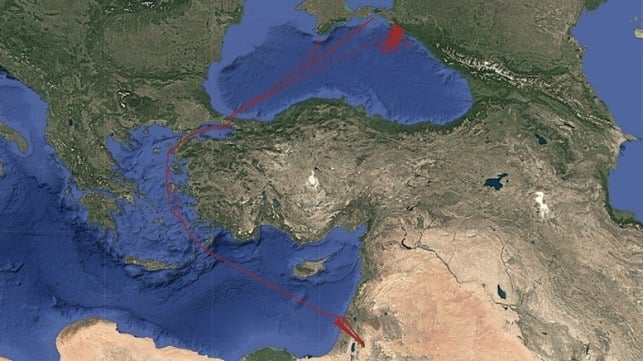
The vessel has been identified by Israeli media as the Panormitis (IMO 9445201), a Greek-owned bulker that recently anchored off Haifa. Her exact position is unknown: due to the heavy GPS spoofing found in Israeli airspace, Panormitis' AIS system shows (falsely) that the vessel is located in a cluster of ships at Queen Alia International Airport in Amman, Jordan, 80 miles inland.
It is not Panormitis' first call in Haifa. AIS data provided by Pole Star Global shows that the ship spent about four weeks in the northeast (Russian) corner of the Black Sea in February through March, then transited to Haifa. She returned northwards to call again in the same region in April, potentially reaching the Kerch Strait, then transited back to Haifa once again. The vessel operated with AIS turned off for a significant part of her voyage in the Black Sea, a common practice in the region.
According to Haaretz, the Russian export system for ex-Ukrainian wheat revolves around ship-to-ship transfers, conducted near the southern entrance to Kerch Strait. Shuttle vessels move grain from Sevastopol and other Russian-occupied loading ports to a designated granary ship - in several cases, the bulker Glendale - which then transloads the grain onto the internationally-trading bulkers that carry it to market. In this account, based on satellite imaging, some of the ships that carry stolen grain abroad never call in a Russian port; they load offshore, and can therefore deny connections to the Russian occupation economy. Suspect voyages of this type between the Kerch Strait and Israel have been identified as far back as 2023, with multiple vessels implicated.
Israeli foreign affairs minister Gideon Sa'ar said in a statement that "evidence substantiating the allegations [about Panormitis] have yet to be provided," and he claimed that Ukraine had not reached out privately before broadcasting the complaint on social media. Sa'ar suggested that the matter would be handled locally as an administrative issue.
Ukraine summoned Israel's ambassador to Kyiv on April 27 and filed a formal protest after a second shipment of grain allegedly stolen from Russian-occupied Ukrainian territories docked at the port of Haifa, in a diplomatic escalation that has thrust Israel's policy of studied neutrality toward the Russia-Ukraine war into uncomfortable public scrutiny.
The démarche followed a major investigation published by the Israeli newspaper Haaretz on April 26, which documented a sustained pattern of Russian-looted Ukrainian grain reaching Israeli ports. An internal log obtained by Haaretz from Russian authorities in occupied Ukrainian ports lists more than 30 shipments of stolen grain with Israel listed as the destination — a figure that dwarfs the individual incidents that have so far become public.
The paper trail: Ukraine warned Israel on March 23
The most damaging element of the story for Israel is not the grain itself but the documentary record of what it knew and when. An official statement published on April 16 by Ukraine's Ministry of Foreign Affairs — issued before the Haaretz investigation was published — laid out the timeline with precise dates.
Ukraine informed Israeli partners on March 23 about the vessel ABINSK and the possible origin of its cargo from temporarily occupied Ukrainian territories, and "emphasised the inadmissibility of import operations with such products." According to the Ukrainian MFA statement: "Assurances were received regarding an appropriate response."
"It is concerning that despite the information provided and contacts between the parties, the vessel was allowed to unload at the port of Haifa on April 12-14," the statement continued.
Ukraine classifies the ABINSK as a vessel "involved in the activities of the 'shadow fleet', which the aggressor state uses to illegally export, transport and sell stolen Ukrainian grain from the temporarily occupied territories and, ultimately, finance the war against Ukraine." A Ukrainian court issued an arrest warrant for the vessel and its cargo within criminal proceedings. Ukraine immediately sent a formal request for international legal assistance to Israel on the basis of that court decision, asking Israeli authorities to apply the relevant legal mechanisms under Israeli jurisdiction.
The MFA statement expressed hope for "fruitful and constructive interaction" and said Ukraine's embassy in Israel was "in constant contact with the Ministry of Foreign Affairs of Israel and the competent Israeli authorities in order to ensure appropriate steps." Those steps, as subsequent events confirmed, were not taken.
The ABINSK and the Panormitis
The ABINSK delivered nearly 44,000 tonnes of stolen Ukrainian wheat to Haifa. A second vessel, the Panama-flagged bulk carrier Panormitis, arrived in Haifa Bay on April 26 and was awaiting permission to berth as the diplomatic storm was breaking. According to Ukrainian investigative journalist Kateryna Yaresko from the SeaKrime project, who first broke the story, the Panormitis was loaded with grain from occupied Ukrainian territories via transfers from other ships and departed from the Port of Kavkaz in Russia's Krasnodar region, with a large portion of the cargo transferred from the occupied Ukrainian city of Berdyansk on the Sea of Azov coast.
Ukrainian Foreign Minister Andrii Sybiha said Ukraine values its relationship with Israel but warned that Russia's illegal trade in stolen agricultural products should not undermine bilateral ties. A Ukrainian diplomatic source said that if Israel did not reject the latest cargo, Kyiv would "reserve the right to deploy a full suite of diplomatic and international legal responses" and that Israel had "essentially shrugged off" Kyiv's previous demands. "Frankly, this feels like a slap in the face given the strategic goodwill Ukraine has extended — from designating the IRGC as terrorists to criminalising antisemitism," the source said.
Israeli Foreign Minister Gideon Sa'ar told Sybiha that Ukraine had provided no evidence to support allegations that the grain was "stolen" and accused him of conducting diplomacy through the media — a claim directly contradicted by Ukraine's published MFA statement documenting the March 23 notification and Israel's assurances. A community note was subsequently added to Sa'ar's social media post pointing out that "Ukraine provided evidence and formal requests for legal assistance to Israel regarding previous shipments of alleged stolen grain since March, including ambassadorial meetings and a judicial cooperation request, despite claims to the contrary."
The scale of the operation
Russia established the State Grain Operator in the occupied city of Melitopol in May 2022 as the primary vehicle for monetising looted Ukrainian agricultural production. The SGO exported 212,000 tonnes of Ukrainian grain in 2023 alone, estimated at $46mn, operating through a network of shell companies. According to Kyiv's estimates, at least 15mn tonnes of Ukrainian grain have been stolen by Russia since the start of the full-scale invasion.
The Haaretz investigation, drawing on the internal Russian port logs, documents more than 30 shipments of stolen grain destined for Israel, a figure that places the ABINSK and Panormitis incidents not as isolated events but as part of a systematic commercial relationship between Russia's occupation economy and Israeli grain importers.
Israel is a major destination but not the only one. Egypt, Turkey, Bangladesh and Libya are also significant recipients, with approximately 70 countries receiving some volume of stolen Ukrainian grain according to tracking data. The EU is now weighing sanctions against individuals involved in the smuggling operation.
The broader policy context
Russia effectively supplies 70 to 80% of Israel's wheat imports, according to $A data. Israel has not joined international sanctions against Russia, has declined to supply Ukraine with weapons including the Iron Dome missile defence system, and Netanyahu has sought throughout the war to maintain a neutral stance between Moscow and Kyiv. That neutrality has become harder to sustain as Russia has deepened its support for Iran during the US-Israel war, providing critical intelligence to Tehran against Israeli forces.
The grain scandal has brought that unspoken tension into the open at the worst possible moment — as Israel simultaneously seeks Ukrainian diplomatic support in the Iran war and continues to import Russian wheat taken from the Ukrainian soil that Russian troops are occupying. The MFA documents make clear that this is not a question of ignorance. Israel was told. Israel gave assurances. Israel allowed the ship to dock.
Ukraine Destroys Sea Drone as Russia Strikes Odesa Ports and Cargo Ships
Ukrainian officials report that Russia continues to target the port infrastructure in the Greater Odesa region in an effort to disrupt commercial trade. They assert the recent strikes on commercial shipping are deliberate acts by the enemy.
Overnight, another cargo ship was struck while sailing in the corridor that Ukraine has maintained for two and a half years for commercial shipping. According to the reports, it was the third commercial ship struck recently, however the Ukrainian Navy also released images of a successful interdiction of a sea drone attempting to attack one of the ports in the Greater Odesa region.
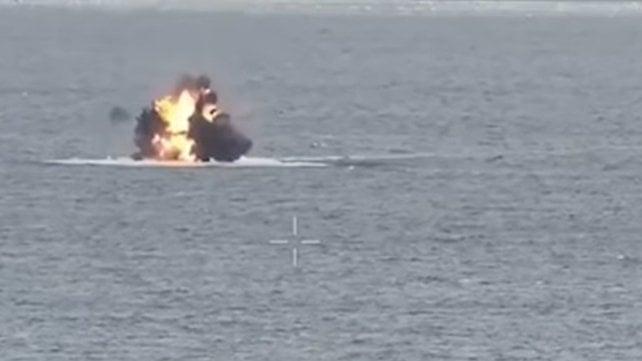
The brief video released by the Navy shows a sea drone approaching when it is hit and explodes. The Navy said they had been able to detect and track the approaching drone and destroyed it before it was able to reach one of the ports in the Greater Odesa area.
The ship that was hit overnight was only identified as a bulker registered in St. Kitts and Nevis. It was struck by two drones, which started a fire on the ship. None of the crew was injured, and they were able to extinguish the fire. The ship was heading toward the Odesa ports.
On Wednesday, the Seaports Administration of Ukraine reported that the port infrastructure was attacked overnight. It said a drone had caused a local fire that damaged warehouse facilities. They also said a cargo ship was hit in the area of its hold and reported a fire.
Media reports said it was the latest in a series of recent attacks. Another ship registered in St. Kitts and Nevis had also been recently struck. A Syrian crewmember was killed, and the assistant captain was injured on a Comoros-flagged bulker that was carrying soy. The Seaports Authority reports the port infrastructure remains operational. It, however, continues to operate with safety restrictions.
Earlier in the week, Oleksiy Kuleba, Vice Prime Minister for the Reconstruction of Ukraine, highlighted that the ports had met 98 percent of their target of over 21 million tons for the first quarter of the year despite the ongoing attacks. He said since the beginning of the year, the ports have been attacked on average every five days, with 193 infrastructure facilities and 25 civilian vessels damaged. Despite that, they handled over 11.6 million tons of grain and 1.2 million tons of steel and metal products. Container handling increased by 43 percent to over 63,000 TEU during the quarter.
Since the start of the Ukrainian Sea Corridor in September 2023, Kuleba says it has processed over 190 million tons of cargo, of which over 110 million tons are grain.
Drone strike triggers fire at Russia's Tuapse oil refinery in latest attack on Black Sea facilities
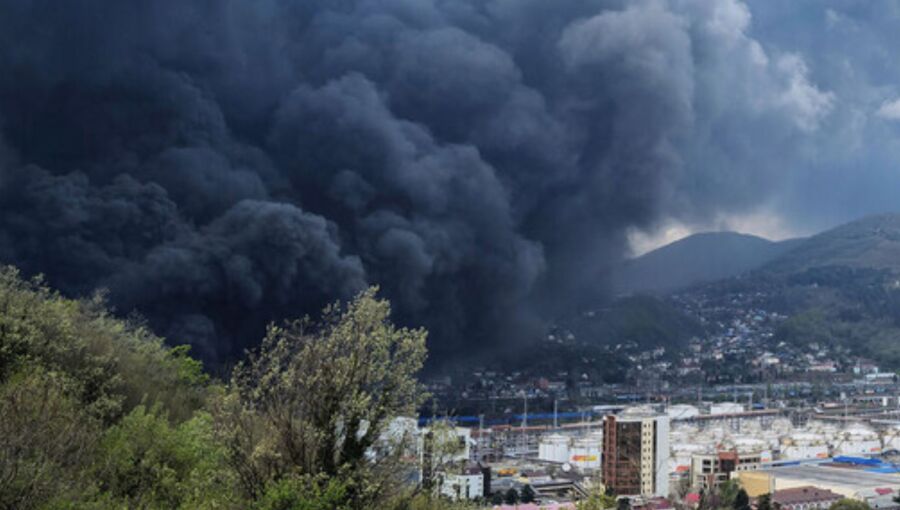
A fire broke out at the Tuapse oil refinery in Russia's Krasnodar Krai on April 28 after a drone strike, the regional operational headquarters said, Kommersant reported.
Falling debris from unmanned aerial vehicles caused the blaze on the refinery's territory. There were no immediate reports of casualties.
A total of 122 personnel and 39 units of equipment have been deployed to contain the fire, including units from the Krasnodar Krai branch of Russia's Emergencies Ministry and other specialist services.
The incident is the third major drone attack on Tuapse infrastructure in recent weeks. Drones struck the city's seaport on the night of April 20, with the resulting fire taking until April 24 to extinguish. An earlier attack on the maritime terminal on the night of April 16 caused another fire that burned until April 19.
The repeated strikes have led to environmental damage. Following the series of fires and subsequent heavy rainfall, oil products from the terminal entered the Tuapse River and then the Black Sea coastal waters. Emergency response work has been organised to contain further contamination.
A petroleum products collection system has been deployed on a section of the river downstream, with simultaneous cleanup work on the coastal strip and in the marine area. By the morning of April 27, 4,200 cubic metres of soil contaminated with petroleum products and water-fuel oil mixtures had been collected from three sites.
Emergency services continue firefighting operations at the refinery and are monitoring conditions in the city and at adjacent industrial facilities. Further information on the scale of the fire and the consequences of the incident is being clarified.
Tuapse, located on Russia's Black Sea coast, is home to one of the country's principal oil export terminals and a refinery operated by Rosneft. The facility processes around 12mn tonnes of crude per year and serves as a key outlet for Russian crude and refined products to international markets via the Black Sea.
The site has been a recurring target of Ukrainian long-range drone strikes throughout the war, with attacks intensifying through 2025 and 2026 as Kyiv has sought to disrupt Russia's hydrocarbon export revenues.
The damage at Tuapse forms part of a wider pattern of strikes on Russian refining infrastructure that have periodically tightened domestic fuel supply and contributed to retail price rises in some regions.

No comments:
Post a Comment