It’s possible that I shall make an ass of myself. But in that case one can always get out of it with a little dialectic. I have, of course, so worded my proposition as to be right either way (K.Marx, Letter to F.Engels on the Indian Mutiny)
Wednesday, May 06, 2026
A Chemical Breakthrough That Could Fix the Plastic Crisis
Hyper-industrial-scale plastic production has become an industrial-scale health, environmental, and remediation problem. It is challenging to put a dollar figure on burying ourselves alive.
The damage appears to have no endpoint. The UNDP estimates that up to $600 billion in environmental damage and ecosystem losses so far, but that figure fails to capture a bare minimum of $250-billion in annual health-care costs linked to plastics. Microplastics are now in our blood and our organs. They are the air that we breathe.
It’s becoming harder each day to put a figure on such a broad scale of damage, and it’s getting worse, quickly. The world is now producing more than 400 million tonnes of plastic annually, and is eyeing 500 million tonnes in the next five years, with less than 10% recycled into usable material.
Textiles account for a massive share of this. Around 92 million tonnes of clothing are discarded every year, much of it polyester, and only about 1% is recycled back into new fibers. We built synthetics to last, and they do–forever.
Forever is now a present-day problem, but tech innovator Denovia has a solution: It’s taking aim at one of the largest failure points in the global materials economy: The inability to turn plastic waste back into a usable supply.
The company has demonstrated that mixed, contaminated textile waste can be broken down into terephthalic acid at 98.3% purity, approaching virgin-grade quality. And it can do it in a fraction of the time any other technology has managed so far. If that holds at scale, it could mark a new beginning for our forever synthetics and a new era for plastics.
“What we have achieved is not just an incremental improvement; it is a fundamental shift in what textile recycling can deliver. Our technology handles the complex, blended materials that have historically been impossible to recycle, and it does so with remarkable efficiency and output quality. This is the solution the world has been waiting for,” the company said in a March statement.
Denovia’s technology originated from a collaboration with a group of expert scientists who had been developing the underlying chemistry for roughly six years . At its core, the process uses a proprietary liquid to break down plastics at the molecular level. Waste material such as PET bottles or polyester textiles is first shredded to increase surface area, then introduced into the solution, where heat and pressure trigger rapid depolymerization.
In practical terms, the system splits long polymer chains back into their original chemical building blocks, such as terephthalic acid and monoethylene glycol, within minutes. These monomers are then purified and reused to produce new, virgin quality plastic, effectively resetting the material to its original state rather than degrading it through traditional recycling methods.
Denovia’s edge comes down to how quickly and efficiently the process works compared to what’s out there today. Most competing technologies take far longer to break plastics down and require significantly higher costs to operate, and many still haven’t proven they can generate meaningful revenue at scale.
In contrast, Denovia’s process brings depolymerization down to minutes, not hours, using moderate heat and a system that can reuse the majority of its input liquid. From what the company has seen, few, if any, technologies appear to match it on speed, economics, and output quality.
Published research shows how slow and energy intensive traditional plastic recycling still is. Most PET depolymerization today runs in the range of 30 to 180 minutes and often at temperatures well above 150°C. Denovia is claiming something very different — depolymerization in about five minutes.
If that holds outside the lab, it changes the equation. Shorter cycle times mean more throughput from the same system, lower energy use per ton, and less capital tied up in equipment. More importantly, it shifts the economics. Instead of paying to dispose of plastic and textile waste, operators can convert it into a usable chemical output and generate revenue from it.
A Different Kind of Recycling Business
Recycling has been a failure.
That’s why Denovia is doing it differently. It’s structured as a technology platform, not a traditional recycling operator. It doesn’t collect waste or operate large processing networks. It builds and licenses its system to existing waste management companies, plugging into infrastructure that already handles the majority of global waste.
Most of the world’s waste is already being collected. Denovia is simply plugging it directly into its high-tech infrastructure. The model centers on granting exclusivity and taking a share of revenue over time. Users pay an upfront premium for exclusivity, and Denovia takes a percentage of revenue–indefinitely.
Denovia is also exploring Ontario as the home of its planned Canadian flagship innovation hub — a next-generation facility built to process waste at scale, showcase Denovia’s technologies in action, and prove what true circularity can look like in the real world. With major feedstock suppliers already in the region, strong industrial infrastructure, and direct access to the U.S. border, Ontario gives Denovia a powerful platform to serve both Canadian and American markets.
The economics represent something that could shake the recycling business out of its doldrums.
Researchers estimate that disposing of plastic waste costs up to $13.3 billion annually. That translates into costs that run into the hundreds of dollars per ton once collection, transport, and processing are included.
Denovia’s process moves in the opposite direction. Based on current estimates, each batch could generate the equivalent of roughly $4,000 to $8,000 in output value, depending on recovery rates, output quality, and market pricing. “You’re turning a guaranteed loss into a scalable revenue stream,” Denovia Inc. founder Nick Spina told Oilprice.com.
Throughput is designed to scale. The PL5000 system processes roughly two tonnes per batch, with cycle assumptions around 30 minutes and the ability to run continuously.
The Industry Everyone Is About to Chase
Between now and 2040, the world requires over $15 trillion in private sector investment and $1.5 trillion in public expenditure in order to reduce “annual mismanaged plastic volumes by 90% relative to 2019 levels”, according to Circulate Initiative.
McKinsey sees it as a multi-billion opportunity for those companies that can crack the technology to make it all usable again.
“Amidst growing recognition that plastics will continue to play a vital role in many applications long into the future, plastic recycling represents a $50-$75 billion economic opportunity by 2035,” McKinsey told investors recently.
And capital is now pouring in.
In Europe alone, more than €8 billion has already been committed to scaling chemical recycling technologies designed to process mixed and contaminated waste streams. In the U.S., the American Chemistry Council (ACC) says there has been about $10.5 billion in announced investments for both mechanical and advanced recycling in the U.S. in recent years.
And it could be a $48.5-billion boost for the American economy.
The biggest players in the chemical industry are already circling. Dow Inc. (NYSE: DOW), the world’s largest plastics producer, has been building its circularity strategy for years, backing advanced recycling partnerships and quietly positioning recycled feedstock as a core supply chain asset. DuPont de Nemours (NYSE: DD) has been repositioning itself around the materials science that makes advanced recycling possible, filtration, separation, specialty chemistry — the backbone of any serious depolymerization operation.
Then there’s Air Products and Chemicals (NYSE: APD), which may be the quietest play of all. Industrial gases don’t make headlines, but hydrogen and nitrogen are the backbone of large-scale chemical processing, and that includes every serious advanced recycling system being built today. Air Products is already embedded in the industrial infrastructure this sector runs on. When the build-out accelerates, it’s already there.
Early projections have placed the value of Devonia’s technology in the multi-billion dollar range, with commercial partnerships and discussions underway across waste-heavy institutions including donation networks and healthcare systems.
That’s because Denovia has a major competitive edge.
Denovia’s process runs in minutes. Competing systems take significantly longer and are far more expensive, with little evidence of consistent profitability.
It doesn’t collect waste or build processing networks. It licenses its technology into existing infrastructure. Partners pay upfront for access and exclusivity, and Denovia takes a share of revenue.
Plastic was engineered to last. We never built a system to deal with it after use, and the cost is now running into the trillions when you include environmental damage, health impacts, and remediation. If Denovia’s process scales, it flips the script, turning a frightening liability into revenue. A trillion-dollar problem becomes a multi trillion-dollar revenue stream, and the economics of waste change with it.
By. Michael Scott
Trump Turns to Courts to Shield Big Oil from Climate Lawsuits
The Trump administration is using federal courts to block state lawsuits targeting oil companies, arguing that climate regulation falls under federal—not state—authority.
Multiple Democratic-led states have sued firms like ExxonMobil and American Petroleum Institute for alleged climate deception, but the Justice Department is actively intervening to stop these cases.
Legal outcomes are mixed: some courts have rejected federal interference while others favor industry, highlighting an ongoing battle between state-level climate litigation and federal energy policy.
Donald Trump has denied, downplayed, or sought to reverse action on climate change through a combination of public rhetoric, the appointment of skeptics to key positions, and the dismantling of environmental regulations. As of 2026, his actions have included calling climate change a “hoax” or “scam,” withdrawing the US from global climate agreements, and systematically removing climate data from federal websites. (Natural Resources Defense Council)
Now his administration is turning to the courts to defend oil and gas companies against lawsuits by mostly blue (Democratic-led) states.
The U.S. Justice Department filed a lawsuit on Monday to block Minnesota from moving forward with a long-running lawsuit seeking to hold ExxonMobil and other oil industry participants responsible for harms caused by climate change…
The Justice Department’s latest lawsuit took aim at a lawsuit that Minnesota Attorney General Keith Ellison filed in 2020 during Trump’s first term against Exxon, Koch Industries and the American Petroleum Institute.
That lawsuit accuses the defendants of fraud and of violating state law by misleading Minnesotans about the climate-change consequences of using fossil fuels. The defendants deny wrongdoing and have been fighting the case for years.
In announcing Monday’s lawsuit, the Justice Department cited an executive order Trump signed last year directing it to take action to stop the enforcement of state laws and lawsuits that burden the production of oil and gas.
“President Trump promised to unleash American energy dominance, and Minnesota officials cannot undermine his directive by mandating that their woke climate preferences become the uniform policy of our nation,” Associate Attorney General Stanley Woodward said in a statement.
The Justice Department argues that through its lawsuit, Minnesota is seeking in violation of the U.S. Constitution to regulate greenhouse gas emissions, which are the exclusive domain of the federal government.
At least 15 other states brought similar lawsuits, including Massachusetts, New York and Rhode Island, states the Associated Press.
“The American people deserve a Department of Justice that fights for us, and it's a tremendous shame that Trump's DOJ would rather sell us out to Big Oil,” Ellison, a Democrat, said.
The American Petroleum Institute said when Ellison sued in 2020 the action was baseless.
AP notes The administration in February revoked a scientific finding that long has been the central basis for U.S. action to regulate greenhouse gas emissions and fight climate change, the most aggressive move by the Republican president to roll back climate regulations. The rule finalized by the Environmental Protection Agency rescinded a 2009 government declaration known as the endangerment finding that determined carbon dioxide and other greenhouse gases threaten public health and welfare.
ExxonMobil (NYSE:XOM) has a long history of both studying climate change — a misnomer because the warming is not a change, it’s been going on for 21,000 years — and questioning the scientific evidence for it.
A 2015 investigation by InsideClimateNews found ExxonMobil, currently the eighth largest oil company by revenue, was aware of climate change as early as 1977, before it became a public issue.
This knowledge did not prevent the company from spending decades refusing to publicly acknowledge climate change and even promoting climate misinformation—an approach many have likened to the lies spread by the tobacco industry regarding the health risks of smoking…
Exxon didn’t just understand the science, the company actively engaged with it. In the 1970s and 1980s it employed top scientists to look into the issue and launched its own ambitious research program that empirically sampled carbon dioxide and built rigorous climate models. Exxon even spent more than $1 million on a tanker project that would tackle how much CO2 is absorbed by the oceans. It was one of the biggest scientific questions of the time, meaning that Exxon was truly conducting unprecedented research.
In their eight-month-long investigation, reporters at InsideClimateNews interviewed former Exxon employees, scientists and federal officials and analyzed hundreds of pages of internal documents. They found that the company’s knowledge of climate change dates back to July 1977, when its senior scientist James Black delivered a sobering message on the topic. “In the first place, there is general scientific agreement that the most likely manner in which mankind is influencing the global climate is through carbon dioxide release from the burning of fossil fuels," Black told Exxon’s management committee. A year later he warned Exxon that doubling CO2 gases in the atmosphere would increase average global temperatures by two or three degrees—a number that is consistent with the scientific consensus today. He continued to warn that “present thinking holds that man has a time window of five to 10 years before the need for hard decisions regarding changes in energy strategies might become critical." In other words, Exxon needed to act.
A spokesman for ExxonMobil disagrees that any of its earlier statements were so stark, let alone conclusive.
“We didn’t reach those conclusions, nor did we try to bury it like they suggest,” Allan Jeffers told Scientific American.
But the magazine goes on to say that One thing is certain: in June 1988, when NASA scientist James Hansen told a congressional hearing that the planet was already warming, Exxon remained publicly convinced that the science was still controversial. Furthermore, experts agree that Exxon became a leader in campaigns of confusion. By 1989 the company had helped create the Global Climate Coalition (disbanded in 2002) to question the scientific basis for concern about climate change. It also helped to prevent the U.S. from signing the international treaty on climate known as the Kyoto Protocol in 1998 to control greenhouse gases. Exxon’s tactic not only worked on the U.S. but also stopped other countries, such as China and India, from signing the treaty.
Meanwhile, the lower courts are fighting back against perceived federal intervention in state court processes.
In mid-April, a federal judge dismissed a Trump administration lawsuit seeking to stop Hawaii from suing fossil fuel companies in state court over global warming.
Targeted companies include BP (LSE:BP), Chevron (NYSE:CVX), ExxonMobil and Shell (LSE:SHEL) for allegedly selling products the companies knew would warm the Earth.
In January, a different federal judge threw out a similar suit that sought to block Michigan from suing major oil companies, Reuters reported.
The Center for Climate Integrity goes deeper into both cases, stating that Hawaii’s case, filed just hours after the Trump administration’s preemptive attempt to block it, seeks to make the companies pay for damages caused by “a decades-long campaign of deception to discredit the scientific consensus on climate change.” Michigan’s, filed earlier this year in federal court, accuses the “fossil fuel cartel” of driving up costs for consumers by conspiring to block cleaner and cheaper energy sources in violation of antitrust laws.
Also in mid-April, the US Supreme Court handed a win to oil and gas companies fighting lawsuits over coastal land loss and environmental degradation in Louisiana — a red (Republican-led) state.
As reported by News 15, The unanimous procedural decision gives the companies a new day in federal court after a state jury ordered Chevron to pay upward of $740 million to clean up damage to the state’s coastline, one of multiple similar lawsuits. The companies were backed by the Trump administration and argued that the case belongs in federal court because they began oil production and refining during World War II as U.S. contractors. Louisiana’s coastal parishes have lost more than 2,000 square miles of land over the past century.
SCOTUS currently has a 6-3 conservative majority, with the six appointed by Republican presidents (including three appointments by Trump) and three by Democratic presidents.
By Andrew Topf for Oilprice.com
British Billionaire Slams Europe's Energy Policy and Expands U.S. Oil Business
Ineos acquired a 21% stake in three Gulf of Mexico oil and gas assets alongside Shell.
Founder Jim Ratcliffe said Europe’s energy strategy is damaging economic growth and industrial competitiveness.
The company has invested more than $3 billion in the U.S. as it shifts focus away from Europe.
Europe and the UK’s approach to energy policy is “all over the place” and eroding the region’s security and growth prospects, Jim Ratcliffe has said in an announcement confirming Ineos’s plans to expand its oil and gas operations in the Gulf of Mexico.
In a statement announcing Ineos’s fresh investment in the US alongside Shell, the billionaire chemicals tycoon blasted Britain and the EU for neglecting their energy and industrial sectors, saying both were crucial for a vibrant economy.
“Growth in an economy is highly correlated to competitive energy prices, and it’s a huge issue for national security,” Ratcliffe said. “If you can’t get energy, then you can’t run your hospitals, run industry or heat your houses.”
Ineos announced on Tuesday it had taken a 21 per cent stake in three oil and gas sites off the east coast of America as part of a wider push into the world’s largest economy. Ineos did not disclose how much it bought the stake for.
The chemicals juggernaut, which also boasts a large oil and gas division, has now committed over $3bn to its US operations as it seeks to diversify away from upstream operations in Europe and the UK.
Jim Ratcliffe, who also owns Manchester United, has repeatedly hit out at British and EU policymakers’ decision-making for throttling Ineos’s growth, blaming the continent’s sky high energy costs and excess regulation for its latest push into the US.
Jim Ratcliffe hails ‘stable investment environment’ in America
The stinging broadside comes despite the government injecting £105m into Ineos’s Grangemouth plant as recently as December, after the tycoon warned what is the UK’s last ethylene plant faced closure without state support. The investment saved hundreds of jobs, ministers said at the time, and Ratcliffe hailed it as a sign of the UK government’s “commitment to British manufacturing”.
The deal announced on Tuesday means Ineos’s energy division will now work with Shell to seek out untapped oil and gas reserves in the shelf, which is located 80 miles off the Louisiana coast. The group will chiefly help the Anglo-Dutch energy major to develop the Fort Sumter discovery, which is estimated to contain over 125m barrels of oil equivalent. But it will also launch more exploration projects in the area before 2030, Ineos Energy said.
“Europe is all over the place,” Ratcliffe added. “From an investment point of view, you always go to the stable rather than the unstable. I would have a lot more confidence in investments in America in the energy sector than I would in Europe.”
Jim Ratcliffe’s wider Ineos business is currently locked in a battle to bear down on its enormous debt pile, which at the end of last year topped $18bn – 13.5 times more than its annual earnings. Credit ratings agency Moody’s has downgraded the group’s debt twice since September, saying the company’s operating performance has suffered from “continued and greater than expected deterioration”.
Billionaire Ratcliffe is currently overseeing a major disposal programme in a bid to shore up the company’s balance sheet. He is reportedly nearing a sale of Ligue 1 football team Nice, while his co-founder Andy Currie has reportedly put his 271ft yacht on the market for €85m.
A spokesman for the government told The Times: “The UK has one of the most robust fiscal frameworks in the world, which helps maintain economic stability while unlocking £120 billion of investment in our future infrastructure with disciplined day-to-day spending.
A Washington-based watchdog says Central Asia has become a major conduit for Russian sanctions evasion through trade and financial networks.
Kazakhstan and Kyrgyzstan are accused of facilitating the movement of dual-use goods and financial flows into Russia, though both governments deny wrongdoing.
The report urges Western governments to intensify monitoring and sanctions enforcement targeting logistics, banking, and intermediary service providers.
Central Asian states are a key conduit for Russia’s sanctions-busting trade, enabling “logistical and financial support for diversion networks” dedicated to procuring goods for the Russian war machine, a watchdog group has documented.
A report, titled Russia’s Sanction Evasion Research 2025-2026, published by the Washington, DC-based Center for Global Civic and Political Strategies (CGCPS), notes that “Russia has demonstrated significant adaptive capacity in mitigating the operational impact of Western sanctions,” adding that Central Asia serves as a pivotal “‘back door route’ for imports into Russia.”
The report maintains that flows of “some” Common High Priority List (CHPL) commodities – items that can range from capacitors and transceivers to ball bearings and automated machine tools – increased in 2025 from Kazakhstan, Kyrgyzstan and Uzbekistan to Russia.
Kazakhstan and Kyrgyzstan “share open borders [with Russia] through the Eurasian Economic Union (EAEU), removing customs inspections scrutiny for intra-bloc trade,” the report states. “Western-made [dual-use] electronics, microchips, and communications equipment are imported into Kazakhstan or Kyrgyzstan as civilian goods, then legally exported into Russia under local trade codes.”
Central Asian governments have denied helping Russia evade sanctions, but the numbers paint a complicated picture. In Kazakhstan’s case, exports of CHPL goods to Russia shot up by over 400 percent in 2022, indicating the existence of “a systematic evasion mechanism supported by shared infrastructure and minimal oversight.” Over the past two years, however, CHPL exports from Kazakhstan to Russia have sharply fallen. Several Kazakh entities have been hit with Western sanctions in recent years.
The CGCPS report concludes that the Kazakh government is not systematically complicit in helping Russia evade sanctions, stating that the Astana’s membership in the EAEU and Kazakhstan’s long-shared border with Russia “create structural vulnerabilities that can be exploited by sanctions-evasion networks.”
Kyrgyzstan has faced scrutiny not only for funneling CHPL goods to Russia, but also for helping Russia finance its procurement efforts by offering the Kremlin access to international financial markets. The report characterizes the country as an “increasingly visible node within broader sanctions-evasion networks.”
“Analysts [in 2025] identified several Kyrgyz-registered crypto platforms as potential transit nodes for Russian-linked financial flows,” the report states. “Concerns emerged that some exchanges may have functioned as shell or successor entities to previously sanctioned digital asset platforms operating within the wider Eurasian shadow-finance network.”
US, EU and UK officials found sufficient evidence in 2025 of sanctions-busting activity that several Kyrgyz banks were sanctioned, along with the cryptocurrency exchange Grinex. In April, the EU imposed “anti-circumvention” sanctions on the Kyrgyz government as part of its 20th sanctions package.
In the Caucasus, the report notes that Georgia is “one of the most significant transit and re-export risk nodes” in the region, while Azerbaijan has served as an important logistics hub for the North-South corridor, a trade route that connects Russia to Iran, India and beyond.
The report recommends that Western sanctions enforcement mechanisms devote more “monitoring resources” to the “geographic chokepoints” of sanctions-busting activity, including in Central Asia.
The CGCPS also urges heightened scrutiny of and targeted sanctions on the financial enablers of sanctions evasion schemes, including insurance providers, legal and corporate service providers and financial institutions.
“Targeting intermediary service providers can generate broader deterrence across evasion networks,” the report states.
The European offshore wind market is experiencing a structural supply constraint as the exit of GE Vernova from new orders leaves Siemens Gamesa and Vestas as the primary suppliers for the region.
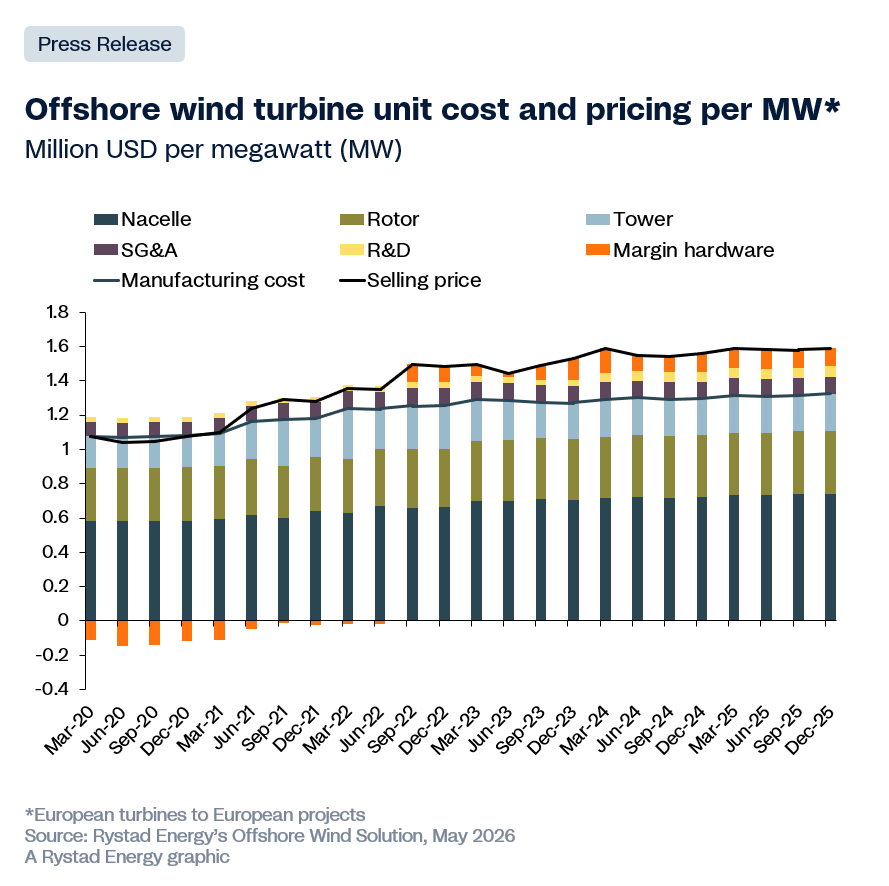
Turbine selling prices have increased by 40% to 45% since 2020, a surge that outpaces manufacturing cost inflation and reflects the immense technical complexity of newer 14 to 15 MW models.
Original equipment manufacturers have gained significant pricing power and are now passing higher costs and risks to developers through stricter contract terms as they recover from previous inflationary losses.
Europe's offshore wind expansion is running into a structural supply constraint where the turbine market is becoming increasingly concentrated. GE Vernova, Siemens Gamesa and Vestas have historically anchored Western offshore turbine supply, but with GE Vernova having paused new offshore wind orders following a series of technical and operational setbacks, Siemens Gamesa and Vestas now account for virtually all turbines available to European developers. Rystad Energy’s analysis of the offshore wind market outlines a sharp increase in per-megawatt (MW) costs, with turbine selling prices rising by between 40% and 45% since 2020, outpacing manufacturing cost increases of 20% to 25% over the same period.
This pricing pressure is most acute in the turbine's most complex components. The nacelle, which houses the generator, gearbox and power electronics that convert wind into electricity, sits at the center of current supply constraints, while similar pressures are emerging in blade manufacturing, driven by increasing turbine sizes, longer production cycles and the logistical demands of transporting and installing next-generation components.
The supply constraint is not evenly distributed across the turbine value chain. It is most pronounced in nacelles and blades, where supplier concentration is high and substitution is limited, while towers remain comparatively more flexible, with a broader supplier base and lower barriers to entry. As a result, the market is becoming increasingly constrained in its most critical components, shaping the overall balance between supply and demand.
Europe's offshore ambitions are real, and the pipeline reflects genuine political commitment. But the market has moved into structurally tight territory: high demand, limited supplier diversity and rising turbine complexity. That combination gives original equipment manufacturers (OEM) real pricing power and the ability to be selective about which projects get built. If Europe doesn't meaningfully expand Western manufacturing capacity or rethink how supply constraints are addressed in its auction frameworks, it won't deliver its post-2030 targets at the pace or cost the energy transition requires; especially in the current climate that has so much uncertainty as a result of the middle east conflict,
Sander Baksjoberget, Senior Analyst, Offshore WInd Research
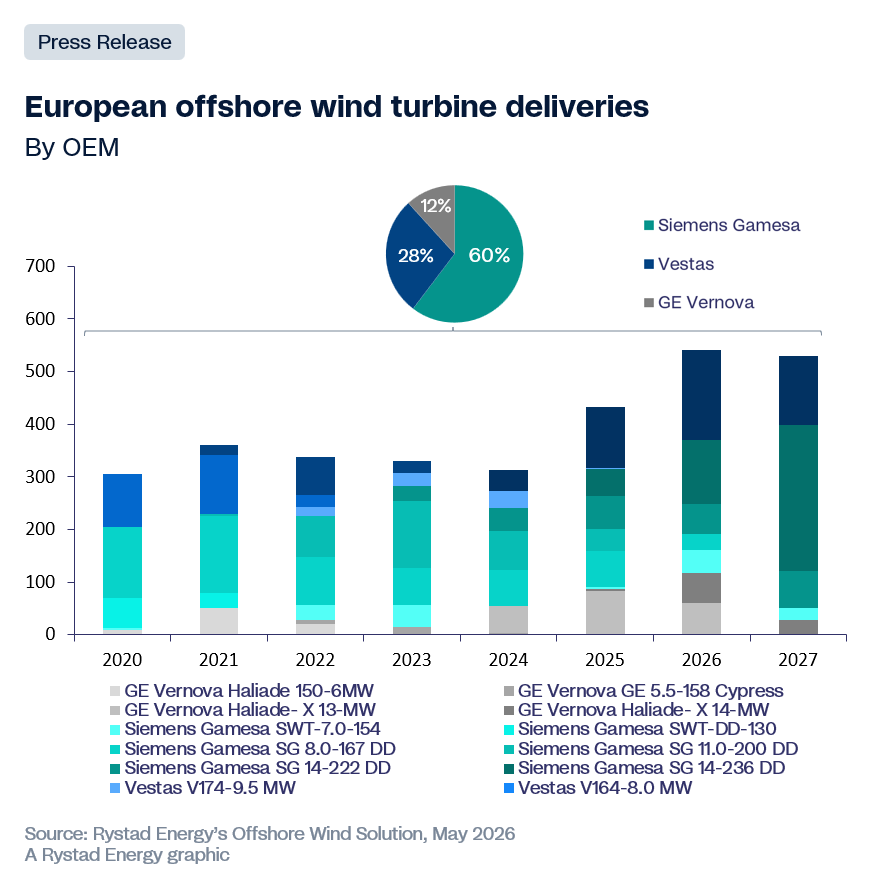
The mix of turbines being delivered between 2020 and 2027 shows how quickly the market has changed. Earlier years were dominated by smaller 9 to 10 MW turbines, while more recent deliveries are shifting toward the larger 14 to 15 MW class. Siemens Gamesa was first to move into bigger turbines, signing contracts for its 14-MW model ahead of Vestas before moving into the 15-MW class, while Vestas' V236-15-MW grew in popularity from 2024 onward. Siemens Gamesa still holds the larger overall share of deliveries, cementing its position as the market leader. This shift in turbine size is important context for understanding price increases: the turbines being built and installed today are significantly larger and more complex than those from five years ago, and that complexity is reflected in what OEMs can charge.
The 40% to 45% rise in turbine selling prices since 2020 cannot be explained by rising costs alone. In 2020 and 2021, turbines were sold under contracts that assumed relatively stable input costs, and when inflation hit hard through 2021 to 2023, manufacturers were locked into those agreements and absorbed the losses themselves. When those contracts expired from 2023 onward, prices reset sharply and the burden shifted to developers, who now face higher turbine prices and tighter contract terms. Manufacturers are recovering their margins on newer deals, although profitability across offshore divisions remains squeezed by the costs of ramping up and scaling a new generation of larger, more complex turbines.
The key shift in the offshore turbine market is not just the level of cost inflation, but how those costs are distributed across the value chain. Rystad Energy’s analysis models a scenario where a 30% increase in selected input categories would raise total manufacturing costs by around 17%, reflecting how different components are exposed to different cost drivers.
The ability of manufacturers to absorb such increase has also changed. Between 2021 and 2023, OEMs were largely locked into fixed price contracts and absorbed rising costs through margin compression. As those contacts have rolled off and supply conditions have tightened, newer agreements are being signed with less pressure on OEMs to take on that risk. While developers continue to anchor project economics, suppliers are now in a stronger position to pass a larger share of future cost increases through to developers via higher turbine prices and stricter contract terms.
Lufthansa Group expects the surge in jet fuel prices to cost it an additional $2 billion this year as the closure of the Strait of Hormuz “is leading to a shortage in kerosene supply and thus to a significant increase in kerosene prices,” Europe’s biggest airline said on Wednesday.
Lufthansa expects strong summer travel numbers, but it warned that “At the same time, the current closure of the Strait of Hormuz is leading to a shortage in kerosene supply and thus to a significant increase in kerosene prices.”
The war in Iran and the closure of the Strait of Hormuz have severely constrained Europe’s jet fuel supply, while jet fuel prices have spiked to over $200 per barrel.
The war in Iran has cut most of Europe’s imports of jet fuel, while local output has been falling for nearly two decades due to dozens of refineries closing permanently or being converted to biofuel production.
Despite the fact that the airline group has hedged about 80% of fuel costs for 2026, the spike in jet fuel prices “places a substantial burden on the cost base of Lufthansa Group airlines,” it said.
As of current estimates, the kerosene price surge would lead to additional costs of 1.7 billion euros, or $2 billion, in 2026, Lufthansa said.
“While no restrictions in kerosene supply are currently expected at any of the Lufthansa Group hubs, potentially reduced fuel availability later in the year represents an additional risk factor,” the airline said.
Till Streichert, chief financial officer of Deutsche Lufthansa AG, warned “Our annual profit will likely be lower than originally anticipated.”
Lufthansa last month said it would remove a total of 20,000 short-haul flights from its European summer schedule. A week earlier, Lufthansa had said it was accelerating plans to reduce its flight program and retire some aircraft earlier “In view of significantly increased kerosene prices, which have more than doubled compared to the period before the Iran war, as well as rising additional burdens from labor disputes.”
Cargo vessels and tanker owners, who hoped for a U.S. escort out of the Strait of Hormuz earlier this week, are back scrambling to find feasible solutions to passing the critical trade chokepoint after U.S. President Donald Trump called off the 'Project Freedom' effort to help guide vessels out of the Strait, just three days after announcing it.
Over the weekend, President Trump announced 'Project Freedom' to help guide vessels out of the Strait of Hormuz, and some ships did pass the chokepoint under U.S. protection early this week.
One of two such vessels was a ship operated by a subsidiary of Denmark-based shipping giant AP Moller-Maersk, the company confirmed this week. The ship, Alliance Fairfax, had been stranded west of the Strait of Hormuz since the war began on February 28, Maersk said.
But the short-lived relief that stranded ships could soon find their way out of the Strait was cut short only three days into the project Freedom endeavor. President Trump late on Tuesday called off the effort, saying in a social media post that "while the Blockade will remain in full force and effect, Project Freedom (The Movement of Ships through the Strait of Hormuz) will be paused for a short period of time to see whether or not the Agreement can be finalized and signed."
The Strait of Hormuz was mostly clear of traffic after the pause of the Project Freedom plan, according to vessel-tracking data monitored by Bloomberg.
Since Project Freedom was announced and later abandoned, Iran has signaled it is expanding the area around the Strait of Hormuz it now controls.
Early on Wednesday, reports emerged that the U.S. believed it was nearing a framework agreement to end the war with Iran—a deal that would eventually reopen the Strait of Hormuz. Oil prices plunged by 12% early in the morning EDT before paring their losses.
After Iran announced its plan to charge for safe passage through the Strait of Hormuz in March, a plethora of scam operators popped up to offer fraudulent paperwork in exchange for payment in cryptocurrency. That problem may now have a solution, though not the one that the shipping community would prefer: Iran has launched an official "Persian Gulf Strait Authority" with its own formal email address, providing owners with a verifiable single window for arranging transit with the Islamic Revolutionary Guard Corps, a U.S.-designated foreign terrorist organization.
According to Islamic of Iran Public Broadcasting, vessels wanting to transit the Strait of Hormuz will receive an email from the official address "info@PGSA.ir," which will include information about Iran's transit regulations. Once the shipowner "aligns their procedures with this framework," they can obtain authorization for passage.
The creation of a new government authority to interface with the IRGC does not resolve the questionable legality of Iran's tolls on an internationally-designated strait. But there is a more pressing compliance concern: the U.S. has threatened to sanction any entity that pays Iran for transit. Shipowners may think twice about openly communicating arrangements with the new authority's email account, given the surveillance capabilities of U.S. signals intelligence services.
Meanwhile, on the south side of the strait, the U.S. continues to promote a new safety "umbrella" for ships transiting outbound through Omani waters. The newly-formed "Project Freedom" is a competing vision for marine traffic: guided by the U.S., conducted without charge. Iran opposes the mission and has used force in an attempt to block it, including attacks on merchant ships and on U.S. Navy destroyers.
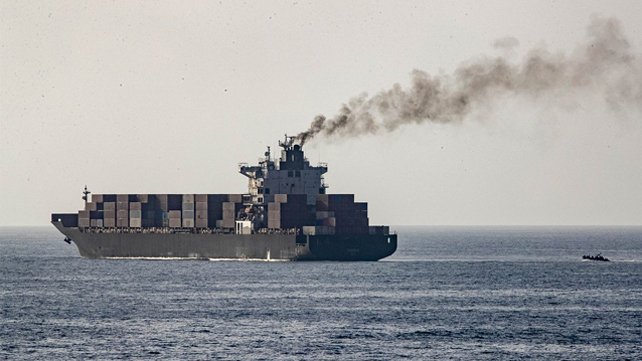
Those actions continued Tuesday: an unspecified cargo vessel was struck by a projectile in the strait, according to UKMTO. Martin Kelly of EOS Risk Group has identified the target as a CMA vessel, and CBS reports that it was the Maltese-flagged boxship CMA CGM San Antonio.
Several of the ship's crewmembers were injured in a cruise missile strike, two officials clarified to CBS.
Like other ships operating in the strait in the last few days, CMA CGM San Antonio has gone dark for security purposes, and her AIS transmission has not been received since Tuesday. Her last known position was off Dubai.
The IRGC's Positions on Larak Overlook the "Tehran Tollbooth" Route
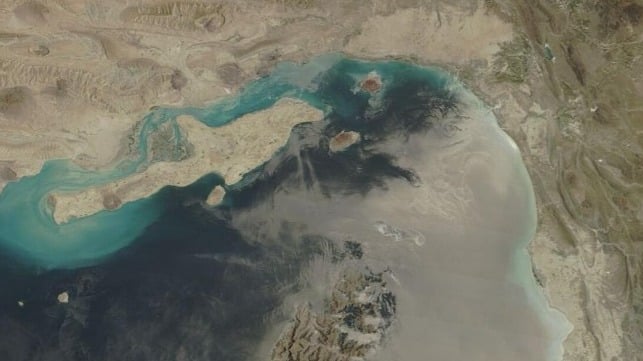
Larak, center, sits just east of Qeshm at the northernmost point of the strait (NASA Worldview)
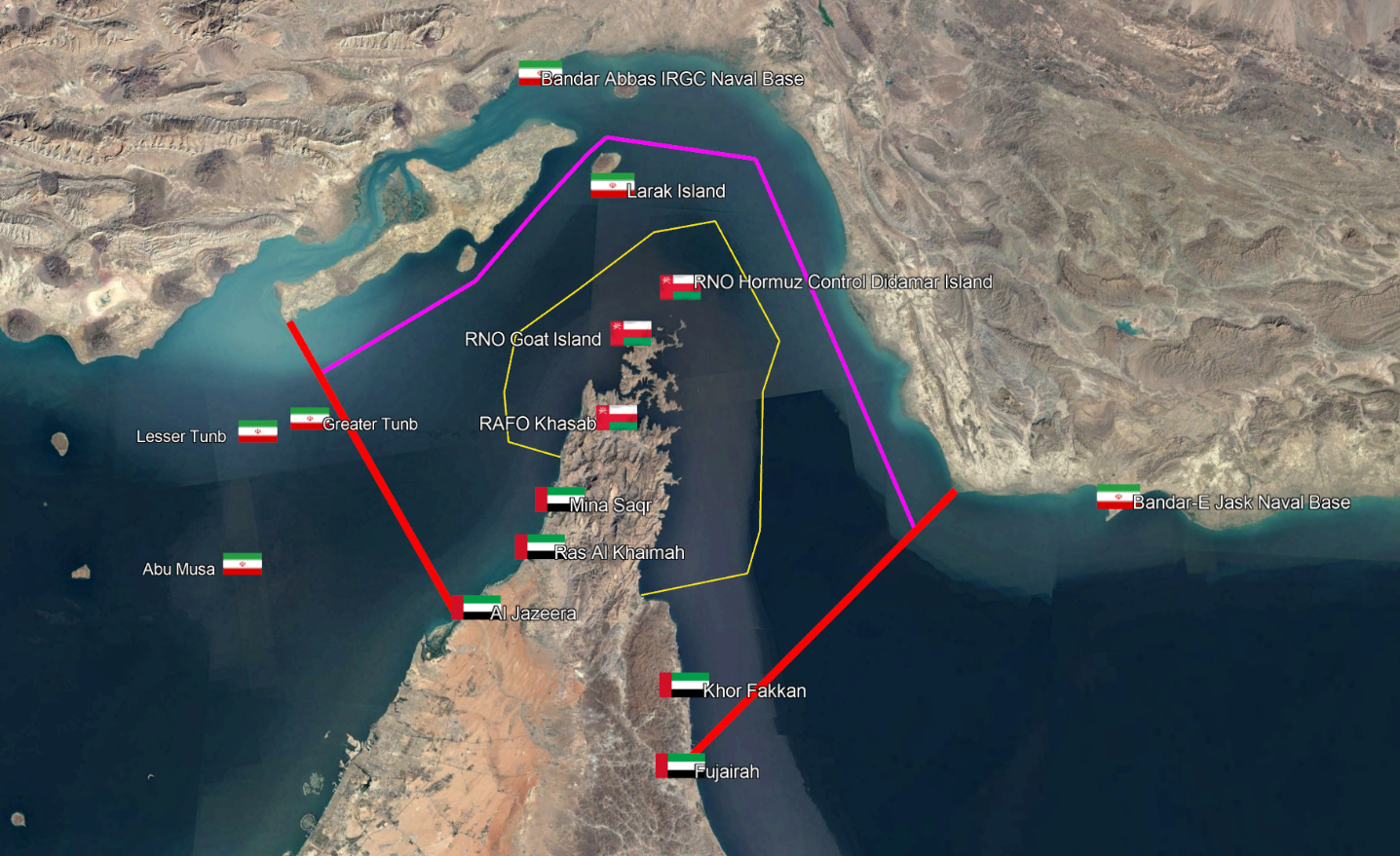
Larak Island, to the south of and covering the approaches to Iran’s largest port at Bandar Abbas, has achieved some notoriety in recent weeks as the island which Iran’s IRGC says merchant traffic must circumnavigate to transit the Strait of Hormuz on Iranian terms.
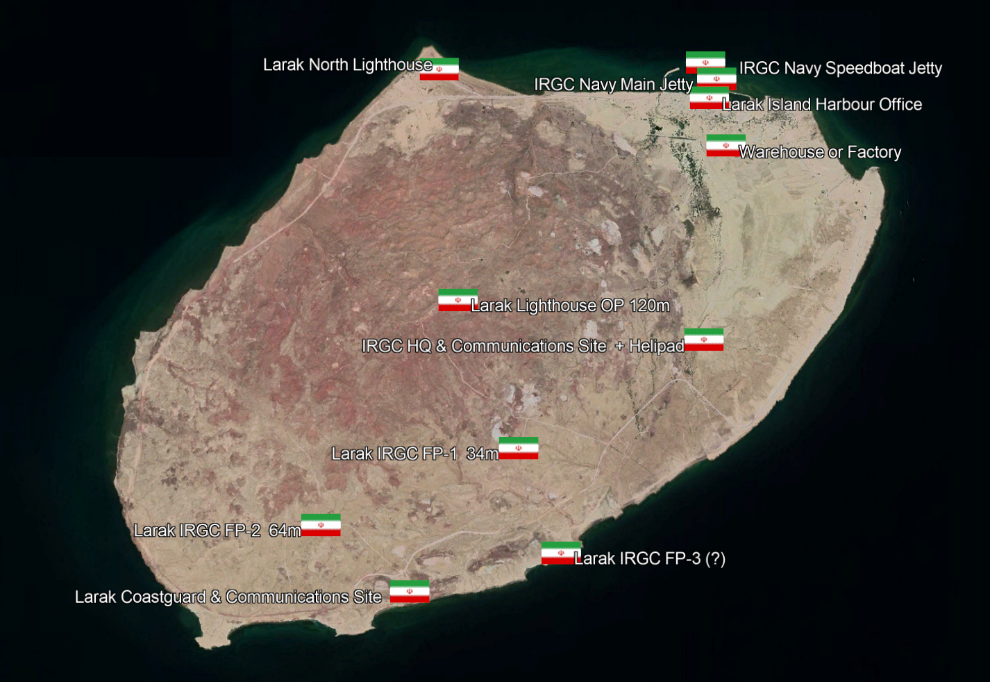
Larak is largely barren, a plug of sandstone 134 meters at its highest. The only settlement is the village of Larak on the northern side of the island, which is graced by the remains of a Portuguese castle. Locals get by with subsistence fishing, goat herding and smuggling, and hence the IRGC presence on the island is probably a substantial source of income. A feature of the landscape are recharge dams, designed to trap flood water and replenish local water supply when it rains occasionally.
There is little on the island by way of conventional military footprint, but IRGC facilities will merge with and be largely indistinguishable from the civilian infrastructure. The coast guard maintains a separate establishment to the IRGC Navy, but both communicate with passing sea traffic on the common Channel 16.
IRGC locations on the island of Larak (Google Earth/Copernicus/CJRC)
Lighthouses: Whether manned by coast guard or IRGC Navy staff, or both, Larak North Lighthouse and Larak Lighthouse on the high point of the island both provide visual observation of sea movements to north and south to fill out the maritime intelligence picture. Larak Lighthouse on the peak appears to have a coastal radar, two communications towers and in normal times flashes a white light every 12 seconds.
IRGC HQ & Communications Site: This is an active site, with until recently two tall communications towers, and a commercial ship’s radar on a 25-meter mast. The site has the only helipad identified on the island, suggestive of the headquarters function. The site also has garaging, which would be suitable for parking up anti-ship missiles and drones on mobile launchers.
Prepared Firing Points (FP1-3): Three prepared locations, each comprising three or more earthwork firing platforms, dominate the strait to the south. All three locations are connected to the island’s road network, so that mobile launchers can quickly reach these positions from hidden or protected storage locations elsewhere on the island. These storage locations cannot easily be identified, and may include caves and underground tunnels, but the IRGC also has protocols for keeping mobile drone and missile launchers in civilian buildings and warehouses. There is a substantial warehouse just south of the village of Larak, for which there is no obvious or declared purpose, which could be such a storage facility.
IRGC Navy Facilities: The IRGC Navy uses the only harbor on the island with a breakwater at Larak village. Before the current war, two 17-meter Peykaap II-class missile boats were frequently seen berthed on the main jetty in the harbor. The Peykaap II are each equipped with a pair of single Kowsar or Nasr anti-ship missile launchers, with the missiles using internal guidance and active terminal homing out to a range of 20 nm. At a second jetty close by, also seen on recent overhead visits, was an average of six fast speed boats, of the Taregh Class or smaller. These two jetties appear, from the low resolution imagery still available since February 28, to be the only two sites which may have been attacked.
Given the covert character of the IRGC presence on Larak Island, some capability is likely to have survived since February 28. Mobile drone and missile launchers can be hidden with relative ease, and replacements may have been brought onto the island during the ceasefire to replace any stock which has been destroyed, such that some offensive drone and missile capability may still be in place. In any case, the most important role for the island in the IRGC scheme of battle is to act as an observation post, from which to maintain surveillance of the Strait and from which to cue strike assets held elsewhere.
Larak Island sits at the northern tip of the IRGC’s recently-declared prohibition zone. Red boundaries show the approximate border of the prohibition zone, and the Iranian shipping channel is show in purple. The border of Omani territorial waters is marked in yellow. The Disputed Islands in the western approaches to the Strait are occupied by Iran (Google Earth/Copernicus/CJRC)
Fujairah in Focus as Oil Flows Reroute Around Hormuz Crisis
Fujairah has become a critical export and bunkering hub as the Strait of Hormuz remains closed, offering one of the few routes for UAE crude and fuels to reach global markets.
Its importance has surged due to infrastructure like the Abu Dhabi Crude Oil Pipeline, which allows significant volumes to bypass Hormuz—though it cannot fully replace lost regional exports.
Rising strategic value has made Fujairah a target, with recent attacks and escalating tensions highlighting its central role in global oil supply and shipping routes.
As the Strait of Hormuz has now been closed for nearly nine weeks, the oil hub at Fujairah in the United Arab Emirates (UAE) has become an even more prominent oil export and bunkering hub than it has ever been.
Thanks to its strategic position on the east coast of the UAE and outside the Strait of Hormuz, Fujairah is now the key export port for crude and fuels from the UAE and an even more important bunkering port for ship refueling.
The strategic position of Fujairah outside the blocked Strait of Hormuz made it a target of Iranian attacks as early as the second week of the now nine-week-long war. In March, attacks at Fujairah suspended oil loading and bunkering operations several times, before the early-April ceasefire temporarily halted attacks from Iran.
However, the oil port was hit earlier this week after the United States announced Project Freedom to escort ships out of the Strait of Hormuz – currently paused after just three days by President Trump.
The new attack at the Fujairah Petroleum Industries Zone caused a fire and sent oil prices surging on Monday, as the oil hub outside the Strait of Hormuz is strategic to the UAE’s oil exports and to global shipping.
Fujairah is the UAE’s only access to the Indian Ocean and is one of the few key oil export points that do not depend on tankers passing through the Strait of Hormuz
Fujairah is not only a key export route bypassing the critical oil chokepoint, but it is also a major hub for crude and fuels in storage and a key bunkering port for refueling ships. The port is the most important bunkering hub in the Middle East and one of the world’s most critical and largest ship-refueling sites alongside Singapore and Rotterdam, as well as China’s Zhoushan.
The port of Fujairah is the end point of a pipeline carrying crude from the giant oilfields in Abu Dhabi.
The Abu Dhabi Crude Oil Pipeline (ADCOP) runs from onshore oil facilities at Habshan to Fujairah. The original nameplate capacity of the line is 1.5 million barrels per day (bpd) with a reported current capacity close to 1.8 million bpd, according to the International Energy Agency. The UAE has typically exported around 1.1 million bpd of domestic crude via this route, leaving room for up to 700,000 bpd of additional volumes in the case of a Strait closure.
Fujairah is in no way in a position to replace, even partially, the Middle East’s export volumes lost to the closed Strait of Hormuz. But it is critical for supplies to Asia, especially India, in this period of heightened tensions.
Moreover, Fujairah is home to the FRL refinery partly owned by the world’s biggest independent oil trader, Vitol. The refinery offers about 100,000 bpd of refining capacity, adjacent to the storage terminal of VTTI, jointly owned by Vitol, FM Global Infrastructure Fund, and the Abu Dhabi national energy company.
So, Fujairah is one of the few key oil and fuel export routes that bypass the Strait of Hormuz and is a very important bunkering hub in the Middle East for ships traveling to Asia and Africa.
As the Middle East crisis doesn’t appear anywhere close to resolution, the Fujairah hub is taking the spotlight not only because it offers an oil export valve for supply that doesn’t need to pass through the Strait of Hormuz.
As of Monday, according to Iran’s Islamic Revolutionary Guard Corps (IRGC), the new map of expanded Iranian control over the Middle East’s most critical oil shipping lane includes Fujairah.
IRGC unveiled on Monday a new map showing expanded areas around the critical chokepoint that Iran now claims to have under control. The area extends from a line between Kuh-e Mobarak in Iran and south of Fujairah in the UAE, and from another line between the end of Iran’s Qeshm Island and just west of Umm Al Quwain in the UAE, according to the IRGC Navy.
By Tsvetana Paraskova for Oilprice.com
After Attack on CMA CGM Boxship, Trump Suspends Hormuz Transit Corridor
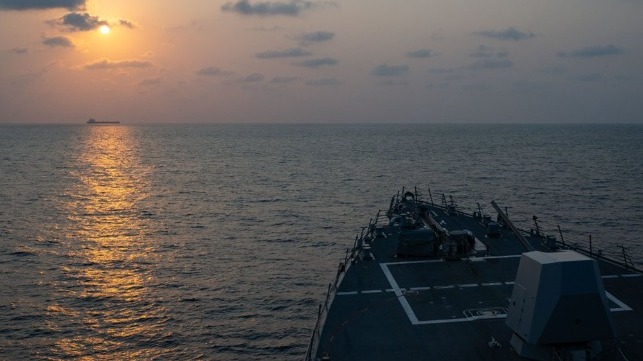
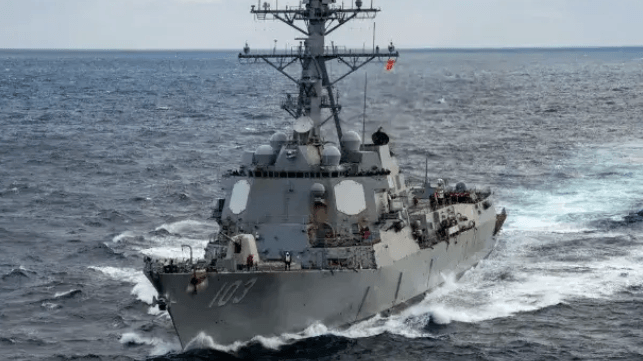
Destroyer USS Pinckney monitors traffic in the Gulf of Oman, May 2026 (USN)
On Tuesday, a cargo vessel was struck by a projectile in the Strait of Hormuz, according to UKMTO - the latest in a series of ship strikes that Iran has launched following the initiation of a U.S.-led maritime security corridor. Shortly after, President Donald Trump announced a temporary "pause" for the corridor program, which was intended to provide a security "umbrella" for merchant ships trapped in the Arabian Gulf to escape via the Omani sector of the strait. The initiative had been in effect for two days, and several participants - and apparent nonparticipants - had come under Iranian attack.
CBS reports that the vessel struck in Tuesday's attack was the Maltese-flagged boxship CMA CGM San Antonio, and officials told the network that the ship may have been hit by a cruise missile. Several crewmembers were injured in the strike, two officials told CBS.
Like other ships operating in the strait in the last few days, CMA CGM San Antonio has gone dark for security purposes, and her AIS transmission has not been received since Tuesday. Her last known position was off Dubai.
Hours after news broke of the strike on the boxship, President Donald Trump declared Project Freedom a "tremendous military success" and announced that it would be paused for diplomatic negotiations.
"Based on the request of Pakistan and other countries . . . we have mutually agreed that, while the blockade [on Iranian traffic] will remain in full force and effect, Project Freedom . . . will be paused for a short period of time to see whether or not the agreement [with Iran] can be finalized," Trump said in a statement.
Just hours earlier, in a Pentagon press briefing, top officials said that the now-suspended Project Freedom corridor was beyond a success - it was a "gift." They gave no predictions that it would be put on hold later in the day.
"As a direct gift from the United States to the world, we have established a powerful red, white and blue dome over the strait. American destroyers are on station, supported by hundreds of fighter jets, helicopters, drones and surveillance aircraft providing 24/7 overwatch for peaceful commercial vessels, except Iran’s of course," Defense Secretary Pete Hegseth told reporters.
"We have a much better defensive arrangement [than traditional escort operations], where we have multiple layers that include ships, helicopters, aircraft, airborne early warning, electronic warfare – we have a much broader defensive package than you would have ever had if you were just escorting. I feel good about that, and it was proven just in the last couple of hours," said Adm. Brad Cooper, commander of Central Command, speaking to TWZ earlier in the morning.
U.S. Releases Additional Iranian Crewmembers to Pakistan for Repatriation
U.S. has released crewmembers from the Iranian containership and will also return the ship after repairs (CENTCOM)
Pakistan’s Foreign Ministry reported that it has organized the repatriation of the Iranian crewmembers from the containership Touska. Pakistani officials called it a “confidence-building measure” by the United States as it continues to seek to mediate the war between the U.S. and Iran.
The statement from the Foreign Ministry said the crewmembers had been flown to Pakistan late on Sunday, May 3, to be handed over to the Iranian authorities. U.S. Central Command (CENTCOM) confirmed in a statement to ABC News that the transfer had taken place, and late on Monday, Iran's Fars News Agency, which is closely aligned with the IRGC, released photos saying the crew was home in Iran.
According to the Iranian report, six of the crewmembers had been released last week, and 15 others had arrived in Iran today. The Pakistanis are saying 22 crewmembers had been handed over. Iran, however, is saying that seven crewmembers remain in Pakistan for a total of 28 from the vessel.
In a bellicose statement last week, Iran said it planned to recapture the containership, which the United States seized on April 19. Donald Trump asserted the ship had ignored warnings in the Arabian Sea after the start of the blockade. USS Spruance fired on the ship, disabling the engine room, and then U.S. forces boarded and searched the ship. Iran said it had deferred military action to rescue the crew and ship to avoid injury to the crew.
Pakistan is reporting that the United States has also agreed to hand the ship back to its owners after repairs. It will be put in Pakistani waters, they report.
“Pakistan welcomes such confidence-building measures,” it said. Pakistan says it will continue to pursue ongoing mediation efforts for regional peace and security.
The move comes as the U.S. continues the blockade and asserts it would be enabling the exit of foreign ships through the Strait of Hormuz. Iran called any actions a violation of the ceasefire, and there were new reports that Iran fired on commercial shipping and claimed an attack on a U.S. destroyer.
CENTCOM on Sunday reported that 49 commercial vessels have now been redirected to comply with the blockade. It said that U.S. forces remain fully committed to total enforcement of the blockade against Iranian shipping and its ports.
Iran Attacked Two US Navy Destroyers During First Day of "Project Freedom"
Defense officials have identified the destroyers that transited the Strait of Hormuz Monday as USS Truxtun and USS Mason, according to CBS.
The vessels reached the relative safety of the Arabian Gulf, but only after coming under fire, as previously confirmed by CENTCOM commander Adm. Brad Cooper. CBS obtained additional detail: Iran responded to the transit by launching missiles and drones at the warships, and it dispatched small craft to interfere with the transit.
Other air defense assets were on hand to engage and defeat the inbound threats, and half a dozen small boats were destroyed, according to Adm. Cooper. Neither U.S. warship was struck - but the intensity of the reported barrage is not likely to provide reassurance to shipping, especially as two U.S.-flagged merchant vessels came under fire in the course of the first day of operation.
Foreign-flagged traffic near the waterway also came under fire, even though it is unclear if the foreign vessels selected for attack had any connection to the U.S.-operated "Project Freedom" transit scheme.
The multipurpose cargo ship HMM Namu sustained an explosion and fire in way of the engine room on Monday evening; the fire was out by Tuesday morning, and operator HMM is waiting for safe access to inspect the compartment in order to confirm whether it was an attack or a technical fault. At present, HMM said in a statement, the engine room is still filled with CO2 from the firefighting effort. Once ready, the vessel will be towed into port at Dubai for inspection and investigation.
A second vessel, the ADNOC-operated tanker Barakah, was reportedly hit by two drones off the coast of Oman while conducting a Hormuz transit. The crew are uninjured, ADNOC said in a statement.
Indonesia Says Iranian Tankers Have Legal Right of Passage in Lombok Strait
Two Iranian tankers are reported to have diverted to sail through Indonesia's Lombok Strait in an attempt to avoid the U.S. blockade (file photo from Iranian state media)
Indonesian officials said they are aware of the reports that Iranian crude oil tankers are transiting the Lombok Strait and cited the right of free passage. The statements came after reports by TankerTrackers.com that two Iranian-flagged crude oil tankers have slipped past the U.S. blockade and are routing through the passage east of Bali as an alternative to the more closely tracked Malacca Strait.
“We believe that these vessels are exercising their right of passage in accordance with international law,” Foreign Ministry spokesperson Ynonne Mewengkang is reported to have said, according to the Indonesian news service Bernama. The Foreign Ministry cited the 1982 UNCLOS treaty (United Nations Convention on the Law of the Sea), which has been in force for the past 32 years. It reiterated the right of “Innocent Passage” as well as many of the other basic rules regarding the oceans.
U.S. Central Command (CENTCOM) asserted that as of May 5, U.S. forces had directed 51 vessels to turn around or return to port as part of the blockade on Iranian ships and ports. The number of ships is increased by a few each day according to the CENTCOM statements.
TankerTrackers.com first reported on May 2 that it had confirmed an Iranian-flagged tanker named Huge (IMO 9357183), which it had last seen off Sri Lanka, had in fact transited the Lombok Strait of Indonesia. It said the vessel, which is 317,367 dwt and laden with 1.9 million barrels valued at nearly $220 million, was bound for the Riau Archipelago. It is a notorious area for shadow fleet tankers to make illegal ship-to-ship transfers. TankerTrackers.com noted the vessel had been dark for about six weeks, and they believed it had departed Iran just hours before the U.S. started its blockade.
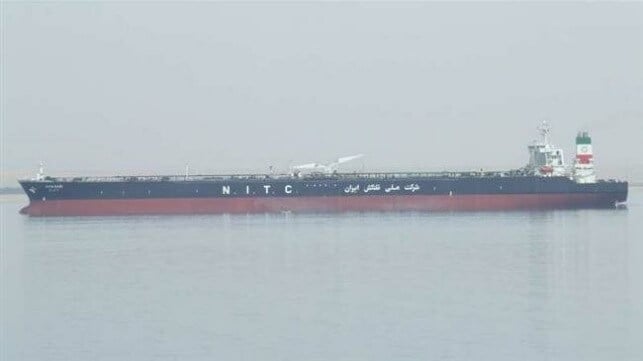
Huge, built in 2008, has been sailing under the Iranian flag since 2015. It is operated by the National Iranian Tanker Corporation (NITC) and is on the U.S. sanctions list.
While only a handful of vessels appeared to have escaped the U.S. efforts, TankerTrakers.com reported on May 3 that it had spotted a second Iranian-flagged tanker taking the same route. The crude oil tanker Derya (IMO 9569700) appears to have been searching for a destination for its cargo of 1.88 million barrels. TankerTrackers.com reported the tanker missed the window of the U.S. waiver to deliver oil to India and had been at sea since mid-April.
Built in 2013, the vessel is also under U.S. sanctions. It entered the Lombok Strait, also heading to the Riau Archipelago.
TankerTrakers.com calculates that, in total, 25 tankers associated with Iran had departed with crude oil cargoes in April, but 15 of them were before the blockade. Since the start of the blockade, TankerTrackers.com reports seven tankers were redirected, and only one, Huge, had reached the Far East. The U.S. also seized two tankers associated with Iran that were accused of being stateless in April. The U.S. is reportedly seeking forfeiture orders from the U.S. courts for those vessels.
Indonesia said it would continue to monitor the situation and “communicate through appropriate diplomatic channels.” However, at least for now, it is not taking any action against the tankers sailing through its waterway.
We noted in Part 1 that when confronted with the failure of 44 days of bombing Iran “back-to-the-stone-age”and, also, thankfully, being reluctant to send American boots into a Gallipoli-scale slaughter on the ground, the Donald turned to his goofy Secy of Treasury for a 4-D chess move.
To wit, a blockade of the Gulf of Oman, which commenced on April 13th. The latter was supposed to dry-up Iran’s cash flow from global oil sales and to then fill its oil storage tanks full to the rim, thereby causing the pipelines connecting to its 3.5 million b/d oil production apparatus to back up and then explode in a post-constipationary release.
Alas, the Donald’s genius boy band – also including Pete Hegseth and Little Marco Rubio – forget the elephant in the room. To wit, it was always a question of which of the dueling blockades – Iran’s at the Strait of Hormuz or the US Navy’s outside of the SOH on the Gulf of Oman – would run out of time first.
However, you only had to know a little bit about the world’s 103 million barrel per day petroleum supply, demand and storage system, and a tad more about oilfield engineering, production management and storage systems, to realize that there was never a doubt as to the outcome.
Namely, that the true-believers who run Iran, and in the face of an existential threat to their regime, were destined to outlast the world economy’s ability to function without the Persian Gulf’s massive flows of hydrocarbons and its derivatives. These crucial ingredients of global economic life ordinarily transit the Strait of Hormuz (SOH) to the tune of 30 million BOEs (barrels of oil equivalent) each and every day.
Of course, the truth is that the Donald is lazy, impatient and impulsive—and therefore is always ready to run with a factoid or cockamamie notion that suits his purposes at the moment. And regardless of whether it happens to be true, valid, plausible and or even rational.
So when the know-it-all but actually clueless Wall Streeter at the Treasury Department tried to horn-in on the Big Boys action in the White House Situation Room by stumping up his “Operation Economic Fury”, the Donald was all ears. He then assuredly announced that Bessent’s brilliant idea would soon be giving the term “silver bullet” a wholly new definition – even as he patted himself on the back for making it possible:
“The blockade is genius. The blockade has been 100% foolproof. It shows how good our Navy is, I can tell you that. Nobody is going to play games. We have the greatest military in the world, and I built much of it during my first term.”
Except. Except. The prowess of the US Navy wasn’t hardly the half of it. In truth, the blockade was really about oil patch engineering. That and the proven resourcefulness of the Iranian regime when it comes to thwarting attacks on its economy after decades of sanctions, embargoes and malicious economic pressures of every kind.
The Donald was apprised of none of this, of course, so naturally he went ball-to-the-walls, exuberantly promoting the efficacy of the blockade.
“When you have lines of vast amounts of oil pouring through your system, if for any reason that line is closed because you can’t continue to put it into containers or ships… what happens is that line explodes from within, both mechanically and in the earth… They say they only have about three days left before that happens. And when it explodes, you can never rebuild it the way it is.”
Well, three days have passed since the Donald issued the above statement, and nothing has exploded in the Iranian oilfields. And that’s par for the course when it comes to the Donald’s penchant for making up shit and then announcing it to the world.
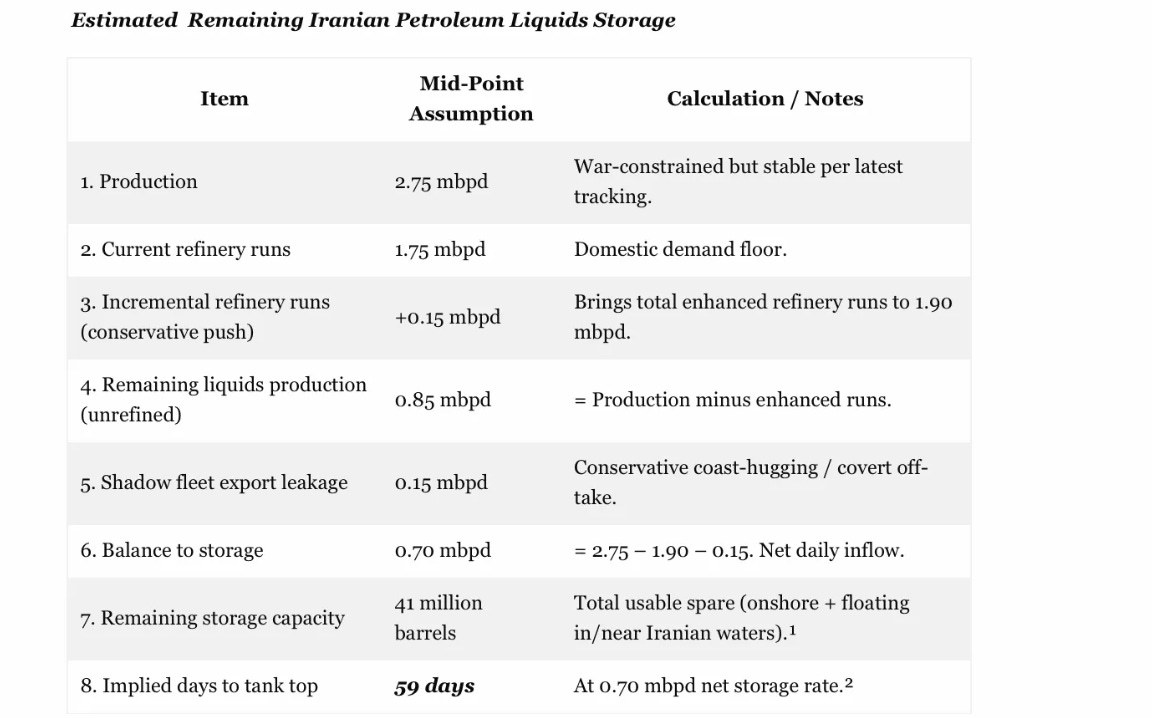
In the first place, there was not a remote chance that Iran’s 41 million barrels of above ground storage tanks would fill to the rim, and then blow up its oil fields in less than three days. As we demonstrated in Part 1, they would have had upwards of 60 days of combined above ground and floating storage – even if production were to remain at the current 2.75 million barrels per day.
But for crying out loud. It doesn’t have to remain there. Iran’s extensive oilfields do not function as some inflexible deus ex machina. Over any reasonable period of time, production levels can be managed significantly higher or lower.
As it happens, however, people who know how to produce 3-5 million barrels per day, as they have over the last decade from Iran’s aging oilfields, would sure as hell know how to carefully reduce production to the level of domestic use (1.75 million barrels/day) plus available storage.
To be sure, throttling back the daily oil lifting rates might well hurt economically via short-run revenue losses and potential future output declines requiring costly restarts. But modulating production levels is a manageable engineering task – not the Donald’s doomsday “lines exploding from within” scenario.
Indeed, oil companies the world over do this during periodic field maintenance, price crashes, or force majeure all the time. The current US blockade, therefore, might create some pain through sustained pressure on exports and storage but not an unmanageable, instantaneous blow-up.
So the blockade was never destined to generate a sudden catastrophic “gotcha” event, as portrayed by Bessent, who knows little about the oil fields and the Donald, who comprehends even less.
Oil production (especially in Iran’s mature fields) can and routinely is managed with gradual rate reductions, flow choking, and planned shut-ins to minimize reservoir and infrastructure damage. The “explosion in three days” scenario is therefore not merely hyperbolic; it’s just plain barking nonsense.
In fact, gradual cutbacks to close the gap between daily output and daily off-take – even with no exports and extremely limited storage – would be readily feasible and well within the range of standard oilfield practice.
So start with the current gap between production at 2.75 mb/d and domestic refinery runs and internal use at about 1.75 mb/d. Even if the enhanced refinery runs and small leakage shown in the table below did not happen, the maximum required cutback from current production levels would be about 35% or 1.0 mb/d. Tops.
Needless to say, Iran’s petroleum engineers and oilfield managers – especially given several weeks to implement adjustments – have designed their wells, pipelines, and reservoirs with controls for this exact situation. Thus, its wells have adjustable chokes (valves) at the wellhead. Operators can slowly reduce flow rates over hours or days instead of slamming everything shut. This prevents sudden pressure spikes while allowing the reservoir to equilibrate.
Iran could also prioritize this production curtailment process on a field-by-field basis, starting with less critical wells. So if exports stop completely, upstream production doesn’t have to keep pumping at full volume into full tanks/pipelines.
They can throttle back lifting rates to match available storage or domestic use. Many Iranian fields already use gas lift or water/gas injection for pressure support; these systems can be scaled down gradually to avoid disrupting reservoir dynamics.
In fact, they’ve handled temporary large shut-ins before without “explosions.” Standard protocols involve monitoring bottom-hole pressure, injecting inhibitors (to prevent corrosion/scaling), and avoiding abrupt stops that could cause paraffin/wax buildup or sand settling.
Long-term issues (e.g., clay swelling in carbonates, water intrusion, or minor mechanical deformation) are real in mature fields like Iran’s. But they’re mitigable with planning – not irreversible “explosions.”
Similarly, high water-cut wells might need nitrogen lifts or pumps to restart, but that’s routine work-over work, not evidence of a field-destroying crisis. So what the “explosion” claim actually refers to is the risk of pressure buildup in pipelines and reservoirs when off-take flow is blocked downstream while upstream production continues unchecked. In theory, this could lead to over-pressure, clogs, or leaks—but real world systems have safety relief valves, pressure sensors, and automatic shutdowns.
Indeed, oilfield experts note that literal pipeline/well explosions from this kind of hypothetical situation are “nearly impossible”. The real risk is longer-term in the form of forced shut-ins in mature carbonate reservoirs (common in Iran). This could disrupt pressure support from gas re-injection, leading to some permanent productivity loss (e.g., 100k-500k bpd in worst-case selective fields).
But even this kind of potential impairment builds over weeks and months with poor – not standard – management. Moreover, Iran’s fields are not uniquely fragile like ultra-heavy oil (Venezuela) or shale. They’ve restarted after past shut-ins with limited lasting damage.
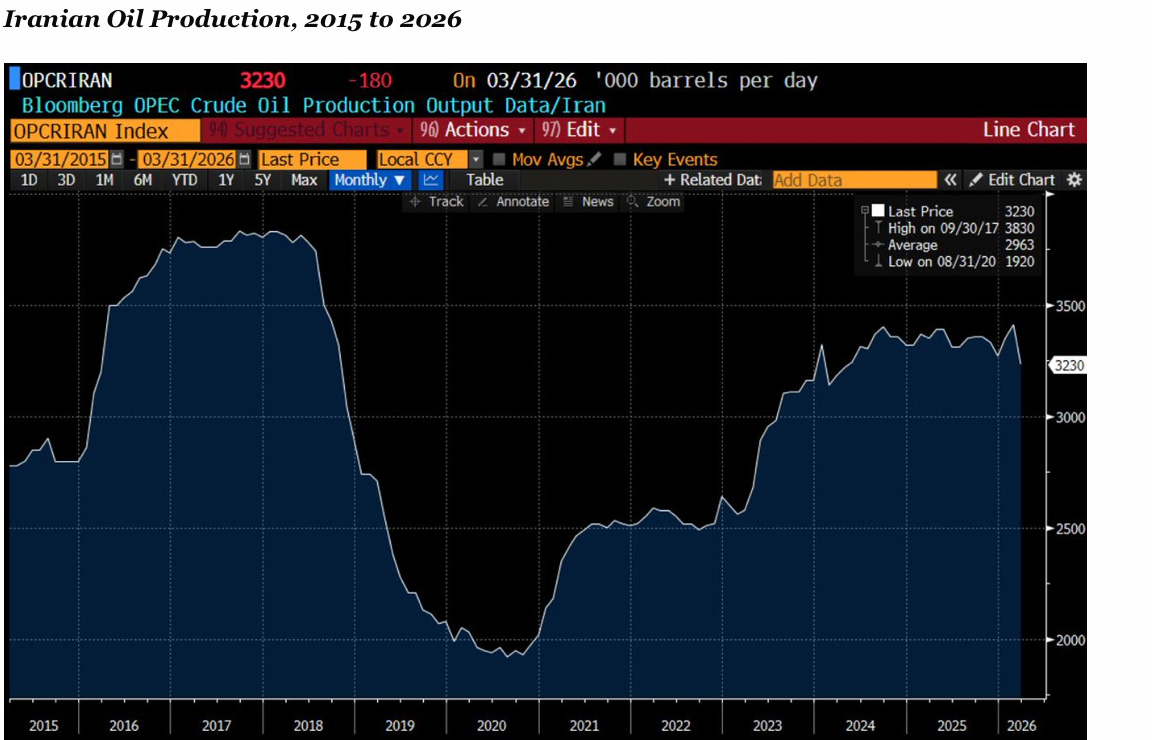
For example, after the global collapse of oil demand in the spring of 2020 owning to worldwide pandemic lockdowns, Iranian production was reduced by nearly 50% in a matter of months, from 3.75 mb/d to 1.9 mb/d.
Yet after the global economy re-opened and returned to normal petroleum demand levels, production was subsequently restored to pre-war levels at just under 3.5 mb/d during 2024 and 2025.
In short, there is going to be no explosion in the Iranian oil fields. The Donald is chasing yet another delusion ponied up by his utterly incompetent staff.
Between creative expansion of its storage including floating vessels and salt caverns, enhanced refinery runs to bolster the domestic economy, even minor export leakages via its coast-hugging dark fleet and standard oilfield production management, the Iranians are likely to keep their petroleum economy stable and functioning.
So the blockade won’t be a SILVER BULLET to rescue the Donald from his Iranian War folly, either.
Meanwhile, the Donald is yet again waiting for Godot. But he doesn’t have much time left because the other side of the dueling blockade equation is deteriorating fast. That is, not only is oil heading once again to $125 per barrel and $5 per gallon for gas, but the rest of the vast array of industrial commodities which normally flow through the SOH are beginning to take a larger and larger bite out of global economic stability with each passing week.
So the Donald, as usual, is utterly delusional when he plays school yard negotiator, barking at the swing-sets and slides with the refrain “I’ve got all the time in the world.”
He doesn’t. Not even remotely.
In fact, the near-total closure of the Strait of Hormuz since early March 2026 has also created one of the most acute non-oil supply shocks in modern agricultural history, to take the most obvious example.
Roughly one-third of global seaborne fertilizer trade – about 16 million tonnes in 2024 and 2025 – normally transits the SOH from Persian Gulf producers. Accordingly, the Gulf states plus Iran account for 34-49% of globally traded urea, 23-30% of ammonia, 41-50% of sulfur, and 20-26% of phosphate fertilizers (DAP/MAP).
These volumes cannot be easily rerouted: pipelines serve only crude oil, not bulk fertilizers or sulfur, and alternative ports lack capacity or infrastructure. Production has also been directly curtailed by attacks on gas processing infrastructure and feed-stock shortages.
On the nitrogen fertilizer side (urea and ammonium nitrate chains), Qatar’s QAFCO is the world’s largest single-site urea exporter with capacity of 5.4 million tonnes/year or about 10-14% of global exports. But it halted output almost entirely after the LNG/gas plant strikes. Saudi Arabia’s SABIC and other Gulf producers have also seen exports drop sharply.
On a pre-crisis basis the region shipped about 10.5 million tonnes of urea annually (21% of global trade) and supplied India 40% of its urea imports – along with major quantities to Brazil, the USA, Australia, and West Africa. Monthly Arab Gulf urea loadings exceeded 1.5 million tonnes; Iran added another 350,000-400,000 tonnes.
With shipments stalled, urea prices jumped 50%+ within weeks after February 28th (e.g., from $480/tonne to $720/tonne), and ammonia followed. Ammonium nitrate, derived from the same ammonia stream, faces parallel tightness. These nitrogen fertilizers are critical for cereal, oil-seed, and rice crops. The shortages now swelling by the day will force farmers to cut application rates or switch crops, directly lowering yields.
The negative impacts of the SOH closure on the sulfur-phosphate chain is further compounding the ag crisis. Gulf producers (Saudi Aramco, ADNOC, Qatar) supply 41-50% of globally traded sulfur, a byproduct of oil/gas desulfurization and essential feedstock for sulfuric acid.
Sulfuric acid, in turn, converts phosphate rock into water-soluble DAP and MA – which are the world’s go-to yield enhancing fertilizers. In this context, Saudi’s Ma’aden complex is the region’s largest phosphate exporter, accounting for 26% of global DAP trade. Disruptions here ripple far beyond the Gulf to China, Morocco and Indonesia (the major phosphate producers), which rely on Gulf sulfur. So their output is now constrained, as well.
Phosphate prices and NPK blends have surged, hitting West Africa and Latin America especially hard. Overall, analysts estimate 25-38% of global nitrogen/phosphate trade and 45% of sulfur trade are at risk.
The timing is truly catastrophic for “next fall.” Northern Hemisphere spring/summer 2026 planting (already underway in parts of the US, Europe, and Asia) faces immediate shortages, but the bigger shock will likely hit the 2026-2027 crop year fall planting in the Southern Hemisphere (Brazil, Australia, Argentina) and winter wheat cycles in the Northern Hemisphere.
IFPRI and other forecasters warn of 5-15% potential declines in global grain/oilseed yields if fertilizer use drops 10-20% in import-dependent regions.
India (heavily reliant on Gulf urea) and Brazil (key soy/corn exporter) are most exposed. Reduced applications in these two giant ag producers could shrink global harvests by millions of tonnes, tightening global food supplies into late 2026 and 2027.
Food-price inflation is already materializing: urea-driven cost increases are already feeding into higher bread, rice, meat, and vegetable prices. Developing nations therefore face acute food-security risks, including higher import bills, subsidy strains, and possible rationing or unrest.
Even the US and EU, though less dependent, are faced with elevated farm-input costs and secondary effects via global commodity markets. No quick fixes exist. Alternative suppliers (Russia, Egypt, China) cannot scale fast enough, and many face their own export curbs or logistics issues.
In addition, strategic fertilizer reserves are minimal compared to oil stocks. The result is a classic “food security time bomb”. Higher fertilizer prices squeeze margins, reduce planted acres or yields, and cascade into grocery bills and political instability – all likely hitting by fall 2026.
In the case of helium and semiconductors, Qatar supplies 30-36% of global helium as a byproduct of its massive North Field LNG/gas processing. Production at Ras Laffan – the world’s largest helium hub – halted in early March after infrastructure missile strikes and LNG curtailments, removing roughly one-third of world supply overnight.
Helium ships in specialized cryogenic containers that last only 35-48 days before boil-off. Consequently, thousands of containers are now stranded or evaporating. South Korea and Taiwan (largest importers) will face acute shortages first.
Helium is irreplaceable in semiconductor fabrication for wafer etching, plasma processes, and ultra-low-temperature cooling. Chipmakers already report 14-20% export cuts translating into fab-line risks; prices have soared 50%+.
Needless to say, the Chip Shock threatens AI hardware, memory, and advanced logic production at a time of surging demand.
Healthcare (MRI magnets) and aerospace are also being hit. But semiconductors feel the earliest pinch – with potential major output losses in Asia within weeks if stocks run dry.
The Persian Gulf is also a 35-40% player in global petrochemical exports ($20–25 billion annually through SOH). Saudi, UAE, and Qatar export massive volumes of methanol (14 million tonnes/year regionally), monoethylene glycol (MEG, 6.5 million tonnes), polyethylene (PE, 12.5+ million tonnes), polypropylene (PP), and other olefins derived from ethane, propane, and naphtha.
Iran’s 80-90 million tonne petrochemical capacity has also curtailed exports to prioritize domestic needs. Naphtha and LPG feedstock flows to Asia (Japan imports 70%, South Korea 50%) are already being throttled, forcing steam cracker shutdowns in Northeast Asia.
Downstream impacts, of course, cascade into plastics, textiles (MEG for polyester), packaging, automotive parts, and construction resins. Prices for PE, PP, and MEG have jumped by upwards of 10% to 15% in days. Consequently, Asian buyers are scrambling to access US or European alternatives, tightening global polymer markets.
The shocks, in turn, are already reshaping supply chains and inflating costs for everyday goods from bottles to fibers. And given the complexity and length of global supply chains, these effects are expected to persist for months even if shipping partially resumes.
Aluminum and broader industrial sectors are also being impacted heavily. The Gulf smelters (UAE’s EGA at about 2.7 million tonnes, Saudi Ma’aden at about 0.8 million tonnes, Bahrain’s Alba) produce about 9-10% of global primary aluminum, almost all exported via the SOH.
Strikes damaged EGA’s Al Taweelah complex and Alba facilities. So exports have largely halted, with limited truck rerouting to Oman ports proving costly and slow. Raw-material imports (alumina/bauxite) are also being blocked, risking further Gulf smelter production curtailments.
The region supplies about 20% of non-China aluminum to the US, EU, and Asia. Accordingly, LME inventories have already plummeted, while aluminum prices have hit 4-year highs. Overall, the global industry has seen premiums surge and the market flip from pre-war surplus to a growing supply deficit.
Downstream effects from the growing shortage of primary aluminum are rippling into autos, construction, packaging, renewables (solar frames, wind components), and aerospace. Other industrials (e.g., sulfur for metals processing) face collateral pressure.
Combined, these shocks are materially raising manufacturing costs globally, delaying projects, and feeding inflation in finished goods – compounding the fertilizer and petrochemical hits.
Needless to say, recovery in all of these Persian Gulf-fed sectors hinges on Hormuz reopening. In turn, that means the Donald does not have all the time in the world – if any time at all – before widespread “stagflation” spreads globally and laps up on the economic shores of the USA, as well.
The U.S. military is matching Iran's new kinetic methods of blockade enforcement, switching to more forceful means to prevent an inbound tanker from running the naval cordon in the Gulf of Oman.
According to the U.S. Central Command, the sanctioned, Iranian-flagged tanker Hasna (IMO 9212917) was under way and attempting to reach a port on Oman's Gulf of Oman coastline. U.S. forces issued several warnings to the Hasna's crew to cease movement or turn around, but the Hasna did not comply.
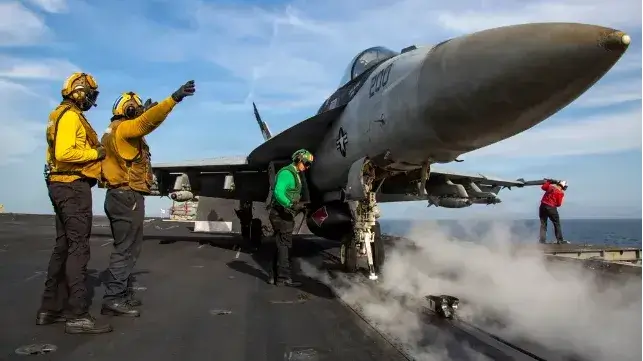
To enforce the blockade, CENTCOM dispatched an F/A-18 Super Hornet from USS Abraham Lincoln to take kinetic measures. At about 0900 Eastern Time on Wednesday, the fighter used its 20mm cannon to target the vessel's rudder, disabling Hasna and compelling her crew to stop transiting to Iran. (On a large tanker in ballast, the upper half of the rudder is out of the water and vulnerable to targeting.)
"The U.S. blockade against ships attempting to enter or depart Iranian ports remains in full effect," the command said in a statement. "CENTCOM forces continue to act deliberately and professionally to ensure compliance."
The fighter-strike method of blockade enforcement could improve CENTCOM's ability to tighten the interdiction campaign against Iranian shipping, without requiring scarce surface combatants or manpower-intensive boardings. Tanker-tracking experts have observed leakage through the American blockade, particularly westbound tonnage transiting in ballast. These empty tankers are critical to to Iran's ongoing effort to keep oil production high, as the vessels provide extra floating storage - extending the time horizon before Iranian producers have to begin shutting in wells for lack of a place to put more oil. Shut-ins risk damage at wellheads and long-term lost production; the administration has attempted to turn that risk into a ticking countdown clock in a calculated effort to pressure Iran into political concessions. Tanker storage has given Iran the ability to keep pumping for weeks after many analysts' early expectations, thereby lessening long-term economic harm from the blockade and making it easier to resist U.S. demands.