Thursday, May 28, 2026


BHP Killed Its Own Hedge Against the Green Steel Shift

  • Leaked internal documents show BHP scrapped a beneficiation plant at its Jimblebar mine that its own analysis rated positively and projected to cut 1.7 million tonnes of scope-three emissions annually – the exact kind of higher-grade ore China’s decarbonizing steel sector and new DRI-based steelmaking technology increasingly requires.

  • The cancellation came as BHP also halted a $400 million solar project, deferred a $1.3 billion renewables plan to 2031, and purchased 62 new diesel trucks locking in fossil fuel use through at least the late 2030s – all while a 2023 internal memo by BHP Australia president Geraldine Slattery warned that slow emissions progress risked "reputational impacts" and threatened the company’s "licence to operate."

  • With Simandou’s high-grade exports ramping up, China’s steel ETS tightening toward absolute caps by 2027, and Australia’s iron ore revenue forecast already declining, BHP’s decision to delay the projects that would have positioned it for a greener steel market is a strategic question as much as a climate one.
blast furance in industrial plant

China just expanded its national emissions trading scheme to cover steel production. The EU's carbon border adjustment mechanism entered its definitive phase in January, putting a financial penalty on emissions-intensive steel. Simandou, the world's largest untapped deposit of high-grade iron ore, shipped its first cargoes to China in late 2025. The market for lower-grade ore is contracting. The market for ore that can feed cleaner steelmaking is growing.

BHP just canceled the project that would have positioned it for the second market. Instead, it bought 62 diesel trucks.

That's the core of what hundreds of leaked internal documents obtained by The Guardian and the Australian Broadcasting Corporation actually reveal. Yes, they expose the gap between BHP's public climate pledges and its internal decisions. But the more consequential story is commercial. The world's largest miner just walked away from its best hedge against the structural shift in its most important market.

The canceled facility was a beneficiation plant at Jimblebar in Western Australia's Pilbara region. The purpose was to upgrade BHP's iron ore to a higher grade – the kind that steelmakers need to produce lower-emissions steel. BHP's own analysis rated the project as having "excellent social value" and "well-aligned" to its climate targets. The projected return on investment was positive. And it would have cut scope-three emissions by 1.7 million tonnes annually, the equivalent of removing more than 350,000 cars from the road.

BHP shelved it in mid-2025. The reasoning cited internally: marginal economics, competition for capital. That calculus was made before China's steel ETS tightened, before the EU's carbon levy moved from paperwork to actual financial liability, and before Simandou – grading at 65% iron against Pilbara's typical 58-62% – started displacing lower-grade supply. The math may look different now.

The documents also show BHP paused a board-approved $400 million solar-and-battery project at Jimblebar, citing "cash prioritization requirements," and deferred a $1.3 billion plan for solar, wind and battery infrastructure to support electric trucks and trains – with no major spending now expected before 2031. To make up the gap, BHP purchased 62 new diesel trucks, locking in fossil fuel operations at the site through at least the late 2030s and potentially 2041. A 2023 memo from BHP Australia president Geraldine Slattery warned explicitly that "slow emissions reduction progress" in the Pilbara risked "reputational impacts" and undermined the company’s “licence to operate, sustain and grow.” The company’s response to that warning was to slow the reduction further.

A BHP spokesperson told Bloomberg the company had cut emissions 36% from its 2020 baseline by mid-2025, with 70% of total electricity now drawn from renewable sources, and that key decarbonization technologies for heavy equipment “are not yet ready to be deployed.” BHP did not respond to a separate request for comment.

BHP’s main Pilbara rival is taking a different approach. Fortescue is pushing ahead with electrification and renewables despite industry skepticism about its timelines, and is investing in green iron as a commercial product, not just a climate commitment. The divergence matters because this is no longer a story about reputation. Australia’s iron ore export revenue is forecast to drop from A$116 billion to A$97 billion by 2026-27. China is building direct reduction ironmaking capacity at scale, which requires higher-grade ore than Australia typically produces. Beijing has issued mandates requiring steelmakers to increase green energy use. Chinese demand for standard Pilbara ore has already peaked.

BHP has a 30% emissions reduction target for 2030 and a net-zero pledge for 2050. Those commitments are now backed by diesel trucks ordered to last until 2041 and a beneficiation plant that got canceled because the economics were deemed marginal. The internal documents make clear that BHP knew the reputational risk. What they also reveal, unintentionally, is the commercial one.

By Michael Kern for Oilprice.com 

Floating Solar Could Be a Lifeline for Land-Scarce Nations Facing Energy Crises

  • A new NTUT study found offshore floating photovoltaic systems generate 12% more energy over their lifetime than equivalent land-based solar, due to seawater’s natural cooling effect.

  • Taiwan — 99% dependent on imported natural gas and battered by the Hormuz closure — faces acute pressure to find land-scarce renewable alternatives.

  • Researchers say OFPV is a “strategic solution” for any densely populated country with limited land, with potential applications across Southeast Asia and West Africa.

Floating solar farms could be significantly more efficient than solar farms on land thanks to the natural cooling effects of seawater, according to new findings from a comparative study conducted by researchers from the National Taipei University of Technology (NTUT) in Taiwan. The floating solar panels used in the study produced 12 percent more energy than the on-land models, with potentially huge implications for global energy security and decarbonization pathways.

The study, published this month in the Journal of Renewable and Sustainable Energy, compared the life cycles of an offshore floating photovoltaic (OFPV) in the waters off of Taiwan to a solar farm on the island. The study found that the OFPV system generated about 12 percent more energy in its lifetime thanks to the natural cooling effects of the seawater, which increased the system’s efficiency. Moreover, it found that OFPV also enhanced emission reductions.

“Because of this higher energy output, they also achieve greater carbon emission reductions,” study co-author Ching-Feng Chen, PhD, was recently quoted by Interesting Engineering. “In simple terms, even though both systems use similar technology, placing solar panels on water can make them more effective,” Chen went on to say.

This could have enormous implications for Taiwan, which is currently experiencing an existential energy crisis. Taiwan’s energy grid is totally isolated and strained, supporting a population of 23 million as well as an enormous and energy-intensive tech manufacturing sector with extremely limited land and energy resources. On top of that, Taiwan’s energy sector also faces major security threats from China and is simultaneously being battered by a still-unfolding energy crisis driven by the closure of the Strait of Hormuz.

At present, Taiwan is 99 percent dependent on imported natural gas. This renders the island extremely vulnerable to the kind of market shocks we’re seeing now due to the U.S.-Israel war in Iran. Asian markets have been hit extremely hard by the closure of the Strait of Hormuz, and Taiwan is no exception – in 2025 about one-third of the island’s liquefied natural gas imports came through the Strait. “For a country where gas-fired plants generate around half of all electricity, this is a direct hit to the fuel that was supposed to make Taiwan’s power system cleaner, flexible and secure,” Oilprice reported last week.

Taiwan desperately needs to update and diversify its energy mix, but the country’s small size and high population density pose major challenges for building out utility-scale clean energy resources. Solar and wind farms take up a lot of space, and Taiwan simply doesn’t have the land to spare. But what Taiwan does have a lot of is coastline. Offshore solar could therefore offer a lifeline to the island’s beleaguered energy sector.

As land-use conflicts surrounding renewable energy become more commonplace and more intense around the world, OFPV could offer a win-win for energy security as well as national security, within and beyond Taiwan. The potential advantages of the NTUT study extend to many other countries with similar land and population constraints.

“From a broader perspective, our work shows that offshore floating solar is not just a technical alternative but a strategic solution for other countries with limited land resources that can help expand their renewable energy capacity while still meeting environmental and land-use constraints,” Chen elaborated in a press release accompanying the study.

In fact, the idea of offshore solar as a lifeline for “population hotspots” is not a new one. In 2023, World Energy suggested that “vast arrays of solar panels floating on calm seas near the Equator could provide effectively unlimited solar energy to densely populated countries in Southeast Asia and West Africa.” The discovery that such solar panels can be even more productive than on-land models is just the cherry on top of this land-use issue.

By Haley Zaremba for Oilprice.com

Sanctioned Russian Diesel Tanker Fails to Reach Cuba

A Russian tanker carrying 270,000 barrels of diesel fuel, which is under US and EU sanctions, spent weeks trying to reach crisis-hit Cuba, which is also under US sanctions, as well as amid what's essentially become a full energy blockade, but has failed to reach the island nation and turned southward toward Brazil.

The exiled Russian outlet, The Insider, has detailed the following based on maritime tracking data:

The Russian-flagged tanker Universal (IMO: 9384306), which had been drifting for almost a month in the Sargasso Sea approaching the Antilles, has finally moved. However, the vessel is heading south, not toward Cuba, according to data from the Starboard Maritime Intelligence ship tracking service provided to The Insider. The vessel's current destination is listed as FOR ORDER. Judging by the vessel's movements, the United States has denied the tanker permission to transit Cuba. (machine translation)

via The Insider

It had been bound for Cuba since its departure from Russia in April, and was for a month drifting in an area some 1,000 miles northeast of Cuba.

Its destination remains listed as "For order" - which means it is still in a holding pattern awaiting routing and final destination instructions.

According to more details of it prior movements via The Moscow Times, "The Universal departed from the Russian Baltic port of Vistino in the Leningrad region on April 6 and, according to Britain's The Telegraph, was escorted through the English Channel by a Russian military convoy."

It was the Russian Black Sea Fleet frigate Admiral Grigorovich that accompanied the vessel into the Atlantic. Such extreme measures as a full military escort are deemed necessary due to prior EU country interdictions of sanctioned Russian ships.

Especially going back to April, Cuba and its population have been facing tightening economic strains where rolling blackouts and fuel shortages have intensified public hardship.

This energy crisis has become a central issue in its relations with Washington, as the government seeks relief from sanctions that limit access to fuel imports. A main supplier, Venezuela, has curtailed oil shipments to Cuba since the United States captured dictator Nicolás Maduro in January.

The White House has repeatedly proclaimed that the Cuban government is in a weakened state. President Trump has also threatened "Cuba is next". "The country is very weak. They’re in a very weak position economically, obviously, and financially," WH Press Secretary Karoline Leavitt said back in April.

By Zerohedge.com


Myanmar military steps up fight for rare earth area and border routes

Stock image.

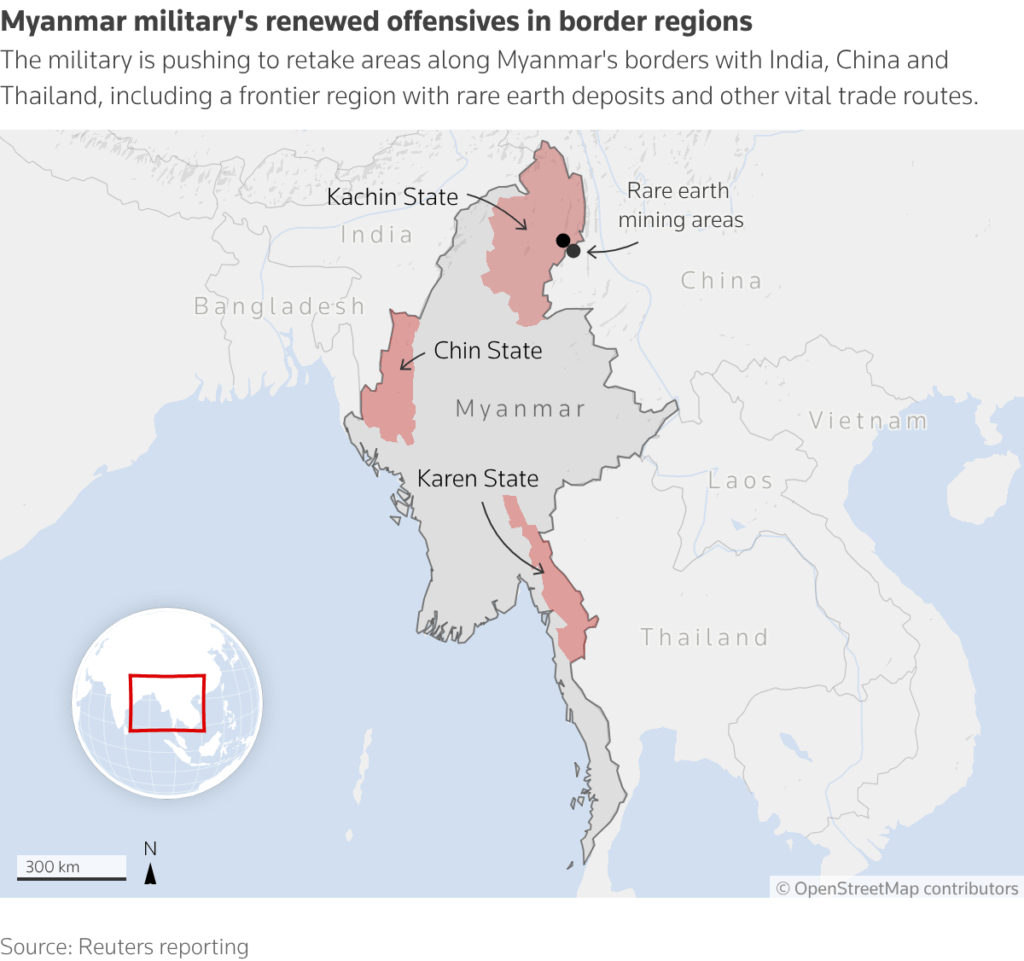
Myanmar’s military has launched renewed offensives into several border regions, including a frontier area with critical rare earth deposits and other vital trade routes, a month after a new administration took formal control of the war-torn country.

New military chief Ye Win Oo, who took office in March after his long-time predecessor stepped down to become president, is making an aggressive push to reclaim strategic border strongholds from ethnic armies that have gained strength in recent years, spokesmen for rebel groups and analysts told Reuters.

The military’s recent offensives have focused on Kachin State, a region rich in heavy rare earth elements that abuts China, as well as Chin State on the Indian border and a key trade corridor in Karen State, next to Thailand.

At a meeting last week, Ye Win Oo told soldiers that the military had secured Falam town in Chin State and an arterial route between Mandalay and Myitkyina in Kachin State, the state-run Global New Light of Myanmar newspaper reported.

“The military’s strategic rationale is that they need to regain control over the primary communication and trade routes in Myanmar,” said Myanmar analyst Sai Kyi Zin Soe.

“We can see that the military is trying desperately to recapture towns that host border trade gates.”

An official from Myanmar’s presidential office, reached via phone, declined to comment.

Reuters could not independently verify the details of military offensives and their early successes across parts of Myanmar, where media access remains restricted.

The offensives come after former junta chief-turned-president Min Aung Hlaing last month asked rebel groups opposed to the military to enter into peace talks within 100 days – a proposal that many ethnic armies immediately rejected.

Myanmar’s ongoing conflict was sparked in 2021, when the military staged a coup that ousted the democratically elected civilian government led by Nobel laureate Aung San Suu Kyi.

The takeover triggered a nationwide uprising that escalated into an armed resistance, with multiple ethnic armies and rebel groups pushing the military out of several regions.

Border gateways

The military is seeking to drive deeper into northern Kachin State, with an eye to retake mining belts along the Chinese border that produce roughly half of the world’s heavy rare earths, which are essential for wind turbines and electric vehicles.

Naw Bu, spokesperson for the Kachin Independence Army that took control of the area in October 2024, said the armed group has prepared their defences, particularly around the Chipwi and Pangwa township areas.

“We will welcome them with the barrels of our guns,” he said.

Simultaneously, the military has launched an intensified offensive on the western front in Chin State, bordering India, which could disrupt a key cross-border logistics route that supports opposition groups inside Myanmar.


Resistance fighters have undertaken strategic retreats from Falam and Tonzong towns in the state, as the military uses heavy aerial bombings to recover lost territory, said Salai Van, a spokesperson for the Chin National Front.

Illicit Iranian deliveries of jet fuel have previously powered an expansive bombing campaign by the Myanmar military, which struck more than 1,000 civilian locations in a 15-month period, Reuters has reported.

The war machine does not yet appear to have been slowed down by fuel shortages triggered by the conflict in Iran, although the country’s farmers and other civilians have been hard hit by the global energy crisis.

The military has also launched an offensive to control the Myawaddy-Kawkareik highway near Thailand, a key trade route around which fighting has raged on since the Karen National Union ethnic army pushed into the border town of Myawaddy in 2024.

The KNU is among those that Min Aung Hlaing specifically mentioned as part of his attempt to bring opposition groups to the table by July 31.

“The military has repeatedly and continuously violated pledges along the path to peace and paid no heed to agreements,” said Saw Taw Nee, a spokesperson for the ​KNU.

“Therefore, it goes without saying that there is a complete absence of trust. Whatever they attempt, it is bound to fail.”

(By Reuters staff; Editing by Devjyot Ghoshal and Lincoln Feast)

U.S. Scores Major Rare Earth Win With Greenland Deposit Deal

As Washington races to build a rare earth supply chain that can survive the Pentagon’s 2027 ban on Chinese-origin materials, REalloys (NASDAQ: ALOY) has locked in long-term supply from one of the largest known heavy rare earth deposits in the world.

The company announced last Thursday that it has signed a definitive 15-year offtake agreement with Critical Metals Corp. (NASDAQ: CRML) covering 15% of Phase 1 production from the Tanbreez project in southern Greenland, a massive heavy rare earth deposit containing Dysprosium and Terbium, the two most strategically sensitive magnet materials used in fighter aircraft, missile systems, radar platforms, drones, and advanced defense hardware.

REalloys is building one of the only integrated heavy rare earth metallization and magnet production platforms in North America as Washington pushes to break its dependence on Chinese processing capacity before the Pentagon ban takes effect in only seven months.

The company’s Euclid, Ohio, operation focuses on the hardest part of the rare earth supply chain outside China: converting rare earth oxides into defense-grade metals, alloys, and eventually the world’s strongest and most advanced magnet: the NdFeB permanent magnet type used in missile systems, fighter aircraft, radar platforms, robotics, EV drivetrains, and advanced industrial systems. 

REalloys says it is scaling that Ohio platform into the largest heavy rare earth metallization facility outside China, supported by a growing network of allied-nation feedstock agreements.

The Tanbreez agreement significantly expands that network.

Under the deal, REalloys will secure 15% of monthly Phase 1 production from the Greenland project for an initial 15-year term. 

This is another major announcement for REalloys as the company rushes to stay ahead of major defense deadlines. 

The Tanbreez offtake deal follows REalloys strategic partnership with Saskatchewan Research Council, tied to 80% of the output from the Saskatchewan Research Council’s commercial rare earth processing facility. It also adds to the company’s previously secured rights to up to 10% of production from the high-grade Sheep Creek rare earth deposit in Montana, and its control of the Hoidas Lake rare earth asset in Saskatchewan. 

GREENLAND IS EMERGING AS A WESTERN RARE EARTH STRONGHOLD

Trump didn’t manage to buy Greenland, but REalloys got its critical minerals. 

The strategic importance of the Tanbreez project goes far beyond scale. 

The Greenland deposit is one of the largest known heavy rare earth resources globally and one of the few major Western-aligned projects capable of supplying meaningful quantities of Dysprosium and Terbium outside China.

Tanbreez isn’t just another rare earths venue. It’s a heavy rare earth behemoth, while most global deposits focus on less valuable light rare earth production. Critical Metals estimates heavy rare earths account for roughly 27% of the project’s total profile. Most global deposits focused primarily on light rare earth production.

The Greenland project is already fully permitted and advancing under a Western-aligned ownership structure following Greenland's approval of Critical Metals’ acquisition of a controlling 92.5% interest earlier this year. 

For REalloys, the deal secures another long-term heavy rare earth materials now central to Pentagon supply chain planning amid a Middle East conflict that is rapidly depleting the arsenal. 

Johns Hopkins economists Steve Hanke and Jeffrey Weng told Fortune magazine that the U.S. has already burned through massive portions of its precision weapons inventory across Iran and Ukraine, while remaining dependent on Chinese-controlled rare earth materials to replace them. The economists suggest that Washington has blown through 45% of its Precision Strike Missile inventory just in Iran, and nearly 50% of its THAAD interceptors and 30% of its Tomahawk cruise missiles, among others. 

Those systems rely on samarium-cobalt magnets or dysprosium- and terbium-enhanced NdFeB magnets that still flow overwhelmingly through China’s refining and metallization system. The authors estimate that replenishing just four major weapons systems could require between five and ten metric tons of finished defense-grade rare earth magnets, with more than 95% of current supply chains still tied to China.

And that’s the gap REalloys is helping to close, with a North American solution helmed by a leadership lineup that represents the who’s who of American defense. 

Joe Kasper, former Chief of Staff to the U.S. Secretary of Defense, leads REalloys’      advisory board, working closely with REalloys’ Board Chair, Stephen duMont, president of GM Defense, and seated Board member, General Jack Keane, former Vice Chief of Staff of the U.S. Army.               

These are the people who’ve run defense procurement from the inside, the ones who decide who gets qualified, who gets funded, and who actually ends up supplying material into weapons systems.

“This is about building a completely sovereign supply chain from input to finished product, without relying on foreign processing,” Joe Kasper, former Chief of Staff to the U.S. Secretary of Defense and now Chairman of REalloys’ advisory board, told Oilprice.com. “If the U.S. can’t access domestically-processed and manufactured materials, then it does not have a rare earths supply chain at all.”

All Systems Go

REalloys’ Phase One operations are already turning rare earths into alloys in Ohio, amid an ongoing build-out that will launch next year alongside the Pentagon ban on Chinese-origin rare earths. Its plans for Phase Two are a major scale-up.  

In Phase One, REalloys intends to move into North American production of high-purity rare earth oxides that can be turned into metals and alloys, using a mix of recycled magnets and mined feedstock. This is the point at which material is produced in the United States and can move through a traceable supply chain. The capital required is about $75 million, and the buildout has $50 million in cash already allocated. 

By Phase Two, it will all run through the Ohio facility, where REalloys already converts rare earth oxides into metal and alloy form. The buildout increases throughput and expands the range of material it can process, including heavy rare earths like Dysprosium and Terbium. Feedstock is expected to come from both recycled magnets and upstream feedstock supply agreements, like the one from the Tanbreez project, with the material moving through reduction and alloying in-house before leaving as finished product.

Phase Two will also vertically integrate by adding rare earths magnet production to the pipeline. By 2029, the plan is to add magnet manufacturing in Ohio, closing the full circle from processed material into finished components.

Instead of selling metal and alloys into someone else’s system, REalloys would produce NdFeB magnets itself from its own integrated solution and keep that margin. 

This is where the economics takes a major leap forward, and it’s what prompted Clears Street in April to launch coverage of REalloys

Clear Street initiated coverage of REalloys with a Buy rating and a $35 price target, even though the stock was trading just under $8 at the time of the report, because the current valuation does not reflect what the system could look like once it’s running at scale.

The Rare Earths End Game

Rare earths are now facing tightening restrictions on both sides of the Pacific. 

And Washington is scrambling to the point of internal divisions over how fast this entire supply chain can be built. 

Bloomberg reports that internal disagreements are emerging inside the Trump administration after China’s export restrictions exposed major U.S. vulnerabilities. The argument is over whether the U.S. should rely on market forces to rebuild the rare earth industry or use aggressive state-backed financing and industrial policy similar to the model China used to dominate the sector.

The pressure is now extending well beyond junior mining and processing companies. Large U.S. industrial and defense players like GE Aerospace (NYSE:GE) and LMT (NYSE:LMT) are increasingly exposed to the rare earth supply chain bottleneck as advanced jet engines, missile systems, radar platforms, and aerospace electronics remain heavily dependent on Dysprosium-, Terbium-, and NdFeB-based magnet systems. As Pentagon restrictions tighten ahead of 2027, securing non-Chinese processing and metallization capacity is rapidly becoming a strategic issue across the broader U.S. defense-industrial base.

This is why companies capable of securing even a single strategic link in the non-Chinese rare earth supply chain could become some of the most valuable industrial and defense assets of the next decade.

By. Charles Kennedy


China Keeps Rare Earth Pressure on Washington After Trump Summit

  • Trump’s Beijing summit produced business deals and temporary diplomatic easing, but failed to secure a long-term rollback of China’s rare earth export restrictions.

  • China continues to dominate heavy rare earth supply, with exports of key materials like dysprosium, terbium, and yttrium still heavily restricted.

  • The U.S. and Europe are accelerating efforts to build independent rare earth supply chains through major investments in domestic mining, processing, recycling, and magnet production.

Two weeks ago, U.S. President Donald Trump paid a visit to Beijing for a high-level summit with Chinese leader Xi Jinping, with a view to stabilizing bilateral trade, securing new business deals, and seeking China's diplomatic leverage to help manage the conflict in Iran. Trump traveled with a delegation of high-level American CEOs to encourage China to open its markets to U.S. tech companies, and managed to secure several multibillion-dollar deals. The summit yielded a modest tactical detente and improved diplomatic normalcy between the two rival powers, with the White House reporting that Xi remains opposed to the militarization of the Strait of Hormuz. However, Trump’s visit had a glaring failure: the discussions in Beijing did not result in a formal agreement or long-term trade truce concerning China’s easing of rare earths export restrictions.

Still, China “can ground America’s drone fleet with a single phone call”, according to an opinion piece this week in American military publication Stars and Stripes. Back in November, Beijing reaffirmed that broad export restrictions introduced earlier, such as the outright bans on rare earth extraction/separation technology and the specific volume controls on select critical minerals like tungsten, bismuth, antimony, as well as various medium- to heavy-rare-earth elements, remain fully in effect. China did pause the sweeping, second-wave controls that had mandated export licenses for foreign entities and products containing trace amounts of Chinese-origin rare earth materials, it had announced in October 2025–but only for one year.

Related: Aluminum Market Facing ‘Serious and Prolonged Supply Outage’

And now, an analysis by Fitch Group's BMI Research notes that Xi’s team only promised to address U.S. supply shortage concerns without providing concrete structural extensions or policy adjustments during the latest meeting.

Chinese shipments of highly critical "heavy" rare earths remain drastically suppressed despite the one-year respite, with dysprosium, terbium, and yttrium exports currently running at just 41%, 49%, and 42% of pre-restriction levels, respectively. Worryingly, the price of yttrium has skyrocketed 15-fold due to acute shortages stemming from China's export rules, triggering severe disruptions across the U.S. aerospace and semiconductor industries where the mineral acts as a vital protective and thermal coating. China accounts for ~70% of U.S.’ yttrium supply, as well as 100% of its terbium, holmium, and lutetium.

China’s rare earths hegemony has sent the United States and its Western peers scrambling for alternative supplies.

Back in July, the U.S. Department of Defense (DoD) agreed to purchase $400 million in preferred stock in MP Materials (NYSE:MP), making the Pentagon the company's largest shareholder with an equity stake of roughly 15%. The agreement includes a 10-year offtake contract with a price floor, ensuring that MP Materials' output goes directly to defense and commercial customers to secure domestic supply chain independence. MP Materials is utilizing this capital and an additional $1 billion in commercial debt from JPMorgan Chase and Goldman Sachs to build the "10X Facility," a massive rare earth magnet manufacturing campus located in Northlake, Texas.

Around the same time, USA Rare Earth (NYSE:USAR) signed a non-binding Letter of Intent (LOI) with the U.S. Department of Commerce to access $1.6 billion in government funding, which will be drawn from a finance facility created under the CHIPS and Science Act. The funding package consists of a proposed $1.3 billion senior secured loan and $277 million in federal funding. The company will also issue a 10% equity stake (and warrants for additional shares) to the U.S. government. The investment will fast-track the mining, processing, and refining of heavy rare earth elements at their Round Top deposit in Sierra Blanca, Texas, with commercial production anticipated to begin in 2028.

REalloys (NASDAQ:ALOY) is also positioning itself within the emerging Western rare earth supply chain through a series of agreements tied to heavy rare earth processing and metallization capacity in North America. The company has secured long-term supply agreements with the Saskatchewan Research Council (SRC) for neodymium-praseodymium (NdPr), dysprosium, and terbium output, while funding upgrades to SRC’s processing facility in Saskatoon and developing a heavy rare earth metallization platform in Ohio focused on producing defense-grade metals and alloys. REalloys has also signed feedstock agreements tied to the Tanbreez project in Greenland and the Sheep Creek rare earth deposit in Montana as part of a broader mine-to-magnet strategy targeting U.S. defense and industrial markets.

Meanwhile, Europe is bypassing China's near-monopoly on rare earths through the Critical Raw Materials Act (CRMA), which caps single-country dependency. The bloc is investing heavily in domestic extraction, processing, and recycling, shortlisting strategic projects and signing resource partnerships with Western-allied nations. Recognizing the vulnerability of supply chains, the European Commission is implementing coordinated defense strategies through initiatives such as RESourceEU Action Plan, an initiative backed by up to €3 billion in funding that coordinates demand aggregation, supply stress tests, and the joint purchasing of critical minerals among member states. The CRMA also mandates that at least 25% of the EU's strategic raw materials come from recycled waste by 2030.

European automakers and tech manufacturers are also increasingly designing products that bypass rare earths altogether. For instance, manufacturers are pivoting to magnet-free motors, including synchronous reluctance motors and induction motors, which eliminate the need for neodymium-based permanent magnets in electric vehicles. 

By Alex Kimani for Oilprice.com