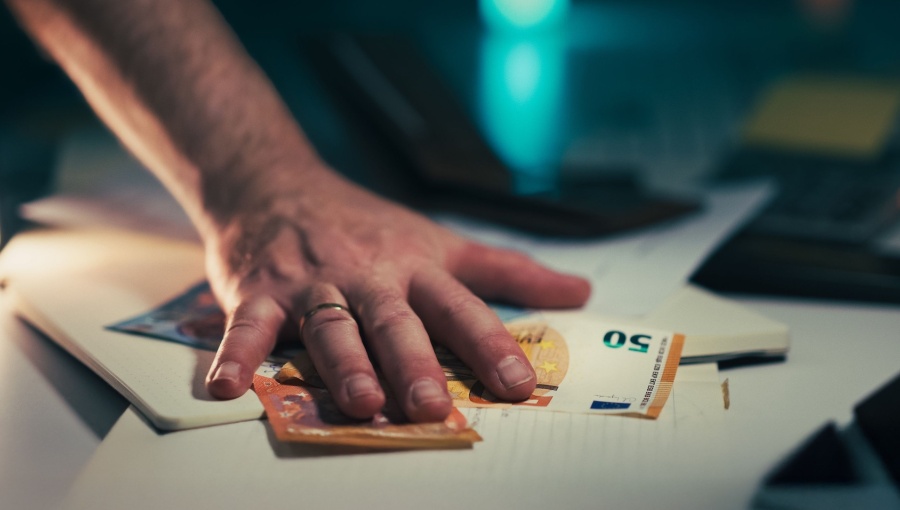
Prosecutors in Serbia have accused the owner of collapsed Alta banka of taking about €383mn from the lender's vault, in a case that could rank among the biggest banking scandals in Southeast Europe.
Davor Macura, owner of the bank through his Alta Group, was arrested on November 2 alongside two bank officials on suspicion of withdrawing around RSD45bn (€383mn) without authorisation. The two employees, the head of treasury and cash management and a treasury associate, are suspected of allowing him access using their own cards or handing them over to him.
The National Bank of Serbia (NBS) revoked the bank's licence on October 30, citing a significant deterioration in its financial position. Clients had already withdrawn millions in deposits in the days before the closure.
The alleged amount taken represents about a fifth of Alta's RSD215bn (€1.83bn) in assets at the end of July, when it was Serbia's ninth-largest lender.
The case follows a similar pattern to a series of banking scandals across the Western Balkans and other Southeast European countries over the past three decades, in which politically connected domestic lenders expanded rapidly before regulators intervened, often leaving substantial losses for depositors and taxpayers.
Macura has been described by Serbian media as close to the Serbian Progressive Party (SNS), which lost the October 25 general election to a student-backed movement after 14 years in power. The Student List has called Alta the "tip of the corrupt octopus" and urged banks to monitor potential capital flight during the transition.
Moldova's stolen billion
Moldova's 2014 banking fraud remains one of the region's most notorious cases. About $1bn was siphoned from three banks – Banca de Economii, Banca Sociala and Unibank – through loans to companies that failed to repay them.
The central bank covered the shortfall with emergency loans guaranteed by the government, which were subsequently converted into public debt. The losses were estimated by think tank Expert Grup at around 12% of GDP.
Businessman Ilan Shor, who chaired Banca de Economii, was sentenced to 15 years in prison in 2023 and remains abroad as a fugitive. Former Democratic Party leader Vladimir Plahotniuc, extradited from Greece in 2025, received a 19-year sentence on April 22. Both said they were considering appeals.
Moldova also served as a conduit for the Russian Laundromat, a money-laundering operation that moved at least $22bn and potentially as much as $80bn out of Russia between 2011 and 2014, with the assistance of Moldovan court rulings.
Businessman Veaceslav Platon, who owned Moldindconbank at the time, was sent to trial in September over the alleged illegal takeover of a stake in Moldova-Agroindbank in 2014, using funds investigators suspect may have originated from the Laundromat.
Bulgaria's €1.9bn banking collapse
Bulgaria's Corporate Commercial Bank (Corpbank), or KTB, was the country's fourth-largest lender when a depositor run in June 2014 triggered a liquidity crisis.
An audit uncovered a BGN3.75bn (€1.92bn) capital shortfall, prompting the central bank to revoke its licence in November. The deposit insurance fund paid BGN3.68bn (€1.88bn) to depositors.
Prosecutors indicted 18 people over the collapse, including majority owner Tsvetan Vassilev. He remains outside Bulgaria's jurisdiction after settling in Serbia, which granted him political asylum in 2022. Bulgaria issued a fresh European arrest warrant for him in 2024.
Bosnia's politically connected lenders
Mostar-based Hercegovacka Banka became one of the most overtly political banking cases in the region. In April 2001, international High Representative Wolfgang Petritsch placed the lender under provisional administration amid suspicions it was financing the Croatian Democratic Union's campaign for Croat self-rule. Nato-led SFOR troops escorted auditors into branches, triggering riots in Croat-majority towns.
Administrator Toby Robinson reported in December 2002 that the bank had been insolvent before the intervention and that BAM216mn (€110mn) in capital, transferred from Croatia to support the Bosnian Croat army, had disappeared.
Former Bosnian presidency member Ante Jelavic was sentenced at first instance to 10 years in 2005 over the embezzlement of Croatian aid channelled through the bank. He subsequently left for Croatia.
Republika Srpska also suffered major banking failures. Bobar Banka went bankrupt in 2014, with a court confirming charges against 16 people in 2017 over the alleged diversion of around BAM122.5mn (€63mn). State institutions, health funds, utilities and pension funds lost deposits.
State-owned Banka Srpske, formerly Balkan Investment Bank, lost its licence in 2016 after an audit found it had reported a profit for 2014 despite suffering a loss of at least BAM17mn (€8.7mn). Its liquidation was a condition set by the International Monetary Fund (IMF) for a new loan.
Montenegro's family-linked banks
In Montenegro, banking failures have often raised questions about links between lenders and political elites.
Prva Banka, majority-owned by Aco Djukanovic, brother of long-time leader Milo Djukanovic, was the country's second-largest lender when the state provided it with a €44mn loan in December 2008 to prevent its collapse. Anti-corruption groups dubbed it the family's "personal ATM".
After the Democratic Party of Socialists lost power, state companies wirhdrew €13.1mn in deposits from the bank in 2021.
The central bank placed Atlas Banka and Invest Banka Montenegro, both owned by businessman Dusko Knezevic, under temporary administration in December 2018. Both subsequently went bankrupt.
Prosecutors accused Knezevic of leading a criminal group that laundered €500mn through Atlas Banka. He denied the allegations from London and accused Djukanovic's circle of attempting to seize his businesses.
The Alta scandal has also spread to Montenegro, where the central bank revoked the payment services licence of Macura's Alta Pay Group on November 1.
Albania's inside jobs
Albania's most prominent banking scandal involved the theft of ALL713mn (€5.1mn) from the Bank of Albania's vault in 2014.
Police arrested central bank employees in July that year after the cash disappeared. Employee Ardian Bitraj confessed to smuggling banknotes out of the building in his clothes or inside old books. He told police he had stolen money daily during the 2014 World Cup to fund gambling, Reuters reported.
Bitraj was sentenced to 13 years in prison, while long-serving governor Ardian Fullani was dismissed.
In 2022, police foiled a gang that had tunnelled up from the sewers towards an unnamed commercial bank beneath one of Tirana's main boulevards.
Current governor Gent Sejko, appointed in 2015 to oversee reforms after the theft, has also come under scrutiny. Prosecutors in April 2024 asked the special prosecution to investigate his handling of Micro Credit Albania (MCA), a debt collector licensed by the central bank, according to Transparency International's case file.
By July 2020, MCA had paid about €5.2mn for €85mn in bad loans acquired from 10 banks and other lenders, while recovering around €10.7mn from borrowers. It imposed penalties of 2% a day, equivalent to 730% annually.
Prosecutors suspect the scheme extracted €36.8mn from around 30,000 people through abusive fees, wage seizures and home auctions. Sejko has denied that the central bank violated the law. The special prosecution sent 16 people and four companies to trial in July 2025, according to Shqiptarja.
Croatia's trading losses
Croatia's banking scandals have largely involved trading losses and politically directed lending.
In March 2002, depositors queued outside Rijecka Banka after its chief currency trader Eduard Nodilo was arrested for concealing losses on dollar-euro trades. The bank's shares fell 37% in a single day.
The Croatian National Bank's final report put losses between 1998 and March 2002 at $97.3mn. Bayerische Landesbank, which owned 60% of the lender, returned its stake to the state. Erste subsequently acquired the bank, while Nodilo was jailed.
The crisis followed a series of bank collapses in the late 1990s, when lenders had extended loans to associates of then-president Franjo Tudjman, undermining public confidence in the banking sector.
The biggest financial fallout came from Austria's Hypo Alpe Adria, which expanded rapidly across Croatia and the Balkans before Austria nationalised it in December 2009.
Former Croatian prime minister Ivo Sanader was twice convicted of receiving a HRK3.6mn (€480,000) commission from the bank in 1994, before being acquitted in a third retrial in 2022.
Hypo's Balkan operations were sold to sold to Advent and the European Bank for Reconstruction and Development (EBRD) in 2015 and renamed Addiko. Alta Group built a 30% stake in the Vienna-based lender in 2024.

No comments:
Post a Comment