It’s possible that I shall make an ass of myself. But in that case one can always get out of it with a little dialectic. I have, of course, so worded my proposition as to be right either way (K.Marx, Letter to F.Engels on the Indian Mutiny)
Wednesday, November 04, 2026
Mercury pollution disrupts the stress response and may threaten crocodiles
Gold mining introduces an overlooked threat to wild caimans, reducing their ability to survive environmental changes.
Mercury pollution from artisanal gold mining in tropical regions is finding its way into wildlife. A team from the University of Vienna and the Veterinary University of Vienna shows that mercury exposure impairs glucocorticoid response that helps animals cope with acute stress. This weakened stress response could reduce the caimans' chances of survival and reproduction. The findings, recently published in the journal Communications Biology, point to a previously overlooked endocrine threat to crocodylians.
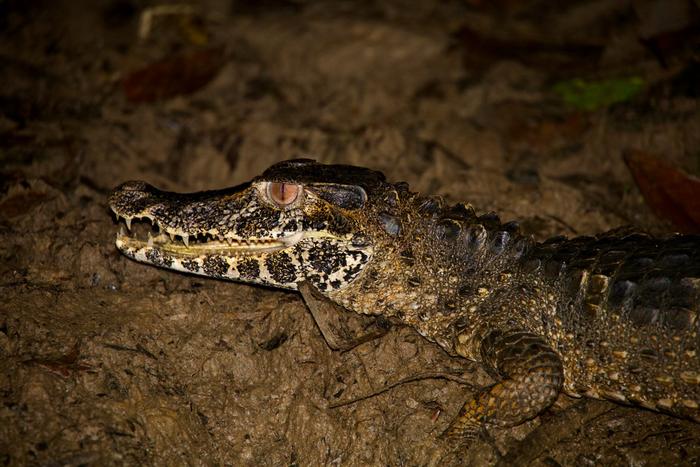
Working with wild Smooth-fronted caimans (Paleosuchus trigonatus) in the rainforest of French Guiana, researchers found that individuals with higher mercury levels in their blood reached lower peak corticosterone during standardized stress tests. This suggests that mercury acts as an endocrine-disrupting chemical which could compromise the crocodylians capacity to cope with environmental change.
A hormonal system under pressure
Since pre-industrial times, atmospheric mercury has increased by an estimated 300-500%, largely due to fossil fuel combustion and gold mining. Mercury is a potent endocrine-disrupting chemical: in vertebrates, including humans, it can interfere with steroid receptors, among them the glucocorticoid receptor, which mediates the body’s stress response.
The hypothalamic-pituitary-adrenal axis enables animals to maintain homeostasis during acute challenges, rapidly ramping up hormone levels such as corticosterone to mobilize energy and trigger appropriate behavioral responses. In healthy vertebrates, this peak is fast and pronounced. In caimans from mercury-contaminated environments, however, the research team observed a significantly dampened hormonal spike – evidence that the flexibility of this vital response system decreases as blood mercury concentrations increase.
A comparative analysis by the team further indicates that a cysteine residue within the ligand-binding domain of the glucocorticoid receptor, a site known to be targeted by methylmercury, is conserved across crocodylian species, offering a possible molecular explanation for the disruption observed.
"Given the overlap of crocodylian habitats with gold mining activities, this is a conservation concern that deserves immediate attention" says Jérémy Lemaire from the University of Vienna, project lead and first author of this study. "A fast, robust stress response is essential for survival in the wild. We show that even relatively low mercury burdens affect this response in caimans, potentially limiting their ability to cope with predators, extreme weather, human disturbance, and ultimately survive in the wild".
A widespread and largely invisible risk
In many tropical regions, mercury emissions from gold mining are prevalent and can travel worldwide through the atmosphere. As long-lived apex predators, caimans accumulate mercury through their diet over many years, making them sensitive indicators of contamination in their ecosystems.
Crocodylian species are among the most threatened vertebrate groups worldwide. Even subtle endocrine disruption can result in lower survival rates and reproductive success at the population level. Notably, the effects observed in this study occurred at mercury concentrations within the range already reported for crocodylian species elsewhere in the world – suggesting that similar endocrine risks may be far more widespread than currently recognized.
Summary:
Wild caimans with elevated blood mercury showed a dampened maximal corticosterone response during capture-and-handling tests.
The amplitude of the stress response, and their flexibility to cope with challenges, decreased as blood mercury concentration increased.
Comparative analysis indicates that a cysteine residue within the glucocorticoid receptor's ligand-binding domain, known to be targeted by methylmercury, is conserved in crocodylians, pointing to a possible molecular mechanism.
The effects were observed at mercury concentrations already reported for crocodylian species worldwide, suggesting the risk is not limited to French Guiana.
The findings raise concern for the conservation of crocodylians and other apex predators in regions overlapping with gold mining activity.
About the University of Vienna:
For over 650 years the University of Vienna has stood for education, research and innovation. Today, it is ranked among the top 100 and thus the top four per cent of all universities worldwide and is globally connected. With degree programmes covering 188 disciplines, and approximately 11,000 employees, we are one of the largest academic institutions in Europe. Here, people from a broad spectrum of disciplines come together to carry out research at the highest level and develop solutions for current and future challenges. Its students and graduates develop reflected and sustainable solutions to complex challenges using innovative spirit and curiosity.
Mercury contamination impairs the hypothalamic-pituitary-adrenal axis of a neotropical caiman
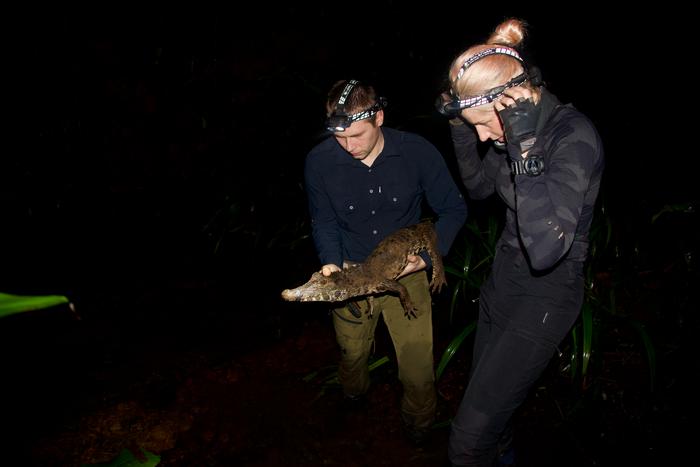
Fig. 2: Realease of a Smooth-fronted caiman (Paleosuchus trigonatus) adult after testing for stress response in French Guiana. (R. Mangionne on the right & J. Lemaire on the left).
Fig. 3: Arataye River, Saut Parare in the Nature reserve Les Nouragues, French Guiana.

No comments:
Post a Comment