Indonesia-North Korea Thaw Opens Door To Closer Security Ties – Analysis
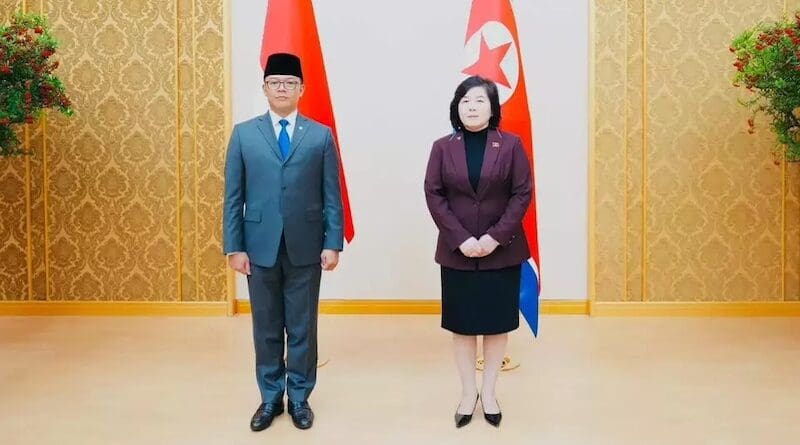
Indonesia's Foreign Minister Sugiono meets his North Korean counterpart Choe Son-Hui in Pyongyang on Oct. 11, 2025. (Photo Courtesy of Foreign Affairs Ministry)
October 22, 2025
Geopolitical Monitor
By Geo Dzakwan Arshali
Whether framed as coincidence or careful arrangement, October 2025 offered a moment of surprising symbolism in Indonesia-North Korea relations. Pyongyang marked its 80th Workers’ Party anniversary just as Jakarta celebrated the 80th year of its armed forces, and against this setting that Indonesian Foreign Minister Sugiono set out on the first visit to North Korea by an Indonesian top diplomat for over a decade. Whereas official statements spoke only of friendship, the strategic timing and Indonesia’s recent defense buildup suggest deeper strategic interests, fueling speculation that low-profile security ties might be under consideration.
Jakarta’s Longstanding Relations with Pyongyang
Indonesia’s links to North Korea run deep from the Cold War era, but have historically been political rather than military. Diplomatic relations were established in 1964 as an extension of Indonesia’s non-aligned foreign policy, after which Indonesia’s founding father Sukarno hosted North Korea’s Kim Il-sung in Indonesia. After a brief interruption in the late 1960s, Indonesia under Suharto re-aligned toward the West but never officially cut relations with Pyongyang. Megawati Sukarnoputri, Sukarno’s daughter and later Indonesian president, revived personal channels with the Kim family, meeting Kim Jong-il in 2002 and affirming the symbolism of dynastic respect between Jakarta and Pyongyang.
For decades, the two nations have maintained cordial yet understated relations. North Korea maintains its embassy in Jakarta, and after a temporary COVID shutdown, Indonesia reopened its Pyongyang embassy in July 2025. Prabowo also met Kim Jong Un during the Victory Day Parade hosted by Xi Jinping in Beijing. Nevertheless, trade ties remain minimal, with official figures indicating a decline from USD 2.3 million in the first eight months in 2024 to USD 2.1 million in the same period in the year after.
Indonesia, North Korea, and ASEAN Reactions
The October visit saw the two foreign ministers sign a memorandum of understanding to establish a formal bilateral consultation mechanism, which would explore cooperation in political, socio-cultural, technical, and even sports sectors. Expectedly, it did not mention military affairs. But any consultation channel, even framed as civilian or political, can carry security implications. Moreover, Indonesia’s renewed engagement with Pyongyang aligns with its enduring commitment to free and active foreign policy doctrine, which seeks a balanced involvement with all major powers.
Indonesia, interestingly, has ramped up its defense ambitions since Prabowo took office. The Indonesian National Armed Forces’ 80th anniversary parade displayed new domestically-built and imported systems, specifically the debut of Indonesia’s first autonomous unmanned submarine KSOT-008 that reveals Jakarta’s intent to military modernization. The country, at its core, has further diversified its arms procurement to include a broader array of partners, acquiring equipment and technology from Turkey, France, Russia, India, the United Kingdom, Italy, China, and even South Korea.
In light of this, engagement with North Korea, even if limited to consultation or technical dialogue, could be seen as a calculated extension of that approach. Discreet engagement with Pyongyang provides Indonesia an opportunity to access North Korean know-how and thereby advances Jakarta’s strategic military modernization. But even so, technical focused interactions carry considerable diplomatic risk that will inevitably draw scrutiny from Western partners and ASEAN neighbors given North Korea’s UN-sanctioned status. This is a situation Indonesia must navigate delicately to pursue its defense interests without jeopardizing its credibility.
Southeast Asia may take a positive view given North Korea’s deliberate efforts to re-establish contact with the region in recent years. The ASEAN bloc remains committed to diplomacy and adherence to UN rules, as demonstrated at the November 2024 ASEAN Summit, in which member states expressed grave concern regarding North Korean missile testing and repeated demands for compliance to UN resolutions. Pyongyang’s immediate objective is clear in its pursuit of normalizing defense-related diplomacy across Asia and securing new partnerships to offset its growing international isolation. With Jakarta, widely perceived as a de facto leader within ASEAN, signaling openness to North Korea-ASEAN engagement through the ASEAN Regional Forum, the region is likely to welcome cautious initiatives that facilitate constructive dialogue and uphold regional stability.
Future Trajectories of Jakarta-Pyongyang Ties
Critics argue that Indonesia’s hypothetical movement into substantive security ties with North Korea in a non-starter. Indonesia is a UN member state bound by Security Council resolutions banning arms trade and military assistance to Pyongyang. Domestic politics, moreover, could complicate such a move, with Indonesian citizens still being sensitive to human rights and non-proliferation, and any assumed to be visible closeness to an isolated regime politically risky. ASEAN’s norms of gradualism and unanimity, in the same way, mean that Indonesia could face regional pushback if its outreach to Pyongyang is regarded as undermining shared principles.
While these concerns are valid, they overlook certain key considerations. Indonesia’s foreign policy tradition of autonomy, reinforced by Prabowo’s willingness to engage all sides, makes similar outreach consistent with Jakarta’s broader strategy. Southeast Asia’s renewal diplomatic ties with North Korea, furthermore, demonstrate a pragmatic blend of political symbolism and strategic hedging. Vietnam and Laos are already deepening cooperation especially party-to-party, given their ideological alignment and historical ties, with Vietnam now enhancing to defense partnership, while others still maintain cautious engagement. And by inviting North Korea deeper into ASEAN frameworks, as Indonesia extended, Jakarta can claim it is containing Pyongyang through dialogue rather than breaking away.
What might possibly happen next for Indonesia and North Korea can be assessed by probability and impact, with any security cooperation likely to be low-profile and incremental:
First, the high-impact but low-probability scenario would involve Indonesia engaging in arms or advanced technology transfers from North Korea, which would constitute a clear breach of UN sanctions and almost certainly trigger international backlash; this is improbable without a significant radical change in government doctrine.
Second, a more plausible medium-probability path lies in what might be called gray-zone cooperation, where Indonesia sustains patterns of consultation and non-traditional cooperation with Pyongyang that fall short of explicit arms transactions. In this way, quiet exchanges on cybersecurity or maritime domain awareness could develop, producing gradual mutual understanding and potential skills transfer over time, much as Vietnam’s experience suggests.
Third, the low-probability but symbolically significant option is that Indonesia’s outreach remains largely rhetorical, serving primarily to signal Jakarta’s independent stance. In this scenario, gestures of longstanding friendship continue but without translating into substantive cooperation, which represents the baseline outcome if both sides decide to play safe.
Indonesia’s Calculated Approach to Regional Stability
For Indonesia, if the goal is true strategic autonomy and national interest, Jakarta should avoid vague back-channels that could raise suspicion. The government could publicly clarify the scope of any North Korea engagement, for instance, by declaring that consultation mechanisms are confined to non-dual-use areas and by submitting clear reports to the UN sanctions committee.
At the same time, Indonesia’s Western partners and regional neighbors need to approach engagement with pragmatism. They should continuously remind Jakarta of its obligations under UN sanctions, making clear that even symbolic interactions with North Korea are bounded by diplomatic limits, and any indications of arms procurement would carry serious consequences. Nevertheless, such pressure must be carefully calibrated, as overreaction could prompt Indonesian leaders to quietly adjust their approach, seeking alternatives that avoid direct confrontation while still advancing their strategic interests.
Either way, what is clear is that Indonesia and North Korea are rebuilding a measured, modest rapport. Whether the two nations’ engagement remains minor or emerges as a significant factor in regional security will depend on Jakarta’s intent and the strict boundaries it establishes. History shows Indonesia’s foreign policy often surprises, and under Prabowo’s assertive and more active foreign policy stance, this middle power can be expected to assert itself more decisively in influencing regional strategic landscape. If properly managed, this renewed engagement could allow ASEAN to draw Pyongyang into other regional frameworks and strengthen stability.
This article was published at Geopoliticalmonitor.com

Geopolitical Monitor
Geopoliticalmonitor.com is an open-source intelligence collection and forecasting service, providing research, analysis and up to date coverage on situations and events that have a substantive impact on political, military and economic affairs.
Geopolitical Monitor
Geopoliticalmonitor.com is an open-source intelligence collection and forecasting service, providing research, analysis and up to date coverage on situations and events that have a substantive impact on political, military and economic affairs.

No comments:
Post a Comment