Critical minerals drive new commodity supercycle: Sprott
Governments and investors are increasingly treating critical materials such as copper and uranium as strategic assets, helping drive what Sprott says could be the early stages of a new commodity bull market.

Commodity markets entered 2026 with renewed momentum as resource equities broke above long-term trading ranges after years of underrepresentation in global portfolios. According to a Sprott report released this week, the emerging cycle differs sharply from past booms, with structural forces such as deglobalization, fiscal expansion and rising geopolitical tensions reshaping demand for raw materials.
Rather than mirroring the China-driven construction boom of 2000–2014 or the inflation-led rally of the 1970s, the emerging cycle is being powered by investment in electricity systems, digital infrastructure and energy security.
Governments are increasingly prioritizing control over critical supply chains, pushing materials tied to electrification, defence and advanced infrastructure into strategic territory.
Within the broader resource sector, performance has begun to diverge sharply. Materials tied directly to electrification, power generation and energy security are outperforming traditional bulk commodities that dominated earlier cycles.
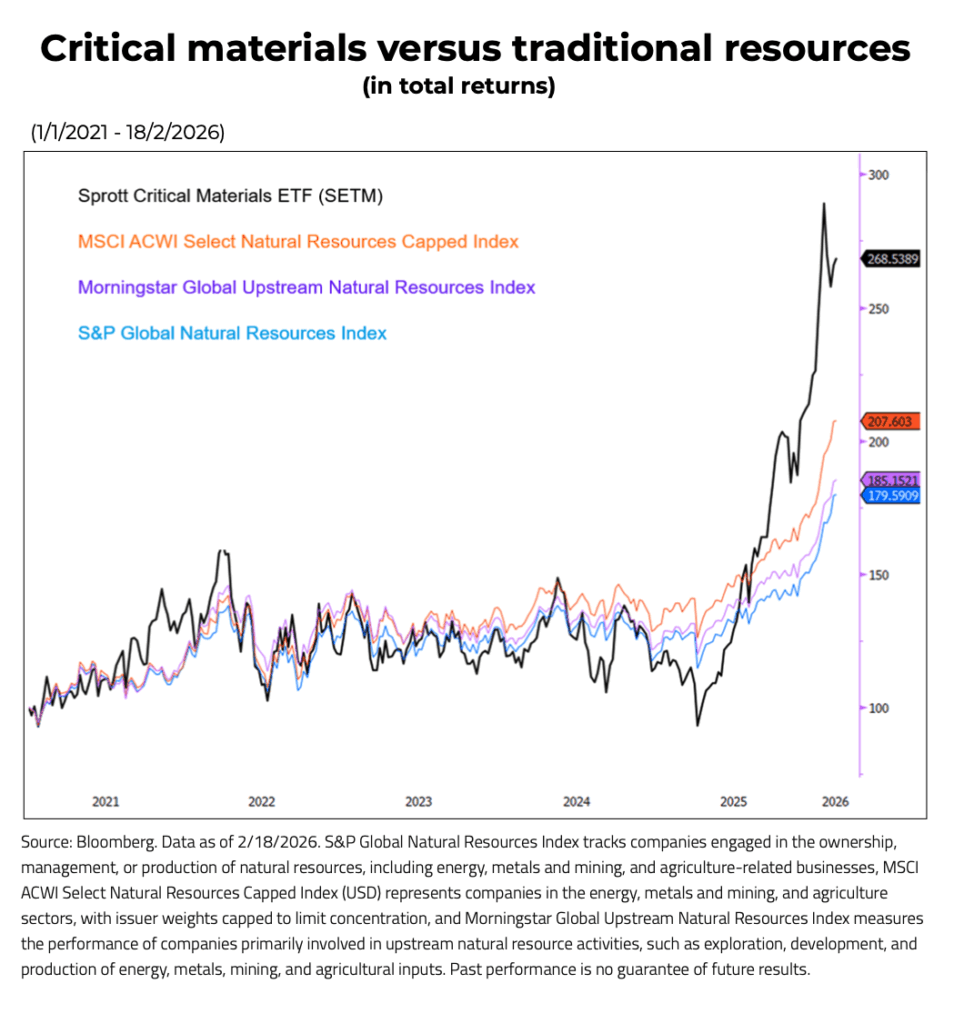
The report highlights that the Sprott Critical Materials ETF (SETM) has significantly outperformed broader natural resource benchmarks since April 2025, underscoring growing investor focus on metals essential to modern infrastructure.
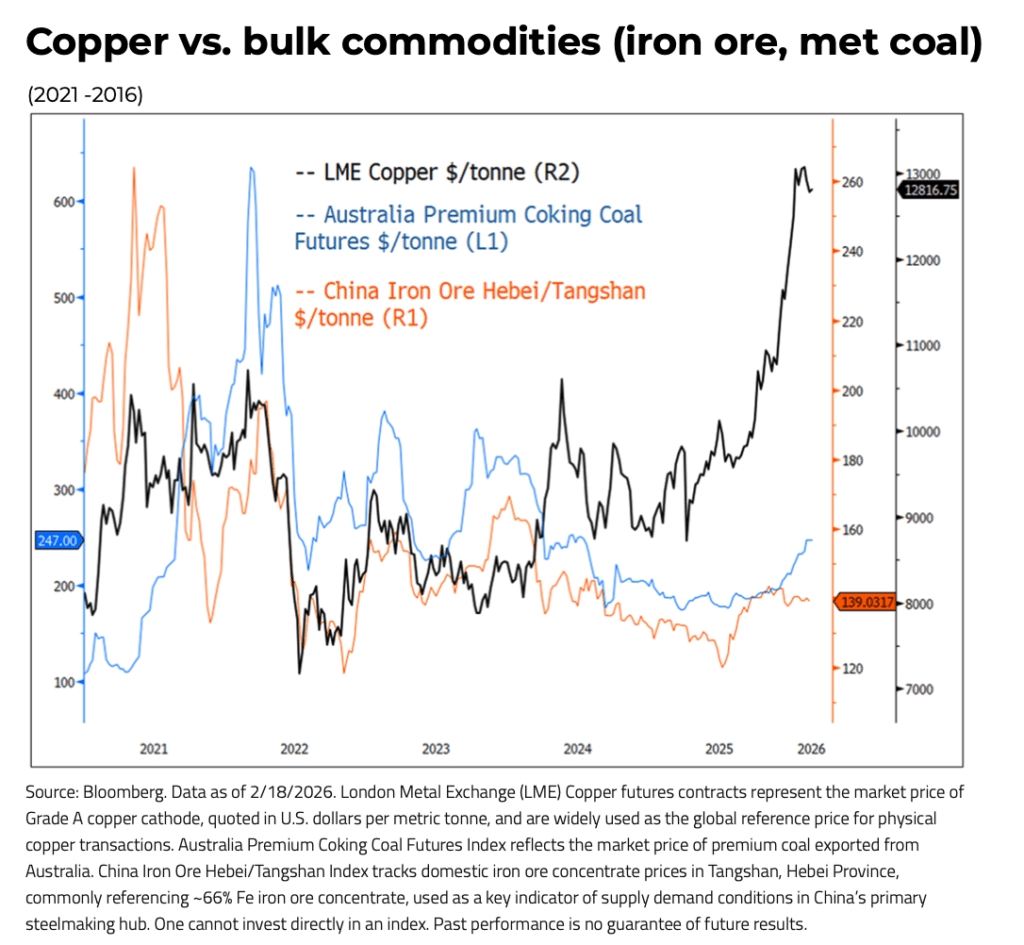
Copper sits at the centre of this shift., helping tighten its supply-demand balance relative to construction-focused bulk commodities. According to Sprott, copper-focused producers have increasingly outperformed large diversified miners whose earnings remain more closely tied to iron ore and other bulks.
Uranium over oil
Energy markets show a similar divergence. Oil markets still face ample supply and a long-term decline in consumption intensity relative to global GDP. Uranium, by contrast, is entering the cycle with constrained supply and strengthening demand as countries revisit nuclear power.
Sprott says the renewed interest in nuclear energy is driven primarily by energy security rather than environmental policy. Governments are extending reactor lifespans, planning new capacity and rebuilding long-term uranium contract coverage on the back of rising geopolitical tensions.
Beyond copper and uranium, the firm sees favourable fundamentals for other critical materials including lithium, rare earth elements and silver. Lithium and rare earths are essential for batteries and high-efficiency motors, while silver benefits from both industrial demand and its role as a monetary metal.
The report argues that critical minerals are increasingly being valued not only by traditional supply-demand dynamics but also by their strategic importance to national security and technological infrastructure.
Despite the shift, many resource allocations still emphasize broad exposure to sectors that dominated earlier cycles, such as chemicals, forest products and agriculture. Sprott says this lag in recognition is typical in the early stages of commodity bull markets.
The firm expects investment in power generation, electricity grids, data centres and mineral supply chains to drive demand over a multi-year horizon. At the same time, long project lead times and a decade of underinvestment in new supply could keep markets tight.
Targeted exposure to critical minerals may therefore offer stronger returns than broad commodity allocations, Sprott says. The firm highlights investment vehicles such as the Sprott Critical Materials ETF (NASDAQ: SETM), which focuses on companies deriving at least 50% of revenue or assets from critical materials, and the actively managed Sprott Active Metals & Miners ETF (NYSE: METL).
While volatility remains likely, Sprott believes the structural forces reshaping the global economy could support sustained outperformance for select commodities and mining companies tied to electrification and energy security.
Cove Capital, Saudi conglomerate to collaborate on critical minerals

US-based private investment firm Cove Capital LLC has partnered with Saudi industrial conglomerate Tariq Abdel Hadi Abdullah Al-Qahtani & Brothers Company (AHQ) on the joint development of critical minerals assets.
A memorandum of understanding (MOU) was signed on Thursday establishing the framework for collaboration to identify, evaluate, acquire, finance and operate critical minerals projects globally.
The partnership is intended to strengthen secure, allied-aligned supply chains serving both the US and Saudi Arabia, while advancing broader bilateral industrial cooperation, the companies said in a statement.
Specifically, Cove Capital and AHQ will jointly evaluate upstream and midstream critical minerals assets, form project-level joint ventures or special purpose vehicles, and develop downstream refining, processing and manufacturing capacity in both regions.
They will also explore the establishment of a dedicated critical minerals investment fund focused on deploying capital into strategic mining assets and advanced processing technologies.
The collaboration aligns with Saudi Arabia’s Vision 2030 objectives to expand its mining sector, localize industrial capacity and position the Kingdom as a global hub for minerals processing. It also aligns with ongoing US initiatives to strengthen domestic and allied supply chains for critical minerals that are foundational to national defense and economic resilience.
Under the agreement, the parties intend to pursue diversified financing structures, including participation from Saudi institutional and sovereign capital, engagement with US development finance institutions, potential alignment with the recently announced $12 billion US critical minerals stockpile initiative.
A joint steering committee will be established to review opportunities and oversee coordination, with specific projects to be governed by definitive agreements executed separately, the companies said.
“This MOU represents a meaningful step in aligning US and Saudi industrial capabilities around critical minerals that underpin modern defense systems, advanced manufacturing, and emerging technologies. AHQ brings significant industrial strength and regional leadership,” Pini Althaus, chairman and CEO of Cove Capital, commented.
Founded in 2015, Cove Capital is focused on identifying and investing in critical minerals assets across the globe. To date, it has established a large presence in Central Asia through a 70% ownership in a tungsten mining joint venture in Kazakhstan.
“Critical minerals are central to the Kingdom’s industrial transformation and to global economic stability. In Cove Capital, we are partnering with what we view as the leading US critical minerals investment and development group, given its track record of advancing world-class projects,” Abdulmalik Tariq Alqahtani, chief executive of AHQ, added.
USA Rare Earth to buy remaining Round Top stake for $73M
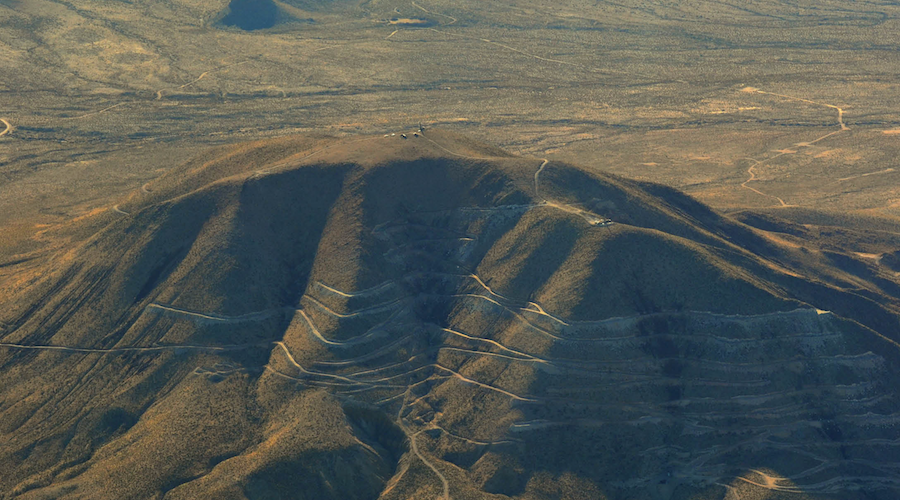
USA Rare Earth (Nasdaq: USAR) will acquire the remaining minority interest in the Round Top rare earth deposit in Texas in a $73 million all-stock deal, securing full control of a key US source of critical minerals.
The Oklahoma-based company is purchasing all outstanding shares of Texas Mineral Resources (OTCMKTS: TMRC) for about 3.8 million shares of USA Rare Earth common stock.
Shares of USA Rare Earth rose about 1% in pre-market trading following the announcement.
The deal will make USA Rare Earth the sole operator of the Round Top project, which the company says is the largest known US source of heavy rare earth elements, as well as gallium and beryllium.
“This acquisition secures a vital pillar in our strategy to build the world’s leading globally integrated, non-China critical mineral technology platform,” USA Rare Earth CEO Barbara Humpton said in a statement.
USA Rare Earth has accelerated its development timeline for the Texas project as demand for domestic critical minerals grows. Last year, the company said it expected commercial production to begin in late 2028, two years earlier than its previous target, citing faster progress at its processing facilities and rising US demand.
In January, the US Commerce Department agreed to support a $1.6 billion debt-and-equity financing package in exchange for a 10% stake in the company. The funding is intended to help build the Texas mine and a magnet manufacturing facility aimed at supplying the defence and high-tech sectors.
Mine-to-magnet
The push aligns with broader US policy efforts to expand domestic critical mineral production and reduce reliance on China, which dominates the global supply chain. President Donald Trump invoked emergency powers last year to accelerate development of US-based critical mineral resources.
USA Rare Earth describes itself as a mine-to-magnet solution designed to challenge China’s grip on the permanent magnet supply chain. Under its Accelerated Mining Plan, the company expects to extract nearly 40,000 tonnes per day of rare earth and critical mineral feedstock by 2030.
The boards of both companies have approved the transaction, which is expected to close in the third quarter.

No comments:
Post a Comment