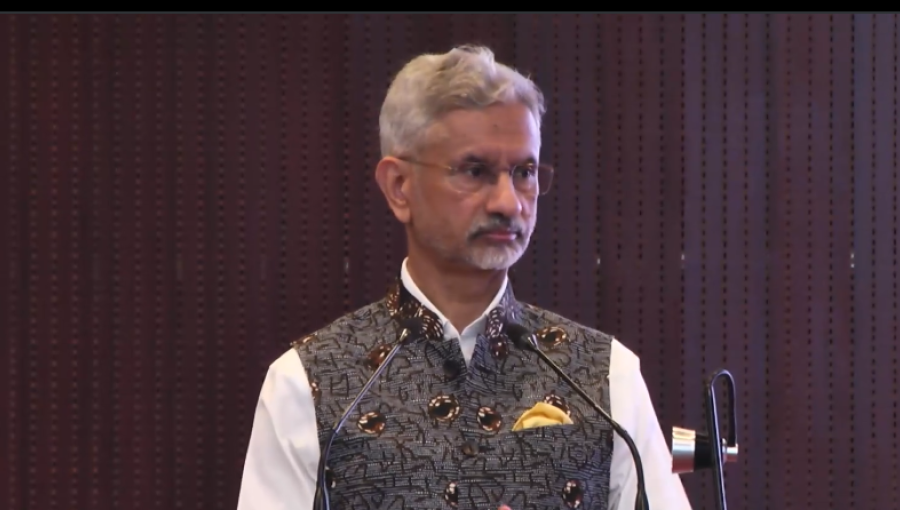
A routine meeting has revealed sharp divisions among BRICS member states over the West Asia conflict. The divergences reportedly prevented the representatives of the states involved from agreeing on a unified communiqué at the bloc's annual Middle East and North Africa consultations, held in New Delhi on April 23 and 24, 2026. As an alternative the meeting chair's statement was released in lieu of the customary joint declaration, Deccan Herald reported.
Purportedly, the two-day meeting of BRICS Deputy Foreign Ministers and Special Envoys on the Middle East and North Africa was chaired by India, represented by Secretary South Dr Neena Malhotra of India's Ministry of External Affairs.
While the various delegations exchanged assessments on the deteriorating regional situation, covering the Gaza crisis, Lebanon, Syria, Yemen, Sudan and Libya, consensus broke down over how to characterise the conflict stemming from US and Israeli strikes on Iran, and Iran's subsequent response, with member states holding materially divergent positions on attribution and resolution.
In follow-on unilateral press briefings though, India's Ministry of External Affairs moved to address reports suggesting New Delhi had softened its position on Palestine, stating explicitly that its long-standing stance on the issue remains unchanged and that no dilution of any kind had occurred.
Unconfirmed social media reports and claims were also denied by India suggesting that all other BRICS member states were unhappy with New Delhi’s closeness to the US and Israel and its perceived neglect towards supporting Iran.
In line with this, at least one social media influencer peddling a pro-Pakistan line was observed repeating unfounded claims that other members of BRICS were even looking to expel India from the grouping while inviting Pakistan in as a replacement.
However no formal mechanism exists by which any of the members can be expelled, although new members being admitted does require a full consensus among all current members, with India’s objection to Pakistan being admitted immediately dousing Islamabad’s hopes of joining the grouping.
In spite of the diplomatic impasse at the declaration level, the consultations reportedly addressed humanitarian conditions across several conflict-affected states and examined prospects for post-conflict stabilisation in the broader MENA region.
While the failure to produce a joint communiqué is a visible signal of the stress that the West Asia conflict is placing on BRICS cohesion, the members states including India, China and Russia realise that while not economically competitive on the same scale as the US and EU, the grouping represents the majority of the world’s population, natural resources and industrial base.
Any wedges or divisions among the group will derail the goals of its members to project a joint front against the economic dominance and policy hegemony of the collective West.

No comments:
Post a Comment