
The US Supreme Court’s decision in Louisiana v Callais is the latest and probably most decisive blow to the Voting Rights Act since the attacks went full force in the aftermath of the election of President Obama. The attacks, well-orchestrated and following a path that had been advanced by the Redeemer (white supremacist) movement of the 19th century, has worked to use the words of the Constitution and Voting Rights Act as a way to destroy the intent behind the Voting Rights Act.
The Louisiana v Callais decision revolves around a Congressional district that was created in Louisiana to address the need for Black political power in the state. Continuous efforts by racist Republicans have aimed to eliminate Black political power and cripple the Democrats. The Court decided that too much attention had been paid to race in the creation of this district. The clear intent of this decision is to eliminate race as a category to which attention should be paid in the creation of Congressional districts.
Let’s be clear about a few things. First, this matter of “race.” “Race” is not a descriptive term, contrary to the interpretation that is continually offered by Justice Roberts. It is about history. The history of this country has involved the oppression and marginalization, if not outright suppression of political representation and power for particular populations, most especially African Americans, Chicanos/Mexican Americans, Native Americans, (pre-1965) Asians, and Puerto Ricans. Continuous efforts have been undertaken by forces on the Right to disenfranchise these populations, but rarely in the name of “race.” In fact, if one looks at the 19th and early 20th centuries, supposedly race neutral language was frequently used in order to suppress communities of color.
In today’s situation, Justice Roberts, et.al. would have use believe that racist marginalization is no longer a significant problem and, therefore, attention to “race” in the construction of Congressional districts is somehow inappropriate. This is a classic example of how the Right wishes us to ignore history and pretend as if we can all march off into the future holding hands and sing “We HAVE overcome.”
Second, the destruction of the Voting Rights Act is part and parcel of an effort to further destroy democracy. It is important that we view this in relationship to Trump’s call to the state of Texas to redistrict as a way of gaining more Republican seats in the House of Representatives, an effort subsequently attempted by several other Republican-led states and then countered by Democrats. MAGA wishes to secure long-term, if not permanent, minority rule by the 30% of the population that is entranced with MAGA, supports the super-rich, and seeks a return to the 19th century, with all that entails.
Third, MAGA wishes to eliminate all Congressional districts that have a majority people of color population. Despite the periodic MAGA voices of color that are pulled onto the stage to claim that MAGA is not white supremacist, the reality that MAGA understands is that most majority voters of color districts favor Democrats. Therefore, suppressing the Voting Rights Act and eliminating majority voters of color districts aims at…you guessed it…suppressing Democrats.
One of the tremendous mistakes made by too many supporters of the Voting Rights Act has been to assume that the defense of the Voting Rights Act was assured—in part because for years there was a bi-partisan consensus—and that any defense need only take place in the courts or on the floor of Congress. As the rightwing mobilized, first into the Tea Party and later into MAGA, it should have been clear that a full-scale assault was underway against democracy. What we are seeing now is only one further step towards rightwing authoritarian rule. This cannot happen.
What we need immediately, and have needed for years, is a mass voting rights movement that links litigation and lobbying with grassroots organizing and mobilization. The Voting Rights Act was the result of people in the streets who put immense pressure on Congress. We need that once again, along with new and creative tactics. Let’s consider a few.
We need a new way of drawing Congressional districts that factor in matters such as the long history of racist marginalization.
We need to consider the use of ballot initiatives that force states to change the manner and content of voting districts. Consider the Florida ballot initiative that was used to re-enfranchise thousands of formerly incarcerated citizens. The ballot succeeded only to be undermined by Republicans in the Florida legislature. Knowing what we know now, ballot initiatives must be worded in such a way that nefarious forces cannot undercut them.
We need to prepare for November 2026. MAGA has given every indication that they aim to grab our voting rights. We cannot let that happen. We must vote early and vote in huge numbers against anti-democratic forces. We must start planning now, in our local communities and with a broad array of groups, regarding how to respond to anti-democratic attacks on voting. We must prepare our friends, neighbors and family for the sorts of disinformation that will flow and will be aimed at suppressing our vote.
All of this can and must be done. The Supreme Court decision is a horrible development and there is no way to dress it up and pretend otherwise. What we can do, however, is neutralize its impact by our own organizing, mobilizing, and sheer numbers. Indeed, we must openly challenge those who wish to strip our rights and ensure dominance for the rich and infamous.
Bill Fletcher, Jr. is the coordinator and cofounder of Standing for Democracy. @BillFletcherJr, billfletcherjr.com.
John Roberts might as well wear the robes of the Klan
May 5, 2026
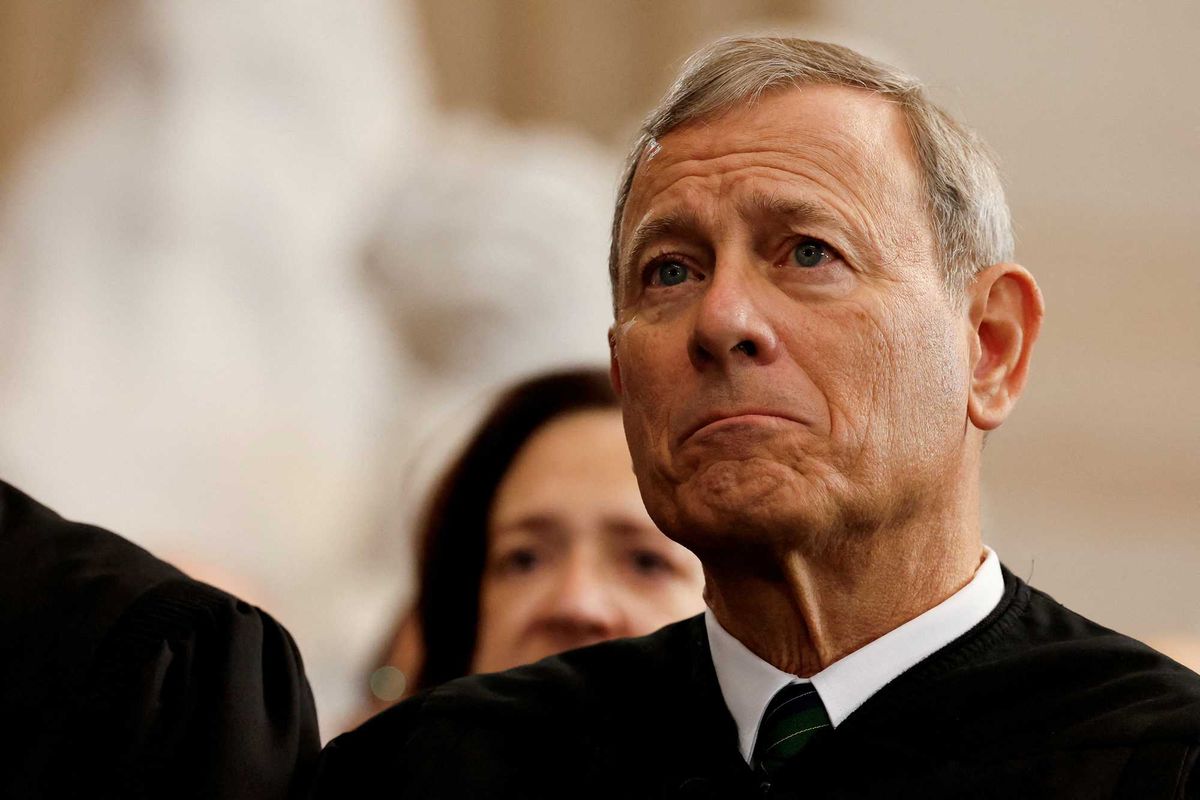
FILE PHOTO: WASHINGTON, DC - JANUARY 20: U.S. Supreme Court Chief Justice John Roberts attends inauguration ceremonies in the Rotunda of the U.S. Capitol on January 20, 2025 in Washington, DC. Donald Trump takes office for his second term as the 47th president of the United States. Chip Somodevilla/Pool via REUTERS/File Photo
George Wallace was sworn in as Governor of Alabama in 1963 and famously declared in his inauguration speech (written by a Ku Klux Klan leader) “segregation now, segregation tomorrow, segregation forever.” Two years later, Alabama state troopers violently broke up a nighttime voting rights march during which a police officer shot and killed young African American protester and Baptist deacon Jimmie Lee Jackson, who was unarmed and protecting his mother.
In response, civil rights leaders, including Martin Luther King and John Lewis, organized a mass march from Selma to Montgomery over the Edmund Pettus Bridge in an attempt to deliver a civil rights and voting rights message to Gov. Wallace. It became known as “Bloody Sunday” as state troopers gassed and beat the protestors, including fracturing Lewis’ skull and sending 57 others to the hospital. Televised images of the brutal attack shocked the nation, directly leading to President Johnson’s push for the Voting Rights Act of 1965.
Numerous Americans, black and white, were injured and even died fighting for the Civil Rights Act. John Roberts and his five Republican Supreme Court colleagues effectively overturned the Civil Rights Act and essentially disenfranchised black voters.
George Wallace tried to disenfranchise black voters with violent state troopers. Roberts disenfranchised black voters with the stroke of a pen. It’s not hyperbole to say that while Roberts wears the black robes of a judge, he may as well wear the white robes of the Klan.
It’s not hyperbole to say that while Roberts wears the black robes of a judge, he may as well wear the white robes of the Klan.
In her dissent to Louisiana v. Callais in which the 6-member Republican majority of the Court effectively overturned Section 2 of the Civil Rights Act, Justice Elena Kagan wrote: “The Voting Rights Act is—or, now more accurately, was—one of the most consequential, efficacious, and amply justified exercises of federal legislative power in our Nation’s history. It was born of the literal blood of Union soldiers and civil rights marchers. It ushered in awe-inspiring change, bringing this Nation closer to fulfilling the ideals of democracy and racial equality.” Kagan concluded, “ I dissent because the Court betrays its duty to faithfully implement the great statute Congress wrote. I dissent because the Court’s decision will set back the foundational right Congress granted of racial equality in electoral opportunity. I dissent.”
But the Court didn’t destroy the Civil Rights Act in a day. It was part of a lifelong mission by John Roberts to do so.
Starting as early as 1981, as a 26-year-old lawyer just three years out of Harvard Law School, Roberts began his campaign to undermine the Civil Rights Act. He got himself a job as Special Assistant to Ronald Reagan’s Attorney General William French Smith. Congress was about to amend the Civil Rights Act to provide that state laws would be illegal if they had a racially discriminatory effect, without having to prove that they had a racially discriminatory intent—something almost impossible to prove.
Roberts zealously took on the assignment coming up with arguments against the Amendment. Roberts wrote over 25 memos opposing the Amendment. In one, he argued that the Civil Rights Act was “the most intrusive interference imaginable by federal courts into state and local processes.”
Despite the efforts of Roberts and others in the Reagan administration, Congress passed the Amendment with overwhelming bipartisan support. Little did anyone imagine at the time that Roberts would become Chief Justice and the leader of right-wing Justices’ ultimately successful efforts to undermine the Civil Rights Act as he had initially set out to do as a young Justice Department official.
At his confirmation hearing, Roberts told the Senate “The existing Voting Rights Act, the constitutionality has been upheld and I don’t have any issue with that.” He was lying.
In 2013, Roberts got his first shot at dismantling the Civil Rights Act. In his 5-4 ruling in Shelby v. Holder, he overturned Section 5 of the Act , which required that states with a history of racist voter suppression pre-clear changes in election laws with the Justice Department to be sure they were not reinstituting racial suppression. He argued that it was no longer necessary since racism in America had diminished since the Act had been passed. In response, many states previously subject to preclearance rushed to enact new voter suppression laws.
In coming years, the Roberts Court further chipped away at the Voting Rights Act. But Roberts finally got his opportunity to make the rest of the Voting Rights Act a nullity when Louisiana v. Calais came before the Court this year. In a 6-3 opinion, which Roberts assigned to his anti-voting rights ally Justice Samuel Alito, the Court overruled the other crown jewel of the Voting Rights Act which had previously held that racially gerrymandered districts were illegal if they had racially discriminatory effect. Instead, racially gerrymandered districts would only be illegal if it can be proven that they have a racially discriminatory intent, a bar that is almost impossible to clear.
This was the argument that Roberts first made as a young Justice Department attorney back in 1982. As Chief Justice, he finally succeeded in his long campaign to revoke the Civil Rights Act.
Meanwhile, if a state can claim that it’s gerrymandering is motivated by ensuring that its political party wins, it’s totally cool with the Roberts Court. With the Court overturning both Section 2 and Section 5 of the Voting Rights Act, it effectively repealed the entire Voting Rights Act that so many had fought and died for.
The very next day, Florida passed a redistricting law that would allow for new levels of gerrymandering designed to erase districts with large populations of black voters.
Roberts accomplished with a pen what George Wallace had tried to accomplish with violent state troopers.
'Desperate' GOP now taking advantage of one of 'worst Supreme Court decisions': analysts
Jonathan Shorman,
May 7, 2026
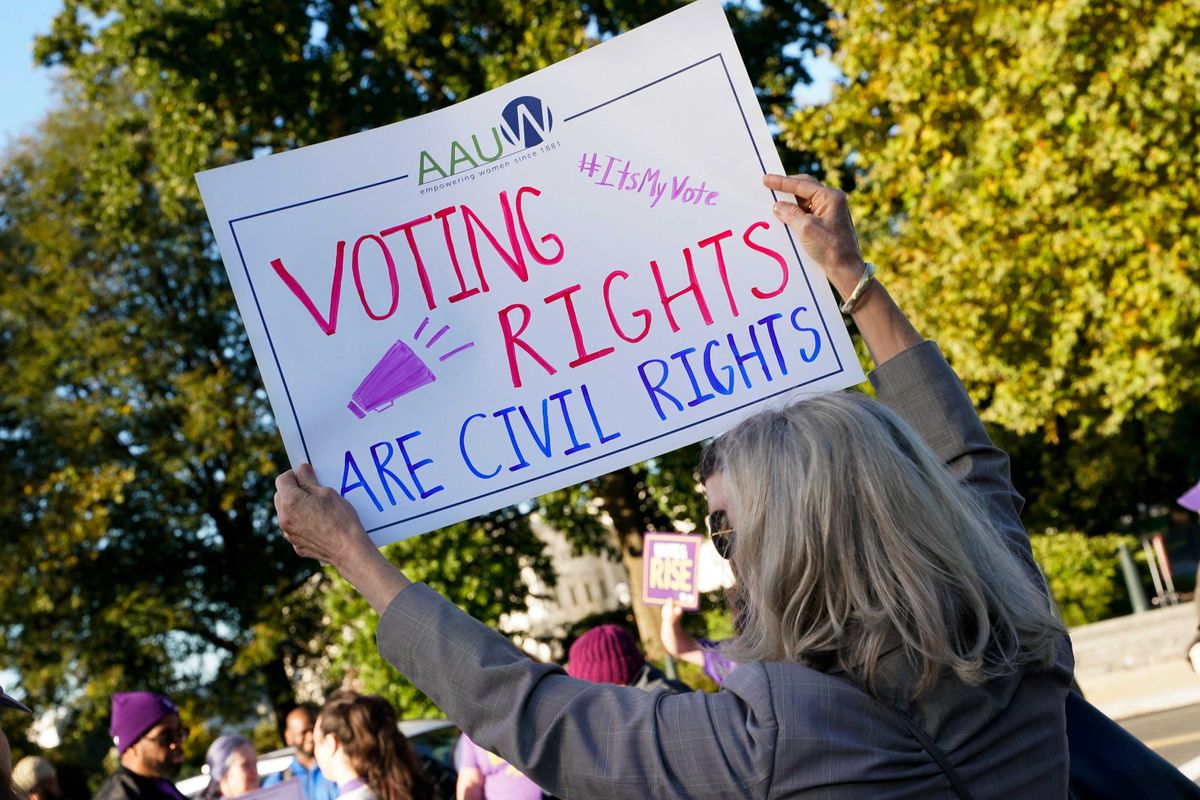
People protest on the day the U.S. Supreme Court hears arguments regarding the composition of Louisiana electoral districts, in Washington, D.C., U.S., October 15, 2025. REUTERS/Elizabeth Frantz
The day after the U.S. Supreme Court crippled the federal Voting Rights Act, NAACP President and CEO Derrick Johnson addressed a virtual gathering for the group’s members and supporters where he ranked the landmark decision alongside the court’s most infamous cases.
Dred Scott excluded Black people from American citizenship ahead of the Civil War. Plessy blessed policies of racial segregation in 1896. And now there was Callais.
The opinion will “probably go down in the history book as one of three of the worst Supreme Court decisions in the history of this nation,” Johnson said.
The Supreme Court’s 6-3 ruling in Louisiana vs. Callais on April 29 cleared states to split apart, for political gain, congressional districts where a majority of residents belong to minority groups. The court’s conservative majority said Louisiana lawmakers acted unconstitutionally when they intentionally created the state’s second majority-Black district, which the justices found unnecessary.
A week after its release, the decision is roiling politics across the South as states move at a rapid pace to recast the political landscape that has taken progressives by surprise.
Republicans, triumphant over their victory at the court, are rushing fresh gerrymanders through Southern statehouses in time for the November midterm elections in an effort to strengthen their party’s control over the region’s U.S. House delegations. They’re acting at lightning speed, over loud protests, and have nullified votes by suspending ongoing elections.
Democrats, especially Black residents, are furious with both the court and GOP politicians, who they believe are poised to wipe away decades of Black political progress in the region. The new maps that seek to oust Black members of Congress and prevent the election of Democrats in the future recall a Jim Crow past of literacy tests and poll taxes, they say.
“We refuse to let you kill us by killing our vote,” Eliza Jane Franklin, a resident of rural Barbour County, Alabama, told a state House hearing Tuesday.
Eliza Jane Franklin of Barbour County, Alabama, holds up a copy of “Witness to Injustice,” a book by David Frost Jr. about racial violence and the Civil Rights Movement in Eufala, Alabama, while speaking to the state House Ways and Means General Fund Committee on May 5, 2026. (Photo by Brian Lyman/Alabama Reflector)
Decision kicked off legislative efforts
The Alabama Legislature is moving to authorize a special primary election using a congressional map currently blocked in federal court, if a district court or, ultimately, the Supreme Court allows the state to move forward. At least one of the state’s two Black members of the U.S. House would be vulnerable.
In Louisiana, the governor has suspended the state’s primary elections for the U.S. House, setting aside some 42,000 votes that were already cast. Republican lawmakers will begin advancing a new gerrymander in a matter of days, aiming to force out at least one of the state’s two Black House members.
Florida Republican Gov. Ron DeSantis signed a new map into law Monday that aims to hand his party up to four additional U.S. House seats. State lawmakers approved the map hours after the Supreme Court’s decision. The map has already drawn multiple legal challenges.
The South Carolina Legislature is weighing whether to redraw maps. And Tennessee lawmakers want to gerrymander a Memphis district currently held by U.S. Rep. Steve Cohen, a white Democrat who represents the state’s only majority-Black district.
“The Supreme Court has opined that redistricting, like the judicial system, should be color-blind,” Tennessee House Speaker Cameron Sexton, a Republican, said in a statement Thursday unveiling a plan to divide the Memphis area among three congressional seats.
Tennessee House Speaker Cameron Sexton. (Photo by John Partipilo/Tennessee Lookout)
More states, in the South and elsewhere, are expected to pursue new maps over the next two years. Georgia Republican Gov. Brian Kemp ruled out a special session this year, for example, but supports redistricting before the 2028 election.
The current moment represents an extraordinary time in America, said Rebekah Caruthers, president and CEO of Fair Elections Center, a nonpartisan voting rights group. But she also called it a reversion “back to America.”
Many thought the presence of Black, Hispanic and Asian American elected officials somehow meant racial discrimination no longer existed, she said.
“And unfortunately, that is a misread of American history,” Caruthers said. “And perhaps it is a retelling of American history for those who want to gloss over America’s very sordid past, especially when it comes to voting rights.”
Midterms impact
The scramble by a handful of Southern states to redraw districts comes as Republicans grasp for any scintilla of advantage ahead of the midterm elections in November.
A U.S. House under Democratic control would spell the end of much of President Donald Trump’s legislative agenda, produce a wave of investigations into his administration and potentially lead to a vote to impeach him in the House, though the Senate would almost certainly acquit him.
U.S. Rep. Steve Cohen, a Democrat who represents Tennessee’s only majority-Black district, speaks to a crowd before a special legislative session that began May 5, 2026. (Photo by John Partipilo/Tennessee Lookout)
“This is all about Donald Trump wanting to avoid hard questions and oversight hearings about his actions,” Cohen said at a news conference in Memphis.
Seth McKee, a political science professor at Oklahoma State University who has studied Southern politics, said Republicans are attempting to “staunch the bleeding” ahead of unfavorable midterm elections.
“The desperation of this Republican Party, it’s off the charts,” McKee said.
Redistricting push supercharged
Prior to Callais, Trump had already urged Republicans to redraw congressional maps for partisan advantage — a process that typically occurs once a decade after the census.
Missouri, North Carolina, Ohio and Texas enacted more GOP-friendly maps, while Democrats struck back in California and Virginia. In Utah, Republicans want to block a court-ordered map that’s more favorable to Democrats.
Republican primary voters have given their approval to that approach. On Tuesday, five Trump-endorsed state legislative candidates in Indiana defeated GOP incumbents who had defied the president to block a gerrymander in the state last year.
But until now the Voting Rights Act limited how far that gerrymandering push could extend.
For decades, Section 2 of the 1965 Voting Rights Act helped protect majority-minority districts from gerrymandering and ensured voters could elect Black candidates to Congress in Southern states following the end of state laws that blocked Black citizens from voting. The Callais opinion guts Section 2 by curtailing the consideration of race when drawing legislative maps.
Republicans have praised the decision and many have been clear that they believe the opinion opens up a path to securing additional GOP seats. Trump has endorsed disregarding primary elections that have already been held so that states can pass new maps — which he predicts can net Republicans an additional 20 seats this fall.
“We cannot allow there to be an Election that is conducted unconstitutionally simply for the ‘convenience’ of State Legislatures,” Trump wrote on Truth Social. “If they have to vote twice, so be it.”
Calls for GOP seats
Over the past week, some Republicans have cast majority-minority districts previously protected by the Voting Rights Act as racist because they were drawn with attention paid to the racial makeup of the map. U.S. Sen. Eric Schmitt, a Missouri Republican, wrote on X that there are “no more excuses for keeping racist maps,” for example, and called for their immediate removal.
Other GOP leaders have centered their case for quick action on political power. Like Trump, they have explicitly invoked control of the U.S. House as a reason to gerrymander. While Republicans have the House, their margin of control is razor thin: 217 to 212, with one independent and five vacancies. Even a modest Democratic wave in November will likely sweep away GOP control.
Alabama Senate President Pro Tem Garlan Gudger Jr. and House Speaker Nathaniel Ledbetter said in a joint statement that the state’s lawmakers have a responsibility to offer Alabama a “fighting chance” to elect seven Republican U.S. representatives. Two of the state’s seven districts are held by Democrats.
“Control of the U.S. House of Representatives could come down to just a handful of seats, and when the dust settles, the people of Alabama will know that their Legislature stood firm, acted decisively, and did everything within its power to fight for fair representation,” Gudger and Ledbetter said.
Alabama Republicans want to use a map passed by lawmakers in 2023 that federal courts blocked from taking effect. Alabama’s current map was drawn by a court-appointed special master.
Alabama Attorney General Steve Marshall, a Republican, asked a federal district court Tuesday for an order that would let the state move forward with the gerrymander.
Carsie Evans of Anniston, Alabama, holds a sign outside the Alabama Statehouse on May 4, 2026, the day the Alabama legislature began a special session that could result in changes to primary elections and congressional legislative district lines. (Photo by Brian Lyman/Alabama Reflector)
In Louisiana, Republicans obtained special permission from the Supreme Court to quickly move forward on a new gerrymander after the justices struck down its current map in the Callais decision.
Absentee voting was already underway in Louisiana before Republican Gov. Jeff Landry suspended congressional primary elections set for May 16. Votes already cast for U.S. House candidates won’t count, Republican Secretary of State Nancy Landry, no relation, has said.
Louisiana state lawmakers are set to begin work on a new map this month that will likely break apart a New Orleans district held by U.S. Rep. Troy Carter, a Black Democrat who has fought with the governor.
“The Court’s decision in these cases has spawned chaos in the State of Louisiana,” Justice Ketanji Brown Jackson, one of the Supreme Court’s three liberal justices, wrote in a dissent of the decision to quickly finalize Callais.
Court challenges
Still, Democrats and other opponents of the gerrymandering effort across the South are turning to the courts. Lawsuits have also been filed challenging the suspension of Louisiana’s congressional primaries and Florida’s new map also faces court challenges.
A petition filed in Louisiana state court by Elias Law Group, a major Democrat-aligned voting rights litigation firm, alleges the governor’s decision to halt the congressional primary is unlawful and unprecedented. Only the state legislature has the power to set the state’s election schedule, the petition argues.
“Governors do not get to cancel elections by executive fiat, least of all elections that are already underway, with ballots in voters’ hands and votes already cast,” Lali Madduri, a partner at Elias Law Group, said in a statement.
Regardless of how the legal challenges play out, Democrats say the Callais decision and the ongoing fallout from the decision underscore the need for massive voter turnout in the November election. A large Democratic turnout that results in a significant Democratic majority in the U.S. House would serve as a rebuke to Trump’s gerrymandering campaign, they say.
Blue state gerrymanders
U.S. Rep. James Clyburn, South Carolina’s sole congressional Democrat, said during the NAACP virtual meeting that a Democratic House could pass voting rights legislation.
“I would hope we could do that because I really think that’s our only hope legislatively,” Clyburn said.
Democrats have long called for the passage of a bill to restore preclearance, a major element of the Voting Rights Act that the Supreme Court paused in 2013, which required states and local governments with a history of racial discrimination to obtain federal permission before making voting changes.
But the measure would face a certain filibuster in the U.S. Senate. Even if Democrats broke a filibuster, Trump would likely veto it.
In effect, Democrats’ most realistic opportunity to enact major voting rights legislation relies on regaining control of the White House and Congress and ending the filibuster — a set of conditions that’s out of reach until at least 2029.
In the meantime, more Democrats are calling for aggressive gerrymandering of blue states as a way to punch back. U.S. House Minority Leader Hakeem Jeffries and Rep. Joseph Morelle, both New York Democrats, on Monday announced an initiative to encourage their state to redraw congressional districts ahead of the 2028 election.
Gerrymandering New York would be an intensive effort, likely requiring voters to repeal or suspend anti-gerrymandering provisions in the state constitution. But voters in California and Virginia have previously endorsed Democratic gerrymanders.
“This is just the beginning,” Jeffries said in a statement. “Across the nation, we will sue, we will redraw and we will win.”
Selma Undone

While making the film SELMA on location in Alabama in late Spring 2014, I recall standing at the crest of the bridge where, decades before, state troopers on horseback charged into a group of 600 peaceful Black marchers and beat them with clubs and bullwhips. It is an eerie, unshakeable feeling. You can feel the courage as you stand in that place, like it’s seeping through the cement, forever there. Forever resisting. The bravery that occurred there happened back in 1965. This is where John Lewis’s skull was fractured. And where the elder Amelia Boynton Robinson was left unconscious on the asphalt. A photograph of her would land on front pages around the world and change the course of American history.
As we worked on the bridge filming the Bloody Sunday scene to attempt to memorialize the events of that day, in preparation for it, we had read everything. Had interviewed eyewitnesses who were still living. Sat with people in Selma and other parts of Alabama. Reviewed the original footage and watched it until we could barely see straight. And still, standing on that bridge with our mighty crew, I was undone by the simplest thought: They just wanted to vote.
That’s it. That is the entire reason that horses charged and the clubs came down. Six hundred people wanted the basic right of citizenship for all people in the country of their birth. And the state of Alabama, with the tacit approval of the federal government, attempted to beat that desire out of them and stop them. The power in the very concrete of that place, however, rises up to tell the story.
They had tried, desperately and repeatedly to vote in all the mandated ways. But the system was designed to fail them with literacy tests that were applied selectively, registration offices open only two days a month during the work day, registrars who simply turned people away or threatened their jobs, and physical intimidation tactics, including rape and lynching. The evil intent of these tactics were never written down anywhere. But the outcome was undeniable.
By now, you have heard that the Supreme Court has declared undeniable outcomes are no longer sufficient grounds for legal remedy. That unless you can prove someone meant to discriminate — not just that they did — the law will not protect you. This is how the Supreme Court disemboweled Section 2 of the Voting Rights Act last week by removing the essential organs that gave it life.
The ruling destroys protections for voters of color, particularly Black voters, across the country and has set the nation back more than sixty years – before 1965. That is exactly the year that Trump and Vance and Hegseth and McConnell and Johnson and Musk and their ilk who support the actions of this administration want this country to be. Before 1965. Before legislation to ensure that our multiracial democracy was equipped with the tools to fully engage with its promise. Stacey Abrams, who has given her political life to this fight and knows its terrain better than almost anyone, wrote that we are “returning to the before-times when voters of color were silenced before a single vote was cast.”
The before-times.
This Supreme Court — case by case – has deliberately narrowed the Voting Rights Act’s enforcement power and built a road back to the before-times. Shelby County v. Holder removed the preclearance requirement. Brnovich v. DNC narrowed what could even constitute a violation. Now, Louisiana v. Callais finishes the gutting. Three cases. One trajectory. Back to how it was before. They sent the horses back onto the bridge. The billy clubs too. They just made sure the cameras don’t matter this time.
As we are told there is no money for healthcare, education, our crumbling infrastructure or SNAP benefits for hungry families because it is simply not “financially possible,” a billion dollars a day is siphoned off in a war of Trump’s choice in the Middle East. When Trump was asked about a timeline for resolution, he said: “We were in Vietnam for 18 years. We were in Iraq for many, many years… I don’t want to rush myself.”
I ask us to hold both of these things at once: the gutting of the Voting Rights Act and an administration who will spend without limit on war and ballrooms, but cannot find the money for the basic needs of its own citizens. These are not separate stories. They are the same story – told in different registers – about who this government believes deserves its resources and its regard.
And if you still need a symbol to clarify whose country this is being redecorated as: for America’s 250th birthday, the government will issue passports bearing Donald Trump’s image this year. The iconography of someone who does not intend for his ideas and institutional violence to be temporary.
Did you know that all four Black Republican members of the House are stepping down or retiring? The party that briefly performed inclusion and made a show of recruiting Black candidates to Congress has, under this administration, dropped even the pretense. This is an administration that has dismantled inclusion and equity programs, fired Black officials across multiple government agencies and our armed forces, assembled an overwhelmingly white senior team and routinely circulates white-supremacist references and rhetoric. Including a racist meme posted by the man who claimed the presidency himself.
And now its judicial appointees have completed the legal architecture to make sure that the growing political power of Black and Brown America can be structurally contained through gerrymandering and being redistricted into irrelevance.
This is not all happening by accident. This is a coordinated project by people who understand that the country’s actual demographics are not in their favor. So the strategy is suppression. Make it harder to vote. Make it harder to challenge the maps when voting happens. Remove the legal protections that allow those challenges to succeed. Do all of this through institutions that are insulated from accountability.
My writing partner on WHEN THEY SEE US Attica Locke posted something that I keep returning to. She wrote: “They cheat because they don’t have the numbers. There are more of us than there are of them. That’s a numerical fact that favors revolution. Hold steady. And know that they’re terrified.” Indeed. They are not winning because they are strong. They are rigging the game because they know they can’t win it fairly.
What brings me out of that despair is to think about precedent. There is precedent for our refusal and our courage. Ordinary people who did extraordinary things stood on this ground before. They knew they were outnumbered by force. They knew the law, as written and applied at that moment, was not on their side. They knew the president had not yet moved, that Congress had not yet acted, that the courts had not yet intervened. They knew all of that. And they walked onto the bridge anyway.
Because they understood that showing up and refusing to accept white supremacy dressed in the language of law was itself a form of power. They knew that visibility and witness and refusal are weapons that have moved this country toward its stated ideals.
Last week’s Supreme Court decision is the latest provocation in a very long war that was already old when those marchers stepped onto that Selma bridge in 1965. Sixty years later, the bridge is still there. And so are we.
It will take all of us to rebuild what they have undone. It will take all of us to overcome it again. But we shall. We shall.
The US Supreme Court, Race & the Right to Vote

In perhaps its most insidious decision in nearly a century, the U.S. Supreme Court disemboweled Section 2 of the landmark Voting Rights Act (VRA) of 1965, the “crown jewel” of the U.S. civil rights movement.
The VRA ended Jim Crow-era election procedures that precluded Black people from voting in the South through intimidation, literacy tests and poll taxes. It was part of a system of post-Civil War legalized racial segregation meant to restore white supremacy after the end of slavery and the federal, military occupation of the South.
Jim Crow lasted from 1877 until passage of the Civil Rights Act of 1964 and the Voting Rights Act the following year.
Section 2 of the VRA allows states to draw voting districts that benefit candidates from racial minorities and enables citizens to challenge election maps as racially discriminatory.
In its Wednesday ruling in Louisiana v. Callais, the 6-3 rightwing supermajority of the Court struck down a congressional map that a group of self-described “non-African American” voters had challenged as an unconstitutional gerrymander.
Court members Samuel Alito, John Roberts, Clarence Thomas, Brett Kavanaugh, Neil Gorsuch and Amy Coney Barrett held that drawing districts to remedy past discrimination itself constitutes unconstitutional racial discrimination.
For 61 years, the VRA has been one of the most significant protections against racial gerrymandering. Thanks to the VRA, there are now more than 10,000 Black elected officials throughout the country, compared to about 1,500 in 1970.
Callais paves the way for the largest decrease in representation by Black members of Congress. It will lead to the elimination of dozens of Black and Latino-majority districts throughout the South and a substantial number of current congressional seats.
“This court’s project to destroy the Voting Rights Act is now complete,” Elena Kagan wrote in dissent, joined by Sonia Sotomayor and Ketanji Brown Jackson. “Today’s decision renders Section 2 all but a dead letter.”
Section 2 prohibits any voting qualification or prerequisite to voting, or practice or procedure, that “results in a denial or abridgment of the right of any citizen of the United States to vote on account of race.”
That occurs when voters of color “have less opportunity than other members of the electorate to participate in the political process and to elect representatives of their choice.”
Congress amended Section 2 in 1982 to provide that evidence of discriminatory intent is not necessary to prove racial discrimination; even policies that appear neutral can have a discriminatory effect on a particular group.
In the 1986 case of Thornburg v. Gingles, the Supreme Court interpreted the amended Section 2 and established a multi-factor test to decide when a jurisdiction must draw districts to provide minority voters a fair opportunity to elect representatives of their choosing.
The Gingles test has been used by courts for 40 years. Three years ago, the high court affirmed the test in Allen v. Milligan and held that Alabama’s congressional map likely violated Section 2.
The Callais Majority Rewrites a Congressional Statute
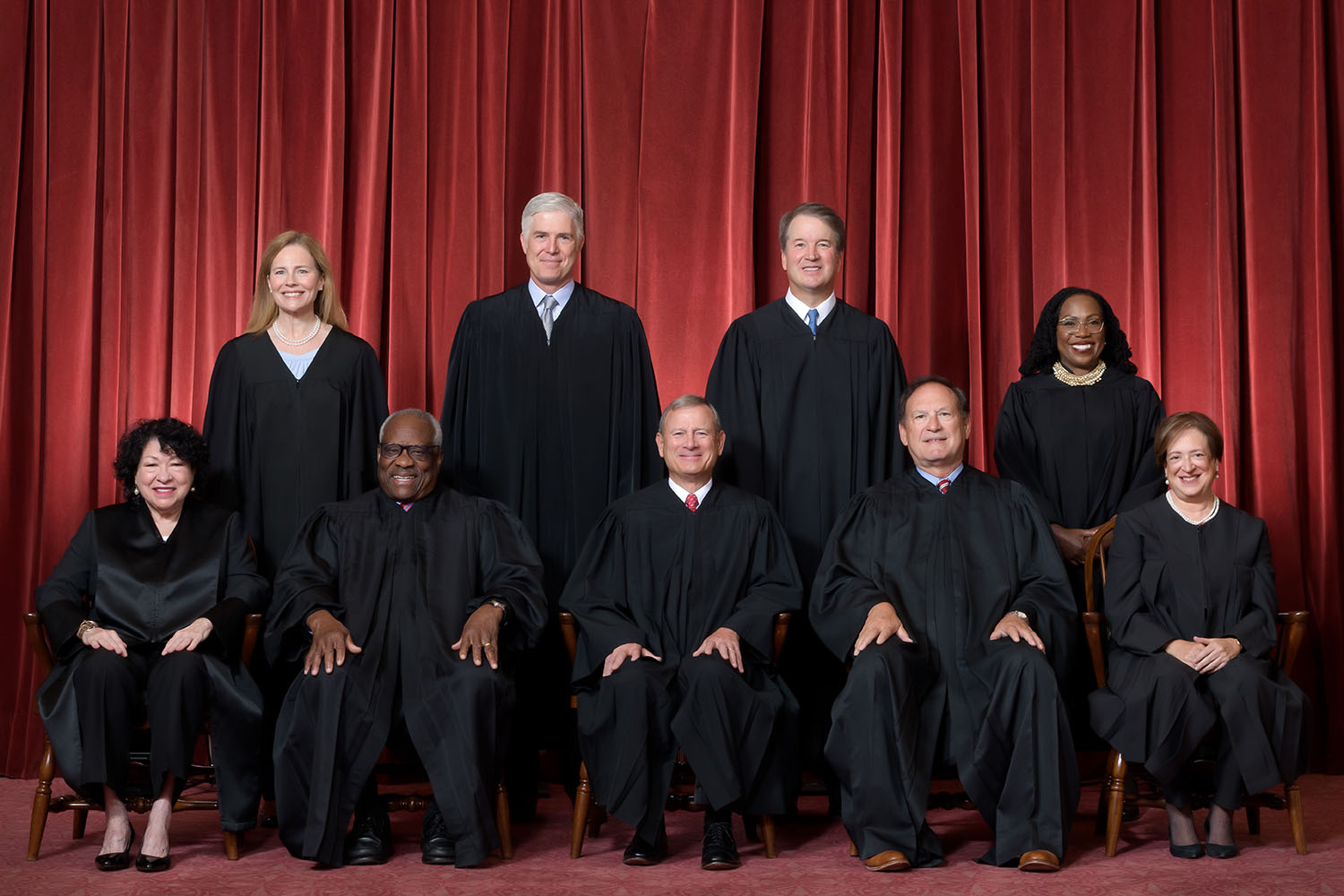
The Roberts Court since June 2022: Front row, from left: Sonia Sotomayor, Clarence Thomas, Chief Justice John Roberts, Samuel Alito and Elena Kagan. Back row, from left: Amy Coney Barrett, Neil Gorsuch, Brett Kavanaugh and Ketanji Brown Jackson. (Fred Schilling, Collection of the Supreme Court of the United States, Wikimedia Commons, Public Domain)
In Louisiana v. Callais, a coalition of Black voters and civil rights groups sought to reinstate a map that the Louisiana state legislature had adopted in 2024. The map established a second majority-Black congressional district. It was drawn in response to a U.S. district court ruling that a map drawn in 2022 likely violated Section 2.
That 2022 map included only one majority-Black district out of Louisiana’s six congressional districts. The coalition maintained that the 2022 map diluted the votes of Black residents, who comprise about one-third of Louisiana’s population.
The Fifth Circuit Court of Appeals affirmed the district court decision that the 2022 map likely violated Section 2, and the appellate court ordered Louisiana to draw a new map by Jan. 15, 2024. The Louisiana Legislature complied and drew a map with a second majority-Black district.
In response, the “non-African American” voters challenged the 2024 map as unconstitutional because it separated voters based primarily on race.
Samuel Alito, writing for the Court’s supermajority, said that the 2024 map “relied too heavily on race.” He wrote that the coalition of Black voters had not proved “an objective likelihood that the [2022] map was the result of intentional racial discrimination,” even though it only contained one majority-Black district out of the state’s six Black districts.
Despite the 1982 congressional amendment to Section 2, stating that racial discrimination can be proved by showing discriminatory effect, the Court restored the requirement that voters challenging district maps must prove that “circumstances give rise to a strong inference that intentional discrimination occurred.”
While asserting that it was simply “updating” the Gingles test, the Court actually rewrote it to erect an insurmountable barrier to plaintiffs’ claims of racial discrimination.
“In sum,” Alito concluded,
“because the Voting Rights Act did not require Louisiana to create an additional majority-minority district, no compelling interest justified the State’s use of race in creating [the 2024 map]. That map is an unconstitutional gerrymander, and its use would violate the plaintiffs’ constitutional rights.”
After the Supreme Court’s decision, states can now defend their maps by claiming they were just engaging in partisan (as opposed to racial) gerrymandering. The high court decided in the 2019 case of Rucho v. Common Cause that although partisan gerrymandering is unconstitutional, it cannot be challenged in federal court.
“Today . . . the majority straight-facedly holds that the Voting Rights Act must be brought low to make the world safe for partisan gerrymanders,” Kagan wrote in her dissent.
Now “the State need do nothing more than announce a partisan gerrymander. Assuming the State has left behind no smoking-gun evidence of a race-based motive (an almost fanciful prospect), Section 2 will play no role.”
Kagan further declared:
“The Voting Rights Act is — or, now more accurately, was — one of the most consequential, efficacious, and amply justified exercises of federal legislative power in our Nation’s history. It was born of the literal blood of Union soldiers and civil rights marchers. It ushered in awe-inspiring change, bringing this Nation closer to fulfilling the ideals of democracy and racial equality.
And it has been repeatedly, and overwhelmingly, reauthorized by the people’s representatives in Congress. Only they have the right to say it is no longer needed — not the Members of this Court. I dissent, then, from this latest chapter in the majority’s now-completed demolition of the Voting Rights Act.”
Roberts Fulfills Longtime Goal of Neutering Voting Rights
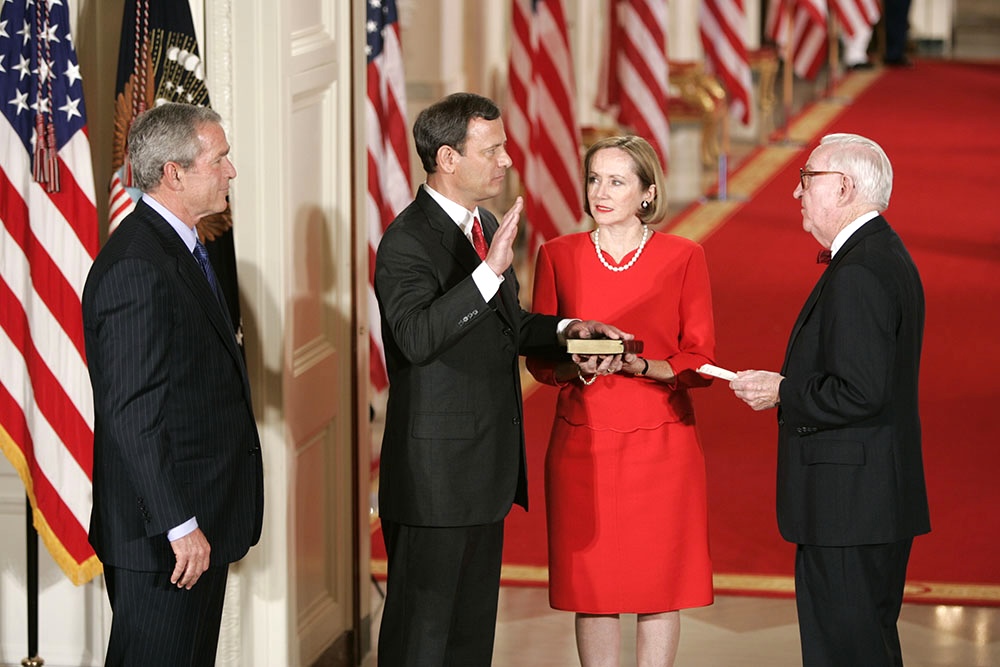
Roberts taking the oath of office as chief justice by Justice John Paul Stevens in the White House as President George W. Bush and Roberts’ wife Jane look on, Sept. 29, 2005. (White House Photo Office /Wikimedia Commons/Public Domain)
“John Roberts has proven far more dangerous than ideologues like Thomas and Alito. He is a politician who plays a long game, slicing the salami piece by piece until there’s nothing left,” David Gespass, Alabama civil rights attorney and past president of the National Lawyers Guild, posted on Facebook.
Roberts has a history of eschewing the consideration of race in voting and discrimination cases. As a young lawyer in the Ronald Reagan administration, Roberts promoted a “colorblind” approach to voting rights and discrimination in public schools.
In 1982, when Congress was considering amending Section 2 to prohibit voting practices that had a racially discriminatory effect, Roberts was the point person in the Justice Department in the campaign to defeat the amendment.
In a 2006 voting rights case, Roberts cynically wrote, “It is a sordid business, this divvying us up by race.” The following year, he flippantly wrote in a case striking down voluntary desegregation programs in Louisville and Seattle, “The way to stop discrimination on the basis of race is to stop discriminating on the basis of race.”
Roberts authored the 2013 opinion in Shelby County v. Holder that gutted Section 5 of the Voting Rights Act, which had required federal preclearance before changes to election rules could go into effect in jurisdictions with a history of discriminatory voting practices.
“What the Supreme Court did today is stab the Voting Rights Act of 1965 in its very heart,” civil rights icon Rep. John Lewis said at the time.
But in Shelby, Roberts provided assurances that Section 2 would still be available to challenge racial discrimination in voting.
Now, the Roberts Court has neutered Section 2 as well.
Roberts’ “aim has always been clear, but he takes his time to reach it to deceive people into thinking he’s careful and deliberative, looking at each case on its own merits,” Gespass added. “He is careful and deliberative, carefully and deliberately moving toward a country that returns what little power others have won from rich white men back to them.”
‘An Outright Power Grab’
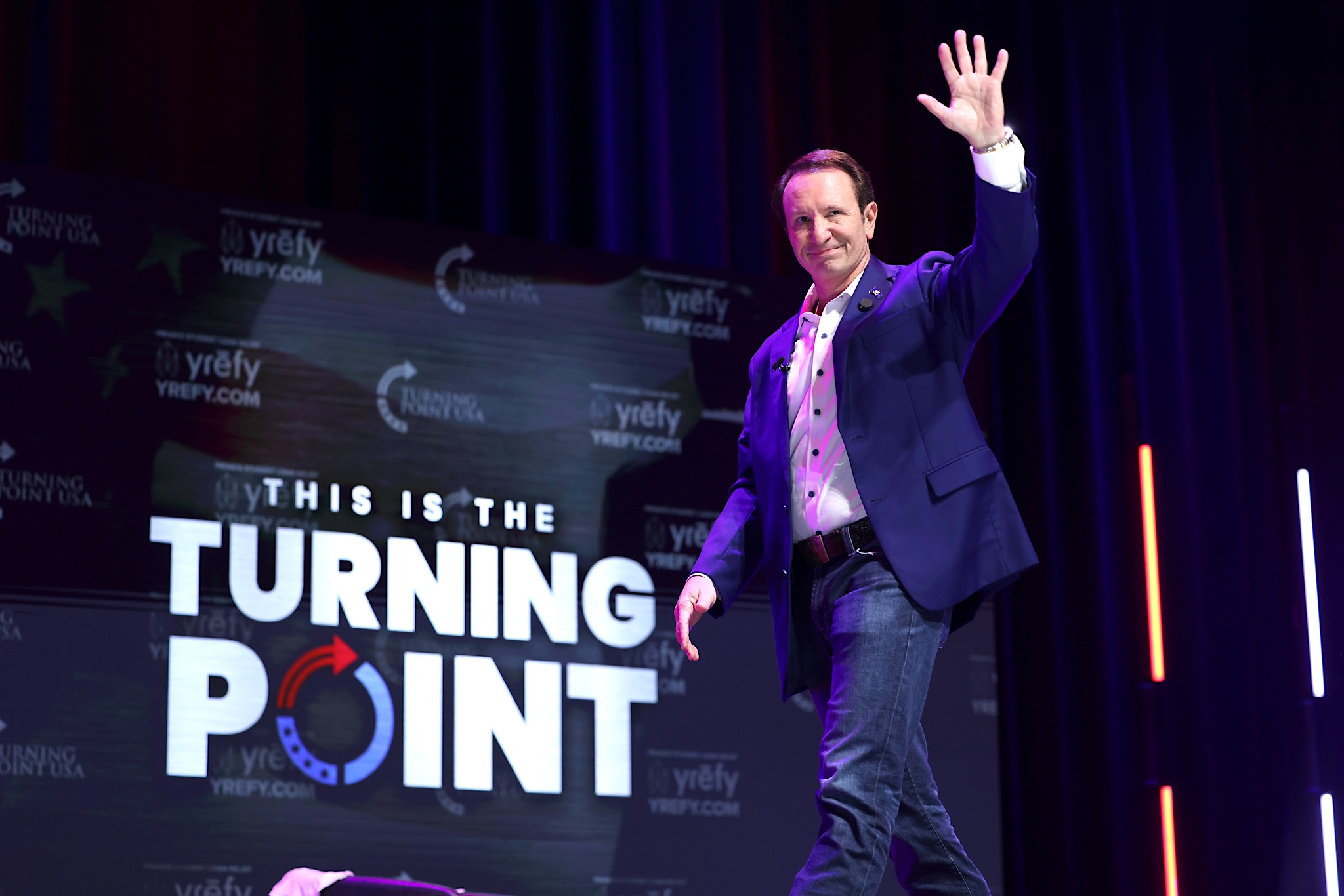
Louisiana Gov. Jeff Landry at an even in Baton Rouge in October 2025. (Gage Skidmore / Flickr / CC BY-SA 2.0)
“With this decision in Louisiana v. Callais, the Supreme Court has opened the door to a coordinated attack on Black voters across this country,” Democratic Rep. Yvette Clarke of New York and chair of the Congressional Black Caucus, said at a press conference after the ruling was announced.
Nearly 70 of the 435 congressional districts are protected by Section 2, according to election law expert Nicholas Stephanopoulos.
Democracy Docket has data showing that the Callais ruling will likely derail 28 pro-voting lawsuits that seek to prevent state legislatures from drawing maps that dilute the power of racial minority voters.
The ruling has already prompted a rash of Republican redistricting efforts throughout the South in advance of the 2026 midterm elections this November. Republicans in Louisiana, Tennessee and Georgia are considering redistricting before the midterms.
Louisiana has suspended next month’s primaries to allow lawmakers to pass a new congressional map first. If these efforts occur and sustain legal challenges, the GOP stands to gain as many as five new seats this year.
GOP-led states could pick up as many as 19 new GOP-allied House seats in the coming years.
David Wasserman, senior editor and elections analyst for The Cook Political Report with Amy Walter, told Axios, “I think, realistically, we’re probably talking about one to three seats for 2026, but it’s not hyperbolic to call this an apocalyptic ruling for Black majority districts in 2028 in the Deep South.”
An analysis conducted by The New York Times last year found that Democrats could lose about 12 majority-minority districts throughout the South if the Court struck down part of the VRA.
“This is an outright power grab,” Rep. Clarke said. “It’s about silencing Black voices, dismantling majority Black districts and rigging the maps so that politicians can choose their voters instead of the other way around.”
Marjorie Cohn is professor emerita at Thomas Jefferson School of Law, dean of the People’s Academy of International Law and past president of the National Lawyers Guild. She sits on the national advisory boards of Veterans For Peace and Assange Defense, and is a member of the bureau of the International Association of Democratic Lawyers and the U.S. representative to the continental advisory council of the Association of American Jurists. Her books include Drones and Targeted Killing: Legal, Moral and Geopolitical Issues.


No comments:
Post a Comment