Showing posts sorted by relevance for query Puffin. Sort by date Show all posts

Monday, October 02, 2023

At Canada's largest Atlantic puffin colony, chicks are dying of starvation

CBC
Sun, October 1, 2023 
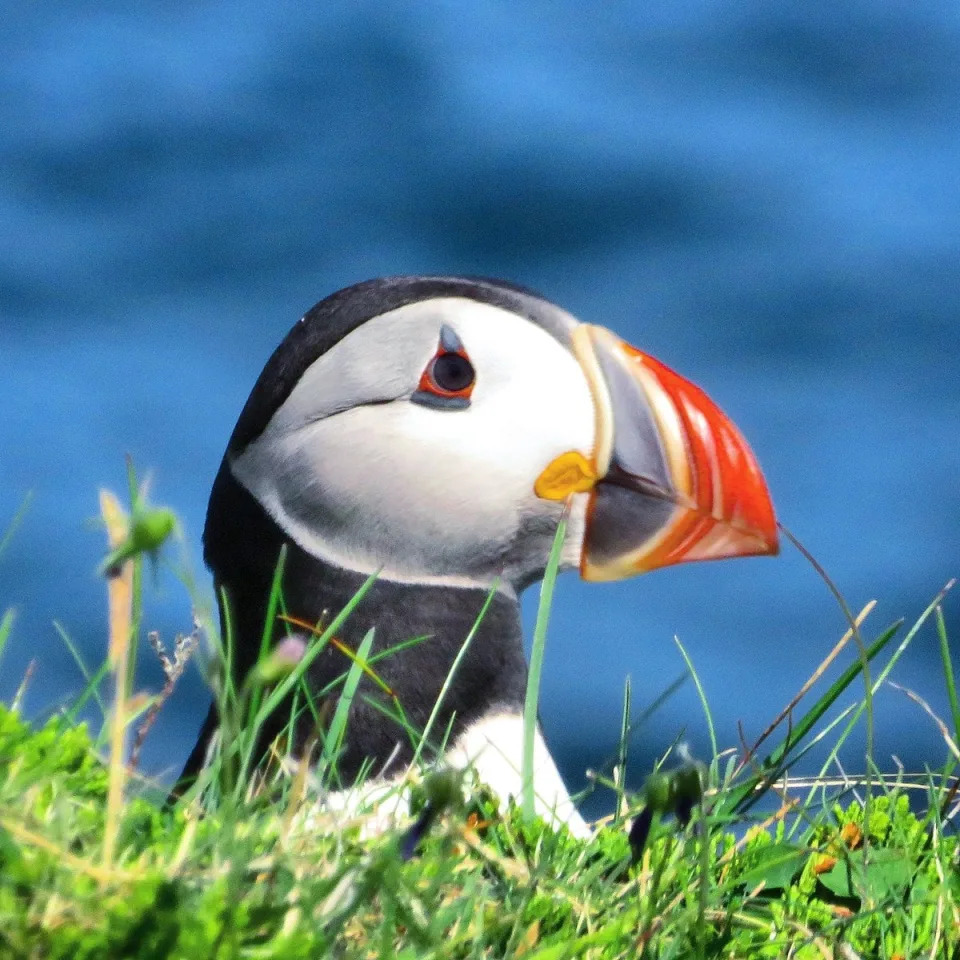
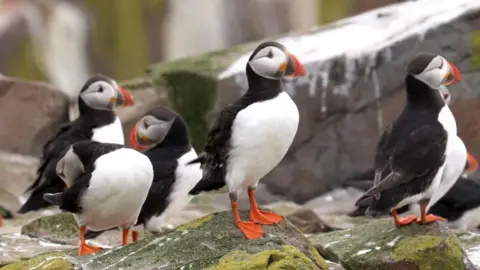
A puffin pokes its head out of its nest in Elliston. (Submitted by Mark Gray - image credit)

The volunteers who rescue Atlantic puffin chicks — called "pufflings" — knew something was wrong when so few strays from the Witless Bay Ecological Reserve on Newfoundland's Avalon Peninsula showed up this summer.

The fledglings emerge from their burrow at night to avoid predators, but some are attracted to the lights in the rapidly growing communities on shore. Members of a group called the Puffin Patrol capture the stranded pufflings and release them into the ocean.

"The Puffin Patrol wasn't finding very many birds," said Sabina Wilhelm, a wildlife biologist with Environment and Climate Change Canada.

"And the birds that were being found were actually very small in body weight."

Some were less than half the normal size for puffins their age.

After searching a sampling of nests on the ecological reserve where Atlantic puffins congregate to breed each spring, Wilhelm and her colleagues discovered that many chicks had perished.

The grim discovery connects the fate of the Atlantic puffin — which is not only the official bird of Newfoundland and Labrador, but a ubiquitous image in the province — with serious problems in ocean ecology, including warming ocean temperatures and a struggling, complex food web.
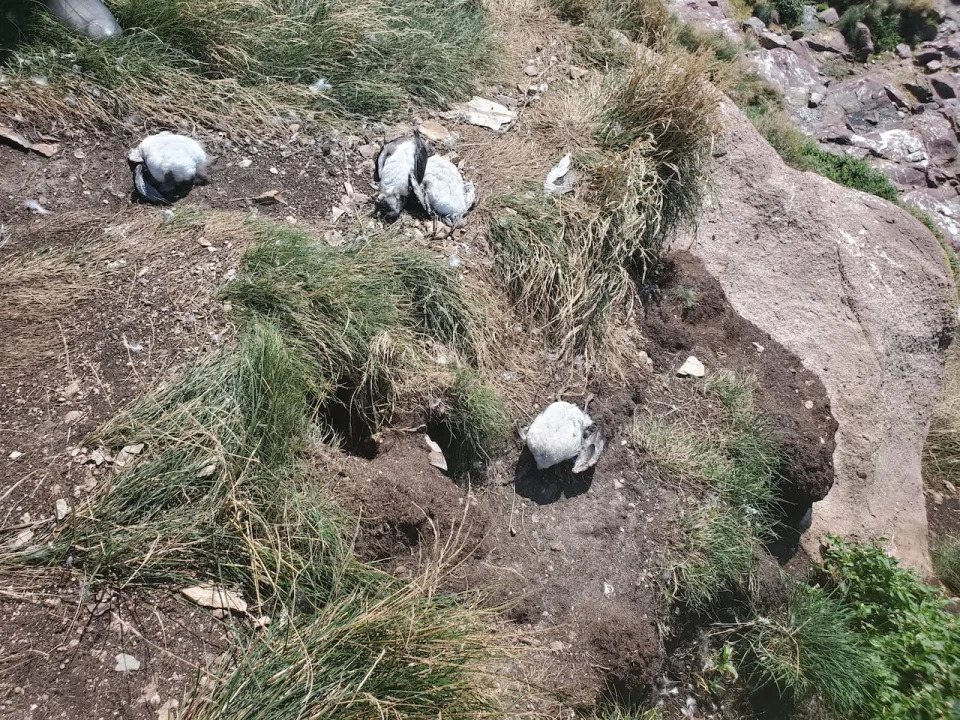
Sabina Wilhelm and her colleagues were alarmed that the Puffin Patrol wasn't seeing very many birds this year, so they went searching for them, finding many birds.

Sabina Wilhelm and her colleagues were alarmed that the Puffin Patrol wasn't seeing very many birds this year, so they went searching for them, finding many birds. (Submitted by Sabina Wilhelm)

'They died of starvation'

Tests ruled out avian flu, which caused a massive die-off of birds in 2022.

"Just based on the the body mass and just picking up the dead chicks, that were just skin and bones, so essentially they died of starvation."

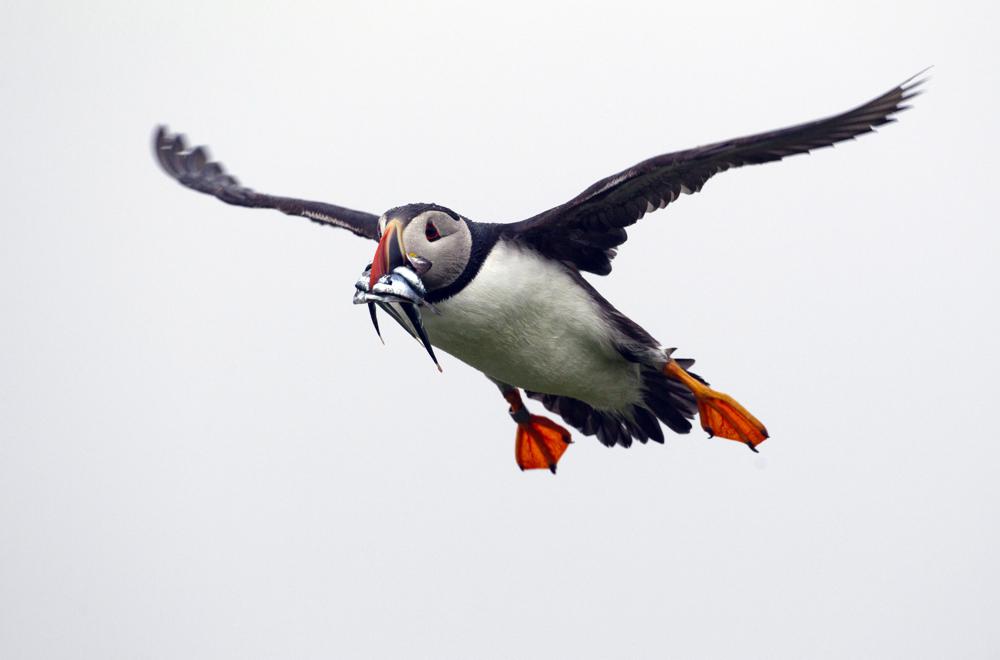
Adult puffins dive for food such as capelin, a forage fish that can make up as much as 50 per cent of their diet, and bring it back to the nest, a burrow in the cliffs.

But when food is scarce the adults feed themselves, and the chick is left to starve.

Another anomaly is that puffins bred later this year, said Wilhelm.

"Normally they start fledging in early August and by the end of August, early September, most of them are gone," she said.

"There seems to have been this mismatch between breeding activity and the fact that capelin kind of disappeared.… Other years there might have still been a lot of capelin in August. That just didn't happen this year."

Warmer ocean temperatures also work against Atlantic puffins, who can dive to a depth of only 50 metres to catch capelin and other forage fish such as sandlance and herring.
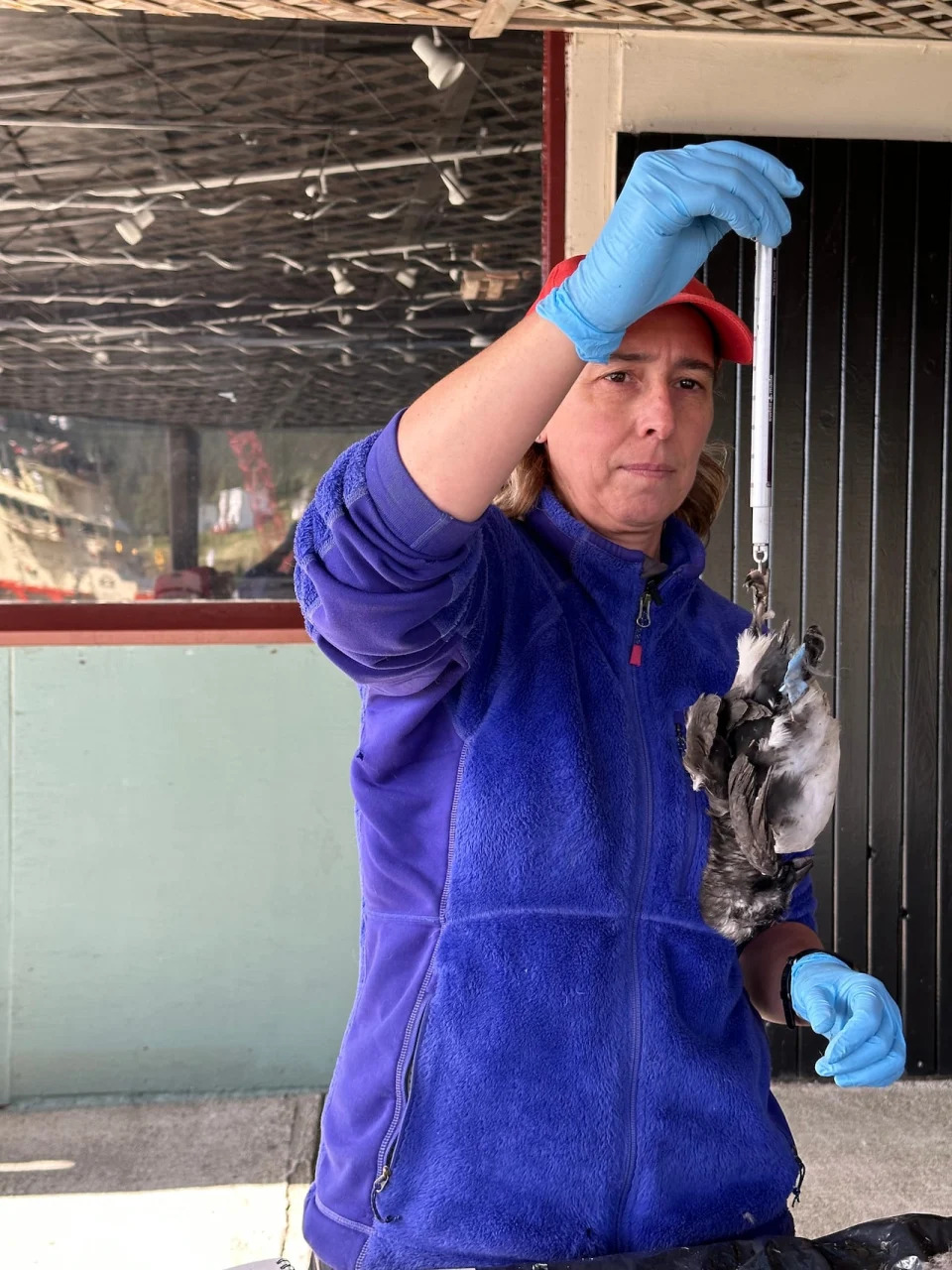
Wildlife biologist Sabina Wilhelm weighs and measures puffin chicks, or pufflings, who were found dead in their nests, having starved to death because capelin, their main food source, was not available this summer. Many of those gathered for testing were less than half their normal size.

Wildlife biologist Sabina Wilhelm weighs and measures puffin chicks, or pufflings, who were found dead in their nests, having starved to death because capelin, their main food source, was not available this summer. Many of those gathered for testing were less than half their normal size. (Chris O'Neill-Yates/CBC)

"So if the fish are moving downwards into the water column because the waters are warmer, then suddenly … they're not accessible to the puffins anymore because they can't dive that deep," said Wilhelm.

With more than 300,000 nesting pairs breeding at the Witless Bay Ecological Reserve, the Atlantic puffin population is robust overall, said Wilhelm.

Because they live well into their 20s, losing their offspring in one year does not spell disaster for the species. But the starvation of so many Atlantic chicks this year is a concern, said Wilhelm.

When tour boat operator Joe O'Brien noticed dead chicks floating on the water, he alerted Wilhelm and her colleagues.

O'Brien, a former fisherman, has been bringing tourists to the Witless Bay Ecological Reserve for 39 summers.

With so many species, from cod to seabirds to whales, relying on capelin for their survival, O'Brien says it's time for a new approach to managing this fishery.

"Should we be harvesting capelin at all?" asked O'Brien.

"Shouldn't that be a sign to to management that we should change our philosophy respecting the ocean?"
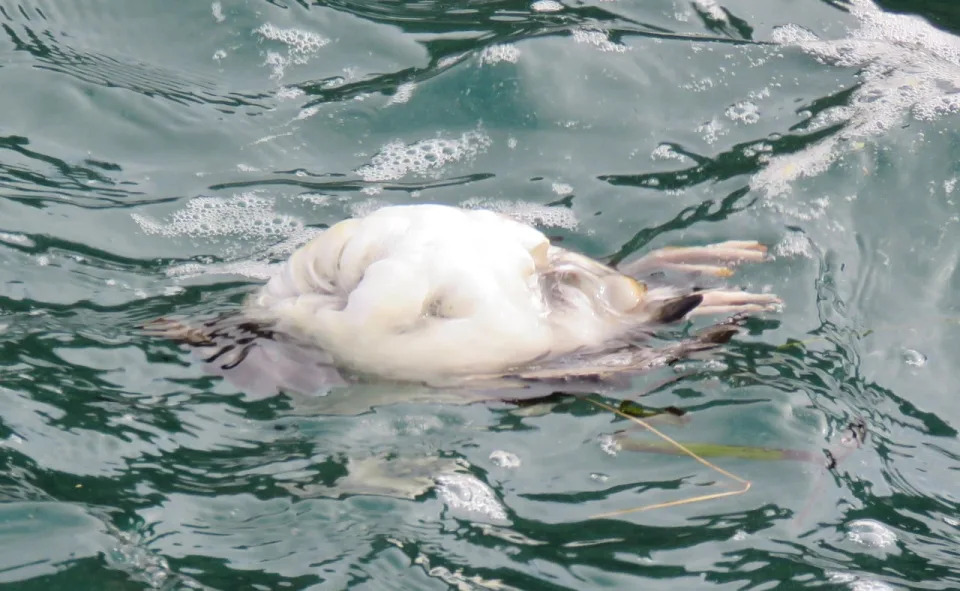

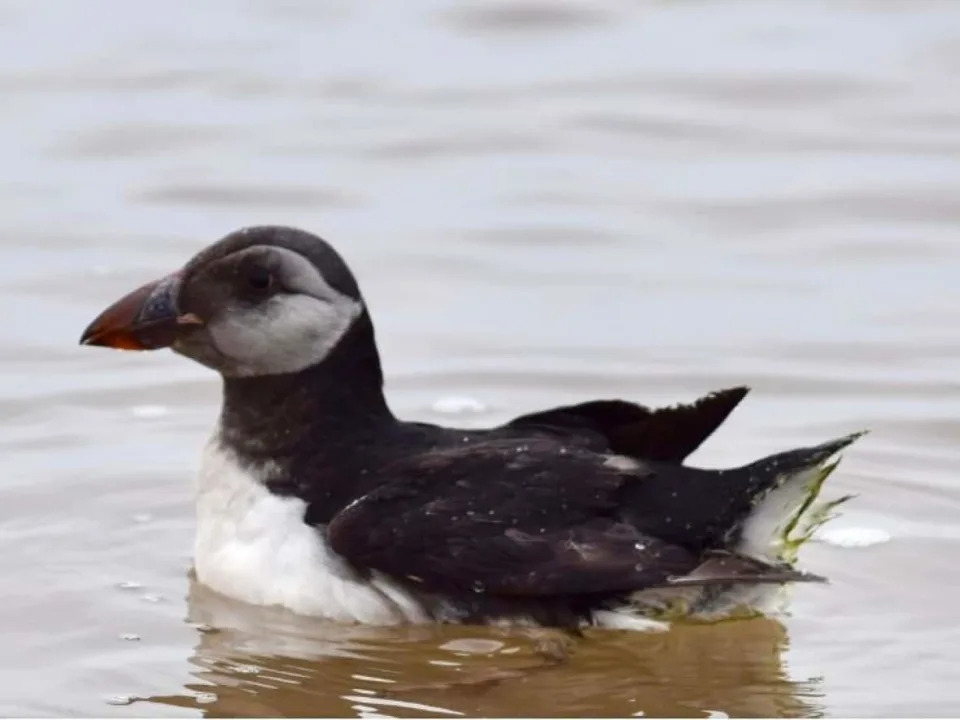
A dead Atlantic puffin chick floats in the water off Bird Island in the Witless Bay Ecological Reserve, Canada's largest Atlantic puffin colony. Some 300,000 nesting pairs return to the reserve every year to breed.

A dead Atlantic puffin chick floats in the water off Bird Island in the Witless Bay Ecological Reserve, Canada's largest Atlantic puffin colony. Some 300,000 nesting pairs return to the reserve every year to breed. (Chris O'Neill-Yates/CBC)

The Department of Fisheries and Oceans categorizes the capelin stock as "critical," yet it allowed a commercial fishery of 14,533 tonnes in 2023 for the second year in a row.

In its capelin management plan, DFO said, "Science shows the fishery's impact on capelin is small compared to predation by other species such as seabirds, cod and other fish."

Capelin are caught using a purse seine, which surrounds the fish, corralling them into the net and tightening it, similar to a drawstring, before it's hauled aboard a fishing vessel.

However, the species is a mere fraction of its abundance in the 1980s. As the principal food for cod, capelin overfishing is recognized as one of the key factors in the collapse of northern cod stocks more than three decades ago.

Valued for its eggs, or roe, female capelin is exported to China, the United States, Taiwan and Japan,

In the 2023 season, capelin sold for an average of 16 cents a pound, netting $4.5 million to fishermen in landed value, making it one of the least lucrative fisheries in the province.

"We're destroying them in mass volumes … only taking the females.… That's crazy," said O'Brien.

Tour boat operator Joe O'Brien noticed dead puffins floating on the water this summer near the Witless Bay Ecological Reserve, 30 kilometres south of St. John's.

Tour boat operator Joe O'Brien noticed dead puffins floating on the water this summer near the Witless Bay Ecological Reserve, 30 kilometres south of St. John's. (Chris O'Neill-Yates/CBC)

"Why are we catching one of the main sources of food for just about everything in the water?"

Capelin fishery 'incomprehensible'

Ian Jones, a marine bird biologist at Memorial University, is also concerned about the impact fishing capelin has on the entire ecosystem.

"When I hear these claims that somehow you can keep fishing a forage fish like this … it's incomprehensible to me," he said, adding that the fisheries "arguably don't bring in a whole lot of money."

The effects of fishing a forage species, a rapidly warming ocean due to climate change, increasing amounts of artificial light, seabird hunting and monofilament fishing nets are cumulatively stacked against seabirds' long-term survival, said Jones.

While Atlantic puffins can sustain some mortality because of their abundance, the Leach's storm petrel has seen a decline of about 50 per cent in recent years, said Jones.

"We haven't seen a bird disappearing at this rate since the passenger pigeon," said Jones.

Like the Atlantic puffin, the Leach's storm petrel is also affected by a growing amount of artificial light from communities, boats and offshore oil installations.
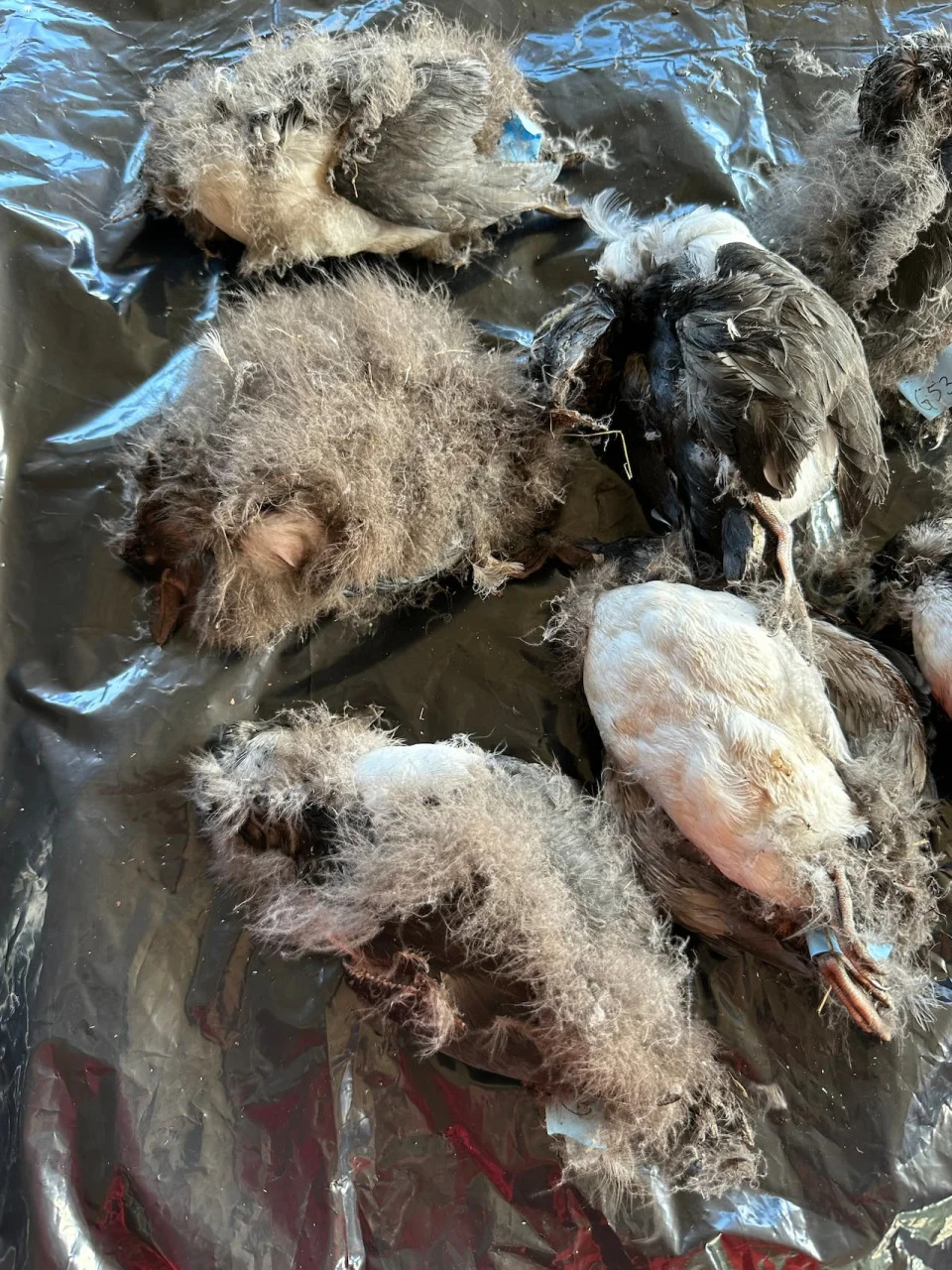
Wildlife biologists checked some burrows where Atlantic puffins nest and found a large number of pufflings dead in their nest from starvation. Adult puffins will feed themselves first, and the scarcity of capelin, a forage species of fish, meant there was not enough food to take back to the nest to feed their chicks. Capelin make up to 50 per cent of their diet.More

Wildlife biologists checked some burrows where Atlantic puffins nest and found a large number of pufflings dead in their nest from starvation. Adult puffins will feed themselves first, and the scarcity of capelin, a forage species of fish, meant there was not enough food to take back to the nest to feed their chicks. Capelin make up to 50 per cent of their diet. (Chris O'Neill-Yates/CBC)

"These seabirds that have evolved to survive in one of the harshest environments on Earth are faced with this completely disorientating artificial light," said Jones. "They don't successfully get out to sea so they basically strand on land and and die in very large numbers."

'Canary in the coalmine'

The United Nations calls light pollution "a significant and growing threat to wildlife" that contributes to the death of millions of birds globally.

Seabirds that migrate at night and go off course chasing artificial light are at risk of becoming exhausted, being eaten by predators, or colliding with buildings.

The impact of warming ocean temperatures is already being found in other Atlantic puffin populations.

"The worry is, is that these puffins are going to experience the same fate here in Newfoundland that they're experiencing in the Eastern Atlantic," said Jones, "with year after year of no chick surviving, the population begins to crash and then in some areas disappear."

Seabirds are a great indicator of the health of the ecosystem, says Wilhelm, and O'Brien says the puffin is warning us the ocean is under stress from climate change.

"The puffin is acting like the canary in the coal mine."

Wednesday, March 08, 2023

NB
Atlantic puffin returns to open water after 'miracle' rescue


Wed, March 8, 2023 

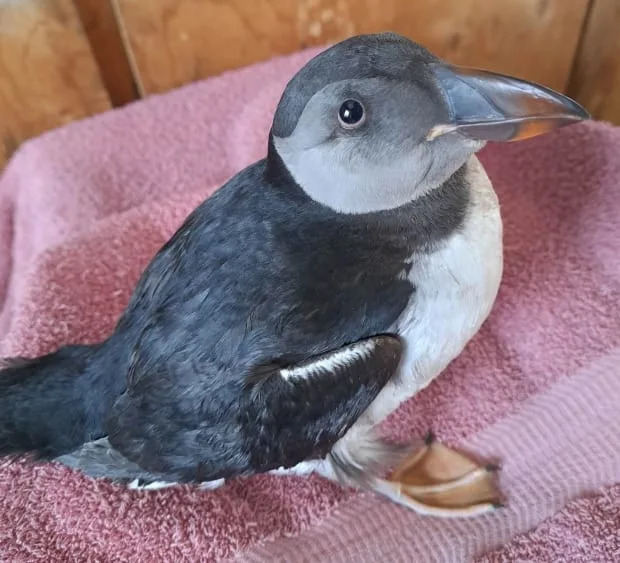
This young Atlantic puffin was released into the water off the New Brunswick coast just days after it was found in the middle of a busy road in Riverview. (Atlantic Wildlife Institute/Facebook - image credit)

The tiny Atlantic puffin rescued from a busy four-lane road in southeastern New Brunswick last Thursday has already been released into open water after a short recovery at the Atlantic Wildlife Institute.

Pam Novak of the Atlantic Wildlife Institute said that when the email came in about a tiny bird in Riverview that had clearly lost its way, she thought it was a typo, and the sender meant pigeon — not puffin.

"Luckily, it was found as quickly as it was," she said. "For the gentleman who found him to find him so quickly before it actually got hit by a car is what the miracle of this is — that that bird didn't get injured."

Weighing in at just 400 grams, Novak and her team did some research and concluded the Atlantic puffin was likely a juvenile, going into its second year. It's plumage is dull, and the bill itself didn't have the iconic orange and yellow colours yet.

Submitted by Pam Novak

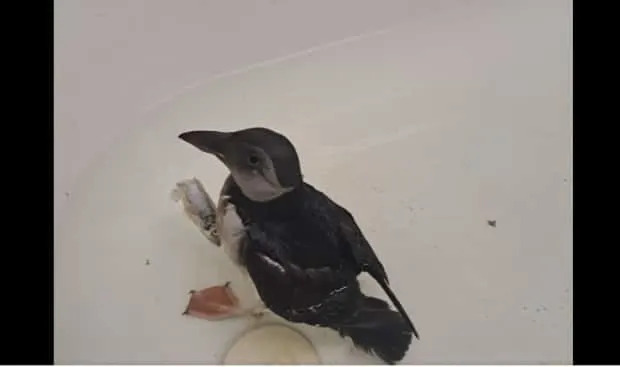
After an exam, a few days of rest, and a bathtub swimming test, Novak knew the puffin was ready to be released into open water.

"We have a little pool set up to make sure that we can see that activity happening and he passed that test," she said. "Then it was a matter of getting him back out."

When it came time for the release, the bird "was very happy to go," she said as she laughed. "No looking back."

The wildlife care team determined the bird was most likely on its way to Grand Manan or nearby Machias Seal Island, and drove the Atlantic puffin down the Bay of Fundy coast to find open water and a direct route to the breeding grounds.

"The consensus was that it's probably trying to get down to Machias Seal Island, so that's where we put it … and shortened his or her trek to get right to the island."

LISTEN | Pam Novak tells Information Morning Moncton about how a rescued puffin has been returned to the wild:

Novak suspects the lonely puffin may had become disoriented by fog that moved in that morning. It was also a "pretty breezy, snowy kind of day."

While there is no way to know whether the bird will survive, Novak is hopeful.


Atlantic Wildlife Institute/Facebook

"A lot of times you're not going to know what's going to happen. All we can do is put a bird out that we felt was in good healthy condition, didn't show any kind of ailments, just got itself put off track for whatever reason and just give them that second chance."

The last time Novak saw the bird, it was in deep open water — a quiet place she describes as the best spot it could be.

"Last we saw it was diving underwater and it took off and that was that," she said. "So that's all we can ask for."

Tuesday, October 10, 2023

Arctic puffins evolved into a new species 6 generations ago, but they might be less fit to survive, a new study shows

Maiya Focht
Updated Mon, October 9, 2023 

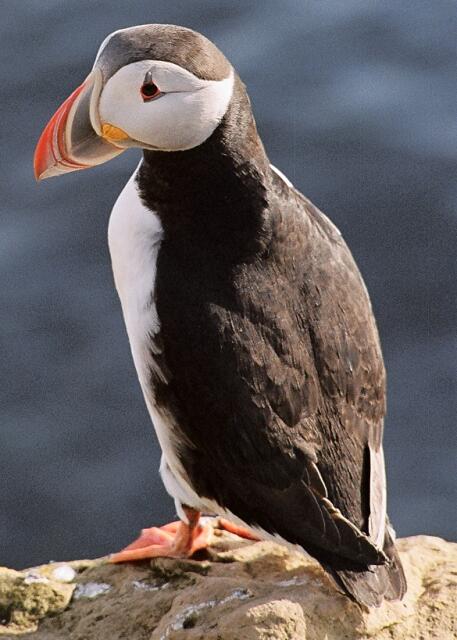
Puffins beak changes color depending on the time of year.
Annemarie Loof

Scientists analyzed Atlantic puffin genes and found they had been interbreeding in recent history.


They traced the first hybrid puffin back to 1910, after climate change had started to grip the globe.


That suggests that the interbreeding was caused by climate change.


They're small, they're cute, and they're evolving right before our eyes — a hybrid species of Atlantic puffins that formed in the last century was recently discovered by scientists.

The hybrid group formed when two of three subspecies of Atlantic puffins began mating six generations ago, around 1910, according to a study published in the journal Science Advances.

It probably began happening when climate change affected one of the subspecies' habitats, sending them to mingle with another group, the study detailed.
Different subspecies of Atlantic puffin look very similar.Annemarie LoofAtlantic puffins' evolution isn't necessarily for the better

The authors also found that all three subspecies of puffin that live around the Atlantic Ocean have been losing genetic diversity over the past century.

This could make them less fit to survive in the future, Oliver Kersten, an evolutionary biologist at the University of Oslo who led the research, told Insider.

Decreased genetic diversity can harm sperm quality across a population, decrease birth rates, and make the organisms within a group more susceptible to disease and parasites, according to multiple studies. All of these factors can make a group less resilient to climate change, and more likely to face extinction.

It's important to study the genetic changes happening in puffins right now so we can best plan for how to protect, "such an iconic species," Kersten said.
A pair of puffins in the Farne Islands near Northumberland, UK.Evie Easterbrook/Wildlife Photographer of the YearA genetic map for Atlantic puffins

Other species in the Arctic have hybridized, like the beluga whale and polar bear, but this is the first time that scientists have been able to track how an Arctic species' genes have changed over time because of hybridization, Kersten said.

Without genetics, researchers might never know how puffins are changing in response to their unique environment since the different subspecies look very similar, Kersten said.

But genes don't lie. When you compare the genetics of the two subspecies to their new offspring, you get a map of how the hybrid species formed, and how they're currently living.
The Atlantic puffin was broken up into three distinct subspecies nearly 40,000 years ago.Annemarie LoofFrom 40,000 years ago to the 20th century

What their analysis found is that the original three subspecies began diverging from one another roughly 40,000 years ago. That likely corresponds to the breakup of an ancient glacier over the Arctic, Kersten told Insider.

The break up of the glacier put the different puffin populations onto different islands around the Atlantic, where they could evolve independently.

One group settled the north of the Arctic (F. a. naumanni), one group landed on the coastlines of what would become the United Kingdom (F. a. grabae), and the other (F. a. arctica), picked the south of the Arctic.

Fast forward to 1910, more than 100 years after the start of the Industrial Revolution, when humans began releasing greenhouse gases into the air at a never-before-seen rate. The scientists found that this is when some of the northern Arctic colonies moved south, meeting at Bear Island (Bjørnøya) in Norway.

Kersten and his colleagues hypothesize that this happened because climate change made the northern habitat unsuitable for puffins. It could've been a disruption to the food chain from overfishing, a change in water temperature, or any number of human-related effects on the Arctic, that made them want to leave.

Studying these animals may help us understand how our actions may be affecting them, Kersten said. He hopes that his work makes people understand that their actions have effects for the Arctic in general, and for the puffin in specific.


Saturday, March 07, 2026

Is “Parallel Left” U.S. Media-Funding Puffin Foundation Also Funding J Street “Lobby” Group?


by Bob Feldman / March 6th, 2026

Most U.S. Antiwar Movement organizers and U.S. Antiwar Movement supporters in the current decade are opposed to the U.S. power elite government’s bi-partisan policy of continuing to ship weapons to the genocidal Israeli war machine in 2026. And most U.S. Antiwar Movement organizers and U.S. Antiwar Movement supporters in the current decade support the Palestine Solidarity Movement’s Global BDS campaign.


Yet between Jan. 1, 2020 and Dec. 31, 2024, the educational fund of the Democratic Party-oriented liberal Zionist J Street “lobby” group (which still apparently does not support the Palestinian Solidarity Movement’s Global BDS campaign), the J Street Education Fund Inc., was given 4 “charitable” grants, totaling $85,000, by a foundation, The Puffin Foundation, which has also been funding “parallel left” U.S. media groups in a big way during the current decade of U.S. history.

According to The Puffin Foundation’s Form 990 financial filings for 2020, 2021, 2022, 2023, and 2024, between Jan. 1, 2020 and Dec. 31, 2024, the fair market value of the “non-profit” Puffin Foundation’s assets increased from over $76 million to nearly $87 million; while during this same period, The Puffin Foundation, for example, gave:

1. Four “charitable” grants, totaling $650,000, to help fund the “Democracy Now!” parallel left media firm;

2. Four “charitable” grants, totaling $110,000, to help fund the “Jacobin” magazine/Jacobin Foundation parallel left media firm;

3. Eight “charitable” grants, totaling $2,335,000, to help fund “The Nation” magazine/Nation LLC/Nation Institute/Nation Fund/Type Media Center parallel left media firm;

4. Five “charitable” grants, totaling $1,694,160, to help fund the “In These Times” magazine/Institute for Public Affairs parallel left media firm;

5. One “charitable” grant, totaling $150,000, to help fund the “Mother Jones” magazine/Foundation For National Progress/Center For Investigative Reporting parallel left media firm; and

6. Three “charitable” grants, totaling $140,000, to help fund the parallel left “Dissent” magazine.


And, at the same time “charitable” grants are being given to the generally financially secretive upper-middle class folks who control the editorial content of the various Democratic Party-oriented parallel left media groups in this decade by foundations like The Puffin Foundation, the degree to which young working-class and elderly working-class people, of all racial backgrounds, in the USA and abroad (“the 90 percent”) continue to be economically exploited and politically manipulated by both the foundations set up by U.S. capitalists and the upper-middle-class (“the 10 percent”) seems to be increasing in 2026, while the threat of World War III breaking out in the current decade remains.

Bob Feldman is a longtime antiwar U.S. left Movement writer/blogger/activist, not funded by elite foundation money, as well as an antiwar singer-songwriter (some of whose previous historical Movement writings/exposes' and non-commercial folk songs can be found for free on a Substack blog, The Rag Blog archive, bandcamp, youtube, etc). Read other articles by Bob.

Saturday, January 04, 2020


Puffins scratch their itches with sticks in first example of seabirds using tools

Scottie Andrew

CNN
Published Friday, January 3, 2020 

Puffins caught using 'tools' to scratch itch


Surveillance video of an Atlantic puffin suggests the species may be smarter than we thought.Perhaps puffins aren't as bird-brained as previously believed.

A team of animal experts observed two Atlantic puffins, more than 1,500 kilometres apart, spontaneously scratching themselves with sticks -- the first time wild seabirds have been spotted using tools, according to new findings in the journal Proceedings of the National Academy of Sciences.

It's exciting for a few reasons, author Annette Fayet said: It could mean wild birds are capable of using tools and have a reason to use them. Animals who use tools typically have higher cognitive abilities.

Related Stories
Puffins fill up nesting islands this year despite challenges
Mass puffin die-off linked to climate change, researchers say
Study sheds light on little-known migration habits of iconic Atlantic puffin

What's more, the birds exhibited the same behavior on different islands -- so while it may be rare for the swollen-chested birds to scratch themselves with branches, the behavior isn't restricted to a single population.

"Seabirds' physical cognition may have been underestimated," the authors wrote.

An itch their beaks couldn't scratch

Researchers observed two puffins -- one in Wales, one on an Icelandic island (where researchers planted a camera) -- using a stick to scratch themselves.

In footage from Iceland, a puffin toddles toward the camera, picks up a stick in its beak, then reaches under its chest to scratch itself with the tiny branch.

The authors aren't sure just why the puffins picked up sticks, though they assume it needed to knock off seabird ticks that plague coastal populations. Perhaps the branch was a more effective removal method than its beak.

Stick scratching is the second type of tool use in birds

The study rules out any doubt that the birds were merely building nests -- puffins are particular, and prefer lining their burrows with softer materials, like grass and feathers. The footage shows the puffin in Iceland collecting both.

The stick it used to scratch its chest, meanwhile, remains on the grass, right where the puffin dropped it.


Animals use tools for a few reasons, researchers noted, mainly to feed. It's not uncommon for some creatures to maintain themselves using tools, like chimpanzees that groom or wipe themselves with natural objects and captive parrots that scratch with sticks.

The puffins' scratching is only the second type of tool use related to body care spotted in wild birds -- the first is "anting," when birds smear ants all over their plumage to fight parasites.

"Our observations alone cannot solve the puzzle of the evolution of animal tool use," Fayet told CNN. "Many more species may also be using tools, but we simply haven't observed them yet."


---30---

Sunday, September 02, 2007

Puffin Dance

Now that the Liberals have adopted the Puffin as their official mascot their Great Leader does the Puffin Dance.

http://engagedspectator.files.wordpress.com/2007/09/bilde.jpg

After all the Puffin is known as the "clown of the sea,"

Yes, yes I know this photo is already controversial.

However to be fair and balanced here are some more goofy politician photo's.


I guess that was Day doing his

Stanfield imitation.


And of course who can ever forget this.
The Queen of the BBQ circuit
before he became King.


Apparently it's a Liberal Leader tradition
to also be the Minister of Dance.
Pierre does the pirouette.


H/T to Engaged Spectator.


Find blog posts, photos, events and more off-site about:
, ,

,
, , ,

Liberal Party Song

Along with their new official mascot and dance the Liberal Party could adopt this as their anthem.

The Puffin Song
Copyright 1990 by Tom Knight

I'm not like the penguin, don't confuse me with ducks
I'm dressed for dinner in my finest fancy tux
My beak it is pretty, my feathers are fine
Long time ago, the hunters wanted mine

Call me a Puffin, 'cuz that's my name
I live on an island just off the coast of Maine
But I wasn't born here, I was brought by a man
And now my burrow is here on Egg Rock Island

Chorus:
Come fly with me
Fly across the sea
Come fly with me
Puffins we will be

My brothers and sisters, my lovely wife
We like to gather, we love the social life
A picnic for puffins, a tasty old treat
I hope you like fish, it's our favorite thing to eat (Chorus)

And here is an exercise they could try at their next caucus meeting.
An original dramatic action song – “Underwater World” – proved the perfect
opportunity for all age groups to work together.

" For a Puffin likes nuthin',
more than tasty fish,
And a beak thats full for stuffin',
is every Puffin's wish."

The value of this sharing was soon apparent. The children
worked in mixed age groups and the P3 seaweeds (7-8 year olds) were
soon swaying as gracefully as the P7 ones (11-12 year olds). The P1 shoals
of fish (5-6 year olds) were shown how to twist and wriggle by their older
brothers and sisters, and the young puffins took no time at all to copy the
older ones in tossing sandeels in their beaks, while waddling around the
stage! There was a great sense of togetherness and of each individual
contribution being an important part of the whole

For their next convention they could invite the Puffins to play.


Find blog posts, photos, events and more off-site about:
, ,

,
, , ,

Sunday, May 29, 2022

Decline in North Sea puffins causes concern


nIn both places, a census is taking place to determine the extent of the decline, which has been blamed on rising sea temperatures and other environmental factors (AFP/Andy Buchanan)

Stuart GRAHAM
Sat, May 28, 2022


The Isle of May, off Scotland's east coast, is home to one of the UK's biggest colonies of seabirds. Some 200,000 birds, from kittiwakes to guillemots can flock to the rocky outcrop at the height of the breeding season.

But conservationists are concerned about dwindling numbers of one of the island's most distinctive visitors -- the Atlantic puffin.

"The population was really booming in the 80s and 90s and then suddenly, a crash," David Steel, a manager at the nature reserve, told AFP.

"We lost nearly 30 percent of all puffins in the mid-2000s and since then the population has slowly increased but nothing compared to what it used to be."


Just over 50 miles (80 kilometres) down the coast on the Farne Islands, off Northumberland in northeast England, there are similar concerns.

In both places, global warming, high winds, rains, coastal erosion, pollution and overfishing of its favoured food -- sand eels -- is being blamed for dwindling numbers.

"Climate change is having a big effect with prey items in the sea," affecting sand eels which feed on plankton in the North Sea, said Steel.

"The plankton is moving north as the sea temperature increases. So if there are less sand eels the puffins are going to struggle."

- Census -


On a meadow on one of the Farne Islands, rangers slowly slide their arms into narrow sandy burrows, searching for signs of nesting pairs of puffins, which are known locally as "tommy noddies".

"Quite often you will get a bit of a nip, which is a good sign because it means then that the burrow is occupied," said one of the rangers, Rosie Parsons.

In 2015, the International Union for the Conservation of Nature gave puffins "vulnerable" status, after large declines over much of their European range.

Rising sea temperatures have caused sand eels to move north to cooler waters, forcing the birds to follow but where more extreme weather can be fatal for them.

The traditional enemies of puffins, which grow to just under 30 centimetres (one foot) tall and weigh around 450 grams (around a pound), are seagulls and seals.

Puffins mate for life and lay a single egg in April or May.

Due to their low reproductive rate, populations can take decades to recover from a sudden knock.

A full puffin census is being carried out on the Farne Islands and the Isle of May this year.

Concerns were raised last year when a limited count recorded 36,211 breeding pairs across four of the Farne Islands compared to 42,474 pairs in 2018.

Puffin numbers on the islands peaked at 55,674 pairs in 2003 before a sudden crash to 36,835 in 2008 a due to an extremely low number of sand eels.

Zoologist Richard Bevan, from Newcastle University, hopes the resumed annual count will provide a more accurate estimate of puffins on the islands.

"Up until 2018 surveys were done on the Farnes every five years, which means you don't know what's happening in the four years in between," he told AFP.

Before 2018, teams of researchers would check every burrow they came across on an island and form an estimate from that.

The university then found a way to subsample to form an accurate estimate of the population. This has sped up the count and made the task far less arduous.

- Concern -

Measuring puffin numbers is difficult, said Bevan.

Sometimes it will be easy to spot one of the birds, returning to nests with a sand eel clamped in its beak, but puffins are often underground.

"Often the only way to do it is to stick your arm into a burrow and check," he said.

The 2022 census will give scientists a picture of how the puffin population is being affected by factors such as climate change and local changes in sand eel availability, Bevan says.

"Looking at the data, it is worrying to see that over the last four years we have seen a downward trend," he says.

"However, these are data for a short time period and compared to the population counts in the early 1990s they are still reasonable numbers."

Although there is not an immediate danger of the puffins becoming extinct, the fact that their numbers are falling "triggers concern".

"With a declining population you have to keep your eye on it to make sure that doesn't continue," he said.

"If it does continue we have to be aware of the factors that contribute to it and how we can ameliorate those."

srg/phz/cjo/ach

Friday, September 06, 2024

Puffins increase on Farne Islands despite bird flu

Fiona Trott
North of England correspondent, BBC News•@bbcfionatrott

Puffins are on the red list of Birds of Conservation Concern


A puffin population has been declared "stable" following fears that bird flu might have had a more devastating effect.

The first full count for five years on the Farne Islands off Northumberland has revealed the endangered species has in fact increased by 15% since 2019.

There are now thought to be 50,000 breeding pairs on the site, which is cared for by the National Trust.

Ranger Sophia Jackson said the birds' self-isolating behaviours meant they had "weathered this particular storm".


Sophia Jackson said she was extremely happy with the increase in numbers


Ms Jackson said: "Puffins nest in separate burrows and clean them out.

"In that way, the disease is less likely to spread as fast as it does through the other seabirds, which is why we saw a decline in them."

The National Trust said another interesting finding was that fewer pairs have been recorded on the outer islands.

It is thought puffins may have relocated, after stormy weather forced grey seals to move higher up into their territory, causing some burrows to collapse.


The Farnes, along with neighbouring Coquet Island, are home to the largest puffin colonies in England


All the results will form part of the national Seabird Monitoring Programme and follow six weeks of hard work by the rangers, who were on their hands and knees checking burrows for signs of fresh digging or hatched eggshells.

Earlier this week, five more species of seabird were added to the UK red list of birds at most need of conservation. Puffins were one of five types of bird already on the list.

During the avian flu outbreak in 2022 and 2023, about 10,000 birds on the Farne Islands perished.

More than 900 puffin carcasses were collected but a combination of the Covid pandemic and then bird flu meant conservationists could not get close enough to carry out their full census.


Tom Hendry says "initial figures on other species are concerning"


Ranger Tom Hendry said while puffin numbers are holding up, some cliff nesting birds appear to be struggling.

Initial figures suggest the shag population is down by 75% on the inner islands, but there is some hope.

"To us, it looks like they may have had a productive breeding season," he said.

"So with any luck, next year's count will show that like the puffins, they too have stabilised."


There were fears for the species which only lay one egg a year


Ben McCarthy, head of nature and restoration ecology at the National Trust said long-term monitoring was vital.

"The Farne Islands will be an important bellwether for how they're doing in the face of our changing climate," he said.

Meanwhile, the local rangers said they would make the habitat as welcoming as they can for the puffins next year.

Ms Jackson added: "It's hard work but you're their guardians and you do become attached to them, every single one."

Friday, August 31, 2007

Huffin and Puffin


This is too silly by half. However it should be noted that the Liberal Party of Canada hides it's excrement too, but not well enough as the Gomery Commission proved.

And is flapping ones wings very hard, puffins flap their wings a hundred times to get going, a backhanded comment on Dion's Leadership?


Canadian political parties might not have official birds just yet, but deputy Liberal leader Michael Ignatieff has a suggestion for his party -- the humble Atlantic puffin.

"They put their excrement in one place. They hide their excrement ... They flap their wings very hard and they work like hell," he told reporters at the annual summer caucus gathering in St. John's, Nfld.

"This seems to me a symbol for what our party should be."


Liberals embrace Family Values....

And like a true politician, Mr. Ignatieff praised puffins for their "good family values." "They stay together for 30 years," he said.


Unlike Emperor Penguins who were embraced by the social conservatives for their family values until someone pointed out that they also have shown homosexual and polygamous tendencies.

When dealing with fowling ones image one should be careful of not appearing bird brained.

"My wife and I were very impressed with the noble bird. Noble in my lexicon means underappreciated as well."
Noble ah yes Mssr. Ignatieff does come from a Russian Aristocratic family after all, so I guess he can appreciate nobility and being in Dion's cabinet I guess he also understands being underappreciated.


Find blog posts, photos, events and more off-site about:
, ,

,
, , ,

Friday, October 15, 2021

Nothing funny about bad year for Maine’s clownish puffins
By PATRICK WHITTLE


FILE - In this July 1, 2013, file photo, a puffin prepares to land with a bill full of fish on Eastern Egg Rock off the Maine coast. This year's warm summer was bad for Maine's beloved puffins. Far fewer chicks fledged than need to to stabilize the population.
 (AP Photo/Robert F. Bukaty, File)


PORTLAND, Maine (AP) — Maine’s beloved puffins suffered one of their worst years for reproduction in decades this summer due to a lack of the small fish they eat.

Puffins are seabirds with colorful beaks that nest on four small islands off the coast of Maine. There are about 1,500 breeding pairs in the state and they are dependent on fish such as herring and sand lance to be able to feed their young.

Only about a quarter of the birds were able to raise chicks this summer, said Don Lyons, director of conservation science for the National Audubon Society’s Seabird Institute in Bremen, Maine. About two-thirds of the birds succeed in a normal year, he said.

The puffin colonies have suffered only one or two less productive years in the four decades since their populations were restored in Maine, Lyons said. The birds had a poor year because of warm ocean temperatures this summer that reduced the availability of the fish the chicks need to survive, he said.

“There were fewer fish for puffins to catch, and the ones they were able to were not ideal for chicks,” Lyons said. “It’s a severe warning this year.”'


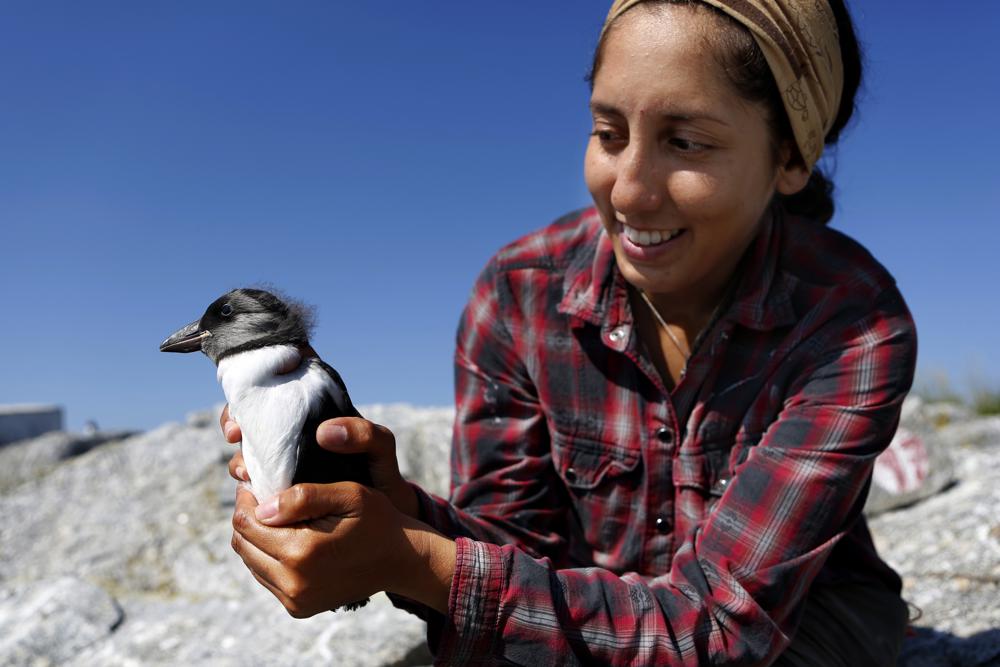
 In this July 19, 2019, file photo, research assistant Andreinna Alvarez, of Ecuador, holds a puffin chick before weighing and banding the bird on Eastern Egg Rock, a small island off the coast of Maine. This year's warm summer was bad for Maine's beloved puffins. Far fewer chicks fledged than need to to stabilize the population.
 (AP Photo/Robert F. Bukaty, File)

The islands where puffins nest are located in the Gulf of Maine, a body of water that is warming faster than the vast majority of the world’s oceans. Researchers have not seen much mortality of adult puffins, but the population will suffer if the birds continue to have difficulty raising chicks, Lyons said.

The discouraging news comes after positive signs in recent years despite the challenging environmental conditions. The population of the birds, which are on Maine’s state threatened species list, has been stable in recent years.

The birds had one of their most productive seasons for mating pairs in years in 2019. Scientists including Stephen Kress, who has studied the birds for decades, said at the time that birds seemed to be doing well because the Gulf of Maine had a cool year that led to an abundance of food.

The puffins are Atlantic puffins that also live in Canada and the other side of the ocean. Internationally, they’re listed as “vulnerable” by the International Union for Conservation of Nature.

Sunday, September 02, 2007

Rudderless Liberals

Well they have a new mascot, a dance and possibly a new party song. That's a start.

Liberals can win the next federal election, but only if they come up with clear policy alternatives, some fresh ideas, new faces and a simple message, the party's pollster said Thursday.

While Canadians still don't trust Harper entirely, MPs said Marzolini told them voters aren't particularly enamoured of the Liberal team or its agenda either.

The problem is their Leader.

Liberal Leader Stéphane Dion, second from right, and his wife, Janine Krieber, relax aboard the tour boat Atlantic Puffin in Bay Bulls, Nfld., August 28, 2007. Dion was gracious and polite, but humour challenged, the Star's Susan Delacourt says.


Find blog posts, photos, events and more off-site about:
, ,

,
, , ,

Tuesday, January 28, 2025

EU challenges British ban on sandeel fishing aimed at protecting marine ecosystem
Europe


The EU and Britain go to court at the Hague on Tuesday over a UK ban on the fishing of sandeels, a tiny fish celebrated by conservationists, in what is seen as a bellwether for other potential litigation between London and Brussels.


 28/01/2025 - 
FRANCE24
By: NEWS WIRES
Sandeels are treasured by the atlantic puffin, a rare and threatened seabird.
 © Loïc Venance, AFP


A tiny silver fish which is an important food source in the North Sea will take centre stage Tuesday as the European Union and Britain square off over post-Brexit fishing rights.

The bitter arbitration case over sandeels is seen as a bellwether for other potential litigation between London and Brussels in a perennial hot-bed industry, experts said.

Tuesday's clash at the Hague-based Permanent Court for Arbitration also marks the first courtroom trade battle between the 27-member trading bloc and Britain since it left the EU in 2020.

Brussels has dragged London before the PCA following a decision last year to ban all commercial fishing of sandeels in British waters because of environmental concerns.


London in March ordered all fishing to stop, saying in court documents that "sandeels are integral to the marine ecosystem of the North Sea".

Because of climate change and commercial fishing, the tiny fish "risked further decline... as well as species that are dependent on sandeels for food including fish, marine mammals, and seabirds".

This included vulnerable species like the Atlantic puffin, seals, porpoises and other fish like cod and haddock, Britain's lawyers said.

But Brussels is accusing London of failing to keep to commitments made under the landmark Trade and Cooperation Agreement, which gave the EU access to British waters for several years during a transition period after London's exit.

Under the deal, the EU's fishing fleet retained access to British waters for a five-and-half-year transition period, ending mid-2026. After that, access to respective waters will be decided in annual negotiations.

"The EU does not call into question the right of the UK to adopt fisheries management measures in pursuit of legitimate conservation objectives," Brussels' lawyers said in court papers.

"Rather, this dispute is about the UK's failure to abide by its commitments under the agreement."

London failed to apply "evidence-based, proportionate and non-discriminatory measures when restricting the right to EU vessels to full access to UK waters to fish sandeel", the EU lawyers said.

Brussels is backing Denmark in the dispute, whose vessels take some 96 percent of the EU's quota for the species, with sandeel catches averaging some £41.2 million (49 million euros) annually.

"The loss of access to fisheries in English waters could affect relations with the EU, including Denmark, as they are likely to lead to employment losses and business losses overseas," the EU's lawyers warned.
'Important issue'

The case will now be fought out over three days at the PCA's stately headquarters at the Peace Palace in The Hague, which also houses the International Court of Justice.

Set up in 1899, the PCA is the world's oldest arbitral tribunal and resolves disputes between countries and private parties through referring to contracts, special agreements and various treaties, such as the UN Convention on the Law of the Sea.

The EU's decision to open a case before the PCA "will not have been taken lightly and reflected the political importance it places on fishing rights", writes Joel Reland, a senior researcher at UK in a Changing Europe, a London-based think tank.

In a number of "influential member states -- including France, the Netherlands and Denmark -- fishing rights are an important issue, with many communities relying on access to British waters for their livelihoods".

"This dispute is an early warning that the renegotiation of access rights, before the TCA fisheries chapter expires in June 2026, will be critical for the EU," said Reland.

A ruling in the case is expected by the end of March.

(AFP)

Tuesday, September 14, 2021


Cyclones starve North Atlantic seabirds


Peer-Reviewed Publication

CNRS

Atlantic puffin 

IMAGE: ATLANTIC PUFFIN view more 

CREDIT: © DAVID GRÉMILLET

Every winter, thousands of emaciated seabird carcasses are found on North American and European shores. In an article published on the 13 September in Current Biology, an international team of scientists including the CNRShas shown how cyclones are causing the deaths of these birds. The latter are frequently exposed to high-intensity cyclones, which can last several days, when they migrate from their Arctic nesting sites to the North Atlantic further south in order to winter in more favourable conditions. After equipping more than 1,500 birds of the five main species concerned (Atlantic puffins, little auks, black-legged kittiwakes, and two species of guillemots) with small loggers2 and by comparing their movements with the trajectories of cyclones, the scientists were able to determine the degree of exposure of the birds to these weather events. By modeling the energy expenditure of birds under such conditions, the study suggests, surprisingly, that the birds do not die from increased energy expenditure, but as a result of their inability to feed during a cyclone. The species studied are particularly unsuited to fly in high winds and some cannot dive into a stormy sea, preventing them from feeding. Trapped during a cyclone, these birds will starve if the unfavourable conditions persist beyond the few days that their body reserves allow them to survive without food. As the frequency of severe cyclones in the North Atlantic increases with climate change, seabirds wintering in this area will be even more vulnerable to such events.

CAPTION

Flight of a little auk equipped with a GLS system (eastern Greenland).

CREDIT

© David Grémillet

Notes


1 – Among those who took part in the study are scientists from the Centre d'écologie fonctionnelle et évolutive (CNRS/Université de Monptellier/IRD/EPHE), the laboratory Littoral, environment et societies (CNRS/La Rochelle Université) and the Centre for biological studies of Chizé (CNRS/La Rochelle Université).

The following major international structures took part (among others): the University of Wisconsin, the Norwegian Polar Institute and the Norwegian Institute for Nature Research.

2 - GLS (Global Location Sensor) tags are tiny tracking devices weighing around 1g, capable of recording light levels in the vicinity of the bird, allowing the position of the equipped individual to be calculated. Though less accurate (range of about 200 kilometres) than a GPS device, these loggers require little energy and have a long life span. They are placed on the metal rings that scientists put on the birds’ leg.


Tuesday, March 17, 2020

The First Stegosaur Tracks in Scotland Were Just Discovered on This Windy Island
Mike McRae

Stand on the wind-swept crags lining Scotland's western coast today, and you'd be lucky to spot a puffin or two. But the closer we look, the more evidence we find it was once home to an incredibly diverse array of ancient beasts.© Warpaintcobra/istock/Getty Images Artist impression of a stegosaur
The discovery of new sets of fossilised tracks has expanded the list of potential dinosaur populations that roamed what is now the Isle of Skye. Among them are tracks left by an animal that would have belonged to one of the most famous plate-backed herbivore suborders, Stegosauria.

Scottish and Brazilian researchers have spent the past couple of years analysing two recently found tracksites at a spot on the island's north-eastern coast called Rubha nam Brathairean, or Brothers' Point.

"These new tracksites give us a much clearer picture of the dinosaurs that lived in Scotland 170 million years ago," says University of Edinburgh palaeontologist Stephen Brusatte.

Back then, the lands making up the British Isles were nothing like they are today. Jurassic Scotland sat far closer to the equator, roughly in alignment with where Greece is today. Warm seas and a sub-tropical climate established ecosystems that were bustling with life.

Still, just because it was a virtual paradise doesn't mean it's been perfect for preserving the remains of ancient life. The Jurassic isn't exactly fossil friendly as it is, but Scotland has always seemed especially thin on dinosaur tracks and bones.

In spite of a rich history of fossil hunting throughout much of the United Kingdom, the first clear traces of dinosaur wildlife in Scotland were finally uncovered in the early 1980s when palaeontologists John Hudson and Julian Andrews found the "unmistakable print from a large dinosaur" in a fallen limestone block at Brothers' Point.

Since then, a plethora of tracks belonging to a wide range of long-necked sauropods and fleet-footed theropods have been identified, turning the Isle of Skye into a landmark site for Jurassic researchers.

The most recent additions include teapot-sized holes that haven't been found elsewhere on the island – impressions that are described in palaeontological terms as belonging to a category called Deltapodus.


a close up of a sign: stegosaur footprints skye
© Provided by ScienceAlert
stegosaur footprints skye Deltapod tracks on Isle of Skye (dePolo et al., PLOS One, 2020)

"These discoveries are making Skye one of the best places in the world for understanding dinosaur evolution in the Middle Jurassic," says Brusatte.

Without a means of narrowing down the exact species of dinosaur responsible, the researchers are careful about jumping to any conclusions.

But it's fair to say that this group includes a type of cow-sized dinosaur famed for its lines of geometric plates adorning its spine, and a wicked clump of 'thagomising' spines on its tail.

The team also uncovered another potentially new addition to the list, in the form of large imprints of something with three stubby toes possibly belonging to a group of heavyweight herbivores called ornithopods.

"We knew there were giant long-necked sauropods and jeep-sized carnivores, but we can now add plate-backed stegosaurs to that roster, and maybe even primitive cousins of the duck-billed dinosaurs too," says Brusatte.

Not only do the tracks provide tantalising evidence that stegosaurs once trod along the muddy Scottish coastline, the age of the tracks provides some of the earliest evidence of this particular dinosaur's existence.

Only last year, a species of stegosaur was dug up in the Middle Atlas Mountains of Morocco. At an estimated age of around 168 million years old, the fossilised remains of Adratiklit boulahfa are officially the oldest of its kind.

These tracks at Brother's Point are closer to 170 million years old. While there's no way to confirm what kind of stegosaur might have left them behind, it does help establish timelines and distributions describing their evolution.

"In particular, Deltapodus tracks give good evidence that stegosaurs lived on Skye at this time," says the study's lead author, Paige dePolo from the University of Edinburgh.

With such a rich assortment of tracks being found across the island, this part of Scotland is representative of an important period in evolutionary history, where the late Jurassic's zoo of classic creatures was just beginning to develop their famous characteristics and spread out around the globe.

This research was published in PLOS One.

Monday, September 07, 2020


Trump’s National Labor Relations Board Is Sabotaging Its Own Mission
The federal agency that’s supposed to protect union rights is instead championing the interests of bosses.

By Michelle ChenTwitter THE NATION SEPT 7,2020

SEPTEMBER 21/28, 2020, ISSUE

SCABBY THE RAT
Photo illustration by Cindy Lee.

On a June afternoon in 2019, in front of a statue of George Washington at Federal Hall in New York City’s financial district, more than 100 construction workers and activists gathered for a First Amendment rally. Amid chants of “Free speech, free speech!” an approximately 15-foot-tall gray inflatable rat with glaring red eyes bobbed in the sun. The workers, mostly members of Laborers Local 79, weren’t defending speech, exactly. Rather, they were demanding their right to display Scabby the Rat, the mascot deployed at job sites to shame anti-union bosses.


This article was reported in partnership with Type Investigations, with support from the Puffin Foundation.

The challenge to these workers came from a seemingly unlikely quarter: the National Labor Relations Board, a federal agency responsible for interpreting and enforcing labor law. The NLRB’s general counsel, Peter Robb, had launched a legal assault to ban Scabby from a nonunion construction site at a Staten Island supermarket. Arguing that its menacing presence amounted to illegal protest activity against a “neutral” business under the National Labor Relations Act, Robb, who was appointed by President Donald Trump in 2017, sought a federal court injunction that could effectively outlaw Scabby across the country.

On the steps outside the hall where the Bill of Rights was ratified, Chaz Rynkiewicz, Local 79’s director of organizing, took the microphone and denounced Robb as “an anti-union lawyer that, before he was head of the NLRB, worked for corporations to break unions…. If you know any Trumpsters out there, let them know, educate them. They need to know that they can’t love [their] union and love Trump.”

So far, Scabby has survived the legal attacks. In July 2019, a federal district court judge denied Robb’s request for a preliminary injunction in the Staten Island case. But the giant rat remains under threat: An earlier case against Scabby in Philadelphia is still pending before the NLRB.

The zeal with which Robb has pursued the cherished totem of union solidarity reflects how far the NLRB’s agenda has shifted under Trump. A report by The Nation and Type Investigations—based on interviews with more than 25 labor advocates, attorneys, and current and former NLRB staff members—reveals that the federal agency that’s supposed to protect union rights is instead championing the interests of management.


The NLRB is tasked with administering union elections and processing unfair-labor-practice cases under Section 7 of the National Labor Relations Act, which protects “concerted activity,” the collective action that workers take to try to improve conditions on the job. Over the years, the NLRB’s rulings have tended to oscillate between pro-worker and pro-management decisions, depending on which party holds the White House.


But with management-side lawyers dominating the agency, which is run by a five-seat board and a general counsel, labor advocates say the NLRB is more stridently anti-labor than ever before and is sabotaging its own mission. Not only has Trump’s board consistently sided with bosses, but career civil servants at the NLRB’s regional branches say they are being deprived of funding and staff.
CURRENT ISSUE

View our current issue


Even before Trump’s appointees began to undermine the agency, labor organizers were frustrated with the NLRB. Cases often require years of litigation, and remedies typically entail only back pay or reinstatement after a worker is unlawfully fired—not penalties stiff enough to deter employers from abuse.

After the rally in New York, Rynkiewicz told me, “As an organizer for 20-plus years, I’ve never viewed the NLRB as an ally of labor. It’s a shame to say.”

Just before Scabby was deflated, Rynkiewicz added, “The right-wing anti-union people want to portray the NLRB as a friend of labor. It’s not—even on a good day…. When you have the board’s majority put in place by the Democrats, you get nothing. When you have the board’s majority put in by the Republicans, you get an attack.”
RADICAL ROLLBACKS

The shortcomings of the NLRB are to some degree baked into its structure. During the labor uprisings of the 1930s, police and the National Guard members frequently killed striking workers. Established by the National Labor Relations Act in 1935, the NLRB was designed to maintain labor peace by absorbing the often violent conflicts into the legal arena. The act, a compromise between labor and management, forced companies to bargain with unions, but it also excluded whole categories of workers, such as farm laborers, and effectively limited collective bargaining to individual companies, not whole industries or sectors.

After World War II, conservative majorities in Congress gutted the National Labor Relations Act with the Taft-Hartley Act of 1947, which expanded employers’ power to suppress workplace organizing, allowed the government to break up strikes deemed “national health or safety” threats, and required anti–Communist Party pledges from union officers, which led organized labor to purge many of its most militant union members.
Dangerous web: A 1947 cartoon shows unions trapped in a web labeled “Taft-Hartley compliance.” A spider marked “NLRB” sits at the top. (Phil Drew / The Dispatcher)

Over the next several decades, organized labor withered in numbers and political clout. With private sector union membership now down to about 6 percent, workers and unions are often left seeking justice through this byzantine, Depression-era judicial apparatus.
Ready to blow: A 1948 cartoon from a union newspaper warns of the explosive effects of the Taft-Hartley Act. (Phil Drew / The Dispatcher)

The NLRB’s board is currently dominated by three conservative Trump appointees, two with ties to law firms that have represented some of the country’s largest employers. Board chairman John Ring and board member William Emanuel are lawyers who defended companies such as Marriott International and Uber, respectively. A third member, Marvin Kaplan, previously worked on labor policy as a counsel for House Republicans. The board’s lone Democrat, Lauren McFerran, left when her term expired in late 2019 but was reappointed in August. Neither the Trump administration nor the Senate has moved to fill the board’s fifth seat, which has been vacant since August 2018.

Robb, the NLRB’s general counsel, operates independently of the board and is a veteran management-side lawyer who worked with the Reagan administration to bust the air traffic controllers’ union. While the NLRB’s regional branches process most of the unfair-labor-practice charges—handling investigations, adjudications, and settlements—Robb shapes the agenda for the board, which rules on complaints appealed from the regional level, setting precedents for how the National Labor Relations Act is applied and enforced.

Shortly after being sworn into office in November 2017, Robb set about reversing the legacy of the previous board, which had incrementally expanded workers’ rights. In a series of sweeping decisions, the board scrapped rules instituted under Barack Obama barring workplace policies that impinge on the right to organize, axed a prohibition against employers making unilateral changes to collective bargaining agreements, and overturned a ruling allowing workers to form smaller bargaining units within a larger workforce.

SUPPORT PROGRESSIVE JOURNALISM

If you like this article, please give today to help fund The Nation’s work.


One of the board’s most influential decisions dealt a severe blow to efforts to extend collective bargaining rights for contracted workers. Under Obama, the NLRB loosened the joint employer standard, which determines whether a company can be considered an additional employer of workers hired through a contractor, such as a franchise operator or subcontracted cleaning agency. In 2015, the board ruled that a company could be considered a joint employer if it exercised “indirect control” over workers or had the ability to exercise control.

The Trump board restored a more restrictive joint employer standard—first through a 2017 decision, which the board vacated because of a conflict-of-interest issue, then in 2020 through the administrative rulemaking process. The move upended a multiyear legal challenge brought by McDonald’s workers, who claimed that the company had enough influence over its franchisees to be considered a joint employer and was therefore liable for retaliation against workers involved with the Fight for $15, the campaign for a $15 hourly minimum wage and a union.

The board’s initial moves to nullify Obama-era provisions have been followed by rulings that limit workers’ rights far beyond those under previous Republican administrations. In August 2019 it reduced workers’ rights to protest on private property, determining that management could block musicians with the San Antonio Symphony from leafleting at a performance venue because it was not owned by their employer. It also excluded faculty at religious colleges and universities from its jurisdiction and allowed bosses to bar workers from organizing on company technology and equipment, including the use of e-mail.

In recent months, the board has also used its rule­making process to roll back pro-worker regulations, especially in regard to union elections; make it easier for employers to interfere with voting; weaken rules that protect unionizing construction workers; and shorten the time that employers must wait before petitioning to oust a union.

“It’s breathtaking how many areas of the law, how many precedents they’ve managed to overturn,” said Wilma Lieb­man, a chair of the NLRB under Obama. “And they just kind of snap their fingers and do it, in my view, with little regard for the quality of the legal thinking or reasoning, reaching out to decide issues that aren’t before it.”

Some NLRB staffers fear that Robb is making it more difficult for them to scrutinize employers. In June he directed staffers to dramatically alter their investigative procedures. In some cases, bosses can now preview recordings that could be used as evidence and be present when former supervisors testify against them. NLRB spokesperson Edwin Egee told The Nation and Type Investigations that the “dissemination of information during the investigation” enables the agency to “more fairly enforce the [National Labor Relations Act]” and “aid settlement efforts.” But labor advocates say the measures discourage whistleblowers and compromise the integrity of cases.

The NLRB’s rightward shift under Trump has deterred some unions from taking cases to the agency. A current NLRB staff member, who requested anonymity to avoid retaliation, said she has observed unions opting to settle to avoid triggering an unfavorable ruling. Unions, she said, “are just less likely to turn to us because they…don’t want to create bad law.”

Several graduate student employee unions, including at Boston College, withdrew their cases in 2018 to prevent the board from overturning the Obama-era precedent that supported the collective bargaining rights of graduate workers at private institutions. “We pulled our petition to protect the rights of graduate student workers at private universities nation­wide,” said Sam Levinson, a Boston College graduate student worker, in an e-mail. “The current NLRB has consistently chipped away at the collective bargaining rights for which the labor movement has fought for decades. We decided to organize and build power, instead of allowing Boston College to put the fate of our rights into the hands of Trump and his appointees.”

Even though the petition was dropped, the board initiated a rulemaking process last September to strip collective bargaining rights from graduate student ­employees—another attempt to change policy through an administrative rule change rather than case law.

SUPPORT OUR WORK WITH A DIGITAL SUBSCRIPTION.

Get unlimited access: $9.50 for six months.

INNER TURMOIL

For career staffers who joined the NLRB to help enforce the rights of workers, the Trump board has been demoralizing. “There’s a host of decisions that have come out that are destructive of workers’ rights, and it’s an extremely sad time to be at this agency and work here,” said a second NLRB staff member, who also requested anonymity. “The only hope is that [the administration] will turn before too much damage is done.”

In early 2018, according to Bloomberg Law, Robb floated a proposal to centralize case-­handling authority under officials who report directly to him. The NLRB’s 26 regional directors protested, calling the move a unilateral concentration of authority by a Trump appointee. And Senator Patty Murray (D-Wa.) and Representative Rosa DeLauro (D-Conn.) sent a letter expressing concern. At the time, an NLRB spokesperson told Bloomberg Law that “no plan involving the restructuring of our Regional Offices system has been developed.” Facing congressional scrutiny and a backlash from staff, Robb seemingly shelved the idea.

But in August he appeared to have revived his consolidation efforts with a plan to combine case handling across several branches in Los Angeles, Seattle, San Francisco, Oakland, Denver, and Phoenix. Democrats in Congress criticized the proposal as a backdoor attempt to undercut the regional directors. Egee said the plan did not constitute a reorganization of the local offices and was merely a “resource sharing” initiative intended to “address chronic workload imbalances” between regions.

In 2018, Robb antagonized staffers with a memo recommending dozens of ways to speed up investigations. Although Egee said the guidance was drawn “directly from NLRB employees,” the NLRB Union, which represents workers in the regional offices, responded by arguing that it will “result in a reduction in quality, not an improvement.”

Staffers say they are under pressure to process cases quickly, prioritizing efficiency above all else. Meanwhile, the workforce has shrunk. While the number of field staffers has been decreasing since 2011, Robb exacerbated that trend by offering buyouts and early retirement incentives to eligible employees, according to the NLRB Union. The result, it said, has been a more than 20 percent reduction in staffing since fiscal year 2017—from more than 900 to about 717 full-time equivalents as of June 30. (Egee cited different statistics, stating that the total number of employees has declined less than 4 percent since fiscal year 2018.)

During fiscal year 2019, according to the NLRB’s annual performance report, the processing time from initial filing to judgment for unfair-labor-practice cases fell from 90 to 74 days. Yet the agency’s funding has shrunk by an inflation-adjusted 15 percent since fiscal year 2011, according to the NLRB Union.

A third NLRB field staffer said being asked to work faster with fewer resources feels like an attack on the agency. “If you are trying to [end] the administrative state and you want to get rid of the agencies you like the least—ours is probably one of them—then this is what you do. You really starve the staff, and you decrease morale.”

Some NLRB employees have left the agency on principle, according to another current staff member. “It is really tough when you believe in Section 7 rights and you have to write [a legal rationale] that you believe is eroding them,” the person said, noting that the NLRB was losing both experienced senior staffers and talented younger lawyers. “We’ve had some incredibly bright attorneys hired in the last five or so years who are jumping ship…. They’re still in labor law. They’re still in the fight. But they’re not going to fight from within the board.”

The agency’s two staff unions—the NLRB Union and the NLRB Professional Association, which represents employees at the headquarters—have been waging a modest resistance. They have accused the board of under­staff­ing the agency, refusing to bargain in good faith over the Professional Association’s contract, and letting millions of dollars in the agency’s budget go unspent. (The board has disputed the allegations and attributed the underspending to contracts that were not completed or came in under budget.)

Last November, the unions held a rally at the NLRB’s Washington, D.C., headquarters and passed out leaflets reading, “NLRB Leadership is destroying the agency from within by refusing to spend funds to hire staff.” They even brought Scabby the Rat to stand guard.
Industrial unrest: Anti-union vigilantes attack striking workers in Ambridge, Pa. The NLRB was designed to reduce the number of labor actions. (Universal History Archive / Universal Images Group via Getty Images)

A RANK-AND-FILE STRUGGLE

As Trump’s board whittles away labor rights, unions and workers increasingly see the legal bureaucracy of the NLRB as irrelevant or even antithetical to their efforts.

“A lot of people—the layman, the regular worker [or] union worker…they think that the board is there to protect them,” said Rob Atkinson, a former UPS driver. But under the current administration, “it’s obvious with their decisions that they’re no longer a friend of the working man and woman. They’re now a watchdog for the national Chamber of Commerce and Trump’s buddies.”

UPS fired Atkinson, a longtime Teamsters shop steward in western Pennsylvania, in 2014 for allegedly violating package delivery procedures. He filed two grievances, saying he was fired for his activism in a rank-and-file Teamsters movement, but he got no relief from what he said was a biased internal grievance panel.

Atkinson sought justice with the NLRB, and shortly before Trump took office, a lower-level judge found that his dismissal had been retaliatory, invoking an Obama-era ruling that said the board can override a grievance panel when considering certain violations of the National Labor Relations Act. But last December, the Trump-appointed majority on the board reversed that precedent, deciding that the grievance panel should have had the last word.

“My panel was made up of political enemies and people who wanted me gone,” Atkinson said. But his struggle with his former employer “really opened my eyes and showed me how cold and callous big businesses are and how we really need huge, strong unions and a strong National Labor Relations Board…to hold these companies accountable.”

In a statement, UPS said the board “recognized that an internal dispute resolution process can be relied upon to make fair and regular decisions on claims that might take years to resolve in other forums.”

Atkinson is appealing his case in federal court. His experience turned him into something of an NLRB watchdog; he now runs a Facebook group that tracks cases and educates other workers about what Trump is doing to labor law. “Look what the NLRB is doing to our rights and how they’ve turned into an antagonistic organization to the average working man or woman instead of an organization that’s there to uphold us,” he told me.
LABOR

BIDEN NEEDS TO TALK ABOUT JOBS ON LABOR DAY. AND EVERY DAY.


Jane McAlevey

THERE IS POWER EVEN WITHOUT A UNION


P.E. Moskowitz

MCDONALD’S HAS A REAL SEXUAL HARASSMENT PROBLEM


Bryce Covert

The Covid-19 pandemic has led to fresh labor clashes: Meatpacking workers have walked off the job, nurses have protested nationwide demanding more protective gear, and Whole Foods workers have filed suit after being disciplined and fired for wearing Black Lives Matter masks and apparel. Yet the NLRB continues to make it harder for workers to organize.

In July the NLRB Union and other labor groups denounced the board’s safety guidelines for resuming in-­person union elections as inadequate and advocated a move to online or mail-in voting instead. At the same time, the NLRB’s advice division, which provides legal guidance to regional offices, has issued memorandums that seem to give employers the green light to act uni­lateral­ly in response to the pandemic. One advisory suggests that an employer can refuse to bargain with a union over requests for pandemic-related “paid sick leave and hazard pay.” The NLRB also indicated that a person can be fired after speaking out against a company’s Covid-19 safety protocols.

Sharon Block, the director of Harvard Law School’s Labor and Worklife Program and an NLRB member under Obama, said that during the pandemic, it was “incumbent on worker protection agencies like the [NLRB]…to be exceptionally vigilant on behalf of workers and attuned to violations of their rights, because it is so hard to feel secure enough to speak out. [But] this is a board that we watched operate for three years in a way that would not give that kind of security to workers.”

Nonetheless, she added, the systemic problems with enforcing the National Labor Relations Act go beyond the Trump administration. “Even with board members…and a general counsel with the best of intentions who really believe in the spirit and the purpose of the act, it’s just a tool that doesn’t work anymore.”

The Labor and Worklife Program wants to overhaul labor law and extend protections to domestic and undocumented workers. It also advocates for sectoral bargaining, which would enable workers in an industry to negotiate en masse.

In the more immediate term, Democratic lawmakers are pushing the Protecting the Right to Organize Act, which would expand the rights of workers to strike and organize at work, institute meaningful penalties for bosses who violate labor law, and allow workers to sue employers in civil courts rather than be forced to rely solely on lengthy litigation at the NLRB.

Despite its limitations, workers continue to use Section 7 of the National Labor Relations Act, often to ward off campaigns to suppress organizing. Since April, Amazon workers belonging to the grassroots group Amazonians United in Chicago filed several unfair-labor-practice charges with the NLRB, alleging that they were unfairly disciplined by the company after staging walkouts and slowdowns to demand better health protections. Amazonians United member Ted Miin said he and his coworkers were reprimanded for allegedly violating social distancing guidelines at work, which he sees as retaliatory selective enforcement. (Amazon did not return a request for comment.)

Concerned that it might not be worth the effort, Miin was wary of filing a charge. But when the official probe began, the atmosphere at work changed. “Management has basically loosened up on us a lot at our warehouse since we’ve had active NLRB cases open,” he said.

Miin knows his charges may lead to nothing. He acknowledged that “the Trump administration has been rewriting the NLRB rules to favor bosses over workers.” But whatever form their resistance takes, he added, “as workers, we have to protect ourselves. No one’s coming to save us…not the NLRB, not politicians, not reporters. As workers, we have to get organized ourselves.”


MOST POPULAR

1

THE INEVITABLE WHITELASH AGAINST RACIAL JUSTICE HAS STARTED

2

TRUMP’S VILE MILITARY COMMENTS ARE A WINDOW INTO HIS SOUL

3

THE LOOTER IS THE MOST MISUNDERSTOOD FIGURE IN AMERICAN POLITICS

4

HOW DID THE INTERNET GET SO BAD?

5

TRUMP’S NATIONAL LABOR RELATIONS BOARD IS SABOTAGING ITS OWN MISSION


Michelle ChenTWITTERMichelle Chen is a contributing writer for The Nation.