Thursday, February 24, 2022

Standing up for Ukraine: Anti-war protests around the world

Protests against Russia's invasion of Ukraine broke out in many cities across Europe and the world. People came together to show their support for Ukraine and condemn Moscow's actions.
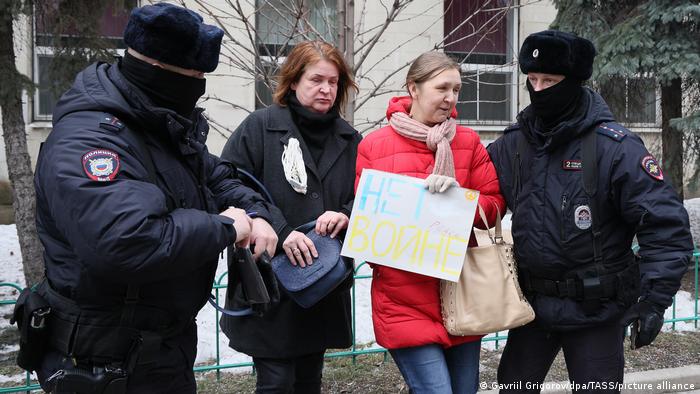

Protests in Moscow
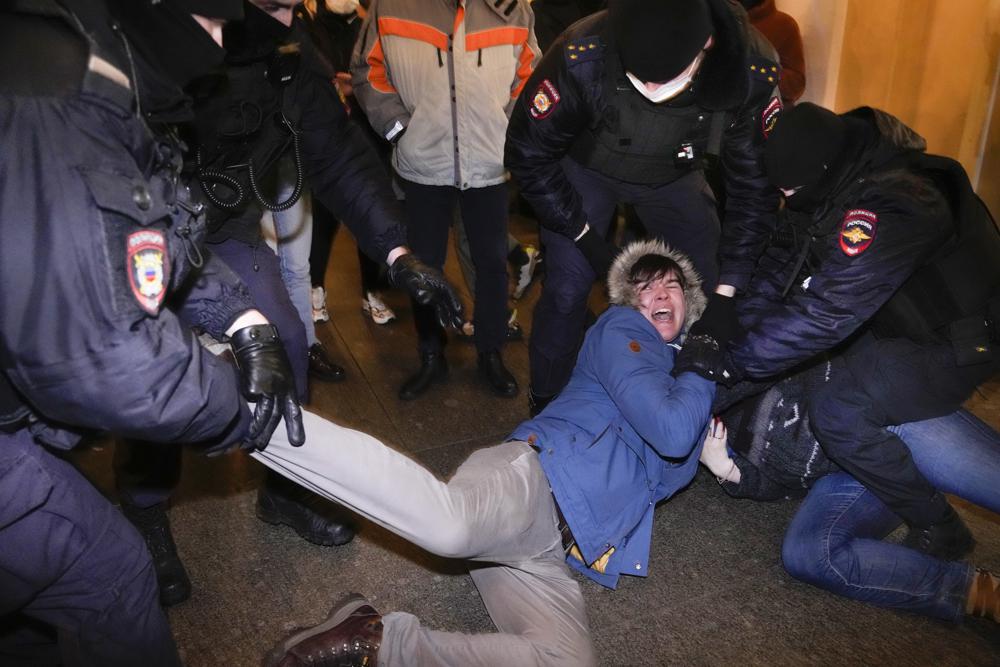
A few brave souls staged an anti-war protest in Moscow, outside the Ukrainian Embassy. Police forces were quick to arrest and whisk them away.
123456
DW

Hundreds arrested as shocked Russians protest Ukraine attack

By DASHA LITVINOVA

1 of 12
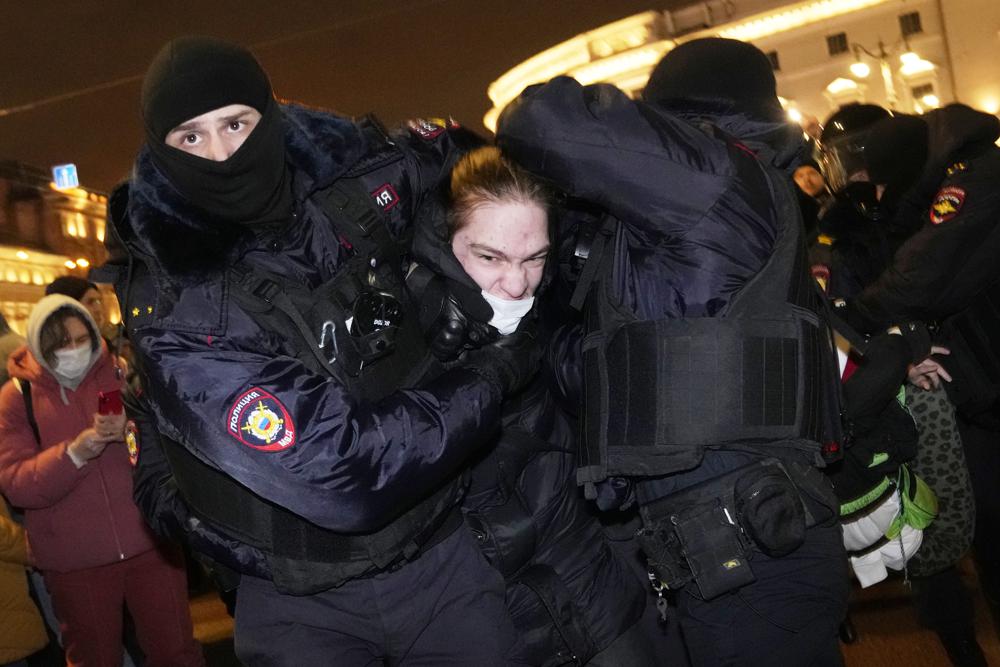
Police officers detain demonstrators in St. Petersburg, Russia, Thursday, Feb. 24, 2022. Hundreds of people gathered in Moscow and St.Petersburg on Thursday, protesting against Russia's attack on Ukraine. Many of the demonstrators were detained. Similar protests took place in other Russian cities, and activists were also arrested. (AP Photo/Dmitri Lovetsky)


MOSCOW (AP) — Shocked Russians turned out by the thousands Thursday to decry their country’s invasion of Ukraine as emotional calls for protests grew on social media. Some 1,745 people in 54 Russian cities were detained, at least 957 of them in Moscow.

Hundreds of posts came pouring in condemning Moscow’s most aggressive actions since the 1979 Soviet invasion of Afghanistan. Vladimir Putin called the attack a “special military operation” to protect civilians in eastern Ukraine from “genocide” — a false claim the U.S. had predicted would be a pretext for invasion, and which many Russians roundly rejected.

Tatyana Usmanova, an opposition activist in Moscow, wrote on Facebook that she thought she was dreaming when she awoke at 5:30 a.m. to the news, which she called “a disgrace that will be forever with us now.”

“I want to ask Ukrainians for forgiveness. We didn’t vote for those who unleashed the war,” she said.

As sirens blasted in Kyiv, Ukraine’s capital, and large explosions were heard there and in other cities, Russians were signing open letters and online petitions demanding the Kremlin halt the assault, which the Ukrainian health minister said had killed at least 57 Ukrainians and wounded dozens more.

“Public opinion is in shock, people are in shock,” political analyst Abbas Gallyamov told The Associated Press.

One petition, started by a prominent human rights advocate, Lev Ponomavyov, garnered over 150,000 signatures within several hours and more than 330,000 by the end of the day. More than 250 journalists put their names on an open letter decrying the aggression. Another one was signed by some 250 scientists, while 194 municipal council members in Moscow and other cities signed a third.

“I’m worried about the people very much, I’m worried to tears,” said Zoya Vorobey, a resident of Korolyov, a town outside Moscow, her voice cracking. “I’ve been watching television since this morning, every minute, to see if anything changes. Unfortunately, nothing.”

Several Russian celebrities and public figures, including some working for state TV, spoke out against the attack. Yelena Kovalskaya, director of a state-funded Moscow theater, announced on Facebook she was quitting her job, saying “it’s impossible to work for a killer and get paid by him.”

“I know that right now many of you feel desperation, helplessness, shame over Vladimir Putin’s attack on the friendly nation of Ukraine. But I urge you not to despair,” human rights activist Marina Litvinovich said in a video statement on Facebook, calling for mass protests Thursday evening.

“We, the Russian people, are against the war Putin has unleashed. We don’t support this war, it is being waged not on our behalf,” Litvinovich said.
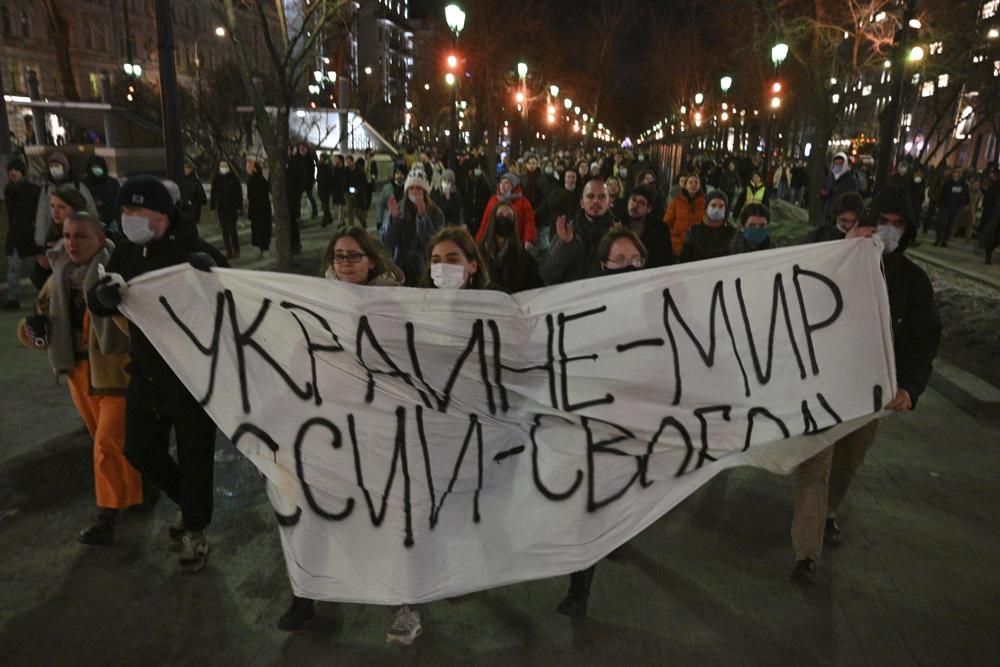
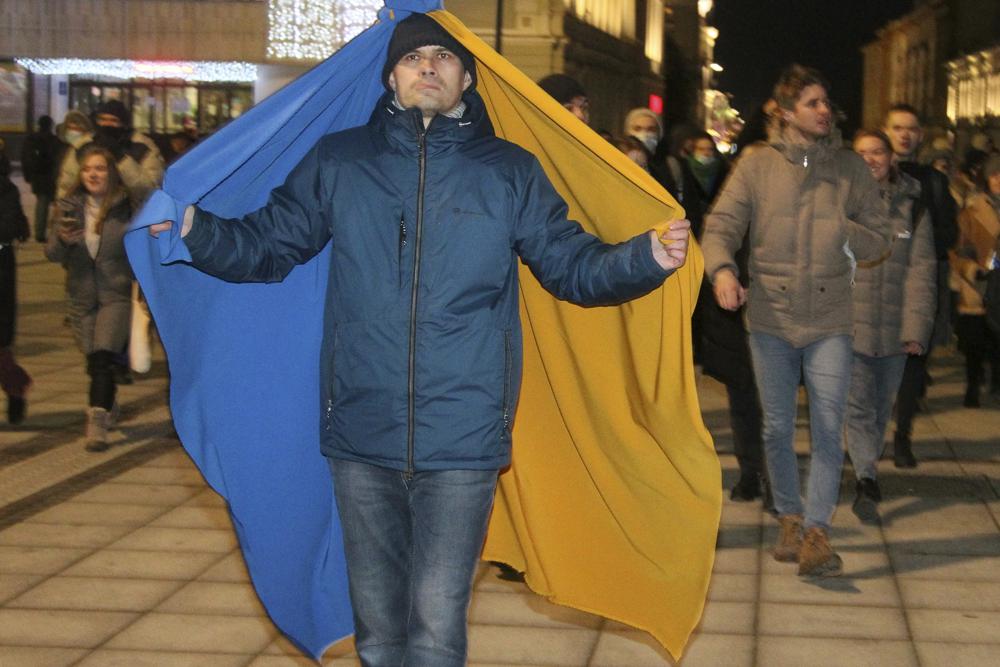

Demonstrators march with a banner that reads: "Ukraine - Peace, Russia - Freedom", in Moscow, Russia, Thursday, Feb. 24, 2022, after Russia's attack on Ukraine. Hundreds of people gathered in the center of Moscow on Thursday, protesting against Russia's attack on Ukraine. Many of the demonstrators were detained. Similar protests took place in other Russian cities, and activists were also arrested. (AP Photo/Dmitry Serebryakov)

But the authorities were having none of that.

In Moscow and other cities, they moved swiftly to crack down on critical voices. Litvinovich was detained outside of her residence shortly after posting the protest call. OVD-Info, a rights group that tracks political arrests, reported that 1,745 people in 54 cities had been detained by Thursday evening, at least 957 of them in Moscow.

Russia’s Investigative Committee issued a warning Thursday afternoon reminding Russians that unauthorized protests are against the law.

Roskomnadzor, state communications and media watchdog, demanded that Russian media use “information and data they get only from official Russian sources.” Some media reported that employees of certain state-funded companies were instructed not to comment publicly on the events in Ukraine.

Human rights advocates warned of a new wave of repression on dissent.

“There will be new (criminal) cases involving subverters, spies, treason, prosecution for antiwar protests, there will be detentions of journalists and bloggers, those who authored critical posts on social media, bans on investigations of the situation in the army and so on,” prominent human rights advocate Pavel Chikov wrote on Facebook.

“It is hard to say how big this new wave will be, given that everything has been suppressed already.”

Despite the pressure from the authorities, more than 1,000 people gathered in the center of Moscow Thursday evening, chanting “No to war!” as passing cars honked their horns.

Hundreds also took to the streets in St. Petersburg and dozens in Yekaterinburg.

“This is the most shameful and terrible day in my life. I even was not able to go to work. My country is an aggressor. I hate Putin. What else should be done to make people open their eyes?” Yekaterina Kuznetsova, 40-year-old engineer who joined the demonstration in St. Petersburg, told the AP.

Russia’s official line in the meantime remained intransigent. Speaker of the upper house of parliament, Valentina Matviyenko charged that those who spoke out against the attack were only caring about their “momentary problems.”

State TV painted the attack in line with what Putin said in his televised address announcing it.

Russia 1 TV host Olga Skabeyeva called it an effort “to protect people in Donbas from a Nazi regime” and said it was “without exaggeration, a crucial junction in history.”


AP writer Kirill Zarubin contributed to this report from Korolyov, Russia.


Sporting world reacts to Russia's invasion of Ukraine — live updates

Sport is utterly insignificant in the face of Russia's invasion of Ukraine. However, those connected with it are making their voices heard
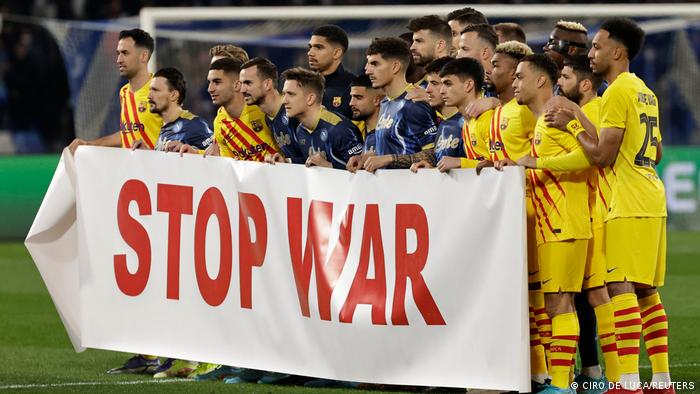

Barcelona and Napoli players hold up a banner with a clear message ahead of their game

  • Support and protest on show
  • F1 team makes livery changes
  • FIFA and DFL respond
  • Bayern basketball game postponed

Last updated: 2318 UTC

Support across football games

Ahead of Zenit's game in Seville, people have gathered outside the stadium to show their support for Ukraine. Zenit is owned and sponsored by the Russian state-owned energy giant Gazprom. Betis won the game and the tie, but only after Zenit had a last-minute goal ruled out by VAR.

Ahead of Barcelona's game against Napoli, the players of both teams came together to hold together a banner with a clear message. Barcelona beat Napoli to advance. Elsewhere, Borussia Dortmund were knocked out by Rangers.

Ahead of their Europa Conference League against Fenerbahce, Slavia Prague wore yellow jerseys with a message of support written on them.

Protest after goal

Atalanta's Ruslan Malinovskyi has just scored in the Europa League and celebrated by revealing a "No war in Ukraine" message written on the undershirt of the Ukraine international.

Meanwhile, UEFA have just confirmed that Zenit's game will go ahead. Interesting that, given the Euro League basketball games including Russian teams were postponed earlier.

F1 team announces livery changes

The Haas Formula 1 team has announced it will remove branding of title sponsor Uralkali, a Russian potash fertilizer producer and exporter, for tomorrow's final day of pre-season testing. The team will race in a plain white livery instead of the usual red, white and blue.

Uralkali is also part-owned by the father of Haas driver Nikita Mazepin.

DFL condems attacks

The DFL, the German football league, has released a statement condemning the Russian attack on Ukraine "in the strongest possible terms."

"War in any form is unacceptable – and incompatible with the values of sport. Our immediate concern is for the people affected in Ukraine. The DFL is in contact with the national and international associations regarding this matter."

FIFA respond to situation

FIFA boss Gianni Infantino has been speaking at a press conference tonight where he also announced the indefinite suspension of Kenya and Zimbabwe from world football due to government interference.

Here are some of his quotes on the situation in Ukraine:

On the Russian invasion:

"I was shocked by what I saw. I am worried and concerned by this situation. FIFA condemns the use of force by Russia in Ukraine and any type of violence to resolve conflicts. Violence is never a solution and FIFA calls on all parties to restore peace through constructive dialogue."

On his relationship with Putin and endorsing a World Cup in Russia:

"We are constantly reflecting on the role of sport in trying to bring people together in a peaceful environment. Today my thoughts are on all the people who are affected by this escalating conflict."

On World Cup games being moved from Russia:

"We have duty to look at this matter seriously, to analyse it. We will look at it as a matter of urgency. We hope the situation will be solved well before the first match (in a month)."

There was also this from AP Global Sports Reporter Rob Harris:

Europa League football

There are football games tonight though, including Zenit St. Petersburg who are playing in Seville against Real Betis in the Europa League. Last night, Benfica's Ukrainian Roman Yaremchuck protested after scoring a goal.

Bayern basketball postpone game

Bayern Munich were due to play CSKA Moscow in a big Euro League basketball game this evening, but the club has postponed the game after events today. Barcelona, the leading team in the tournament, have already stated they will not travel to St. Petersburg for their game vs. Zenit on Friday.

Brazilian players call for help

A number of Brazilian players attached to clubs in Ukraine have sent a heartfelt video plea to their government to help them escape.

More on this story here.

For older updates, please go to page two:

Pages 1 | 2 | Full article


War in Ukraine: 'People are packing up'

There is a sense of confusion and alarm in southern Ukraine as many people pack up their bags and stock up on food and fuel in case they need to flee, France 24's Catherine Norris Trent reports from the city of Zaporizhzhia.

Russia invades Ukraine — how the world reacted

Many world leaders, athletes, and stars have condemned Russian aggression against its neighbor. Read the latest here.
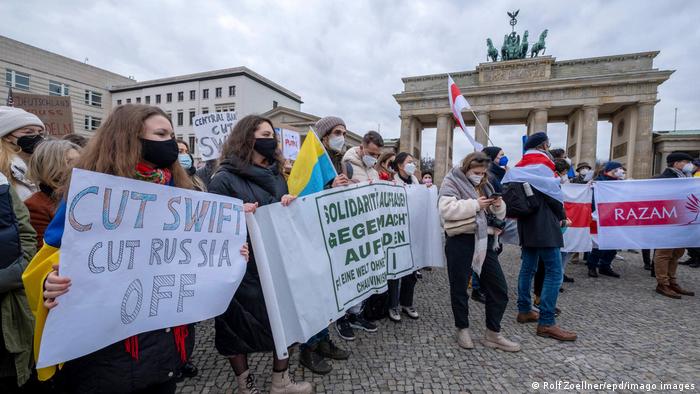

Protests against the invasion also took place in several countries on Thursday, including in central Berlin

European Commission President Ursula von der Leyen condemned on Thursday Russia's invasion of Ukraine, saying that "we will not let President Putin tear down Europe’s security architecture."

Von der Leyen also promised to level the harshest possible sanctions on Russian leaders and businesses, saying that "we will target strategic sectors of the Russian economy by blocking their access to key technologies and markets."

"In addition," she added, "we will freeze Russian assets in the EU and stop the access of Russian banks to the European financial market."

Here's how other leading figures reacted across the globe.

Europe

German Chancellor Olaf Scholz expressed solidarity with Ukrainians, saying the assault was completely without justification and calling it "Putin's war."

"It will be clear that Putin has made a terrible mistake by unleashing this war," Scholz said, adding that Russia would pay a "bitter price" for invading its neighbor, and that additional rounds of sanctions were already in the works.

Later on Thursday, Scholz addressed the nation, saying: "We are determined and acting as one. Therein lies ours strength as free democracies. Putin will not win."

Scholz added that "there is no going back in time to 1986," saying that Cold War politics, wherein large countries decided the fate of smaller ones, would not return. He said that Putin was trying to turn back the clock.

In a televised statement, French President Emmanuel Macron, who held talks with Putin just last week, said the attack represented a "turning point in European history" and, as a result, "there will be profound consequences for our continent and changes in our lives."

"We have tried everything to avoid this war but it is here and we are ready," Macron said. "We will show no weakness," he added. "We will take all measures necessary to defend the sovereignty and stability of our European allies."

British Prime Minister Boris Johnson said the UK would be stepping up its support to Ukraine in an address to the nation. He said Ukraine "is not some faraway country" and added, "we cannot and must not look away."

"I don't believe the Russian dictator will subdue the Ukrainians and their passionate belief that their country should be free," Johnson said.

The UK, like the US and EU, has already implemented a raft of sanctions

Asia and Middle East

Japan, which usually treads more lightly with Moscow than other G7 nations, said it would work with Western allies to counter Russian aggression.

At the same time, South Korea's President Moon Jae-in said that his country "supports and will join economic sanctions and other international efforts to deter the armed aggression and resolve the situation peacefully."

China, which often backs Moscow on the international stage, took a cautious line, not fully condemning Russia but calling for a "peaceful solution." Foreign Ministry spokesperson Hua Chunying said that "China did not wish to see what happened in Ukraine today."

India's Prime Minister Narendra Modi, who has been friendly with Putin in the past, said he spoke with the Russian president on the phone, and called for "an immediate cessation of violence" as well as "concerted efforts from all sides to return to the path of diplomatic negotiations and dialogue."

Although Iranian Foreign Minister Hossein Amirabdollahian blamed "NATO provocations" for the attack, he wrote on Twitter that it was "imperative to establish a cease fire and to find a political and democratic resolution."

Israel announced that it would accept all Ukranian refugees. Foreign Minister Yair Lapid condemned Russia’s actions, and said his country was "ready and prepared to provide humanitarian assistance to the citizens of Ukraine."

North America

In the United States, President Joe Biden said in speech that "we’ve been transparent with the world, we’ve shared intelligence…so there could be no confusion about what Putin is doing. Putin is the aggressor. Putin chose this war."

Biden then announced a new raft of sanctions, which targeted Russian banks and industry.

"We have purposely designed these sanctions to maximize the impact on Russia and minimize the impact on our allies…We are not acting alone. We have built a coalition representing half of world’s economy."

Canadian Prime Minister Justin Trudeau said that he "condemns in the strongest possible terms Russia's egregious attack on Ukraine." 

"Ukraine's sovereignty and territorial integrity must be respected and the Ukrainian people must be free to determine their own future," Trudeau said.

Society

Many celebrities, from horror novelist Stephen King to rapper Cardi B, also spoke out against the attacks. Formula One champions Sebastian Vettel and Max Verstappen said they would not participate in the Russian Grand Prix in September if it goes ahead under the current circumstances. 

Vettel said that "I’m sorry for the innocent people that are losing their lives, that are getting killed for stupid reasons and a very, very strange and mad leadership."

Several Russian celebrities, while not calling out Putin by name, condemned the war. Beloved television chat show host Ivan Urgant wrote "no to war" on his Instagram, under a post that was simply a black square. 

Maxim Galkin, a comedian, musician and husband of megastar Alla Pugacheva, also posted a black square, saying "no to war!"

Russian chess Grandmaster turned Putin critic Garry Kasparov also joined in the online condemnation, calling on allies to "support Ukraine" and "bankrupt Putin's war machine." He also called out former German Chancellor Gerhard Schröder, who works for Russian state oil giant Gazprom, saying that charges should be brought against him.


THE WAR IN UKRAINE THIS

MORNING 

Some of the most striking images coming out of Ukraine after Russian troops launched a wide-ranging attack on the country on Thursday, invading from the south, north and east and carrying out strikes on army installations and infrastructure across several cities. 

Ukraine: The speech that launched war in Europe

Unfounded accusations of genocide, comparisons to the Nazis and a chilling warning to Ukraine's allies: A closer look at Russian president Vladimir's address early Thursday morning in which he announced Russia's invasion of Ukraine.
Putin's threat to the world grows — and much of our news media is not up to the challenge

Brian Karem, Salon
February 24, 2022

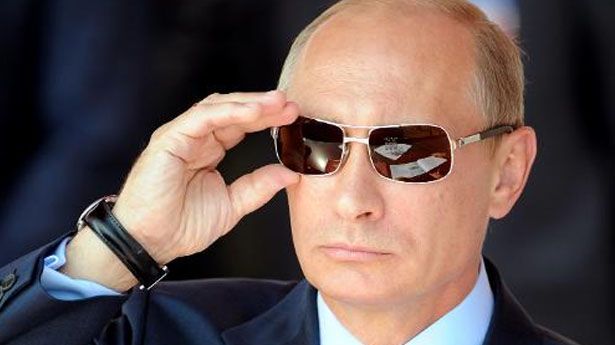
Russian Prime Minister Vladimir Putin adjusts his sunglasses (AFP)

I think "The Golden Girls" puppet show may hold the key to our future.

But first, the past, when we thought we might not have a future: Once a month when I was an elementary school student our school conducted "disaster" drills. This was different from our monthly fire drills. To practice for a school fire, when the warning bell sounded we all gathered together and walked single file out of the school, quickly and quietly. More than a few of us, while standing outside waiting for the all clear, gleefully imagined our schools burning down as we watched.

The disaster drills were quite different. When the alarm sounded for a disaster drill we walked into the hall single file, sat against the wall with our legs crossed and were told to "duck and cover." The disasters we were told we prepared for were tornadoes and/or nuclear war.

RELATED: This is what would happen to Earth if a nuclear war broke out between the West and Russia

The idea of protecting yourself from a nearby nuclear explosion seems quaint or futile today. For those of us who came of age in those times, there's no way to adequately explain our fear that the Soviet Union and the United States would destroy themselves in a paroxysm of nuclear violence, ending life as we knew it on our planet.

This fear culminated in the arrival of Ronald Reagan to the Oval Office. Reagan, a hardcore Cold Warrior, involved the world in nuclear brinkmanship. Previously, the Soviet Union and the United States had exercised nuclear restraint under the Mutually Assured Destruction (or MAD) policy: If anyone started a nuclear war, we would all die. Reagan changed that. He and his administration became convinced a nuclear war was winnable, which Robert Scheer wrote about in explicit detail in his 1982 book, "With Enough Shovels: Reagan, Bush and Nuclear War."
ADVERTISEMENT

"Dig a hole, cover it with a couple of doors and then throw three feet of dirt on top . . . it's the dirt that does it . . . if there are enough shovels to go around everybody's going to make it," T.K. Jones, Deputy Under Secretary of Defense for Strategic and Theater Nuclear Forces, infamously declared.

As a young adult, I was terrified. My girlfriend (now my wife of 39 years) and I wondered if we should bring children into this world. The watershed event of that extremely fearful time was an ABC broadcast in 1983, "The Day After," starring Jason Robards, Steve Guttenberg, John Lithgow and JoBeth Williams. That television movie explicitly showed us for the first time what would happen as a result of nuclear war. More than 100 million Americans watched that original broadcast on November 20, 1983. It remains the most watched TV movie in U.S. history.

A special edition of "View Point" hosted by Ted Koppel aired directly after the movie. It began with Koppel telling American viewers to look out their window. "It's all still there," he reassured us. "Is there still time?" Koppel then asked, wondering as Scrooge did in "A Christmas Carol" if the movie we just saw depicted a future that would be, or only may be. He was joined by a live audience, as well as Henry Kissinger, Elie Wiesel, William F. Buckley Jr., General Brent Scowcroft and Robert McNamara, who had written earlier that year that "nuclear weapons are totally useless except only to deter one's opponent from using them." Also joining them was scientist Carl Sagan.

That night Sagan introduced the world to the concept of nuclear winter. Of the Cold War pitting the U.S. against the U.S.S.R, he famously said, "Imagine a room awash in gasoline, and there are two implacable enemies in that room. One of them has 9,000 matches, the other 7,000 matches. Each of them is concerned about who's ahead, who's stronger."

Some argued later that the movie — and, more importantly, Koppel's frank discussion — seen by millions led to a walk away from nuclear brinkmanship. A little more than five years later the Cold War was over. The Berlin Wall came down and the world took a breath. It was at that time my wife and I had our first child. We had delayed, in part, because we didn't want our children to live in the same world in which we grew up.

For more than 30 years thoughts of an apocalypse caused by nuclear conflagration have taken a back seat to climate change, a stray asteroid, a rogue comet, a pandemic or a variety of other extinction level events.

Then Tuesday, a young reporter who frequents the White House texted me and asked if I was worried about World War III. Another reporter asked me if I thought we could survive it. I confess I hadn't thought of such scenarios in years. But Russian President Vladimir Putin, a former KGB officer with delusions of grandeur, has ordered "a special military operation" on Ukraine. That renewed thoughts I had buried for more than three decades.

The equation remains fundamentally unchanged from 1983. Both countries have arsenals that would render Earth a glowing radioactive hellhole long enough to extinguish all life on the planet. The only people who wouldn't have to worry about the initial blast would be any astronauts in space. But they'd have no home to return to.

Biden knows all of this. Yet, the news we get about Ukraine and from reporters is often lacking in political and historical context, distorts reality and contributes to the potential for a widening conflict. It helps no one that former President Trump publicly sided with Putin, thus further driving a wedge in the American electorate as Biden tries to stop a war.

RELATED: U.S.-Russia confrontation over Ukraine threatens to become all-out war — but why?

There are several things to consider. Could Putin's game in Ukraine lead to a shooting war that includes the U.S.? Could that lead to a nuclear confrontation? The answer to both questions is undeniably yes. Biden knows this too and is playing a long game of slowly strangling the Russian economy with sanctions to halt the threat of expanded war. Putin, who put off his provocative moves until after the Beijing Winter Olympics, is counting on China to be his ally and bail him out with essential raw materials the rest of the world has promised to deny Russia through sanctions. If Putin advances no further than Ukraine on the battlefield it will be a matter of who will blink first. Biden, who knows very well the consequences of the Cold War and how Putin wishes to change the outcome, is also well aware of how quickly things can escalate. Yet, there are still U.S. and NATO troops in close proximity to Ukraine, and Biden has vowed to defend NATO.

In "The Hunt for Red October," former Congressman Fred Thompson, also an actor, played an admiral who summed it up nicely. "This business will get out of control. It will get out of control and we'll be lucky to live through it," he warned. An even more ominous warning was issued by Richard Jordan's Jeffrey Pelt to his Soviet ambassador counterpart: Having our troops and their troops in such close proximity was inherently dangerous. "Wars are started that way," he finished.

That's the rub. Volatility on the battlefield is rarely controllable. Escalation is not only possible but probably inevitable under such circumstances — and playing "chicken," as Putin is doing, rarely goes as intended. Make no mistake, Biden knows what he's doing and deserves our full faith. Dealing with Putin is well within his wheelhouse.

Today's problems are exacerbated by Donald Trump, who called the annexation of Ukrainian breakaway regions "genius" on the part of Putin. Naturally those who still look at Trump as their messiah are calling Biden "a loser" and "asleep at the wheel."

The only way to clean up that part of the equation is with better information, which could also lead to better policy, more accurately informed Americans and eventually — one would hope — better informed politicians. (Trump not withstanding.)

Today's Ukrainian conflict is also exacerbated by the ignorance of those who embolden Putin by supporting Trump. Or as one Christian Trump supporter told me, "It's not our problem. We have enough problems with sleepy Joe," he said, channeling the spirit of Neville Chamberlain.

Which brings me back to "The Golden Girls." I was never a fan of the show, but my wife was, so when "That Golden Girls Show!," a parody with puppets, opened at the Strathmore in D.C., I was obliged to go. I marveled at how a sitcom more than 35 years old is still so popular. And as I watched, I wondered why original ideas weren't nearly as popular. After all, "The Golden Girls" was once an original idea and it obviously caught on and even endured — even NFL players like Buffalo Bills wide receiver Stefon Diggs is clearly a huge fan. I looked around for him Tuesday, and while I didn't see him, I was impressed with the diversity of the audience in the theater. Two guys with MAGA hats sitting in that crowd made me think.

And that took me back to something said by Edward R. Murrow at the Radio Television News Directors Association annual meeting in 1958. "We are to a large extent an imitative society. If one or two or three corporations would undertake to devote just a small fraction of their advertising appropriation along the lines that I have suggested, the procedure might well grow by contagion . . ." Murrow was discussing the need for large corporations to invest in producing solid news and delivering it to the American public.

That's what the crisis in Ukraine underlines in today's news and political world: There are millions who don't remember what the Cold War was like, the threat to our survival Russian aggression presents, and how one madman like Putin could bring it all down.

You heard it here first: "The Golden Girls" could save the planet. If one sitcom can survive and be so popular that a puppet show about the original show can sell out theaters, just imagine what one network or newspaper dedicated to real journalism could do for us all. Maybe Murrow was right about us being an imitative society. If one network did it and it caught on then others might follow.

At least if some in the news industry were as bold as the producers of a puppet show, we'd have a fair chance of understanding actual threats to our existence — like Putin or Trump — when they show up on the world stage.

Putin is essentially trying to rewrite the end of the Cold War. That's another lesson to be learned by TV: Reruns don't change. Putin just needs to watch more "Golden Girls." Maybe he'll get the message.
Putin's Ukraine war declaration was prerecorded 3 days prior to its release: independent Russian paper

Matthew Chapman
February 24, 2022

Vladimir Putin (Shutterstock)


On Thursday, The Daily Beast flagged that Novaya Gazeta, one of the few independent newspapers in Russia, has shared evidence that Vladimir Putin's announcement declaring war on Ukraine was filmed three days before the announcement was actually aired — yet more evidence that the conflict and the justifications for it were carefully scripted and planned by the Kremlin.

"The newspaper, whose editor-in-chief shared last year’s Nobel Peace Prize, published on its Twitter feed what it said was metadata from the Kremlin website showing that the video was recorded on Feb. 21 at 7 p.m. Moscow time," reported Philippe Naughton. "Separately, the Russian-based Conflict Intelligence Team pointed out that Putin was wearing the exact same suit and tie in Thursday’s broadcast as he wore when he announced that Russia was to recognize two breakaway regions in eastern Ukraine — the prelude to all-out war."


Russia's invasion of Ukraine, ostensibly to protect Russian-backed separatists who have declared two so-called "independent republics" in the east of the country, has moved blindingly fast, with gunfire and shelling already reported near the capital city of Kyiv.

Counter-corruption adviser to Congress reveals list of 'US lobbyists serving Putin'

Sarah K. Burris
February 24, 2022

Russian President Vladimir Putin attends a meeting of the presidential rights council via a video link on December 9, 2021. Mikhail Metzel SPUTNIK/AFP

Counter-corruption adviser to Congress Paul Massaro posted a list showing the American lobbying firms that he says are "serving Putin.

The list ranges from those dealing with trade and stock to global finances.

Massaro has urged strict sanctions that go into the heart of every possible financial tie to Moscow, even if they're front companies.

The US and UK have announced some preliminary sanctions. The EU is anticipated to take steps too, which could help target the oligarchs with money stashed through European banks.

Massaro wants to see the UK target the oligarchs, however, which some believe would put increased pressure on Putin.

Ukraine's Foreign Affairs Minister Dmytro Kuleba has said that "severe sanctions" are needed.


'Putin has stopped pretending': Political scientist warns autocrats are brazenly 'trying to remake the world in their image'

Alex Henderson, AlterNet
February 24, 2022

Annual Direct Line with Vladimir Putin in Moscow - Russian President Vladimir Putin speaks during his annual "Direct Line with Vladimir Putin" live call-in show. - -/Kremlin/dpa

When far-right Donald Trump supporters viciously attacked the U.S. Capitol Building on January 6, 2021 — some of whom set up a hangman’s gallows for then-Vice President Mike Pence outside — people all around the world asked, “If democracy isn’t safe in the United States, where it is safe?” And as MAGA Republicans in state legislatures introduce one draconian voter suppression bill after another, it is painfully obvious that many of them believe the U.S. should move in the direction of authoritarians like Hungarian Prime Minister Viktor Orbán and Russian President Vladimir Putin — both of whom are openly admired by Trump and Fox News’ Tucker Carlson, even as Russian forces invade Ukraine.

Democracy is under assault all over the world, from the U.S. to Brazil to Eastern Europe. Journalist and political scientist Yascha Mounk examines the growth of authoritarianism in a disturbing article published by The Atlantic on February 24. And Mounk, a native of Munich, Germany and senior fellow at the Council on Foreign Relations, warns that the world finds itself in an increasingly dangerous position.

“Vladimir Putin has stopped pretending,” Mounk laments. “For months, the Russian president had claimed that he was merely interested in the security of his nation…. Then, he ordered a full-scale attack on a sovereign nation. Russian missiles blew up targets in key cities, including Kyiv, Lviv, and Kharkiv. Russian troops rapidly advanced into Ukrainian territory. War has returned to the heart of Europe.”

Mounk covers a lot of ground in his article, from Russia’s invasion of Ukraine to the January 6, 2021 insurrection to the military junta in Myanmar — describing all of those things as examples of authoritarianism continuing to advance.

“The attack on Ukraine coincided with the long-planned publication of a Freedom House report on the state of democracy in the world,” Mounk observes. “As this year’s report went live on the organization’s website, just after midnight this morning, CNN was showing live pictures of Russian troops advancing across the border and billowing towers of smoke rising above major Ukrainian cities. Based on meticulous monitoring of developments in every corner of the globe, Freedom House finds that the world has entered the 16th consecutive year of what the political scientist Larry Diamond has termed a ‘democratic recession.’”

Describing Freedom House’s findings, Mounk offers a lot of reasons to be worried.

“In 2021, the number of countries moving away from democracy once again exceeded the number of countries moving toward it by a big margin,” Mounk notes. “Democratic institutions and civil rights deteriorated in 60 countries, with Afghanistan, Nicaragua, Tunisia, and Sudan experiencing especially precipitous declines. At the beginning of the democratic recession, about half of the world’s population lived in a country classified as ‘free.’ Now, only two out of every ten people do.”

“Assaults on democracy,” Mounk warns, have “grown much more brazen.”

“Many democracies are now rife with acrid divisions and face domestic challenges to their stability; this strain on democratic institutions is especially pronounced in the United States,” Mounk observes. “And the power of the democratic world is being challenged by a rising China and a revanchist Russia; the world’s dictators can turn to resurgent authoritarian regimes for economic investments, military supplies and international legitimacy.”

Mounk continues, “All of this helps explain why the world’s dictators are taking off their masks. Autocratic leaders, from Myanmar to Nicaragua, no longer feel constrained by the need to maintain some semblance of democratic legitimacy or appease the State Department. And those dictators, like Vladimir Putin, who also have significant military might at their disposal, are now trying to remake the world order in their image.”
A historian corrects misunderstandings about Ukrainian and Russian history

The first casualty of war, says historian Ronald Suny, is not just the truth. Often, he says, “it is what is left out.”

The Conversation
February 24, 2022

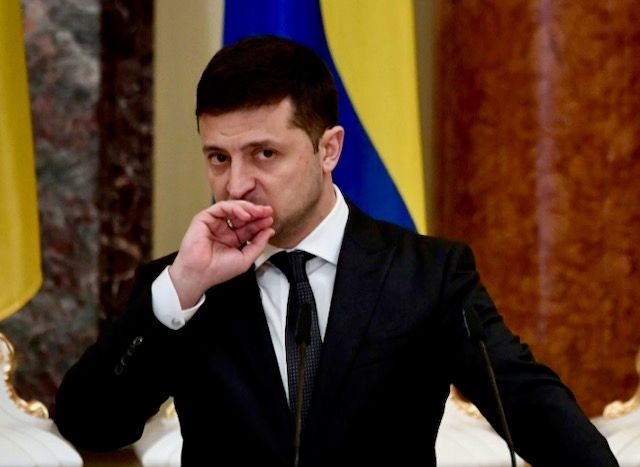
Ukraine's President Volodymyr Zelensky AFP/File / Sergei SUPINSKY

Russian President Vladimir Putin began a full-scale attack on Ukraine on Feb. 24, 2022 and many in the world are now getting a crash course in the complex and intertwined history of those two nations and their peoples. Much of what the public is hearing, though, is jarring to historian Suny’s ears. That’s because some of it is incomplete, some of it is wrong, and some of it is obscured or refracted by the self-interest or the limited perspective of who is telling it. We asked Suny, a professor at the University of Michigan, to respond to a number of popular historical assertions he’s heard recently.
Putin’s view of Russo-Ukrainian history has been widely criticized in the West. What do you think motivates his version of the history?

Putin believes that Ukrainians, Belarusians and Russians are one people, bound by shared history and culture. But he also is aware that they have become separate states recognized in international law and by Russian governments as well. At the same time, he questions the historical formation of the modern Ukrainian state, which he says was the tragic product of decisions by former Russian leaders Vladimir Lenin, Josef Stalin and Nikita Khrushchev. He also questions the sovereignty and distinctive nation-ness of Ukraine. While he promotes national identity in Russia, he denigrates the growing sense of nation-ness in Ukraine.

Putin indicates that Ukraine by its very nature ought to be friendly, not hostile, to Russia. But he sees its current government as illegitimate, aggressively nationalist and even fascist. The condition for peaceful relations between states, he repeatedly says, is that they do not threaten the security of other states. Yet, as is clear from the invasion, he presents the greatest threat to Ukraine.

Putin sees Ukraine as an existential threat to Russia, believing that if it enters NATO, offensive weaponry will be placed closer to the Russian border, as already is being done in Romania and Poland.

It’s possible to interpret Putin’s statements about the historical genesis of the Ukrainian state as self-serving history and a way of saying, “We created them, we can take them back.” But I believe he may instead have been making a forceful appeal to Ukraine and the West to recognize the security interests of Russia and provide guarantees that there will be no further moves by NATO toward Russia and into Ukraine. Ironically, his recent actions have driven Ukrainians more tightly into the arms of the West.
The Western position is that the breakaway regions Putin recognized, Donetsk and Luhansk, are integral parts of Ukraine. Russia claims that the Donbass region, which includes these two provinces, is historically and rightfully part of Russia. What does history tell us?

During the Soviet period, these two provinces were officially part of Ukraine. When the USSR disintegrated, the former Soviet republic boundaries became, under international law, the legal boundaries of the post-Soviet states. Russia repeatedly recognized those borders, though reluctantly in the case of Crimea.

But when one raises the fraught question of what lands belong to what people, a whole can of worms is opened. The Donbass has historically been inhabited by Russians, Ukrainians, Jews and others. It was in Soviet and post-Soviet times largely Russian ethnically and linguistically. When in 2014 the Maidan revolution in Kyiv moved the country toward the West and Ukrainian nationalists threatened to limit the use of the Russian language in parts of Ukraine, rebels in the Donbas violently resisted the central government of Ukraine.

After months of fighting between Ukrainian forces and pro-Russian rebel forces in the Donbas in 2014, regular Russian forces moved in from Russia, and a war began that has lasted for the last eight years, with thousands killed and wounded.

Historical claims to land are always contested – think of Israelis and Palestinians, Armenians and Azerbaijanis – and they are countered by claims that the majority living on the land in the present takes precedence over historical claims from the past. Russia can claim Donbass with its own arguments based on ethnicity, but so can Ukrainians with arguments based on historical possession. Such arguments go nowhere and often lead, as can be seen today, to bloody conflict.

Why was Russia’s recognition of Donetsk and Luhansk People’s Republics as independent such a pivotal event in the conflict?

When Putin recognized the Donbass republics as independent states, he seriously escalated the conflict, which turned out to be the prelude to a full-scale invasion of Ukraine. That invasion is a hard, harsh signal to the West that Russia will not back down and accept the further arming of and placing of weaponry in Ukraine, Poland and Romania. The Russian president has now led his country into a dangerous preventive war – a war based on the anxiety that sometime in the future his country will be attacked – the outcome of which is unpredictable.

A New York Times story on Putin’s histories of Ukraine says “The newly created Soviet government under Lenin that drew so much of Mr. Putin’s scorn on Monday would eventually crush the nascent independent Ukrainian state. During the Soviet era, the Ukrainian language was banished from schools and its culture was permitted to exist only as a cartoonish caricature of dancing Cossacks in puffy pants.” Is this history of Soviet repression accurate?

Lenin’s government won the 1918-1921 civil war in Ukraine and drove out foreign interventionists, thus consolidating and recognizing the Ukrainian Soviet Socialist Republic. But Putin is essentially correct that it was Lenin’s policies that promoted Ukrainian statehood within the USSR, within a Soviet empire, officially granting it and other Soviet republics the constitutional right to secede from the Union without conditions. This right, Putin angrily asserts, was a landmine that eventually blew up the Soviet Union.

NOT JUST THE UKRAINE THIS WAS THE ERA OF THE STALIN PURGES ACROSS THE USSR
But under Stalin, Ukrainian language and culture began to be powerfully undermined. This started in the early 1930s, when Ukrainian nationalists were repressed, the horrific “Death Famine” killed millions of Ukrainian peasants, and Russification, which is the process of promoting Russian language and culture, accelerated in the republic.

Within the strict bounds of the Soviet system, Ukraine, like many other nationalities in the USSR, became a modern nation, conscious of its history, literate in its language, and even in puffy pants permitted to celebrate its ethnic culture. But the contradictory policies of the Soviets in Ukraine both promoted a Ukrainian cultural nation while restricting its freedoms, sovereignty and expressions of nationalism.

History is both a contested and a subversive social science. It is used and misused by governments and pundits and propagandists. But for historians it is also a way to find out what happened in the past and why. As a search for truth, it becomes subversive of convenient and comfortable but inaccurate views of where we came from and where we might be going.

Ronald Suny, Professor of History and Political Science, University of Michigan

This article is republished from The Conversation under a Creative Commons license. Read the original article.

How Russia’s recognition of breakaway parts of Ukraine breached international law – and set the stage for invasion

The Conversation
February 24, 2022

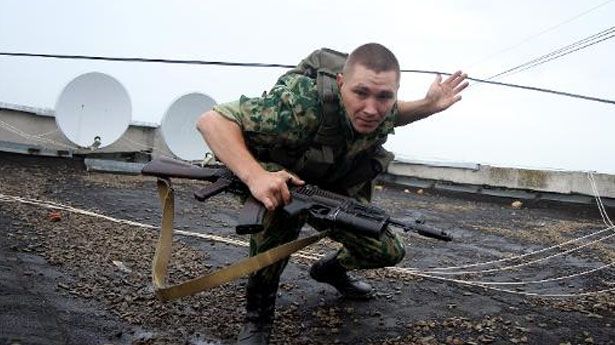
A pro-Russia militant shoots from a roof of a residential building in Ukraine (AFP)

Before Russia began its invasion of Ukraine, it “recognized” two parts of eastern Ukraine as sovereign states: the so-called people’s republics of Donetsk and Luhansk. That recognition is now central to what both Russia and the West are saying about the invasion.

Why does this kind of state recognition matter so much, and how does it challenge international law?
The international law on statehood

International law has rules about what qualifies as a state – and thus what entities get the many rights that follow from statehood. The rules are a compromise between two approaches.

One approach is hard-headed realism. This says we should acknowledge whoever has control on the ground, even if they are lawbreakers or dictators rather than democrats.

The general rule about statehood is that states must meet requirements of effectiveness. The Montevideo Convention of 1933 lists these: population, territory, government and a “capacity to enter into relations with the other states”.

The last requirement can also be described as independence.

The Donetsk and Luhansk republics have probably never had enough independence to qualify as states. For one thing, Ukraine did not give up disputing the territory. For another thing, they have always depended on Russia rather than being truly independent.

But that is not the only problem with them.

The other approach that shapes the law of statehood is the idealism enshrined in the United Nations Charter. One of the rules in the charter, which became binding international law in 1945, is states must not use military force against other states (except defensively or if the UN Security Council authorizes it).

This underpins an exception to the general rule. A territory cannot qualify as a state if it was created by illegal military force. And it appears the creation of these two republics in eastern Ukraine in 2014 – and their continued survival – was made possible by illegal Russian military support.


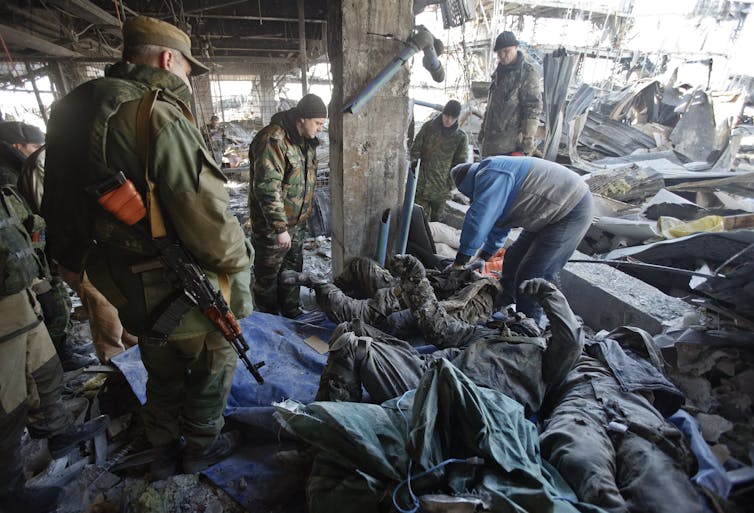
Russian-backed separatists stand next to the bodies of Ukrainian servicemen amid the rubble of the airport in Donetsk in 2015.
Vadim Ghirda/AP

Illegal recognition


Since the Donetsk and Luhansk republics are not states in international law, the territory remains under Ukraine’s sovereignty. By recognizing them, Russia denied this sovereignty in a fundamental way. The international lawyer and judge Hersch Lauterpacht called recognition in this situation “an international delinquency”.

In other words, it is illegal. Many states have pointed this out, including the United States and Australia.

This situation used to happen more often. In 1903, the US recognized part of Colombia as the new state of Panama so that Americans could build a canal there. In 1932, Japan recognized part of northeast China as the new state of Manchukuo, which was a Japanese puppet.

What has changed, since 1945, is the rule in the UN Charter against the use of military force by one state against another. That raises the stakes because illegal state recognition can be used to justify an illegal invasion.

The recognition opens up new arguments for Russia

That is exactly what has happened here. As soon as Russia recognized the Donetsk and Luhansk republics, they invited Russian troops onto “their” territory as “peacekeepers”. But it was still Ukraine’s territory, not theirs. And that made the troops invaders, not peacekeepers.

The value of the recognition to Russia is that the invasion looked a little less brazen.

If the two republics genuinely were sovereign states, it would be within their rights to invite the Russian troops, just as other states are free to host US troops. On that premise, Russia can tell its own people and anyone else who will listen that it acted legally.

Some further arguments are now also open to Russia, again based on the incorrect premise that the two republics are states. The Donetsk and Luhansk republics both claim additional Ukrainian territory that they do not control. Russia can now use these claims as a pretext for invading deeper into Ukraine.

We can get insights into what Russia might do from what it has done in the past.

In 2008, Russia recognized two breakaway parts of Georgia as states – Abkhazia and South Ossetia. It still militarily occupies them.

In 2014, Russia recognized a different part of Ukraine – Crimea – as a new state. In this case, Russia went further than military occupation. The so-called republic of Crimea was uncannily short-lived. Within two days, it held a disputed referendum and signed a “treaty” to become part of Russia.


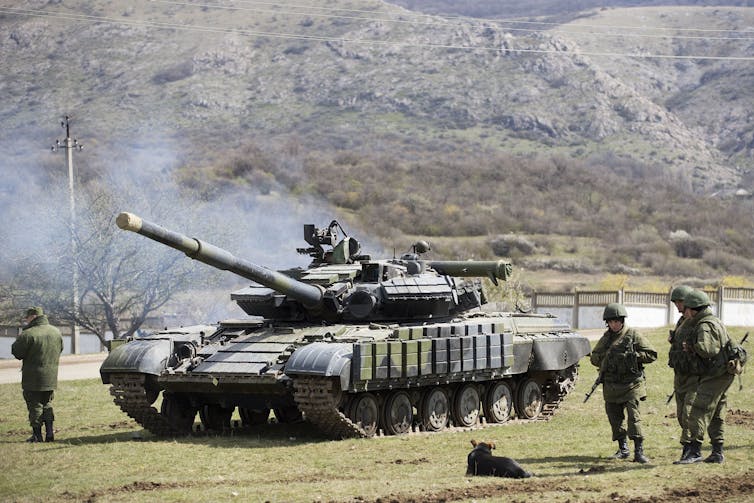
Russian soldiers at a former Ukrainian military base in Crimea after the territory’s annexation by Russia.Pavel Golovkin/AP

Russia’s challenge to international law

Russia is not the only state to illegally invade another in recent decades. It is not even the only great power. The US invasion of Iraq in 2003 was widely condemned as illegal, too.

One difference may be that Russia is challenging the law in a more sustained, systematic way that makes democratic states fearful. But it is not quite accurate to say Russia wants to return the world to how it was before 1945. It has not repudiated the UN Charter.

On the contrary, at least for the time being, it is cloaking some of its illegal behavior in language from international law. That was what recognizing the two republics was about.

But it wants a world in which, for Russia, the flimsiest cloak of legal language is enough.

Rowan Nicholson, Lecturer in Law, Flinders University

This article is republished from The Conversation under a Creative Commons license. Read the original article.
Bangui hails Russian 'saviours' of battered C. Africa


The 'Russian monument' in Bangui 
(AFP/Carol VALADE)
A man at the 'Russian Monument' offers his support to Vladimir Putin's policy in Ukraine (AFP/Carol VALADE)

Thu, February 24, 2022

Russia has been branded a pariah for invading Ukraine, but in the remote Central African Republic, the country has fans -- supporters who say its paramilitaries "saved" their war-torn country.

Beneath a statue of Russian fighters protecting a woman and her children, civilians joined a military tribute in Bangui on Wednesday to thank Russians who 14 months ago helped prevent a takeover by armed rebels.

The "Russian monument," as the people of the capital call it, stands in a square of reddish clay earth near the university.

About a hundred people of all ages waved Russian and CAR flags before troops from an elite unit and figures close to the government.

Some held up banners and signs proclaiming "Central Africans with Russia" and even "Russia will save the Donbass from war" -- a reference to the Ukrainian territory that President Vladimir Putin cited as justification for Thursday's attack.

In December 2020, as elections loomed, a coalition of armed groups advanced on Bangui, prompting President Faustin Archange Touadera to appeal to the Kremlin for help under bilateral accords.

Russia sent hundreds of paramilitaries to the deeply poor and landlocked country, where they joined others who had been present for three years. Rwanda also sent a military contingent.

In a few months, with Russian backing, the CAR's ill-equipped and poorly-trained army drove back rebels who had occupied two-thirds of the CAR's territory.

Today, government forces have regained control over the major cities -- the immediate crisis is over, although the threat of violence remains.

The rebels have scattered into the countryside, where they launch attacks on the security forces and civilians.


- 'Wagner' controversy -

Russia describes its personnel as "unarmed instructors," but the UN and France -- CAR's colonial power and traditional ally -- say they are from Wagner, a private and unaccountable security firm.

The help has come at a cost, for the operatives have been accused of extrajudicial killings and other abuses.

Last year, a group of UN experts denounced abuses committed against civilians by the CAR armed forces and their Russian allies.

And on Tuesday, France and the United States alleged at the UN Security Council on Tuesday that Wagner "mercenaries" killed dozens of civilians last month.

In July 2018, three Russian journalists investigating Wagner's activities in the CAR were ambushed and killed.


- 'Real peace' -


Inaugurated by Touadera with great fanfare in December as a "tribute to the Russian armed forces and fighters," the statue bears no inscription.

"The Russians have always been there on our side," claimed Yefi Kezza, a member of Touadera's United Hearts Movement (MCU) and also of the National Galaxy Platform, which organised the tribute and vilifies France and the UN.

"The Russians came and did a remarkable job to liberate the Central African people," added Blaise-Didacien Kossimatchi, another member of the National Galaxy Platform.

Several demonstrators sported T-shirts stamped "I am Wagner," identifying with the controversial security firm which supports the Kremlin's interests -- with deniability.

Soldiers of the 6th Territorial Infantry Battalion, an elite unit of the Central African Armed Forces (FACA), snapped to attention for the CAR national anthem.

Their commander laid a wreath at the foot of the statue in hommage to the "Defenders of the Fatherland."


None of the Russian paramilitaries or diplomats who usually attend such events was to be seen, however.

"The peace that the FACA and the Russians have brought us is truly the peace of God," announced one speaker at the microphone, rousing cheers from the crowd.

"What interests us is to have real peace," said Nelson Ezechiel Yangelema, a first-year student in the faculty of science.

"The Russians must still give the CAR a helping hand."

cv-dyg-gir/nb/bsp/ri
France violated rights of children held in 'inhuman' Syria camps, UN watchdog says


France has violated the rights of French children by leaving them for years in inhuman and life-threatening conditions in Syrian camps for family members of suspected jihadists, a UN watchdog said Thursday.

The UN child rights committee ruled that "France has the responsibility and power to protect the French children in the Syrian camps against an imminent risk to their lives by taking action to repatriate them."

It stressed in a statement that "the prolonged detention of the child victims in life-threatening conditions also amounts to inhuman and degrading treatment or punishment."

The committee, whose 18 independent experts are tasked with monitoring the implementation of the Convention on the Rights of the Child, issued its findings after considering three cases involving 49 French children held in Kurdish-controlled camps in Syria's northeast.

Relatives of suspected jihadists, including children, are kept in a number of camps in the region, the largest of which is Al-Hol with around 56,000 displaced people and refugees.

Repeated calls for Western countries to repatriate their nationals have largely fallen on deaf ears.

"The children are living in inhuman sanitary conditions, lacking basic necessities including water, food and health care, and facing an imminent risk of death," committee member Ann Skelton warned.

"The situation is therefore extremely urgent."

She pointed out that at least 62 children have reportedly died in the camps due to these conditions since the start of 2021.
'War-like zone'

The French cases were brought by a group of French nationals on behalf of their grandchildren, nieces and nephews -- some as young as five -- long stuck in the camps.

Some of the children were born in Syria, while others were brought there by their French parents at a very young age.

Their parents are alleged to have collaborated with the Islamic State group.

Since their relatives took their cases to the committee in 2019, the French government has repatriated 11 of the children.

The remaining 38 -- some as young as five years old -- are still being detained in the "closed camps in a war-like zone", the committee said.

Its statement said France had "not shown that it gave due consideration to the best interests of the child victims when assessing their relatives' requests for repatriation".

The committee urged France to take urgent action to repatriate the remaining 38 child victims.

In the meantime, it called on Paris to take additional measures to mitigate the risks faced by the children remaining in northeastern Syria.

"We call on France to take immediate action, as every day that passes there is a renewed possibility for further casualties," Skelton said.

(AFP)
Dogs show signs of mourning after loss of canine companions

Thu, 24 February 2022, 

Dogs exhibit behaviors consistent with grief after the death of a canine companion, a new study shows (AFP/TIMOTHY A. CLARY) (TIMOTHY A. CLARY)

Dogs are deeply affected by the deaths of canine companions, eating and playing less and seeking attention more following a loss, a large scientific study said Thursday.

Signs of grief have previously been reported across many species, including great apes, whales, dolphins, elephants and birds.

Among the canid family, there were some prior indications: some wild wolves have been reported burying the carcasses of two-week-old pups, and a dingo mother had been observed transporting its deceased pup to different locations in the days following its death.

But the evidence was overall sparse, and, when it came to domestic dogs, confined to anecdotal reports from owners, which run the risk of anthropomorphism and over-stating the case.

The new study, published in the Nature journal Scientific Reports, involved a survey completed by 426 Italian adults who owned at least two dogs, one of whom had died while the other was alive.

Negative changes were reported by 86 percent of owners, with a quarter saying these lasted longer than six months.

These behaviors included more attention seeking (67 percent), reduced playfulness (57 percent), and reduced overall activity (46 percent).

Surviving dogs also slept more, became more fearful, ate less, and whined or barked more.

The researchers found that the length of time the two dogs had lived together was not an important factor in determining grief -- rather it was the quality of the relationship the pair had shared that mattered.

How much the owner felt the loss also played a significant role, suggesting that the surviving dog was also responding to the human's emotional cues.

"This is potentially a major welfare issue that has been overlooked," with better understanding of behavior patterns key to meeting the animals' emotional needs, concluded the authors.

ia/st
COVID: Is England scrapping self-isolation too soon?

England is ditching self-isolation for positive COVID-19 cases, leaving scientists concerned about variants, the spread of the coronavirus and sick people being forced to work.


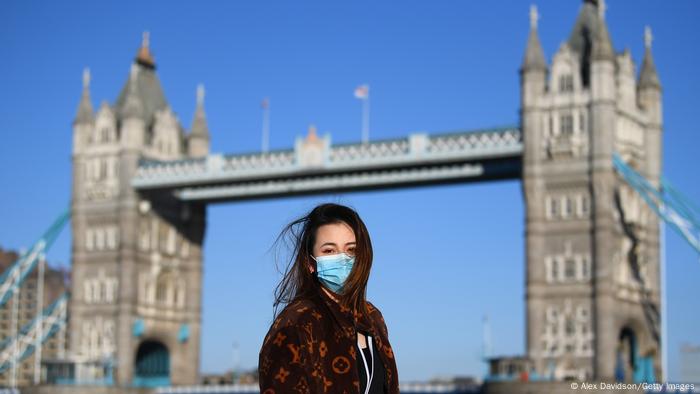
Masks haven't been mandatory for a while, now England has scrapped mandatory self-isolation for positive COVID cases as well

The legal requirement to self-isolate after testing positive for COVID-19 has been lifted in England, and scientists are concerned that the changes will lead to more infections and potential new variants.

As of February 24, people no longer legally have to self-isolate, but the UK government says that, until April 1, it still advises people who test positive to stay home and avoid contact with others for five days and then test negative two days in a row.

Mask-wearing and social distancing have not been compulsory in England since late January.

Zoe Hyde, an epidemiologist at the University of Western Australia, told DW that, while easing quarantine requirements for contacts of cases could be justified if protocols such as testing negative were in place, this was not the case for positive cases.

"Ending the requirement for known cases to isolate is completely at odds with public health," Hyde said.

"It's a recipe for more transmission, more waves of disease, new variants, and sustained disruption to health systems and the economy," she added.

But Catherine Bennett, chair in epidemiology at Deakin University in Australia, told DW that the change in rules wouldn't result in all positive cases choosing not to self-isolate.

"This is part of the transition to living alongside the virus where we move away from rules that are increasingly difficult to enforce," Bennett said.

"Removing rules to self-isolate doesn't mean people must stop isolating, just as having rules doesn't mean everyone is following them. So, whilst there might be more people out mixing than there currently are, it won't be a step change from 0% to 100%," Bennett said.

Pressure to work


Sarah Pitt, a principal lecturer at the University of Brighton and fellow at the UK-based Institute of Biomedical Science, told DW that she worries that people who are ill with COVID-19 and should be resting would be under pressure to go to work once the isolation requirement falls.

"This might affect the time it takes for them to recover, might increase the risk of them developing long COVID, and they can also infect other people," Pitt said.

The loss of financial assistance for people who are too ill to work adds another layer of pressure.

From February 24, self-isolation support payments will end, along with national funding for practical support and the medicine delivery service.

"Removing the legal requirement to self-isolate means that people will not receive the same financial assistance that they had before, so some people will have to go to work when they really should be at home," Pitt said.
Concern over variants

Scientists have also expressed concern about the change to England's self-isolation rules and the potential for new variants.

"Variants can emerge anywhere in the course of viral replication, and, the higher the infection rates, the sooner we might see one," Bennett said.

A press statement about the government's "plan for living with COVID" says the United Kingdom will "begin to treat Covid as other infectious diseases such as flu."

But the coronavirus is more contagious than influenza.

Pitt said the coronavirus was very unpredictable and had not settled down yet.

"There is absolutely nothing in the virology which suggests that any new variants will be milder than omicron," Pitt said.

On Twitter, Deepti Gurdasani, a clinical epidemiologist at Queen Mary University of London, expressed concern about the omicron sublineage BA.2 as the UK government plans to end all self-isolation.

"In the midst of this, our govt appears to have made a decision to halt free testing for the majority, and self-isolation for all. It was never a question of *if a VOC emerges*. We have one now, and it is growing in the UK, and globally," Gurdasani wrote, referring to variants of concern.


In a statement on February 22, the World Health Organization (WHO) said studies had shown that BA.2 has a growth advantage over BA.1, and that initial data suggests that BA.2 is "inherently more transmissible" than BA.1, which is currently the most common omicron sublineage reported.
Living with the virus

Investment in public health messaging is important for creating behavioral change, Bennett said.

The epidemiologist said that, if the public understands that simpler measures such as mask wearing indoors helps reduce transmission risk when infection rates are rising, this will help reduce the need for more formal rules.

"Then we are moving into a more sustainable approach to infectious disease control," Bennett said.

Booster vaccinations could also help counterbalance the changes to England's self-isolation rules, she added.

"If increasing booster doses can reduce symptomatic infection from omicron by half for five months or more, then this could offset the changes to isolation rules if there was more effort to make the vaccines available globally," Bennet said.

But living with coronavirus means understanding the virus, Pitt said, including how infectious it is, how it spreads and how serious the disease can be ― even in vaccinated people.

A sensible precaution would be to continue to wear face coverings on public transport, Pitt said. As of February 24, masks will no longer be required on public transport in London. But Transport for London, the government body responsible for most of London's public transport, recommended that passengers who can wear a mask continue to do so.


"We do not complain when health care workers wear gloves to examine patients these days," Pitt said, "but that precaution only came in as a measure to protect against HIV in the 1980s and 1990s."

Wearing masks could become a part of life to protect people from the coronavirus and other airborne diseases, just like wearing surgical gloves did.

"It was controversial at the time, but it is normal practice now," Pitt said.

Edited by: Carla Bleiker
How the climate crisis is threatening our energy supply

Whether it's heat or heavy rain, the consequences of climate change are putting our energy security at risk. Oil, gas and nuclear energy are particularly vulnerable. So, what does that mean for our future?


More extreme weather will increasingly threaten energy infrastructure

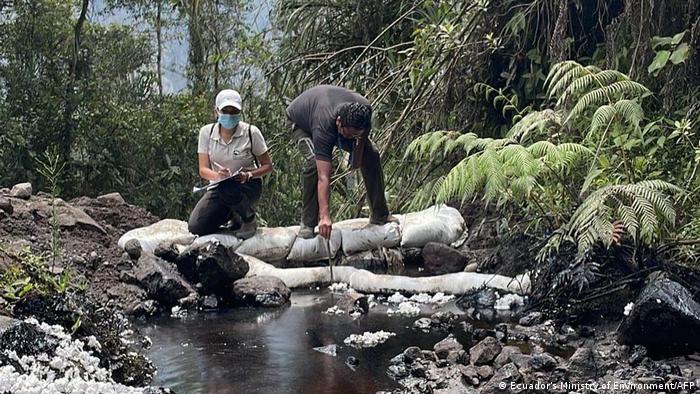
At the end of January, torrential rains poured over parts of the South American state of Ecuador. As a result, an oil pipeline in the eastern province of Napo in the Amazon region was severely damaged — thousands of liters of oil began to leak out and contaminate the surrounding soil.

"The accident is a disaster for the environment," Hans-Joseph Fell, the founder of Energy Watch Group, which is investigating a global transition to renewable energies, told DW. "The consequences of climate change, such as heavy rainfall or drought, have a very strong influence on the availability of conventional energy."
Conventional energy: Low resilience in extreme weather

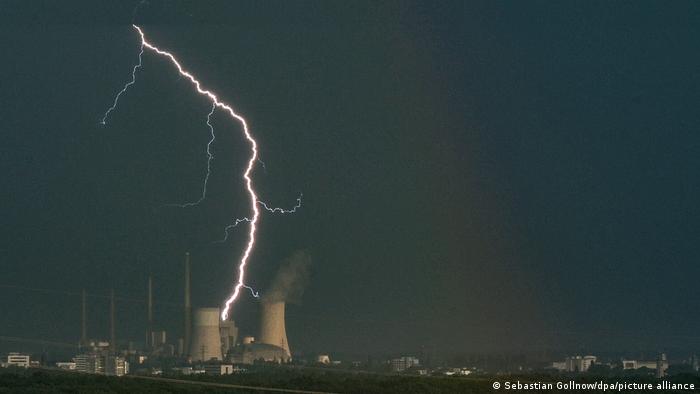
Oil is particularly at risk, as the recent string of oil accidents shows. But it's not the only energy source impacted by the increasing number of extreme weather events. During hotter months, nuclear power plants sometimes have to be shut down because rivers are too warm to be used as cooling water.


Around one million liters of oil leaked from a pipeline into the rainforest in Ecuador


During the hot European summer in 2018, for example, France was forced to shut down four reactors, and the Grohnde Nuclear Power Plant in Germany almost followed suit. Nuclear power plants by the sea do not have this problem, but they in turn could be threatened by rising sea levels.

Extremely low water levels in the Rhine in 2018 also caused the price of heating oil to rise sharply. Like many other goods, it was no longer possible to simply transport the oil across the entire river by ship.

Extreme drought also severely damages hydropower facilities. This has global consequences. Following long periods of extreme heat in the summer of 2021, numerous reservoirs in the US and many parts of Latin America almost dried up. The hydropower plant by Lake Mead near Las Vegas produced a quarter less electricity than usual in July.

According to an analysis by the Institute of Energy Economics at the University of Cologne (EWI), lower levels of electricity generation from hydropower in Latin America led to high demand for liquefied natural gas from the US in 2021. The gas was sold on the American continent instead of to Europe, impacting the volume of gas available in Europe this winter.

Meanwhile, heavy rain and flooding in Indonesia, severe storms in Australia and the US, as well as flooding in China, meant less coal was mined in 2021, according to the study. As a result, demand for gas — and gas prices — have risen even further.

Financial sector invests in wind and solar power


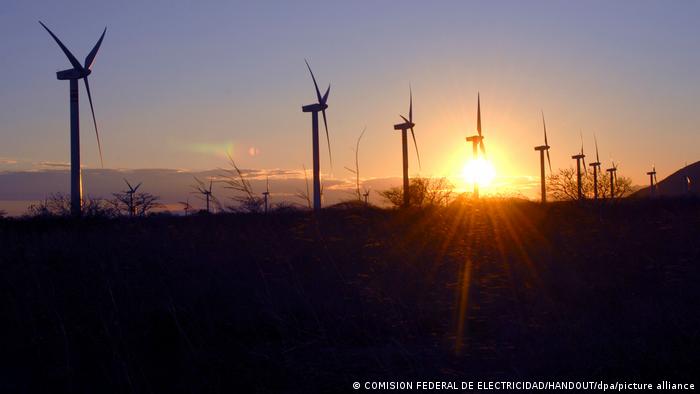
"In contrast to fossil fuels, using wind and solar power to generate electricity is more resilient to weather extremes, and therefore more crisis-proof," said Tim Bachmann, who manages the clean technology fund at asset management company, DWS Group.

The decentralized generation of wind and solar energy has proven to be an advantage in extreme weather conditions, according to Bachmann.

"That's why many large companies in the US, including internet companies, carmakers and others, have signed long-term power contracts with wind and solar farm operators," he said.

There are also far fewer logistical problems to contend with, because the electricity is directly generated from the wind and sun. Coal, oil, gas or uranium on the other hand must first be transported to power plants, where they are converted into energy. And there are various risks inherent in even just transporting the fuels.

How climate-proof is wind power?

But what about the risks posed by extreme weather when it comes to wind and solar power — for example, when hurricanes barrel into wind farms?

Martin Dörenkämper, of the Site Assessment Department at the Fraunhofer Institute for Wind Energy Systems (IWES), explained the importance of decentralized networks, so if turbines in the north have to go off the grid, those in other regions can compensate.

"Even in a strong winter storm, only the wind turbines at the heart of the storm need to be shut down, but not those at the edge of the wind field," he told DW, adding that modern wind turbines can withstand high speeds, and that engineers are currently working to equip them for winds of up to 200 kilometers per hour.

He says no other great climate change adaptation measures are necessary. In places where winters are becoming wetter as a result of global warming — such as in Scandinavia — the power plants must be heated to prevent ice from forming. During periods of heat, stronger cooling measures are necessary.


Wind power is inherently resilient to climate change


Solar panels vs hailstones


The risks posed by the climate crisis also seem manageable when it comes to solar power, according to the latest findings. In order to withstand stronger storms, the substructures and frames of future plants would need to be reinforced, as well as the glass of the solar modules. That's according to Harry Wirth, who is responsible for photovoltaic modules and power plants at the Fraunhofer Institute for Solar Energy Systems (ISE). And it's all technically feasible.

Wirth says solar power systems are also being prepared for stronger hailstorms. According to insurance company Munich Re, this risk has already significantly increased in Europe due to climate change.

"For this purpose, the modules are bombarded with artificial hail in the laboratory," he told DW. "Hailstones between 2.5 and five centimeters in diameter are used."
Heat-resistant, high-voltage lines in the works

Whether conventional or renewable energy, it has to be transported to where it is needed — be that to private households, municipalities or industrial companies. And that means the entire power grid must be able to withstand the risks of the climate crisis.

Mathias Fischer is the press spokesperson for electricity grid operators Tennet. The group operates the entire Dutch high-voltage grid and is the largest grid operator in Germany.


"Due to rising temperatures, we are increasingly relying on so-called high-temperature conductor cables for electricity pylons," explained Fischer. "They can get hotter than conventional cables without bending."

The sticking point of renewables: Stability and storage


"The biggest challenge for the industry during the energy transition is to keep the frequency of the power grid constant at 50 Hertz," said Fischer.

This is easier with conventional power plants, because they can always power up when electricity is needed and pause when there is already enough in the grid. But it becomes more complicated when dealing with many decentralized systems that generate different amounts of energy, depending on how much wind and sun is available.

This means grid expansion is essential in order to transport large amounts of offshore wind power to regions with high electricity demand. Storage possibilities for renewable energy would also need to be realized and built quickly, for example in the form of green hydrogen.

This can be converted into energy whenever electricity is needed. However, renewable electricity stored in hydrogen is also more susceptible to the consequences of climate change, with storms, floods and heatwaves all posing a threat to hydrogen tanks or pipelines.

This article was orignally published in German.

DOUBLE HARVEST: SOLAR PANELS ON FARMS
Harvesting electricity — and berries
Fabian Karthaus is one of the first farmers in Germany to grow raspberries and blueberries under photovoltaic panels. His solar field near the city of Paderborn in northwestern Germany is 0.4 hectares (about 1 acre), but he would like to expand it to 10. He could then generate enough electricity for around 4,000 households — and provide more berries for supermarkets.