Tuesday, February 04, 2025

THE FORGOTTEN WAR

Nagorno-Karabakh Conflict: Is a Lasting Peace Agreement Finally Within Reach?

By Eurasianet - Feb 04, 2025

Armenian Prime Minister Nikol Pashinyan has expressed willingness to explore a modified version of the Zangezur corridor, without granting Azerbaijan extraterritorial rights.
Armenia has also proposed dropping international court cases against Azerbaijan and is open to dissolving the OSCE Minsk Group to advance peace talks.
These concessions are likely linked to Armenia's desire to create new trade possibilities, including joining a project to export electricity from Central Asia to Europe via Azerbaijan.


Armenian Prime Minister Nikol Pashinyan is sending signals designed to place the Armenian-Azerbaijani peace process back on the front burner. In particular, Pashinyan has expressed openness to exploring a modified version of the Zangezur corridor, which would establish a direct link between Azerbaijan proper and the Nakhchivan exclave via Armenian territory.

The corridor issue has proven a major stumbling block for the peace process. Last summer, both sides agreed to set the issue aside, but a few weeks ago, Azerbaijani leader Ilham Aliyev unexpectedly restored Zangezur to the negotiating agenda, slamming the brakes on hopes that a peace deal could be finalized quickly.

Azerbaijan has demanded extraterritorial rights for Zangezur, something that would effectively extend Baku’s sovereignty over the route. Armenia has been wary of the very notion of a corridor, but at a January 31 news conference, Pashinyan appeared to adjust his position slightly, saying Armenia would be willing to establish a corridor under the same terms that Azerbaijan would enjoy on a planned railway via Iran to connect to its exclave. Extraterritoriality is not part of the Iranian route discussions.

Armenian Foreign Minister Ararat Mirzoyan was cagey when asked about Armenia’s vision for Zangezur, repeating that Armenia wants to retain full authority over administration of the route, while holding out the possibility that Azerbaijan could enjoy some sort of special privileges. “Naturally, we also recognize that the 21st century is an era of simplifications and logistical facilitation, where all nations seek to ease transit procedures,” Mirzoyan told journalists on January 30. “With Azerbaijan as well, once transport links are unblocked, we foresee certain simplified procedures that could be applied, bringing benefits to both us [Armenia] and Azerbaijan.”

Pashinyan also announced that Armenia has made new proposals on two issues in peace negotiations that remain unresolved, including the possible withdrawal of cases currently pending in international courts. He similarly announced at his January 31 news conference a tentative willingness to explore the dissolution of the OSCE Minsk Group, which oversaw peace negotiations for decades but whose influence has dissipated since Baku’s reconquest of Nagorno-Karabakh. Azerbaijan has long accused Minsk Group members, especially France, of being biased in Armenia’s favor.

Pashinyan’s efforts to entice Azerbaijan back to the negotiating table are likely linked to a desire to create new trade possibilities. On January 30, he stated Armenia’s intent on joining a project facilitating the export of electricity from Central Asia across the Caspian Sea to Azerbaijan and onward to Europe. On February 3, Azerbaijan’s parliament ratified an agreement with Kazakhstan and Uzbekistan to generate “green” electricity and send it westward via a cable beneath the Caspian Sea.

By Eurasianet.org
POSTMODERN IMPERIALI$M

Gates-Bezos backed KoBold begins hunt for battery metals in Namibia


4th February 2025
By: Bloomberg

KoBold Metals Co., backed by billionaires including Bill Gates and Sam Altman, is extending its search for battery metals to Namibia, a country not known for producing the minerals.

The company is prospecting for lithium and nickel in southern and central Namibia after securing licenses in the third quarter of last year, Mfikeyi Makayi, chief executive officer of its African operations, said in an interview Tuesday in Cape Town.


KoBold was valued at nearly $3-billion in its latest fund-raising round. The US-based company uses artificial intelligence to scour the earth for undiscovered deposits of minerals critical to the energy transition. Lithium and nickel are both crucial to make rechargeable batteries used in electric vehicles.

Yet Namibia isn’t known for producing either — the southwest African nation is better known as one of the world’s biggest sources of uranium.


“This is why we’re exploring,” Makayi said. “Because it’s not known doesn’t mean the opportunities to look deeper are not there.”

KoBold is still doing early-stage prospecting and field exploration before it starts drilling, she said.


CHILE

Wealth Minerals and the Quechua Indigenous Community of Ollagüe Sign Agreement to Jointly Develop the Kuska Lithium Project

FOR IMMEDIATE RELEASE…Vancouver, British Columbia: Wealth Minerals Ltd. (the “Company” or “Wealth”) – (TSXV: WML; OTCQB: WMLLF; SSE: WMLCL; FSE: EJZN) and the Quechua Indigenous Community of Ollagüe (“CIQO”), collectively the “Parties”, have agreed (the “Agreement”) to form a joint venture company (the “JV”) to develop the Kuska Lithium Project (“Kuska”) on the territory of the Ollagüe Salar.

The Agreement considers that CIQO will make their best efforts to promptly work with the Wealth team to establish a Chilean legal entity to serve as the JV, and CIQO will own a 5% free-carried interest in the JV and have the right to one of five director seats on the Board of Directors of the JV.  Both Wealth and CIQO believe this structure is the right balance to bring Kuska to production and ensure the highest standards of community participation and transparency. The Parties have also discussed the JV developing new projects in the CIQO general area of interest where there may be synergies with Kuska.

The Kuska Project is located in the Ollagüe Salar, Antofogasta region, northern Chile, and is presently 100% owned by Wealth Minerals and royalty-free. The maiden resource report published by Wealth Minerals Ltd. (see press release January 17, 2023 and Technical Report of January 13, 2023 “Estimated Lithium Resources Ollagüe Project” posted on SEDARPlus) estimates 741,000 tons Lithium Carbonate Equivalent (“LCE”) indicated resources grading 175 mg/L (plus 701,000 tons LCE inferred resources grading 185 mg/L) with an average indicated lithium grade of 175mg/l. On January 4, 2024, Wealth announced the key highlights of a PEA produced by DRA Global Limited. The PEA describes the Kuska Project development towards a 20,000 metric tpa LCE output and an anticipated Life of Mine (“LOM”) of 20 years. The Kuska Project in the PEA estimates a Pre-Tax NPV10% of US$1.65 bn and a 33% IRR. The PEA was filed on SEDARPlus on February 16, 2024.

On September 30, 2024, the Government of Chile announced that the Strategic Council of the Lithium and Salt Flats Committee (“Strategic Council”) had approved a first group of six locations for the development of lithium projects in Chile, which included the Ollagüe Salar. The decision was based on all six locations having favorable conditions for the feasibility of a lithium operation. The decision of the Strategic Council means that Kuska will be prioritized to receive a special lithium operation contract (“CEOL”) by the State of Chile (see press release of September 30, 2024).

Regarding the Agreement, Henk van Alphen, CEO of Wealth Minerals Ltd. commented: “We have been working on the base of this agreement for several years and we are confident that the only way to do mining is by effectively incorporating communities into the business and project activities. We plan to continue advancing the development of Kuska, indeed to now accelerate the pace, so that we can soon build a lithium production operation at Ollagüe.”

For his part, Víctor Nina Huanca, President of the Quechua Indigenous Community of Ollagüe, indicates “The association with Wealth Minerals for the Kuska project will allow the Community to be involved in the development of the project, making decisions and guiding the care and protection of the most vulnerable sectors of our territory, ensuring that everything is done with the highest standards. Respect for our worldview and the environment will be key to carrying out this process. We trust that we will be able to continue moving forward together for the good of Chile, the Antofagasta Region and the Community of Ollagüe. This JV initiative, the first of its kind in Chile, gives the Quechua Community of Ollagüe important leadership in the new development agenda of the indigenous peoples of Chile, in which the community acts empowered, directly managing its territory.”

About Wealth Minerals Ltd.

Wealth is a mineral resource company with interests in Canada and Chile. The Company’s focus is the acquisition and development of lithium projects in South America.

The Company opportunistically advances battery metal projects where it has a peer advantage in project selection and initial evaluation.  Lithium market dynamics and a rapidly increasing metal price are the result of profound structural issues with the industry meeting anticipated future demand. Wealth is positioning itself to be a major beneficiary of this future mismatch of supply and demand. In parallel with lithium market dynamics, Wealth believes other battery metals will benefit from similar industry trends.

For further details on the Company readers are referred to the Company’s website (www.wealthminerals.com) and its Canadian regulatory filings on SEDAR at www.sedarplus.ca.

On Behalf of the Board of Directors of

WEALTH MINERALS LTD.

Facebook – https://www.facebook.com/WealthMineralsLtd
Linkedin – https://www.linkedin.com/company/wealth-minerals
Twitter – https://www.twitter.com/WealthMinerals

 Neither TSX Venture Exchange nor its Regulation Services Provider (as that term is defined in the policies of the TSX Venture Exchange) accepts responsibility for the adequacy or accuracy of this press release, which has been prepared by management.

ECOCIDE

Guinea sees maximum Simandou output in second year of operation

Bloomberg News | February 4, 2025 | 


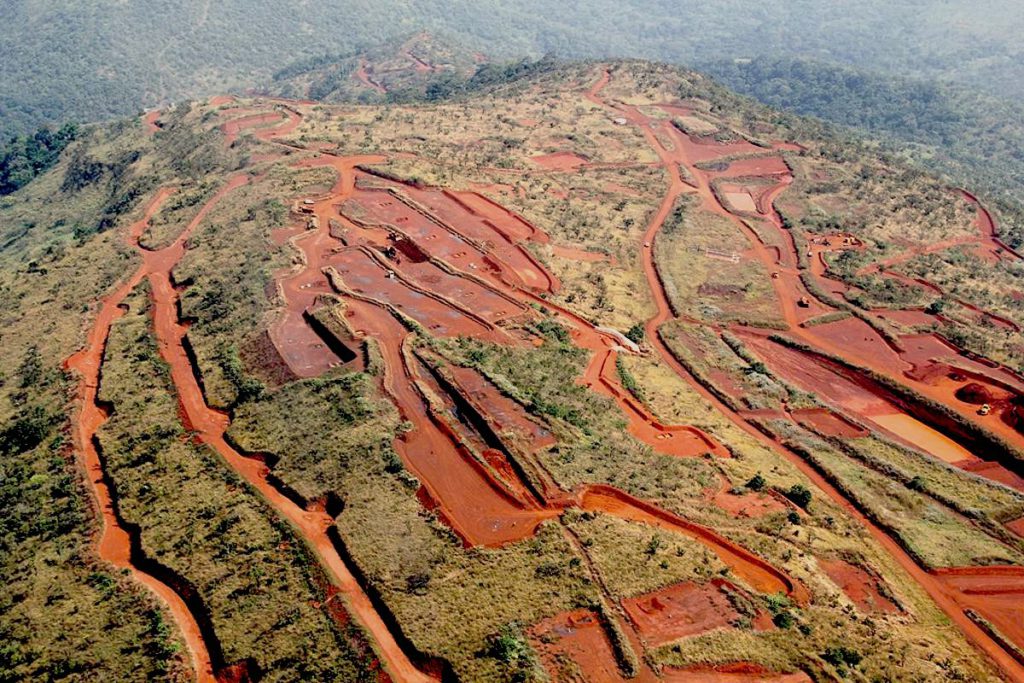
Simandou deposit, Guinea. (Image courtesy of Rio Tinto.)

Guinea expects the giant Simandou iron ore project, which is expected to begin production by December, to achieve maximum output by its second year of operation.


The government projects the two mines at the world’s largest untapped iron ore deposit will produce 30 million tons each in the first year, Mines and Geology Minister Bouna Sylla told Bloomberg TV in an interview. Output is then expected to double to 60 million tons at each cite the following year, he said on Tuesday on the sidelines of the Mining Indaba conference in Cape Town.

For a mine “to arrive at 60 million tons, that will take roughly two years because you have the ramp-up time,” Sylla said.

The Simandou project is divided into four blocks, with blocks 1 and 2 controlled by Winning Consortium Simandou, backed by Chinese companies including China Baowu Steel Group. Rio Tinto Plc and Aluminum Corp. of China, known as Chinalco, own blocks 3 and 4.

In addition to its iron ore deposits, Guinea is also the world’s biggest exporter of bauxite, a raw material used to make aluminum.

(By Jennifer Zabasajja and Moses Mozart Dzawu)

Read More: Guinea’s Simandou iron ore project seen aiding climate goal
IMPERIALISM & NEO-COLONIALISM 
Barrick CEO says miner ‘making progress’ in dispute with Mali

Bloomberg News | February 4, 2025 


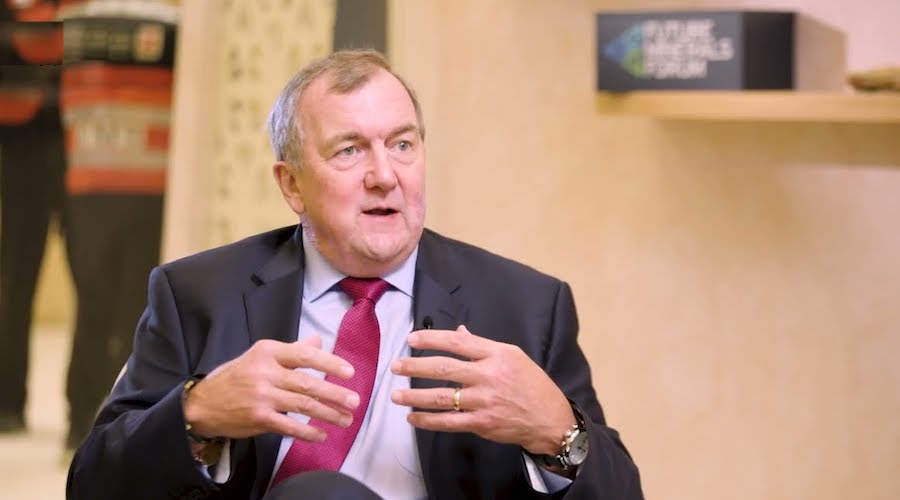
Barrick Gold CEO, Mark Bristow. in interview at the Future Minerals Forum 2024. (Screenshot from FMF TV.)

Barrick Gold Corp. chief executive officer Mark Bristow said the company is “making progress” in its dispute with Mali’s military regime, but the advances haven’t come as fast as expected.


The Canadian company last month suspended operations at the vast Loulo-Gounkoto complex in Mali after the government started removing gold from the nation’s biggest mine in the latest escalation of a months-long dispute. Barrick and Mali’s military rulers are locked in a standoff over the distribution of revenue from an asset that’s key for both the company and the government

The state has blocked Barrick from shipping the precious metal out of the country since November, and put out an arrest warrant for Bristow. The miner has begun arbitration proceedings against Mali.

“Mali has got itself in a position where it is really trying to shake out some short-term cash out of the industry, and this industry is the very foundation of the economy,” Bristow said. “We’re making progress, not as fast as I would expect, but I’m sure everyone is a little cautious.”

The CEO of the world’s No. 2 gold producer also said more consolidation was needed in the mining industry, with too many companies running too few assets. Barrick would continue to grow organically and buy back shares, Bristow said.

The Barrick chief said there’s still “a lot of upside” in gold, which held near a record after US President Donald Trump’s 10% tariffs on China prompted swift retaliation from Beijing, buoying haven demand.

“We are seeing a continuation of de-dollarization, fueled by the actions coming out of Washington and the White House,” Bristow said. “Conflicts on every continent. Gold has really arrived as the ultimate store of value and people are buying the physical.”

(By Dylan Griffiths and Jennifer Zabasajja)
Ferrexpo plunges 51% after $3.8 billion Ukrainian civil claim

Bloomberg News | February 4, 2025 | 


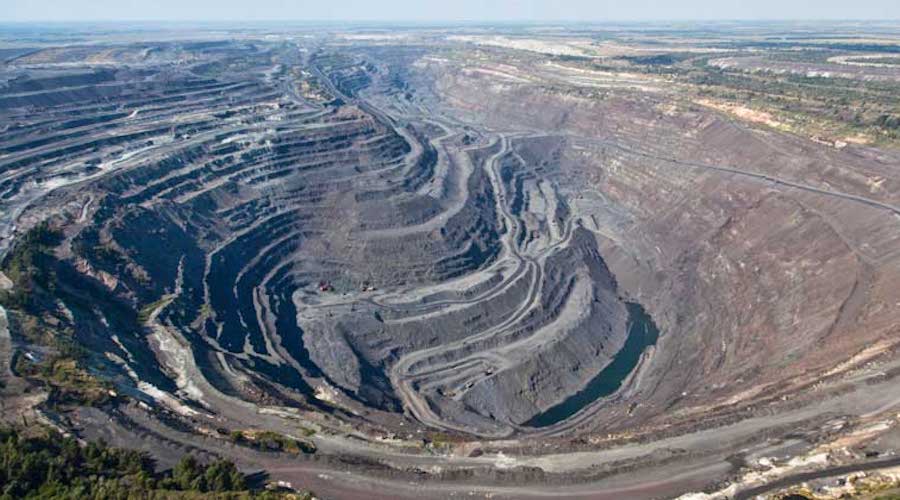
Ferrexpo’s FPM mine. (Image courtesy of Ferrexpo)

Shares in London-listed miner Ferrexpo PLC sank as much as 51% after the company said a civil claim worth 157 billion Ukrainian hryvnias ($3.8 billion) had been filed against its subsidiary in the Eastern European country.


The Swiss-headquartered iron ore producer saw its biggest intraday drop on record, before paring losses to 23%. Earlier Tuesday the company issued a statement informing investors that its Ukrainian subsidiary Ferrexpo Poltava Mining was facing a claim for allegedly illegally mining and selling subsoil, which is said to have caused damage to the environment.

Ferrexpo rejected the allegations, and said the accusations it faced had “transformed” from earlier ones accusing the company of alleged illegal sale of waste products. The subsidiary intends to defend its position in the Ukrainian courts, according to a market update released by the company.

In mid-January, Ferrexpo issued a statement in response to reports in Ukrainian media concerning accusations made by the Prosecutor General’s Office of Ukraine against four senior managers of its subsidiary, concerning the alleged illegal mining and sale of waste products.

The company said the minerals in question were not a separate mineral resource, and that it had been selling waste products for many years until September 2021, which had been subject to state inspections.

Ferrexpo’s Poltava operation, located in central Ukraine, is the group’s largest mine. Before Russia’s invasion of Ukraine in 2022, Ferrexpo PLC was the world’s third-largest exporter of iron ore pellets.

(By Jack Ryan)
Russia says Trump comments on Ukrainian rare earth minerals amount to request to buy US aid

Reuters | February 4, 2025 | 


The Kremlin said on Tuesday that comments by US President Donald Trump suggesting he wants Ukraine to supply Washington with rare earth minerals show he now wants Kyiv to pay for US assistance rather than receive it for free.


Trump told reporters on Monday that Ukraine was willing to engage in the exchange, adding that he wants “equalization” from Ukraine for Washington’s “close to $300 billion” in support.


Kremlin spokesman Dmitry Peskov said the comment demonstrated the US is no longer willing to provide free aid to Kyiv.

(By Dmitry Antonov and Lucy Papachristou; Editing by Andrew Osborn)
China hits back at US tariffs with mineral export curbs

Cecilia Jamasmie | February 4, 2025


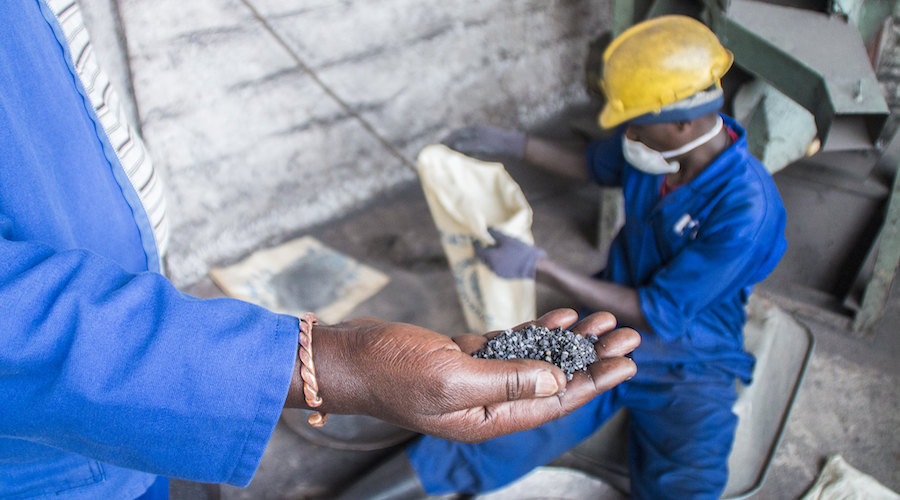
Washed tungsten, Rwanda. (Image: Fairphone | Flickr.) | Under Creative Commons license. “Attribution-NonCommercial-ShareAlike CC BY-NC-SA.”

China unveiled a series of retaliatory measures against the United States on Tuesday, including restrictions on the export of five critical metals used in defence, clean energy, and other industries. The move comes in response to President Trump’s announcement on Friday of a blanket 10% additional tariff on Chinese imports.


Beijing’s new export controls target tungsten, tellurium, bismuth, indium, and molybdenum, stating that export licenses will only be granted to companies complying with “relevant regulations.” However, the Chinese government has not provided details about the specific criteria for compliance.

While significant, these measures fall short of the mineral export bans that China imposed on the US in December, which included gallium, germanium, antimony, and so-called superhard materials.

Some of the newly imposed controls are expected to have minimal impact on US industries. For instance, the United States is a major producer of molybdenum, a metal used to strengthen steel and reduce corrosion, and relies on negligible imports of it from China, according to the latest data from the US Geological Survey (USGS).

Additionally, US tariffs on indium and tungsten — set at 25% since last year — have already driven American importers to diversify their supply chains. Over the past four years, less than 10% of US indium imports have come from China, with South Korea, Japan, and Canada emerging as key suppliers, according to the USGS.

Still, vulnerabilities remain. The US ceased mining tungsten, a mineral critical for alloys and specialty steels, in 2015 and has not produced refined bismuth since 1997, relying entirely on imports for both materials.

Despite a declining share of tungsten imports from China, the country remains the primary supplier, making any sudden disruptions potentially damaging to US industries reliant on this resource.

Counter tariffs

China’s finance ministry also announced additional tariffs on US goods. Starting February 10, the country will impose a 15% duty on coal and liquefied natural gas (LNG) imports and raise tariffs by 10% on American crude oil, agricultural equipment, and certain cars.

President Trump, now in his second term, recently directed his administration to investigate China’s adherence to a trade deal reached during his first presidency in 2020. Economists note that the final results of this review, expected by April 1, could pave the way for further tariff measures.

In his first term in 2018, Trump launched a fierce two-year trade war with China, targeting its significant trade surplus with the US through tit-for-tat tariffs on hundreds of billions of dollars in goods. The conflict disrupted global supply chains and strained the world economy.

In 2020, China agreed to purchase an additional $200 billion in US goods annually to end the trade war. However, the covid-19 pandemic derailed the agreement, and China’s trade deficit with the US grew to $361 billion last year, according to the country’s customs data released in December.


China’s Critical Mineral Export Curbs Could Upend Market

By Irina Slav - Feb 04, 2025, 

China announced curbs on the exports of three critical minerals in December 2024.

China looks to curb lithium battery tech exports as a retaliatory measure to U.S. trade policy.

Beijing’s export restriction move only highlights China’s already well-known dominance in transition technology and the rest of the world’s near complete reliance on it for this technology.


In early December, China announced curbs on the exports of three critical minerals, including antimony, gallium, germanium, and several other minerals, to the United States. The price of these minerals soared, especially in antimony, which is a key ingredient in semiconductors and weapons. Now, China is reportedly planning to do the same to lithium battery tech exports, which could completely upend the critical minerals market.

The United States is the primary target of these limits as President Trump hardens the tariff rhetoric—and action—on both U.S. neighbors and China. In his latest squeeze on major trade partners, Trump threatened to impose 25% import tariffs on Mexican and Canadian products, which got most of the media attention. Yet he also imposed an additional 10% tariff on Chinese imports to make his point about the U.S. being shortchanged on trade.

In this context, China’s bans, although chronologically preceding the Trump tariffs, are a retaliatory measure to U.S. trade policy. In a more specific context, however, the context of the energy transition, Beijing’s export restriction move only highlights China’s already well-known dominance in transition technology and the rest of the world’s near complete reliance on it for this technology. When it comes to the transition, in other words, China holds all the cards.

Recent antimony price developments are a case in point. When China announced it would curb exports of the critical mineral, antimony prices surged to all-time highs, ending 2024 at $40,000 per ton for a total annual rise of a whopping 250%. “We have already sold some small quantities for $40,000,” a metals trader from Europe told Reuters at the time. “Non-Chinese sellers...will charge more to maximize profits.”

The problem is that it’s not just antimony that is being restricted. Indeed, an Argus senior analyst told the South China Morning Post last month that “There is a risk that China might expand its export restrictions on critical materials in the near term.” Ellie Saklatvala also told the SCMP that “In the short term, it will be very difficult for the US to significantly reduce its reliance on China for critical minerals – it usually takes many years and huge investments to develop new supply sources.”

That last comment sums up the challenges lying ahead for the United States and, to a much larger extent, Europe in securing enough critical minerals for the energy transition and balancing this priority with its foreign policy objectives, which seem to focus on containing China’s global influence. That would certainly be a tough act, and it is an act that the United States no longer has to try and master—because Trump has essentially pulled the brakes on the whole transition push.

Yet even without the energy transition as a top priority, the U.S. still needs critical minerals for its tech and defense industries—and China knows this well, which is precisely why it is curbing exports. And there is nothing importers can do except scramble to tap the limited pool of non-Chinese supplies. A further complication arose just this month when the U.S. president imposed those tariffs on Canada—which also produces critical minerals.

Indeed, analysts were quick to point out that Canada could use its mining industry as a bargaining chip in tariff negotiations with Trump because it either already mines or at least has resources of 16 out of 50 critical minerals that would come in handy as alternatives to Chinese supply, including germanium and gallium.

Meanwhile, the issue with critical mineral supply is becoming increasingly urgent because China is not just curbing exports—it is doubling down on cementing its global dominance in the sector with massive ongoing investments and reserve reporting mandates for Chinese miners operating abroad.


By Irina Slav for Oilprice.com


Italian Navy and Messina Hold Exercise Practicing Boarding and Inspection

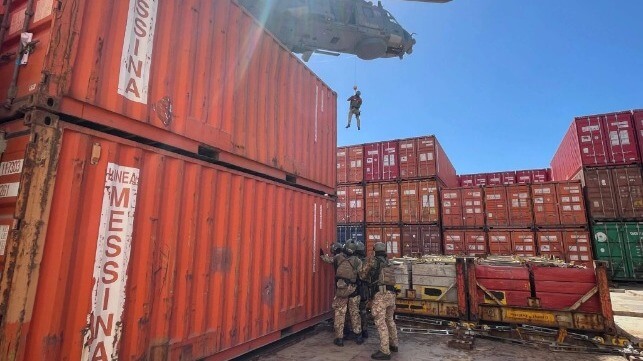
Navy boarding merchant ship
Italian Navy practices boarding another Messina vessel in a2024 exercise (Linea Messina)

Published Feb 4, 2025 5:58 PM by The Maritime Executive


The Italian Navy is highlighting one of its regular training exercises working with the merchant fleet. It is part of a long-term project also involving the trade association Assarmatori designed to build cooperation and familiarize the navy personnel and merchant sailors in the routine for vessel inspections.

The vessel selected for the latest exercise was the Jolly Verde of Ignazio Messina (Linea Messina). Built in 2007 and previously operating under charter to MSC Mediterranean Shipping Company, the containership became the largest vessel in the Messina fleet when she was acquired in April 2024.  The vessel which is 80,000 dwt is 928 feet (283 meters) in length and has a capacity for 6,300 TEU. She operates with a crew of 22.

Jolly Verde was sailing in the Eastern Mediterranean yesterday, February 3, from Spain to the Suez Canal.  Messina reported when they acquired the ship last year that it would be deployed on a route to the Middle East and India. The exercise involved the Italian frigate Alpino.

The trade association reports initially, radio contact was established between the Italian frigate and the merchant ship, with the Command of the military unit declaring its intentions and requesting the commander to proceed with the boarding of the inspection teams. The military reached the containership to inspect it, verifying the regularity of the ship and cargo documents before permitting it to resume regular navigation.

“Exercises of this kind are now taking place frequently and their success testifies to the high level of collaboration achieved between the Navy, our association, and the shipping companies,” said Stefano Messina, President of Assarmatori. “A particularly valuable relationship,” he noted is formed with a view to guaranteeing crews high safety standards and protecting cargo and traffic even on potentially risky routes. He notes currently it is, “a difficult and highly challenging historical period.”

They note the exercise gives the navy team practice at boarding a vessel. For the merchant ship, it provides the opportunity to understand the procedure and how to interact with the navy during an inspection.

The Italian Navy has participated in the recent NATO efforts to ensure the safety of merchant ships sailing both in the Gulf of Guinea and off the Horn of Africa. The exercises which take place every few months focus on elements such as boarding, inspection, and intervention during incidents of piracy.


Video: Singapore Deploys Autonomous, Remotely-Controlled Patrol Boats

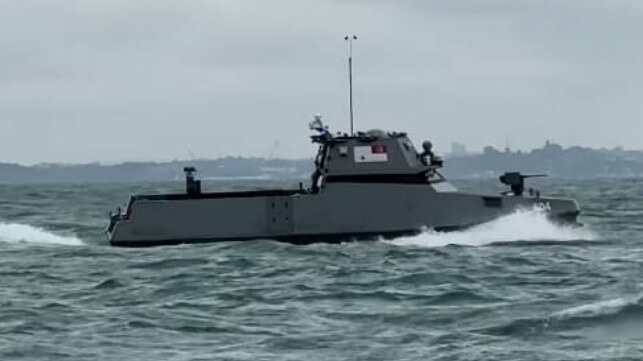
Singapore patrol boat
Singapore's new fleet of romote-controlled, autonomous patrols boats have begun patrols (Singapore Navy)

Published Feb 4, 2025 1:48 PM by The Maritime Executive


The efforts to monitor and protect shipping around Singapore, one of the busiest shipping lanes in the world, have gained a new remotely-controlled, autonomous patrol boat. The Singapore Navy put its new autonomous boats on display with a demonstration of its capabilities as it began patrols in the harbor.

The Marsec USV was designed and built in Singapore using the latest in automation and AI technology. The Straits Times newspaper witnessed the demonstration while the Navy also posted a video about the crafts online.

According to the report, three of the vessels have begun patrols and a fourth will be added later in the year. Each is 17 meters (approximately 56 feet) and 30 tonnes. They are powered by two diesel engines using water jets which give the patrol boats a top speed of over 25 knots. They can carry a 20-foot container or its equivalent, and they are designed for continuous operations of up to 36 hours.


Operations are overseen from a shoreside control station, but the vessels also incorporate a high level of autonomy in managing their navigation. They are outfitted with collision detection and avoidance systems employing a series of sensors, radar, and cameras. The video feed also provides a 360-degree perspective for the operators.

Each of the vessels is outfitted with a range of capabilities for their monitoring and enforcement roles. They have long-range acoustic devices, sirens, and speakers to issue voice commands. They also have a stabilized, remotely operated machine gun and a laser system to disorient perpetrators.

The vessels were deployed in 2025 after over 1,000 hours of testing. The Straits Times reports Navy officers said during the briefing that they conducted manned trials, but the operators never needed to intervene during the trials. 

In addition to its current role in monitoring, the Navy reports it is looking at additional missions for the vessels. This could include mine detection or deploying countermeasures.