Sunday, March 02, 2025


Social movements

#StopFuelingGenocide: Boycott Chevron!


Saturday 1 March 2025, by Ted Franklin


During the second weekend of Trump’s second term, demonstrators in more than 20 U.S. cities staged lively protests outside Chevron gas stations, plants, and offices. Their demand: an end to the oil giant’s lucrative partnership with the apartheid State of Israel.


In Oakland and Alameda, California, scores of protesters braved an atmospheric river to successfully halt patronage at Chevron-owned gas stations. In Washington, D.C., demonstrators gathered outside Chevron’s lobbying office calling for Chevron to “Stop Fueling Genocide.”

Other spirited actions took place in Birmingham, Alabama; Bellingham, Tacoma, Wenatchee, and Seattle, Washington; Portland, Oregon; San Jose, Silicon Valley, Berkeley, Sacramento, Chino Hills, and Los Angeles California; Plano, Texas; Tampa, Florida; and Golden, Colorado.

Many of the demonstrators have confronted Chevron before. The corporation has long been a world-class villain in the eyes of climate and environmental activists for its ecological depredations around the world.

Now it has become one of the prime targets of global BDS (boycott, divestment, sanctions) organizing in support of the Palestinian people. With a huge public presence of more than 7,000 gas stations in the United States and a direct role in empowering Israel’s atrocities, Chevron is a prime candidate for an organized consumer boycott.

Chevron earned its billing as a top-tier target of the Palestinian-led BDS Movement by pumping gas — lots of it. Israel’s war machine couldn’t run without the gas supplied by Chevron. Off the coast of Palestine in the eastern Mediterranean Sea there are vast reserves of fossil gas. Since 2020 Chevron has operated the two major Israeli-claimed fossil gas fields, Tamar and Leviathan.

As Israel bombed hospitals, homes, universities, and UN schools in Gaza, Chevron pumped gas from the depths of the sea to feed Israel’s onshore power generation plants. The plants produce most of Israel’s electricity. Without Chevron’s ongoing contribution the lights would go out on Israel’s military, police stations, and illegal settlements. Chevron also pumps billions of dollars in revenue to Israeli government coffers.
Demanding an End to Complicity

The Palestinian BDS National Committee (BNC) — the largest coalition in Palestinian civil society — launched the escalating global boycott campaign targeting Chevron in January 2024. The BDS movement had first called for divestment from Chevron in 2020 when Chevron took over from Noble Energy as the primary owner and operator of Israel’s gas fields. The campaign is now expanding to engage with the broader public by mounting a consumer boycott of Chevron gas stations, including those operating under the brand names Texaco and Caltex.

“Chevron has been a divestment target, but we added it as a boycott target after Israel’s Gaza genocide began, and we’ve already seen campaigns and actions around the world at Chevron gas stations, refineries, and corporate offices as well as Chevron’s university partnerships and event sponsorships,” says Olivia Katbi, BNC North American coordinator.

“We are not asking for charity, but for solidarity,” explains Omar Barghouti, cofounder of the BNC in 2005 and recipient of the Gandhi Peace Award in 2017. “We’re demanding an end to complicity. As the struggle that ended apartheid in South Africa has shown, ending state, corporate, and institutional complicity in Israel’s regime of oppression, especially through the nonviolent tactics of BDS, is the most effective form of solidarity with our liberation struggle.”

The BDS movement based its targeting of Chevron on a strategic analysis of how a boycott can have a meaningful impact on corporations complicit in suffering.
Opportunity for a Win

“The BDS movement uses the historically successful method of targeted boycotts inspired by the South African anti-apartheid movement, the US Civil Rights movement, and the Indian anti-colonial struggle, among others worldwide,” says Katbi. “We strategically focus on a relatively smaller number of carefully selected companies that play a clear and direct role in Israel’s crimes — and where there is a real potential for winning.”

Katbi further explains, “Chevron entered the Israeli market in 2020; it can just as easily exit. Therefore, we see this as a winnable campaign. The Chevron campaign has an easy way for consumers to be involved and apply pressure, by boycotting, picketing, and engaging with local gas stations. This tactic is inspired by the Shell boycott during the South African anti-apartheid movement.

Other complicit companies with gas stations, like Valero, are on the divestment list. But to be successful in our boycott campaigning against Chevron, we need to focus on one company at a time.”

While expressing appreciation for those who feel compelled to boycott all products and services of companies tied in any way to Israel, the BDS movement argues for more focus on fewer targets. Spontaneous campaigns aimed at Starbucks and McDonald’s have attracted popular support, but they don’t make the BNC’s list of priority targets. Apartheid can thrive without Ventis and Big Macs, they say, but it can’t run without gas. Going after every complicit company runs the risk of making no impression on any of them.
Cross-Movement Synergy: Apartheid and Environmental Devastation

The BDS Movement also sees in the Chevron boycott a strategic opportunity to build an alliance between Palestine solidarity and environmental activists based on a shared understanding and abhorrence of the human, ecological, and climate impacts of Israel’s assault on Gaza.

Chevron holds the “distinction” of being the world’s leading historical producer of greenhouse gas emissions among investor-owned oil companies. An exhaustive 2021 report on Chevron’s global record of ecocide, genocide, and corruption exposed Chevron’s “severe abuse of Indigenous people, as well as massive destruction of local environments while forcing the world into a crisis from fossil fuel-induced climate change.” Israel’s war, like all wars, contributes directly to destroying the climate and adding fuel to the fossil fuel industry’s effort to burn up the planet.

“We’re building a global intersectional Boycott Chevron campaign in partnership with the climate justice movement and Indigenous peoples around the world, including in Ecuador, who are exposing and resisting the colonial violence of Chevron’s extractivism, environmental destruction, and grave human rights violations,” says BNC’s Barghouti.

“In Gaza, Israel is not only committing a genocide against 2.3 million Palestinians,” Barghouti avers.

“It is also committing what international law experts call domicide — the mass destruction of homes and living conditions to make our territory uninhabitable — and ecocide. Though the full extent of the damage caused to the environment by Israel’s relentless bombardment and destruction in Gaza has not yet been documented, satellite imagery already showed the destruction of about 38 to 48 percent of tree cover and farmland.”

As the Guardian reported nearly a year ago, “Palestinian olive groves and farms have been reduced to packed earth. Soil and groundwater have been contaminated by munitions and toxins. The sea is choked with sewage and waste, the air polluted by smoke and particulate matter.”

“Palestinians living under Israel’s colonial rule, with no control over our land or natural resources, are highly vulnerable to the climate crisis,” Barghouti stresses.

“With Israel monopolizing resources, destroying our agricultural land, denying access to water, rising temperatures are exacerbating desertification as well as water and land scarcity, entrenching climate apartheid.”
#BoycottChevron Strengthens Solidarity

U.S. organizations ranging from the Quaker group American Friends Service Committee (AFSC) and US Campaign for Palestinian Rights (USCPR) to the Democratic Socialists of America (DSA) have taken up the BNC’s call to organize around the Chevron Boycott. AFSC has provided an extensive toolkit for organizers, including designs for stickers, banners, and flyers that can be adapted by local campaigns and a Fact Sheet: Chevron Fuels Israeli Apartheid and War Crimes.

Since the launch of the boycott, the BNC reports that “tens of thousands of consumers have taken the pledge to boycott Chevron gas stations, dozens of groups around the world have led pickets at Chevron, Caltex, and Texaco gas stations, and at least three cities have divested from Chevron.”

In February 2024, hundreds of protesters staged a “Chevron Out of Palestine” rally outside the gates of Chevron’s Richmond refinery, one of the largest refineries in California. The participants and endorsers of the rally included such diverse groups as the Oil & Gas Action Network, East Bay DSA, Idle No More, Bay Area Palestine Solidarity, Labor Rise Climate Jobs Action Group, Jewish Voice for Peace, Common Humanity Collective, Sunrise Movement, 1000 Grandmothers, Rich City Rays, Rising Tide, Coalition Against Chevron in Myanmar, San Francisco Committee for Human Rights in the Philippines, Asian Pacific Environmental Network, Palestinian Feminist Collective, Bay Area Health Workers for Palestine, Muslim Writers Collective, Amazon Watch, California Trade Justice Coalition.

In August 2024, a similarly broad coalition of organizations in Los Angeles, dedicated to Palestinian human rights and to addressing the global climate crisis, demonstrated at the Chevron Refinery in El Segundo, just south of the LA airport.

The LA coalition included Black Lives Matter, Code Pink, Extinction Rebellion, Veterans for Peace, White People 4 Black Lives, Queers 4 Palestine, Youth Climate Strike, SoCal 350 Climate Action, and local chapters of Students for Justice in Palestine.

Demonstrations at the refinery gates have served a useful purpose in uniting different social movements in common cause, but the isolated locations of the refineries means that the actions reached few members of the public directly. That is changing as the emphasis shifts to gas station pickets reaching out to Chevron’s customers.

Operating under the brand names Chevron, Texaco, and Caltex, Chevron stations are scattered across 21 states, with the largest concentrations in California, Texas, Georgia, Florida, Alabama, Washington, Louisiana, Arizona, Oregon, and Nevada.

Hundreds are corporate-owned, but the majority are owned by franchisees who are locked into long-term relationships with the behemoth. Boycott organizers are asking these franchise owners to communicate directly with Chevron urging termination of its contracts with Israel.

In September 2024, #BoycottChevron climate justice groups and human rights activists staged 15 public events around the world as part of a week of action targeting Chevron. Protesters decorated Chevron’s headquarters in San Ramon, California, with a large banner declaring Chevron “the genocide energy company.”

Demonstrators at gas stations asked vehicle owners to gas up elsewhere and Chevron franchise owners to sign a letter asking Chevron to divest from Israel and post in their window a notice that they have asked Chevron to do so. Franchisees who sign on will not be picketed.

In September 2024 #BoycottChevron climate justice groups and human rights activists staged 15 public events around the world as part of a week of action targeting Chevron. Protesters decorated Chevron’s headquarters in San Ramon, California, with a large banner declaring Chevron “the genocide energy company.”

Demonstrators at gas stations asked vehicle owners to fill up elsewhere and sign the boycott pledge. Chevron franchise owners were asked to sign a letter asking the corporation to divest from Israel and to post a notice in their window that they have done so. Franchisees who sign on are not picketed.

As part of the September week of action the Democratic Socialists of America International Committee launched DSA’s own #StopFuelingGenocide campaign, calling on DSA chapters across the country to help build the boycott. In recent months California DSA members organized demonstrations at gas stations in Oakland, Silicon Valley, and San Diego, and Texas DSAers staged actions in Houston and Austin.

Chevron seeks to curry local favor by investing a small portion of its PR budget in the nonprofit community. When local governments seek to regulate Chevron’s activities the beneficiaries of Chevron’s “charity” are expected to show up at public hearings and put a community face on Chevron’s talking points. DSA is encouraging its chapters to pressure nonprofits and organizers of charity events to turn down fossil-fuel money this year.

Chevron is in the process of moving its global headquarters from California to Houston, Texas, where it is the main sponsor of the annual Houston Marathon. This year, Houston DSA was on hand to explain that Chevron’s generosity in Houston is funded in part by its profiteering in the Eastern Mediterranean.
It’s Only a Short-Term Business

Boycott organizers recognize that it will take a massive global movement to persuade Chevron to end its business in Israel, much less to end its production of fossil fuels, as the future of a human-habitable planet requires.

Despite the challenges, #BoycottChevron activists believe victory is possible. Besides the boycott campaign, there are many other factors at play.

Chevron’s assets off the coast of Palestine face risks beyond the very real reputational injury and economic pressure the international movement brings to bear. Chevron CEO Mike Wirth acknowledged in a sit-down interview sponsored by the Atlantic Council, a ruling-class think tank, that Chevron’s gas fields in the Eastern Mediterranean face physical peril operating in a war zone.

As the 2021 report shows, with hundreds of lawsuits on every continent against the corporation for spills, blowouts, and other violations of numerous laws including those against violent crimes, Chevron was already liable for tens of billions of dollars in fines and compensation before it began its activities connected to the Palestinian genocide.

“Chevron only began investments in Israeli apartheid markets in 2020,” DSA campaign leaders explain in their orientation for boycott organizers. “Our task is to make it easier and more profitable for Chevron to divest from its assets in Israel than to continue holding on to them. Chevron can choose to sell off this investment at any time. We can win.”

You can join the #BoycottChevron campaign by sending a message to CEO Mike Wirth via bit.ly/boycottchevron

Resources:

Fact Sheet: Chevron Fuels Israeli Apartheid and War Crimes, Action Center for Corporate Accountability

AFSC Boycott Chevron campaign info

BDS Movement’s Call for a Consumer Boycott of Chevron-Branded Gas Stations

Report on Chevron’s Global Destruction: Ecocide, Genocide, and Corruption

Source: Against the Current 1 March 2025


Attached documentsstopfuelinggenocide-boycott-chevron_a8875.pdf (PDF - 931.7 KiB)
Extraction PDF [->article8875]


Ted Franklin

Ted Franklin is an organizer and retired union attorney who serves on the coordinating committee and editorial board of System Change Not Climate Change. He is a founding member of the Labor Rise Climate Jobs Action Group and No Coal in Oakland, and is active in efforts to unite the climate justice and labor movements on common goals.


International Viewpoint is published under the responsibility of the Bureau of the Fourth International. Signed articles do not necessarily reflect editorial policy. Articles can be reprinted with acknowledgement, and a live link if possible.


Paul Le Blanc: Why I am rejoining Solidarity and some thoughts on the future


Published 

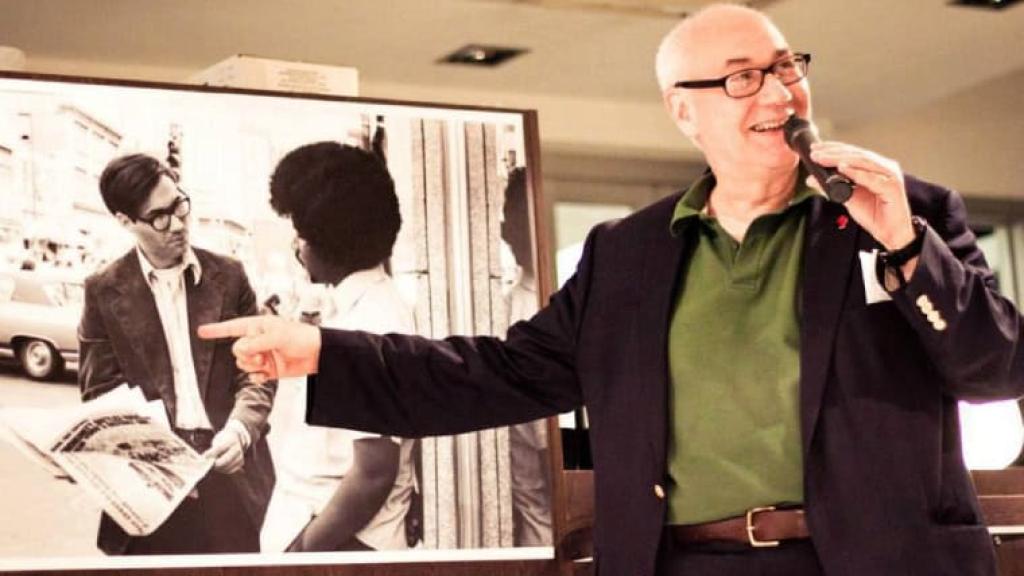
US historian Paul Le Blanc

A longtime friend, with whom I share a mutual respect, recently sent me an email regarding my decision to rejoin Solidarity.* What follows are the texts (slightly edited) of a two-part answer to him, and then my replies to a couple of emails he sent in response.


I will try to give a sense of where rejoining Solidarity fits into my thinking about what we seem to be facing and “what is to be done” at this point in time. This will take a couple of emails — this one dealing with more general matters, and another that I will send tomorrow dealing more directly with the questions you have asked.

It feels to me that time is running out — certainly for me and perhaps for humanity.

Being almost 78 years old, I do not expect to be politically functional (or even alive) for more than five years or so. Although I am definitely feeling, shall we say, “less energetic” than was the case in earlier phases of my life, the fact remains that for now I seem to have some juice left in me — so there is still an impulse to do what I can to help advance the struggle. But I find a heightened need to pick and choose. (More on that in a moment.)

Parallel to this, it seems to me that time is limited in regard to saving humanity from being overwhelmed by a cascade of social and environmental catastrophes — it feels like we may have a decade or two or three to pull that off, but not much more. At this point, particularly in the United States, it is not clear that we can pull that off, given the fact that Trumpism and similar toxic authoritarian trends are in the ascendency and the organised left has largely disintegrated.

On the other hand, as social and environmental catastrophes unfold, it is likely that a deepening radicalisation will spread among more and more people. That signifies a revolutionary potential that might culminate in effective struggles for a better future. But without coherent organisations to strategise and organise in a way that is capable of helping to shape and mobilise that radicalisation, such revolutionary potential cannot be realised. The fact is that there are no such organisations. Changing that situation, to my way of thinking, must be the highest priority around which to make use of the time and energy remaining to me.

I find that one of the things I am able to do is to write books and articles, and to help generate and circulate books and articles by others, which help move thinking in that direction — and also to give talks and help generate discussions and discussion sessions at conferences and elsewhere that go in that direction. Another thing I am able to do is to be involved in modest but meaningful activist efforts — and given time and energy limitations already alluded to, over the past couple of years, I have focused on environmental justice efforts primarily through the Pittsburgh Green New Deal and the Global Ecosocialist Network.

But this is not enough. If the organisation we need is actually going to come into being, I think much of it will come together through the efforts of thoughtful and experienced activists who are currently in a small scattering of already-existing groups. This includes Solidarity. And that brings us more directly to the question you have raised in your email. In tomorrow's concluding email, I will take that up.


First of all, I owe you an apology. Not only because I am a day late in sending this off, but especially because it has ballooned into something much more than what you were asking for. It has become more a saga of a decades-long organisational quest than a direct answer to a simple question. You may decide to skip over much of what follows in order to get to the more direct answer, and for that I would certainly not blame you.

In any event, here is the promised concluding email on what we are facing and “what is to be done,” dealing specifically with your initial questions:

  • Why I decided to rejoin Solidarity.
  • What are my thoughts on the internal affairs of Solidarity.

When I was in the process of rejoining, I was asked to fill out a brief questionnaire which included the question: “Why are you interested in joining Solidarity?” Here is the brief response I gave:

Since the 2019 collapse of the ISO, Solidarity has continued to function as a socialist organisation, formally representing perspectives with which I am in basic agreement.

I believe the mass socialist organisation that I would like to see will probably draw from smaller organisational clusters of revolutionary socialists, of which Solidarity has proved to be one of the most durable.

Also, Solidarity is affiliated with the Fourth International, with which I strongly identify.

Everything I wrote in that brief response is true — but I was keenly aware of providing only a limited sketch of what I truly think. In approaching more complete answers to the questions you have raised, it might make sense to outline why I joined Solidarity in the first place and why I left it.

How I came to join Solidarity is a long story — sort of like a “shaggy dog” story — that has its roots in more than two decades of preliminaries.

Preliminaries

Long, long ago, after considerable experience as a new left activist in the 1960s and early '70s, and after considerable thought (and also a considerable amount of independent study), I made the decision to join the Socialist Workers Party (SWP), to which I devoted ten years of my life as a political activist.

The SWP of the 1970s was a unique intergenerational entity, with layers of comrades (some still a living part of the organisation) with experience going back to the socialist movement headed by Eugene V Debs and seasoned by the militant Industrial Workers of the World, powerfully impacted (back in the day, in real time) by Vladimir Lenin and Leon Trotsky and other comrades who made the Russian Revolution of 1917. It included some who had been part of the early Communist movement of the 1920s, people who resisted and fought against the twin corruptions of Stalinist authoritarianism and reformist adaptation to capitalism, and new layers of comrades who had been active in the radical mass upsurges of the ’30s and ’40s. It included some who had found ways to survive and endure as revolutionaries in the face of the conservative backlash during the ’50s, and more who had been part of the radical resurgence of the ’60s.

There was much to be learned in this rich context — including some negative qualities that were sectarian and sterile — but, for me as well as others, there was much more that was incredibly positive and helped to shape us as serious political activists.

Some of the negative qualities in the makeup of the SWP came to the fore as the late ’70s flowed into the ’80s, corrupting the newer and younger leadership, pushing aside the organisation's positive qualities and traditions. This trend culminated in a covert programmatic transformation of the organisation into a cultish and authoritarian sect involving waves of expulsions and resignations. (Elsewhere I have attempted to help document and analyse all of this.)

After my own expulsion, and a brief period of trying to find my way within the organisational cross-currents of those who had also been driven out, I ended up in the smallest and most modest of the organisations — the Fourth Internationalist Tendency (FIT). Unlike the other new groups, the FIT did not intend to become a replacement of the SWP. Instead, it focused on three goals.

  1. One goal was to demonstrate that utilising an essentially non-sectarian variant of the old SWP orientation could contribute positively to developing an understanding of and engagement with US and global realities.
  2. Another goal was to utilise that analytical approach to explaining how and why the positive political entity that the SWP represented could degenerate into its opposite.
  3. A central goal was to labour, with assistance from the Fourth International, to create a situation through which those who had been expelled and driven out of the SWP would be taken back into that organisation. This would provide an organisational framework for serious, clarifying, democratic discussions and debates (which had been prevented by the corrupted new leadership), culminating in decisions to guide the efforts of a unified US section of the Fourth International.

As I have been writing this, it has occurred to me that my ongoing references to the importance of the Fourth International (FI) seem to suggest that perhaps I should compose a third email to explain how I see this global network that originated with Trotsky and his co-thinkers back in the 1930s. I will avoid composing that addendum — though I will offer a few more comments on the FI later in this email.

The FIT came into existence at the close of 1983, but it was not until seven years later that the SWP leadership — in an offhand manner — publicly stated that it no longer considered itself part of the FI. This news caused not a ripple of dissent in what was left of the SWP membership. At that point, at the conclusion of a democratic discussion, the FIT adopted as its third goal a commitment to unite with one of the organised fragments of expelled SWPers as a first step in uniting all fragments into a new, unified FI section. The two possibilities for more immediate steps of unification were Socialist Action and the FI Caucus of Solidarity. We committed ourselves to a serious exploration of these possibilities.

Joining Solidarity

Initially, some of us guessed that Socialist Action (SA) would be the group with which we would unify. But the discussion process soon revealed that SA’s rigidity would allow unity only on the basis of the FIT being absorbed and digested into an organisation that would permit no dissent from its predetermined sectarian trajectory. Solidarity, on the other hand, made it clear that — assuming we would accept the fact that the FI Caucus was organically inseparable from Solidarity as a whole — we would be welcomed into the organisation, with full democratic rights to maintain our political orientation, including the right to continue producing, as an independent journal, our monthly Bulletin in Defense of Marxism. On this basis, a majority of the FIT voted to dissolve our organisation and — on an individual basis — join Solidarity. It was on this basis that I joined Solidarity.

Those who had been part of the FIT quickly went in different directions:

  • Some who had disagreed with the majority decision chose not to join Solidarity.
  • Among those who joined, one grouping of younger comrades who had been especially enthusiastic about joining were soon outraged that their idealised and highly romanticised notion of what Solidarity was turned out to be a mirage. They formed an irreconcilable and provocative faction that the bulk of Solidarity members found intolerable, resulting in them being kicked out.
  • One highly articulate FIT leader made his own place and his own way in Solidarity, with no serious inclination to consult with others who had been in the FIT, contributing to the disintegration of what some had envisioned as an FIT current within Solidarity.
  • Several members found the organisation to be quite inhospitable to attitudes that had been acceptable in the FIT, and some could not find in the new group the sense of community and purpose that had been a norm for them in the FIT — and they drifted away.
  • Several older comrades were not able to be active in the new group, and death soon claimed most of those who decided to stay the course.
  • Very few adjusted to simply being members of Solidarity.

At a certain point, I decided that I would be part of this “very few.” I worked to help build a Solidarity chapter in Pittsburgh and eventually (although sometimes identifying with an oppositional current) served for two years as part of Solidarity's political committee.

Leaving Solidarity

This brings me — at long last — to why I left Solidarity. After considerable experience, I came to the conclusion that, in large measure, my earlier critique of Solidarity (when I was part of the FIT) had been at least partly correct.

Solidarity initially came into being as a “regroupment” effort initiated by three separate entities with somewhat different histories — the International Socialists, Workers Power, and a sizable group of former SWPers who constituted the first split-off from Socialist Action, adopting the name Socialist Unity. Part of the glue that seemed to hold this three-group entity together was to avoid political disagreements, especially those rooted in each group’s history, that might result in disunity.

This tended to nurture an internal culture of theoretical agnosticism and to choke off the possibility of having serious political discussions that might, in fact, have given the organisation as a whole a sense of direction. People were encouraged to do their own thing and not feel compelled to work together on a common orientation. Meetings tended to move away from discussions of “what we should do” and devolved into one or another activist giving an informational report on what they were doing, which resulted in meetings having a “show-and-tell” quality. For some this posed a question of why one should keep attending meetings that simply added up to talk-talk-talk.

I became fond of quoting one of the organisation’s founders, who noted, after a few years, that “Solidarity is an organization of revolutionaries — it is not yet a revolutionary organization.” Inspired by my vision of the best that the SWP had been, I was hopeful that there might be some commonly agreed-upon project that could give the organisation a sense of collective purpose and collective functioning, forming a bridge to Solidarity actually becoming a revolutionary organisation.

There were attempts to get things going in that direction. At one point, a couple of experienced labour comrades urged that the organisation adopt a general orientation of trade union organising among workers. At another point, we seemed to be on the verge of a campaign designed to transform Solidarity into an activist anti-racist organisation. At yet a different point, there was an attempt to get all of the Solidarity chapters to unify around conducting a series of classes reading and discussing a broad range of Marxist texts. For various reasons, none of these efforts gained sufficient support or traction to get off the ground.

I noticed that the organisation’s membership was aging, with attrition due less to death than to apparent weariness. Periodically a new group of young comrades would join (this happened with the last major incarnation of the Pittsburgh chapter) — but most of the promising influxes of youth would give way to one or another exodus fostered by confusion, boredom, disillusionment or the lure of new reformist or anarchist fashions. There was no durable growth. I began to see (and refer to) Solidarity as “the slow boat to nowhere.”

There were four reasons for my staying in Solidarity.

  1. I was in basic agreement with what Solidarity formally stood for, even if — as an organisation — it did not seem to be doing much about this.
  2. I respected the fact that it contained revolutionaries and activists who did good work, albeit more or less independently of what Solidarity was (or more accurately, was not) doing.
  3. I felt that a person self-identifying as a revolutionary socialist should be part of an organisation which stands for revolutionary socialism — and that a FI supporter should belong to an organisation having some relationship, even a loose one, with the FI.
  4. Solidarity was blessedly free of any sectarian pretence of being an adequate revolutionary organisation, let alone of being the incarnation (or even the embryo) of the revolutionary organisation we need.

For several years I offered very frank critiques of Solidarity in the organisation’s internal discussion bulletins. At a certain point I was very clear in my mind and in things that I said that the primary reason I remained in Solidarity was because I did not see anything better — and if that changed, I would leave Solidarity.

At a certain point, I concluded that something better had come into being: the International Socialist Organization. The ISO was now the largest revolutionary socialist organisation in the United States — with substantial resources and a largely youthful membership — and it was moving away from the insular sectarianism with which it had been afflicted. As a group it was clearly committed to Bolshevik-Leninist traditions that were important to me (and which Solidarity, as an organisation, stood aside from). It was also proving to be interested in developing a relationship with the FI. 

I was in basic agreement with its political program, and I found that my clearly and publicly stated disagreements would be tolerated. I found through experience that I could work fairly well with this group. Despite limitations I could perceive, which were largely due to youthful inexperience, I concluded that I could do more as part of the ISO than was possible as part of Solidarity.

I have no regrets about shifting my membership from Solidarity to the ISO when I did, nor do I regret most of my ten-year experience in the ISO. On the other hand, limitations that I perceived seemed clearer to me as time went on — and these problems eventually generated a severe internal crisis which culminated in its precipitous collapse. Elsewhere I have attempted to more fully describe and analyse this.

How I came to rejoin Solidarity

Finally, finally, finally at long last I am coming to a direct answer to your questions. But first (of course!) there is something more I want to interject.

Amid the rise and fall and disappearance of organisations in which I placed great hopes, I have attempted to remain true to my revolutionary commitments in four ways. One element of “remaining true” involves the continuation of a substantial amount of writing, editing, speaking, educational work, and so on. A second has involved a commitment to keeping alive a revolutionary internationalist engagement — connecting with activists in more than a dozen countries that I have visited, plus engaging with global networks, including the International Institute for Research and Education and the FI. A third has involved sustaining, to the best of my abilities, an involvement in at least some activist efforts. And a fourth has been reflected in my being a member of certain socialist organisations — and my rejoining Solidarity especially fits into this fourth element of trying to be true. So I will say something more about this fourth element, with a focus on how it has been realised over the past five years.

Not long after the collapse of the ISO, I decided to join two socialist organisations — the Democratic Socialists of America (DSA) and the Tempest Collective.

It was easy to join DSA nationally — which I did early on by filling out a brief form and signing up for a modest automatic dues payment. This was simply a means for making contact with, and receiving information about, what had suddenly, in the wake of the initial Bernie Sanders Presidential campaign, become the largest socialist group in the US (with a paper membership hitting the 100,000 mark, and an active membership estimated at only 10% of that — which was still an impressive 10,000 people). To be a member required one to agree with a very general commitment to democratic, progressive, and socialist principles — which was no problem at all.

I almost joined the local branch (consisting of 700 paper members, “only” about 10% active), but I veered away after close friends reported that it had been taken over by an intolerant clique engaging in “cancel culture” and expulsions (including of the group’s initial leaders) aimed at those guilty of “incorrect” behaviour.

After a couple of years, this ugliness seemed to have melted away, and I joined the local DSA chapter. In addition to attending some of the monthly meetings (generally drawing between 40 and 80 people — mostly between 18 and 30-something years of age), I attempted to become engaged with two different working groups — the ecosocialist working group and the political education working group.

It turned out that the first — under the banner of “mutual aid” — was basically engaged in providing free food to poor people, and I was unable to find my footing within it. Through the second I was able to help organise two good educational programs (using short videos and capable speakers) that were embedded in chapter meetings: one on the Green New Deal and another on Rosa Luxemburg. The first working group seems to have melted away. The capable coordinator of the second resigned after concluding that DSA was so diffuse and non-activist that his time would be better spent in a different organisation, consequently joining the Party of Socialism and Liberation.

While disagreeing with this comrade’s solution, his critique struck me as more or less accurate — but it still makes sense to me to maintain my membership at this time, with no high expectations.

My expectations were much higher with Tempest. The initial core of the group was composed of people who had been part of the ISO, and most were between the ages of 20 and 50. Others who were not from the ISO also joined. The hundred or so members were predominantly much younger than me, very bright, with a much higher level of political experience and theoretical knowledge than was common in DSA. Yet there were also limitations which resulted in my becoming keenly disappointed.

There were at least two problems, it seemed to me, that were responsible for these limitations. One was the fact that comrades had been badly burned by the negative aspects of the ISO experience, with the collapse of confident and optimistic assumptions, which fed into a deeply agnostic and uncertain approach to actually doing things (reminiscent of some of Solidarity’s limitations).

Another problem was the fact that the internal culture of the ISO in its “good old days” had very serious limitations. Many branches were animated by routines involving paper sales, literature tables, forums, abstract political discussions, and not much else — such as participating with non-members in serious social struggles. There were comrades who did engage in serious mass work and organising, but this was not connected with any democratic collectivist process within the ISO as a whole. There was a disconnect, it seemed to me, between discussion and struggle, contributing to a shallowness in political understanding and organisational norms.

It seemed clear to me, through some frustrating experiences, that my efforts in the group were unlikely to be fruitful. Worse, it seemed to me that the group as a whole had no clear sense of activist direction and, from what I could see, seemed unlikely to find its way to such a direction. Still, I am in basic agreement with what the group stands for, and I know it contains very good people. So it makes sense to me to continue paying dues and to remain a member.

Also, as Bertolt Brecht once said: “Because things are as they are, they will not stay as they are.” We have entered a period destined to be saturated by very terrible shocks. This includes the proliferation of environmental catastrophes, complemented by a jarring triumph and predictable outcomes of Trumpism.

This will have — and already is having — a powerful impact on the lives and consciousness of millions of people, and a mass radicalisation is in the process of unfolding, with people pushed out of what has been “normal.” (This also impacts on members of such groups as Solidarity, DSA and Tempest.) Where they end up cannot be predicted, but the outcome will not automatically be a future shaped by revolutionary-democratic, humanist, and socialist values and commitments.

I believe that hoped-for future can only come into being if an organisation that does not yet exist can somehow come into being: a revolutionary socialist organisation with sufficient political clarity, rock-hard commitment combined with tactical flexibility, organisational coherence, and a mass base.

If such an organisation does come into being, it will in large measure be the result of different forces — in part drawn from small groups of good people with the right kinds of ideas and commitments — cohering into something approximating what is needed.

Despite its obvious imperfections, it seems to me that DSA is one such group. The Tempest Collective is another. That is one reason that I choose to belong to them. And based on my experience and brooding reflections, it seems obvious to me that Solidarity is yet another — and that it makes sense for me to belong to it. And so I have rejoined it.

Internal stirrings in Solidarity

The first question is finally answered, and now on to the second. This can be done more succinctly, because I have just become a member of Solidarity once again, so there is much less I am able to say about the state of the internal affairs of Solidarity.

I have been warmly welcomed into the organisation. As one comrade put it: “Welcome home.” I have had substantial telephone discussions with a couple of people. But where I live (Pittsburgh) there is no longer (and not yet) a branch of the organisation.

On the other hand, I have attended a couple of online meetings that have been organised to discuss some of the internal documents prepared for the upcoming World Congress of the FI. One of these discussions was an open meeting of Solidarity’s National Committee, which also discussed a motion that Solidarity become the US section of the FI. In a straw poll taken at the meeting, this motion passed almost unanimously (with a couple of abstentions). Soon a mail poll of the entire membership will decide the matter.

In the two Zoom discussions there were several things I noticed. Solidarity seems the same in some ways, but also different. Some of the same old faces are there, but some are gone, and there were some new faces as well. It is as if the organisation has been stirred, and it is not quite the same as when I left it. There were differences on important questions — yet these were discussed with a clarity and comradeliness that positively impressed me. At the same time, I found common reference points that made me feel very much at home.

Regardless of the outcome of the upcoming vote regarding the nature of Solidarity’s relationship with the FI, the fact that it is taking place — along with the discussions I witnessed and participated in — indicates a dramatic development. I think it is a good development.

Whether or not one considers all the changes to have been for the better, it is undeniable that the FI has also changed.

When it was initially founded in 1938, the FI perceived itself as “the world party of socialist revolution” — in contrast to the Second International that had been corrupted by policies and practices of a reformist bureaucracy, and in contrast to the Third International that had been corrupted by policies and practices of the Stalinist bureaucracy. Both of these were brilliantly and incisively analysed and critiqued by Trotsky and his co-thinkers. It was anticipated that the tiny forces in the FI would soon be reinforced by massive breakaways of revolutionary-minded elements from the Socialist and Communist movements, plus other radicalised forces from the ranks of the working class and the oppressed.

This anticipated growth did not happen, although for many years Fourth Internationalists were unwilling or unable to let go of this vision. Eventually, some dissident members sarcastically proclaimed that the FI had shifted from being the world party of socialist revolution to the world party of socialist resolutions.

In the 21st century, rejecting the notion that it represents “the sole vanguard,” the FI describes itself in this way: “Its forces are limited, but they are present on every continent and have actively contributed to the resistance to Nazism, May ’68 in France, solidarity with anti-colonial struggles (Algeria, Vietnam), the growth of the anti-globalization movement and the development of ecosocialism.” Today it reaches out to those who share the “belief that an ecosocialist society, liberated from class, gender, race or colonial domination is needed, and can be achieved only through a revolution.”

To the extent that Solidarity — not a cluster of its members, but the organisation as a whole — connects with the FI, it seems to me to be going in a revolutionary internationalist direction that will make the organisation stronger, while also (through the contribution of its own experience and insights) making the FI stronger.


I am glad to have received your most recent email.

One thing that strikes me is that I may have presented my thoughts on the FI in an unbalanced and misleading way. It was not decisive in my rejoining Solidarity — I was quite unaware of current developments regarding Solidarity’s relationship with the FI before I decided to rejoin. Only after rejoining did I discover that such developments were unfolding, that an FI World Congress was coming up, and that a couple of about-to-take-place online discussions in Solidarity were to be focused on that. Attending both discussions (over the past week-and-a-half) pulled my narrative in that direction more than would otherwise have been the case.

This is not to be dismissive of the FI — but more decisive for me is a general internationalism which has become a more intense part of my experiences, perceptions and commitments over the past couple of decades. Connecting with activists and groups in more than twenty countries — most of whom were not affiliated with the FI — has been of profound importance for me. My thinking and feelings about the FI (in its current incarnation) fit into that but do not define it.

While Solidarity’s growing connection with the FI strikes me quite positively, it was — to repeat — not a factor in my rejoining. Instead, that decision flowed from the belief that the effective revolutionary socialist group we need is likely to be initiated (as I have noted) by

... small groups of good people with the right kinds of ideas and commitments ... cohering into something approximating what is needed.

Despite its obvious imperfections, it seems to me that DSA is one such group. The Tempest Collective is another. That is one reason that I choose to belong to them. And based on my experience and brooding reflections, it seems obvious to me that Solidarity is yet another — and that it makes sense for me to belong to it. And so I have rejoined it.

Of course, DSA as a whole will not go in this direction — but I agree with you that elements within it might, particularly if Solidarity and Tempest unite for the purpose of bringing such an organisation into being.

Your conclusions about the current crisis of capitalism make sense to me, and I very much agree with your quite negative assessment of the Democratic Party (although I believe some left-wing Democrats elected to local offices could be won to something better).

I would like to respond to something you say with which I am in sympathy but also only partial agreement. You write: “My two major concerns are: getting a base in the working class via union work (including issues of race, gender, climate, internationalism, etc.) and being clear on the Democratic Party and the need to actually begin experiments in independent political action.”

I want to see a strong left-wing base in the working class, and I am in favour of the kind of class-conscious, democratic, radical union work you describe. But most people who are part of the working class are not in unions, most members of Tempest and Solidarity are not in unions, and for that matter, I am not in a union. It would not be a simple thing for a majority of us (including most workers) to be in a union. For that matter, successful engagement in independent political action will be dependent on popular mobilisations and struggles, through social movements largely functioning outside of a trade union framework.

At the same time, I think you are right that if a small group tries to do too many things, “prioritising” all of the important social movements, its efforts will be too diffuse. There needs to be greater focus, and I think your two major concerns are necessary but not sufficient. 

I think there is another concern that should be added, which connects with the two you have identified while allowing for the engagement of activists outside of the unions, with potential for uniting social movements prepared to push in the direction of independent political action. For me, this additional focus has to do with what has been identified, variously, as the Green New Deal, Climate Justice, Climate Jobs, etc. Over the past few years, I have devoted a considerable amount of energy to that.

In any event, I very much agree with you that it would be a very good thing for Tempest, Solidarity, and others to join together to build a broader revolutionary current. I also agree with your comment: “Perhaps building a broader revolutionary current could be such a project centred on independent political action, union democracy, growth, and militancy; anti-imperialism; anti-racism/gender rights; ecosocialism; and an understanding of the deep nature of the crisis of capitalism (even if there is disagreement on the specifics).”


I was pleased to receive your most recent email, which dramatically narrows any seeming disagreements between us. I am very glad that my clarification regarding revolutionary internationalism has been understood. I am also heartened by your two assertions that “any revolutionary current we can aid won't be mostly workers, but it is a matter of direction,” and that “it will be the social movements that are key to independent political action, but I think local union groups can be drawn in …” 

I would only add that most of those involved in social movements and in such groups as Tempest, Solidarity, and DSA may not be unionised workers, but they happen to be part of the working class (due to the fact that they are dependent for a living income derived from the sale of their labour-power, that is to say, their ability to work for an employer). In any event, I think we are pretty much on the same page.

I think we are also in agreement regarding the logic of helping to create greater socialist unity around the general political and activist orientation we have been discussing — which might fruitfully involve an organisational unity of those involved in the Tempest Collective, Solidarity, and at least some of the currents in DSA. Bringing this about will, of course, not be a simple matter, but it will certainly be worth staying in touch with each other to share information and ideas. 

And beyond that, there may be some things we can do together — and with others — to help advance such a unification process.
  • *

    This means I am currently a member of three socialist organisations – Solidarity, the Tempest Collective, and Democratic Socialists of America. The reasons for this are indicated below.

Resisting the “Everything, Everywhere All at Once” Blitzkrieg

MAGA’s fast-moving coup is upending the longstanding arrangements that have undergirded domestic politics and the US role in the world. What does this mean for the resistance, and how can the US Left maximize our impact?


February 28, 2025
Source: Convergence


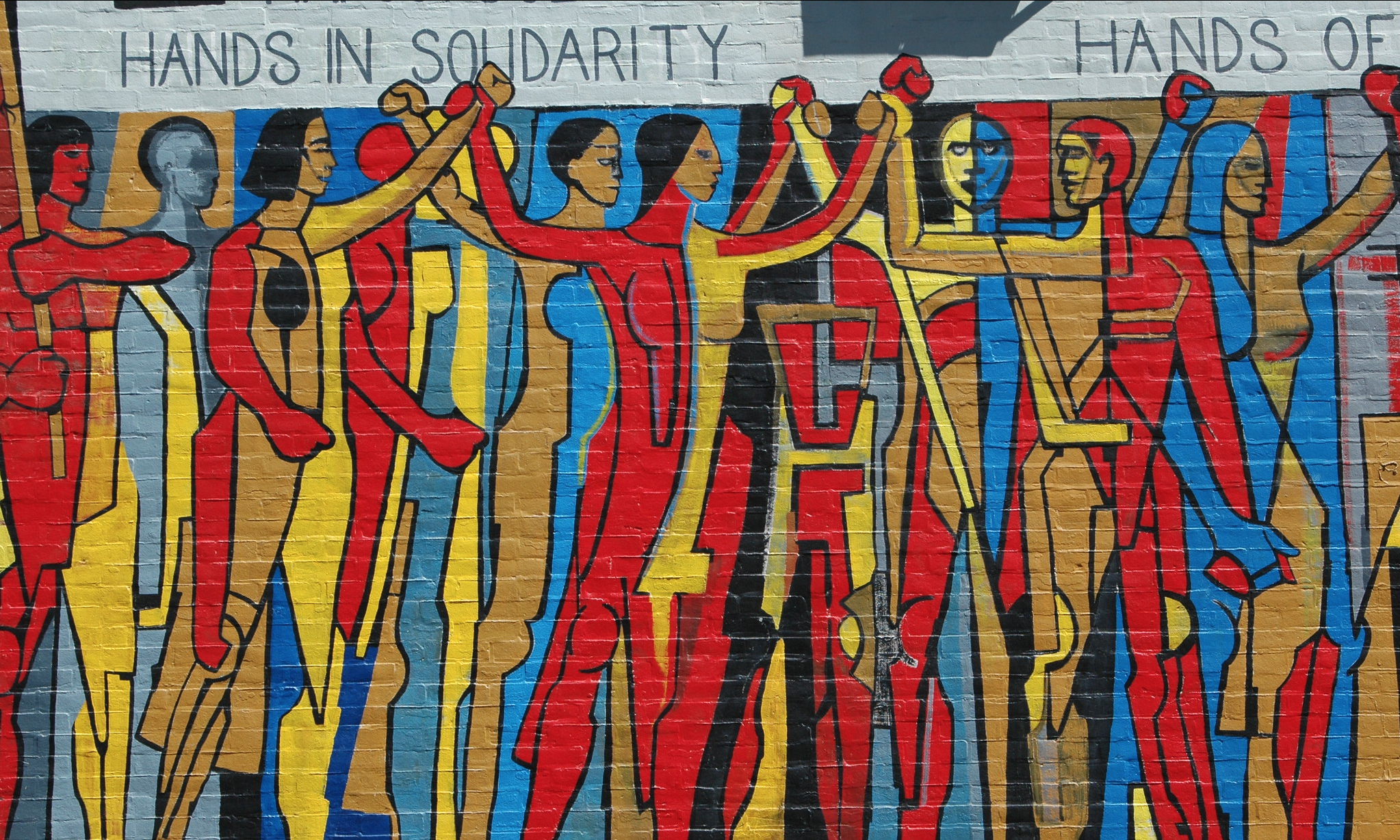
Hands in Solidarity, Hands of Freedom mural on the side of the United Electrical Workers trade union building on West Monroe Street at Ashland Avenue in Chicago, Illinois. Artist Dan Manrique Arias painted this mural in 1997 on the south wall of the United Electrical Workers Union. Photo credit: Terence Faircloth

MAGA’s fast-moving coup is upending the longstanding arrangements that have undergirded domestic politics and the US role in the world. What does this mean for the resistance, and how can the US Left maximize our impact?

No wonder all our heads are spinning. The foundations of the world and the domestic order that everyone under 80 years old has grown up in have been under strain for two decades. Now they are being cracked wide open. A MAGA bloc that has meshed white Christian nationalists, right-wing populists, and a Musk-led “broligarchy” (now MAGA’s dominant faction) has captured the citadel of global power. And it is conducting a Constitution-scrapping coup to consolidate authoritarian rule and implement its take-over-everything-everywhere agenda.

It is urgent to get caught up with the breadth of the changes underway. Doing so requires the broad Left to sustain a difficult, deep-going analytic conversation even as we intensify our practical efforts to put roadblocks in MAGA’s path and build mass traction for a vision of a post-MAGA future that centers multiracial democracy.

In that spirit, I offer four initial theses as one potential entryway into the urgent political and strategic exploration this moment demands.
1. There is no going back.


…the only question is what comes next.

The takeover of the US government that is currently underway aims to change the US political and economic system and shift the map of global politics in fundamental ways.

This moment of epochal change has not come out of the blue. The US-led neoliberal order–with its forever wars, growing gap between the wealth of a few and the poverty of the many, and pathological inaction on climate change–has lost its capacity to undergird social stability or political legitimacy. An exit from that order in one direction or another has been on the horizon since the 2008 financial crisis.

The acceleration of the system’s “polycrisis” intersects with a new phase of the 60-year backlash against the gains of the “long ‘60s” upsurge, driven first and foremost by the Black-led Civil Rights Movement. The political bloc organized around this full-spectrum counter-offensive had gathered enough power by 2020 to prevent any accountability for its first attempt at a political coup. MAGA spent the years after January 6, 2021 building out their disinformation-demagogy infrastructure and making detailed plans for coup number two, which was to be activated whatever the vote count in the 2024 election, and which is now fully underway.

The system of “checks and balances” codified in the US Constitution is rapidly being replaced by the unchecked power of a “unitary executive,” sparking a Constitutional crisis. Every part of the Right’s “long march through the institutions” is now being taken to a new level. Under the banner of fighting DEI and an “immigrant invasion,” the post-Civil Rights Movement racial order is being replaced by a 21st-century version of Jim Crow. Women’s and LGBTQI+ rights are being curtailed via a theocracy-based gender-hierarchy regime, and the very existence of trans people is being challenged. Government bodies and policies that put restrictions on capital, protect workers’ rights, or have a “safety net” component are being dispensed with, as are tens of thousands of federal workers.

Foreign policy is now officially based on the doctrine of might makes right. Multilateralism is out and the pretense of respecting international law (already shredded by Biden’s backing for genocide) is explicitly rejected. The groundwork is being laid for a global alliance of oligarchs, dictators, and fascists (Netanyahu, Putin, Orban, Modi, Trump et al). Using military threats, actual military force, and/or economic warfare (tariffs and sanctions), Washington will now take everything it can get from previous allies and targeted opponents alike.

Even if every administration move is stopped tomorrow, there is no going back to the pre-MAGA world. The combination of continuing polycrisis and the damage that Trump and Musk have already wrought means the only question is what comes next.
2. The range of possible near-term scenarios is very wide


It matters that for all his skills as a demagogue, Trump remains an unpredictable narcissist who surrounds himself with yes-men. The potential for over-reach and strategic stupidity are heightened in a movement with that kind of leader.

A common view among militant anti-MAGA liberals is that, over the course of Trump’s second term, MAGA will transform the US government into something in between a liberal democracy and a dictatorship. Tweaking a term Victor Orban uses to describe his rule in Hungary—“illiberal democracy”—Steven Levitsky and Lucan A. Way, writing in Foreign Affairs, describe the arrangement to come as “competitive authoritarianism.” Chris Cillizza summarizes their view this way:


What lies ahead is not fascist or single-party dictatorship but competitive authoritarianism—a system in which parties compete in elections but the incumbent’s abuse of power tilts the playing field against the opposition… Opposition forces are legal and aboveground, and they contest seriously for power. Elections are often fiercely contested… And once in a while, incumbents lose.

Something like that could certainly be in the cards. But other scenarios—most worse, but some better—are possible over the next two to four years as well.

Worse scenarios are possible because predictions about a shift to “competitive authoritarianism” assume this transition takes place without economic crises, major wars (tariff protectionism has often spurred both of those), large-scale popular upheavals, and/or a serious uptick in organized and semi-organized violence. There is no reason at all to adopt that assumption. On the contrary, the degree of shock (with or without awe) Trump and Musk are applying to a Constitutional system that has lasted more than 200 years–and to a global economic and political order which has the US at its very center–makes some kind of out-of-control catastrophe quite likely.

And in light of Trump’s “I am your retribution” pledge, his pardon of all January 6 defendants, and the cheers from the MAGA base for dehumanizing vitriol directed at immigrants, trans people, Palestinians, Marxists, and “libtards,” assuming that some kind of new state-sanctioned, lynch-mob enforced order “can’t happen here” is simply a manifestation of denial. Descent into a system closer to outright fascism (“techno” or otherwise), may not be the most likely outcome of Trump’s second term, but it cannot be ruled out.

On the other hand, with or without economic crisis or war, the MAGA project has vulnerabilities. It could stall and open the door for a project taking the country in a progressive direction.

The coalition that propelled the GOP to victory in 2024 has numerous parts, and Trump’s governing program—as opposed to his campaign messaging—does not appeal to all of them. The biggest divide is between those people, largely working-class, who voted for Trump because they thought he would address their economic hardship, and the billionaires who want more wealth and profit for themselves. With Musk in the lead, Trump 2.0 has governed so far solely in the interests of the latter.

Add to that the fact that even if all components of the MAGA 2024 coalition stay on board, they do not constitute a majority of the US people. Trump won at the ballot box because a large section of the anti-MAGA majority was either uninspired by or downright alienated from the Democratic campaign and stayed home.

Also, it matters that for all his skills as a demagogue, Trump remains an unpredictable narcissist who surrounds himself with yes-men. The potential for over-reach and strategic stupidity are heightened in a movement with that kind of leader.

Can these factors be transformed from vulnerabilities into a political force that blocks MAGA’s agenda? That depends on the scope and depth of the anti-MAGA resistance.
3. In the resistance, spread courage, be flexible, look for fresh leadership


We can model courage, amplify it when it is displayed, and recognize that courage will also be demonstrated by some people that surprise us.

After a slow start compared to 2016, MAGA’s across-the-board assault has begun to spark an across-the-board resistance. Organizations and leaders that fought hard to stop MAGA before last November have pivoted and are throwing down. Bernie is on a nationwide “Fighting Oligarchy” tour targeting working-class districts and AOC was threatened with arrest by Trump’s “border czar” for providing “know your rights” information to immigrants. The Working Families Party and Justice Democrats are recruiting and training working-class people to run for office in 2026.

Grassroots groups in every targeted constituency (United We Dream, “Rise Up for Trans Youth,” and hundreds more) are organizing their bases and pressuring Democratic Party leaders and electeds to join the fight. In the labor movement, resistance actions are coming from the AFL-CIO leadership (including the “The Department of People Who Work for a Living” initiative) and from rank-and-file initiative (the newly formed Federal Unionists Network (FUN)). Choose Democracy has published “What can I do to fight this coup?,” a resource based on their study of anti-authoritarian organizing worldwide.

And it’s not only pre-existing organizations that are engaging in the fray. Like the FUN network above and #50501, new organizations are springing up. And like the 19,000 students in the Fresno and Madera Unified School Districts in California’s Central Valley who stayed out of school on the national “Day Without Immigrants” protests Feb. 3, new people are stepping into activist and leadership roles.

Practical priority number one for the Left is to bring everything we have to the battles underway: our energy and resources; our proposals for action; our willingness to take risks; our commitment to “an injury to one is an injury to all” as a guide to action. At the same time, to maximize our contribution we also need to understand our limitations. The political forces from Bernie leftward are not strong enough to halt the MAGA offensive on our own. A far broader anti-MAGA coalition is needed, as are new strategies and tactics for this new period.

Those new approaches will not all be generated within our current ranks. The resistance movement is already broad and diverse. It will (and must!) become even more so, which means no single strategy, however insightful, will guide all its parts. Polling shows majorities disapprove of Trump and Musk and oppose bedrock elements of their agenda, but it’s hard to predict what issue will turn public opinion into activity that imposes political consequences on MAGA.

Translating this combination of urgency and a sense of proportion into action can make us most effective at playing the roles we are best equipped to play.

We can bring a measure of leadership to each battlefront, but should be alert to leadership potential in people first stepping forward from working-class and specially oppressed constituencies, and nurture that potential.

We can model courage, amplify it when it is displayed, and recognize that courage will also be demonstrated by some people that surprise us.

We need to build out the on-ramps into our organizations and networks, and lean toward boldness in bringing people who get on those ramps into leadership positions.

Overall, we can think of ourselves as one of the smaller wheels that move bigger wheels, and act accordingly.
4. Aim for a leap in political and operational unity


What’s needed is a large cohort of activists who are embedded in the workplaces, neighborhoods, and cultural and religious institutions of working-class life and act as catalysts to unleash the energy, combativeness, and all-around political leadership potential of those with whom they share the conditions of life.

The Left has an opportunity to make not just an important but a unique contribution to the broad resistance by offering a positive, motivating, and convincingly realistic vision of a post-MAGA-in-power society.

Gaining mass traction for such a vision is important for two reasons. First, it strengthens the resistance. We learned from the 2024 election that opposition to MAGA is not enough to move a large portion of the anti-MAGA majority into action; a positive vision of what MAGA’s opponents are fighting for is required. Two, if and when MAGA is pushed back, in the absence of a progressive force with a credible post-MAGA vision, some variant of the “back to the pre-MAGA status quo” perspective that characterizes a big section of the Democratic Party leadership will win out. That kind of arrangement will not address the needs of the US majority, and will leave the door open for MAGA to posture again as an agent of positive change and for future elections to look a lot more like 2024 than 2020.

Over the last several years, a broad swath of US radicals have gravitated toward advocacy of participating in a broad electoral front against MAGA while working to increase the independent strength of social justice organizations. (Convergence formulates this as “Block and Build.”) When describing the political and economic arrangement this current is fighting for, the most common approach as of now is to advocate for a robust political democracy that is anchored in the interests and needs of the multiracial working class. And in organizational terms, since January 20 there has been a leap in interaction between groups in or close to this political ballpark, and an increased measure of cooperation in mass education, message coordination, and practical organizing work.

Building on that progress, leaps forward both on the political/strategic and operational/organizational levels are now required.

The vision of a multiracial working-class democracy, and the strategy to gain enough governing power to put the country on that path, must be fleshed out and made more concrete. The key issues that process will need to address include: Getting specific about different strategies for power at the local, state and federal levels, and in red, blue and purple areas;
Deepening both components of an inside/outside strategy—fighting inside government and Democratic Party structures and engaging in disruption and mass non-compliance outside those structures;
Understanding the ways in which today’s fights around gender and patriarchy are central to the MAGA vs. anti-MAGA conflict;
Figuring out how to win or “win back” sectors of the Black, Latino/a and Asian-American constituencies that have drifted toward MAGA;
And, since without an internationalist vision any progressive movement in the US is vulnerable to an imperial version of patriotism, developing our foreign policy vision in today’s rapidly changing global landscape.

As the Left takes up these and other matters, I think drawing on the framework of fighting for a Third Reconstruction can be of great help. This framework roots us in US history, sheds significant light on the ways democratic and class struggle intersect and interweave and highlights the driving-force role of the Black working class. The Third Reconstruction outlook is already part of Left discussion (See Peniel E. Joseph, Rev. William Barber, Carl Davidson and Bill Fletcher, Jr., and my own writing) and propels those who take it up to look (or look again) at the work of W.E.B. Dubois, which is valuable even beyond its bearing on this framework.

Even the best radical vision and strategy needs to be offered by a force embedded in the conditions and struggles of workers and the oppressed. And here too there is a foundation to build on. Increasingly, both veteran and new activists agree that skilled paid staffs alone are insufficient for building a durable working-class movement. What’s needed is a large cohort of activists who are embedded in the workplaces, neighborhoods, and cultural and religious institutions of working-class life and act as catalysts to unleash the energy, combativeness, and all-around political leadership potential of those with whom they share the conditions of life. Democratic Socialists of America (DSA) makes a large contribution here and could make a bigger one if the organization shed its political ambivalence—in some factions, downright opposition—toward positioning itself solidly within the broad anti-MAGA front and seeing the strengthening of the front’s progressive wing (not just its socialist component) as a prime strategic task.

Facing a common threat, organizations building bases among workers and the oppressed are breaking out of silos. Cross-organizational dialogue and cooperation are on the rise even as outward-facing activity is intensifying.

As this process moves forward, a few centers of gravity are emerging for forces that oppose MAGA and center working-class interests. Two show particular promise of being able to bring together large portions of today’s progressive trend, forging a political force whose participants range from elected officials to scholars, podcasters, professional organizers, and grassroots activists.

One is the Working Families Party, which has built working alliances on the national level with MoveOn, Indivisible, Public Citizen, Seed the Vote, the Movement for Black Lives (M4BL) and Showing Up for Racial Justice and with numerous state-based power building organizations in the states where it has active operations. WFP has thrown down hard for Palestinian rights and was the initiator of the largest post-election mass call on Zoom with 150,000 participants registered and 200 endorsing organizations.

The second is the motion in the labor movement generated by UAW President Shawn Fain’s call for unions to align contract expiration dates for May 1, 2028 and prepare for a nationwide strike on that date. That initiative taps into the new militancy bubbling up from rank-and-file workers and the growing support for unions fighting for the interests not only of their members but of the working class as a whole, manifested especially in the work of Bargaining for the Common Good.

The political landscape is changing fast. Perhaps other formations with comparable savvy and reach will emerge. The key point is that even as we go all-out in day-to-day resistance to the MAGA blitzkrieg, we need to be investing in an effort that can spearhead the development of a united radical force where the whole adds up to more than the sum of its parts.


Max Elbaum (he/him) has been involved in peace and anti-racist movements since joining Students for a Democratic Society (SDS) in Madison, Wisconsin in the 1960s. Through the 1970s and 1980s he participated in campaigns defending affirmative action and opposing U.S. military interventions in the Third World while writing extensively for the radical press and taking part in then-widespread efforts to construct a new U.S. revolutionary political party. In the 1990s, he was the editor of CrossRoads, a magazine featuring dialogue and debate among socialists and radicals from different left political traditions. In 2001, he was among the founders of War Times/Tiempo de Guerras, until 2006 a free bilingual in-print tabloid distributed nationwide and until 2011 an on-line information and analysis project. He is currently one of the editors of Organizing Upgrade.