Tuesday, March 18, 2025

GUNBOAT DIPLOMACY

Trump Orders US Military to Plan Invasion of Panama to Seize Canal: Report


U.S. officials familiar with the planning said options for "reclaiming" the vital waterway include close cooperation with Panama's military and, absent that, possible war.


Two cargo ships enter the Miraflores Locks of the Panama Canal in Panama City on January 22, 2025.
(Photo: Martin Bernetti/AFP via Getty Images)


Brett Wilkins
Mar 13, 2025
COMMON DREAMS

President Donald Trump has directed the Pentagon to prepare plans for carrying out his threat to "take back" the Panama Canal, including by military force if needed, two U.S. officials familiar with the situation told NBC News Thursday.

According to the outlet, the officials said that U.S. Southern Command (SOUTHCOM) is drawing up potential plans that run the gamut from working more closely with Panama's military to a less likely scenario in which U.S. troops invade the country and take the canal by force. They also said that SOUTHCOM commander Adm. Alvin Holsey has presented draft strategies to be reviewed by U.S. Defense Secretary Pete Hegseth, who is scheduled to visit Panama next month.

The officials explained that the likelihood of a U.S invasion depended on the level of cooperation shown by the Panamanian military.

Trump has repeatedly refused to rule out use of military force to seize control of the vital U.S.-built waterway, as well as Greenland, an autonomous territory of NATO ally Denmark.

Last week during his joint address to Congress, Trump proclaimed that "to further enhance our national security, my administration will be reclaiming the Panama Canal," but his administration has not clarified precisely what "reclaiming" entails.

The Republican president says the U.S. needs to retake control of the Panama Canal to enhance "economic security," and has falsely claimed that the waterway is "operated by China."

Earlier this month, the New York-based investment firm BlackRock led a group of investors in a $23 billion deal to purchase ports at both ends of the Panama Canal from a Hong Kong-based conglomerate, an agreement Trump dubiously seized upon as proof that "we've already started" reclaiming the conduit.

Panamanian President José Raúl Molina countered that "the Panama Canal is not in the process of being reclaimed... The canal is Panamanian and will continue to be Panamanian!"

The U.S. controlled what was formerly called the Panama Canal Zone from the time of the waterway's construction in the early 20th century—largely done by Afro-Caribbean workers, thousands of whom died in what's widely known as the world's deadliest construction project—until then-President Jimmy Carter transferred sovereignty to Panama in the late 1970s. Under the Torrijos-Carter treaties, the U.S. reserves the right to use military force to defend the canal's neutrality.

The United States has repeatedly used deadly military force in Panama over the decades, including during a 1964 student-led uprising against American control in which 22 Panamanians and four U.S. soldiers were killed, and in a full-scale invasion in 1989 ordered by then-President George H.W. Bush to capture erstwhile ally and CIA asset turned narcotrafficking dictator Manuel Noriega. The U.S. invaders killed hundreds of Panamanians, including many civilians.

Writing for Americas Quarterly this week, Panamanian jurist Alonso E. Illueca argued that Panama's efforts to appease Trump aren't working. These include the BlackRock deal and other moves like quitting China's "Belt and Road" initiative, taking in third-country migrants deported by the U.S., backing a U.S. resolution on Ukraine at the United Nations Security Council, auditing the country's ports, and revisiting a railway project originally developed by the Chinese government.

"Panama should abandon its accommodating policy towards the U.S., which can only lead to escalating demands to banish Chinese influence, to the detriment of Panama's national sovereignty," Illueca asserted.

"An alternative policy for Panama is to align with the rules based international order," he continued. "This includes establishing synergies with like-minded states which have been also affected by U.S. actions such as Canada, Mexico, Greenland, and Denmark. The country should seek to transcend the U.S.-China binary and find alternatives for alliances, which should include partners like the European Union."

"In short," Illueca added, "the way forward for Panama lies in replacing strategic dissonance with strategic clarity."
'National Disgrace': Sanders and Senate Dems Call Out Trump Attack on Education Dept


"Our nation's public schools, colleges, and universities are preparing the next generation of America's leaders—we must take steps to strengthen education in this country, not take a wrecking ball to the agency that exists to do so."


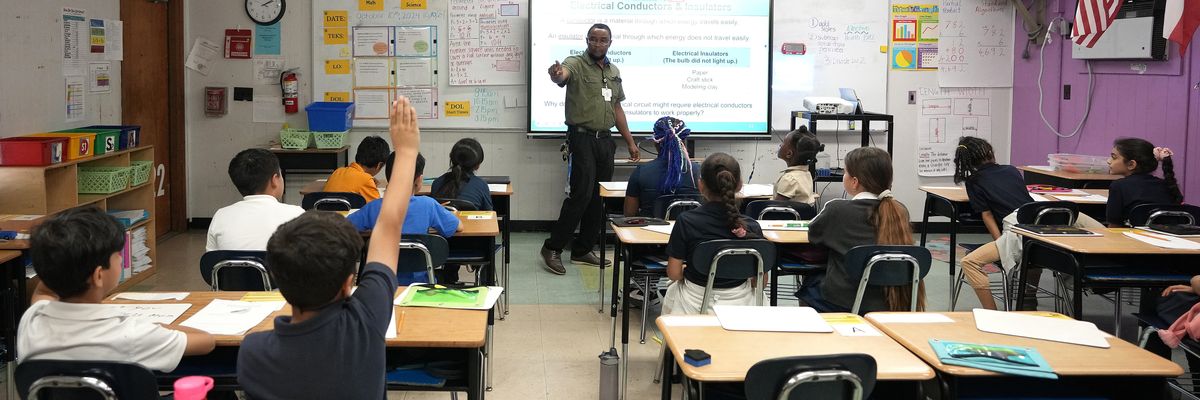
Fourth grade science teacher Paul Obakpolo teaches at Benavidez Elementary School on October 10, 2024, in Houston.
(Photo: Karen Warren/Houston Chronicle via Getty Images)

Julia Conley
Mar 17, 2025
COMMON DREAMS

In a letter to U.S. Education Secretary Linda McMahon on Monday, Sen. Bernie Sanders led more than three dozen of his Democratic colleagues in dismissing the Trump administration's "false claims of financial savings" from slashing more than 1,000 jobs at the Education Department, emphasizing that the wealthy people leading federal policy "will not be harmed by these egregious attacks" on public schools.

"Wealthy families sending their children to elite, private schools will still be able to get a quality education even if every public school disappears in this country," reads the letter spearheaded by Sanders (I-Vt.), the ranking member of the Senate Health, Education, Labor, and Pensions Committee. "But for working-class families, high-quality public education is an opportunity they rely on for their children to have a path to do well in life."

The decision by President Donald Trump and his unelected billionaire ally, Elon Musk of the so-called Department of Government Efficiency( DOGE), to slash the Department of Education (DOE) workforce by 50%—or 1,300 people—and take steps to illegally close the agency has already had an impact on students, noted the senators, pointing to a glitch in the Free Application for Federal Financial Aid (FAFSA) that preventing families from accessing the applications "not even 24 hours after the staff reductions were announced."

"The staff normally responsible for fixing those errors had reportedly been cut," reads the letter, which was also signed by lawmakers including Sens. Elizabeth Warren (D-Mass.), Peter Welch (D-Vt.), and Ron Wyden (D-Ore.).

"Without the Department of Education, there is no guarantee that states would uphold students' civil and educational rights."

The letter was sent as The Associated Pressreported that cuts within the DOE's Office of Civil Rights have placed new barriers in front of families with children who have disabilities. Families who can't afford to take legal action against schools or districts that are not providing accommodations or services for students with disabilities have long been able to rely on on the office to open an investigation into their cases, but the AP reported that "more than 20,000 pending cases—including those related to kids with disabilities, historically the largest share of the office's work—largely sat idle for weeks after Trump took office."

"A freeze on processing the cases was lifted early this month, but advocates question whether the department can make progress on them with a smaller staff," reported the outlet.

The reduction in force has been compounded by the fact that the remaining staff has been directed to prioritize antisemitism cases, as the Trump administration places significant attention on allegations that pro-Palestinian organizers, particularly on college campuses, have endangered Jewish students by speaking out in favor of Palestinian rights and against Israel's U.S.-backed assault on Gaza and the West Bank.

An analysis of more than 550 campus protests found that 97% of the demonstrations last year remained non-violent, contrary to repeated claims by both Republican and Democratic lawmakers that they placed Jewish students in danger. Meanwhile, the Trump administration, pro-Israel advocates, and Republicans have dismissed outcry over Musk's display of a Nazi salute at an inaugural event in January.

"Special needs kids [are] now suffering because of a manufactured hysteria aimed [at] silencing dissent against genocide," said writer and political analyst Yousef Munayyer. "Utter depravity."

In their letter, Sanders and his Democratic colleagues noted that "several regional offices responsible for investigating potential violations of students' civil rights in local schools" have also been shuttered, expressing alarm that many cases will likely "go uninvestigated and that students will be left in unsafe learning environments as a result."

They noted that at a time of "massive income and wealth inequality, when 60% of people live paycheck to paycheck," the federal government's defunding of public education "would result in either higher property taxes or decreased funding for public schools, including in rural areas."

"It is a national disgrace that the Trump administration is attempting to illegally abolish the Department of Education and thus, undermine a high-quality education for our students," wrote the lawmakers. "These reductions will have devastating impacts on our nation's students and we are deeply concerned that without staff, the department will be unable to fulfill critical functions, such as ensuring students can access federal financial aid, upholding students' civil rights, and guaranteeing that federal funding reaches communities promptly and is well-spent."

Trump, they noted, has expressed a desire "to return education back to the states" despite the fact that state governments and local school boards already make education policy, with just 11% of public education funding coming from the DOE.

However, "the Department of Education has a necessary and irreplaceable responsibility to implement federal laws that ensure equal opportunity for all children in this country," they wrote. "These laws guarantee fundamental protections, such as ensuring that children with disabilities receive a free appropriate public education in the least restrictive environment, that students from low-income backgrounds and students of color will not be disproportionately taught by less experienced and qualified teachers, and that parents will receive information about their child's academic achievement."

"Without the Department of Education, there is no guarantee that states would uphold students' civil and educational rights," said the lawmakers. "We will not stand by as you attempt to turn back the clock on education in this country through gutting the Department of Education. Our nation's public schools, colleges, and universities are preparing the next generation of America's leaders—we must take steps to strengthen education in this country, not take a wrecking ball to the agency that exists to do so."
Peace Institute Vows Legal Action to Oppose 'Illegal Takeover' by DOGE


"If DOGE can do this to USIP, what's to stop them from breaking into offices of other NGOs that receive U.S. funds? Or law firms or media that annoy the president?" said one humanitarian advocate.


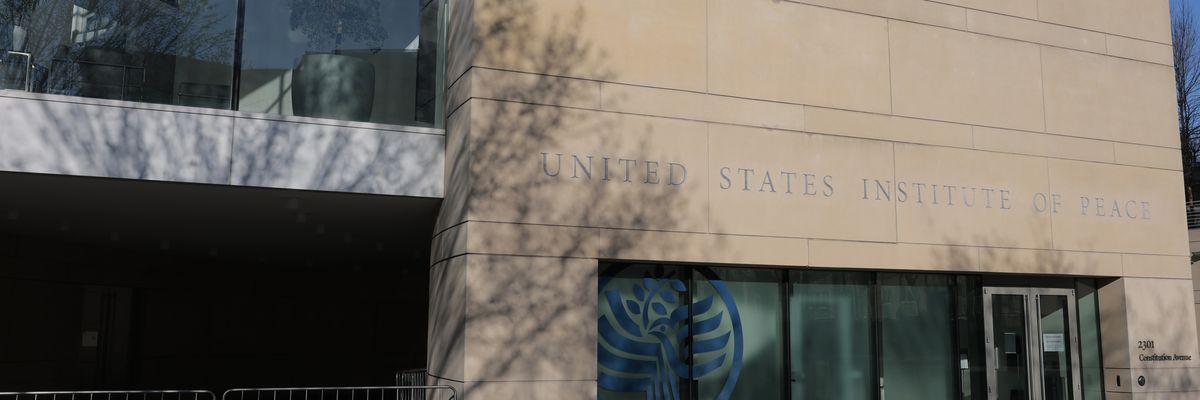
A view of the United States Institute of Peace (USIP) building headquarters is seen on March 18, 2025 in Washington, D.C.
(Photo: Anna Moneymaker/Getty Images)

Eloise Goldsmith
Mar 18, 2025
COMMON DREAMS


Representatives of Elon Musk's Department of Government Efficiency on Monday entered the headquarters with of the U.S. Institute of Peace with the help of D.C. police, according to the institute's staff—and now USIP's acting president, who was fired by the institute's newly configured board, is vowing to take legal action.

Fired acting president George Moose, who is challenging his removal, toldThe Associated Press on Monday, "What has happened here today is an illegal takeover by elements of the executive branch of a private nonprofit."

To CNN, Moose said that the institute intends to "vigorously" oppose DOGE's actions in court. "We are confident of our legal status, and we are confident that a court that gives us a hearing will be persuaded by the strength of our legal argument," he told the outlet.

The dramatic showdown on Monday follows an executive order signed by U.S. President Donald Trump in February that called for "the nonstatutory components and functions" of select "governmental entities"—including USiP—to "be eliminated to the maximum extent consistent with applicable law."

USIP, whose mission is to promote peace and end conflict abroad, is an independent organization that was created by Congress in 1984. Representatives from USIP contend that because the institute is a congressionally chartered nonprofit, Musk and Trump do not have the power to dismantle it, according to the The New York Times.

On Friday, the White House told all but three members of USIP's board they were fired and its remaining members—Defense Secretary Pete Hegseth, Secretary of State Marco Rubio, and president of the National Defense University Peter Garvin—replaced Moose with Kenneth Jackson, a State Department official who, per the Times, was involved in the Trump administration's targeting of the now largely hollowed out U.S. Agency for International Development. USIP does not view Jackson's appointment as legal, per CNN.

DOGE representatives unsuccessfully tried to gain access to the USIP building twice on Friday, the second time with FBI agents in toe, but were turned away by representatives for the institute, according to the Times.

Then, on Monday, members of DOGE arrived again with Jackson. According to multiple outlets, citing representatives from USIP, the institute called the D.C. Metropolitan Police, but when they arrived they allowed Musk's team to enter the building.

USIP's chief security officer Colin O'Brien toldCNN that when he went out to greet the police "they held the door open and allowed members of DOGE to enter the building, where they were also followed by 10 to 12 police officers, uniformed D.C. police officers."

Some USIP officials remained in the building after DOGE representatives were let in, including Moose. Police later forced him to leave the building, per CNN.

"Mr. Moose denied lawful access to Kenneth Jackson, the acting USIP president (as approved by the USIP board). The D.C. Police Department arrived on-site and escorted Mr. Jackson into the building. The only unlawful individual was Mr. Moose, who refused to comply, and even tried to fire USIP's private security team when said security team went to give access to Mr. Jackson," DOGE wrote in a post on X on Monday night.

Rep. Don Beyer (D-Va.) declared on X on Monday night that "I was at USIP tonight to conduct congressional oversight over DOGE's break-in. I spoke with Acting President & CEO Moose. USIP is an independent, non-profit entity and I will work to stop DOGE's illegal power grab."


Jeremy Konyndyk, the president of Refugees International, wrote on X: "if DOGE can do this to USIP, what's to stop them from breaking into offices of other NGOs that receive U.S. funds? Or law firms or media that annoy the president?"

Two Musk officials who gained entry to USIP on Monday were Nate Cavanaugh and Justin Aimonetti, the same DOGE staffers who last month forced entry to the U.S. African Development Foundation (USADF), which was also named in Trump's February order, per the Times.

In early March, staff with the USADF tried to keep DOGE staff from entering their offices in D.C. DOGE staff managed to gain entry after returning with U.S. Marshals.
'Completely Delusional': Trump Calls for Reinvigorating Domestic Use of US Coal

"Donald Trump is not concerned with Americans' health or economic wellbeing. He is only concerned with helping out his billionaire buddies in the fossil fuel industry," said one climate advocate.


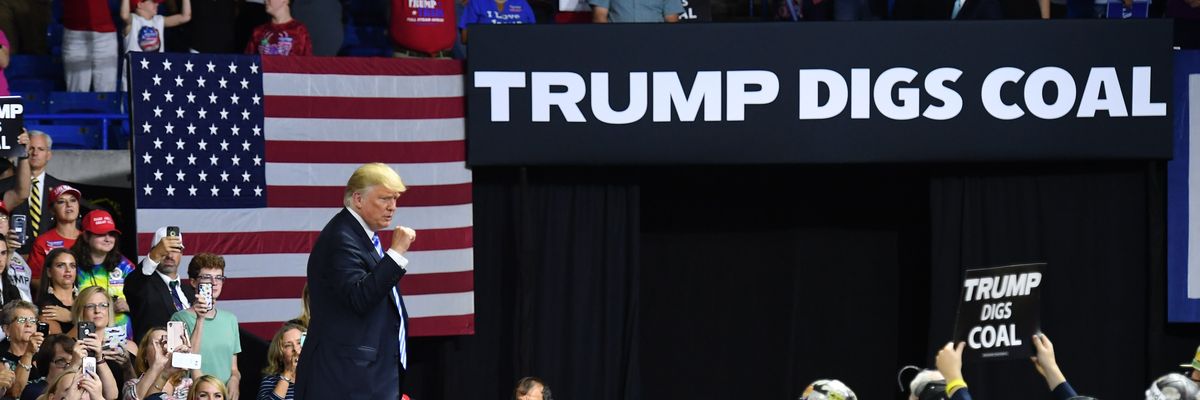
U.S. President Donald Trump salutes his supporters at a political rally at Charleston Civic Center in Charleston, West Virginia on August 21, 2018.
(Photo: Mandel Ngan / AFP)


Eloise Goldsmith
Mar 18, 2025
COMMON DREAMS

After U.S. President Donald Trump declared on Truth Social on Monday night that he is ordering his administration "to immediately begin producing Energy with BEAUTIFUL, CLEAN COAL," a leader at the grassroots environmental group Sierra Club quickly hit back, calling the move "completely delusional."


Trump said he was announcing the move as a means to counter China's economic edge. The announcement comes "after years of being held captive by Environmental Extremists, Lunatics, Radicals, and Thugs, allowing other Countries, in particular China, to gain tremendous Economic advantage over us by opening up hundreds of all Coal Fire Power Plants," Trump wrote.

It was not immediately clear what Trump's directive was referring to or how his announcement on social media would impact U.S. policy, according to Bloomberg.

"There is no such thing as clean coal. There is only coal that pollutes our air and water so severely that nearly half a million Americans have died prematurely from coal in the last two decades," said Sierra Club director of climate policy Patrick Drupp in a statement Tuesday. "Donald Trump is not concerned with Americans' health or economic wellbeing. He is only concerned with helping out his billionaire buddies in the fossil fuel industry."

Trump's cabinet includes a number figures who are friendly to the fossil fuel industry, such as Energy Secretary Chris Wright, who was a fracking industry CEO, and Interior Secretary Doug Burgum, a known ally of oil and gas companies.

On his first day in office, Trump declared a national energy emergency to ensure "an affordable and reliable domestic supply of energy," called for expedited "permitting and leasing of energy and natural resource projects in Alaska," and withdrew the United States from the the world's main climate pact.

The U.S. is mulling using emergency authority to bring coal-fired plants back online and halt others from shutting, Burgum toldBloomberg Television in an interview last week.

"Under the national energy emergency, which President Trump has declared, we've got to keep every coal plant open," Burgum said while at the energy sector gathering CERAWeek. "And if there had been units at a coal plant that have been shut down, we need to bring those back."

Meanwhile, Environmental Protection Agency Administrator Lee Zeldin earlier this month announced a new effort to rollback a host of EPA regulations, including some that will impact coal producers.

The coal mining company Peabody Energy saw their stock rise 3.5% after Trump's Monday post on social media about "clean coal," according to Tuesday morning reporting from Schaeffer's Investment Research.

As of 2023, coal accounted for 16.2% of U.S. electricity generation, according to the U.S. Energy Information Administration. That year, 21.4% came from renewables.

In its statement released on Tuesday, Sierra Club took issue with Trump's assertion that investing in coal has provided an economic boost to other countries. "Trump refers to the 'Economic advantage' that burning coal has afforded other nations. In reality, renewable energy is quickly becoming more affordable and reliable than coal," they wrote.

In 2023, the think tank Energy Innovation Policy & Technology released an analysis which found that 99% of coal plants are more expensive to run compared to replacing their generation capacity with either solar or wind power, when taking into account credits that were made available through the Inflation Reduction Act.


The Fix Our Forests Act and the Politics of Wildfire

Logging interests and the U.S. Forest Service have a history of using the wildfire threat to create “emergency” authority to bypass environmental reviews and curtail judicial oversight.


Trees grow in a redwood forest.
(Photo: Getty Images)


Rob Lewis
Mar 18, 2025
Common Dreams

When on January 23 of this year, California Senator Jarred Huffman stood on the House floor to voice his opposition to the Fix Our Forests Act, or FOFA,, he bitterly noted how the bill had been rushed to a vote without normal consultation.

The reason for the rush was obvious. Fires were raging in the suburbs of Los Angeles and FOFA’s proponents wanted to capitalize on the tragedy to pitch their bill, which in the name of wildfire prevention exempts vast acreage of backcountry logging from ordinary scientific and judicial oversight. The irony is that the LA fires had no connection with forests whatsoever. They began as grass and brush fires near populated areas, which, fanned by ferocious Santa Ana winds, quickly spread building to building, with disastrous results.

The irony widens when you consider that in 2024, Huffman, along with California Republican Jay Obernolte, introduced a bill that actually would help communities deal with fire. Called the Community Protection and Wildfire Resilience Act, it proposed $1 billion per year to help communities harden homes and critical infrastructure while also creating defensive space around their perimeters. The bill was introduced this year yet again, six days after FOFA was rushed to a vote, but it hasn’t even been given a hearing by the House Natural Resources Committee. That committee is chaired by Oklahoma Republican Bruce Westerman, who, it turns out, is the chief sponsor of the Fix Our Forests Act.

Once again, it’s the same old formula: slash citizen oversight in the name of wildfire reduction.

Do you see the political convolutions at work here? A very real fire danger facing communities is used to promote a bill focused primarily on back country “fuels reduction,” far from such communities, while the Huffman-Obernolte bill, that focuses on the communities themselves, gets nowhere. The process not only puts millions of acres of mature and old-growth forests at risk of massive “mechanical treatments,” it leaves the immediate fire dangers faced by communities largely unaddressed.

This political formula is nothing new. Twenty two years ago, then-President George W. Bush signed into law the Healthy Forests Restoration Act of 2003, which also sought environmental restrictions for expanded logging under the pretext of preventing wildfires like those in California. The concern for conservationists was the same then as it is now—logging interests and the U.S. Forest Service using the wildfire threat to create “emergency” authority to bypass environmental reviews and curtail judicial oversight, providing easier access to mature and old-growth forests, while doing little in the way of home hardening and community protection.

Proponents of the Fix our Forests Act would counter that there are provisions within the bill that help coordinate grant applications for communities. That’s well and good, but falls far short of what the Huffman-Obernolte bill provides, which not only includes major funding to harden homes and critical infrastructure, but helps with early detection and evacuation planning and initiates Community Protection and Wildfire Resilience plans for insurance certification.

Further, there is a plethora of research that contradicts the notion that fuels reduction and forest thinning protects communities from wildfire. In fact, intensive forest management is shown to often increase fire severity. Meanwhile, the industry position that forest protection increases fire risk doesn’t stand up to scrutiny. Indeed, years of mechanical treatments have done little to solve the problem, while doing tremendous ecological damage.

Now we have President Donald Trump’s all-caps Executive Order: “IMMEDIATE EXPANSION OF AMERICAN TIMBER PRODUCTION.” Once again, it’s the same old formula: slash citizen oversight in the name of wildfire reduction. The order calls for action to “reduce unnecessarily lengthy processes and associated costs related to administrative approvals for timber production, forest management, and wildfire risk reduction treatments,” while putting community safety up as the justification. From the first paragraph: “Furthermore, as recent disasters demonstrate, forest management and wildfire risk reduction projects can save American lives and communities.” Only they don’t. The only things shown to save lives and communities are the types of actions put forth by the Community Protections and Wildfire Resilience act.

The Democratic Party has a history of protecting public lands and a constituency that expects such protection. A similar thing can be said of certain moderate Republicans, where a courageous spirit prevails when it comes to environmental protection. If there ever was a time to remember that tradition and that spirit, it would be now.


Our work is licensed under Creative Commons (CC BY-NC-ND 3.0). Feel free to republish and share widely.


Rob Lewis is an environmental writer, poet, and activist. He has been published in numerous anthologies, newspapers, and magazines, and is the author of the poem and essay collection, The Silence of Vanishing Things. He currently writes the Substack newsletter, The Climate According to Life.
Full Bio >
'Not Acceptable': Trump EPA Teases Evisceration of Scientific Research Office

"Every decision EPA makes must be in furtherance of protecting human health and the environment, and that just can't happen if you gut EPA science," said one Democratic lawmaker.


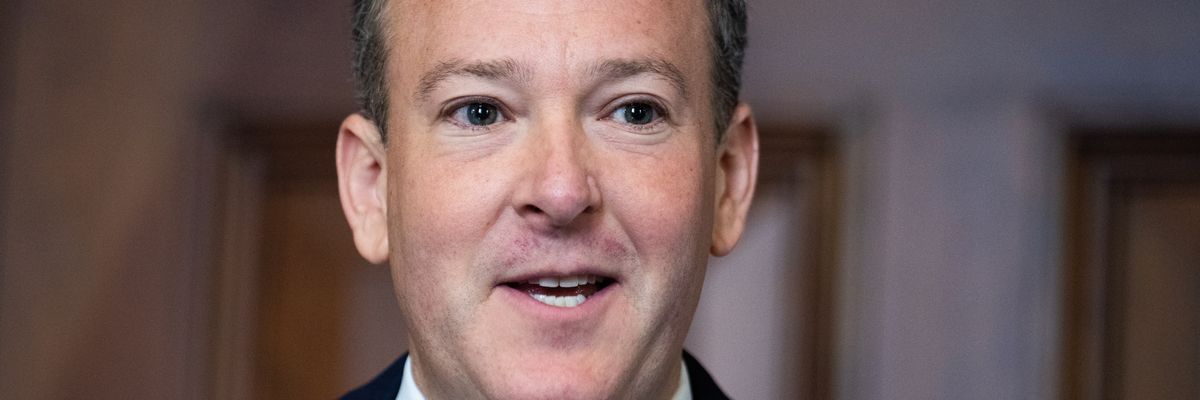
Lee Zeldin, administrator of the Environmental Protection Agency, speaks at the EPA on February 18, 2025.
Photo: Tom Williams/CQ-Roll Call, Inc via Getty Images

Julia Conley
Mar 18, 2025
COMMON DREAMS


Climate campaigners on Tuesday accused the Republican head of the U.S. Environmental Protection Agency of a "calculated betrayal of public health and the environment" after House Democrats obtained documents outlining the possible elimination of the EPA's science research office—whose work underpins the agency's anti-pollution policies.

The Democratic staff on the House Science, Space, and Technology Committee reviewed the proposal, which was shared with the White House last Friday and called for the EPA Office of Research and Development (ORD) to be eliminated as a national program office, with 50-75% of its 1,540 staffers dismissed and the rest reassigned to EPA positions that "align with administration priorities."

The ORD employs chemists, biologists, doctors, nurses, and experts on wetlands and other issues who contribute to research on per- and polyfluoroalkyl substances (PFAS), or "forever chemicals," in drinking water; contamination in drinking water caused by fracking; the impact of wildfire smoke on public health; and other environmental matters. The New York Times reported that the proposed cuts—which follow President Donald Trump's call to slash the EPA's overall budget by 65%—would cost jobs at the agency's major research labs in North Carolina and Oklahoma.

Rep. Zoe Lofgren (D-Calif.) ranking member of the House science panel, told the Times that closing the office would mean the EPA was no longer meeting its legal obligation to use the "best available science" to draft regulations and policies.

"Every decision EPA makes must be in furtherance of protecting human health and the environment, and that just can't happen if you gut EPA science," Lofgren said, noting that the ORD was created by Congress and cannot be unilaterally dismantled by the executive branch.

The plan to eliminate the ORD "sells out our public health," said the Federation of American Scientists.


During his campaign, Trump promised the fossil fuel industry he would work to slash regulations meant to protect public health. On Tuesday, Chitra Kumar, managing director of the climate and energy program at the Union of Concerned Scientists, said making it harder for the government to "set protective health standards" is likely "exactly what this administration is aiming for."

"The scientists and experts in this office conduct and review the best available science to set limits on pollution and regulate hazardous chemicals to keep the public safe," said Kumar. "We're talking about soot that worsens asthma and heart disease, carcinogenic 'forever chemicals' in drinking water, and heat-trapping emissions driving climate change. The administration knows, and history shows, that industry will not regulate itself."

With an EPA spokesperson saying Tuesday that "no decisions have been made yet," Kumar said that "it's paramount that the administration hear: This is not acceptable."

"Everyone, including President Trump and his Cabinet's children and grandchildren, would feel the consequences of this move, not to mention the most polluted communities, predominantly Black, Brown and low income, who would bear the brunt," said Kumar. "Is the administration’s ideology and pledge to industries that strong that they are willing to put their own loved ones at risk?"

The potential closure of the ORD would represent another victory for the authors of Project 2025, the right-wing policy blueprint that called to shutter the Department of Education and impose work requirements for Medicaid recipients.

The agenda's chapter on the EPA calls for the elimination of programs in the ORD and claims that the office is "precautionary, bloated, unaccountable, closed, outcome-driven, hostile to public and legislative input, and inclined to pursue political rather than purely scientific goals."

Project 2025's authors have particularly called for the termination of the ORD's Integrated Risk Information System (IRIS), which informs toxic chemical regulations by assessing their effects on human health. As ProPublicareported earlier this month, Republicans in Congress are pushing legislation that would prohibit the EPA from using IRIS' chemical assessments to underpin regulations and other policies.

The American Chemistry Council, which represents more than 190 corporations, called on EPA Administrator Lee Zeldin to disband IRIS earlier this year, and the Republican lawmaker who introduced a bill to end the program represents a district where formaldehyde maker Hexion has a plant.

The push to close the ORD, according to former official Jennifer Orme-Zavaleta, is the result of a "multi-decade... attack on the risk-assessment process, in particular."

Without the ORD and IRIS, Orme-Zavaleta told the Times, "the agency will not be fulfilling its mission, and people will not be protected. They will be at greater risk. The environment will be at greater risk."

John Noel, deputy climate director for Greenpeace USA, said the push to close the ORD and end its risk assessment work suggests that Zeldin "seems to believe his job is to serve corporate polluters rather than the American people."

"For decades, these EPA regulations have been a critical line of defense against harmful pollution, protecting public health, and tackling the climate crisis," said Noel. "Yet even these safeguards have never been enough. This year alone, our country has been ravaged by extreme hurricanes, devastating wildfires, and record-breaking heat—in large part, consequences of pollution. Instead of holding these industries accountable, the EPA is giving them a free pass."

“EPA exists to protect our health and environment—not to gut the very safeguards that protect us," said Noel. "As the climate crisis grows, the agency must reverse this reckless course and recommit to its core mission: protecting people and not the economic interests of polluting corporations."
TRUMP'S MERCANTILISM

Neo-Feudalism: the Enemy the Left Must Name to Defeat

The only way forward is to complete the unfinished revolution against feudalism—not through reactionary nationalism, but through systemic transformation.


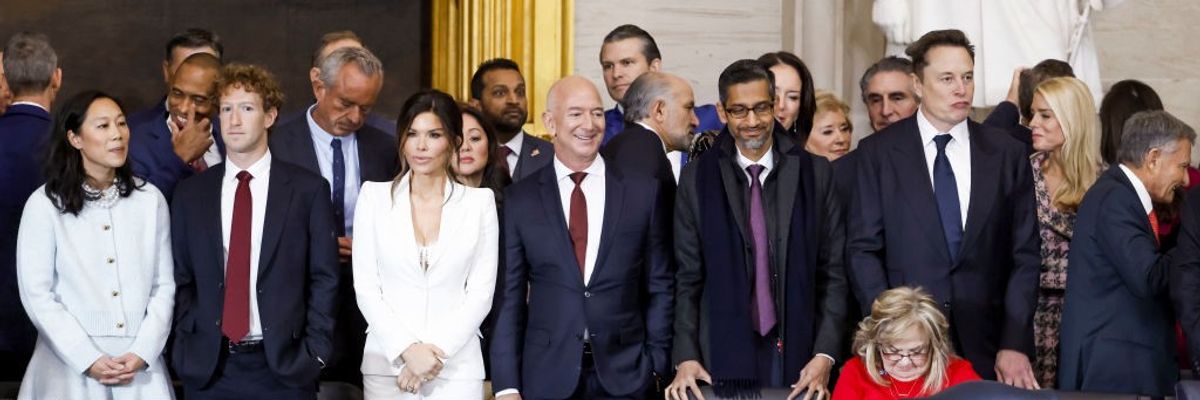
Priscilla Chan, Meta CEO Mark Zuckerberg, Lauren Sanchez, businessman Jeff Bezos, Alphabet's CEO Sundar Pichai, and businessman Elon Musk, among other dignitaries, attend the United States Capitol on January 20, 2025 in Washington, D.C.
(Photo: Shawn Thew-Pool/Getty Images)


Vinnie Rotondaro
Mar 18, 2025
Common Dreams


In 1776, America declared independence not just from a king, but from an entire feudal order. The promise was radical: no more lords and vassals, no more aristocratic monopolies, no more inherited rule. It was a vision of self-governance, economic freedom, and political democracy.

As we know, this promise was deeply flawed from the outset—built atop the brutal reality of chattel slavery, which entrenched a racial caste system even as the revolution sought to break from feudal hierarchy.

Still, the revolutionary spark—that governance should belong to the people, not an inherited elite—set a course for future struggles, from abolition to labor rights to civil rights. The unfinished promise of 1776 has always been to extend that right to everyone, dismantling old forms of domination wherever they persist.

The fight against neo-feudalism must be reclaimed by a left willing to challenge entrenched power at its roots, not merely manage decline.

Yet nearly 250 years later, we find ourselves under the shadow of a system that eerily resembles the one we once revolted against. Power is no longer held by monarchs but by corporate oligarchs and billionaire dynasties. The vast majority of Americans—trapped in cycles of debt, precarious labor, and diminishing rights—are not citizens in any meaningful sense.

We talk around this reality. We call it “money in politics,” “corporate influence,” and “economic inequality.” But these are symptoms, not the disease. The disease is neo-feudalism—a system in which power is entrenched, inherited, and designed to be impossible to escape. And unless we call it by its true name, we will never build the movement needed to fight it.

Feudalism may have faded in name, but many of its structures remain. Today’s hierarchy mirrors the past in ways we can no longer ignore.Then: Lords owned the land, and peasants worked it under their control.
Now: A handful of corporations and investment firms own vast swaths of housing, farmland, and industry.
Then: Aristocracies passed power down through hereditary privilege.
Now: Dynastic billionaires and corporate monopolies ensure that wealth remains concentrated in a ruling class.
Then: The peasantry was bound to their lords by custom, debt, and necessity.
Now: Student debt, medical bills, and stagnant wages trap entire generations in perpetual economic dependence.
Then: Political power was controlled by a small elite who ruled by divine right.
Now: The illusion of democracy masks the fact that billionaires fund both parties, controlling policy no matter who is elected.

This is not the free society America was supposed to be. It is a highly stratified system in which the many serve the interests of the few, with no meaningful path to real power. And worse, the establishment left—rather than challenging this order—has come to represent it.

The Democratic Party was once the party of the working class. Today, it has become the party of the professional-managerial elite—the bureaucrats, consultants, and media figures who believe that governing is their birthright.

The establishment left has in many ways absorbed the role of the aristocracy—not just in terms of wealth but in the way it positions itself as the enlightened ruling class. They claim to stand for “equity” and “democracy,” yet do nothing to challenge the real structures of power.

Instead, they manage decline while maintaining their own privilege—careful not to upset the donor class that sustains them.

As newly elected Democratic National Committee Chair Ken Martin put it, “There are a lot of good billionaires out there that have been with Democrats, who share our values, and we will take their money. But we’re not taking money from those bad billionaires.”

Pronouncements from global elites certainly don’t help either. The now-infamous slogan “You’ll own nothing and be happy”—popularized by the World Economic Forum and widely interpreted as a blueprint for a hyper-managed future—only fuels growing resentment toward an emerging system where ownership, autonomy, and mobility are increasingly out of reach for the average person.

This is why figures like Steve Bannon and reactionary populists have hijacked the narrative of neo-feudalism. Despite his own ties to oligarchs, Bannon has correctly identified that America is no longer a capitalist democracy but a feudal order where power is locked away from ordinary people.

He explicitly frames this crisis as a return to feudal hierarchy: “The ‘hate America’ crowd… they believe in some sort of techno-feudal situation, like was in Italy, back in the 14th and 15th century… where they are like a city-state, and there are a bunch of serfs that work for them. Not American citizens, but serfs, indentured servants.”

He has also drawn direct comparisons between modern economic conditions and serfdom: “Here’s the thing with millennials, they’re like 19th-century Russian serfs. They’re in better shape, they have more information, they’re better dressed. But they don’t own anything.”

However, Bannon’s solution—a nationalist strongman government—represents just another form of vassalage.

Reactionary populists like Bannon, President Donald Trump, and Tucker Carlson exploit real economic grievances and redirect them into a revenge narrative. Instead of seeing neo-feudalism as a system that transcends party or nationality—one that has evolved from medieval serfdom to corporate vassalage—they reframe it as a nationalist grievance.

Bannon likens “globalists” (an ambiguous term) to feudal overlords, but insists that nationalism can break their grip. Trump labels the deep state and liberal elites as the enemy, but assumes the role of a strongman to restore justice. Carlson says the working class is being crushed, but blames cultural elites rather than the billionaire class as a whole.

This misdirection is key. Rather than exposing the true architects of neo-feudalism—corporate monopolists, financial barons, and entrenched dynasties—these reactionaries redirect public anger toward an amorphous “cultural aristocracy” of media figures, academics, and bureaucrats. The real oligarchs escape scrutiny, while the working class is fed a narrative that pits them against cultural elites rather than the economic structures that keep them in servitude.

The only way forward is to complete the unfinished revolution against feudalism—not through reactionary nationalism, but through systemic transformation. The fight against neo-feudalism must be reclaimed by a left willing to challenge entrenched power at its roots, not merely manage decline.

The question is no longer whether neo-feudalism exists. The question is whether the left will finally recognize it—and act before it’s too late. If it fails, the fight will be lost to those who see the problem but offer only deeper subjugation as the solution.


Our work is licensed under Creative Commons (CC BY-NC-ND 3.0). Feel free to republish and share widely.


Vinnie Rotondaro
Vinnie Rotondaro’s work has appeared in Vox, Vice, and Narratively, where he won the 2014 New York Press Club award for “best internet feature.” Currently, he is a doctoral student at the California Institute of Integral Studies where he is studying the intersections of identity, power structures, and historical consciousness, with a focus on the Italian American experience.
Full Bio >
Judge Rules Musk's DOGE Acted Unconstitutionally by Dismantling USAID

"This case is a milestone in pushing back on Musk and DOGE's illegality," said Norm Eisen of the State Democracy Defenders Fund.


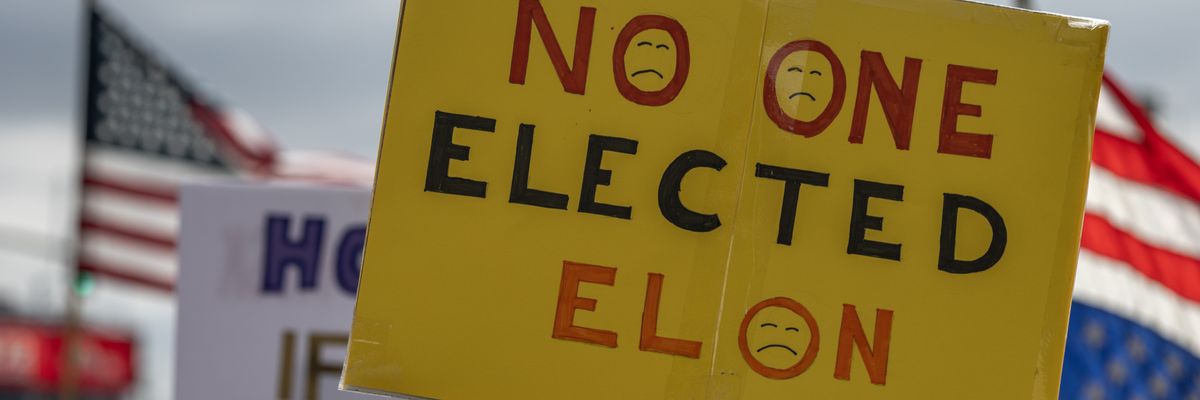
People protest outside the former SpaceX headquarters to denounce the chaos caused by massive government slashing efforts by SpaceX CEO Elon Musk on March 1, 2025 in Hawthorne, California.
(Photo: David McNew/Getty Images)


Julia Conley
Mar 18, 2025
COMMON DREAMS

A U.S. judge on Tuesday barred the Trump administration-created Department of Government Efficiency from taking "any actions relating" to the federal international aid agency it began pushing to dismantle in February, and said "special government employee" Elon Musk likely acted unconstitutionally "in multiple ways" by moving to shut down the agency.

In Maryland, U.S. District Judge Theodore Chuang ruled in favor of 26 current and former employees of the U.S. Agency for International Development (USAID), one of the earliest targets of Musk's push to slash government spending and fire tens of thousands of civil servants. Chuang ordered DOGE to restore email, payment, and system access to all current USAID employees.

The workers are being represented by the State Democracy Defenders Fund, and have accused Musk of acting unconstitutionally.


"Today's decision is an important victory against Elon Musk and his DOGE attack on USAID, the United States government, and the Constitution," said Norm Eisen, executive chair of the group. "They are performing surgery with a chainsaw instead of a scalpel, harming not just the people USAID serves but also the majority of Americans who count on the stability of our government. This case is a milestone in pushing back on Musk and DOGE's illegality."

Chuang is one of several federal judges who have blocked President Donald Trump and Musk's actions ostensibly aimed at improving "efficiency" and eliminating waste in the federal government; other judges have blocked the president's freezing of federal grants and loans, his invocation of the Alien Enemies Act, and his order attacking diversity, equity, and inclusiveness programs.

But Chuang's ruling reportedly marks the first time a judge has ruled that Musk should likely be required to be confirmed by the U.S. Senate under the Constitution's appointments clause.

"The record of his activities to date establishes that his role has been and will continue to be as the leader of DOGE, with the same duties and degree of continuity as if he was formally in that position,'" wrote Chuang.

The State Democracy Defenders Fund noted Tuesday that "the Constitution's appointments clause only gives those powers to people nominated by the president and confirmed by the U.S. Senate, neither of which applies to Musk. Since Musk's role as the de facto DOGE administrator constitutes the performance of significant governmental duties that should only be handled by duly appointed officers of the United States, the plaintiffs ultimately seek a permanent injunction preventing Musk and his team from continuing their roles."

The Trump administration has claimed Musk is only an adviser to the president and is not the administrator of DOGE, which has spearheaded efforts to shut down agencies including the Department of Education and the Consumer Financial Protection Bureau (CFPB), and to fire federal employees across agencies.

"If a president could escape appointments clause scrutiny by having advisers go beyond the traditional role of White House advisers who communicate the president's priorities to agency heads and instead exercise significant authority throughout the federal government so as to bypass duly appointed officers, the appointments clause would be reduced to nothing more than a technical formality," the judge said.

Chuang rejected the claim that DOGE's actions are not being directed by Musk, saying the Tesla CEO and Trump megadonor appeared to have been involved in closing the CFPB and to "have taken other unilateral actions without any apparent authorization from agency officials."

"The evidence presently favors the conclusion that contrary to defendants' sweeping claim that Musk acted only as an adviser, Musk made the decisions to shut down USAID's headquarters and website even though he 'lacked the authority to make that decision,'" Chuang said, quoting an argument from the Trump administration.

Mimi Marziani of Marziani, Stevens & Gonzalez PLLC, which helped defend the USAID workers in court, said the plaintiffs "are regular Americans who have faithfully served our country and the public good but have had their lives turned upside down because Musk wants to play master of the universe."

"We are proud to stand up for the plaintiffs and the Constitution," said Marziani, "which is designed to guard against these very sorts of abuses because our nation depends upon a government for all, not for a few."
'What Oligarchy Looks Like': Trump Reportedly Picks Union-Busting Lawyer for Labor Post

Crystal Carey is a partner at Morgan Lewis, the "top choice of union-busting rat bastards everywhere," one labor journalist said, highlighting how "Amazon has taken full advantage of their evil talents."


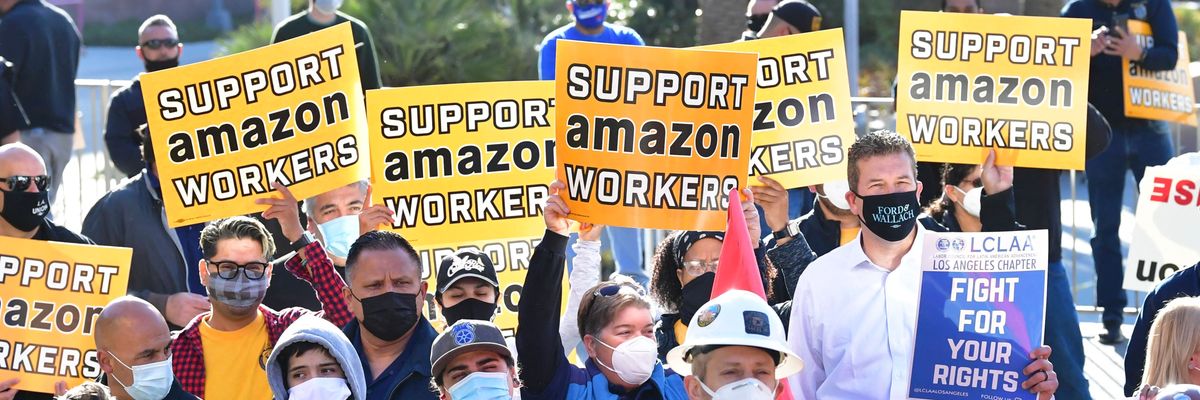
Supporters of unionization efforts by Amazon workers in Alabama held a rally on March 21, 2021 in Los Angeles, California.
(Photo: Frederic J. Brow/AFP via Getty Images)


Jessica Corbett
Mar 18, 2025
COMMON DREAMS


Amid widespread frustrations with U.S. President Donald Trump's attacks on working people, including his pursuit of an economic agenda "of, by, and for billionaires," the Republican is reportedly considering yet another betrayal: installing a partner at "a go-to union-busting law firm" as the next general counsel of the National Labor Relations Board.

That's according to David Dayen, executive editor of The American Prospect. Shortly after taking office in January, Trump fired NLRB General Counsel Jennifer Abruzzo—and Democratic board member Gwynne Wilcox, who is fighting her ouster in court. Dayen exclusively reported Monday that Trump plans to replace Abruzzo with Crystal Carey from "the notorious anti-union law firm Morgan Lewis."

Carey is "a former NLRB attorney with experience on both the general counsel and board sides of the agency," according to her biography on the firm's website. Now, "she represents employers" across a wide range of industries for collective bargaining, labor law counseling, and NLRB investigations and litigation.

Since the 1950s, her firm has been "involved in some of the most prominent labor battles in America... from the 1981 air traffic controllers strike to efforts by McDonald's to resist the Fight for $15," Dayen explained. "One of Morgan Lewis' biggest current clients is Amazon, which used algorithmic management and surveillance tactics to prevent unionization at its warehouse in Bessemer, Alabama, in 2021. Amazon also has an active lawsuit that seeks to declare the NLRB unconstitutional."

While Dayen's multiple sources didn't know when a formal announcement would be made and the White House did not respond to a request for comment, the journalist—and many readers of his report—highlighted that "the selection would confirm that any talk of the second term of President Trump being in any way pro-labor was largely lip service or sheer fantasy."

The Philadelphia Council AFL-CIO said on social media: "Union-busting is disgusting, especially when it's coming from the highest office. When unelected billionaires have the ear of an already corrupt president, workers and working families will continue to be on the chopping block. This is what oligarchy looks like, folks."


Labor journalist Kim Kelly sarcastically said, "More great stuff from the 'pro-worker' administration."


"To emphasize how much this sucks, Morgan Lewis is *the* top choice of union-busting rat bastards everywhere and Amazon has taken full advantage of their evil talents to harass and intimidate low-wage workers in the South out of organizing," she added.

Jimmy Williams, general president of the International Union of Painters and Allied Trades, said Trump's reported selection of Carey "comes as a complete shock to No ONE."

Some critics took aim at International Brotherhood of Teamsters president Sean O'Brien, who has repeatedly faced backlash for cozying up to Trump's GOP since he spoke at the Republican National Convention last summer. He also came under fire for praising Lori Chavez-DeRemer, Trump's labor secretary pick, who was confirmed last week.

Dayen noted that "labor secretary is not a big policymaking job, at least not compared to the NLRB general counsel. The general counsel sets priorities for NLRB cases, which govern union elections and rights in the workplace. The Labor Department has important priorities as well, but the work to end the slide in union density in the United States really begins at the NLRB."

In response to Dayen's reporting, Emma Lydon, managing director of government relations at Progressive Change Campaign Committee, said: "Great work, Sean O'Brien. Cozying up to fascists and billionaires really worked out well for all of us."

Jonathan Cohn, political director for Progressive Mass, similarly quipped, "Congratulations to Sean O'Brien!"

The labor podcast Work Stoppagesaid: "Thanks Sean O'Brien for claiming Trump wants to help U.S. workers! He just gave the most powerful labor law post in the country to one of the lawyers fighting the Teamsters at Amazon."

"Allying with the right didn't work for Teamsters" under former Presidents Richard Nixon or Ronald Reagan, the podcast's account added, "and it won't work now."

 Cornell Students, Professor Sue Trump For Targeting Palestine Defenders


"The First Amendment does not come with a 'Palestine Exception,'" said the American-Arab Anti-Discrimination Committee, which filed the suit.


Cornell University students including Momodou Taal (right) march in opposition to Israel's annihilation of Gaza in December 2023 in Ithaca, New York.
(Photo: Coalition for Mutual Liberation)

Brett Wilkins
Mar 17, 2025
COMMON DREAMS

lawsuit filed Saturday on behalf of two Cornell University graduates students and one professor at the Ivy League school in Upstate New York is challenging what plaintiffs are calling "the Trump administration's unconstitutional campaign against free speech—particularly as it targets international students and scholars who protest or express support for Palestinian rights."

"The lawsuit seeks a nationwide injunction of executive orders used by the administration to target and deport international students advocating for Palestinian freedom, rights, and liberation under the guise of protecting national security," explained the American-Arab Anti-Discrimination Committee (ADC), which sued on behalf of Ph.D. students Momodou Taal and Sriram Parasurama and professor Mukoma Wa Ngũgĩ.


Taal, a British-Gambian national, is facing possible deportation for his pro-Palestine activism on campus. Parasurama was arrested last October for protesting Israel's annihilation of Gaza at a career fair and was subsequently de-enrolled from Cornell and banned from the university's campus in Ithaca, New York for three years. Wa Ngũgĩ is a professor of literature who works with Taal. Parasurama and Wa Ngũgĩ are U.S. citizens.

"Defendants' attempt to bar non-citizens from criticizing the U.S. government, its institutions, American culture, or the government of Israel—and to prohibit citizens from hearing those views—serves no legitimate government interest in preventing terrorism or enforcing immigration laws," the lawsuit states. "The justifications offered are pretextual and dangerous. Criticism of the U.S. government does not constitute terrorism, and criticism of the Israeli government is not antisemitism."

Taal said in a statement that "the U.S. government claims to be zealous about free speech—except when it comes to Palestine."

"We've been here before: McCarthyism to civil rights to Vietnam, times when this country has deviated from its stated commitments to free speech," he continued. "This is another generational moment, another hour of reckoning. Why is there a Palestine exception?"


"Only in a dictatorship can the leader jail and banish political opponents for criticizing his administration" Taal added. "A nationwide injunction is therefore necessary while the court considers the merits."

Parasurama said: "These draconian executive orders aim to crack down on those willing to protest against our country's active role in the genocide of the Palestinian people. They are part of a broader moral crisis our nation is grappling with. This lawsuit allows us to recover our basic rights and protect international students like Momodou Taal."

Wa Ngũgĩ said that "I was born in the U.S. but grew up under the [Daniel arap] Moi dictatorship in Kenya in the 1980s. Students and people of conscience in Kenya were being detained, tortured, exiled or killed. My own family experienced the full brunt of this oppressive society. When I moved back to the U.S. in the early 1990s I could not foresee this attempt to chill free speech and directly attack our universities."


The Trump administration has invoked the president's January executive order authorizing the arrest, detention, and deportation of noncitizen students and others who took part in protests against Israel's assault on Gaza, which has left more than 170,000 Palestinians dead, maimed, or missing and around 2 million others forcibly displaced, starved, or sickened, according to local and international agencies. Israel's conduct in the war is the subject of an International Court of Justice genocide case brought by South Africa.

Last week, immigration authorities arrested Mahmoud Khalil, an Algerian citizen of Palestinian descent who helped Gaza protests at Columbia University while he was a graduate student there. Trump called Khalil's detention "the first arrest of many to come."

Pro-Israel activists played a role in Khalil's arrest. Shai Davidai, an assistant professor at Columbia who was temporarily banned from campus last year after harassing university employees, and Columbia student David Lederer have waged what Khalil called "a vicious, coordinated, and dehumanizing doxxing campaign" against him and other activists. The group Canary Mission last week released a video naming five other international students it says are "linked to campus extremism at Columbia."

The Department of Justice announced Friday that it is investigating whether pro-Palestinian demonstrators at over 60 colleges and universities including Columbia and Cornell violated federal anti-terrorism laws.

On Monday, ADC legal director and case co-counsel Chris Godshall-Bennett said that "this is one of those times people will look back on and ask what we did."

"We will not stand idly by while the government disappears its political opponents," he continued. "My family fled European antisemitism and came to the United States where our Constitution protects us from tyranny. My Jewish identity won't be used as an excuse to persecute the Palestinian people and its allies without a fight."

"This is one of those times people will look back on and ask what we did."

"Through this litigation, we seek both immediate and long-term relief to protect non-citizens from deportation and citizens from prosecution based on their constitutionally protected speech," Godshall-Bennett added.

Lead plaintiffs' counsel Eric Lee said that "this lawsuit aims to vindicate the rights of all non-citizens and citizens in the U.S., but the courthouse is only one arena in this fight."

"We appeal to the population: Stand up and exercise your First Amendment rights by actively and vigorously opposing the danger of dictatorship," Lee added. "As we prepare to mark the 250th anniversary of the American Revolution next year, recall the words from the Declaration of Independence: 'That whenever any Form of Government becomes destructive of these ends, it is the Right of the People to alter or to abolish it.'"

Pro-Palestine demonstrations continue at Cornell and on campuses across the nation and around the world. Last week, 17 activists led by the group Students for Justice in Palestine were detained by police after interrupting a Cornell panel on the history of the so-called Israel-Palestine "conflict," whose members included former Israeli foreign minister and alleged war criminal Tzipi Livni.