Tuesday, March 18, 2025


To the brain, Esperanto and Klingon appear the same as English or Mandarin


A new study finds natural and invented languages elicit similar responses in the brain’s language-processing network.


Massachusetts Institute of Technology


CAMBRIDGE, MA -- Within the human brain, a network of regions has evolved to process language. These regions are consistently activated whenever people listen to their native language or any language in which they are proficient.

A new study by MIT researchers finds that this network also responds to languages that are completely invented, such as Esperanto, which was created in the late 1800s as a way to promote international communication, and even to languages made up for television shows such as “Star Trek” and “Game of Thrones.”

To study how the brain responds to these artificial languages, MIT neuroscientists convened nearly 50 speakers of these languages over a single weekend. Using functional magnetic resonance imaging (fMRI), the researchers found that when participants listened to a constructed language in which they were proficient, the same brain regions lit up as those activated when they processed their native language.

“We find that constructed languages very much recruit the same system as natural languages, which suggests that the key feature that is necessary to engage the system may have to do with the kinds of meanings that both kinds of languages can express,” says Evelina Fedorenko, an associate professor of neuroscience at MIT, a member of MIT’s McGovern Institute for Brain Research and the senior author of the study.

The findings help to define some of the key properties of language, the researchers say, and suggest that it’s not necessary for languages to have naturally evolved over a long period of time or to have a large number of speakers.

“It helps us narrow down this question of what a language is, and do it empirically, by testing how our brain responds to stimuli that might or might not be language-like,” says Saima Malik-Moraleda, an MIT postdoc and the lead author of the paper, which appears this week in the Proceedings of the National Academy of Sciences.

Convening the conlang community

Unlike natural languages, which evolve within communities and are shaped over time, constructed languages, or “conlangs,” are typically created by one person who decides what sounds will be used, how to label different concepts, and what the grammatical rules are.

Esperanto, the most widely spoken conlang, was created in 1887 by Ludwik Zamenhok, who intended it to be used as a universal language for international communication. Currently, it is estimated that around 60,000 people worldwide are proficient in Esperanto.

In previous work, Fedorenko and her students have found that computer programming languages, such as Python — another type of invented language — do not activate the brain network that is used to process natural language. Instead, people who read computer code rely on the so-called multiple demand network, a brain system that is often recruited for difficult cognitive tasks.

Fedorenko and others have also investigated how the brain responds to other stimuli that share features with language, including music and nonverbal communication such as gestures and facial expressions.

“We spent a lot of time looking at all these various kinds of stimuli, finding again and again that none of them engage the language-processing mechanisms,” Fedorenko says. “So then the question becomes, what is it that natural languages have that none of those other systems do?”

That led the researchers to wonder if artificial languages like Esperanto would be processed more like programming languages or more like natural languages. Similar to programming languages, constructed languages are created by an individual for a specific purpose, without natural evolution within a community. However, unlike programming languages, both conlangs and natural languages can be used to convey meanings about the state of the external world or the speaker’s internal state.

To explore how the brain processes conlangs, the researchers invited speakers of Esperanto and several other constructed languages to MIT for a weekend conference in November 2022. The other languages included Klingon (from “Star Trek”), Na’vi (from “Avatar”), and two languages from “Game of Thrones” (High Valyrian and Dothraki). For all of these languages, there are texts available for people who want to learn the language, and for Esperanto, Klingon, and High Valyrian, there is even a Duolingo app available.

“It was a really fun event where all the communities came to participate, and over a weekend, we collected all the data,” says Malik-Moraleda, who co-led the data collection effort with former MIT postbac Maya Taliaferro, now a PhD student at New York University.

During that event, which also featured talks from several of the conlang creators, the researchers used fMRI to scan 44 conlang speakers as they listened to sentences from the constructed language in which they were proficient. The creators of these languages — who are co-authors on the paper — helped construct the sentences that were presented to the participants.

While in the scanner, the participants also either listened to or read sentences in their native language, and performed some nonlinguistic tasks for comparison. The researchers found that when people listened to a conlang, the same language regions in the brain were activated as when they listened to their native language.

Common features

The findings help to identify some of the key features that are necessary to recruit the brain’s language processing areas, the researchers say. One of the main characteristics driving language responses seems to be the ability to convey meanings about the interior and exterior world — a trait that is shared by natural and constructed languages, but not programming languages.

“All of the languages, both natural and constructed, express meanings related to inner and outer worlds. They refer to objects in the world, to properties of objects, to events,” Fedorenko says. “Whereas programming languages are much more similar to math. A programming language is a symbolic generative system that allows you to express complex meanings, but it’s a self-contained system: The meanings are highly abstract and mostly relational, and not connected to the real world that we experience.”

Some other characteristics of natural languages, which are not shared by constructed languages, don’t seem to be necessary to generate a response in the language network.

“It doesn’t matter whether the language is created and shaped over time by a community of speakers, because these constructed languages are not,” Malik-Moraleda says. “It doesn’t matter how old they are, because conlangs that are just a decade old engage the same brain regions as natural languages that have been around for many hundreds of years.”

To further refine the features of language that activate the brain’s language network, Fedorenko’s lab is now planning to study how the brain responds to a conlang called Lojban, which was created by the Logical Language Group in the 1990s and was designed to prevent ambiguity of meanings and promote more efficient communication.

###

The research was funded by MIT’s McGovern Institute for Brain Research, Brain and Cognitive Sciences Department, the Simons Center for the Social Brain, the Frederick A. and Carole J. Middleton Career Development Professorship, and the U.S. National Institutes of Health.


Unveiling the mysterious “sprite fireworks” over the Himalayas


Institute of Atmospheric Physics, Chinese Academy of Sciences
Cosmic Fireworks 

image: 

The photo, titled Cosmic Fireworks, won the Skyscapes category of the 2023 Astronomy Photographer of the Year competition, hosted by the Royal Observatory Greenwich. This breathtaking image not only showcases the awe-inspiring beauty of sprite discharges but also sparks public interest in extreme weather phenomena and their scientific significance.

view more 

Credit: Angel An


Have you ever heard of—or even seen—red lightning? These are not animated characters but real atmospheric phenomena known as electrical discharges that occur high above thunderstorms. Scientists refer to them as "red sprites", named for their jellyfish-like appearance and vivid red flashes. Now, imagine witnessing these mesmerizing displays over the world's highest mountain range—the Himalayas!

On the night of May 19, 2022, two Chinese astrophotographers, Angel An and Shuchang Dong, captured a spectacular display of over one hundred red sprites over the Himalayas. The observation site, located on the southern Tibetan Plateau near Pumoyongcuo Lake—one of the region's three sacred lakes—revealed a breathtaking celestial event. Among the phenomena captured were dancing sprites, rare secondary jets, and the first-ever recorded case in Asia of green airglow at the base of the nighttime ionosphere, dubbed “ghost sprites”. This extraordinary event attracted global attention and was widely covered by major media outlets.

A recent study published in Advances in Atmospheric Sciences by Professor Gaopeng Lu and his team at the University of Science and Technology of China sheds light on the driving force behind this grand “sprite fireworks”—lightning and thunderstorms.

“This event was truly remarkable,” said Professor Gaopeng Lu. “By analyzing the parent lightning discharges, we discovered that the sprites were triggered by high-peak current positive cloud-to-ground lightning strikes within a massive mesoscale convective system. This suggests that thunderstorms in the Himalayan region have the potential to produce some of the most complex and intense upper-atmospheric electrical discharges on Earth.”

Lacking precise timestamps for detailed analysis, the research team developed an innovative method to synchronize video time using satellite trajectories and star field analysis. This innovative approach allowed them to determine the exact occurrence times of the sprites and link them to their parent lightning discharges. One of the anonymous reviewers praised the technique, highlighting its potential as a reliable timing tool for citizen scientists contributing to scientific observations.

The study revealed that the parent lightning discharges occurred within stratiform precipitation regions of a mesoscale convective complex stretching from the Ganges Plain to the southern foothills of the Tibetan Plateau. This event recorded the highest number of sprites during a single thunderstorm in South Asia, suggesting that thunderstorms in this region possess upper-atmospheric discharge capabilities comparable to those in the U.S. Great Plains and offshore European storms. Moreover, the findings indicate that these storms may generate even more complex discharge structures, potentially influencing atmospheric coupling processes with significant physical and chemical effects.


Red Sprites [VIDEO] | 

See you in the funny papers: How superhero comics tell the story of Jewish America


A five-story replica of a stamp of Superman in 1998 in Cleveland, home of the superhero’s creators, Jerry Siegel and Joe Shuster. 

March 16, 2025

Nearly a hundred years ago, a hastily crafted spaceship crash-landed in Smallville, Kansas. Inside was an infant – the sole survivor of a planet destroyed by old age. Discovering he possessed superhuman strength and abilities, the boy committed to channeling his power to benefit humankind and champion the oppressed.

This is the story of Superman: one of the most recognizable characters in history, who first reached audiences in the pages of Action Comics in 1938 – what many fans consider the most important single comic in history.

As a historian of American immigration and ethnicity – and a lifelong comics fan – I read this well-known bit of fiction as an allegory about immigration and the American dream. It is, at its core, the ultimate story of an immigrant in the early 20th century, when many people saw the United States as a land with open gates, providing such orphans of the world an opportunity to reach their fullest potential.

Taken in and raised by a rural family under the name Clark Kent, the baby was imbued with the best qualities of America. But, like all immigrant stories, Kent’s is a two-parter. There is also the emigrant story: the story of how Kal-El – Superman’s name at birth – was driven from his home on Planet Krypton to embrace a new land.

That origin story reflects the heritage of Superman’s creators: two of the many Jewish American writers and artists who ushered in the Golden Age of comic books.
Jewish history…


A card from 1909, found in the Jewish Museum of New York, depicts Jewish Americans welcoming Jews emigrating from Russia.Heritage Images/Hulton Archive via Getty Images

The American comics industry was largely started by the children of Jewish immigrants. Like most publishing in the early 20th century, it was centered in New York City, home to the country’s largest Jewish population. Though they were still a very small minority, immigration had swelled the United States’ Jewish population more than a thousandfold: from roughly 3,000 in 1820 to roughly 3,500,000 in 1920.

Comic books had not yet been devised, but strip comics in newspapers were a regular feature. They began in the late 19th century with popular stories featuring recurring characters, such as Richard F. Outcault’s “Yellow Kid” and “the Little Bears” by Jimmy Swinnerton.

A few Jewish creators were able to break into the industry, such as Harry Hershfield and his comic “Abie the Agent.” Hershfield’s success was exceptional in three ways: He broke into mainstream newspaper comics, his titular character was also Jewish, and he never adopted an anglicized pen name – as many other Jewish creators felt they must.


Shoppers and vendors outside of haberdasheries on Hester Street in a Jewish neighborhood of New York’s Lower East Side around 1900.Photo by Hulton Archive/Getty Images

Generally, however, Jews were barred from the more prestigious jobs in newspaper cartooning. A more accessible alternative was the cheaper, second-tier business of reprinting previously published works.

In 1933, second-generation Jewish New Yorker Max Gaines – born Maxwell Ginzburg – began a new publication, “Funnies on Parade.” “Funnies” pulled together preexisting comic strips, reproducing them in saddle-stitched pamphlets that became the standard for the American comics industry. He went on to found All-American Comics and Educational Comics.

Another publisher, Malcolm Wheeler-Nicholson, founded National Allied Publications in 1934 and published the first comic book to feature entirely new material, rather than reprints of newspaper strips. He joined forces with two Jewish immigrants, Harry Donenfeld and Jack Leibowitz. At National, they created and distributed Detective and Action Comics – the precursors to DC, which would become one of the two largest comics distributors in history.

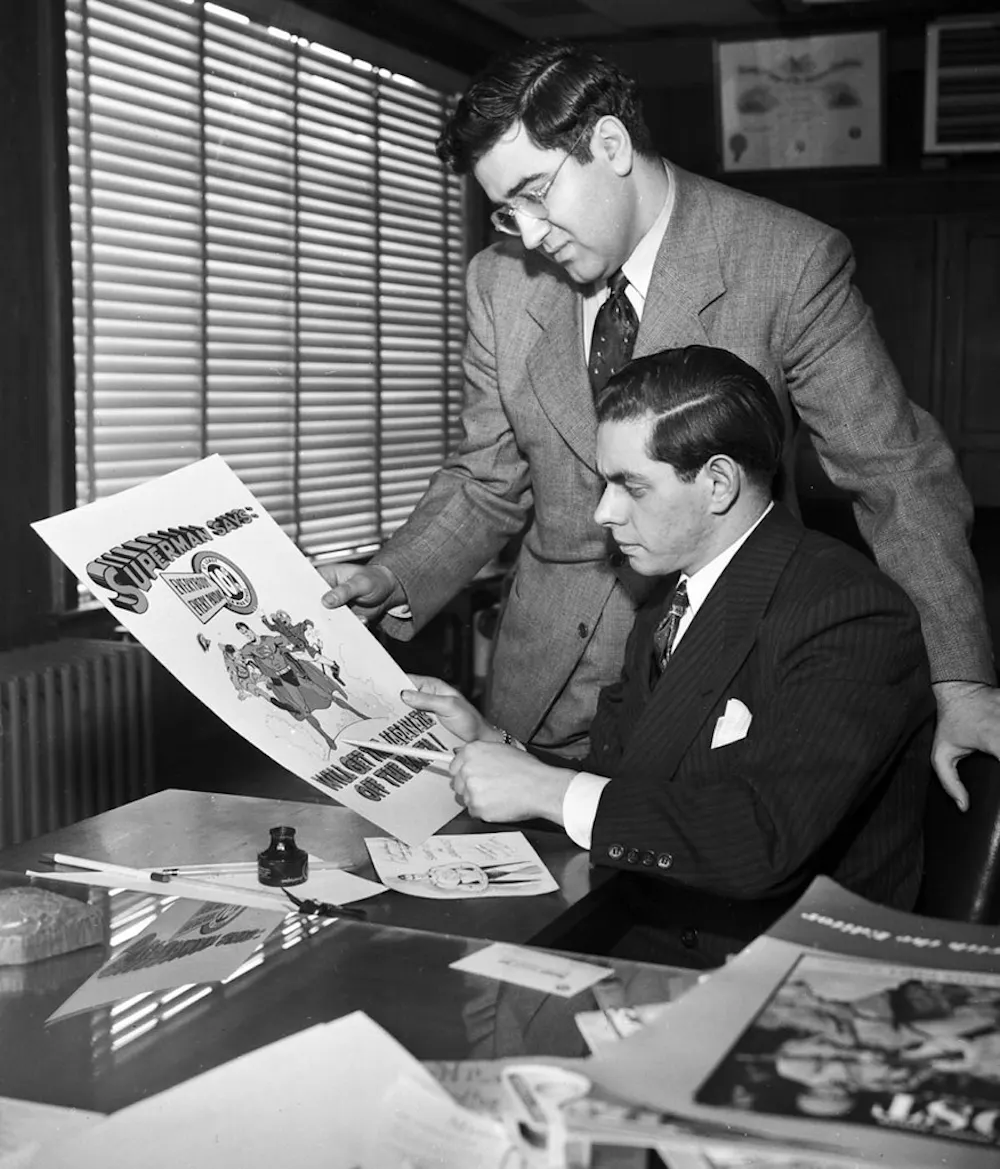
It was at Action Comics that Jerry Siegel and Joe Shuster, two second-generation immigrants from a Jewish neighborhood in Cleveland, found a home for Superman. It would also be where two Jewish kids from the Bronx, Bob Kane and Bill Finger – born Robert Kahn and Milton Finger – found a home for their character, Batman, in 1939.


Jerry Siegel and Joe Shuster, creators of Superman, pictured in the 1940s.New Yorker/Wikimedia Commons

The success of these characters inspired another prominent second-generation Jewish New Yorker, pulp magazine publisher Moses “Martin” Goodman, to enter comics production with his line, “Timely Comics.” The 1939 debut featured what would become two of the early industry’s most well-known superheroes: the Sub-Mariner and the Human Torch. These characters would be mainstays of Goodman’s company, even when it became better known as Marvel Comics.

Thus were born the “big two,” Marvel and DC, from humble Jewish origins.
…and Jewish stories

The creation and popularization of superhero comics isn’t Jewish just because of its history. The content was, too, reflecting the values and priorities of Jewish America at the time: a community influenced by its origins and traditions, as well as the American mainstream.

Some of the most foundational early comics echo Jewish history and texts, such as Superman’s story, which parallels the Jewish hero Moses. The biblical prophet was born in Egypt, where the Israelites were enslaved, and soon after Pharaoh ordered the murder of all their newborn sons. Similarly, Superman’s people, the Kryptonians, faced an existential threat: the destruction of their planet.

Moses’ life is saved when his mother floats him down the Nile in a hastily constructed and tarred basket. Kal-El, too, is sent away to safety in a hastily constructed craft. Both boys are raised by strangers in a strange land and destined to become heroes to their people.

Comics also reflected the feelings and fears of Jews in a moment in time. For example, in the wake of Kristallnacht – the 1938 night of widespread organized attacks on German Jews and their property, which many historians see as a turning point toward the Holocaust – Finger and Kane debuted Batman’s Gotham City. The city is a dark contrast to Superman’s shining metropolis, a place where villains lurked around every corner and reflected the darkest sides of modern humanity.

Some comic artists and writers used their platform to make political statements. Jack Kirby – born Kurtzberg – and Hymie “Joe” Simon, creators of Captain America, explained that they “knew what was going on over in Europe. World events gave us the perfect comic-book villain, Adolf Hitler, with his ranting, goose-stepping and ridiculous moustache. So we decided to create the perfect hero who would be his foil.” The comic debut of Captain America in 1941 featured a brightly colored cover with the brand-new hero punching Adolf Hitler in the face.

In later generations, characters penned by Jewish authors continued to grapple with issues of outsider status, hiding aspects of their identity, and maintaining their determination to better the world in spite of rejection from it. Think of Spider-Man, the Fantastic Four and X-Men. All of these were created by Stan Lee – another Jewish creator, born Stanley Martin Lieber – who was hired into Timely Comics at just 17 years old.

With so many of the most popular comics written by New York Jews, and centered in the city, much of New York’s Yiddish-tinged, recognizably Jewish language made its way onto the pages. Lee’s Spider-Man, for example, frequently exclaims “oy!” or calls bad guys “putz” or “shmuck.”

In later years, Jewish authors such as Chris Claremont and Brian Michael Bendis introduced or took over mainstream characters who were overtly Jewish – reflecting an emerging comfort with a more public Jewish ethnic identity in America. In X-Men, for example, Kitty Pryde recounts her encounters with contemporary antisemitism. Magneto, who is at times friend but often foe of the X-Men, developed a backstory as a Holocaust survivor.

History is never solely about retelling; it’s about gaining a better understanding of complex narratives. Trends in comics history, particularly in the superhero genre, offer insight into the ways that Jewish American anxieties, ambitions, patriotism and sense of place in the U.S. continually changed over the 20th century. To me, this understanding makes the retelling of these classic stories even more meaningful and entertaining.

Miriam Eve Mora, Managing Director of the Raoul Wallenberg Institute, University of Michigan

This article is republished from The Conversation under a Creative Commons license. Read the original article.
How an unexpected observation, a 10th-century recipe and an explorer’s encounter with a cabbage thief upend what we know about collard greens’ journey to the American South

March 16, 2025

For generations, collard greens have formed an important part of African and African-diaspora diets around the world.

The leafy vegetable is a quintessential part of African American, Southern and “soul” foods in the United States. Collards are also important in some regions of Africa: In Kenya, where they are called sukuma wiki, they are one of the most commonly consumed vegetables.

Until now, the consensus scholarly view has held that collards came to the Americas early in the 16th century with Spanish, Portuguese or English Europeans, who introduced collards as a garden plant that was then taken up by enslaved Africans.

But our discovery of collards growing in southern Moroccan oases gardens put us on a quest to better understand the path collards took to arrive in the American South. Our new research suggests that they arrived in Morocco with early Muslim traders, adding the potential of a stop in North Africa hundreds of years before they journeyed to North America.

Moreover, the similarity in recipes from Morocco and the American South supports the idea that Moroccan oases may have been a stop in the journey collards took to America.
A green path

Collard greens belong to the species Brassica oleracea, which also includes broccoli, cauliflower, cabbage, kohlrabi and Brussels sprouts. The huge genetic diversity within the species has complicated research into where collards were first domesticated and how they moved around the world.

Evidence suggests collards were likely domesticated in the Mediterranean, from wild relatives also found on coastlines around the Mediterranean. Their path from the Mediterranean to the American South remains unclear.
A new theory sprouts

As ethnobiologists and researchers interested in traditional foodways, we have been studying leafy vegetables across Morocco for 20-plus years. Yet we had never seen collards growing in any of the other areas across north and central Morocco we had worked in.

While working in date palm oases in southern Morocco, we were, therefore, surprised to find collard greens in the gardens of African diaspora communities that are descended from enslaved people brought across the Sahara.

Suspecting that the presence of collards in an important ancient trade hub might shed new light on the history of the plant and its journey to the Americas, we began collecting stories, proverbs and recipes from the African diaspora communities and searching for potential links to other places where collards are culturally important.

Tracking down information was complicated: Leafy vegetables rarely show up in the archaeological record, and historical texts use the same words to refer to heading cabbage – what most people call “cabbage” today – and nonheading cabbages such as collards and kale, which were more common than heading varieties until fairly recently.

Historical texts in English refer to both as “cabbage” or “cole.” In Spanish, both are called “cole”; and “couve” is used similarly in Portuguese. Arabic texts use “kornub” to refer to both. However, this was one important clue to the ancient Arabic origins of collards in Morocco. In Moroccan Arabic, cabbage is called “mkouwer” or “melfouf,” and cauliflower is usually called “chou-fleur” – a word derived from the French. Moroccans only rarely use “kurunb,” from classical Arabic, to refer to cauliflower.

The communities that grow collards in Morocco call it by the ancient Arabic name “kornub.”

As we searched, we were astonished to find a recipe in a 10th-century cookbook from Baghdad that was almost identical to how people in Morocco cook collards. Moreover, the cookbook describes in detail a variety of cabbage with smooth leaves called “kurunb Nabati,” or “Nabatean cabbage,” where only the leaves are eaten. That, and the fact that the preparation description refers clearly to leaves rather than heads, offered further evidence that this was referencing collard greens.


We pieced together a possible historical route from Baghdad to Morocco from the rare cases when historical documents included specific descriptions of the plant.

One report from a British explorer who traveled through Algeria in 1860 included notes about finding various types of “cabbage” and about a man who had stolen cabbage and had it concealed under his shirt – suggesting flat leaves rather than heads.

Moreover, a colleague at the Oman Botanic Garden told us that collards are grown in oases gardens in the Hajar mountains of Oman.
Middle East to American South

After piecing it all together, our research suggests that collards arrived in Morocco from Iraq and Oman with early Kharijite Muslim traders in the eighth century. These are the same people who founded the great city of Sijilmasa and ran the early trade routes that carried gold and enslaved humans across the Sahara.

The presence of collards in Moroccan oases also necessitates a reconsideration of the currently held assumption of how the vegetable arrived in the Americas.

We couldn’t find concrete evidence of connections between Morocco and the arrival of collards in the Americas, so it’s impossible to say that the consensus scholarly view on collards’ journey is wrong. Still, the currently held assumption that collards arrived in the Americas with settlers and were adopted by Africans who used them as a substitute in leafy green recipes from Africa needs revisiting.

Indeed, unlike common collards recipes, most leafy vegetable recipes from West and Central Africa include fish, ground nuts or peanuts and palm oil. Compared with leafy vegetable recipes from West Africa, the collard recipes used in the United States today are strikingly similar to those from Morocco and 10th-century Baghdad. The similarity in recipes from Morocco and the American South suggests that Moroccan oases may have been a stop in the journey collards took to America.

The story of collards in the Moroccan oases is an opportunity to consider the ways the transatlantic trade systems were entangled with the trade routes and systems before them, especially the trans-Saharan trade routes, and what these entanglements mean for the foodways of Africans and African diasporas around the world.

Bronwen Powell, Associate Professor of Geography, African Studies and Anthropology, Penn State and Abderrahim Ouarghidi, Assistant Teaching Professor of African Studies and Anthropology, Penn State

This article is republished from The Conversation under a Creative Commons license. Read the original article.


Philly Roller Derby league turns 20 - here’s how the sport skated its way to feminism, anti-racism and queer liberation


Photo by Rachel Moore on Unsplash

March 16, 2025

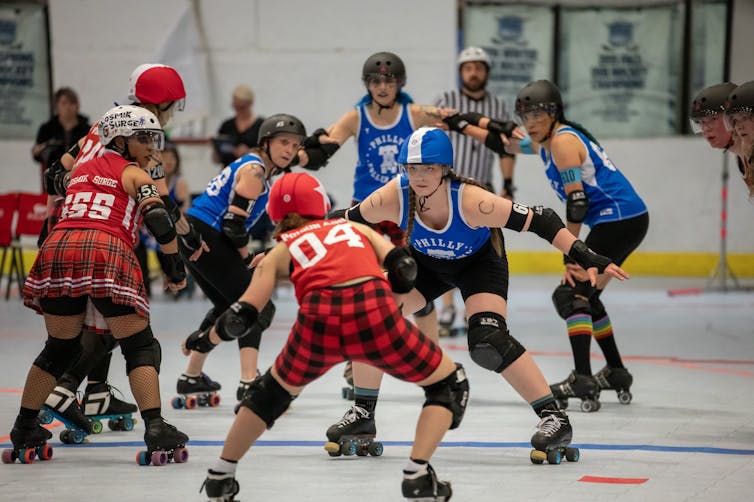
For 20 years, Philly Roller Derby skaters, who go by names like Woolly Slammoth, TrailBlazeHer and Reba Smackentire, have jammed and blocked their way around oval skating rinks in the spirit of feminism, anti-racism, body positivity and queer liberation.


When the Philly league joined the Women’s Flat Track Derby Association in 2005, it was one of the first, following the Texas Rollergirls in Austin and leagues in Portland, Oregon; Chicago; New York; and other cities. The WFTDA, which governs flat-track roller derby, had formed just one year prior with a goal of “revolutioniz[ing] the role of women in sports.”

Primarily organized by women, the association takes an explicitly feminist position and welcomes anyone who is of a “marginalized gender.” This includes cisgender women as well as all transgender, intersex and two-spirit individuals. Intersex people have chromosomes and/or reproductive organs that do not fit into a binary male or female classification, while two-spirit refers to members of Indigenous cultures who identify as having both a masculine and feminine spirit.

I’m a kinesiology professor who studies philosophic and historical perspectives of sport – especially women’s sport. I have a particular fondness for roller derby, which started in the U.S. in 1935.

In some ways, roller derby’s reinvention as a revolutionary feminist sport in the 21st century isn’t that surprising. After all, women have been included as, at minimum, equal participants since the sport’s beginning.The Passyunk Punks, in red, compete against the Germantown Loose Cannons, in blue, during the 2024 home team season.@winterrosefoto/Philly Roller Derby, CC BY-SA
Feminist roots

Seeds of roller derby’s feminist roots can be traced to its earliest version: the Transcontinental Roller Derby.

This endurance-sport fad of the Great Depression featured pairs of skaters accumulating miles as they skated laps around a track, following imaginary routes across the country. American sportswriter Frank Deford perpetuated the apocryphal story of Leo Seltzer’s invention of roller derby. Seltzer, an entertainment entrepreneur and promoter of walkathons, supposedly scribbled the basics of the sport on a tablecloth at a Ricketts restaurant in Chicago in the spring of 1935.

Whatever the truth of that story, what is true is that in August 1935, spectators gathered in the air-conditioned Chicago Coliseum to watch 25 pairs of skaters set off to travel 3,000 miles – the approximate distance of a cross-country trek from New York to San Francisco – all while never leaving the city.

Seltzer organized the event, which featured man-woman duos skating thousands of laps around a banked track while the crowd followed their fictional cross-country progress on a large electronic map. More than a month after they started, Bernie McKay and Clarice Martin completed the race in 493 hours and 12 minutes.

, organizing Transcontinental Roller Derby events in cities like Cincinnati, New York, St. Louis, Indianapolis and Miami. In May 1937, roller derby made its way to the Philadelphia Arena on Market Street
.
A 1937 article in the Mount Carmel Item newspaper describes the new sport of roller derby.
Mount Carmel Item, 1937

In all of those cities, skaters completed what the Chicago Tribune called an “imaginary cross-country dash,” sometimes covering up to 100 miles per day. Early on, the pairs skated for 10 to 12 hours daily. Eventually, skaters spent only the event hours on the track, usually starting at 7 p.m. or 8 p.m. and finishing at midnight or 1 a.m. Teams alternated skaters – women skated against women and men against men – in 15-minute turns. In some locations, cots were set up on the inside of the track, giving alternating skaters a place to rest.

Seltzer saw women as an untapped sports audience who could bolster the success of his endeavor. He , selling “Ladies Day” tickets, and dispersing discounted tickets to businesses frequented by women customers.

Seltzer believed that women spectators would be drawn to women skaters. This, in part, drove him to ensure a place for women in the roller derby. Few opportunities for women existed in traditional sports at that time. When women did participate in sport, many had to deal with commentary about their appearance and a focus on their beauty rather than their athletic accomplishments.

This was the case with roller derby too. For example, one Chicago Tribune reporter wrote that a 1935 leader of the roller derby was “the blonde in the cerise tights, and a right pretty gal she is” – without ever mentioning her name.

Roller derby skater Yolanda Trevino of the Eastern Warriors falls to the ground under a board as a member of the Brooklyn Bombers skates past her during a match at the Philadelphia Arena in 1970.


Paying the price

Despite the participation of women since its beginning, roller derby has certainly not been a total bastion of feminist progress.

Even when challenging gender norms, women skaters were objectified. Their appearance was used to market the sport in promotional photographs. Skaters like , whose photo advertised the opening of roller derby to Indianapolis Star readers in 1937, posed in their uniforms, but without the tights and pads worn during the event.

Roller derby in the 1970s, ‘80s and '90s featured strong, tough women skaters. But as communications professor Heidi Mau and I wrote in a chapter of “Sportswomen’s Apparel in the United States,” the uniforms during that era were typically tight with low-cut zippers. Organizers of roller derby – and its competitors like RollerGames and RollerJam – embraced stereotypical ideas about femininity and beauty and sexualized women skaters.

The inclusion of women also signaled to some that roller derby was not a legitimate sport – something that haunts it to this day.

Philly Roller Derby members skate in the 2024 Philly Pride parade
.Jon Dilks/Philly Roller Derby, CC BY-SA

Historian Michella Marino, in her comprehensive history of the sport, says that women roller derby skaters “paid a price” for doing something subversive in challenging gender norms. That price, she writes, is that sports media relegated them to the level of “spectacle,” which led to the belief that the sport was illegitimate precisely because women competed on the same level as men.

Sports columnists in the 1930s emphasized that roller derby was a dramatic spectacle, calling it a “,” an “insane indoor sport” that was about “putting on a show.”

Women skaters today approach roller derby with a feminist, do-it-yourself attitude. The modern leagues were created by women who wanted to skate and didn’t want to wait for someone else to start a team. The Women’s Flat Track Derby Association now boasts over 400 leagues on six continents.

Today’s roller derby draws spectators of all types. Tickets typically go for about $15. Some audiences come for the Riot Grrrl, or feminist punk, personas of the skaters, and are rewarded with fast-paced, high-contact skating. Others see it as a cheap family outing, and leagues advertise themselves as family friendly. Some leagues now have co-ed youth leagues, like the Junior Brawlstars of the Philly Roller Derby.

Other leagues have branched out beyond women’s flat-track roller derby, like the Penn Jersey Roller Derby in Camden, New Jersey - also founded in 2005. Home to the Devils and Hooligans, Penn Jersey competes in flat and banked track versions of the sport and even includes a team competing in the Men’s Roller Derby Association.

Still, roller derby remains unabashedly feminist, a sport that encourages women to subvert gender norms while they skate to athletic success.

Colleen English, Associate Professor of Kinesiology, Penn State

This article is republished from The Conversation under a Creative Commons license. Read the original article.
Mexico City, home to world’s biggest bullring, bans killing bulls

By AFP
March 18, 2025


Mexico City is home to the world's biggest bullring, the Plaza de Toros, which has a capacity of more than 40,000 people - Copyright AFP/File Tetiana DZHAFAROVA, Brendan Smialowski, YURI KOCHETKOV

Legislators in Mexico City, home to the world’s largest bullring, voted Tuesday to ban bullfights where the animals are killed or wounded, as opponents and supporters staged rival protests.

The initiative, which was promoted by the capital city’s mayor Clara Brugada, aims to move toward “violence-free” bullfighting events.

Mexico City cannot allow “cruelty as a spectacle, much less the long pain and death of an animal for entertainment,” Brugada said last week.

The vote also bans using sharp objects such as swords, but matadors can use capes and muletas — sticks with red cloth hanging from them.

The ban, which also limits bullfights to 15 minutes for each animal, was approved by 61 votes in favor and one against, the capital’s legislature announced.

Mexico’s President Claudia Sheinbaum last week threw her support behind the initiative, calling it a “good solution” to maintain jobs in the bullfighting industry while respecting a constitutional reform prohibiting animal abuse.

Bullfighting promoters, however, opposed the ban, saying it threatens a deeply rooted cultural tradition.

Scuffles involving rival demonstrators broke out near the legislature before riot police intervened.

Mexico City is a bastion of bullfighting, and at its heart sits the Plaza de Toros, which has the capacity for more than 40,000 people.

But the capital is also considered a progressive stronghold, and there have been years of legal battles between bullfighting supporters and animal rights activists, who welcomed the ban on wounding the animals.

Anton Aguilar, executive director of Humane World for Animals Mexico, called it “an important step toward eradicating the torment and killing of animals for entertainment.”

At the same time, “it’s important also to acknowledge that a bull event without violence does not mean one without suffering, as bulls will still be subjected to significant and completely unnecessary stress,” he added.

Several of Mexico’s 32 states have banned bullfighting, which was brought by the Spanish conquistadors centuries ago.

Bullfighters point to the economic value of the industry, which generated 80,000 jobs and around $50 million in revenue in 2023, according to figures from the Mexico City legislature.

Among other countries, Ecuador, Spain, France, Mexico, Peru, Portugal and Venezuela still hold bullfighting events.

Colombia last year approved a ban on bullfights starting in 2027, while the killing of animals has been banned in the Ecuadoran capital Quito.
Judge blocks Trump administration order to ban transgender people from military


Continuing US federal judges' resistance to President Donald Trump's sweeping executive orders, a Washington, D.C., District Judge moved to block Trump's ban on transgender people from serving in the military, a seminal component of the President's crusade to eliminate diversity, equality, and inclusion initiatives in the US.


Issued on: 19/03/2025 - 
By: FRANCE 24
Protester waves a LGBTQIA pride flag in front of the U.S. Supreme Court Building on June 26, 2023 in Washington, DC. © Anna Moneymaker, Getty Images/AFP

A federal judge blocked enforcement of President Donald Trump’s executive order banning transgender people from military service on Tuesday, the latest in a string of legal setbacks for his sweeping agenda.

US District Judge Ana Reyes in Washington, D.C., ruled that Trump's order to exclude transgender troops from military service likely violates their constitutional rights. She was the second judge of the day to rule against the administration, and both rulings came within hours of an extraordinary conflict as Trump called for impeaching a third judge who temporarily blocked deportation flights, drawing a rare rebuke from Chief Justice John Roberts.

Reyes, who was nominated by President Joe Biden, delayed her order until Friday morning to give the administration time to appeal.

"The court knows that this opinion will lead to heated public debate and appeals. In a healthy democracy, both are positive outcomes,” Reyes wrote. “We should all agree, however, that every person who has answered the call to serve deserves our gratitude and respect.”

Army Reserves 2nd Lt. Nicolas Talbott, one of 14 transgender active-duty servicemembers named as plaintiffs in the lawsuit, said he was holding his breath as he waited to find out if he would be separated from the military next week.

“This is such a sigh of relief,” he said. “This is all I’ve ever wanted to do. This is my dream job, and I finally have it. And I was so terrified that I was about to lose it.”

The White House didn’t immediately respond to a message seeking comment. Trump’s deputy chief of staff, Stephen Miller, posted about the ruling on social media, writing, “District court judges have now decided they are in command of the Armed Forces…is there no end to this madness?”

The judge issued a preliminary injunction requested by attorneys who also represent others seeking to join the military.

On Jan. 27, Trump signed an executive order that claims the sexual identity of transgender service members "conflicts with a soldier’s commitment to an honorable, truthful, and disciplined lifestyle, even in one’s personal life” and is harmful to military readiness.

In response to the order, Defense Secretary Pete Hegseth issued a policy that presumptively disqualifies people with gender dysphoria from military service. Gender dysphoria is the distress that a person feels because their assigned gender and gender identity don’t match. The medical condition has been linked to depression and suicidal thoughts.

Plaintiffs’ attorneys contend Trump’s order violates transgender people’s rights to equal protection under the Fifth Amendment.

Government lawyers argue that military officials have broad discretion to decide how to assign and deploy servicemembers without judicial interference.

Reyes said she did not take lightly her decision to issue an injunction blocking Trump’s order, noting that “Judicial overreach is no less pernicious than executive overreach.” But, she said, it was also the responsibility of each branch of government to provide checks and balances for the others, and the court “therefore must act to uphold the equal protection rights that the military defends every day.”

Thousands of transgender people serve in the military, but they represent less than 1% of the total number of active-duty service members.

In 2016, a Defense Department policy permitted transgender people to serve openly in the military. During Trump’s first term in the White House, the Republican issued a directive to ban transgender service members. The Supreme Court allowed the ban to take effect. President Joe Biden, a Democrat, scrapped it when he took office.

Hegseth’s Feb. 26 policy says service members or applicants for military service who have “a current diagnosis or history of, or exhibit symptoms consistent with, gender dysphoria are incompatible with the high mental and physical standards necessary for military service.”

The plaintiffs who sued to block Trump’s order include an Army Reserves platoon leader from Pennsylvania, an Army major who was awarded a Bronze Star for service in Afghanistan and a Sailor of the Year award winner serving in the Navy.

“The cruel irony is that thousands of transgender servicemembers have sacrificed—some risking their lives—to ensure for others the very equal protection rights the military ban seeks to deny them," Reyes wrote.

Their attorneys, from the National Center for Lesbian Rights and GLAD Law, said transgender troops “seek nothing more than the opportunity to continue dedicating their lives to defending the Nation.”

“Yet these accomplished servicemembers are now subject to an order that says they must be separated from the military based on a characteristic that has no bearing on their proven ability to do the job,” plaintiffs’ attorneys wrote. “This is a stark and reckless reversal of policy that denigrates honorable transgender servicemembers, disrupts unit cohesion, and weakens our military.”

Government attorneys said the Defense Department has a history of disqualifying people from military service if they have physical or emotional impairments, including mental health conditions.

“In any context other than the one at issue in this case, DoD’s professional military judgment about the risks of allowing individuals with physical or emotional impairments to serve in the military would be virtually unquestionable,” they wrote.

Plaintiffs’ attorneys say Trump’s order fits his administration’s pattern of discriminating against transgender people.

Federal judges in Seattle and Baltimore separately paused Trump’s executive order halting federal support for gender-affirming care for transgender youth under 19. Last month, a judge blocked prison officials from transferring three incarcerated transgender women to men’s facilities and terminating their access to hormone therapy under another Trump order.

Trump also signed orders that set up new rules about how schools can teach about gender and that intend to ban transgender athletes from participating in girls’ and women’s sports.

“From its first days, this administration has moved to strip protections from transgender people across multiple domains — including housing, social services, schools, sports, healthcare, employment, international travel, and family life,” plaintiffs’ lawyers wrote.

Talbott, 31, of Akron, Ohio, enlisted in March 2024 as an openly trans person after fighting for roughly nine years to join the service. He said his fellow soldiers gave him some good-natured flak for being so much older than other recruits, but never treated him differently for being trans. Talbott anticipates that his colleagues will be “pretty excited that I get to stay.”

“Now I can go back to focusing on what’s really important, which is the mission,” said Talbott, a platoon leader for a military policing unit.

(France 24 with AP)
Alarm as Texas Files State's First Criminal Abortion Charges Against Midwife

"Republicans are strategically targeting people they think the public won't rally behind," said rights advocate Jessica Valenti. "Let's make sure to prove them wrong."


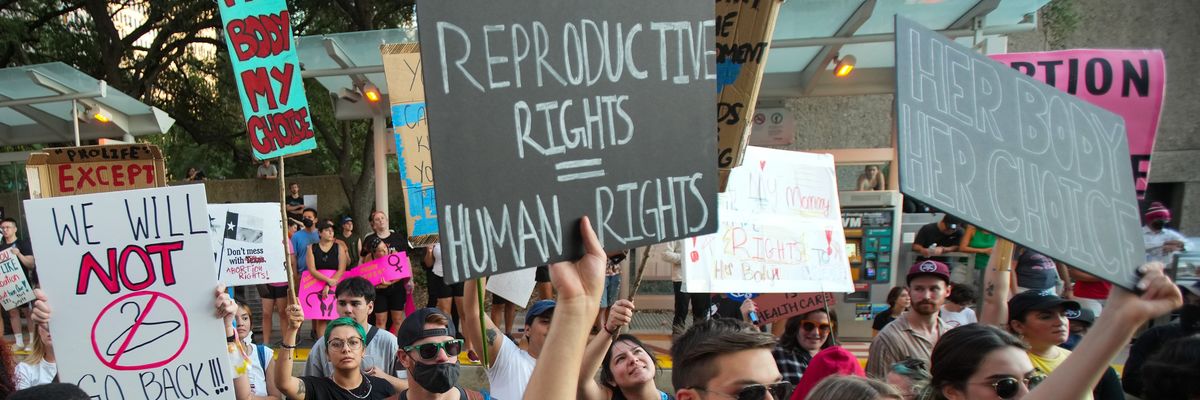
Abortion rights demonstrators protest outside the Bob Casey Federal Courthouse on June 24, 2022, in Houston, after the Supreme Court overturned Roe vs. Wade that affirmed the constitutional right to an abortion.
(Photo: Brett Coomer/Houston Chronicle via Getty Images)

Julia Conley
Mar 18, 2025
COMMON DREAMS

A midwife in the Houston area on Monday became the first person to be criminally charged under Texas' abortion ban, with Republican state Attorney General Ken Paxton accusing Maria Margarita Rojas of providing illegal abortion care and practicing medicine without a license.

If convicted, Rojas faces up to 20 years in prison under the state's near-total ban on abortion.

Writer and abortion rights advocate Jessica Valenti said Rojas is likely being "targeted" by Paxton, noting that the midwife provides "healthcare to a primarily Spanish-speaking, low-income community."

"Paxton, a political operator who picks cases strategically, likely chose Rojas because he believes Americans won't find her sympathetic—whether due to racism, classism, or the stories his office plans to spin," wrote Valenti. "In other words: Republicans are strategically targeting people they think the public won't rally behind. Let's make sure to prove them wrong."

Rojas owns and operates Clínicas Latinoamericanas, which includes four health clinics in the Houston suburbs of Spring, Waller, and Cypress. She has reportedly been a certified midwife in Texas since 2018 and was an obstetrician in Peru before immigrating to the United States.

According to The Washington Post, Rojas was first arrested on March 6 on charges of practicing medicine without a license, and was held on $10,000 bond. The new charges were added Monday, and Rojas and another employee of the clinic, Jose Ley, were being held in a jail in Waller County, with their bond set at a combined $1.4 million.

The New York Times noted that Waller County, where the charges were brought, is more conservative than Harris County, the largest county in Texas and the one where a majority of Rojas' clinics are located.

Court documents show that Paxton's office has accused Rojas of having "attempted an abortion on" a woman identified as E.G. in March.

"Paxton and Texas Republicans will be working overtime to paint Rojas as a villain, regardless of the truth. They know that abortion bans are incredibly unpopular, as is arresting healthcare providers."

Rojas was "known by law enforcement to have performed an abortion" on another occasion earlier this year, according to the attorney general, who has filed for a temporary restraining order against Clínicas Latinoamericanas "to prevent further illegal activity."

When she was first arrested, Rojas was "pulled over by the police at gunpoint and handcuffed" while she was on her way to the clinic and was taken to Austin and held overnight before being released, her friend and fellow midwife Holly Shearman told the Post.

Shearman said she did not believe Rojas is guilty of the charges against her.

Valenti emphasized that most details of Rojas' case at this point are being shared by Paxton's office, and warned that the vehemently anti-abortion attorney general will likely attempt to portray the midwife in a negative light to garner support—considering that a majority of Americans don't support criminal charges for health professionals who provide abortion care.

A survey last March by the KFF found that 8 in 10 Democrats, two-thirds of Independents, and about 50% of Republicans did not believe doctors who provide abortion care should face fines or prison time.

"You cannot trust any information coming from Paxton's office or Texas law enforcement," said Valenti. "Paxton and Texas Republicans will be working overtime to paint Rojas as a villain, regardless of the truth. They know that abortion bans are incredibly unpopular, as is arresting healthcare providers. They're not just fighting a legal battle here, but a PR one."

Valenti noted that when Paxton filed a civil lawsuit against Dr. Maggie Carpenter, a physician in New York who he accused of prescribing and sending pills for a medication abortion to a patient in Texas, he claimed the Texas resident "suffered 'serious complications' despite providing no evidence." Carpenter was fined more than $100,000 last month.

"There's every reason to believe Paxton's team will pull similar tactics here, coming out with all sorts of claims about this midwife and her practice," wrote Valenti.

Marc Hearron, interim associate director of ligation at the Center for Reproductive Rights, told the Post that "Texas officials have been trying every which way to terrify healthcare practitioners from providing care and to trap Texans."

Hearron toldThe Cut that "doctors all across the state are saying that they are afraid that their judgment is going to be second-guessed, and all of these actions show that Paxton is chomping at the bit to go after anybody who provides an abortion."

"It's just a litany of situations where it shows the state of Texas does not care about women's lives," said Hearron. "What it cares about is stopping women from getting the care that they need, no matter what."
In Key State of Delaware, 'Corporate Insider Power Grab' Quietly Underway

"Delaware's Senate just chose billionaire insiders—like Elon Musk and Mark Zuckerberg—over pension funds, retirement savers, and other investors by passing S.B. 21."


Elon Musk, CEO of Tesla, arrives at the Delaware Court of Chancery in Wilmington on November 16, 2022.
(Photo: Hannah Beier for The Washington Post via Getty Images)

Jessica Corbett
Mar 18, 2025
COMMON DREAMS

The push to pass Senate Bill 21 in Delaware, the "corporate capital of the world," is garnering criticism from some anti-monopoly, economic, and legal experts this week.

"Delaware's Senate just chose billionaire insiders—like Elon Musk and Mark Zuckerberg—over pension funds, retirement savers, and other investors by passing S.B. 21," Laurel Kilgour, research manager at the American Economic Liberties Project (AELP), said in a Monday statement about state senators' overwhelming support for the "corporate insider power grab" last week.


Delaware lawmakers are swiftly working to overhaul state law after a judge ruled against Musk's $56 billion 2018 compensation package for Tesla. The CEO—who is the world's richest person and now a key leader in President Donald Trump's administration—then moved the incorporation for his other companies elsewhere, and urged other businesses to follow suit. Some are doing so and others are reportedly considering it, including Zuckerberg's Meta, the parent company of Facebook and Instagram.

As Business Insiderreported last month, citing Delaware's Division of Corporations, nearly 2.2 million entities are registered in the tiny state, including two-thirds of all Fortune 500 companies.

"This bill only serves to make it easier for corporate boards to rubber-stamp excessive executive pay and self-serving deals that drain returns from pensioners and retirement accounts," warned Kilgour. "Coming on the heels of another panicked giveaway to the corporate defense bar just last year, this is a reckless move that will undermine investor confidence and further erode Delaware's credibility as a fair corporate forum. The Delaware House must step in and stop this dangerous bill before it's too late."


Specifically, as AELP laid out, "S.B. 21 jeopardizes the ability of investors to protect themselves from harmful board decisions that slash returns to investors' hard-earned retirement savings, such as awarding exorbitant executive pay packages that far exceed any rational benchmark, or overpaying to acquire companies in which controlling shareholders have financial stakes."

"The bill makes it easier for corporate boards to insulate directors and controlling shareholders from litigation over conflicts of interest and self-dealing by corporate insiders, narrows who qualifies as a controlling shareholder, imposes a new presumption that board members are independent no matter who they are appointed by, and makes it more difficult for shareholders to discover conflicts by restricting their access to internal corporate records," the nonprofit detailed.

Joseph R. Mason, a Ph.D. economist and fellow at the University of Pennsylvania's Wharton School of Business, also sounded the alarm on S.B. 21 with a Monday opinion piece in the Delaware Business Times.

"I recently conducted an economic impact study on the likely effects of Senate Bill 21 (S.B. 21) on the Delaware economy. Based on my findings, a reasonable estimate of the annual economic activity lost due to S.B. 21's passage is $117 million-$235 million in decreased economic activity and 450-900 lost jobs, statewide," he wrote. "My analysis very likely understates the impact to Delaware, as it only estimates lost economic activity generated by law firms located in the state."


Mason's op-ed followed a Delaware Onlinepiece from attorney Greg Varallo, who is head of Bernstein Litowitz Berger & Grossmann's Delaware office and represented Richard Tornetta, the Tesla shareholder behind the Musk case in the state.

"On March 5, this paper published an op-ed by William Chandler and Lawrence Hamermesh," Varallo pointed out last week, referring to a former chancellor on the Delaware Court of Chancery who is now a partner at Wilson Sonsini Goodrich & Rosati, and a professor emeritus at the Widener University Delaware School of Law.

"In the piece, my old friends extolled the virtues of S.B. 21, going so far as to argue that the bill restored balance to the corporate law playing field. Nonsense. S.B. 21 is a license to steal for corporate controllers like Elon Musk," argued the lawyer, who spent decades leading a defense-side firm.

According to Varallo: "The idea that S.B. 21 will restore 'balance' between the interests of regular investors and billionaires who control companies is demonstrably false S.B. 21 creates 'safe harbors' for controllers to steal from their controlled public companies and from the stockholders who invested in those companies without having to answer for doing so. The bill overturns decades of thoughtfully crafted common law and puts Delaware in direct competition with Nevada for the state which gives controllers the clearest and easiest to follow road map to commit grand larceny."

"This isn't someone else's problem. If your retirement includes index funds, as most do, you are a stockholder in controlled companies because no index fund operates without owning controlled companies," he added. "As a citizen who believes that the independence of our judiciary is at the very core of our form of government, I can't sit still while the proponents of this legislation continue to attack the public servants who serve on the Court of Chancery, the nation's leading business court."

Meanwhile, as the Delaware Business Timesnoted Monday, S.B. 21 is backed by "two of the most powerful Delaware business organizations, the Delaware State Chamber of Commerce and the Delaware Business Roundtable," and groups that testified in support of it include ChristianaCare, the Central Delaware Chamber of Commerce, and the Home Builders Association of Delaware.

Despite expert warnings, Delaware lawmakers are continuing their efforts to send S.B. 21 to the desk of Democratic Gov. Matt Meyer, who last week called on them to pass the legislation "as quickly as possible." According to the Delaware General Assembly website, the state House introduced an amendment to the bill on Tuesday.